
C1 June 2014 (R) Q9
9. The curve \(C\) has equation \(y = \dfrac{1}{3}x^2 + 8\)
The line \(L\) has equation \(y = 3x + k\), where \(k\) is a positive constant.
Given that line \(L\) is a tangent to \(C\),
| Scheme | Marks |
|---|---|
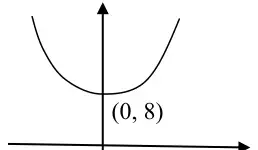 | B1 |
| Graph passes through \((0, 8)\) | B1 |
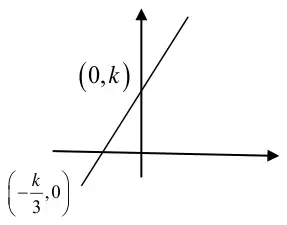 | M1 |
| Both \(\left(-\dfrac{k}{3}, 0\right)\) and \((0, k)\) | A1 |
| Allow marks even if on the same diagram | |
| (4) |
Notes
B1: Shape for \(C\). \(\cup\) Approximately Symmetrical about the \(y\) axis
B1: Coordinates of \((0, 8)\) There must be a graph.
Accept graph crossing positive \(y\) axis with only 8 marked. Accept \((8,0)\) if given on \(y\) axis.
M1: Shape for \(L\). A straight line with positive gradient and positive intercept
A1: Coordinates of \((0, k)\) and \((-k/3, 0)\) or \(k\) marked on \(y\) axis, and \(-k/3\) marked on \(x\) axis or even Accept \((k, 0)\) on \(y\) axis and \((0, -k/3)\) on \(x\) axis
Method 1
| Scheme | Marks |
|---|---|
| Equate curves \(\dfrac{1}{3}x^2 + 8 = 3x + k\) and proceed to collect terms on one side | M1 |
| \(\dfrac{1}{3}x^2 - 3x + (8 - k)\) | A1 |
| Method 1a: Uses “\(b^2 = 4ac\)” Method 1b: Attempt \(\tfrac{1}{3}\left(x - \tfrac{9}{2}\right)^2 - \lambda + 8 - k\) | dM1 |
| Method 1a: \(9 = 4\times\dfrac{1}{3}\times(8 - k) \Rightarrow k = ..\) Method 1b: Deduce that \(k = 8 - \lambda\) | dM1 |
| \(k = \dfrac{5}{4}\) o.e. | A1 |
| (5) | |
| (9 marks) |
Notes
M1: Equate curves \(\dfrac{1}{3}x^2 + 8 = 3x + k\) and proceed to collect \(x\) terms on one side and \((8 - k)\) terms together on the same side or on the other side
A1: Achieves an expression that leads to the point of intersection e.g \(\dfrac{1}{3}x^2 - 3x + (8 - k)\)
Method 1a
dM1: (depends on previous M mark) Uses the fact that \(b^2 = 4ac\) or ‘\(b^2 - 4ac\)’\(= 0\) is true
dM1: (depends on previous M mark) Solves their \(b^2 = 4ac\), leading to \(k = ..\)
A1: cso \(k = \dfrac{5}{4}\) Accept equivalents like 1.25 etc.
Method 1b
dM1: (depends on previous M mark) Uses completion of the square as shown in scheme
dM1: (depends on previous M mark) Uses \(k = 8 - \lambda\)
A1: cso \(k = \dfrac{5}{4}\) Accept equivalents like 1.25 etc.
Method 2
| Scheme | Marks |
|---|---|
| Attempts to set \(\dfrac{\mathrm{d}y}{\mathrm{d}x} = 3\) | M1 |
| \(\dfrac{2}{3}x = 3 \Rightarrow x = 4.5\) | A1 |
| Method 2a: Substitutes \(x = \text{"}4.5\text{"}\) into \(y = \dfrac{1}{3}x^2 + 8 \Rightarrow y = \ldots.(14.75)\) Method 2b: Substitutes \(x = \text{"}4.5\text{"}\) into \(\dfrac{1}{3}x^2 + 8 = 3x + k\) | dM1 |
| Method 2a: Substitutes both their \(x\) and \(y\) into \(y = 3x + k\) to find \(k\) Method 2b: Finds \(k =\) | dM1 |
| \(k = 1.25\) o.e. | A1 |
| (5) |
M1: Equate \(\dfrac{\mathrm{d}y}{\mathrm{d}x} = 3\) Not given just for derivative
A1: Solves to get \(x = 4.5\)
Method 2a
dM1: Substitutes their 4.5 into equation for \(C\) to give \(y\) coordinate
dM1: Substitutes both their \(x\) and \(y\) into \(y = 3x + k\) to find \(k\)
A1: cso \(k = \dfrac{5}{4}\) Accept equivalents like 1.25 etc.
Method 2b
dM1: Substitutes their 4.5 into \(\dfrac{1}{3}x^2 + 8 = 3x + k\)
dM1: Finds \(k\)
A1: cso \(k = \dfrac{5}{4}\) Accept equivalents like 1.25 etc.