
C1 June 2017 Q5
5.\[\mathrm{f}(x) = x^2 - 8x + 19\]
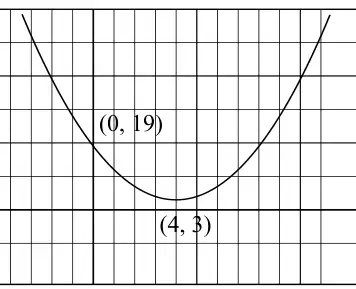
The curve \(C\) with equation \(y = \mathrm{f}(x)\) crosses the \(y\)-axis at the point \(P\) and has a minimum point at the point \(Q\).
| Scheme | Marks |
|---|---|
| \(\mathrm{f}(x) = (x - 4)^2 + 3\) | M1A1 |
| Allow \(a = -4\), \(b = 3\) to score both marks | |
| (2) |
Notes
M1: \(\mathrm{f}(x) = \left(x \pm 4\right)^2 \pm \alpha,\ \alpha \neq 0\) (where \(\alpha\) is a single number or a numerical expression \(\neq 0\))
A1: Allow \(\left(x + {}^{-}4\right)^2 + 3\) and ignore any spurious “= 0”
| Scheme | Marks |
|---|---|
| U shape anywhere even with no axes. Do not allow a “V” shape i.e. with an obvious vertex. | B1 |
| \(P(0, 19)\). Allow (0, 19) or just 19 marked in the correct place as long as the curve (or straight line) passes through or touches here and allow (19, 0) as long as it is marked in the correct place. Correct coordinates may be seen in the body of the script as long as the curve (or straight line) passes through or touches here. If there is any ambiguity, the sketch has precedence. (There must be a sketch to score this mark) | B1 |
| \(Q(4, 3)\). Correct coordinates that can be scored without a sketch but if a sketch is drawn then it must have a minimum in the first quadrant and no other turning points. May be seen in the body of the script. If there is any ambiguity, the sketch has precedence. Allow this mark if 4 is clearly marked on the \(x\)-axis below the minimum and 3 is marked clearly on the \(y\)-axis and corresponds to the minimum, | B1 |
| (3) |
| Scheme | Marks |
|---|---|
| \(PQ^2 = \left(0 - 4\right)^2 + \left(19 - 3\right)^2\) | M1 |
| \(PQ = \sqrt{4^2 + 16^2}\) | A1 |
| \(PQ = 4\sqrt{17}\) | A1 |
| (3) | |
| (8 marks) |
Notes
M1: Correct use of Pythagoras’ Theorem on 2 points of the form \((0, p)\) and \((q, r)\) where \(q \neq 0\) and \(p \neq r\) with \(p\), \(q\) and \(r\) numeric.
A1: Correct un-simplified numerical expression for \(PQ\) including the square root. This must come from a correct \(P\) and \(Q\). Allow e.g. \(PQ = \sqrt{\left(0 - 4\right)^2 + \left(19 - 3\right)^2}\).
Allow \(\pm\sqrt{\left(0 - 4\right)^2 + \left(19 - 3\right)^2}\)
A1: Cao and cso i.e. This must come from a correct \(P\) and \(Q\).
Note that it is possible to obtain the correct value for PQ from (-4,3) and (0, 19) and e.g. (0, 13) and (4, -3) but the A marks in (c) can only be awarded for the correct P and Q.