Quadratics

More questions on this topic: GCSE Algebra: Solving Quadratics (243) IGCSE Algebra: Solving Quadratics (113) Level 2 FM Algebra: Solving Quadratics (27) AS Pure: Quadratics (189)

Your progress
0 of 106 done
Ticks are kept only in this browser: clearing your browsing data or changing device loses them. · ·

Edexcel

Edexcel · Old spec

AQA

OCR A

OCR MEI

WJEC

June 2025 Paper 2 Q11

EdexcelCurrent spec11 marksModellingQuadratics

11. A company is trying to determine the most profitable selling price for a new toy.

Given that

  • if the selling price of each toy is £30, the company expects to sell 1500 toys in one year
  • if the selling price of each toy is £50, the company expects to sell 300 toys in one year

Using a linear model, with \(y\) being the expected number of toys sold in one year and \(x\) pounds being the selling price of the toy,

(a) find an equation for \(y\) in terms of \(x\). (3)

Given that

  • the cost of making each toy is £10
  • the company has additional costs of £8 000 per year
(b) show that, according to the model, the yearly profit, \(P\), in thousands of pounds, is given by\[P = -0.06x^2 + 3.9x - 41\] (3)

Use the model given in part (b) to answer parts (c), (d) and (e).

Given that the company wishes to make a profit on sales of the toy,

(c) find the range of possible selling prices of the toy. (2)
(d) Hence, or otherwise, deduce the selling price of the toy that maximises the profit. (1)

In one particular year, the company sold the toy for £35 and made £21 750 profit.

(e) Use this information to evaluate the suitability of the model. (2)

June 2025 Paper 1 Q6

EdexcelCurrent spec7 marksModellingQuadratics

6. A scientist is monitoring the flight of sea birds after they leave their nests on a cliff.

The height above the sea, \(h\) metres, of one of the birds is modelled by the equation

\[h = A - B\,t^{1.5} \qquad\qquad h \geqslant 0 \qquad 0 \leqslant t \leqslant T\]

where \(t\) seconds is the time after the bird leaves its nest and \(A\), \(B\) and \(T\) are positive constants.

Given that

  • the bird was 17.6 m above the sea exactly 4 seconds after leaving its nest
  • the bird was 11.9 m above the sea exactly 9 seconds after leaving its nest
(a) find a complete equation for the model. (4)

Find, according to the model,

(b) the height of the bird’s nest above the sea, (1)
(c) the limitation on the value of \(T\). (2)

June 2025 Paper 1 Q4

EdexcelCurrent spec5 marksPolynomialsQuadratics

4. Given that

  • \(\mathrm{f}(x) = 2x^3 + 3x^2 - 16x + 16\)
  • \(\mathrm{f}(-4) = 0\)
(a) write \(\mathrm{f}(x)\) in the form\[(x + a)Q(x)\]where \(a\) is a constant and \(Q(x)\) is a quadratic expression. (3)
(b) Hence prove that \(-4\) is the only real root of the equation\[\mathrm{f}(x) = 0\](Solutions relying on calculator technology are not acceptable.) (2)

June 2024 Paper 1 Q15

EdexcelCurrent spec6 marksProofQuadratics

15.

(i) Show that \(k^2 - 4k + 5\) is positive for all real values of \(k\). (2)
(ii) A student was asked to prove by contradiction that
“There are no positive integers \(x\) and \(y\) such that \((3x + 2y)(2x - 5y) = 28\)”
The start of the student’s proof is shown below.
Assume that positive integers \(x\) and \(y\) exist such that
\((3x + 2y)(2x - 5y) = 28\)

If \(3x + 2y = 14\) and \(2x - 5y = 2\)\[\left.\begin{aligned}3x + 2y &= 14\\ 2x - 5y &= 2\end{aligned}\right\} \Rightarrow x = \frac{74}{19},\ y = \frac{22}{19}\ \ \text{Not integers}\]
Show the calculations and statements needed to complete the proof. (4)

June 2024 Paper 2 Q9

EdexcelCurrent spec7 marksModellingQuadratics

9.

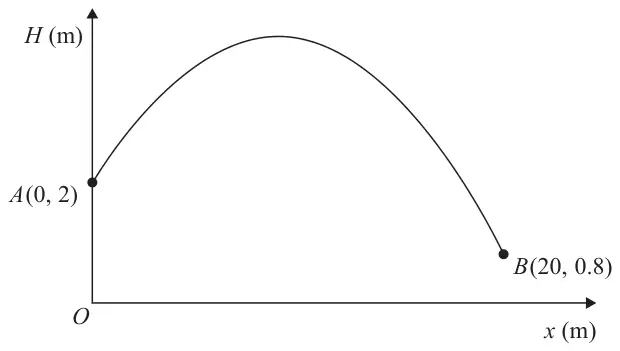
Figure 3: graph of H (m) against x (m): a parabolic path from A(0, 2) on the H-axis rising to a maximum and falling to B(20, 0.8)
Figure 3

The graph in Figure 3 shows the path of a small ball.

The ball travels in a vertical plane above horizontal ground.

The ball is thrown from the point represented by \(A\) and caught at the point represented by \(B\).

The height, \(H\) metres, of the ball above the ground has been plotted against the horizontal distance, \(x\) metres, measured from the point where the ball was thrown.

With respect to a fixed origin \(O\), the point \(A\) has coordinates \((0, 2)\) and the point \(B\) has coordinates \((20, 0.8)\), as shown in Figure 3.

The ball reaches its maximum height when \(x = 9\)

A quadratic function, linking \(H\) with \(x\), is used to model the path of the ball.

(a) Find \(H\) in terms of \(x\). (4)
(b) Give one limitation of the model. (1)

Chandra is standing directly under the path of the ball at a point 16 m horizontally from \(O\).

Chandra can catch the ball if the ball is less than 2.5 m above the ground.

(c) Use the model to determine if Chandra can catch the ball. (2)

June 2024 Paper 1 Q8

EdexcelCurrent spec11 marksFunctions (including |mod|)Quadratics

8. The functions f and g are defined by

\[\begin{aligned}&\mathrm{f}(x) = 4 - 3x^2 &&\quad x \in \mathbb{R}\\[4pt]&\mathrm{g}(x) = \frac{5}{2x-9} &&\quad x \in \mathbb{R},\ x \neq \frac{9}{2}\end{aligned}\]
(a) Find \(\mathrm{fg}(2)\) (2)
(b) Find \(\mathrm{g}^{-1}\) (3)
(c)
(i) Find \(\mathrm{gf}(x)\), giving your answer as a simplified fraction.
(ii) Deduce the range of \(\mathrm{gf}(x)\). (3)

The function h is defined by

\[\mathrm{h}(x) = 2x^2 - 6x + k \qquad x \in \mathbb{R}\]

where \(k\) is a constant.

(d) Find the range of values of \(k\) for which the equation\[\mathrm{f}(x) = \mathrm{h}(x)\]has no real solutions. (3)

June 2023 Paper 1 Q10

EdexcelCurrent spec9 marksCo-ordinate GeometryQuadratics

10. A circle \(C\) has equation\[x^2 + y^2 + 6kx - 2ky + 7 = 0\]where \(k\) is a constant.

(a) Find in terms of \(k\),
(i) the coordinates of the centre of \(C\)
(ii) the radius of \(C\) (3)

The line with equation \(y = 2x - 1\) intersects \(C\) at 2 distinct points.

(b) Find the range of possible values of \(k\). (6)

June 2023 Paper 1 Q9

EdexcelCurrent spec7 marksQuadraticsSequences & Series

9. The first three terms of a geometric sequence are\[3k + 4 \qquad 12 - 3k \qquad k + 16\]where \(k\) is a constant.

(a) Show that \(k\) satisfies the equation\[3k^2 - 62k + 40 = 0\] (2)

Given that the sequence converges,

(b)
(i) find the value of \(k\), giving a reason for your answer,
(ii) find the value of \(S_{\infty}\) (5)

June 2023 Paper 2 Q3

EdexcelCurrent spec5 marksLogs & ExponentialsQuadratics

3. Given that\[\log_{2}(x + 3) + \log_{2}(x + 10) = 2 + 2\log_{2} x\]

(a) show that\[3x^2 - 13x - 30 = 0\] (3)
(b)
(i) Write down the roots of the equation\[3x^2 - 13x - 30 = 0\]
(ii) Hence state which of the roots in part (b)(i) is not a solution of\[\log_{2}(x + 3) + \log_{2}(x + 10) = 2 + 2\log_{2} x\]giving a reason for your answer. (2)

June 2022 Paper 2 Q16

16.

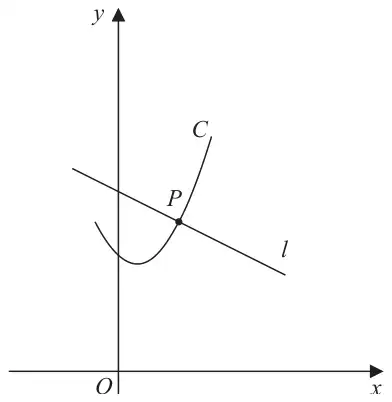
Figure 6: curve C, a U-shaped arc above the x-axis to the right of the y-axis, with the line l crossing it at the point P on its rising part
Figure 6

Figure 6 shows a sketch of the curve \(C\) with parametric equations

\[x = 2\tan t + 1 \qquad y = 2\sec^2 t + 3 \qquad -\dfrac{\pi}{4} \leqslant t \leqslant \dfrac{\pi}{3}\]

The line \(l\) is the normal to \(C\) at the point \(P\) where \(t = \dfrac{\pi}{4}\)

(a) Using parametric differentiation, show that an equation for \(l\) is\[y = -\dfrac{1}{2}x + \dfrac{17}{2}\] (5)
(b) Show that all points on \(C\) satisfy the equation\[y = \dfrac{1}{2}(x - 1)^2 + 5\] (2)

The straight line with equation

\[y = -\dfrac{1}{2}x + k \qquad \text{where } k \text{ is a constant}\]

intersects \(C\) at two distinct points.

(c) Find the range of possible values for \(k\). (5)

June 2022 Paper 2 Q12

EdexcelCurrent spec6 marksDifferentiationQuadratics

12. The function f is defined by

\[\mathrm{f}(x) = \dfrac{\mathrm{e}^{3x}}{4x^2 + k}\]

where \(k\) is a positive constant.

(a) Show that\[\mathrm{f}^{\prime}(x) = (12x^2 - 8x + 3k)\,\mathrm{g}(x)\]where \(\mathrm{g}(x)\) is a function to be found. (3)

Given that the curve with equation \(y = \mathrm{f}(x)\) has at least one stationary point,

(b) find the range of possible values of \(k\). (3)

June 2022 Paper 1 Q11

EdexcelCurrent spec7 marksPolynomialsQuadratics

11.

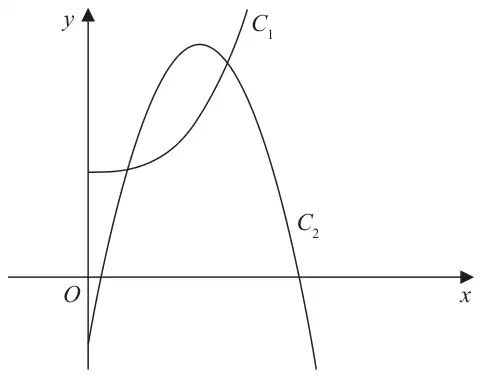
Figure 4: sketch of curve C1 rising from a positive y-intercept and the n-shaped curve C2, crossing twice for x > 0
Figure 4

Figure 4 shows a sketch of part of the curve \(C_1\) with equation

\[y = 2x^3 + 10 \qquad x \gt 0\]

and part of the curve \(C_2\) with equation

\[y = 42x - 15x^2 - 7 \qquad x \gt 0\]
(a) Verify that the curves intersect at \(x = \dfrac{1}{2}\) (2)

The curves intersect again at the point \(P\)

(b) Using algebra and showing all stages of working, find the exact \(x\) coordinate of \(P\) (5)

June 2022 Paper 1 Q5

EdexcelCurrent spec6 marksModellingQuadratics

5. The height, \(h\) metres, of a tree, \(t\) years after being planted, is modelled by the equation

\[h^2 = at + b \qquad 0 \leqslant t \lt 25\]

where \(a\) and \(b\) are constants.

Given that

  • the height of the tree was 2.60 m, exactly 2 years after being planted
  • the height of the tree was 5.10 m, exactly 10 years after being planted
(a) find a complete equation for the model, giving the values of \(a\) and \(b\) to 3 significant figures. (4)

Given that the height of the tree was 7 m, exactly 20 years after being planted

(b) evaluate the model, giving reasons for your answer. (2)

October 2021 Paper 1 Q12

EdexcelCurrent spec9 marksModellingQuadratics

12.

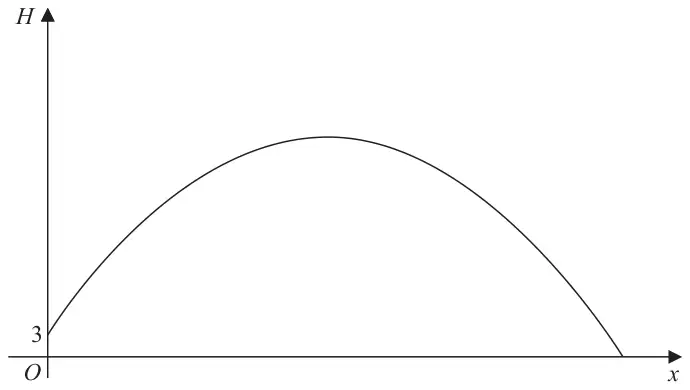
Figure 3: graph of H against x: a parabola-shaped trajectory starting at height 3 on the H-axis, rising to a maximum and falling to meet the x-axis
Figure 3

Figure 3 is a graph of the trajectory of a golf ball after the ball has been hit until it first hits the ground.

The vertical height, \(H\) metres, of the ball above the ground has been plotted against the horizontal distance travelled, \(x\) metres, measured from where the ball was hit.

The ball is modelled as a particle travelling in a vertical plane above horizontal ground.

Given that the ball

  • is hit from a point on the top of a platform of vertical height 3 m above the ground
  • reaches its maximum vertical height after travelling a horizontal distance of 90 m
  • is at a vertical height of 27 m above the ground after travelling a horizontal distance of 120 m

Given also that \(H\) is modelled as a quadratic function in \(x\)

(a) find \(H\) in terms of \(x\) (5)
(b) Hence find, according to the model,
(i) the maximum vertical height of the ball above the ground,
(ii) the horizontal distance travelled by the ball, from when it was hit to when it first hits the ground, giving your answer to the nearest metre. (3)
(c) The possible effects of wind or air resistance are two limitations of the model. Give one other limitation of this model. (1)

October 2021 Paper 1 Q7

EdexcelCurrent spec9 marksCo-ordinate GeometryQuadratics

7. The circle \(C\) has equation

\[x^2 + y^2 - 10x + 4y + 11 = 0\]
(a) Find
(i) the coordinates of the centre of \(C\),
(ii) the exact radius of \(C\), giving your answer as a simplified surd. (4)

The line \(l\) has equation \(y = 3x + k\) where \(k\) is a constant.

Given that \(l\) is a tangent to \(C\),

(b) find the possible values of \(k\), giving your answers as simplified surds. (5)

October 2021 Paper 1 Q3

EdexcelCurrent spec6 marksQuadraticsSequences & Series

3. The sequence \(u_1,\ u_2,\ u_3,\ \ldots\) is defined by

\[u_{n+1} = k - \frac{24}{u_n} \qquad u_1 = 2\]

where \(k\) is an integer.

Given that \(u_1 + 2u_2 + u_3 = 0\)

(a) show that\[3k^2 - 58k + 240 = 0\] (3)
(b) Find the value of \(k\), giving a reason for your answer. (2)
(c) Find the value of \(u_3\) (1)

October 2021 Paper 1 Q2

2. Given that

\[\mathrm{f}(x) = x^2 - 4x + 5 \qquad x \in \mathbb{R}\]
(a) express \(\mathrm{f}(x)\) in the form \((x+a)^2 + b\) where \(a\) and \(b\) are integers to be found. (2)

The curve with equation \(y = \mathrm{f}(x)\)

  • meets the \(y\)-axis at the point \(P\)
  • has a minimum turning point at the point \(Q\)
(b) Write down
(i) the coordinates of \(P\)
(ii) the coordinates of \(Q\) (2)

October 2020 Paper 2 Q14

EdexcelCurrent spec7 marksCo-ordinate GeometryQuadratics

14. A circle \(C\) with radius \(r\)

  • lies only in the 1st quadrant
  • touches the \(x\)-axis and touches the \(y\)-axis

The line \(l\) has equation \(2x + y = 12\)

(a) Show that the \(x\) coordinates of the points of intersection of \(l\) with \(C\) satisfy\[5x^2 + (2r - 48)x + (r^2 - 24r + 144) = 0\] (3)

Given also that \(l\) is a tangent to \(C\),

(b) find the two possible values of \(r\), giving your answers as fully simplified surds. (4)

October 2020 Paper 1 Q7

EdexcelCurrent spec5 marksCo-ordinate GeometryQuadratics

7.

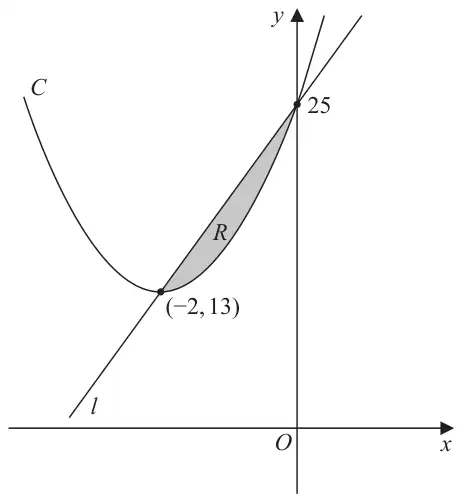
Figure 1: parabola C with minimum point (−2, 13) and straight line l meeting C at (−2, 13) and at (0, 25) on the y-axis; the region R between C and l is shaded
Figure 1

Figure 1 shows a sketch of a curve \(C\) with equation \(y = \mathrm{f}(x)\) and a straight line \(l\).

The curve \(C\) meets \(l\) at the points \((-2, 13)\) and \((0, 25)\) as shown.

The shaded region \(R\) is bounded by \(C\) and \(l\) as shown in Figure 1.

Given that

  • \(\mathrm{f}(x)\) is a quadratic function in \(x\)
  • \((-2, 13)\) is the minimum turning point of \(y = \mathrm{f}(x)\)

use inequalities to define \(R\). (5)

June 2019 Paper 2 Q6

EdexcelCurrent spec10 marksFunctions (including |mod|)Quadratics

6.

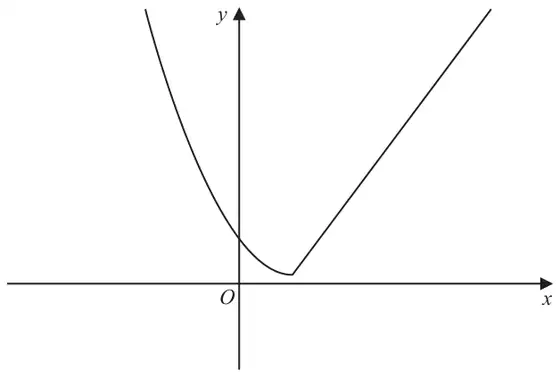
Figure 4: graph of y = g(x): part of a parabola for x ≤ 2 crossing the y-axis, joined at its lowest point to a straight line with positive gradient for x > 2
Figure 4

Figure 4 shows a sketch of the graph of \(y = \mathrm{g}(x)\), where

\[\mathrm{g}(x) = \begin{cases} (x-2)^2 + 1 & x \leqslant 2 \\ 4x - 7 & x \gt 2 \end{cases}\]
(a) Find the value of \(\mathrm{gg}(0)\). (2)
(b) Find all values of \(x\) for which\[\mathrm{g}(x) \gt 28\] (4)

The function h is defined by

\[\mathrm{h}(x) = (x-2)^2 + 1 \qquad x \leqslant 2\]
(c) Explain why h has an inverse but g does not. (1)
(d) Solve the equation\[\mathrm{h}^{-1}(x) = -\frac{1}{2}\] (3)

June 2019 Paper 1 Q5

5.

\[\mathrm{f}(x) = 2x^2 + 4x + 9 \qquad x \in \mathbb{R}\]
(a) Write \(\mathrm{f}(x)\) in the form \(a(x+b)^2 + c\), where \(a\), \(b\) and \(c\) are integers to be found. (3)
(b) Sketch the curve with equation \(y = \mathrm{f}(x)\) showing any points of intersection with the coordinate axes and the coordinates of any turning point. (3)
(c)
(i) Describe fully the transformation that maps the curve with equation \(y = \mathrm{f}(x)\) onto the curve with equation \(y = \mathrm{g}(x)\) where\[\mathrm{g}(x) = 2(x-2)^2 + 4x - 3 \qquad x \in \mathbb{R}\]
(ii) Find the range of the function\[\mathrm{h}(x) = \frac{21}{2x^2 + 4x + 9} \qquad x \in \mathbb{R}\] (4)

June 2019 Paper 2 Q1

EdexcelCurrent spec3 marksLogs & ExponentialsQuadratics

1. Given

\[2^x \times 4^y = \frac{1}{2\sqrt{2}}\]

express \(y\) as a function of \(x\). (3)

June 2018 Paper 1 Q14

EdexcelCurrent spec10 marksParametric EquationsQuadratics

14. A curve \(C\) has parametric equations

\[x = 3 + 2\sin t, \qquad y = 4 + 2\cos 2t, \qquad 0 \leqslant t \lt 2\pi\]
(a) Show that all points on \(C\) satisfy \(y = 6 - (x - 3)^2\) (2)
(b)
(i) Sketch the curve \(C\).
(ii) Explain briefly why \(C\) does not include all points of \(y = 6 - (x - 3)^2,\ \ x \in \mathbb{R}\) (3)

The line with equation \(x + y = k\), where \(k\) is a constant, intersects \(C\) at two distinct points.

(c) State the range of values of \(k\), writing your answer in set notation. (5)

June 2018 Paper 2 Q8

EdexcelCurrent spec7 marksModellingQuadratics

8.

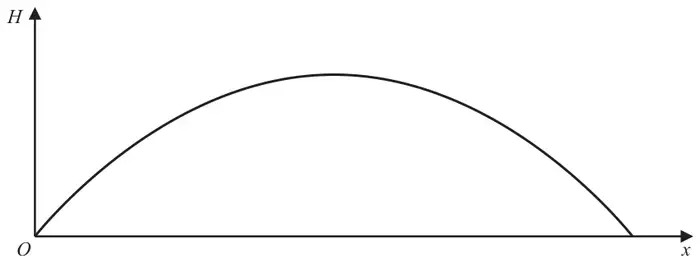
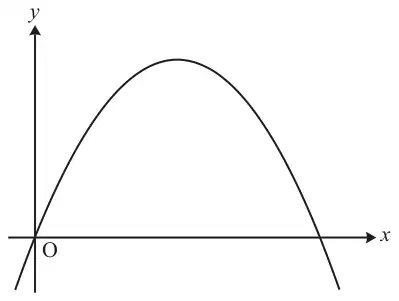
Figure 1: graph of H against x: an arch-shaped curve starting at O and returning to the x-axis
Figure 1

Figure 1 is a graph showing the trajectory of a rugby ball.

The height of the ball above the ground, \(H\) metres, has been plotted against the horizontal distance, \(x\) metres, measured from the point where the ball was kicked.

The ball travels in a vertical plane.

The ball reaches a maximum height of 12 metres and hits the ground at a point 40 metres from where it was kicked.

(a) Find a quadratic equation linking \(H\) with \(x\) that models this situation. (3)

The ball passes over the horizontal bar of a set of rugby posts that is perpendicular to the path of the ball. The bar is 3 metres above the ground.

(b) Use your equation to find the greatest horizontal distance of the bar from \(O\). (3)
(c) Give one limitation of the model. (1)

C3 January 2007 Q2

EdexcelOld spec8 marksAlgebraic FractionsQuadratics

2. \[\mathrm{f}(x) = 1 - \frac{3}{x + 2} + \frac{3}{(x + 2)^2}, \quad x \neq -2.\]

(a) Show that \(\mathrm{f}(x) = \dfrac{x^2 + x + 1}{(x + 2)^2}\), \(x \neq -2\). (4)
(b) Show that \(x^2 + x + 1 \gt 0\) for all values of \(x\). (3)
(c) Show that \(\mathrm{f}(x) \gt 0\) for all values of \(x\), \(x \neq -2\). (1)

June 2025 Paper 1 Q9

AQACurrent spec10 marksQuadraticsSequences & Series

9

(a) A geometric series, \(S\), has second term 60

The common ratio of \(S\) is 0.2

Find the exact value of the sum of the first five terms of \(S\)

[4 marks]
(b) A different geometric series, \(T\), has second term 60 and positive common ratio \(r\)

The sum to infinity of \(T\) is \(T_{\infty}\)

(i) Show that\[T_{\infty} = \frac{60}{r - r^2}\] [2 marks]
(ii) Find the maximum value of \(r - r^2\) [2 marks]
(iii) Hence find the range of possible values of \(T_{\infty}\)

Fully justify your answer.

[2 marks]

June 2025 Paper 3 Q5

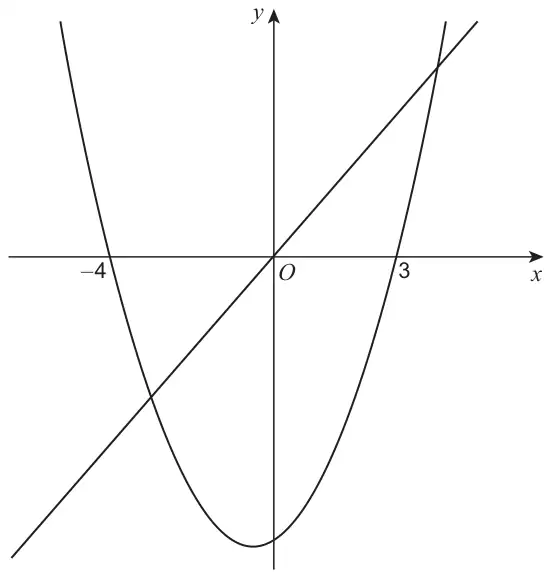
5 The diagram shows the graphs of \(y = 2x\) and \(y = (x - 3)(x + 4)\).

The line y = 2x through the origin and the U-shaped parabola y = (x − 3)(x + 4) crossing the x-axis at −4 and 3; the line meets the parabola twice

The region R is defined by the inequalities

\[(x - 3)(x + 4) \leqslant y \leqslant 2x \ \textbf{ and } \ x \leqslant 0\]

Shade the region R on the diagram. [2 marks]

June 2025 Paper 2 Q3

AQACurrent spec1 markQuadratics

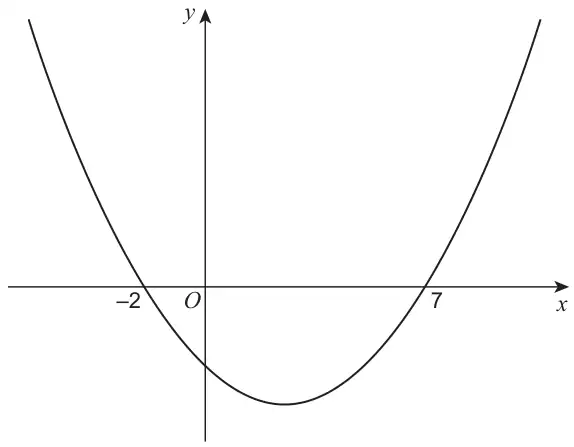
3 The diagram shows the graph with equation \(y = (x + 2)(x - 7)\)

U-shaped parabola crossing the x-axis at −2 and 7, with its minimum below the x-axis

Solve the inequality.

\[(x + 2)(x - 7) \gt 0\]

Tick (✓) one box. [1 mark]

  • \(x \in (-\infty, -2) \cap (7, \infty)\)
  • \(x \in (-\infty, -2) \cup (7, \infty)\)
  • \(x \in (-\infty, -2] \cap [7, \infty)\)
  • \(x \in (-\infty, -2] \cup [7, \infty)\)

June 2024 Paper 1 Q7

AQACurrent spec4 marksProofQuadratics

7 Show that

\[\frac{3 + \sqrt{8n}}{1 + \sqrt{2n}}\]

can be written as

\[\frac{4n - 3 + \sqrt{2n}}{2n - 1}\]

where \(n\) is a positive integer. [4 marks]

June 2024 Paper 3 Q7

AQACurrent spec5 marksCo-ordinate GeometryQuadratics

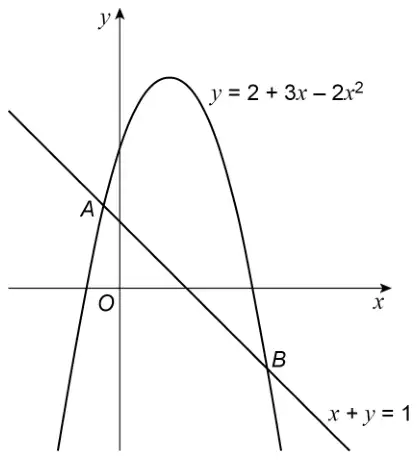
7 The graphs with equations

\[y = 2 + 3x - 2x^2 \quad \text{and} \quad x + y = 1\]

are shown in the diagram below.

The parabola y = 2 + 3x − 2x² and the line x + y = 1, intersecting at A (above the x-axis, left of the y-axis) and B (below the x-axis)

The graphs intersect at the points \(A\) and \(B\)

(a) On the diagram above, shade and label the region, \(R\), that is satisfied by the inequalities\[0 \leqslant y \leqslant 2 + 3x - 2x^2\]

and

\[x + y \geqslant 1\] [2 marks]
(b) Find the exact coordinates of \(A\) [3 marks]

June 2024 Paper 2 Q3

AQACurrent spec1 markQuadratics

3 Solve the inequality

\[(1 - x)(x - 4) \lt 0\]

[1 mark]

Tick (✓) one box.

  • \(\{x : x \lt 1\} \cup \{x : x \gt 4\}\)
  • \(\{x : x \lt 1\} \cap \{x : x \gt 4\}\)
  • \(\{x : x \lt 1\} \cup \{x : x \geqslant 4\}\)
  • \(\{x : x \lt 1\} \cap \{x : x \geqslant 4\}\)

June 2024 Paper 3 Q2

AQACurrent spec1 markQuadratics

2 The quadratic equation

\[4x^2 + bx + 9 = 0\]

has one repeated real root.

Find \(b\)

Circle your answer. [1 mark]

  • \(b = 0\)
  • \(b = \pm 12\)
  • \(b = \pm 13\)
  • \(b = \pm 36\)

June 2023 Paper 1 Q7

AQACurrent spec4 marksProofQuadratics

7

(a) Given that \(n\) is a positive integer, express\[\frac{7}{3 + 5\sqrt{n}} - \frac{7}{5\sqrt{n} - 3}\]as a single fraction not involving surds. [3 marks]
(b) Hence, deduce that\[\frac{7}{3 + 5\sqrt{n}} - \frac{7}{5\sqrt{n} - 3}\]is a rational number for all positive integer values of \(n\) [1 mark]

June 2023 Paper 3 Q6

6

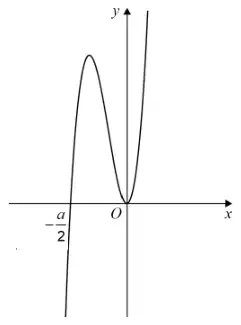
(a) Sketch the curve with equation\[y = x^2(2x + a)\]

where \(a \gt 0\) [3 marks]

(b) The polynomial \(\mathrm{p}(x)\) is given by\[\mathrm{p}(x) = x^2(2x + a) + 36\]
(i) It is given that \(x + 3\) is a factor of \(\mathrm{p}(x)\)

Use the factor theorem to show \(a = 2\) [2 marks]

(ii) State the transformation which maps the curve with equation\[y = x^2(2x + 2)\]

onto the curve with equation

\[y = x^2(2x + 2) + 36\] [2 marks]
(iii) The polynomial \(x^2(2x + 2) + 36\) can be written as \((x + 3)(2x^2 + bx + c)\)

Without finding the values of \(b\) and \(c\), use your answers to parts (a) and (b)(ii) to explain why

\[b^2 \lt 8c\] [2 marks]

June 2023 Paper 3 Q4

AQACurrent spec2 marksQuadratics

4 Express

\[\frac{5 - \sqrt[3]{x}}{x^2}\]

in the form

\[5x^p - x^q\]

where \(p\) and \(q\) are constants. [2 marks]

June 2023 Paper 2 Q1

AQACurrent spec1 markQuadratics

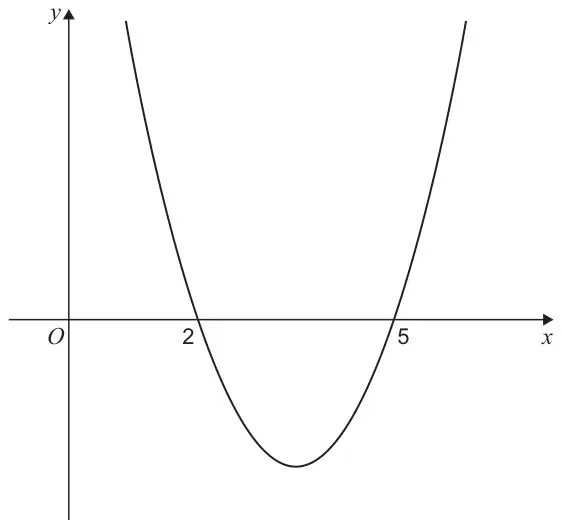
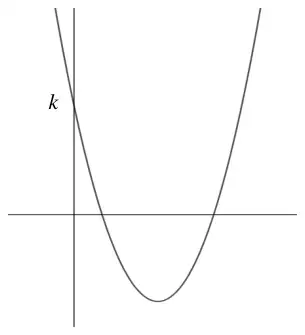
1 The graph of \(y = ax^2 + bx + c\) has roots \(x = 2\) and \(x = 5\), as shown in the diagram below.

U-shaped parabola crossing the x-axis at x = 2 and x = 5, with its minimum point below the x-axis

State the set of values of \(x\) which satisfy

\[ax^2 + bx + c \gt 0\]

Tick (✓) one box. [1 mark]

  • \(\{x : x \lt 2\} \cup \{x : x \gt 5\}\)
  • \(\{x : 0 \lt x \lt 2\} \cap \{x : x \gt 5\}\)
  • \(\{x : 2 \lt x \lt 5\}\)
  • \(\{x : 2 \gt x \gt 5\}\)

June 2021 Paper 3 Q6

AQACurrent spec4 marksAlgebraic FractionsQuadratics

6 Given that \(x \gt 0\) and \(x \ne 25\), fully simplify

\[\frac{10 + 5x - 2x^{\frac{1}{2}} - x^{\frac{3}{2}}}{5 - \sqrt{x}}\]

Fully justify your answer. [4 marks]

June 2021 Paper 1 Q1

AQACurrent spec1 markQuadratics

1 State the set of values of \(x\) which satisfies the inequality

\[(x - 3)(2x + 7) \gt 0\]

Tick (✓) one box. [1 mark]

  • \(\left\{x : -\dfrac{7}{2} \lt x \lt 3\right\}\)
  • \(\left\{x : x \lt -3 \text{ or } x \gt \dfrac{7}{2}\right\}\)
  • \(\left\{x : x \lt -\dfrac{7}{2} \text{ or } x \gt 3\right\}\)
  • \(\left\{x : -3 \lt x \lt \dfrac{7}{2}\right\}\)

June 2020 Paper 3 Q7

AQACurrent spec7 marksBinomial ExpansionQuadratics

7

(a) Using \({}^nC_r = \dfrac{n!}{r!(n - r)!}\) show that \({}^nC_2 = \dfrac{n(n - 1)}{2}\) [2 marks]
(b)
(i) Show that the equation\[2 \times {}^nC_4 = 51 \times {}^nC_2\]simplifies to\[n^2 - 5n - 300 = 0\] [3 marks]
(ii) Hence, solve the equation\[2 \times {}^nC_4 = 51 \times {}^nC_2\] [2 marks]

June 2020 Paper 3 Q4

AQACurrent spec7 marksPolynomialsQuadratics

4

\[\mathrm{p}(x) = 4x^3 - 15x^2 - 48x - 36\]
(a) Use the factor theorem to prove that \(x - 6\) is a factor of \(\mathrm{p}(x)\). [2 marks]
(b)
(i) Prove that the graph of \(y = \mathrm{p}(x)\) intersects the \(x\)-axis at exactly one point. [4 marks]
(ii) State the coordinates of this point of intersection. [1 mark]

June 2020 Paper 1 Q4

4

(a) Sketch the graph of\[y = 4 - |2x - 6|\]
Blank axes: x-axis and y-axis meeting at the origin O
[3 marks]
(b) Solve the inequality\[4 - |2x - 6| \gt 2\] [2 marks]

June 2019 Paper 3 Q4

4 Sketch the region defined by the inequalities

\[y \leqslant (1 - 2x)(x + 3) \quad \text{and} \quad y - x \leqslant 3\]

Clearly indicate your region by shading it in and labelling it \(R\). [3 marks]

June 2019 Paper 2 Q2

AQACurrent spec1 markQuadratics

2 Simplify \(\sqrt{a^{\frac{2}{3}} \times a^{\frac{2}{5}}}\)

Circle your answer. [1 mark]

  • \(a^{\frac{2}{15}}\)
  • \(a^{\frac{4}{15}}\)
  • \(a^{\frac{8}{15}}\)
  • \(a^{\frac{16}{15}}\)

June 2018 Paper 2 Q4

4 A curve, \(C\), has equation \(y = x^2 - 6x + k\), where \(k\) is a constant.

The equation \(x^2 - 6x + k = 0\) has two distinct positive roots.

(a) Sketch \(C\) on the axes below. [2 marks]
Blank x-y axes for the sketch
(b) Find the range of possible values for \(k\).

Fully justify your answer. [4 marks]

June 2025 Paper 3 Q4

4 Functions f and g are defined for all real values of \(x\) by

\(\mathrm{f}(x) = \dfrac{x - k}{2}\) and \(\mathrm{g}(x) = x^2 + kx + 5\), where \(k\) is a constant.

You are given that the equation \(\mathrm{f}^{-1}\mathrm{g}(x) = 4 - 2kx\) has real distinct roots.

(a) Show that \(k\) satisfies the inequality \(2k^2 - k - 6 \gt 0\). [5]
(b) In this question you must show detailed reasoning.

Hence find the set of values of \(k\). Give your answer in set notation. [3]

June 2025 Paper 2 Q2

OCR ACurrent spec9 marksLogs & ExponentialsQuadratics

2

In this question you must show detailed reasoning.

Solve the following equations.

(a) \(\left(x^2 - 5\right)^{\frac{3}{2}} = 8\) [3]
(b) \(\mathrm{e}^{3y} = 2\) [2]
(c) \(x^4 - 3x^2 - 4 = 0\) [4]

June 2025 Paper 1 Q1

OCR ACurrent spec8 marksQuadratics

1 Express each of the following in the form \(px^q\), where \(p\) and \(q\) are constants.

(a) \(\dfrac{2}{\sqrt[4]{x}}\) [1]
(b) \(\left(5x\sqrt{x}\right)^3\) [2]
(c) \(\sqrt{2x^3} \times \sqrt{8x^5}\) [2]
(d) \(x^5\left(27x^6\right)^{\frac{1}{3}}\) [3]

June 2025 Paper 2 Q1

OCR ACurrent spec3 marksQuadratics

1

In this question you must show detailed reasoning.

Solve the inequality \(x^2 + 3x \leqslant 10\). [3]

June 2025 Paper 3 Q1

OCR ACurrent spec5 marksDifferentiationQuadratics

1

(a) Express \(3x^2 - 12x + 17\) in the form \(a(x - b)^2 + c\) where \(a\), \(b\) and \(c\) are constants. [3]
(b) State the coordinates of the minimum point of the curve \(y = 3x^2 - 12x + 17\). [1]
(c) State the equation of the normal to the curve \(y = 3x^2 - 12x + 17\) at its minimum point. [1]

June 2024 Paper 1 Q10

OCR ACurrent spec8 marksQuadraticsSequences & Series

10 In this question you must show detailed reasoning.

The first three terms of a convergent geometric progression are \(2x + 3\), \(x + 9\) and \(2x - 6\) respectively.

Determine the sum to infinity of this geometric progression. [8]

June 2024 Paper 1 Q7

OCR ACurrent spec10 marksCo-ordinate GeometryQuadratics

7 The point \(A\) has coordinates (1, 7), and the point \(B\) has coordinates (\(h\), 10).

(a) You are given that the gradient of the line \(AB\) is 2.
Find the value of \(h\). [2]
(b) You are given that \(B\) is the midpoint of \(AC\).
Find the coordinates of the point \(C\). [2]
(c) You are given that the straight line through the points \(A\), \(B\) and \(C\) has two distinct points of intersection with the curve \(y = x^2 - 4x + k\).
Determine the set of possible values of \(k\). [6]

June 2024 Paper 3 Q7

OCR ACurrent spec7 marksDifferentiationQuadratics

7

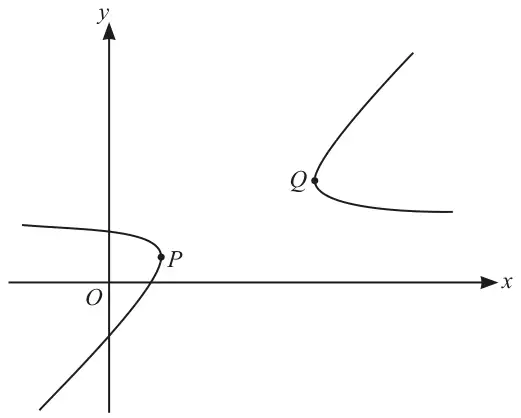
Curve in two branches: one branch near the y-axis with a vertical tangent at the point P just above the x-axis, the other branch further right with a vertical tangent at the point Q higher up

The diagram shows the curve \(5x - 2xy + 2y^2 - k = 0\), where \(k\) is a positive integer.

At the points \(P\) and \(Q\) on the curve, the tangents to the curve are parallel to the \(y\)-axis.

Given that the difference in the \(y\)-coordinates of \(P\) and \(Q\) is 3, determine the \(x\)-coordinates of \(P\) and \(Q\). [7]

June 2024 Paper 1 Q2

2 You are given that \(y\) is inversely proportional to \(x^6\) and \(z\) is directly proportional to the cube root of \(y\).

(a)
(i) Find an equation for \(z\) in terms of \(x\) and \(k\), where \(k\) is a constant of proportionality. [2]
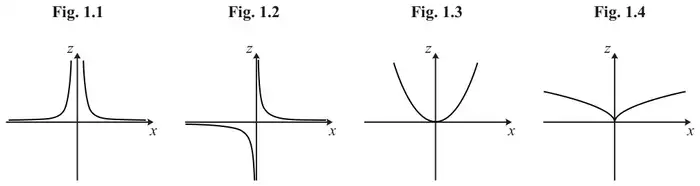
(ii) State which of the diagrams below could represent the graph of \(z\) against \(x\). [1]
Fig. 1.1 to Fig. 1.4: four sketches of z against x. Fig. 1.1: two branches above the x-axis, both rising steeply towards the z-axis. Fig. 1.2: reciprocal-type curve, positive for x greater than 0 and negative for x less than 0. Fig. 1.3: U-shaped curve through the origin. Fig. 1.4: curve through the origin rising on both sides, flattening as x increases
(b) Given that \(z = 3\) when \(x = 4\), determine the values of \(x\) when \(z = 12\). [3]

June 2024 Paper 3 Q2

OCR ACurrent spec5 marksQuadraticsRadians

2 In this question you must show detailed reasoning.

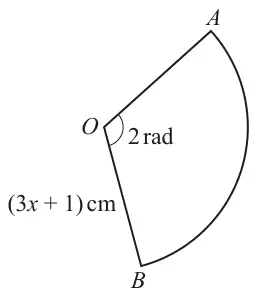
Sector AOB of a circle with centre O, radius OB labelled (3x + 1) cm and angle AOB labelled 2 rad

The diagram shows a sector \(AOB\) of a circle with centre \(O\) and radius \((3x+1)\,\mathrm{cm}\). The angle \(AOB\) is 2 radians. The area of sector \(AOB\) is less than \((44x - 7)\,\mathrm{cm}^2\).

Find the set of possible values of \(x\). Give your answer in set notation. [5]

June 2024 Paper 3 Q1

OCR ACurrent spec4 marksAlgebraic FractionsQuadratics

1 Simplify each of the following.

(a) \(\left(2a^2\right)^3 \times \frac{3}{4}a^{-1}\) [2]
(b) \(\dfrac{4x^2 - 9}{\left(2x^2 + 5x - 12\right)(2x + 3)}\) [2]

June 2023 Paper 1 Q2

OCR ACurrent spec8 marksLogs & ExponentialsQuadratics

2

(a)
(i) Show that \(\dfrac{1}{3 - 2\sqrt{x}} + \dfrac{1}{3 + 2\sqrt{x}}\) can be written in the form \(\dfrac{a}{b + cx}\), where \(a\), \(b\) and \(c\) are constants to be determined. [2]
(ii) Hence solve the equation \(\dfrac{1}{3 - 2\sqrt{x}} + \dfrac{1}{3 + 2\sqrt{x}} = 2\). [2]
(b) In this question you must show detailed reasoning.
Solve the equation \(2^{2y} - 7 \times 2^y - 8 = 0\). [4]

June 2023 Paper 2 Q1

OCR ACurrent spec5 marksQuadratics

1

(a)
(i) Express \(x^2 - 8x + 11\) in the form \((x - a)^2 + b\) where \(a\) and \(b\) are constants. [2]
(ii) Hence write down the minimum value of \(x^2 - 8x + 11\). [1]
(b) Determine the value of the constant \(k\) for which the equation \(x^2 - 8x + 11 = k\) has two equal roots. [2]

June 2022 Paper 1 Q7

OCR ACurrent spec8 marksDifferentiationQuadratics

7 A curve has equation \(2x^3 + 6xy - 3y^2 = 2\).

Show that there are no points on this curve where the tangent is parallel to \(y = x\). [8]

June 2022 Paper 3 Q7

OCR ACurrent spec8 marksQuadraticsTrigonometry

7 In this question you must show detailed reasoning.

(a) Show that the equation \(m\sec\theta + 3\cos\theta = 4\sin\theta\) can be expressed in the form \[m\tan^2\theta - 4\tan\theta + (m + 3) = 0.\] [3]
(b) It is given that there is only one value of \(\theta\), for \(0 \lt \theta \lt \pi\), satisfying the equation \(m\sec\theta + 3\cos\theta = 4\sin\theta\).

Given also that \(m\) is a negative integer, find this value of \(\theta\), correct to 3 significant figures. [5]

June 2022 Paper 1 Q4

OCR ACurrent spec8 marksQuadraticsTrigonometry

4

(a) Write \(2x^2 + 6x + 7\) in the form \(p(x + q)^2 + r\), where \(p\), \(q\) and \(r\) are constants. [3]
(b) State the coordinates of the minimum point on the graph of \(y = 2x^2 + 6x + 7\). [2]
(c) Hence deduce
  • the minimum value of \(2\tan^2\theta + 6\tan\theta + 7\),
  • the smallest positive value of \(\theta\), in degrees, for which the minimum value occurs. [3]

June 2022 Paper 1 Q3

3

(a) In this question you must show detailed reasoning.
Find the coordinates of the points of intersection of the curves with equations \(y = x^2 - 2x + 1\) and \(y = -x^2 + 6x - 5\). [4]
(b) The diagram shows the curves \(y = x^2 - 2x + 1\) and \(y = -x^2 + 6x - 5\).
This diagram is repeated in the Printed Answer Booklet.
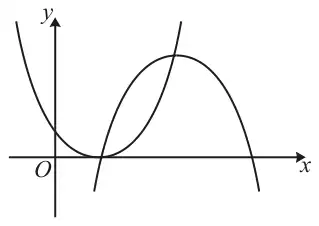
The U-shaped curve y = x squared minus 2x plus 1 touching the x-axis at x = 1, and the n-shaped curve y = minus x squared plus 6x minus 5 crossing the x-axis at x = 1 and further right; the curves meet at x = 1 and again near the top of the n-shaped curve
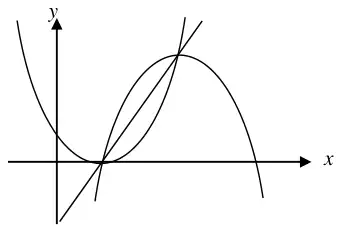
On the diagram in the Printed Answer Booklet, draw the line \(y = 2x - 2\). [2]
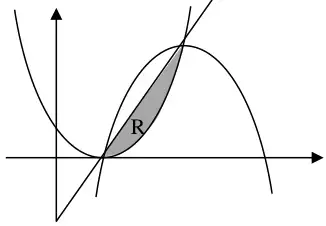
(c) Show on your diagram in the Printed Answer Booklet the region of the \(x\)-\(y\) plane within which all three of the following inequalities are satisfied. \[y \geqslant x^2 - 2x + 1 \qquad y \leqslant -x^2 + 6x - 5 \qquad y \leqslant 2x - 2\] You should indicate the region for which all the inequalities hold by labelling the region \(R\). [1]

October 2021 Paper 1 Q3

OCR ACurrent spec4 marksQuadratics

3 It is given that \(x\) is proportional to the product of the square of \(y\) and the positive square root of \(z\).
When \(y = 2\) and \(z = 9\), \(x = 30\).

(a) Write an equation for \(x\) in terms of \(y\) and \(z\). [2]
(b) Find the value of \(x\) when \(y = 3\) and \(z = 25\). [2]

October 2021 Paper 1 Q2

OCR ACurrent spec4 marksModellingQuadratics

2 Alex is comparing the cost of mobile phone contracts. Contract \(\boldsymbol{A}\) has a set-up cost of £40 and then costs 4p per minute. Contract \(\boldsymbol{B}\) has no set-up cost, does not charge for the first 100 minutes and then costs 6p per minute.

(a) Find an expression for the cost of each of the contracts in terms of \(m\), where \(m\) is the number of minutes for which the phone is used and \(m \gt 100\). [2]
(b) Hence find the value of \(m\) for which both contracts would cost the same. [2]

October 2021 Paper 1 Q1

OCR ACurrent spec4 marksQuadratics

1 Determine the set of values of \(k\) such that the equation \(x^2 + 4x + (k + 3) = 0\) has two distinct real roots. [4]

October 2021 Paper 3 Q1

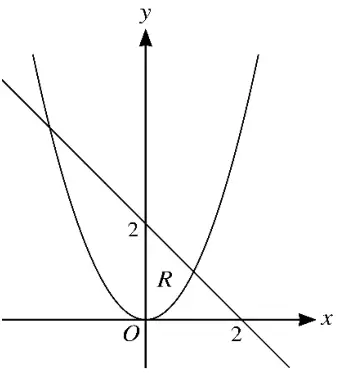
1 Show in a sketch the region of the \(x\)-\(y\) plane within which all three of the following inequalities hold.

\(y \geqslant x^2,\quad x + y \leqslant 2,\quad x \geqslant 0.\)

You should indicate the region for which the inequalities hold by labelling the region \(R\). [3]

October 2020 Paper 1 Q8

OCR ACurrent spec7 marksDifferentiationQuadratics

8

(a) Differentiate \(\left(2 + 3x^2\right)\mathrm{e}^{2x}\) with respect to \(x\). [3]
(b) Hence show that \(\left(2 + 3x^2\right)\mathrm{e}^{2x}\) is increasing for all values of \(x\). [4]

October 2020 Paper 2 Q4

OCR ACurrent spec5 marksQuadraticsTrigonometry

4 In this question you must show detailed reasoning.

Solve the equation \(3\sin^4\phi + \sin^2\phi = 4\), for \(0 \leqslant \phi \lt 2\pi\), where \(\phi\) is measured in radians. [5]

October 2020 Paper 3 Q3

OCR ACurrent spec11 marksFunctions (including |mod|)Quadratics

3 The functions f and g are defined for all real values of \(x\) by

\(\mathrm{f}(x) = 2x^2 + 6x\) and \(\mathrm{g}(x) = 3x + 2\).

(a) Find the range of f. [3]
(b) Give a reason why f has no inverse. [1]
(c) Given that \(\mathrm{fg}(-2) = \mathrm{g}^{-1}(a)\), where \(a\) is a constant, determine the value of \(a\). [4]
(d) Determine the set of values of \(x\) for which \(\mathrm{f}(x) \gt \mathrm{g}(x)\). Give your answer in set notation. [3]

October 2020 Paper 1 Q2

OCR ACurrent spec8 marksQuadratics

2 Simplify fully.

(a) \(\sqrt{12a} \times \sqrt{3a^5}\) [2]
(b) \(\left(64b^3\right)^{\frac{1}{3}} \times \left(4b^4\right)^{-\frac{1}{2}}\) [2]
(c) \(7 \times 9^{3c} - 4 \times 27^{2c}\) [4]

June 2019 Paper 2 Q7

OCR ACurrent spec5 marksPolynomialsQuadratics

7 In this question you must show detailed reasoning.

Use the substitution \(u = 6x^2 + x\) to solve the equation \(36x^4 + 12x^3 + 7x^2 + x - 2 = 0\). [5]

June 2019 Paper 3 Q2

OCR ACurrent spec8 marksCo-ordinate GeometryQuadratics

2 A circle with centre \(C\) has equation \(x^2 + y^2 - 6x + 4y + 4 = 0\).

(a) Find
(i) the coordinates of \(C\), [2]
(ii) the radius of the circle. [1]
(b) Determine the set of values of \(k\) for which the line \(y = kx - 3\) does not intersect or touch the circle. [5]

June 2019 Paper 1 Q1

OCR ACurrent spec4 marksQuadratics

1 In this question you must show detailed reasoning.

Solve the inequality \(10x^2 + x - 2 \gt 0\). [4]

June 2018 Paper 1 Q9

9 The function f is defined for all real values of \(x\) as \(\mathrm{f}(x) = c + 8x - x^2\), where \(c\) is a constant.

(i) Given that the range of f is \(\mathrm{f}(x) \leqslant 19\), find the value of \(c\). [3]
(ii) Given instead that \(\mathrm{ff}(2) = 8\), find the possible values of \(c\). [4]

June 2018 Paper 1 Q5

OCR ACurrent spec8 marksCo-ordinate GeometryQuadratics

5 The equation of a circle is \(x^2 + y^2 + 6x - 2y - 10 = 0\).

(i) Find the centre and radius of the circle. [3]
(ii) Find the coordinates of any points where the line \(y = 2x - 3\) meets the circle \(x^2 + y^2 + 6x - 2y - 10 = 0\). [4]
(iii) State what can be deduced from the answer to part (ii) about the line \(y = 2x - 3\) and the circle \(x^2 + y^2 + 6x - 2y - 10 = 0\). [1]

June 2018 Paper 3 Q4

4 In this question you must show detailed reasoning.

The functions f and g are defined for all real values of \(x\) by

\[\mathrm{f}(x) = x^3 \quad \text{and} \quad \mathrm{g}(x) = x^2 + 2.\]
(i) Write down expressions for
(a) \(\mathrm{fg}(x)\), [1]
(b) \(\mathrm{gf}(x)\). [1]
(ii) Hence find the values of \(x\) for which \(\mathrm{fg}(x) - \mathrm{gf}(x) = 24\). [6]

June 2018 Paper 1 Q3

OCR ACurrent spec4 marksQuadratics

3 In this question you must show detailed reasoning.

Find the two real roots of the equation \(x^4 - 5 = 4x^2\). Give the roots in an exact form. [4]

June 2018 Paper 3 Q3

OCR ACurrent spec6 marksModellingQuadratics

3 In this question you must show detailed reasoning.

A gardener is planning the design for a rectangular flower bed. The requirements are:

  • the length of the flower bed is to be 3 m longer than the width,
  • the length of the flower bed must be at least 14.5 m,
  • the area of the flower bed must be less than \(180\,\mathrm{m}^2\).

The width of the flower bed is \(x\) m.

By writing down and solving appropriate inequalities in \(x\), determine the set of possible values for the width of the flower bed. [6]

June 2018 Paper 3 Q2

2 Solve the equation \(|2x - 1| = |x + 3|\). [3]

June 2018 Paper 2 Q1

OCR ACurrent spec7 marksQuadratics

1

(i) Express \(2x^2 - 12x + 23\) in the form \(a(x + b)^2 + c\). [4]
(ii) Use your result to show that the equation \(2x^2 - 12x + 23 = 0\) has no real roots. [1]
(iii) Given that the equation \(2x^2 - 12x + k = 0\) has repeated roots, find the value of the constant \(k\). [2]

June 2025 Paper 3 Q12

12

The questions in this section refer to the article on the Insert. You should read the article before attempting the questions.

The relevant parts of the article “The trisectrix of Maclaurin” are reproduced below; the line numbers are those printed on the Insert.

Lines 6–7
In 1742, Colin Maclaurin first studied a curve which can be used to trisect an angle. The curve is called the Trisectrix of Maclaurin.

Lines 8–9
The equation of the curve in cartesian form is \(y^2 = \dfrac{x^2(3a-x)}{a+x}\), where \(a\) is a constant. The curve is shown in Fig. C2 below. Only values of \(a > 0\) are considered in this article.

Lines 10–11
It can be shown that everywhere on the curve \(\dfrac{3a-x}{a+x} \geqslant 0\). It follows that \(3a - x \geqslant 0\) and \(a + x > 0\).

Line 12
The curve has the trisection property illustrated in Fig. C2.

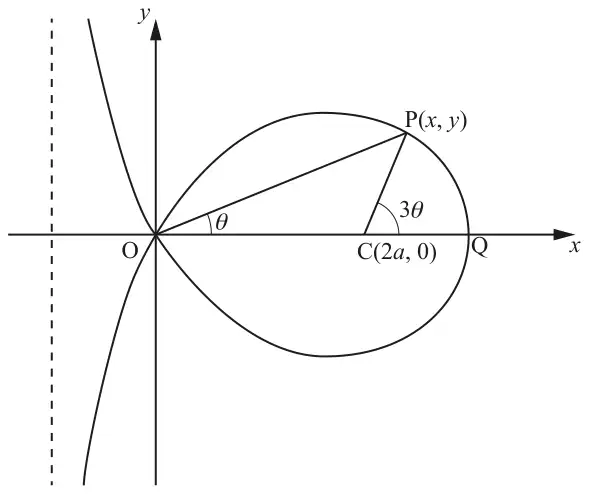
Fig. C2: the trisectrix with a loop through O and Q(right of C(2a, 0)), branches going to infinity near the dashed vertical asymptote left of the y-axis; P(x, y) on the loop, OP at angle θ and CP at angle 3θ to the x-axis
Fig. C2

Lines 14–16
The point C has coordinates \((2a, 0)\) and Q is the point where the curve crosses the positive \(x\)-axis. The point P is a general point \((x, y)\) on the loop of the curve. The origin of the coordinate system is denoted by O.

Line 17
The dashed line is an asymptote to the curve.

Lines 18–19
If the line CP makes an angle \(3\theta\) with the positive \(x\)-axis then the line OP makes an angle \(\theta\) with the positive \(x\)-axis. Angles are measured anticlockwise from the positive \(x\)-axis.

(a) Show that for the point on the curve where \(x = 0\), \(\dfrac{3a-x}{a+x} \geqslant 0\) as given in line 10. [1]
(b) Use the equation of the curve given in line 8 to show that for all points on the curve where \(x \neq 0\), \(\dfrac{3a-x}{a+x} \geqslant 0\) as given in line 10. [1]
(c) Show that it follows that \(3a - x \geqslant 0\) and \(a + x > 0\), as given in lines 10 and 11, for values of \(a > 0\). [3]
(d) Hence find, in terms of \(a\) where \(a > 0\), the range of values of \(x\) for points on the curve \(y^2 = \dfrac{x^2(3a-x)}{a+x}\). [1]
(e) Find the equation of the asymptote to the curve. [1]

June 2025 Paper 1 Q8

OCR MEICurrent spec7 marksCo-ordinate GeometryQuadratics

8

(a) Determine the two values of \(k\) for which the line \(y = 3x + 5\) is a tangent to the curve \(y = k - kx - x^2\). [4]
(b) These values of \(k\) are used to define two curves of the form \(y = k - kx - x^2\).

Determine the coordinates of the point of intersection of these two curves. [3]

June 2024 Paper 2 Q8

OCR MEICurrent spec6 marksDifferentiationQuadratics

8 The equation of a curve is

\(y = 2x^3 + 3mx^2 - 9mx + 4\).

Determine the range of values of \(m\) for which the curve has no stationary values. [6]

June 2024 Paper 3 Q4

OCR MEICurrent spec2 marksQuadratics

4 In this question you must show detailed reasoning.

Determine the exact value of \(\dfrac{1}{\sqrt{2} + 1} + \dfrac{1}{\sqrt{3} + \sqrt{2}} + \dfrac{1}{2 + \sqrt{3}}\). [2]

June 2024 Paper 2 Q1

OCR MEICurrent spec2 marksCo-ordinate GeometryQuadratics

1 Calculate the exact distance between the points \((2, -1)\) and \((6, 1)\). Give your answer in the form \(a\sqrt{b}\), where \(a\) and \(b\) are prime numbers. [2]

June 2024 Paper 3 Q1

OCR MEICurrent spec2 marksQuadratics

1 Solve the inequality \(\dfrac{x}{5} \gt 6 - x\). [2]

June 2023 Paper 1 Q7

OCR MEICurrent spec7 marksCo-ordinate GeometryQuadratics

7 Determine the exact distance between the two points at which the line through \((4, 5)\) and \((6, -1)\) meets the curve \(y = 2x^2 - 7x + 1\). [7]

June 2023 Paper 3 Q7

OCR MEICurrent spec6 marksQuadraticsRadians

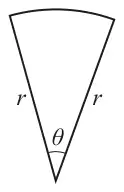
7 A wire, 10 cm long, is bent to form the perimeter of a sector of a circle, as shown in the diagram. The radius is \(r\) cm and the angle at the centre is \(\theta\) radians.

A sector of a circle with two radii labelled r and angle θ at the centre

Determine the maximum possible area of the sector, showing that it is a maximum. [6]

June 2023 Paper 2 Q3

OCR MEICurrent spec3 marksQuadratics

3 In this question you must show detailed reasoning.

Find the smallest possible positive integers \(m\) and \(n\) such that \(\left(\dfrac{64}{49}\right)^{-\frac{3}{2}} = \dfrac{m}{n}\). [3]

June 2023 Paper 3 Q3

OCR MEICurrent spec3 marksQuadratics

3 In this question you must show detailed reasoning.

Find the value of \(k\) such that \(\dfrac{1}{\sqrt{5}+\sqrt{6}} + \dfrac{1}{\sqrt{6}+\sqrt{7}} = \dfrac{k}{\sqrt{5}+\sqrt{7}}\). [3]

June 2023 Paper 3 Q2

OCR MEICurrent spec4 marksFunctions (including |mod|)Quadratics

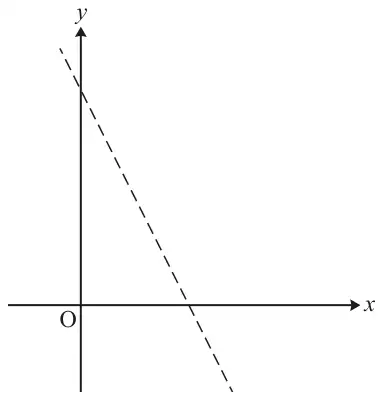
2 The straight line \(y = 5 - 2x\) is shown in the diagram.

Axes with origin O; a dashed straight line with negative gradient crossing the positive y-axis and the positive x-axis
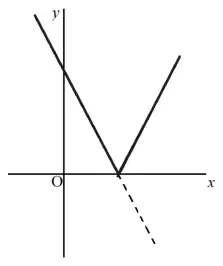
(a) On the copy of the diagram in the Printed Answer Booklet, sketch the graph of \(y = |5 - 2x|\). [1]
(b) Solve the inequality \(|5 - 2x| < 3\). [3]

October 2021 Paper 3 Q6

OCR MEICurrent spec4 marksQuadraticsSequences & Series

6 In this question you must show detailed reasoning.

Show that \(\displaystyle\sum_{r=1}^{3} \frac{1}{\sqrt{r+1} + \sqrt{r}} = 1\). [4]

October 2021 Paper 1 Q3

3

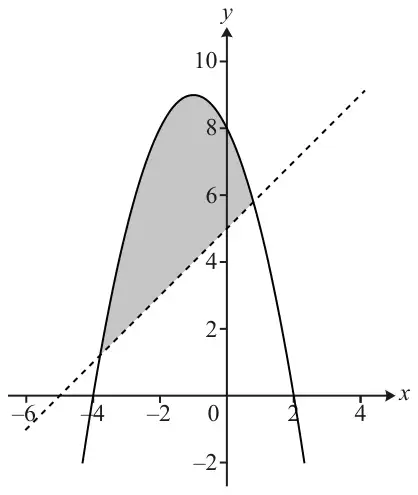
(a) The diagram shows the line \(y = x + 5\) and the curve \(y = 8 - 2x - x^2\). The shaded region is the finite region between the line and the curve. The curved part of the boundary is included in the region but the straight part is not included.

Write down the inequalities that define the shaded region. [2]
Graph of the parabola y = 8 − 2x − x² (solid) and the line y = x + 5 (dashed); the finite region between them, above the line and below the curve, is shaded
(b) In this question you must show detailed reasoning.
Solve the inequality \(8 - 2x - x^2 > x + 5\) giving your answer in exact form. [3]

October 2021 Paper 2 Q3

OCR MEICurrent spec3 marksQuadratics

3 Draw a number line to show the values of \(x\) which belong to the set \(\{x : x \geqslant 2\} \cap \{x : x < 7\}\). [3]

October 2021 Paper 3 Q3

OCR MEICurrent spec7 marksCo-ordinate GeometryQuadratics

3

(a) Determine, in terms of \(k\), the coordinates of the point where the lines with the following equations intersect.
\(x + y = k\)
\(2x - y = 1\) [3]
(b) Determine, in terms of \(k\), the coordinates of the points where the line \(x + y = k\) crosses the curve \(y = x^2 + k\). [4]

October 2021 Paper 3 Q1

1

(a) Express \(x^2 + 8x + 2\) in the form \((x + a)^2 + b\). [2]
(b) Write down the coordinates of the turning point of the curve \(y = x^2 + 8x + 2\). [1]
(c) State the transformation(s) which map(s) the curve \(y = x^2\) onto the curve \(y = x^2 + 8x + 2\). [2]

October 2020 Paper 1 Q2

OCR MEICurrent spec3 marksQuadratics

2 Express \(\dfrac{a+\sqrt{2}}{3-\sqrt{2}}\) in the form \(p + q\sqrt{2}\), giving \(p\) and \(q\) in terms of \(a\). [3]

October 2020 Paper 1 Q1

OCR MEICurrent spec2 marksQuadratics

1 Simplify \(\left(\dfrac{27}{x^9}\right)^{\frac{2}{3}} \times \left(\dfrac{x^4}{9}\right)\). [2]

June 2019 Paper 3 Q13

OCR MEICurrent spec6 marksModellingQuadratics

13

The questions in this section refer to the article on the Insert. You should read the article before attempting the questions.

The relevant parts of the article “Modelling a tube” are reproduced below; the line numbers are those printed on the Insert.

Lines 18–20
Taking the \(y\)-axis as the axis of symmetry of the tube and looking at the tube from the side, as shown in Fig. C2, means that the side width of the tube is \(2x\) at height \(y\).

Line 21
When \(y = 0\), \(x = r\) and when \(y = h\), \(x = 0\).

Lines 22–24
Assuming that the relationship between \(x\) and \(y\) is linear means that the side width decreases at a constant rate as \(y\) increases; this leads to \(ry + hx = hr\).

Lines 25–27
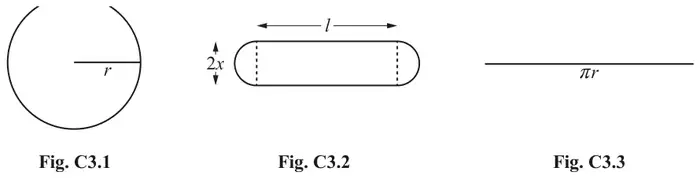
The cross-section at the bottom of the tube is a circle, as shown in Fig. C3.1; at the top of the tube, the cross-section is a line, as shown in Fig. C3.3.

Fig. C3.1: a circle of radius r. Fig. C3.2: a rectangle of length l with semicircular ends, total width 2x. Fig. C3.3: a straight line of length pi r

Lines 28–29
The exact ‘oval’ shape of the cross-section at intermediate points is not easy to determine, so a simple approximation for the shape is used.

Lines 30–34
When the width of the tube is \(2x\), the cross-section will be modelled as a rectangle with semicircular ends, as shown in Fig. C3.2. The radius of the semicircular ends is \(x\). To ensure that the total perimeter of the cross-section is a constant, the length, \(l\), of the rectangular part of the cross-section is given by \(l = \pi(r - x)\). It can be shown that this ensures that the front width of the tube increases at a constant rate as \(y\) increases, as required by the modelling assumptions.

Line 35
Calculating the volume

Lines 36–37
Finding the area of the cross-section shown in Fig. C3.2 and using \(ry + hx = hr\) gives the cross-sectional area in terms of \(y\) as \(\dfrac{\pi r^2}{h^2}(h^2 - y^2)\).

(a)
(i) Show that the cross-sectional area in Fig. C3.2 is \(\pi x(2r - x)\). [2]
(ii) Hence show that the cross-sectional area is \(\dfrac{\pi r^2}{h^2}(h^2 - y^2)\), as given in line 37. [2]
(b) Verify that the formula \(\dfrac{\pi r^2}{h^2}(h^2 - y^2)\) for the cross-sectional area is also valid for
(i) Fig. C3.1, [1]
(ii) Fig. C3.3. [1]

June 2019 Paper 2 Q7

OCR MEICurrent spec5 marksQuadraticsRadians

7 The area of a sector of a circle is \(36.288\,\mathrm{cm}^2\). The angle of the sector is \(\theta\) radians and the radius of the circle is \(r\) cm.

(a) Find an expression for \(\theta\) in terms of \(r\). [1]

The perimeter of the sector is 24.48 cm.

(b) Show that \(\theta = \dfrac{24.48}{r} - 2\). [1]
(c) Find the possible values of \(r\). [3]

June 2019 Paper 3 Q4

OCR MEICurrent spec3 marksQuadratics

4 In this question you must show detailed reasoning.

Show that \(\dfrac{1}{\sqrt{10}+\sqrt{11}} + \dfrac{1}{\sqrt{11}+\sqrt{12}} + \dfrac{1}{\sqrt{12}+\sqrt{13}} = \dfrac{3}{\sqrt{10}+\sqrt{13}}\). [3]

June 2019 Paper 3 Q2

2

(a) Find the transformation which maps the curve \(y = x^2\) to the curve \(y = x^2 + 8x - 7\). [4]
(b) Write down the coordinates of the turning point of \(y = x^2 + 8x - 7\). [1]

June 2018 Paper 3 Q7

OCR MEICurrent spec8 marksCo-ordinate GeometryQuadratics

7 In this question you must show detailed reasoning.

Fig. 7 shows the curve \(y = 5x - x^2\).

The curve y = 5x - x^2, an inverted parabola through the origin
Fig. 7

The line \(y = 4 - kx\) crosses the curve \(y = 5x - x^2\) on the \(x\)-axis and at one other point.

Determine the coordinates of this other point. [8]

June 2018 Paper 2 Q1

OCR MEICurrent spec2 marksQuadratics

1 Show that \(\sqrt{27} + \sqrt{192} = a\sqrt{b}\), where \(a\) and \(b\) are prime numbers to be determined. [2]

June 2022 Unit 3 Q12

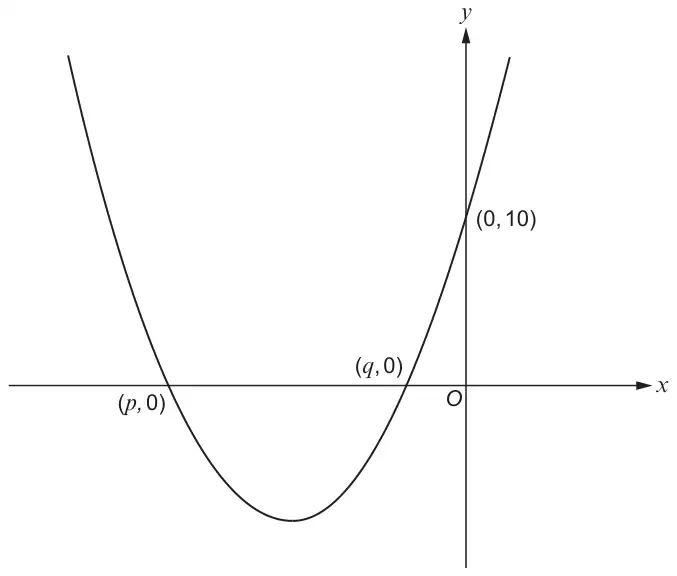
12. The diagram below shows a sketch of the graph of \(y=f(x)\), where\[f(x)=2x^2+12x+10.\]The graph intersects the \(x\)-axis at the points \((p,\ 0)\), \((q,\ 0)\) and the \(y\)-axis at the point \((0,\ 10)\).

Sketch of the parabola y = f(x) crossing the x-axis at (p, 0) and (q, 0) and the y-axis at (0, 10)
(a) Write down the value of \(ff(p)\). [1]
(b) Determine the values of \(p\) and \(q\). [2]
(c) Express \(f(x)\) in the form \(a(x+b)^2+c\), where \(a,\ b,\ c\) are constants whose values are to be found. Write down the coordinates of the minimum point. [3]
(d) Explain why \(f^{-1}(x)\) does not exist. [1]
(e) The function \(g(x)\) is defined as\[g(x)=f(x)\quad\text{for}\quad -3\leqslant x\lt\infty.\]
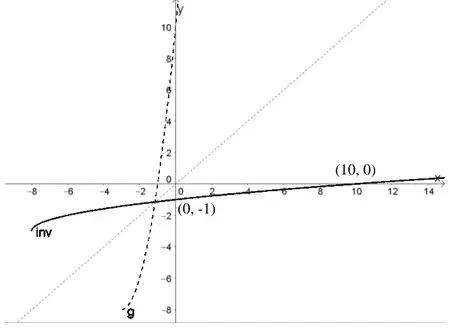
(i) Find an expression for \(g^{-1}(x)\). [4]
(ii) Sketch the graph of \(y=g^{-1}(x)\), indicating the coordinates of the points where the graph intersects the \(x\)-axis and the \(y\)-axis. [2]