Proof

Edexcel

AQA

OCR A

OCR MEI

June 2025 Paper 1 Q8

EdexcelCurrent spec5 marksProof

8. A student was asked to prove that the square of any number can be expressed in the form \(5n\) or \(5n \pm 1\) where \(n \in \mathbb{N}\)

The start of the student’s proof is shown in the box below.

Let \(m = 5k\)
    Consider \(m^2 = (5k)^2 = 25k^2 = 5 \times 5k^2 = 5n \quad \text{where } n = 5k^2\ \checkmark\)
Let \(m = 5k + 1\)
    Consider \(m^2 = (5k + 1)^2\)
        \(= 25k^2 + 10k + 1 = 5(5k^2 + 2k) + 1 = 5n + 1 \quad \text{where } n = 5k^2 + 2k\ \checkmark\)
Let \(m = 5k + 2\)
    Consider \(m^2 = (5k + 2)^2\)
        \(= 25k^2 + 10k + 4 = 5(5k^2 + 2k + 1) - 1 = 5n - 1 \quad \text{where } n = 5k^2 + 2k + 1\ \checkmark\)
(a) Identify and correct an algebraic error in the box above. (1)
(b) Show the calculations and statements that are required to complete the proof. (4)

June 2024 Paper 2 Q15

EdexcelCurrent spec12 marksDifferentiationProof

15. The curve \(C\) has equation

\[(x+y)^3 = 3x^2 - 3y - 2\]
(a) Find an expression for \(\dfrac{\mathrm{d}y}{\mathrm{d}x}\) in terms of \(x\) and \(y\). (5)

The point \(P(1, 0)\) lies on \(C\).

(b) Show that the normal to \(C\) at \(P\) has equation\[y = -2x + 2\] (2)
(c) Prove that the normal to \(C\) at \(P\) does not meet \(C\) again.
You should use algebra for your proof and make your reasoning clear. (5)

June 2024 Paper 1 Q15

EdexcelCurrent spec6 marksProofQuadratics

15.

(i) Show that \(k^2 - 4k + 5\) is positive for all real values of \(k\). (2)
(ii) A student was asked to prove by contradiction that
“There are no positive integers \(x\) and \(y\) such that \((3x + 2y)(2x - 5y) = 28\)”
The start of the student’s proof is shown below.
Assume that positive integers \(x\) and \(y\) exist such that
\((3x + 2y)(2x - 5y) = 28\)

If \(3x + 2y = 14\) and \(2x - 5y = 2\)\[\left.\begin{aligned}3x + 2y &= 14\\ 2x - 5y &= 2\end{aligned}\right\} \Rightarrow x = \frac{74}{19},\ y = \frac{22}{19}\ \ \text{Not integers}\]
Show the calculations and statements needed to complete the proof. (4)

June 2024 Paper 2 Q8

EdexcelCurrent spec7 marksProofTrigonometry

8.

In this question you must show all stages of your working.

Solutions relying entirely on calculator technology are not acceptable.

(a) Prove that\[\frac{1}{\operatorname{cosec}\theta - 1} + \frac{1}{\operatorname{cosec}\theta + 1} \equiv 2\tan\theta\sec\theta \qquad \theta \neq (90n)^\circ,\ n \in \mathbb{Z}\] (3)
(b) Hence solve, for \(0 \lt x \lt 90^\circ\), the equation\[\frac{1}{\operatorname{cosec}2x - 1} + \frac{1}{\operatorname{cosec}2x + 1} = \cot 2x\sec 2x\]Give each answer, in degrees, to one decimal place. (4)

June 2024 Paper 1 Q4

EdexcelCurrent spec3 marksDifferentiationProof

4. Given that \(y = x^2\), use differentiation from first principles to show that \(\dfrac{\mathrm{d}y}{\mathrm{d}x} = 2x\) (3)

June 2025 Paper 3 Q12

AQACurrent spec3 marksProof

12 Given that the real numbers \(a\), \(b\), and \(c\) are such that

\[a \times b = c\]

Use proof by contradiction to show that if \(c\) is irrational then at least one of \(a\) or \(b\) is irrational. [3 marks]

June 2025 Paper 2 Q8

AQACurrent spec6 marksProofTrigonometry

8

(a) Given that \(\cos x \neq 0\) state the value of \(\sec^2 x - \tan^2 x\) [1 mark]
(b) Show that\[(3\sec x + 5\tan x)(5\sec x - 3\tan x) - \frac{16\tan x}{\cos x} = N\]where \(N\) is an integer to be found. [4 marks]
(c) State the two values of \(x\) between \(0^\circ\) and \(360^\circ\) for which the value of \(N\) in part (b) is not valid. [1 mark]

June 2025 Paper 3 Q1

AQACurrent spec1 markProof

1 A student states that the product of two irrational numbers is always irrational.

One of the options is a counter example that shows the student’s statement is incorrect.

Identify the counter example.

Circle your answer. [1 mark]

  • \(\mathrm{e} \times 0 = 0\)
  • \(\dfrac{1}{\pi} \times \pi = 1\)
  • \(\dfrac{1}{\sqrt{2}} \times \sqrt{6} = \sqrt{3}\)
  • \(2 \times \sqrt{3} = \sqrt{6}\)

June 2024 Paper 1 Q15

AQACurrent spec6 marksProofTrigonometry

15

(a) Show that the expression\[\sin 2\theta \operatorname{cosec}\theta + \cos 2\theta \sec\theta\]can be written as\[4\cos\theta - \sec\theta\]where \(\sin\theta \neq 0\) and \(\cos\theta \neq 0\) [4 marks]
(b) A student is attempting to solve the equation\[\sin 2\theta \operatorname{cosec}\theta + \cos 2\theta \sec\theta = 3 \quad \text{for } 0^\circ \leqslant \theta \leqslant 360^\circ\]They use the result from part (a), and write the following incorrect solution:\[\sin 2\theta \operatorname{cosec}\theta + \cos 2\theta \sec\theta = 3\]
Step 1\(4\cos\theta - \sec\theta = 3\)
Step 2\(4\cos\theta - \dfrac{1}{\cos\theta} - 3 = 0\)
Step 3\(4\cos^2\theta - 3\cos\theta - 1 = 0\)
Step 4\(\cos\theta = 1\) or \(\cos\theta = -0.25\)
Step 5\(\theta = 0^\circ,\ 104.5^\circ,\ 255.5^\circ,\ 360^\circ\)
(i) Explain why the student should reject one of their values for \(\cos\theta\) in Step 4. [1 mark]
(ii) State the correct solutions to the equation\[\sin 2\theta \operatorname{cosec}\theta + \cos 2\theta \sec\theta = 3 \quad \text{for } 0^\circ \leqslant \theta \leqslant 360^\circ\] [1 mark]

June 2024 Paper 1 Q13

AQACurrent spec6 marksPolynomialsProof

13

(a) It is given that\[\mathrm{P}(x) = 4x^3 + 8x^2 + 11x + 4\]Use the factor theorem to show that \((2x + 1)\) is a factor of \(\mathrm{P}(x)\) [2 marks]
(b) Express \(\mathrm{P}(x)\) in the form\[\mathrm{P}(x) = (2x + 1)(ax^2 + bx + c)\]where \(a\), \(b\) and \(c\) are constants to be found. [2 marks]
(c) Given that \(n\) is a positive integer, use your answer to part (b) to explain why \(4n^3 + 8n^2 + 11n + 4\) is never prime. [2 marks]

June 2024 Paper 2 Q11

AQACurrent spec6 marksProof

11

(a) A student states that 3 is the smallest value of \(k\) in the interval \(3 \lt k \lt 4\)

Explain the error in the student’s statement. [1 mark]

(b) The student’s teacher says there is no smallest value of \(k\) in the interval \(3 \lt k \lt 4\)

The teacher gives the following correct proof:

Step 1:Assume there is a smallest number in the interval \(3 \lt k \lt 4\) and let this smallest number be \(x\)
Step 2:let \(y = \dfrac{3 + x}{2}\)
Step 3:\(3 \lt y \lt x\) which is a contradiction.
Step 4:Therefore, there is no smallest number in interval \(3 \lt k \lt 4\)
(i) Explain the contradiction stated in Step 3 [1 mark]
(ii) Prove that there is no largest value of \(k\) in the interval \(3 \lt k \lt 4\) [4 marks]

June 2024 Paper 3 Q10

AQACurrent spec5 marksDifferentiationProof

10 It is given that

\[\mathrm{f}(x) = 5x^3 + x\]

Use differentiation from first principles to prove that

\[\mathrm{f}^{\prime}(x) = 15x^2 + 1\]

[5 marks]

June 2024 Paper 1 Q7

AQACurrent spec4 marksProofQuadratics

7 Show that

\[\frac{3 + \sqrt{8n}}{1 + \sqrt{2n}}\]

can be written as

\[\frac{4n - 3 + \sqrt{2n}}{2n - 1}\]

where \(n\) is a positive integer. [4 marks]

June 2023 Paper 2 Q10

AQACurrent spec6 marksProof

10

(a) Expand and simplify \((a - b)^2\) [1 mark]
(b) Peter thinks that the sum of any rational number and its reciprocal is always greater than 2

Peter checks two examples:

\[\frac{2}{3} + \frac{3}{2} = 2.1\dot{6}\]\[2 + \frac{1}{2} = 2.5\]Use a counter example to show that Peter is incorrect. [2 marks]
(c) Given that \(a\) and \(b\) are distinct positive numbers, use proof by contradiction to prove that\[\frac{a}{b} + \frac{b}{a} \gt 2\] [3 marks]

June 2023 Paper 2 Q8

AQACurrent spec10 marksProofTrigonometry

8

(a) Given that \(\cos\theta \neq \pm 1\), prove the identity\[\frac{1}{1 - \cos\theta} + \frac{1}{1 + \cos\theta} \equiv 2\operatorname{cosec}^2\theta\] [4 marks]
(b) Hence, find the set of values of \(A\) for which the equation\[\frac{1}{1 - \cos\theta} + \frac{1}{1 + \cos\theta} = A\]has real solutions.

Fully justify your answer. [3 marks]

(c) Given that \(\theta\) is obtuse and\[\frac{1}{1 - \cos\theta} + \frac{1}{1 + \cos\theta} = 16\]find the exact value of \(\cot\theta\) [3 marks]

June 2023 Paper 1 Q7

AQACurrent spec4 marksProofQuadratics

7

(a) Given that \(n\) is a positive integer, express\[\frac{7}{3 + 5\sqrt{n}} - \frac{7}{5\sqrt{n} - 3}\]as a single fraction not involving surds. [3 marks]
(b) Hence, deduce that\[\frac{7}{3 + 5\sqrt{n}} - \frac{7}{5\sqrt{n} - 3}\]is a rational number for all positive integer values of \(n\) [1 mark]

June 2022 Paper 3 Q9

AQACurrent spec6 marksProof

9 Assume that \(a\) and \(b\) are integers such that

\[a^2 - 4b - 2 = 0\]
(a) Prove that \(a\) is even. [2 marks]
(b) Hence, prove that \(2b + 1\) is even and explain why this is a contradiction. [3 marks]
(c) Explain what can be deduced about the solutions of the equation\[a^2 - 4b - 2 = 0\] [1 mark]

June 2022 Paper 2 Q6

AQACurrent spec5 marksProof

6

(a) Asif notices that \(24^2 = 576\) and \(2 + 4 = 6\) gives the last digit of 576

He checks two more examples:

\(27^2 = 729\)\(29^2 = 841\)
\(2 + 7 = 9\)\(2 + 9 = 11\)
Last digit 9Last digit 1

Asif concludes that he can find the last digit of any square number greater than 100 by adding the digits of the number being squared.

Give a counter example to show that Asif’s conclusion is not correct. [2 marks]

(b) Claire tells Asif that he should look only at the last digit of the number being squared.
\(27^2 = 729\)\(24^2 = 576\)
\(7^2 = 49\)\(4^2 = 16\)
Last digit 9Last digit 6

Using Claire’s method determine the last digit of \(23456789^2\) [1 mark]

(c) Given Claire’s method is correct, use proof by exhaustion to show that no square number has a last digit of 8 [2 marks]

June 2025 Paper 1 Q11

OCR ACurrent spec7 marksProof

11 A student is attempting to prove that \(\sqrt{5}\) is irrational.
The first three lines of their proof are shown below.

Assume that \(\sqrt{5}\) is rational, so it can be written as \(\sqrt{5} = \dfrac{a}{b}\).Line 1
Squaring both sides gives \(5 = \dfrac{a^2}{b^2}\). Hence \(a^2 = 5b^2\).Line 2
Hence \(a\) must be a multiple of 5, so \(a = 5k\), for some integer \(k\).Line 3
(a) State any conditions required on Line 1. [2]
(b) Explain why Line 2 means that \(a\) must be a multiple of 5. [2]
(c) Complete the proof to show that \(\sqrt{5}\) is irrational. [3]

June 2025 Paper 2 Q4

OCR ACurrent spec6 marksProofTrigonometry

4

(a) Prove that \((\cos\theta + \sin\theta)^2 \equiv 1 + \sin 2\theta\). [2]
(b) Hence or otherwise prove that \(\sec 2\theta + \tan 2\theta \equiv \dfrac{\cos\theta + \sin\theta}{\cos\theta - \sin\theta}\). [4]

June 2024 Paper 2 Q7

OCR ACurrent spec8 marksProofSequences & Series

7 Two arithmetic progressions, \(A\) and \(B\), each have 100 terms denoted by \(a_i\) and \(b_i\) respectively, where \(i = 1, 2, 3, \ldots 100\).

The common difference of \(A\) is \(d\), where \(d\) is a positive integer.

The two progressions have the following properties.

  • \(a_1 = b_{100} = 4\)
  • \(b_1 = a_{100}\)
(a) You are given that there is at least one value of \(i\) for which \(b_i = 10 + a_i\).
Show that, in this case,\[i = \frac{101}{2} - \frac{5}{d}.\] [6]
(b) Hence show that it is impossible for the equation \(b_i = 10 + a_i\) to hold unless \(d\) takes certain values, which should be stated. [2]

June 2024 Paper 1 Q3

OCR ACurrent spec8 marksProof

3

(a) Find a counterexample to disprove the statement that the product of two prime numbers is always odd. [1]
(b) In each of the following cases write one of the symbols \(\Rightarrow\), \(\Leftrightarrow\), \(\Leftarrow\) in the box in the Printed Answer Booklet to make each statement correct.
(i) \(x^2 = 3x \quad \boxed{\phantom{\Leftrightarrow}} \quad x = 3\) [1]
(ii) \(x \gt 4 \quad \boxed{\phantom{\Leftrightarrow}} \quad x^3 \gt 64\) [1]
(iii) \(x^\circ = 45^\circ \quad \boxed{\phantom{\Leftrightarrow}} \quad \tan x^\circ = 1\) [1]
(c) Prove that the sum of the squares of any two odd numbers is always a multiple of 2 but never a multiple of 4. [4]

June 2023 Paper 2 Q7

OCR ACurrent spec5 marksProof

7 A student wishes to prove that, for all positive integers \(a\) and \(b\), \(a^2 - 4b \neq 2\).

(a) Prove that \(a^2 - 4b = 2 \Rightarrow a\) is even. [2]
(b) Hence or otherwise prove that, for all positive integers \(a\) and \(b\), \(a^2 - 4b \neq 2\). [3]

June 2022 Paper 2 Q7

OCR ACurrent spec8 marksProof

7 It is given that any integer can be expressed in the form \(3m + r\), where \(m\) is an integer and \(r\) is 0, 1 or 2.

Use this fact to answer the following.

(a) By considering the different values of \(r\), prove that the square of any integer cannot be expressed in the form \(3n + 2\), where \(n\) is an integer. [4]
(b) Three integers are chosen at random from the integers 1 to 99 inclusive. The three integers are not necessarily different.
By considering the different values of \(r\), determine the probability that the sum of these three integers is divisible by 3. [4]

June 2022 Paper 1 Q2

OCR ACurrent spec6 marksProof

2

(a) Given that \(a\) and \(b\) are real numbers, find a counterexample to disprove the statement that, if \(a \gt b\), then \(a^2 \gt b^2\). [1]
(b) A student writes the statement that \(\sin x^\circ = 0.5 \Leftrightarrow x^\circ = 30^\circ\).
(i) Explain why this statement is incorrect. [1]
(ii) Write a corrected version of this statement. [1]
(c) Prove that the sum of four consecutive multiples of 4 is always a multiple of 8. [3]

October 2021 Paper 1 Q10

OCR ACurrent spec11 marksProofTrigonometry

10

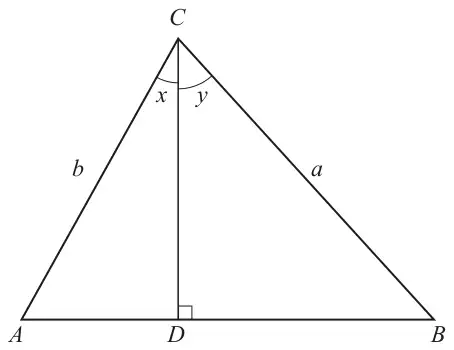
(a)
Triangle ABC with base AB; the perpendicular CD from C meets AB at D with a right angle; angle ACD is x and angle DCB is y; side AC is b and side BC is a
The diagram shows triangle \(ABC\). The perpendicular from \(C\) to \(AB\) meets \(AB\) at \(D\).
Angle \(ACD = x\), angle \(DCB = y\), length \(BC = a\) and length \(AC = b\).
(i) Explain why the length of \(CD\) can be written as \(a\cos y\). [1]
(ii) Show that the area of the triangle \(ADC\) is given by \(\frac{1}{2}ab\sin x\cos y\). [1]
(iii) Hence, or otherwise, show that \(\sin(x + y) = \sin x\cos y + \cos x\sin y\). [4]
(b) Given that \(\sin(30^\circ + \alpha) = \cos(45^\circ - \alpha)\), show that \(\tan\alpha = 2 + \sqrt{6} - \sqrt{3} - \sqrt{2}\). [5]

October 2021 Paper 2 Q8

OCR ACurrent spec6 marksPolynomialsProof

8 The number \(K\) is defined by \(K = n^3 + 1\), where \(n\) is an integer greater than 2.

(a) Given that \(n^3 + 1 \equiv (n + 1)(n^2 + bn + c)\), find the constants \(b\) and \(c\). [1]
(b) Prove that \(K\) has at least two distinct factors other than 1 and \(K\). [5]

June 2025 Paper 3 Q11

OCR MEICurrent spec5 marksProofSequences & Series

11 The \(n\)th term of a sequence is defined by \(a_n = \dfrac{1}{\sqrt{n+1} - 1} - \dfrac{1}{\sqrt{n+1} + 1}\), for \(n \geqslant 1\).

(a) Prove that every term in the sequence, \(a_n\), is a rational number. [3]
(b) Determine whether the sequence is increasing, decreasing or neither. [2]

June 2025 Paper 3 Q10

OCR MEICurrent spec6 marksProofVectors

10 The magnitude of the vector \(\begin{pmatrix}4\\-1\\x\end{pmatrix}\) is an integer.

Determine all possible integer values of \(x\). [6]

June 2025 Paper 2 Q5

OCR MEICurrent spec3 marksProofSequences & Series

5 Prove that the sum of the first \(n\) positive odd numbers is a square number. [3]

June 2024 Paper 3 Q16

OCR MEICurrent spec2 marksProof

16 This question refers to the article on the Insert, “Tangents and normals to a quadratic curve”. The relevant extract (lines 14 to 16) is reproduced here.

The \(y\)-coordinate of the intersection point can be shown to be \(ax_\mathrm{P}x_\mathrm{Q} + b\left(\frac{x_\mathrm{P}+x_\mathrm{Q}}{2}\right) + c\). This is equivalent to \(a\left(\frac{x_\mathrm{P}+x_\mathrm{Q}}{2}\right)^2 + b\left(\frac{x_\mathrm{P}+x_\mathrm{Q}}{2}\right) + c - a\left(\frac{x_\mathrm{P}-x_\mathrm{Q}}{2}\right)^2\).

Show that the expression \(a\left(\frac{x_\mathrm{P}+x_\mathrm{Q}}{2}\right)^2 + b\left(\frac{x_\mathrm{P}+x_\mathrm{Q}}{2}\right) + c - a\left(\frac{x_\mathrm{P}-x_\mathrm{Q}}{2}\right)^2\) is equivalent to \(ax_\mathrm{P}x_\mathrm{Q} + b\left(\frac{x_\mathrm{P}+x_\mathrm{Q}}{2}\right) + c\), as given in lines 15 and 16. [2]

June 2024 Paper 1 Q15

OCR MEICurrent spec9 marksCo-ordinate GeometryProof

15 The circle \(x^2 + y^2 + 2x - 14y + 25 = 0\) has its centre at the point C. The line \(7y = x + 25\) intersects the circle at points A and B.

Prove that triangle ABC is a right-angled triangle. [9]

June 2024 Paper 3 Q7

OCR MEICurrent spec3 marksProofTrigonometry

7 Prove that \(\sin 8\theta \tan 4\theta + \cos 8\theta = 1\). [3]

June 2024 Paper 1 Q1

OCR MEICurrent spec2 marksProof

1 A student states that \(1 + x^2 \lt (1+x)^2\) for all values of \(x\).

Using a counter example, show that the student is wrong. [2]

June 2023 Paper 3 Q10

OCR MEICurrent spec6 marksProofTrigonometry

10

(a) You are given that \((x^2 + y^2)^3 = x^6 + 3x^4y^2 + 3x^2y^4 + y^6\).
Hence, or otherwise, prove that \(\sin^6\theta + \cos^6\theta = 1 - \frac{3}{4}\sin^2 2\theta\) for all values of \(\theta\). [4]
(b) Use the result from part (a) to determine the minimum value of \(\sin^6\theta + \cos^6\theta\). [2]

June 2022 Paper 1 Q12

OCR MEICurrent spec4 marksProof

12 Prove by contradiction that 3 is the only prime number which is 1 less than a square number. [4]

June 2022 Paper 2 Q5

OCR MEICurrent spec3 marksProof

5 Tom conjectures that if \(n\) is an odd number greater than 1, then \(2^n - 1\) is prime.

Find a counter example to disprove Tom’s conjecture. [3]

June 2022 Paper 3 Q3

OCR MEICurrent spec4 marksProofSequences & Series

3 An infinite sequence \(a_1, a_2, a_3, \ldots\) is defined by \(a_n = \dfrac{n}{n+1}\), for all positive integers \(n\).

(a) Find the limit of the sequence. [1]
(b) Prove that this is an increasing sequence. [3]

October 2021 Paper 3 Q15

OCR MEICurrent spec4 marksProofTrigonometry

15

The questions in this section refer to the article on the Insert. You should read the article before attempting the questions.

The relevant parts of the article “Adding arctangents” are reproduced below; the line numbers are those printed on the Insert.

Line 7
It can be shown that \(\arctan\left(\frac{1}{2}\right) + \arctan\left(\frac{1}{3}\right) = \arctan 1\).

Line 29
For any positive \(x\), \(\arctan x + \arctan\left(\dfrac{1}{x}\right) = \dfrac{\pi}{2}\).

Line 37
\(\arctan x + \arctan y = \arctan\left(\dfrac{x + y}{1 - xy}\right) + \pi\), when \(xy > 1\) and \(x, y > 0\)

Lines 41–42
• \(\arctan 1 + \arctan 2 + \arctan 3 = \pi\). This can be proved by using \(\arctan x + \arctan\left(\dfrac{1}{x}\right) = \dfrac{\pi}{2}\) together with \(\arctan\left(\frac{1}{2}\right) + \arctan\left(\frac{1}{3}\right) = \arctan 1\).

Prove that \(\arctan 1 + \arctan 2 + \arctan 3 = \pi\), as given in line 41. [4]

October 2021 Paper 1 Q1

OCR MEICurrent spec2 marksProof

1 Beth states that for all real numbers \(p\) and \(q\), if \(p^2 > q^2\) then \(p > q\).

Prove that Beth is not correct. [2]

October 2020 Paper 3 Q9

OCR MEICurrent spec3 marksProof

9

The questions in this section refer to the article on the Insert. You should read the article before attempting the questions.

The relevant parts of the article “Which is bigger?” are reproduced below; the line numbers are those printed on the Insert.

Lines 4–9
It is often helpful in mathematics to consider simpler examples. It is easy to work out that \(3^4 > 4^3\). In the expression \(3^4\), 3 is the base and 4 is the exponent. Working with integers greater than 1, it is easy to find many examples where \(a^b > b^a\) if \(a < b\). That is, using the smaller base and the larger exponent gives the larger result. This might lead us to conjecture that \(a^b > b^a\) if \(a < b\) and both \(a\) and \(b\) are integers greater than 1. However, it is also possible to find counter examples to this conjecture.

(a) Show that if \(a = 1\) and \(b > 1\) then \(a^b < b^a\). [2]
(b) Find integer values of \(a\) and \(b\) with \(b > a > 1\) and \(a^b\) not greater than \(b^a\) (a counter example to the conjecture given in lines 7–8). [1]