Trigonometry

Edexcel

AQA

OCR A

OCR MEI

June 2025 Paper 1 Q16

EdexcelCurrent spec7 marksIntegrationTrigonometry

16.

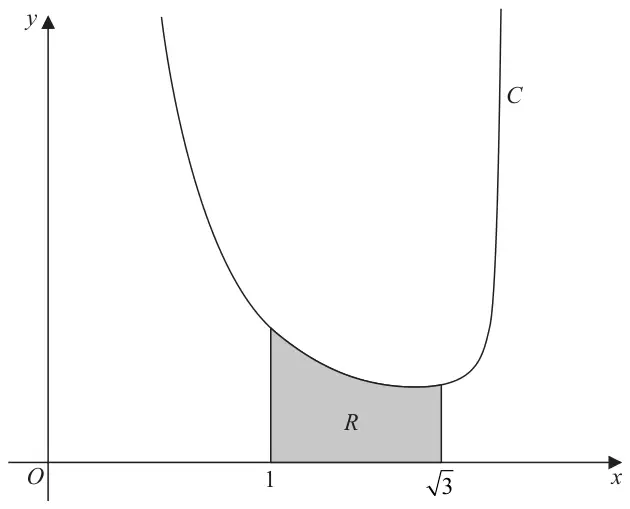
Figure 5: curve C for 0 < x < 2, decreasing to a minimum then rising steeply; region R shaded between C and the x-axis from x = 1 to x = √3
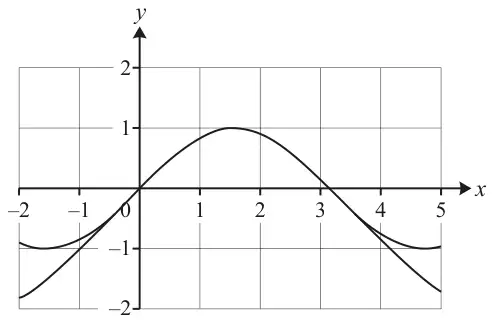
Figure 5

Figure 5 shows a sketch of the curve \(C\) with equation

\[y = \frac{1}{x^2\sqrt{4 - x^2}} \qquad\qquad 0 \lt x \lt 2\]

The region \(R\), shown shaded in Figure 5, is bounded by \(C\), the line with equation \(x = 1\), the \(x\)-axis and the line with equation \(x = \sqrt{3}\)

(a) Use the substitution \(x = 2\sin u\) to show that the area of \(R\) is given by\[\int_a^b k\operatorname{cosec}^2 u\,\mathrm{d}u\]where \(a\), \(b\) and \(k\) are constants to be found. (4)
(b) Hence, using algebraic integration, find the exact area of \(R\).
Give your answer in simplest form. (3)

June 2025 Paper 1 Q14

EdexcelCurrent spec7 marksTrigonometry

14.

In this question you must show all stages of your working.

Solutions relying on calculator technology are not acceptable.

(a) Show that\[\sin(x + 30^\circ) + \sqrt{3}\cos(x + 30^\circ) \equiv 2\cos x\] (3)
(b) Hence solve, for \(0 \leqslant \theta \lt 180^\circ\)\[\sin(\theta + 30^\circ) + \sqrt{3}\cos(\theta + 30^\circ) = 3\sin 2\theta\]giving your answers to one decimal place, where appropriate. (4)

June 2025 Paper 2 Q13

EdexcelCurrent spec3 marksTrigonometry

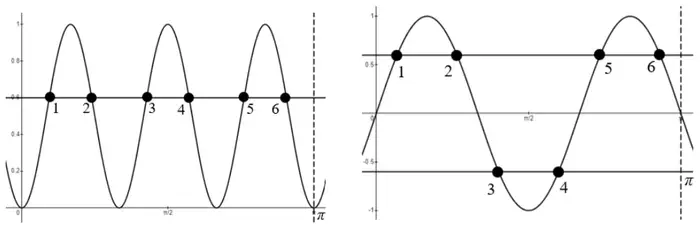
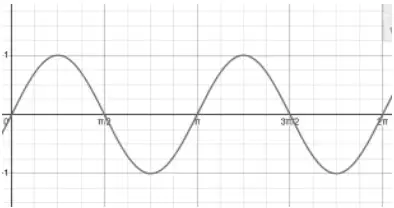
13. Given that for all values of \(k\), where \(0 \lt \left|k\right| \lt 1\), the equation\[\sin(nx) = k \qquad n \in \mathbb{N}\]has exactly 6 solutions in the interval \(0 \leqslant x \lt 2\pi\)

(i) deduce the value of \(n\) (1)
(ii) deduce the number of solutions of the equation\[\sin^2(nx) = k^2\]in the interval \(0 \leqslant x \lt 5\pi\), justifying your answer. (2)

June 2025 Paper 2 Q6

EdexcelCurrent spec6 marksRadiansTrigonometry

6.

In this question you must show detailed reasoning.

(a) Given that \(x\) is small and in radians, use the small angle approximation for \(\cos\theta\) to show that\[1 - \cos^2(2x) \approx 4x^2 - 4x^4\] (2)
(b) Given that \(x\) is small and in radians, use
  • the answer to part (a)
  • the small angle approximations for \(\sin\theta\) and \(\tan\theta\)
to show that\[\frac{1 - \cos^2(2x)}{\sin\left(\frac{x}{3}\right)\tan\left(\frac{x}{2}\right)} \approx a + bx^2\]where \(a\) and \(b\) are constants to be found. (2)
(c) Hence, given that \(x\) is very small, deduce an approximate value for\[\frac{1 - \cos^2(2x)}{\sin\left(\frac{x}{3}\right)\tan\left(\frac{x}{2}\right)}\]giving a reason for your answer. (2)

June 2025 Paper 2 Q4

EdexcelCurrent spec5 marksRadiansTrigonometry

4.

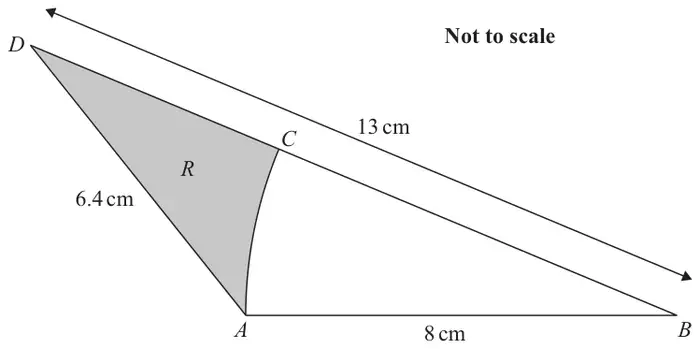
Figure 1: triangle ABD, not to scale, with AD = 6.4 cm, BD = 13 cm, AB = 8 cm; arc AC of a circle centre B with C on BD; region R shaded between DA, DC and the arc
Figure 1

The shape \(ABCD\), shown in Figure 1, consists of a triangle \(ABD\) containing a sector \(ABC\) of a circle with centre \(B\).

Given that

  • \(AD = 6.4\) cm
  • \(BD = 13\) cm
  • \(BA = BC = 8\) cm
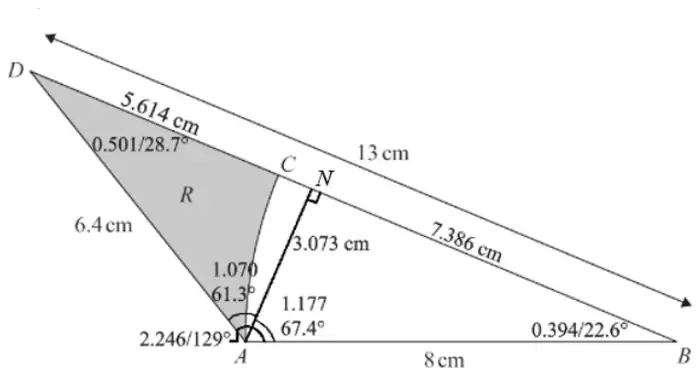
(a) show that angle \(ABC = 0.394\) radians to 3 significant figures. (2)

The region \(R\), shown shaded in Figure 1, is bounded by the line \(CD\), the line \(DA\) and the arc \(AC\).

(b) Find the area of \(R\), giving the answer in cm\(^2\) to 3 significant figures.
You must make your method clear. (3)

June 2024 Paper 1 Q13

EdexcelCurrent spec8 marksIntegrationTrigonometry

13.

(a) Given that \(a\) is a positive constant, use the substitution \(x = a\sin^2\theta\) to show that\[\int_0^{a} x^{\frac{1}{2}}\sqrt{a-x}\,\mathrm{d}x = \frac{1}{2}a^2\int_0^{\frac{\pi}{2}} \sin^2 2\theta\,\mathrm{d}\theta\] (4)
(b) Hence use algebraic integration to show that\[\int_0^{a} x^{\frac{1}{2}}\sqrt{a-x}\,\mathrm{d}x = k\pi a^2\]where \(k\) is a constant to be found. (4)

June 2024 Paper 1 Q12

EdexcelCurrent spec11 marksModellingTrigonometry

12.

(a) Express \(140\cos\theta - 480\sin\theta\) in the form \(K\cos(\theta + \alpha)\)
where \(K \gt 0\) and \(0 \lt \alpha \lt 90^\circ\)
State the value of \(K\) and give the value of \(\alpha\), in degrees, to 2 decimal places. (3)

A scientist studies the number of rabbits and the number of foxes in a wood for one year.

The number of rabbits, \(R\), is modelled by the equation

\[R = A + 140\cos(30t)^\circ - 480\sin(30t)^\circ\]

where \(t\) months is the time after the start of the year and \(A\) is a constant.

Given that, during the year, the maximum number of rabbits in the wood is 1500

(b)
(i) find a complete equation for this model.
(ii) Hence write down the minimum number of rabbits in the wood during the year according to the model. (2)

The actual number of rabbits in the wood is at its minimum value in the middle of April.

(c) Use this information to comment on the model for the number of rabbits. (2)

The number of foxes, \(F\), in the wood during the same year is modelled by the equation

\[F = 100 + 70\sin(30t + 70)^\circ\]

The number of foxes is at its minimum value after \(T\) months.

(d) Find, according to the models, the number of rabbits in the wood at time \(T\) months. (4)

June 2024 Paper 1 Q11

EdexcelCurrent spec4 marksRadiansTrigonometry

11.

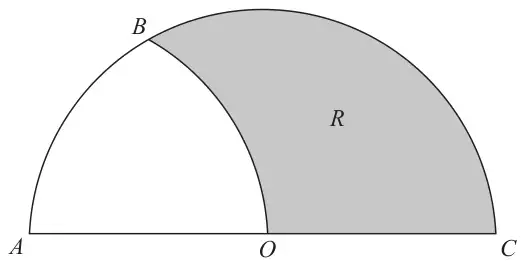
Figure 4: semicircle ABCOA on diameter AC with centre O; arc OB centred at A; shaded region R between arc OB, arc BC and line OC
Figure 4

Figure 4 shows the design of a badge.

The shape \(ABCOA\) is a semicircle with centre \(O\) and diameter 10 cm.

\(OB\) is the arc of a circle with centre \(A\) and radius 5 cm.

The region \(R\), shown shaded in Figure 4, is bounded by the arc \(OB\), the arc \(BC\) and the line \(OC\).

Find the exact area of \(R\).

Give your answer in the form \(\left(a\sqrt{3} + b\pi\right)\text{ cm}^2\), where \(a\) and \(b\) are rational numbers. (4)

June 2024 Paper 2 Q8

EdexcelCurrent spec7 marksProofTrigonometry

8.

In this question you must show all stages of your working.

Solutions relying entirely on calculator technology are not acceptable.

(a) Prove that\[\frac{1}{\operatorname{cosec}\theta - 1} + \frac{1}{\operatorname{cosec}\theta + 1} \equiv 2\tan\theta\sec\theta \qquad \theta \neq (90n)^\circ,\ n \in \mathbb{Z}\] (3)
(b) Hence solve, for \(0 \lt x \lt 90^\circ\), the equation\[\frac{1}{\operatorname{cosec}2x - 1} + \frac{1}{\operatorname{cosec}2x + 1} = \cot 2x\sec 2x\]Give each answer, in degrees, to one decimal place. (4)

June 2024 Paper 2 Q5

EdexcelCurrent spec3 marksRadiansTrigonometry

5. Given that \(\theta\) is small and in radians, use the small angle approximations to find an approximate numerical value of\[\frac{\theta\tan 2\theta}{1 - \cos 3\theta}\] (3)

June 2025 Paper 1 Q16

AQACurrent spec7 marksTrigonometry

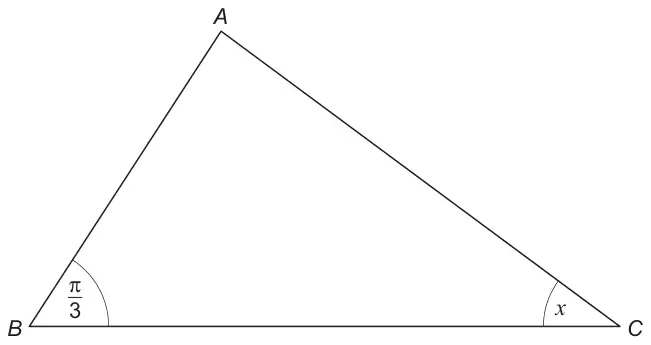
16 The triangle \(ABC\) is shown in the diagram below.

The angle \(ABC\) is \(\dfrac{\pi}{3}\) radians.

The angle \(BCA\) is \(x\) radians.

Triangle ABC with angle π/3 marked at B and angle x marked at C
(a) Explain why angle \(BAC = \dfrac{2\pi}{3} - x\) [1 mark]
(b)
(i) Use the sine rule to show that\[\frac{BC}{AB} = \frac{\sqrt{3}\cot x + p}{q}\]where \(p\) and \(q\) are integers. [5 marks]
(ii) Hence state the exact value of \(x\) when\[\frac{BC}{AB} = \frac{\sqrt{3} + 1}{2}\] [1 mark]

June 2025 Paper 1 Q14

AQACurrent spec8 marksIntegrationTrigonometry

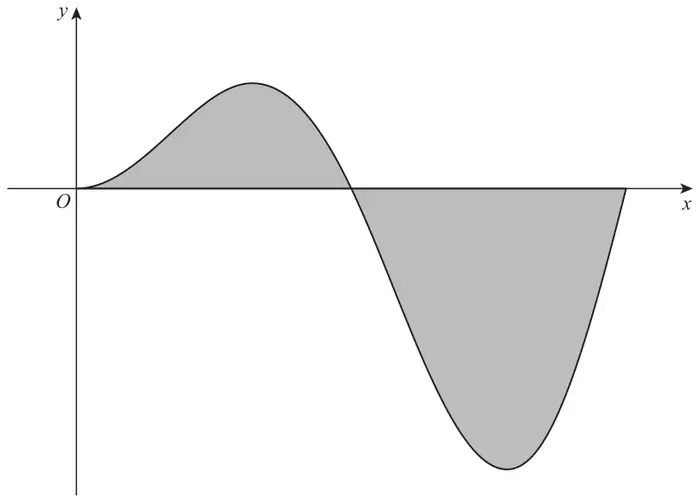
14 The graph of \(y = 4x\sin 2x\) for \(0 \leqslant x \leqslant \pi\) is shown below.

Graph of y = 4x sin 2x for 0 ≤ x ≤ π: a shaded region above the x-axis from O to where the curve crosses the axis, and a larger shaded region below the x-axis from there to x = π

Show that the shaded area enclosed by the \(x\)-axis and the curve is \(k\pi\), where \(k\) is an integer to be found.

Fully justify your answer. [8 marks]

June 2025 Paper 3 Q10

AQACurrent spec10 marksModellingTrigonometry

10

(a) Express\[2\sin x + 5\cos x\]in the form\[R\sin(x + \alpha)\]

where \(R \gt 0\) and \(0^\circ \leqslant \alpha \leqslant 90^\circ\)

[3 marks]
(b) In 2010, the water temperature at a beach could be modelled by the formula\[T = 14.2 - (2\sin d^\circ + 5\cos d^\circ)\]

where:

  • \(T\) is the temperature of the water in °C
  • \(d\) is the number of days after 1 January 2010
(i) Find the value of \(d\) when the temperature of the water reached its lowest value in 2010 [1 mark]
(ii) Find the maximum temperature of the water predicted by the model in 2010

Give your answer to one decimal place.

[1 mark]
(iii) Find the number of weeks in 2010 for which the temperature of the water was higher than 15 °C

Give your answer to the nearest whole number.

[5 marks]

June 2025 Paper 2 Q8

AQACurrent spec6 marksProofTrigonometry

8

(a) Given that \(\cos x \neq 0\) state the value of \(\sec^2 x - \tan^2 x\) [1 mark]
(b) Show that\[(3\sec x + 5\tan x)(5\sec x - 3\tan x) - \frac{16\tan x}{\cos x} = N\]where \(N\) is an integer to be found. [4 marks]
(c) State the two values of \(x\) between \(0^\circ\) and \(360^\circ\) for which the value of \(N\) in part (b) is not valid. [1 mark]

June 2025 Paper 1 Q8

AQACurrent spec5 marksRadiansTrigonometry

8 Show that, for small values of \(\boldsymbol{x}\), the graph with equation

\[y = \frac{4 + \sin 5x - 3\cos 2x}{1 + 2\tan x}\]

can be approximated by the straight line with equation of the form

\[y = ax + 1\]

where \(a\) is a constant to be found. [5 marks]

June 2024 Paper 1 Q15

AQACurrent spec6 marksProofTrigonometry

15

(a) Show that the expression\[\sin 2\theta \operatorname{cosec}\theta + \cos 2\theta \sec\theta\]can be written as\[4\cos\theta - \sec\theta\]where \(\sin\theta \neq 0\) and \(\cos\theta \neq 0\) [4 marks]
(b) A student is attempting to solve the equation\[\sin 2\theta \operatorname{cosec}\theta + \cos 2\theta \sec\theta = 3 \quad \text{for } 0^\circ \leqslant \theta \leqslant 360^\circ\]They use the result from part (a), and write the following incorrect solution:\[\sin 2\theta \operatorname{cosec}\theta + \cos 2\theta \sec\theta = 3\]
Step 1\(4\cos\theta - \sec\theta = 3\)
Step 2\(4\cos\theta - \dfrac{1}{\cos\theta} - 3 = 0\)
Step 3\(4\cos^2\theta - 3\cos\theta - 1 = 0\)
Step 4\(\cos\theta = 1\) or \(\cos\theta = -0.25\)
Step 5\(\theta = 0^\circ,\ 104.5^\circ,\ 255.5^\circ,\ 360^\circ\)
(i) Explain why the student should reject one of their values for \(\cos\theta\) in Step 4. [1 mark]
(ii) State the correct solutions to the equation\[\sin 2\theta \operatorname{cosec}\theta + \cos 2\theta \sec\theta = 3 \quad \text{for } 0^\circ \leqslant \theta \leqslant 360^\circ\] [1 mark]

June 2024 Paper 3 Q9

AQACurrent spec9 marksCo-ordinate GeometryTrigonometry

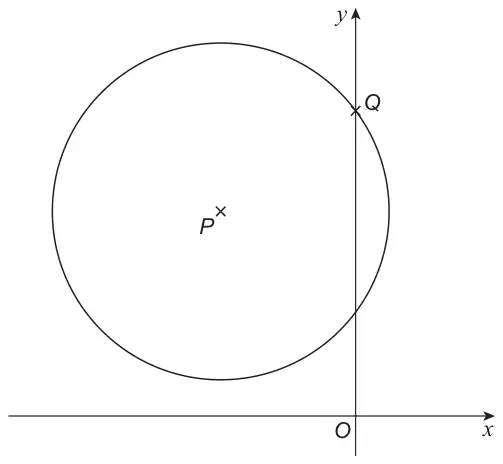
9 Figure 1 below shows a circle.

A circle with centre P, to the left of the y-axis and above the x-axis; the circle crosses the y-axis, with the upper intersection marked Q
Figure 1

The centre of the circle is \(P\) and the circle intersects the \(y\)-axis at \(Q\) as shown in Figure 1.

The equation of the circle is

\[x^2 + y^2 = 12y - 8x - 27\]
(a) Express the equation of the circle in the form\[(x - a)^2 + (y - b)^2 = k\]

where \(a\), \(b\) and \(k\) are constants to be found. [3 marks]

(b) State the coordinates of \(P\) [1 mark]
(c) Find the \(y\)-coordinate of \(Q\) [2 marks]
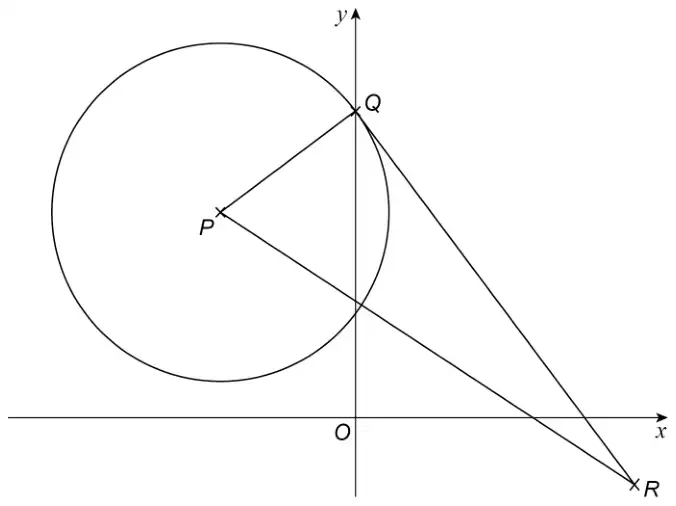
(d) The line segment \(QR\) is a tangent to the circle as shown in Figure 2 below.
The circle with centre P; Q on the y-axis; the tangent QR from Q to the point R below the x-axis to the right; the line segments PQ and PR are drawn
Figure 2

The point \(R\) has coordinates (9, −3).

Find the angle \(QPR\)

Give your answer in radians to three significant figures. [3 marks]

June 2024 Paper 2 Q6

AQACurrent spec6 marksTrigonometry

6 It is given that

\[(2\sin\theta + 3\cos\theta)^2 + (6\sin\theta - \cos\theta)^2 = 30\]

and that \(\theta\) is obtuse.

Find the exact value of \(\sin\theta\).

Fully justify your answer. [6 marks]

June 2024 Paper 1 Q5

AQACurrent spec3 marksTrigonometry

5 Solve the equation

\[\sin^2 x = 1\]

for \(0^\circ \lt x \lt 360^\circ\) [3 marks]

June 2024 Paper 1 Q4

AQACurrent spec1 markTrigonometry

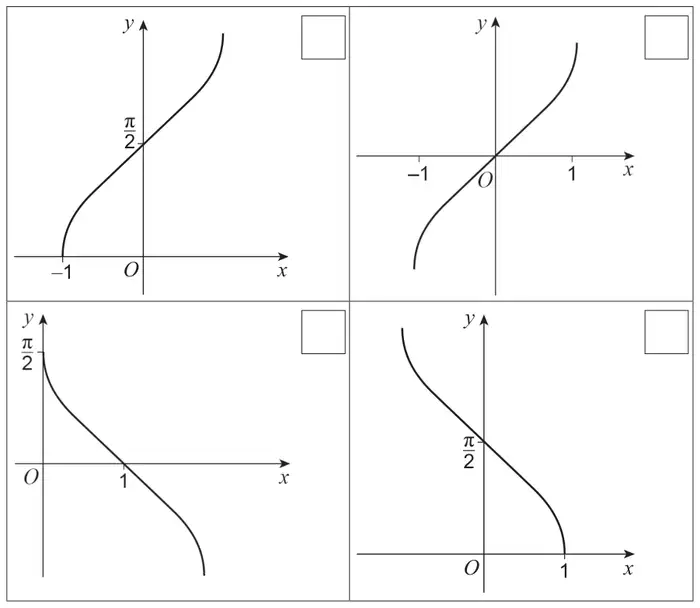
4 One of the diagrams below shows the graph of \(y = \arccos x\)

Identify the graph of \(y = \arccos x\)

Tick (✓) one box. [1 mark]

Four graphs, each with a tick box: top-left increasing curve from (−1, 0) through (0, π/2); top-right increasing curve through O from x = −1 to x = 1; bottom-left decreasing curve from (0, π/2) through (1, 0); bottom-right decreasing curve through (0, π/2) to (1, 0)

June 2023 Paper 1 Q13

AQACurrent spec9 marksNumerical MethodsTrigonometry

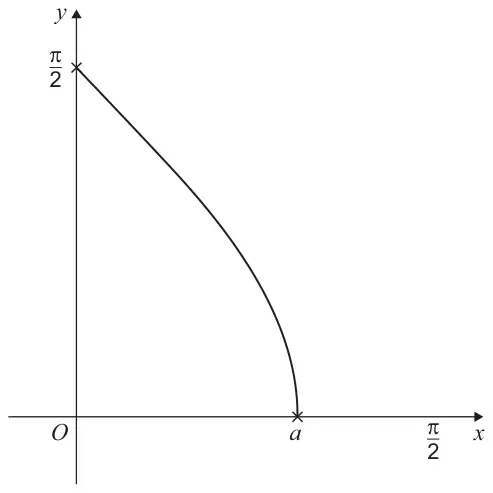
13 The function \(\mathrm{f}\) is defined by

\[\mathrm{f}(x) = \arccos x \quad \text{for } 0 \leqslant x \leqslant a\]

The curve with equation \(y = \mathrm{f}(x)\) is shown below.

Graph of y = arccos x, a decreasing curve from (0, π/2) on the y-axis to (a, 0) on the x-axis, with π/2 also marked on the x-axis to the right of a
(a) State the value of \(a\) [1 mark]
(b)
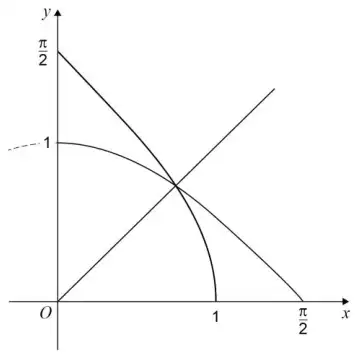
(i) On the diagram above, sketch the curve with equation\[y = \cos x \quad \text{for } 0 \leqslant x \leqslant \frac{\pi}{2}\]and

sketch the line with equation

\[y = x \quad \text{for } 0 \leqslant x \leqslant \frac{\pi}{2}\] [4 marks]
(ii) Explain why the solution to the equation\[x - \cos x = 0\]must also be a solution to the equation\[\cos x = \arccos x\] [1 mark]
(c) Use the Newton-Raphson method with \(x_0 = 0\) to find an approximate solution, \(x_3\), to the equation\[x - \cos x = 0\]Give your answer to four decimal places. [3 marks]

June 2023 Paper 1 Q12

AQACurrent spec8 marksModellingTrigonometry

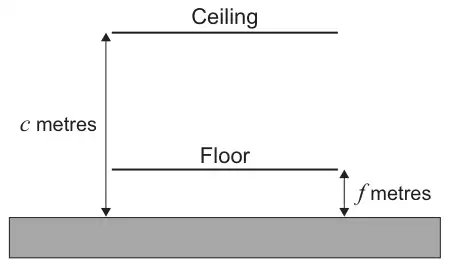
12 One of the rides at a theme park is a room where the floor and ceiling both move up and down for \(10\pi\) seconds.

At time \(t\) seconds after the ride begins, the distance \(f\) metres of the floor above the ground is

\[f = 1 - \cos t\]

At time \(t\) seconds after the ride begins, the distance \(c\) metres of the ceiling above the ground is

\[c = 8 - 4\sin t\]

The ride is shown in the diagram below.

Diagram of the ride: a horizontal ceiling above a horizontal floor, both above the ground, with c metres marked from the ground to the ceiling and f metres marked from the ground to the floor
(a) Show that the initial distance between the floor and ceiling is 8 metres. [1 mark]
(b) Show that the distance \(d\) metres between the floor and ceiling at time \(t\) is given by\[d = 7 + R\cos(t + \alpha)\]where \(R\) and \(\alpha\) are positive constants to be found. [5 marks]
(c) Hence, find the minimum distance between the ceiling and the floor.

Give your answer to the nearest centimetre. [2 marks]

June 2023 Paper 1 Q10

AQACurrent spec8 marksTrigonometry

10 The curve with equation

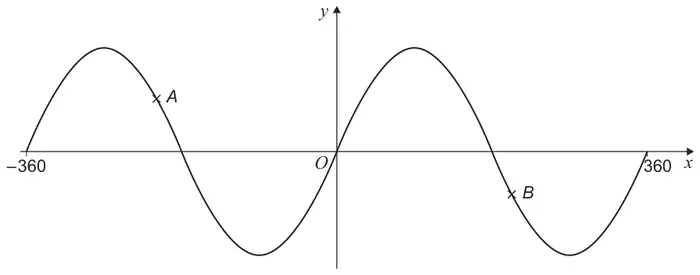
\[y = \sin x^\circ\]

for \(-360 \leqslant x \leqslant 360\) is shown below.

Graph of y = sin x° from x = −360 to x = 360, with point A marked on the curve above the x-axis between x = −270 and x = −180, and point B marked on the curve just below the x-axis between x = 180 and x = 270
(a) Point \(A\) on the curve has coordinates \((a,\ 0.5)\)
(i) Find the value of \(a\) [2 marks]
(ii) State the value of \(\sin(180^\circ - a^\circ)\) [1 mark]
(b) Point \(B\) on the curve has coordinates \(\left(b,\ -\dfrac{3}{7}\right)\)
(i) Find the exact value of \(\sin(b^\circ - 180^\circ)\) [2 marks]
(ii) Find the exact value of \(\cos b^\circ\) [3 marks]

June 2023 Paper 2 Q8

AQACurrent spec10 marksProofTrigonometry

8

(a) Given that \(\cos\theta \neq \pm 1\), prove the identity\[\frac{1}{1 - \cos\theta} + \frac{1}{1 + \cos\theta} \equiv 2\operatorname{cosec}^2\theta\] [4 marks]
(b) Hence, find the set of values of \(A\) for which the equation\[\frac{1}{1 - \cos\theta} + \frac{1}{1 + \cos\theta} = A\]has real solutions.

Fully justify your answer. [3 marks]

(c) Given that \(\theta\) is obtuse and\[\frac{1}{1 - \cos\theta} + \frac{1}{1 + \cos\theta} = 16\]find the exact value of \(\cot\theta\) [3 marks]

June 2022 Paper 1 Q15

AQACurrent spec16 marksIntegrationTrigonometry

15

(a) Given that\[y = \operatorname{cosec}\theta\]
(i) Express \(y\) in terms of \(\sin\theta\). [1 mark]
(ii) Hence, prove that\[\frac{\mathrm{d}y}{\mathrm{d}\theta} = -\operatorname{cosec}\theta\cot\theta\] [3 marks]
(iii) Show that\[\frac{\sqrt{y^2 - 1}}{y} = \cos\theta \qquad \text{for } 0 \lt \theta \lt \frac{\pi}{2}\] [3 marks]
(b)
(i) Use the substitution\[x = 2\operatorname{cosec} u\]to show that\[\int \frac{1}{x^2\sqrt{x^2 - 4}}\,\mathrm{d}x \qquad \text{for } x \gt 2\]can be written as\[k\int \sin u\,\mathrm{d}u\]where \(k\) is a constant to be found. [6 marks]
(ii) Hence, show\[\int \frac{1}{x^2\sqrt{x^2 - 4}}\,\mathrm{d}x = \frac{\sqrt{x^2 - 4}}{4x} + c \qquad \text{for } x \gt 2\]where \(c\) is a constant. [3 marks]

June 2022 Paper 1 Q12

AQACurrent spec8 marksSequences & SeriesTrigonometry

12

(a) A geometric sequence has first term 1 and common ratio \(\dfrac{1}{2}\)
(i) Find the sum to infinity of the sequence. [2 marks]
(ii) Hence, or otherwise, evaluate\[\sum_{n=1}^{\infty} (\sin 30^\circ)^n\] [2 marks]
(b) Find the smallest positive exact value of \(\theta\), in radians, which satisfies the equation\[\sum_{n=0}^{\infty} (\cos\theta)^n = 2 - \sqrt{2}\] [4 marks]

June 2022 Paper 1 Q7

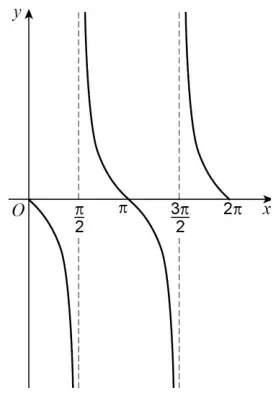
7 Sketch the graph of

\[y = \cot\left(x - \frac{\pi}{2}\right)\]

for \(0 \leqslant x \leqslant 2\pi\) [3 marks]

Blank axes for the sketch: x-axis marked O, π and 2π; y-axis above and below the x-axis

June 2022 Paper 3 Q5

5

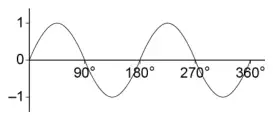
(a) Sketch the graph of\[y = \sin 2x\]for \(0^\circ \leqslant x \leqslant 360^\circ\) [2 marks]
Axes for the sketch: x-axis marked O, 90°, 180°, 270° and 360°; y-axis above and below the x-axis
(b) The equation\[\sin 2x = A\]has exactly two solutions for \(0^\circ \leqslant x \leqslant 360^\circ\)

State the possible values of \(A\). [1 mark]

June 2022 Paper 2 Q4

AQACurrent spec3 marksTrigonometry

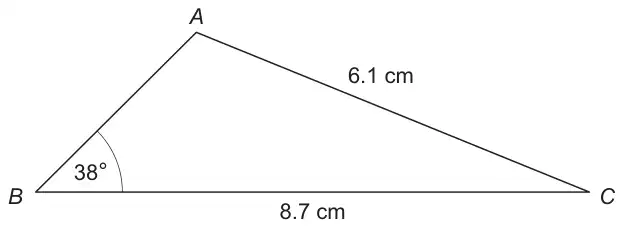
4 The diagram shows a triangle \(ABC\).

Triangle ABC with BC along the bottom of length 8.7 cm, AC of length 6.1 cm, and angle ABC of 38 degrees

\(AB\) is the shortest side.

The lengths of \(AC\) and \(BC\) are 6.1 cm and 8.7 cm respectively.

The size of angle \(ABC\) is 38°

Find the size of the largest angle.

Give your answer to the nearest degree. [3 marks]

June 2025 Paper 1 Q9

OCR ACurrent spec10 marksTrigonometry

9

(a) Express \(3\cos 2x + 4\sin 2x\) in the form \(R\cos(2x - \alpha)\), where \(R \gt 0\) and \(0^\circ \lt \alpha \lt 90^\circ\). [3]
(b) In this question you must show detailed reasoning.

Solve the equation \(\dfrac{3\cos 2x + 4\sin 2x + 6}{3\cos 2x + 4\sin 2x - 1} = 4\) for \(0^\circ \lt x \lt 360^\circ\). [7]

June 2025 Paper 1 Q6

OCR ACurrent spec8 marksRadiansTrigonometry

6

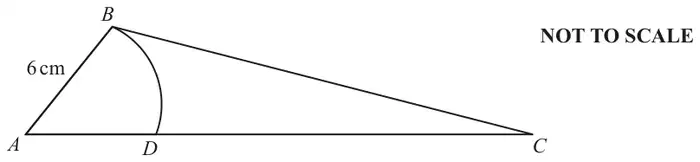
Triangle ABC with AB = 6 cm; an arc BD centred at A meets AC at D. Not to scale.

The diagram shows a triangle \(ABC\). The arc \(BD\) is part of a circle with centre \(A\) and radius 6 cm.

The area of the sector \(ABD\) is \(14.4\ \text{cm}^2\).

(a) Show that angle \(BAD\) is 0.8 radians. [1]

The area of the triangle \(ABC\) is three times the area of the sector \(ABD\).

(b) Find the length \(AC\). [2]
(c) Find the perimeter of the region \(BCD\). [5]

June 2025 Paper 3 Q6

OCR ACurrent spec12 marksDifferentiationTrigonometry

6 The compound angle formulae for \(\sin(A + B)\) and \(\sin(A - B)\) are

\(\sin(A + B) = \sin A\cos B + \cos A\sin B\) and
\(\sin(A - B) = \sin A\cos B - \cos A\sin B\).

(a) By letting \(C = A + B\) and \(D = A - B\), show that
\(\sin C - \sin D = 2\cos\left(\dfrac{C + D}{2}\right)\sin\left(\dfrac{C - D}{2}\right)\). [1]
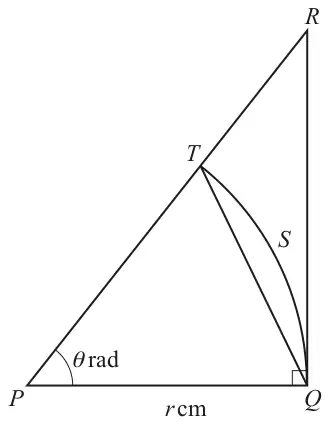
Right-angled triangle PQR with the right angle at Q, PQ = r cm and angle QPR = theta radians. T lies on PR with PT = r; arc QST is part of a circle centre P, and the chord QT is drawn.

The diagram shows a right-angled triangle \(PQR\) with \(PQ = r\) cm. The angle \(QPR\) is \(\theta\) radians. The diagram also shows the sector \(PQST\) of a circle with centre \(P\) and radius \(r\) cm. The line segment \(QT\) is a chord of the sector \(PQST\).

(b) By considering the areas of triangle \(PQT\), sector \(PQST\) and triangle \(PQR\), show that
\(1 \lt \dfrac{\theta}{\sin\theta} \lt \dfrac{1}{\cos\theta}\). [4]
(c)
(i) Hence write down a similar inequality interval for the expression \(\dfrac{\sin\theta}{\theta}\). [1]
(ii) Hence state \(\displaystyle\lim_{\theta \to 0} \frac{\sin\theta}{\theta}\). [1]
(d) Using parts (a) and (c)(ii), show from first principles that the derivative of \(\sin x\) is \(\cos x\), where \(x\) is measured in radians. [4]

A student attempts to use the result regarding the derivative of \(\sin x\) to find the derivative of \(\cos x\). The student’s attempt is shown below.

Let\(y = \cos x\), where \(x\) is measured in radians.
\(y = \sin\left(\dfrac{\pi}{2} - x\right)\)
so\(\dfrac{\mathrm{d}y}{\mathrm{d}x} = \cos\left(\dfrac{\pi}{2} - x\right)\)
but\(\sin x \equiv \cos\left(\dfrac{\pi}{2} - x\right)\)
therefore\(\dfrac{\mathrm{d}y}{\mathrm{d}x} = \sin x\).
(e) Identify the error made by the student. [1]

June 2025 Paper 2 Q4

OCR ACurrent spec6 marksProofTrigonometry

4

(a) Prove that \((\cos\theta + \sin\theta)^2 \equiv 1 + \sin 2\theta\). [2]
(b) Hence or otherwise prove that \(\sec 2\theta + \tan 2\theta \equiv \dfrac{\cos\theta + \sin\theta}{\cos\theta - \sin\theta}\). [4]

June 2024 Paper 1 Q11

OCR ACurrent spec12 marksDifferentiationTrigonometry

11 A curve has equation \(y = 5\ln(1 - \cos 2x)\), where \(x\) is in radians.

(a) State the values of \(x\) for which \(5\ln(1 - \cos 2x)\) is not defined. [2]
(b) \(P\) is the stationary point on the curve that has the smallest positive \(x\)-coordinate.
Determine the exact coordinates of \(P\). [4]
(c)
(i) Show that \(\dfrac{\mathrm{d}^2y}{\mathrm{d}x^2} + 20\mathrm{e}^{-\frac{1}{5}y} = 0\). [5]
(ii) State what can be deduced about all of the stationary points on this curve, giving a reason for your answer. [1]

June 2024 Paper 1 Q9

OCR ACurrent spec9 marksModellingTrigonometry

9 The depth of the water, \(d\) metres, in a tidal river during a given day is modelled by the equation

\(d = 1.9 + 1.1\cos(30t - 60)^\circ\)

where \(t\) is the number of hours after midnight.

(A tidal river is one whose level is influenced by tides.)

(a)
(i) Find the minimum depth of water given by this model. [1]
(ii) Find the value of \(t\) when the minimum depth first occurs. [2]
(b) A boat can only enter the river when the depth of water is at least 1 metre.
Determine the two periods of time during the day between which this boat will not be able to enter the river. Give your answers correct to the nearest minute. [5]

In reality the depth of the river decreases as this boat travels along the river. An improved model uses the equation

\(d = \mathrm{e}^{-cp}\left(1.9 + 1.1\cos(30t - 60)^\circ\right)\)

where \(c\) is a positive constant and \(p\) is the distance, in kilometres, travelled along the river after entering it.

(c) Explain how this new equation could give an improved model. [1]

June 2024 Paper 2 Q6

OCR ACurrent spec10 marksPolynomialsTrigonometry

6 In this question you must show detailed reasoning.

(a)
(i) Use the formula for \(\cos(A + B)\), and the double angle formulae, to show that \(\cos 3\theta = 4\cos^3\theta - 3\cos\theta\). [2]
(ii) Use this result to solve the equation \(4\cos^3\theta - 3\cos\theta - \dfrac{\sqrt{2}}{2} = 0\) for \(0^\circ \leqslant \theta \leqslant 180^\circ\). [3]
(b)
(i) Show that \(\left(x + \dfrac{\sqrt{2}}{2}\right)\left(4x^2 - 2\sqrt{2}x - 1\right) = 4x^3 - 3x - \dfrac{\sqrt{2}}{2}\). [1]
(ii) Hence find the exact roots of the equation \(4x^3 - 3x - \dfrac{\sqrt{2}}{2} = 0\). [2]
(c) Use the results from parts (a)(ii) and (b)(ii) to show that \(\cos 15^\circ = \dfrac{\sqrt{2} + \sqrt{6}}{4}\). [2]

June 2024 Paper 3 Q4

OCR ACurrent spec9 marksRadiansTrigonometry

4

(a) Show that the equation \(2\cot^2 x - 9\,\mathrm{cosec}\,x - 3 = 0\) can be expressed in the form
\(5\sin^2 x + 9\sin x - 2 = 0\). [3]
(b)
(i) In this question you must show detailed reasoning.
Hence solve, for \(0 \lt \theta \lt \pi\),
\(2\cot^2 2\theta - 9\,\mathrm{cosec}\,2\theta - 3 = 0\).
Give your answers correct to 3 decimal places. [4]

The small angle approximation for \(\sin 2\theta\) is used to find an approximation for the smallest positive solution of the equation \(2\cot^2 2\theta - 9\,\mathrm{cosec}\,2\theta - 3 = 0\).

(ii) Show that this approximate solution is accurate to 2 decimal places. [2]

June 2024 Paper 2 Q2

OCR ACurrent spec4 marksTrigonometryVectors

2 The vector \(\begin{pmatrix} a \\ b \end{pmatrix}\) has magnitude 6 and direction \(60^\circ\) above the positive \(x\)-axis.

Determine the exact values of \(a\) and \(b\). [4]

June 2023 Paper 1 Q7

OCR ACurrent spec9 marksTrigonometry

7

(a) Use the result \(\cos(A + B) = \cos A\cos B - \sin A\sin B\) to show that \[\cos(A - B) = \cos A\cos B + \sin A\sin B.\] [2]

The function \(\mathrm{f}(\theta)\) is defined as \(\cos(\theta + 30^\circ)\cos(\theta - 30^\circ)\), where \(\theta\) is in degrees.

(b) Show that \(\mathrm{f}(\theta) = \cos^2\theta - \dfrac{1}{4}\). [3]
(c)
(i) Determine the following.
  • The maximum value of \(\mathrm{f}(\theta)\)
  • The smallest positive value of \(\theta\) for which this maximum value occurs
[2]
(ii) Determine the following.
  • The minimum value of \(\mathrm{f}(\theta)\)
  • The smallest positive value of \(\theta\) for which this minimum value occurs
[2]

June 2023 Paper 2 Q6

OCR ACurrent spec10 marksCo-ordinate GeometryTrigonometry

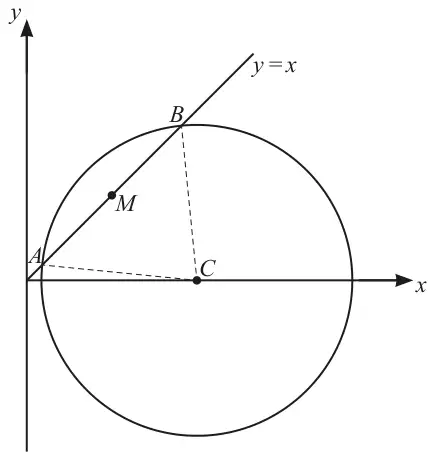
6 A circle has centre \(C\) which lies on the \(x\)-axis, as shown in the diagram. The line \(y = x\) meets the circle at \(A\) and \(B\). The midpoint of \(AB\) is \(M\).

A circle with centre C on the positive x-axis, crossing the y-axis region near the origin; the line y = x cuts the circle at A (near the origin) and B (above C); M is the midpoint of AB; dashed lines join A to C and B to C

The equation of the circle is \(x^2 - 6x + y^2 + a = 0\), where \(a\) is a constant.

(a) In this question you must show detailed reasoning.
Show that the area of triangle \(ABC\) is \(\frac{3}{2}\sqrt{9 - 2a}\). [7]
(b)
(i) Find the value of \(a\) when the area of triangle \(ABC\) is zero. [1]
(ii) Give a geometrical interpretation of the case in part (b)(i). [1]
(c) Give a geometrical interpretation of the case where \(a = 5\). [1]

June 2023 Paper 3 Q6

OCR ACurrent spec6 marksSequences & SeriesTrigonometry

6 The first, third and fourth terms of an arithmetic progression are \(u_1\), \(u_3\) and \(u_4\) respectively, where

\(u_1 = 2\sin\theta, \qquad u_3 = -\sqrt{3}\cos\theta, \qquad u_4 = \frac{7}{2}\sin\theta,\)

and \(\frac{1}{2}\pi \lt \theta \lt \pi\).

(a) Determine the exact value of \(\theta\). [3]
(b) Hence determine the value of \(\displaystyle\sum_{r=1}^{100} u_r\). [3]

June 2023 Paper 2 Q5

OCR ACurrent spec12 marksDifferentiationTrigonometry

5 In this question you must show detailed reasoning.

The function f is defined by \(\mathrm{f}(x) = \cos x + \sqrt{3}\sin x\) with domain \(0 \leqslant x \leqslant 2\pi\).

(a) Solve the following equations.
(i) \(\mathrm{f}'(x) = 0\) [4]
(ii) \(\mathrm{f}''(x) = 0\) [3]

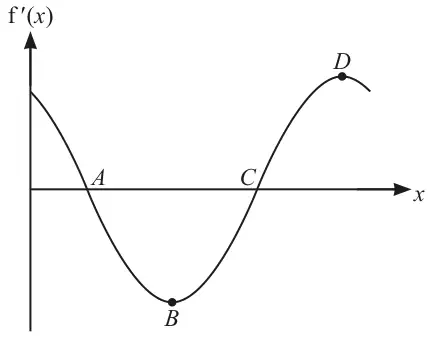
The diagram shows the graph of the gradient function \(y = \mathrm{f}'(x)\) for the domain \(0 \leqslant x \leqslant 2\pi\).

Graph of f prime of x: starts positive on the vertical axis, decreases to cross the x-axis at A, reaches a minimum point B below the axis, rises to cross the x-axis at C, and reaches a maximum point D before turning down
(b) Use your answers to parts (a)(i) and (a)(ii) to find the coordinates of points \(A\), \(B\), \(C\) and \(D\). [2]
(c)
(i) Explain how to use the graph of the gradient function to find the values of \(x\) for which \(\mathrm{f}(x)\) is increasing. [1]
(ii) Using set notation, write down the set of values of \(x\) for which \(\mathrm{f}(x)\) is increasing in the domain \(0 \leqslant x \leqslant 2\pi\). [2]

June 2023 Paper 2 Q4

OCR ACurrent spec9 marksDifferentiationTrigonometry

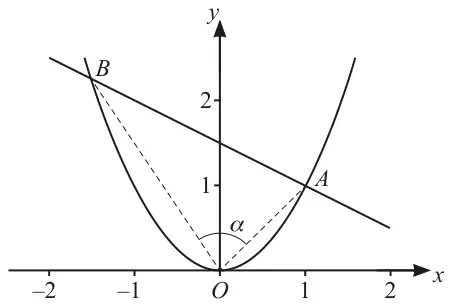
4 The diagram shows part of the graph of \(y = x^2\). The normal to the curve at the point \(A\)(1, 1) meets the curve again at \(B\). Angle \(AOB\) is denoted by \(\alpha\).

Graph of y = x squared for x from -2 to 2, with A at (1, 1) on the curve; the normal at A is a straight line sloping down from left to right, meeting the curve again at B in the second quadrant; dashed lines join O to A and O to B, and the angle AOB is marked alpha
(a) Determine the coordinates of \(B\). [6]
(b) Hence determine the exact value of \(\tan\alpha\). [3]

June 2023 Paper 3 Q2

OCR ACurrent spec5 marksTrigonometry

2

(a) Express \(3\sin x - 4\cos x\) in the form \(R\sin(x - \alpha)\), where \(R \gt 0\) and \(0^\circ \lt \alpha \lt 90^\circ\). Give the value of \(\alpha\) correct to 4 significant figures. [3]
(b) Hence solve the equation \(3\sin x - 4\cos x = 2\) for \(0^\circ \lt x \lt 90^\circ\), giving your answer correct to 3 significant figures. [2]

June 2023 Paper 1 Q1

OCR ACurrent spec5 marksTrigonometry

1 In the triangle \(ABC\), the length \(AB = 6\,\text{cm}\), the length \(AC = 15\,\text{cm}\) and the angle \(BAC = 30^\circ\).

(a) Calculate the length \(BC\). [2]

\(D\) is the point on \(AC\) such that the length \(BD = 4\,\text{cm}\).

(b) Calculate the possible values of the angle \(ADB\). [3]

June 2022 Paper 1 Q9

OCR ACurrent spec7 marksIntegrationTrigonometry

9 Use the substitution \(x = 2\sin\theta\) to show that \(\displaystyle\int_1^{\sqrt{3}} \sqrt{4 - x^2}\,\mathrm{d}x = \tfrac{1}{3}\pi\). [7]

June 2022 Paper 3 Q7

OCR ACurrent spec8 marksQuadraticsTrigonometry

7 In this question you must show detailed reasoning.

(a) Show that the equation \(m\sec\theta + 3\cos\theta = 4\sin\theta\) can be expressed in the form \[m\tan^2\theta - 4\tan\theta + (m + 3) = 0.\] [3]
(b) It is given that there is only one value of \(\theta\), for \(0 \lt \theta \lt \pi\), satisfying the equation \(m\sec\theta + 3\cos\theta = 4\sin\theta\).

Given also that \(m\) is a negative integer, find this value of \(\theta\), correct to 3 significant figures. [5]

June 2022 Paper 1 Q4

OCR ACurrent spec8 marksQuadraticsTrigonometry

4

(a) Write \(2x^2 + 6x + 7\) in the form \(p(x + q)^2 + r\), where \(p\), \(q\) and \(r\) are constants. [3]
(b) State the coordinates of the minimum point on the graph of \(y = 2x^2 + 6x + 7\). [2]
(c) Hence deduce
  • the minimum value of \(2\tan^2\theta + 6\tan\theta + 7\),
  • the smallest positive value of \(\theta\), in degrees, for which the minimum value occurs. [3]

October 2021 Paper 1 Q10

OCR ACurrent spec11 marksProofTrigonometry

10

(a)
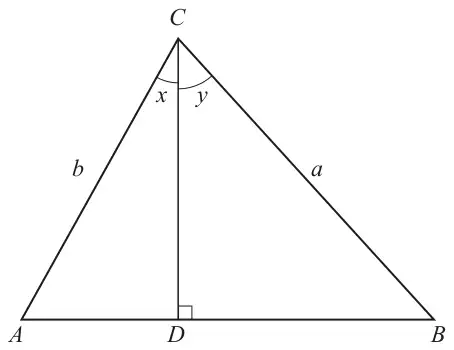
Triangle ABC with base AB; the perpendicular CD from C meets AB at D with a right angle; angle ACD is x and angle DCB is y; side AC is b and side BC is a
The diagram shows triangle \(ABC\). The perpendicular from \(C\) to \(AB\) meets \(AB\) at \(D\).
Angle \(ACD = x\), angle \(DCB = y\), length \(BC = a\) and length \(AC = b\).
(i) Explain why the length of \(CD\) can be written as \(a\cos y\). [1]
(ii) Show that the area of the triangle \(ADC\) is given by \(\frac{1}{2}ab\sin x\cos y\). [1]
(iii) Hence, or otherwise, show that \(\sin(x + y) = \sin x\cos y + \cos x\sin y\). [4]
(b) Given that \(\sin(30^\circ + \alpha) = \cos(45^\circ - \alpha)\), show that \(\tan\alpha = 2 + \sqrt{6} - \sqrt{3} - \sqrt{2}\). [5]

October 2021 Paper 1 Q8

8 Functions f and g are defined for \(0 \leqslant x \leqslant 2\pi\) by \(\mathrm{f}(x) = 2\tan x\) and \(\mathrm{g}(x) = \sec x\).

(a)
(i) State the range of f. [1]
(ii) State the range of g. [1]
(b)
(i) Show that \(\mathrm{fg}(0.6) = 5.33\), correct to 3 significant figures. [2]
(ii) Explain why \(\mathrm{f}^{-1}\mathrm{g}(0.6)\) is not defined. [1]
(c) In this question you must show detailed reasoning.
Solve the equation \((\mathrm{f}(x))^2 + 6\mathrm{g}(x) = 0\). [5]

October 2021 Paper 3 Q6

OCR ACurrent spec6 marksNumerical MethodsTrigonometry

6 The equation \(6\arcsin(2x - 1) - x^2 = 0\) has exactly one real root.

(a) Show by calculation that the root lies between 0.5 and 0.6. [2]

In order to find the root, the iterative formula

\(x_{n+1} = p + q\sin\left(rx_n^2\right),\)

with initial value \(x_0 = 0.5\), is to be used.

(b) Determine the values of the constants \(p\), \(q\) and \(r\). [2]
(c) Hence find the root correct to 4 significant figures. Show the result of each step of the iteration process. [2]

October 2021 Paper 3 Q5

OCR ACurrent spec6 marksModellingTrigonometry

5 A particle \(P\) moves along a straight line in such a way that at time \(t\) seconds \(P\) has velocity \(v\,\mathrm{m\,s^{-1}}\), where

\(v = 12\cos t + 5\sin t.\)

(a) Express \(v\) in the form \(R\cos(t - \alpha)\), where \(R \gt 0\) and \(0 \lt \alpha \lt \frac{1}{2}\pi\). Give the value of \(\alpha\) correct to 4 significant figures. [3]
(b) Hence find the two smallest positive values of \(t\) for which \(P\) is moving, in either direction, with a speed of \(3\,\mathrm{m\,s^{-1}}\). [3]

October 2021 Paper 2 Q4

OCR ACurrent spec10 marksModellingTrigonometry

4 The size, \(P\), of a population of a certain species of insect at time \(t\) months is modelled by the following formula.

\(P = 5000 - 1000\cos(30t)^\circ\)

(a) Write down the maximum size of the population. [1]
(b) Write down the difference between the largest and smallest values of \(P\). [1]
(c) Without giving any numerical values, describe briefly the behaviour of the population over time. [1]
(d) Find the time taken for the population to return to its initial size for the first time. [2]
(e) Determine the time on the second occasion when \(P = 4500\). [4]

A scientist observes the population over a period of time. He notices that, although the population varies in a way similar to the way predicted by the model, the variations become smaller and smaller over time, and \(P\) converges to 5000.

(f) Suggest a change to the model that will take account of this observation. [1]

October 2021 Paper 3 Q2

OCR ACurrent spec6 marksBinomial ExpansionTrigonometry

2

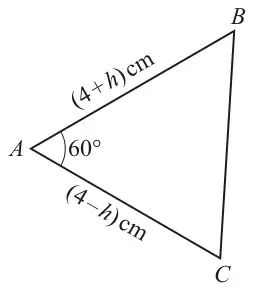
Triangle ABC with angle 60 degrees at A; side AB labelled (4 + h) cm and side AC labelled (4 − h) cm

The diagram shows triangle \(ABC\) in which angle \(A\) is \(60^\circ\) and the lengths of \(AB\) and \(AC\) are \((4 + h)\,\mathrm{cm}\) and \((4 - h)\,\mathrm{cm}\) respectively.

(a) Show that the length of \(BC\) is \(p\,\mathrm{cm}\) where \[p^2 = 16 + 3h^2.\] [2]
(b) Hence show that, when \(h\) is small, \(p \approx 4 + \lambda h^2 + \mu h^4\), where \(\lambda\) and \(\mu\) are rational numbers whose values are to be determined. [4]

June 2025 Paper 3 Q14

OCR MEICurrent spec5 marksParametric EquationsTrigonometry

14

The questions in this section refer to the article on the Insert. You should read the article before attempting the questions.

The relevant parts of the article “The trisectrix of Maclaurin” are reproduced below; the line numbers are those printed on the Insert.

Line 8
The equation of the curve in cartesian form is \(y^2 = \dfrac{x^2(3a-x)}{a+x}\), where \(a\) is a constant.

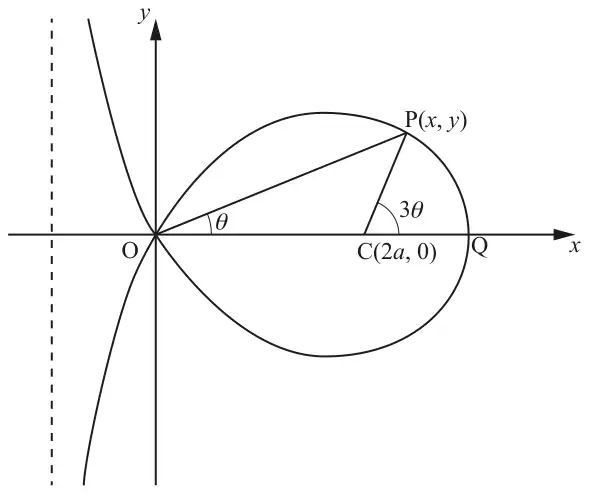
Fig. C2: the trisectrix with a loop through O and Q(right of C(2a, 0)), branches going to infinity near the dashed vertical asymptote left of the y-axis; P(x, y) on the loop, OP at angle θ and CP at angle 3θ to the x-axis
Fig. C2

Lines 14–16
The point C has coordinates \((2a, 0)\) and Q is the point where the curve crosses the positive \(x\)-axis. The point P is a general point \((x, y)\) on the loop of the curve. The origin of the coordinate system is denoted by O.

Line 17
The dashed line is an asymptote to the curve.

Lines 18–19
If the line CP makes an angle \(3\theta\) with the positive \(x\)-axis then the line OP makes an angle \(\theta\) with the positive \(x\)-axis. Angles are measured anticlockwise from the positive \(x\)-axis.

Line 23
Deriving the cartesian equation of the trisectrix

Lines 24–25
Using the formula for \(\tan(A+B)\) in terms of \(\tan A\) and \(\tan B\), it can be shown that
\(\tan 3\theta = \dfrac{t(3-t^2)}{1-3t^2}\), where \(t = \tan\theta\).

Lines 26–27
From this and Fig. C2 it follows that \(\dfrac{x-2a}{y} = \dfrac{1-3t^2}{t(3-t^2)}\).
Hence \(\dfrac{1}{t} - \dfrac{2a}{y} = \dfrac{1-3t^2}{t(3-t^2)}\).

Lines 28–29
It then follows that \(\dfrac{2a}{y} = \dfrac{1}{t} - \dfrac{1-3t^2}{t(3-t^2)} = \dfrac{2+2t^2}{t(3-t^2)}\) so \(\dfrac{a}{y} = \dfrac{1+t^2}{t(3-t^2)}\) and this gives the parametric equation for \(y\), \(y = \dfrac{at(3-t^2)}{1+t^2}\).

Lines 30–31
The equation for \(x\) follows from \(\tan\theta = \dfrac{y}{x}\). Together with the parametric equation for \(y\), this leads to \(x = \dfrac{a(3-t^2)}{1+t^2}\).

Lines 32–33
The parameter \(t\) can be eliminated from the parametric equations to derive the cartesian equation \(y^2 = \dfrac{x^2(3a-x)}{a+x}\), as stated in line 8.

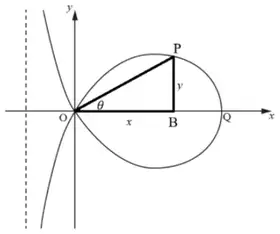
(a) Draw and label a suitable triangle on the diagram in the Printed Answer Booklet to show that \(\tan\theta = \dfrac{y}{x}\), as given in line 30. [1]
(b) Subtract \(x = \dfrac{a(3-t^2)}{1+t^2}\) from \(3a\) to show that \(3a - x = \dfrac{4at^2}{1+t^2}\). [1]
(c) Find an expression, in terms of \(a\) and \(t\), for \(a + x\). [1]
(d) Hence, or otherwise, show that the parametric equations given in lines 29 and 31 are equivalent to \(y^2 = \dfrac{x^2(3a-x)}{a+x}\), as claimed in lines 8 and 33. [2]

June 2025 Paper 3 Q13

OCR MEICurrent spec3 marksTrigonometry

13

The questions in this section refer to the article on the Insert. You should read the article before attempting the questions.

The relevant parts of the article “The trisectrix of Maclaurin” are reproduced below; the line numbers are those printed on the Insert.

Lines 24–25
Using the formula for \(\tan(A+B)\) in terms of \(\tan A\) and \(\tan B\), it can be shown that
\(\tan 3\theta = \dfrac{t(3-t^2)}{1-3t^2}\), where \(t = \tan\theta\).

Use \(\tan(A+B) = \dfrac{\tan A + \tan B}{1 - \tan A\tan B}\), with suitable choices for \(A\) and \(B\), to show that \(\tan 3\theta = \dfrac{t(3-t^2)}{1-3t^2}\), where \(t = \tan\theta\), as given in line 25. [3]

June 2025 Paper 2 Q12

OCR MEICurrent spec6 marksTrigonometry

12 In this question you must show detailed reasoning

Solve the equation \(3\sec^2\theta + 2\tan\theta - 4 = 0\) for \(-180^\circ \lt \theta \lt 180^\circ\). [6]

June 2025 Paper 2 Q6

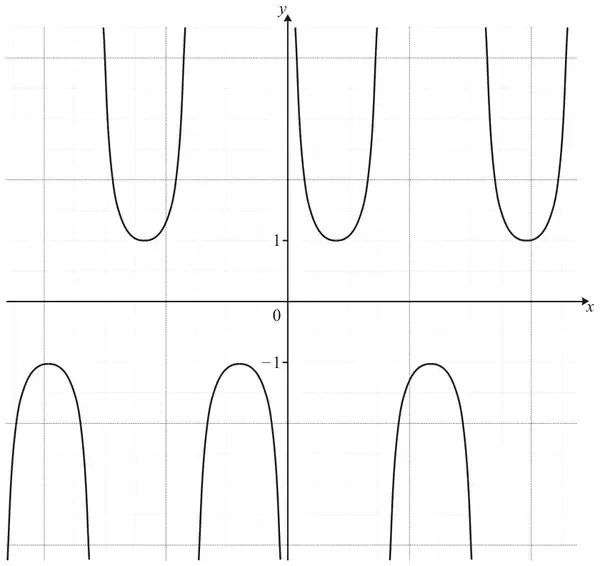
6 The diagram shows part of the graph of \(\mathrm{f}(x) = \operatorname{cosec} 2x\).

Graph of y = cosec 2x on a grid: U-shaped branches with minimum value 1 above the x-axis and inverted branches with maximum value -1 below it
(a) State which of the following is the equation of the curve \(y = \dfrac{1}{\mathrm{f}(x)}\).
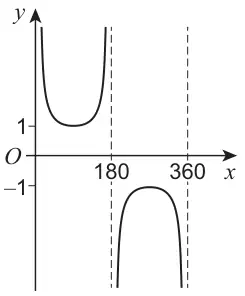
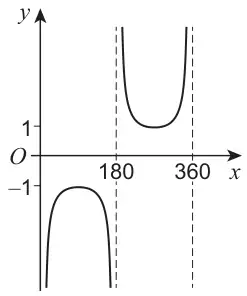
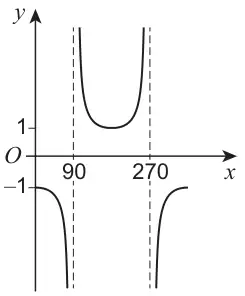
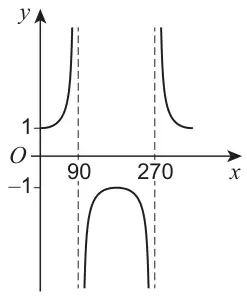
\(y = \cos 2x \qquad y = \operatorname{cosec}(-2x) \qquad y = -\operatorname{cosec} 2x \qquad y = \sin 2x\) [1]
(b) State the exact equations of the asymptotes of \(y = \operatorname{cosec} 2x\) for \(0 \leqslant x \leqslant \pi\). [1]

June 2025 Paper 2 Q3

OCR MEICurrent spec2 marksTrigonometry

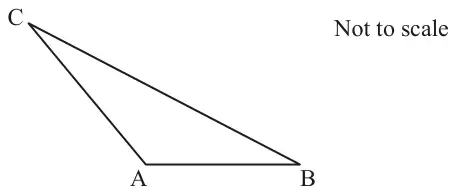
3 The diagram shows triangle ABC.

Triangle ABC with an obtuse angle at A, labelled Not to scale

AB = 4.7 cm, AC = 6.9 cm and BC = 11.2 cm.

Find the size of angle CAB. Give your answer correct to 3 significant figures. [2]

June 2024 Paper 3 Q8

OCR MEICurrent spec8 marksTrigonometry

8 In this question you must show detailed reasoning.

(a) Express \(\cos x + \sqrt{3}\sin x\) in the form \(R\sin(x + \alpha)\), where \(R \gt 0\) and \(0 \lt \alpha \lt \frac{1}{2}\pi\). Give the values of \(R\) and \(\alpha\) in exact form. [4]
(b) Hence solve the equation \(\cos x = \sqrt{3}(1 - \sin x)\) for values of \(x\) in the interval \(-\pi \leqslant x \leqslant \pi\). Give the roots of this equation in exact form. [4]

June 2024 Paper 3 Q7

OCR MEICurrent spec3 marksProofTrigonometry

7 Prove that \(\sin 8\theta \tan 4\theta + \cos 8\theta = 1\). [3]

June 2024 Paper 3 Q6

OCR MEICurrent spec5 marksTrigonometry

6 In this question you must show detailed reasoning.

Solve the equation \(\tan x - 3\cot x = 2\) for values of \(x\) in the interval \(0^\circ \leqslant x \leqslant 360^\circ\). [5]

June 2024 Paper 2 Q4

OCR MEICurrent spec5 marksRadiansTrigonometry

4

(a) On the axes in the Printed Answer Booklet, sketch the graph of \(y = \sin 2\theta\) for \(0 \leqslant \theta \leqslant 2\pi\). [2]
(b) Solve the equation \(\sin 2\theta = -\dfrac{1}{2}\) for \(0 \leqslant \theta \leqslant 2\pi\). [3]

June 2023 Paper 2 Q17

OCR MEICurrent spec6 marksTrigonometry

17 In this question you must show detailed reasoning.

Solve the equation \(2\sin x + \sec x = 4\cos x\), where \(-\pi < x < \pi\). [6]

June 2023 Paper 1 Q10

OCR MEICurrent spec6 marksTrigonometry

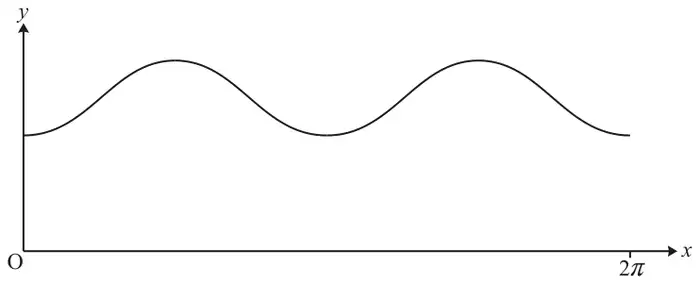
10 The diagram shows the graph of \(y = 1.5 + \sin^2 x\) for \(0 \leqslant x \leqslant 2\pi\).

Graph of y = 1.5 + sin squared x for x from 0 to 2π: a wave starting at a minimum on the y-axis, with two maxima and ending at a minimum at x = 2π
(a) Show that the equation of the graph can be written in the form \(y = a - b\cos 2x\) where \(a\) and \(b\) are constants to be determined. [2]
(b) Write down the period of the function \(1.5 + \sin^2 x\). [1]
(c) Determine the \(x\)-coordinates of the points of intersection of the graph of \(y = 1.5 + \sin^2 x\) with the graph of \(y = 1 + \cos 2x\) in the interval \(0 \leqslant x \leqslant 2\pi\). [3]

June 2023 Paper 3 Q10

OCR MEICurrent spec6 marksProofTrigonometry

10

(a) You are given that \((x^2 + y^2)^3 = x^6 + 3x^4y^2 + 3x^2y^4 + y^6\).
Hence, or otherwise, prove that \(\sin^6\theta + \cos^6\theta = 1 - \frac{3}{4}\sin^2 2\theta\) for all values of \(\theta\). [4]
(b) Use the result from part (a) to determine the minimum value of \(\sin^6\theta + \cos^6\theta\). [2]

June 2023 Paper 3 Q8

OCR MEICurrent spec7 marksTrigonometry

8 A circle with centre A and radius 8 cm and a circle with centre C and radius 12 cm intersect at points B and D.

Quadrilateral ABCD has area \(60\ \mathrm{cm}^2\).

Determine the two possible values for the length AC. [7]

June 2023 Paper 1 Q6

OCR MEICurrent spec5 marksTrigonometry

6

(a) Show that the equation \(\sin\left(x + \frac{1}{6}\pi\right) = \cos\left(x - \frac{1}{4}\pi\right)\) can be written in the form
\(\tan x = \dfrac{\sqrt{2}-1}{\sqrt{3}-\sqrt{2}}\). [4]
(b) Hence solve the equation \(\sin\left(x + \frac{1}{6}\pi\right) = \cos\left(x - \frac{1}{4}\pi\right)\) for \(0 \leqslant x \leqslant 2\pi\). [1]

June 2023 Paper 3 Q1

OCR MEICurrent spec3 marksTrigonometry

1 In this question you must show detailed reasoning.

The obtuse angle \(\theta\) is such that \(\sin\theta = \dfrac{2}{\sqrt{13}}\).

Find the exact value of \(\cos\theta\). [3]

June 2022 Paper 3 Q12

OCR MEICurrent spec5 marksTrigonometry

12

The questions in this section refer to the article on the Insert. You should read the article before attempting the questions.

The relevant parts of the article “Approximating the sine function” are reproduced below; the line numbers are those printed on the Insert.

Lines 23–24
The approximation \(\sin x \approx \dfrac{16x(\pi - x)}{5\pi^2 - 4x(\pi - x)}\) was discovered by an Indian mathematician named Bhaskara in the 7th century.

Lines 29–31
The percentage error in approximating \(\sin x\) by \(\dfrac{16x(\pi - x)}{5\pi^2 - 4x(\pi - x)}\) is less than 2% throughout the interval \(0 \leqslant x \leqslant \pi\). The Bhaskara approximation for \(\sin x\) can be used to derive the following approximation for \(\cos x\); \(\cos x \approx \dfrac{\pi^2 - 4x^2}{\pi^2 + x^2}\).

(a) Show that \(\cos x = \sin\left(x + \frac{\pi}{2}\right)\). [2]
(b) Hence show that \(\sin x \approx \dfrac{16x(\pi - x)}{5\pi^2 - 4x(\pi - x)}\) gives the approximation \(\cos x \approx \dfrac{\pi^2 - 4x^2}{\pi^2 + x^2}\), as stated in line 31. [3]

June 2022 Paper 3 Q11

OCR MEICurrent spec3 marksRadiansTrigonometry

11

The questions in this section refer to the article on the Insert. You should read the article before attempting the questions.

The relevant parts of the article “Approximating the sine function” are reproduced below; the line numbers are those printed on the Insert.

Line 22
A better approximation

Lines 23–28
The approximation \(\sin x \approx \dfrac{16x(\pi - x)}{5\pi^2 - 4x(\pi - x)}\) was discovered by an Indian mathematician named Bhaskara in the 7th century. It is not known how Bhaskara derived the formula but it can be seen that the curve \(y = \dfrac{16x(\pi - x)}{5\pi^2 - 4x(\pi - x)}\) is symmetrical about \(x = \frac{\pi}{2}\) and goes through the points \((0, 0)\), \(\left(\frac{\pi}{2}, 1\right)\) and \((\pi, 0)\). Fig. C4 shows the curves \(y = \sin x\) and \(y = \dfrac{16x(\pi - x)}{5\pi^2 - 4x(\pi - x)}\). Radians were not in use until the 18th century; Bhaskara gave the formula for an angle \(\theta\) degrees as \(\sin\theta \approx \dfrac{4\theta(180 - \theta)}{40500 - \theta(180 - \theta)}\).

Graph on a grid, x from −2 to 5 and y from −2 to 2, showing y = sin x and the Bhaskara curve, which almost coincide between x = 0 and x = π and separate outside that interval.
Fig. C4

Show that, for the angle \(45^\circ\), the formula \(\sin\theta \approx \dfrac{4\theta(180 - \theta)}{40500 - \theta(180 - \theta)}\) given in line 28 gives the same approximation for the sine of the angle as the formula \(\sin x \approx \dfrac{16x(\pi - x)}{5\pi^2 - 4x(\pi - x)}\) given in line 23. [3]

June 2022 Paper 1 Q10

OCR MEICurrent spec8 marksDifferentiationTrigonometry

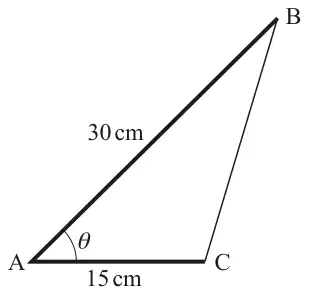
10 A triangle ABC is made from two thin rods hinged together at A and a piece of elastic which joins B and C. AB is a 30 cm rod and AC is a 15 cm rod. The angle BAC is \(\theta\) radians as shown in the diagram.

Triangle ABC with AB = 30 cm, AC = 15 cm horizontal, angle θ at A, and BC the elastic

The angle \(\theta\) increases at a rate of 0.1 radians per second.

Determine the rate of change of the length BC when \(\theta = \frac{1}{3}\pi\). [8]

June 2022 Paper 3 Q4

OCR MEICurrent spec5 marksTrigonometry

4 In this question you must show detailed reasoning.

Determine the exact solutions of the equation \(2\cos^2 x = 3\sin x\) for \(0 \leqslant x \leqslant 2\pi\). [5]

June 2022 Paper 1 Q3

3

(a) Sketch the graph of \(y = \arctan x\) where \(x\) is in radians. [2]
(b) In this question you must show detailed reasoning.
Find all points of intersection of the curves \(y = 3\sin x\cos x\) and \(y = \cos^2 x\) for \(-\pi \leqslant x \leqslant \pi\). [6]

June 2022 Paper 2 Q1

OCR MEICurrent spec4 marksTrigonometry

1 Express \(\cos\theta + \sqrt{3}\sin\theta\) in the form \(R\cos(\theta - \alpha)\), where \(R\) and \(\alpha\) are exact values to be determined. [4]

October 2021 Paper 3 Q15

OCR MEICurrent spec4 marksProofTrigonometry

15

The questions in this section refer to the article on the Insert. You should read the article before attempting the questions.

The relevant parts of the article “Adding arctangents” are reproduced below; the line numbers are those printed on the Insert.

Line 7
It can be shown that \(\arctan\left(\frac{1}{2}\right) + \arctan\left(\frac{1}{3}\right) = \arctan 1\).

Line 29
For any positive \(x\), \(\arctan x + \arctan\left(\dfrac{1}{x}\right) = \dfrac{\pi}{2}\).

Line 37
\(\arctan x + \arctan y = \arctan\left(\dfrac{x + y}{1 - xy}\right) + \pi\), when \(xy > 1\) and \(x, y > 0\)

Lines 41–42
• \(\arctan 1 + \arctan 2 + \arctan 3 = \pi\). This can be proved by using \(\arctan x + \arctan\left(\dfrac{1}{x}\right) = \dfrac{\pi}{2}\) together with \(\arctan\left(\frac{1}{2}\right) + \arctan\left(\frac{1}{3}\right) = \arctan 1\).

Prove that \(\arctan 1 + \arctan 2 + \arctan 3 = \pi\), as given in line 41. [4]

October 2021 Paper 3 Q14

OCR MEICurrent spec5 marksTrigonometry

14

The questions in this section refer to the article on the Insert. You should read the article before attempting the questions.

The relevant parts of the article “Adding arctangents” are reproduced below; the line numbers are those printed on the Insert.

Line 7
It can be shown that \(\arctan\left(\frac{1}{2}\right) + \arctan\left(\frac{1}{3}\right) = \arctan 1\).

Lines 22–23
The arctangent addition formula is a further generalization:
\(\arctan x + \arctan y = \arctan\left(\dfrac{x + y}{1 - xy}\right)\), as long as \(xy < 1\).

Lines 39–40
• For \(n\) a positive integer, \(\arctan\left(\dfrac{1}{n+1}\right) + \arctan\left(\dfrac{1}{n^2+n+1}\right) = \arctan\left(\dfrac{1}{n}\right)\); this follows directly from the arctan addition formula in line 23.

(a) Show that
\(\arctan\left(\dfrac{1}{n+1}\right) + \arctan\left(\dfrac{1}{n^2+n+1}\right) = \arctan\left(\dfrac{1}{n}\right) \Rightarrow \arctan\left(\dfrac{1}{2}\right) + \arctan\left(\dfrac{1}{3}\right) = \arctan 1.\) [1]
(b) Use the arctan addition formula in line 23 to show that
\(\arctan\left(\dfrac{1}{n+1}\right) + \arctan\left(\dfrac{1}{n^2+n+1}\right) = \arctan\left(\dfrac{1}{n}\right)\), as given in line 39. [4]

October 2021 Paper 3 Q13

OCR MEICurrent spec3 marksFunctions (including |mod|)Trigonometry

13

The questions in this section refer to the article on the Insert. You should read the article before attempting the questions.

The relevant parts of the article “Adding arctangents” are reproduced below; the line numbers are those printed on the Insert.

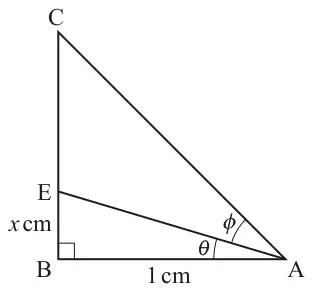
Fig. C2: triangle ABC right-angled at B with AB = 1 cm; E is a point on BC with EB = x cm; angle θ at A between AB and AE, angle φ at A between AE and AC
Fig. C2

Lines 18–19
Triangle ABC in Fig. C2 is the same as triangle ABC in Fig. C1 but E is a point on BC such that EB = \(x\) cm and \(\theta = \arctan x\).

Line 28
Suppose next that \(xy > 1\), and that \(x\) and \(y\) are both positive; in this case \(y > \dfrac{1}{x}\).

Line 29
For any positive \(x\), \(\arctan x + \arctan\left(\dfrac{1}{x}\right) = \dfrac{\pi}{2}\).

Line 30
\(y > \dfrac{1}{x} \Rightarrow \arctan y > \arctan\left(\dfrac{1}{x}\right)\) so it follows that \(\arctan x + \arctan y > \dfrac{\pi}{2}\).

(a) Use triangle ABE in Fig. C2 to show that \(\arctan x + \arctan\left(\dfrac{1}{x}\right) = \dfrac{\pi}{2}\), as given in line 29. [1]
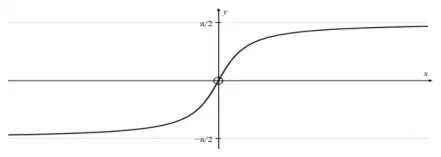
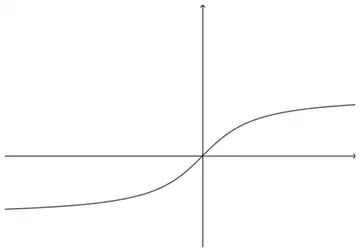
(b) Sketch the graph of \(y = \arctan x\). [1]
(c) What property of the arctan function ensures that \(y > \dfrac{1}{x} \Rightarrow \arctan y > \arctan\left(\dfrac{1}{x}\right)\), as given in line 30? [1]

October 2021 Paper 3 Q12

OCR MEICurrent spec3 marksTrigonometry

12

The questions in this section refer to the article on the Insert. You should read the article before attempting the questions.

The relevant parts of the article “Adding arctangents” are reproduced below; the line numbers are those printed on the Insert.

Line 7
It can be shown that \(\arctan\left(\frac{1}{2}\right) + \arctan\left(\frac{1}{3}\right) = \arctan 1\).

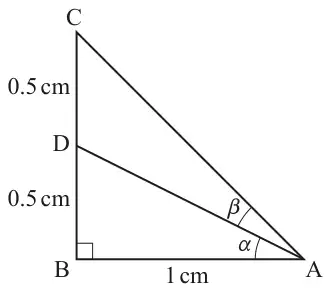
Fig. C1: triangle ABC right-angled at B with AB = 1 cm and BC vertical; D is the midpoint of BC with BD = DC = 0.5 cm; angle α at A between AB and AD, angle β at A between AD and AC
Fig. C1

Lines 8–11
Consider the diagram in Fig. C1.
Triangle ABC is right-angled at B.
AB = BC = 1 cm.
D is the midpoint of BC.

Line 12
Using triangle ABD, \(\tan\alpha = \dfrac{\mathrm{DB}}{\mathrm{BA}} = \dfrac{1}{2}\) so \(\alpha = \arctan\left(\dfrac{1}{2}\right)\).

Line 13
Using triangle ABC, \(\tan(\alpha + \beta) = 1\) so \(\alpha + \beta = \arctan 1\).

Line 14
Hence \(\tan(\alpha + \beta) = \dfrac{\tan\alpha + \tan\beta}{1 - \tan\alpha\tan\beta} = 1\).

Lines 15–16
Using \(\tan\alpha = \dfrac{1}{2}\) and finding \(\tan\beta\), it follows that \(\beta = \arctan\left(\dfrac{1}{3}\right)\),
which gives the required result that \(\arctan\left(\frac{1}{2}\right) + \arctan\left(\frac{1}{3}\right) = \arctan 1\).

Show that \(\beta = \arctan\left(\dfrac{1}{3}\right)\), as given in line 15. [3]

October 2021 Paper 3 Q11

OCR MEICurrent spec5 marksTrigonometry

11 In this question you must show detailed reasoning.

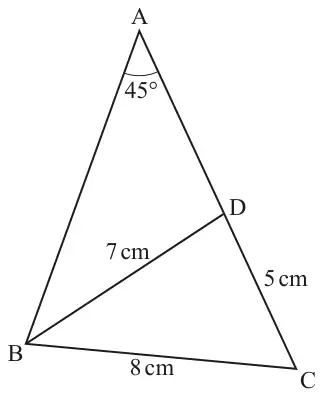
The diagram shows triangle ABC, with BC = 8 cm and angle BAC = 45°. The point D on AC is such that DC = 5 cm and BD = 7 cm.

Triangle ABC with angle 45° at A; D on AC with BD joined; BD = 7 cm, DC = 5 cm, BC = 8 cm

Determine the exact length of AB. [5]

October 2021 Paper 1 Q6

OCR MEICurrent spec7 marksDifferentiationTrigonometry

6

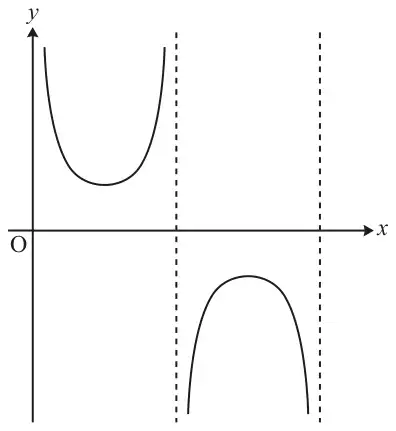
(a) The diagram shows part of the graph of \(y = \operatorname{cosec} x\), where \(x\) is in radians.

State the equations of the three vertical asymptotes that can be seen. [1]
Part of the graph of y = cosec x for x ≥ 0: a U-shaped branch above the x-axis between the y-axis and the first dashed vertical asymptote, and an inverted U-shaped branch below the x-axis between the first and second dashed asymptotes

The tangent to the graph at the point P with \(x\)-coordinate \(\dfrac{\pi}{3}\) meets the \(x\)-axis at Q.

(b) Show that the \(x\)-coordinate of Q is \(\dfrac{\pi}{3} + \sqrt{3}\). (You may use without proof the result that the derivative of \(\operatorname{cosec} x\) is \(-\operatorname{cosec} x \cot x\).) [6]

October 2021 Paper 3 Q2

OCR MEICurrent spec2 marksTrigonometry

2 Solve the equation \(\sin 2x = 0.3\) for \(0^\circ \leqslant x \leqslant 180^\circ\). Give your answer(s) correct to 1 decimal place. [2]

October 2020 Paper 1 Q14

OCR MEICurrent spec10 marksModellingTrigonometry

14 Douglas wants to construct a model for the height of the tide in Liverpool during the day, using a cosine graph to represent the way the height changes.

He knows that the first high tide of the day measures 8.55 m and the first low tide of the day measures 1.75 m.

Douglas uses \(t\) for time and \(h\) for the height of the tide in metres. With his graph-drawing software set to degrees, he begins by drawing the graph of \(h = 5.15 + 3.4\cos t\).

(a) Verify that this equation gives the correct values of \(h\) for the high and low tide. [1]

Douglas also knows that the first high tide of the day occurs at 1 am and the first low tide occurs at 7.20 am. He wants \(t\) to represent the time in hours after midnight, so he modifies his equation to \(h = 5.15 + 3.4\cos(at + b)\).

(b)
(i) Show that Douglas’s modified equation gives the first high tide of the day occurring at the correct time if \(a + b = 0\). [1]
(ii) Use the time of the first low tide of the day to form a second equation relating \(a\) and \(b\). [1]
(iii) Hence show that \(a = 28.42\) correct to 2 decimal places. [2]
(c) Douglas can only sail his boat when the height of the tide is at least 3 m.
Use the model to predict the range of times that morning when he cannot sail. [3]
(d) The next high tide occurs at 12.59 pm when the height of the tide is 8.91 m.
Comment on the suitability of Douglas’s model. [2]

October 2020 Paper 2 Q14

OCR MEICurrent spec8 marksIntegrationTrigonometry

14 In this question you must show detailed reasoning.

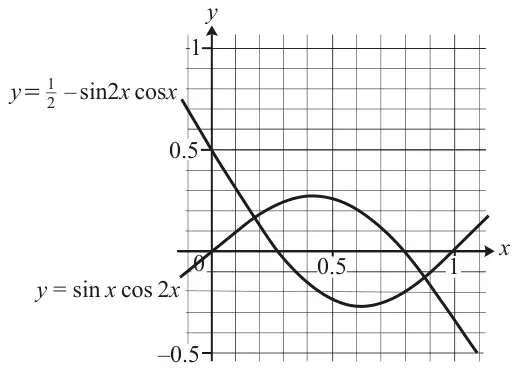
Fig. 14 shows the graphs of \(y = \sin x\cos 2x\) and \(y = \frac{1}{2} - \sin 2x\cos x\).

Fig. 14: graphs of y = sin x cos 2x and y = 1/2 - sin 2x cos x for x from 0 to about 1.1, crossing at two points between which the first curve is above the second
Fig. 14

Use integration to find the area between the two curves, giving your answer in an exact form. [8]

October 2020 Paper 3 Q5

OCR MEICurrent spec11 marksNumerical MethodsTrigonometry

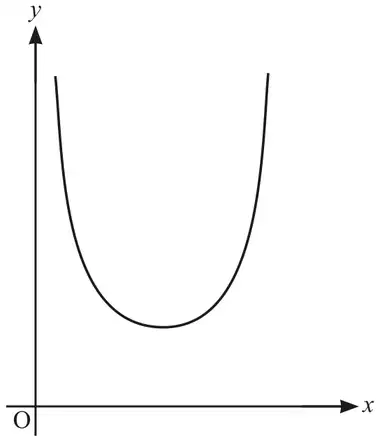
5 Fig. 5 shows part of the curve \(y = \operatorname{cosec} x\) together with the \(x\)- and \(y\)-axes.

Fig. 5: one U-shaped branch of y = cosec x lying above the x-axis to the right of the y-axis, with a minimum point between two vertical asymptotes
Fig. 5
(a) For the section of the curve which is shown in Fig. 5, write down
(i) the equations of the two vertical asymptotes, [2]
(ii) the coordinates of the minimum point. [1]
(b) Show that the equation \(x = \operatorname{cosec} x\) has a root which lies between \(x = 1\) and \(x = 2\). [2]
(c) Use the iteration \(x_{n+1} = \operatorname{cosec}(x_n)\), with \(x_0 = 1\), to find
(i) the values of \(x_1\) and \(x_2\), correct to 5 decimal places, [1]
(ii) this root of the equation, correct to 3 decimal places. [1]
(d) There is another root of \(x = \operatorname{cosec} x\) which lies between \(x = 2\) and \(x = 3\).
Determine whether the iteration \(x_{n+1} = \operatorname{cosec}(x_n)\) with \(x_0 = 2.5\) converges to this root. [1]
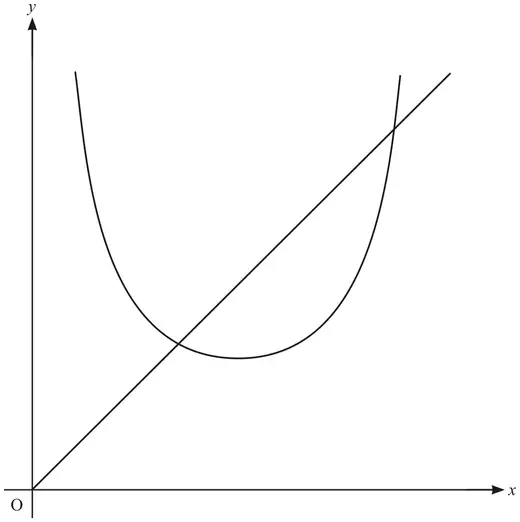
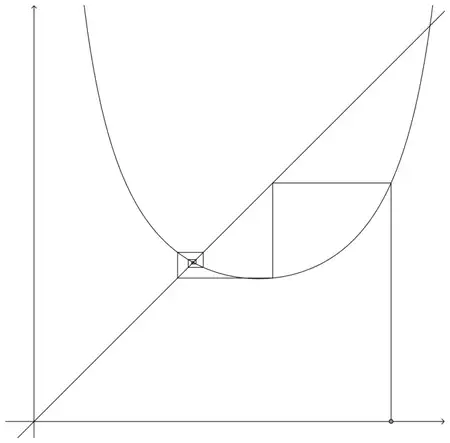
(e) Sketch the staircase or cobweb diagram for the iteration, starting with \(x_0 = 2.5\), on the diagram in the Printed Answer Booklet. [3]

Diagram from the Printed Answer Booklet:

Printed Answer Booklet diagram: the branch of y = cosec x and the line y = x through O, which cuts the curve twice, once to the left of the minimum and once on the steep right-hand side

October 2020 Paper 2 Q3

OCR MEICurrent spec4 marksDifferentiationTrigonometry

3 You are given that \(y = 4x + \sin 8x\).

(a) Find \(\dfrac{\mathrm{d}y}{\mathrm{d}x}\). [2]
(b) Find the smallest positive value of \(x\) for which \(\dfrac{\mathrm{d}y}{\mathrm{d}x} = 0\), giving your answer in an exact form. [2]

October 2020 Paper 2 Q1

OCR MEICurrent spec2 marksTrigonometry

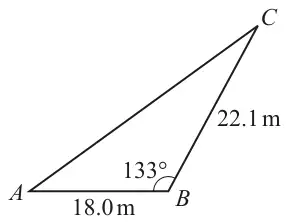
1 Fig. 1 shows triangle \(ABC\).

Fig. 1: triangle ABC with AB = 18.0 m, BC = 22.1 m and angle ABC = 133 degrees
Fig. 1

Calculate the area of triangle \(ABC\), giving your answer correct to 3 significant figures. [2]