
June 2025 Paper 2 Q13
13. Given that for all values of \(k\), where \(0 \lt \left|k\right| \lt 1\), the equation\[\sin(nx) = k \qquad n \in \mathbb{N}\]has exactly 6 solutions in the interval \(0 \leqslant x \lt 2\pi\)
| Scheme | Marks | AO |
|---|---|---|
| \((n =)\ 3\) | B1 | 2.2a |
| (1) |
Notes
B1: cao \((n =)\ 3\)
| Scheme | Marks | AO |
|---|---|---|
| 30 solutions or e.g. each interval of length \(\pi\) has 6 solutions | B1 | 2.2a |
| e.g., Each interval of length \(\pi\) has 6 solutions, and there are 5 intervals of length \(\pi\), so \(5 \times 6 = 30\) solutions. | dB1 | 2.4 |
| (2) | ||
| (3 marks) |
Notes
B1: Either:
- Deduces 30 solutions
- or deduces the correct total number of solutions for \(\sin(nx) = k\) and \(\sin(nx) = -k\) (or \(\sin^2(nx) = k^2\)) in any relevant interval (0 to \(\pi\), \(2\pi\), \(4\pi\) or \(5\pi\))
- or deduces the correct number of solutions in 0 to \(5\pi\) for either \(\sin(nx) = k\) or \(\sin(nx) = -k\)
- or deduces the correct total number of solutions for \(\sin(x) = k\) and \(\sin(x) = -k\) in any relevant interval (0 to \(\pi\), \(2\pi\), \(4\pi\) or \(5\pi\))
dB1: Requires 30 (solutions) and correct justification comprising all the elements in one of the bullet points below. See the tables below for the correct values.
- Deduces the correct total number of solutions for \(\sin(nx) = k\) and \(\sin(nx) = -k\) (or \(\sin^2(nx) = k^2\)) in any relevant interval (0 to \(\pi\), \(2\pi\) or \(4\pi\)) and scales the interval to 0 to \(5\pi\)
- or deduces the correct number of solutions in 0 to \(5\pi\) for \(\sin(nx) = k\) and for \(\sin(nx) = -k\) and then adds
- or finds the total correct number of solutions for \(\sin(x) = k\) and \(\sin(x) = -k\) in any relevant interval (0 to \(\pi\), \(2\pi\), \(4\pi\) or \(5\pi\)) and then scales the interval to 0 to \(5\pi\) and multiplies by 3
Just stating e.g. \(2 \times 6 \times 2.5\) is insufficient for the dB1 mark without further justification.
There are many acceptable variations, and some examples are below.
Some examples:
- 6 solutions in each interval of length \(\pi\) (B1) and 5 intervals of length \(\pi\) so 30 (dB1)
- 12 solutions in each interval of length \(2\pi\) (B1) and 2.5 intervals of length \(2\pi\) so 30 (dB1)
- 2 solutions for \(\sin x = k\) up to \(2\pi\), so for \(\sin^2 x\) there are 4 per \(2\pi\) (B1) and since \(0 \leqslant x \lt 5\pi\) then \(0 \leqslant 3x \lt 15\pi\) so \(\dfrac{15}{2} \times 4 = 30\) (dB1)
- Double the 6 solutions since \(\sin(nx) = \pm k\) (or \(\sin^2(nx) = k^2\)) so 12 (B1) and so 24 in \(4\pi\), hence 30 in \(5\pi\) (dB1)
- 16 solutions for \(\sin(nx) = k\) (B1) and 14 (solutions) for \(\sin(nx) = -k \rightarrow 30\) (dB1)
- \(\sin^2(3x) = \dfrac{1 - \cos(6x)}{2}\) and as \(\cos x = k\) has 5 solutions in 0 to \(5\pi\) (B1) and so \(\cos 6x\) has \(5 \times 6 = 30\) (dB1)
Graphical approaches may be used but these must be convincing, clearly showing the correct number of solutions in one of the relevant intervals. Be lenient with the shape of the curve.
e.g. 30 solutions in \(0 \leqslant x \lt 5\pi\) [with 6 solutions on, for example, either sketch below]
left: \(y = \sin^2(3x)\ \ 0 \leqslant x \lt \pi\); right: \(y = \sin(3x)\ \ 0 \leqslant x \lt \pi\)
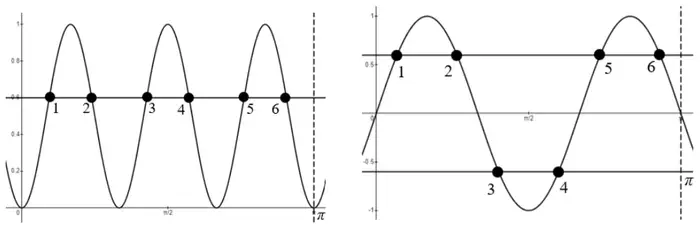
Note that a suitable graph of \(\sin x\) showing, e.g. 10 solutions up to \(5\pi\), followed by 30 (calculation of \(\times 3\) clearly implied) would also be eligible to score the dB1.
The following are examples of an incorrect justification but scores B1dB0 for reaching 30:
- \(\sin(nx) = k\) has \(3 \times 6\) solutions in the interval 0 to \(5\pi\), \(\sin(nx) = -k\) has \(3 \times 4\) solutions (in the interval 0 to \(5\pi\)) so \(18 + 12 = 30\) solutions in total.
- \(\sin(nx) = k\) has 15 solutions in the interval 0 to \(5\pi\), so for \(\sin^2(nx)\) has \(15 \times 2 = 30\) solutions in total.
For reference, the tables below show the total number of solutions for each branch of \(\sin^2(nx) = k^2\) with \(n = 3\) and the bold values score the first B1 provided they are in the correct interval.
| \(0 \leqslant x \lt \pi\) | \(0 \leqslant x \lt 2\pi\) | \(0 \leqslant x \lt 4\pi\) | \(0 \leqslant x \lt 5\pi\) | |
|---|---|---|---|---|
| \(\sin(nx) = k\) | 4 | 6 | 12 | 16 |
| \(\sin(nx) = -k\) | 2 | 6 | 12 | 14 |
| Total solutions | 6 | 12 | 24 | 30 |
and \(n = 1\) for those that deal with \(nx\) (\(3x\)) last.
| \(0 \leqslant x \lt \pi\) | \(0 \leqslant x \lt 2\pi\) | \(0 \leqslant x \lt 4\pi\) | \(0 \leqslant x \lt 5\pi\) | |
|---|---|---|---|---|
| \(\sin(x) = k\) | 2 | 2 | 4 | 6 |
| \(\sin(x) = -k\) | 0 | 2 | 4 | 4 |
| Total solutions | 2 | 4 | 8 | 10 |