June 2025 Paper 1 Q2
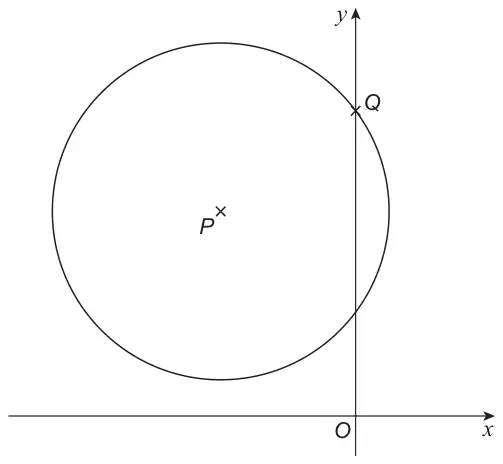
2. The circle \(C\) has equation
\[(x+3)^2 + (y-4)^2 = 24\]| Scheme | Marks | AO |
|---|---|---|
| (i) Centre \((-3,\ 4)\) | B1 | 1.1b |
| (ii) States or implies that \(r^2 = 24\) or \(r = \sqrt{24}\) | M1 | 1.1b |
| \(2\sqrt{6}\) | A1 | 1.1b |
| (3) |
Notes
Mark (i) and (ii) together
(a)(i) B1: Centre \((-3,\ 4)\) Accept without brackets. May be written e.g. \(x = -3,\ y = 4\)
(a)(ii) M1: States or implies that \(r^2 = 24\) or \(r = \sqrt{24}\). A final answer of \(\sqrt{24}\) or \(2\sqrt{6}\) implies the radius
May multiply out the brackets, collect terms (\(x^2 + y^2 + 6x - 8y + 1 = 0\)) and states the radius is \(r^2 = \dfrac{6^2}{4} + \dfrac{(-8)^2}{4} - 1\) o.e. Do not condone slips for this mark.
A1: \(2\sqrt{6}\) isw if they proceed to write as a decimal
| Scheme | Marks | AO |
|---|---|---|
| Attempts a valid method e.g. Finds distance of centre from origin, Sets \(y = 0\) and finds values of \(x\) | M1 | 3.1a |
| Correct calculations, reason and conclusion (see notes) | A1 | 2.4 |
| (2) | ||
| (5 marks) |
Notes
Note that if their radius is incorrect in (a) then maximum score is M1A0 unless they restart in (b)
M1: Attempts a valid method. For example
- Finds the distance (or distance \(^2\)) of the centre from the origin.
They must be attempting \((d =)\sqrt{(\pm\text{``}3\text{''})^2 + (\pm\text{``}4\text{''})^2} = \ldots\) or \(\left(d^2 =\right)(\pm\text{``}3\text{''} - 0)^2 + (\pm\text{``}4\text{''} - 0)^2 = \ldots\) and proceed to a value.
May be seen as substituting the coordinates of the origin into the equation for \(C\) proceeding to a value for the left hand side e.g. 25 (to be able to compare with 24) - Sets \(y = 0\) and attempts to solve \((x+3)^2 + (-4)^2 = 24 \Rightarrow x = \ldots\) (at least one value)
- Sets \(x = 0\) and attempts to solve \((3)^2 + (y-4)^2 = 24 \Rightarrow y = \ldots\) (at least one value)
In each method the starting expression or equation must be correct but do not be concerned by slips when evaluating or processing in finding the distance, the \(x\) coordinate or \(y\) coordinate.
A1: Correct calculation(s), reason and conclusion examples:
| Calculation examples | Reason examples | Conclusion examples |
|---|---|---|
| e.g. \(\left(d^2 =\right) 25\) or e.g. \((d =)\ 5\) | \(25 \gt 24\) o.e. or \(5 \gt \sqrt{24}\) o.e. (allow 4.9 or better) | e.g. origin does NOT lie within circle / origin lies outside circle / not in circle o.e. |
| e.g. \((x+3)^2 + (-4)^2 = 24\) \(\Rightarrow (x =)\ -3 \pm \sqrt{8}\) (allow decimals awrt \(-0.2\) and awrt \(-5.8\)) | roots are both negative (same signs) o.e. | |
| e.g. \((3)^2 + (y-4)^2 = 24\) \(\Rightarrow (y =)\ 4 \pm \sqrt{15}\) (allow decimals awrt \(0.1\) and awrt \(7.9\)) | roots are both positive (same signs) o.e. |
Note if their reasoning is incorrect e.g. referring to the radius as 24 instead of \(\sqrt{24}\) then A0 but allow referencing to “the radius of C” provided their radius in (a) was correct.
Note if they give a reason that the origin does not lie inside the circle \(C\) because e.g. \(25 \neq 24\) this scores M1A0 (M1 for 25 but A0 incorrect reasoning)