Parametric Equations

Edexcel

AQA

OCR A

OCR MEI

June 2025 Paper 2 Q5

EdexcelCurrent spec7 marksDifferentiationParametric Equations

5. The curve \(C\) has parametric equations

\[x = \frac{t - 1}{2} \qquad\qquad y = 5(t + 2)^4 \qquad\qquad t \in \mathbb{R}\]

The point \(P\) with \(x\) coordinate \(-3\) lies on \(C\).

(a) Find the \(y\) coordinate of \(P\). (2)
(b) Find a Cartesian equation for \(C\), giving the answer in the form \(y = \mathrm{f}(x)\) (2)
(c) Hence, or otherwise, find the gradient of \(C\) at the point \(P\). (3)

June 2024 Paper 2 Q10

EdexcelCurrent spec6 marksModellingParametric Equations

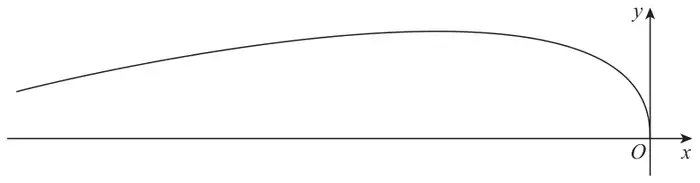
10.

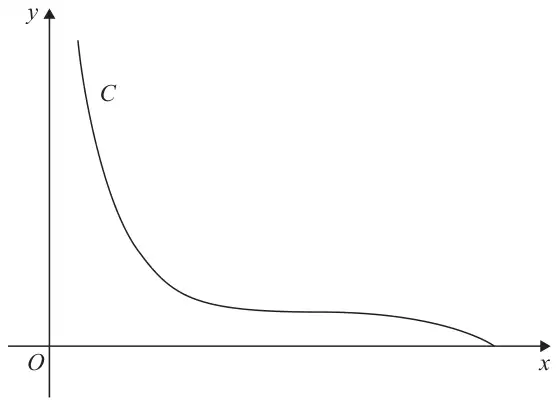
Figure 4: sketch of curve C, decreasing steeply from near the y-axis, levelling out, then meeting the positive x-axis
Figure 4

Figure 4 shows a sketch of the curve \(C\) with parametric equations

\[x = (t+3)^2 \qquad y = 1 - t^3 \qquad -2 \leqslant t \leqslant 1\]

The point \(P\) with coordinates \((4, 2)\) lies on \(C\).

(a) Using parametric differentiation, show that the tangent to \(C\) at \(P\) has equation\[3x + 4y = 20\] (5)

The curve \(C\) is used to model the profile of a slide at a water park.

Units are in metres, with \(y\) being the height of the slide above water level.

(b) Find, according to the model, the greatest height of the slide above water level. (1)

June 2025 Paper 1 Q13

13 A curve \(C\) has parametric equations

\[\begin{gathered}x = 4(4t + 1)^2\\ y = \mathrm{e}^{-4t}\end{gathered}\]

for \(-\dfrac{1}{4} \leqslant t \leqslant 0\)

(a) Find \(\dfrac{\mathrm{d}y}{\mathrm{d}x}\) in terms of \(t\) [3 marks]
(b) Find an equation of the tangent to \(C\) at the point where \(t = 0\) [3 marks]
(c) Find a Cartesian equation for \(C\) in the form \(y = \mathrm{f}(x)\)

Fully justify your answer.

[3 marks]

June 2023 Paper 3 Q9

AQACurrent spec12 marksModellingParametric Equations

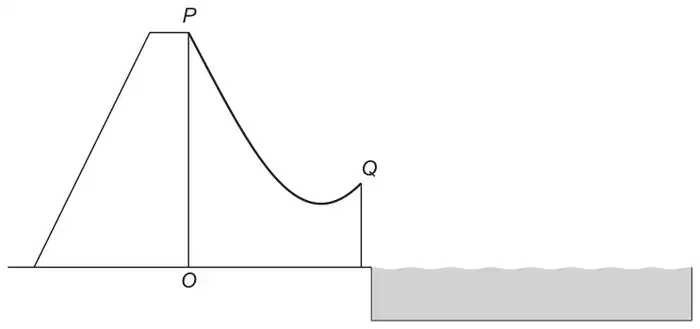
9 A water slide is the shape of a curve \(PQ\) as shown in Figure 1 below.

Side view of a water slide: a platform at P directly above O on the ground, with the slide curving down from P to a lowest point and then rising slightly to Q at the edge of a pool
Figure 1

The curve can be modelled by the parametric equations

\[x = t - \frac{1}{t} + 4.8\]\[y = t + \frac{2}{t}\]

where \(0.2 \leqslant t \leqslant 3\)

The horizontal distance from \(O\) is \(x\) metres.

The vertical distance above the point \(O\) at ground level is \(y\) metres.

\(P\) is the point where \(t = 0.2\) and \(Q\) is the point where \(t = 3\)

(a) To make sure speeds are safe at \(Q\), the difference in height between \(P\) and \(Q\) must be less than 7 metres.

Show that the slide meets this safety requirement. [3 marks]

(b)
(i) Find an expression for \(\dfrac{\mathrm{d}y}{\mathrm{d}x}\) in terms of \(t\) [3 marks]
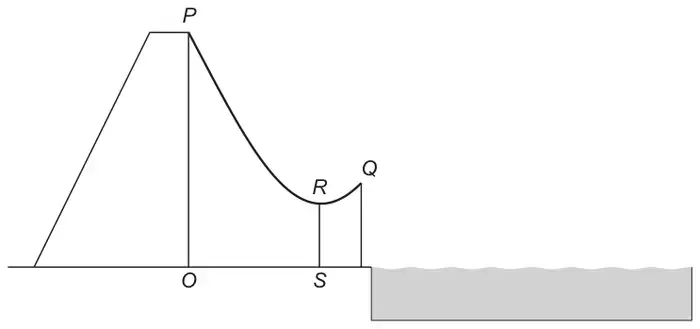
(ii) A vertical support, \(RS\), is to be added between the ground and the lowest point on the slide as shown in Figure 2 below.
The water slide from Figure 1 with a vertical support RS from the lowest point R on the slide down to S on the ground, between O and Q
Figure 2

Find the length of \(RS\) [4 marks]

(iii) Find the acute angle the slide makes with the horizontal at \(Q\)

Give your answer to the nearest degree. [2 marks]

June 2022 Paper 3 Q6

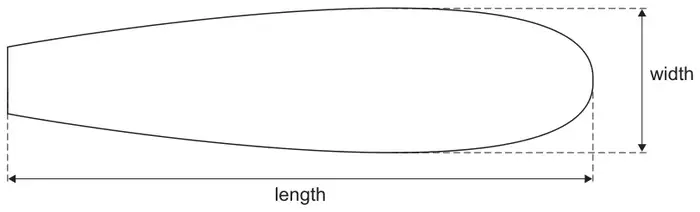
6 A design for a surfboard is shown in Figure 1.

Figure 1: outline of a surfboard, flat at the left-hand end and rounded at the right-hand end; its length is marked along the bottom and its width (the widest point, towards the right) is marked on the right
Figure 1

The curve of the top half of the surfboard can be modelled by the parametric equations

\[x = -2t^2\]\[y = 9t - 0.7t^2\]

for \(0 \leqslant t \leqslant 9.5\) as shown in Figure 2, where \(x\) and \(y\) are measured in centimetres.

Figure 2: the top half of the surfboard drawn on axes, the curve rising from the left, reaching a maximum, then curving down to the origin O at the right-hand end
Figure 2
(a) Find the length of the surfboard. [2 marks]
(b)
(i) Find an expression for \(\dfrac{\mathrm{d}y}{\mathrm{d}x}\) in terms of \(t\). [3 marks]
(ii) Hence, show that the width of the surfboard is approximately one third of its length. [4 marks]

June 2022 Paper 1 Q1

AQACurrent spec1 markParametric Equations

1 A curve is defined by the parametric equations

\[x = \cos\theta \quad \text{and} \quad y = \sin\theta \qquad \text{where } 0 \leqslant \theta \leqslant 2\pi\]

Which of the options shown below is a Cartesian equation for this curve?

Circle your answer. [1 mark]

  • \(\dfrac{y}{x} = \tan\theta\)
  • \(x^2 + y^2 = 1\)
  • \(x^2 - y^2 = 1\)
  • \(x^2y^2 = 1\)

June 2025 Paper 1 Q7

OCR ACurrent spec9 marksDifferentiationParametric Equations

7

In this question you must show detailed reasoning.

A curve has parametric equations \(x = t^3 + t^2\), \(y = t^2 + 2t\) for all real values of \(t\).

The curve passes through the point \(P\) with coordinates \((2, 3)\).

(a) Show that the equation of the tangent to the curve at the point \(P\) can be written as \(5y = 4x + 7\). [5]
(b) Determine the coordinates of the point where the tangent to the curve at \(P\) meets the curve again. [4]

June 2024 Paper 1 Q12

OCR ACurrent spec11 marksIntegrationParametric Equations

12 In this question you must show detailed reasoning.

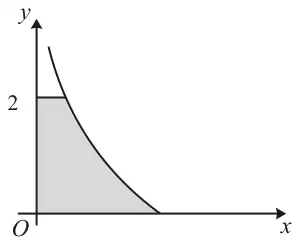
Decreasing curve crossing the line y = 2 near the y-axis and meeting the positive x-axis; the region between the curve, the x-axis, the y-axis and the line y = 2 is shaded

The diagram shows the curve with parametric equations \(x = \dfrac{2}{(2t + 1)^4}\), \(y = 2t^2 + 3t\) for \(t \geqslant 0\).

The shaded region is enclosed by the curve, the \(x\)-axis, the \(y\)-axis and the line \(y = 2\).

(a) Show that the area of the shaded region is given by \(\displaystyle\int_a^b \frac{8t + 6}{(2t + 1)^4}\,\mathrm{d}t\), where \(a\) and \(b\) are constants to be determined. [5]
(b) Determine the exact area of the shaded region. [6]

June 2024 Paper 3 Q6

6 The curve \(C\) is defined, for \(0 \leqslant t \lt 2\pi\), by the parametric equations

\(x = 4k + k\sin t,\quad y = 2 + 4\cos t,\)

where \(k\) is a constant.

(a) Find a cartesian equation for \(C\). You do not need to simplify your answer. [2]

You are given that \(C\) is a circle.

(b)
(i) Determine the radius of \(C\). [2]
(ii) Find the possible coordinates for the centre of \(C\). [2]

June 2023 Paper 3 Q5

OCR ACurrent spec9 marksIntegrationParametric Equations

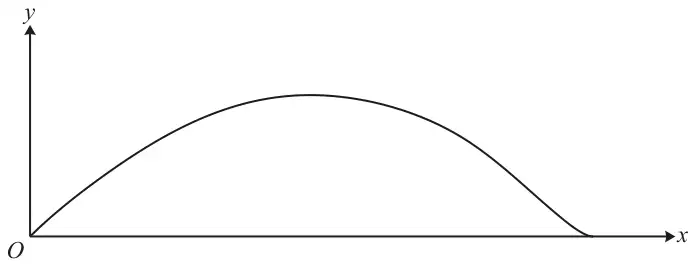
5 A mathematics department is designing a new emblem to place on the walls outside its classrooms. The design for the emblem is shown in the diagram below.

Axes x and y with origin O: a curve starts at O, rises to a single maximum, then falls and meets the x-axis tangentially further along

The emblem is modelled by the region between the \(x\)-axis and the curve with parametric equations

\(x = 1 + 0.2t - \cos t, \qquad y = k\sin^2 t,\)

where \(k\) is a positive constant and \(0 \leqslant t \leqslant \pi\).

Lengths are in metres and the area of the emblem must be \(1\,\mathrm{m}^2\).

(a) Show that \(\displaystyle k\int_0^{\pi} (0.2 + \sin t - 0.2\cos^2 t - \sin t\cos^2 t)\,\mathrm{d}t = 1\). [3]
(b) Determine the exact value of \(k\). [6]

June 2022 Paper 1 Q12

12 A curve has parametric equations \(x = \dfrac{1}{t}\), \(y = 2t\). The point \(P\) is \(\left(\dfrac{1}{p}, 2p\right)\).

(a) Show that the equation of the tangent at \(P\) can be written as \(y = -2p^2x + 4p\). [4]

The tangent to this curve at \(P\) crosses the \(x\)-axis at the point \(A\) and the normal to this curve at \(P\) crosses the \(x\)-axis at the point \(B\).

(b) Show that the ratio \(PA : PB\) is \(1 : 2p^2\). [8]

October 2021 Paper 1 Q9

9 A particle moves in the \(x\)-\(y\) plane so that at time \(t\) seconds, where \(t \geqslant 0\), its coordinates are given by
\(x = \mathrm{e}^{2t} - 4\mathrm{e}^t + 3\), \(y = 2\mathrm{e}^{-3t}\).

(a) Explain why the path of the particle never crosses the \(x\)-axis. [1]
(b) Determine the exact values of \(t\) when the path of the particle intersects the \(y\)-axis. [2]
(c) Show that \(\dfrac{\mathrm{d}y}{\mathrm{d}x} = \dfrac{3}{2\mathrm{e}^{4t} - \mathrm{e}^{5t}}\). [4]
(d) Hence find the coordinates of the particle when its path is parallel to the \(y\)-axis. [3]

June 2025 Paper 3 Q14

OCR MEICurrent spec5 marksParametric EquationsTrigonometry

14

The questions in this section refer to the article on the Insert. You should read the article before attempting the questions.

The relevant parts of the article “The trisectrix of Maclaurin” are reproduced below; the line numbers are those printed on the Insert.

Line 8
The equation of the curve in cartesian form is \(y^2 = \dfrac{x^2(3a-x)}{a+x}\), where \(a\) is a constant.

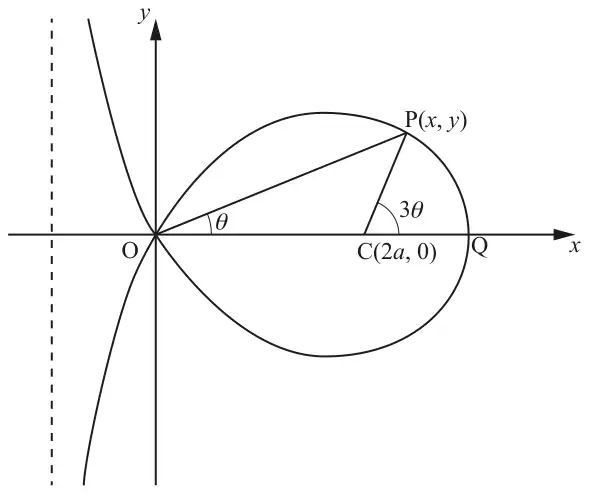
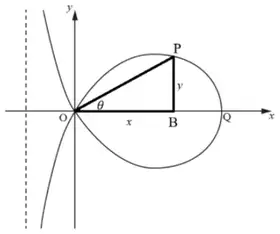
Fig. C2: the trisectrix with a loop through O and Q(right of C(2a, 0)), branches going to infinity near the dashed vertical asymptote left of the y-axis; P(x, y) on the loop, OP at angle θ and CP at angle 3θ to the x-axis
Fig. C2

Lines 14–16
The point C has coordinates \((2a, 0)\) and Q is the point where the curve crosses the positive \(x\)-axis. The point P is a general point \((x, y)\) on the loop of the curve. The origin of the coordinate system is denoted by O.

Line 17
The dashed line is an asymptote to the curve.

Lines 18–19
If the line CP makes an angle \(3\theta\) with the positive \(x\)-axis then the line OP makes an angle \(\theta\) with the positive \(x\)-axis. Angles are measured anticlockwise from the positive \(x\)-axis.

Line 23
Deriving the cartesian equation of the trisectrix

Lines 24–25
Using the formula for \(\tan(A+B)\) in terms of \(\tan A\) and \(\tan B\), it can be shown that
\(\tan 3\theta = \dfrac{t(3-t^2)}{1-3t^2}\), where \(t = \tan\theta\).

Lines 26–27
From this and Fig. C2 it follows that \(\dfrac{x-2a}{y} = \dfrac{1-3t^2}{t(3-t^2)}\).
Hence \(\dfrac{1}{t} - \dfrac{2a}{y} = \dfrac{1-3t^2}{t(3-t^2)}\).

Lines 28–29
It then follows that \(\dfrac{2a}{y} = \dfrac{1}{t} - \dfrac{1-3t^2}{t(3-t^2)} = \dfrac{2+2t^2}{t(3-t^2)}\) so \(\dfrac{a}{y} = \dfrac{1+t^2}{t(3-t^2)}\) and this gives the parametric equation for \(y\), \(y = \dfrac{at(3-t^2)}{1+t^2}\).

Lines 30–31
The equation for \(x\) follows from \(\tan\theta = \dfrac{y}{x}\). Together with the parametric equation for \(y\), this leads to \(x = \dfrac{a(3-t^2)}{1+t^2}\).

Lines 32–33
The parameter \(t\) can be eliminated from the parametric equations to derive the cartesian equation \(y^2 = \dfrac{x^2(3a-x)}{a+x}\), as stated in line 8.

(a) Draw and label a suitable triangle on the diagram in the Printed Answer Booklet to show that \(\tan\theta = \dfrac{y}{x}\), as given in line 30. [1]
(b) Subtract \(x = \dfrac{a(3-t^2)}{1+t^2}\) from \(3a\) to show that \(3a - x = \dfrac{4at^2}{1+t^2}\). [1]
(c) Find an expression, in terms of \(a\) and \(t\), for \(a + x\). [1]
(d) Hence, or otherwise, show that the parametric equations given in lines 29 and 31 are equivalent to \(y^2 = \dfrac{x^2(3a-x)}{a+x}\), as claimed in lines 8 and 33. [2]

June 2024 Paper 3 Q12

OCR MEICurrent spec9 marksDifferentiationParametric Equations

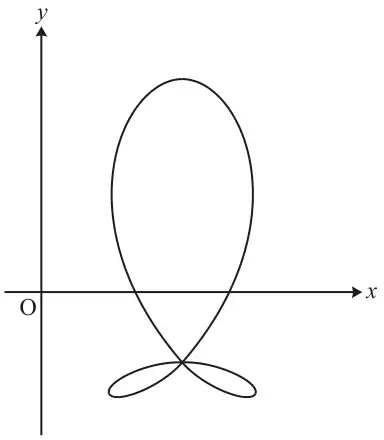
12 The diagram shows the curve with parametric equations

\(x = \sin 2\theta + 2,\ y = 2\cos\theta + \cos 2\theta\), for \(0 \leqslant \theta \lt 2\pi\).

Curve shaped like a large loop above the x-axis crossing itself below the x-axis, with two small loops at the bottom, symmetrical about a vertical line
(a) In this question you must show detailed reasoning.
Determine the exact coordinates of all the stationary points on the curve. [8]
(b) Write down the equation of the line of symmetry of the curve. [1]

June 2023 Paper 2 Q6

6 The parametric equations of a circle are

\(x = 2\cos\theta - 3\) and \(y = 2\sin\theta + 1\).

Determine the cartesian equation of the circle in the form \((x-a)^2 + (y-b)^2 = k\), where \(a\), \(b\) and \(k\) are integers. [4]

June 2022 Paper 2 Q10

10 The parametric equations of a curve are

\(x = 2 + 5\cos\theta\) and \(y = 1 + 5\sin\theta\), where \(0 \leqslant \theta \leqslant 2\pi\).

(a) Determine the cartesian equation of the curve. [3]
(b) Hence or otherwise, find the equation of the tangent to the curve at the point \((5, -3)\), giving your answer in the form \(ax + by + c = 0\), where \(a\), \(b\) and \(c\) are integers to be determined. [4]

June 2022 Paper 1 Q8

OCR MEICurrent spec10 marksDifferentiationParametric Equations

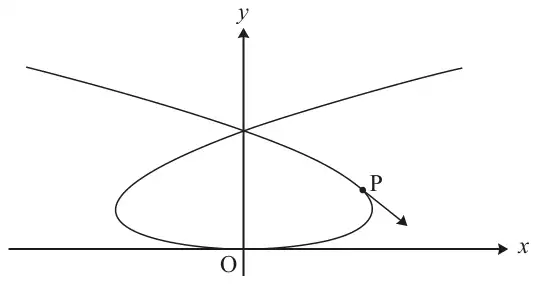
8 A particle moves in the \(x\)-\(y\) plane so that its position at time \(t\) s is given by \(x = t^3 - 8t,\ y = t^2\) for \(-3.5 \lt t \lt 3.5\). The units of distance are metres. The graph shows the path of the particle and the direction of travel at the point P \((8, 4)\).

Path of the particle: a curve starting at the origin O, forming a loop to the left and right of the y-axis that crosses itself on the y-axis, with two branches continuing upwards to the left and right; the point P on the lower right part of the loop with an arrow showing the direction of travel down and to the right
(a) Find \(\dfrac{\mathrm{d}y}{\mathrm{d}x}\) in terms of \(t\). [3]
(b) Hence show that the value of \(\dfrac{\mathrm{d}y}{\mathrm{d}x}\) at P is \(-1\). [2]
(c) Find the time at which the particle is travelling in the direction opposite to that at P. [2]
(d) Find the cartesian equation of the path, giving \(x^2\) as a function of \(y\). [3]

October 2021 Paper 2 Q7

7 The parametric equations of a circle are

\(x = 7 + 5\cos\theta\), \(\quad y = 5\sin\theta - 3\), \(\quad\) for \(0 \leqslant \theta \leqslant 2\pi\).

(a) Find a cartesian equation of the circle. [3]
(b) State the coordinates of the centre of the circle. [1]

October 2020 Paper 1 Q10

OCR MEICurrent spec9 marksDifferentiationParametric Equations

10 In this question you must show detailed reasoning.

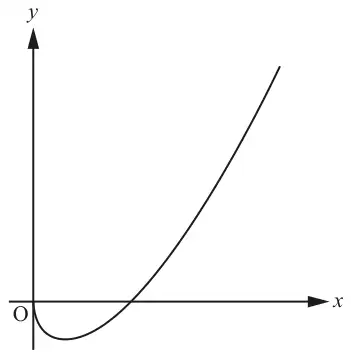
Fig. 10 shows the curve given parametrically by the equations \(x = \dfrac{1}{t^2},\ y = \dfrac{1}{t^3} - \dfrac{1}{t}\), for \(t > 0\).

Fig. 10: the curve starts at O, dips below the x-axis, crosses the x-axis and then rises steeply
Fig. 10
(a) Show that \(\dfrac{\mathrm{d}y}{\mathrm{d}x} = \dfrac{3-t^2}{2t}\). [3]
(b) Find the coordinates of the point on the curve at which the tangent to the curve is parallel to the line \(4y + x = 1\). [3]
(c) Find the cartesian equation of the curve. Give your answer in factorised form. [3]