
June 2024 Paper 3 Q12
12 The diagram shows the curve with parametric equations
\(x = \sin 2\theta + 2,\ y = 2\cos\theta + \cos 2\theta\), for \(0 \leqslant \theta \lt 2\pi\).
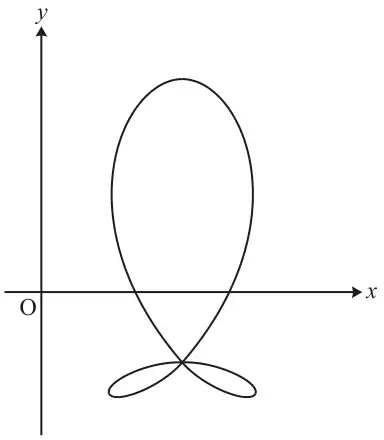
Determine the exact coordinates of all the stationary points on the curve. [8]
| Scheme | Marks | AO |
|---|---|---|
| DR \(\dfrac{\mathrm{d}y}{\mathrm{d}\theta} = -2\sin\theta - 2\sin 2\theta\) | M1 | 3.1a |
| \(\sin\theta + 2\sin\theta\cos\theta = 0\) | M1 | 3.1a |
| \(\boldsymbol{\sin\theta(1 + 2\cos\theta) = 0}\) | *M1 | 1.1 |
| \(\sin\theta = 0\) or \(\cos\theta = -\tfrac{1}{2}\) | DM1 | 1.1 |
| \(\theta = 0\), \(\dfrac{2\pi}{3}\), \(\pi\), \(\dfrac{4\pi}{3}\) | A1 A1 | 1.1 1.1 |
| \((2, 3)\) \((2, -1)\) | A1 | 3.2a |
| \(\left(2 - \dfrac{\sqrt{3}}{2},\ -1.5\right)\) | ||
| \(\left(2 + \dfrac{\sqrt{3}}{2},\ -1.5\right)\) | A1 | 3.2a |
| [8] |
Notes
M1: For differentiation of \(y\) wrt. \(\theta\), may be as part of \(\dfrac{\mathrm{d}y}{\mathrm{d}x}\)
M1: For \(\dfrac{\mathrm{d}y}{\mathrm{d}\theta} = 0\) or \(\dfrac{\mathrm{d}y}{\mathrm{d}x} = 0\) and use of sine or cosine double angle formula.
If \(\dfrac{\mathrm{d}x}{\mathrm{d}\theta}\) is used incorrectly then give M0
*M1: All on one side and factorised.
If they have divided through by \(\sin\theta\) then \(\boldsymbol{1 = -2\cos\theta}\) or \(\boldsymbol{1 + 2\cos\theta = 0}\) will earn this mark
DM1: Dependent on the previous method mark
At least one trig value
Condone if divides through by sin.
A1 A1: www
A marks dependent on M4
At least 2 correct values
All four values correct with no extras
A1: www
At least 2 correct coordinates
oe, must be exact form
A1: www
All four coordinates correct with no extras
oe, must be exact form
Additional guidance
The first M1 is for differentiating y wrt \(\theta\). It might be seen on it’s own as \(\mathrm{d}y/\mathrm{d}\theta\) or as the numerator of \(\mathrm{d}y/\mathrm{d}x\). We are ignoring \(\mathrm{d}x/\mathrm{d}\theta\) unless they try to use it incorrectly in their subsequent work.
The second M1 is for putting their expression equal to 0 AND using either \(\sin 2\theta = 2\sin\theta\cos\theta\) or \(\cos 2\theta\) = one of the correct forms. But if \(\mathrm{d}x/\mathrm{d}\theta\) is used incorrectly here then give M0.
The third M1 is for getting terms on one side and factorised. However, some divide through by sin at this point – they can still get the M1 and also the fourth M1. The 3rd and 4th M1s can be implied (BOD) by seeing 2 correct solutions \(\sin\theta = 0\) and \(\cos\theta = -\frac{1}{2}\).
The 4th M1 is dependent on the previous M1. (We have seen some candidates obtain \(\sin\theta = 0\) (and possibly \(\cos\theta = -\frac{1}{2}\)) from completely wrong working but this does not score).
The A marks are dependent on getting M4 and are for finding exact values of \(\theta\) and the coordinates. Note that the A marks are all www marks (without wrong working), so dividing through by \(\sin\theta\) will cost all the A marks. Allow equivalent correct forms (e.g. \(\frac{4-\sqrt{3}}{2}\) for \(2 - \frac{\sqrt{3}}{2}\), \(\frac{4+\sqrt{3}}{2}\) for \(2 + \frac{\sqrt{3}}{2}\)) for the x-values.
| Scheme | Marks | AO |
|---|---|---|
| \(x = 2\) | B1 | 2.2a |
| [1] |
Additional guidance
\(x=2\) is the only acceptable answer for B1.