Integration

Edexcel

AQA

OCR A

OCR MEI

June 2025 Paper 1 Q16

EdexcelCurrent spec7 marksIntegrationTrigonometry

16.

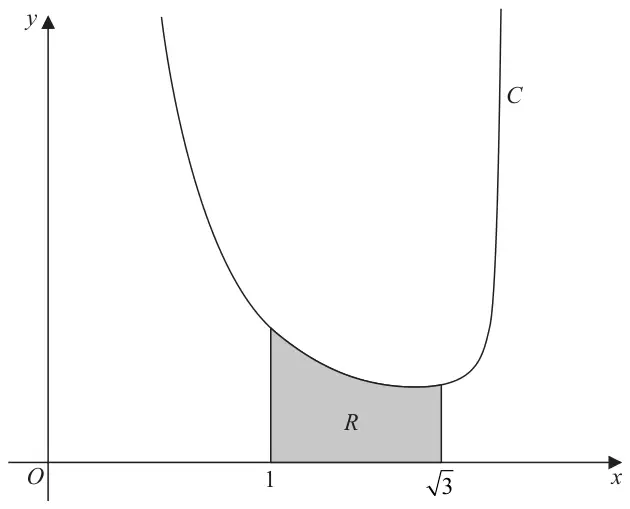
Figure 5: curve C for 0 < x < 2, decreasing to a minimum then rising steeply; region R shaded between C and the x-axis from x = 1 to x = √3
Figure 5

Figure 5 shows a sketch of the curve \(C\) with equation

\[y = \frac{1}{x^2\sqrt{4 - x^2}} \qquad\qquad 0 \lt x \lt 2\]

The region \(R\), shown shaded in Figure 5, is bounded by \(C\), the line with equation \(x = 1\), the \(x\)-axis and the line with equation \(x = \sqrt{3}\)

(a) Use the substitution \(x = 2\sin u\) to show that the area of \(R\) is given by\[\int_a^b k\operatorname{cosec}^2 u\,\mathrm{d}u\]where \(a\), \(b\) and \(k\) are constants to be found. (4)
(b) Hence, using algebraic integration, find the exact area of \(R\).
Give your answer in simplest form. (3)

June 2025 Paper 2 Q15

EdexcelCurrent spec13 marksDifferentiationIntegration

15.

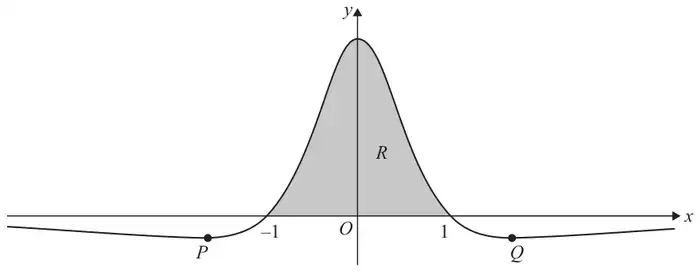
Figure 5: curve y = f(x), symmetrical about the y-axis, with a maximum on the positive y-axis, crossing the x-axis at -1 and 1, with minimum points P (x < -1) and Q (x > 1) below the x-axis; the region R between the curve and the x-axis from -1 to 1 is shaded
Figure 5

In this question you must show all stages of your working.

Solutions relying on calculator technology are not acceptable.

Figure 5 shows a sketch of part of the curve with equation \(y = \mathrm{f}(x)\), where\[\mathrm{f}(x) = \frac{1 - x^2}{\left(1 + x^2\right)^2}\]

The curve

  • intersects the \(x\)-axis at \(-1\) and 1
  • has minimum turning points at \(P\) and \(Q\)

as shown in Figure 5.

(a) Use calculus to find the exact coordinates of \(P\). (5)
(b) Using the substitution \(x = \tan\theta\) show that\[\int_{-1}^{1} \mathrm{f}(x)\,\mathrm{d}x = \int_{\alpha}^{\beta} \cos 2\theta\,\mathrm{d}\theta\]where \(\alpha\) and \(\beta\) are constants to be found. (5)

The finite region \(R\), shown shaded in Figure 5, is bounded by the \(x\)-axis and the curve.

(c) Use algebraic integration to find the area of \(R\). (3)

June 2025 Paper 1 Q13

EdexcelCurrent spec5 marksIntegration

13.

In this question you must show all stages of your working.

Solutions relying on calculator technology are not acceptable.

Show that\[\int_0^2 \frac{x}{(2x+1)^3}\,\mathrm{d}x = \frac{2}{25}\](5)

June 2025 Paper 2 Q10

EdexcelCurrent spec9 marksIntegrationModelling

10. Water flows at a constant rate into a large container.

There is a tap at the bottom of the container.

At time \(t\) hours after the tap was opened

  • the volume of water in the container is \(V\,\mathrm{m}^3\)
  • water is flowing into the container at a constant rate of \(0.45\,\mathrm{m}^3\) per hour
  • water is leaving the container through the tap at a rate of \(0.3V\,\mathrm{m}^3\) per hour
(a) Show that\[20\frac{\mathrm{d}V}{\mathrm{d}t} = 9 - 6V\] (2)

Given that when the tap was opened, there was \(0.25\,\mathrm{m}^3\) of water in the container,

(b) solve the differential equation to show that\[V = P - Q\mathrm{e}^{-kt}\]where \(P\), \(Q\) and \(k\) are positive constants to be found. (5)

Given that

  • the capacity of the container is \(2\,\mathrm{m}^3\)
  • the tap remains open
  • the water continues to flow into the tank at the same rate
(c) determine whether the container will ever become full, giving a reason for your answer. (2)

June 2025 Paper 1 Q5

EdexcelCurrent spec3 marksIntegration

5.

(a) Express \(\displaystyle \lim_{\delta x \to 0} \sum_{x=1.44}^{2.89} \dfrac{2}{\sqrt{x}}\,\delta x\) as an integral. (1)
(b) Hence show that\[\lim_{\delta x \to 0} \sum_{x=1.44}^{2.89} \frac{2}{\sqrt{x}}\,\delta x = k\]where \(k\) is an integer to be found.
(Solutions relying on calculator technology are not acceptable.) (2)

June 2025 Paper 2 Q2

EdexcelCurrent spec4 marksIntegration

2. Find\[\int\left(x^4 - 6x^{\frac{1}{2}} - 3\right)\mathrm{d}x\]giving the answer in simplest form. (4)

June 2024 Paper 1 Q14

EdexcelCurrent spec9 marksIntegrationModelling

14. A balloon is being inflated.

In a simple model,

  • the balloon is modelled as a sphere
  • the rate of increase of the radius of the balloon is inversely proportional to the square root of the radius of the balloon

At time \(t\) seconds, the radius of the balloon is \(r\) cm.

(a) Write down a differential equation to model this situation. (1)

At the instant when \(t = 10\)

  • the radius is 16 cm
  • the radius is increasing at a rate of \(0.9\text{ cm s}^{-1}\)
(b) Solve the differential equation to show that\[r^{\frac{3}{2}} = 5.4t + 10\] (5)
(c) Hence find the radius of the balloon when \(t = 20\)
Give your answer to the nearest millimetre. (2)
(d) Suggest a limitation of the model. (1)

June 2024 Paper 1 Q13

EdexcelCurrent spec8 marksIntegrationTrigonometry

13.

(a) Given that \(a\) is a positive constant, use the substitution \(x = a\sin^2\theta\) to show that\[\int_0^{a} x^{\frac{1}{2}}\sqrt{a-x}\,\mathrm{d}x = \frac{1}{2}a^2\int_0^{\frac{\pi}{2}} \sin^2 2\theta\,\mathrm{d}\theta\] (4)
(b) Hence use algebraic integration to show that\[\int_0^{a} x^{\frac{1}{2}}\sqrt{a-x}\,\mathrm{d}x = k\pi a^2\]where \(k\) is a constant to be found. (4)

June 2024 Paper 2 Q12

EdexcelCurrent spec12 marksAlgebraic FractionsIntegration

12.

(a) Express \(\dfrac{1}{V(25-V)}\) in partial fractions. (2)

The volume, \(V\) microlitres, of a plant cell \(t\) hours after the plant is watered is modelled by the differential equation

\[\frac{\mathrm{d}V}{\mathrm{d}t} = \frac{1}{10}V(25-V)\]

The plant cell has an initial volume of 20 microlitres.

(b) Find, according to the model, the time taken, in minutes, for the volume of the plant cell to reach 24 microlitres. (5)
(c) Show that\[V = \frac{A}{\mathrm{e}^{-kt} + B}\]where \(A\), \(B\) and \(k\) are constants to be found. (3)

The model predicts that there is an upper limit, \(L\) microlitres, on the volume of the plant cell.

(d) Find the value of \(L\), giving a reason for your answer. (2)

June 2024 Paper 2 Q11

EdexcelCurrent spec5 marksIntegration

11.

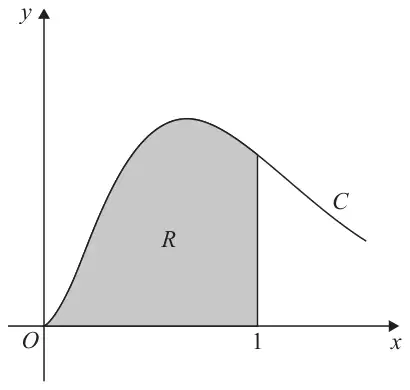
Figure 5: curve C from the origin rising to a maximum then decreasing; region R shaded between C, the x-axis and the line x = 1
Figure 5

In this question you must show all stages of your working.

Solutions relying entirely on calculator technology are not acceptable.

Figure 5 shows a sketch of part of the curve \(C\) with equation

\[y = 8x^2\mathrm{e}^{-3x} \qquad x \geqslant 0\]

The finite region \(R\), shown shaded in Figure 5, is bounded by

  • the curve \(C\)
  • the line with equation \(x = 1\)
  • the \(x\)-axis

Find the exact area of \(R\), giving your answer in the form\[A + B\mathrm{e}^{-3}\]where \(A\) and \(B\) are rational numbers to be found. (5)

June 2024 Paper 1 Q10

EdexcelCurrent spec9 marksDifferentiationIntegration

10.

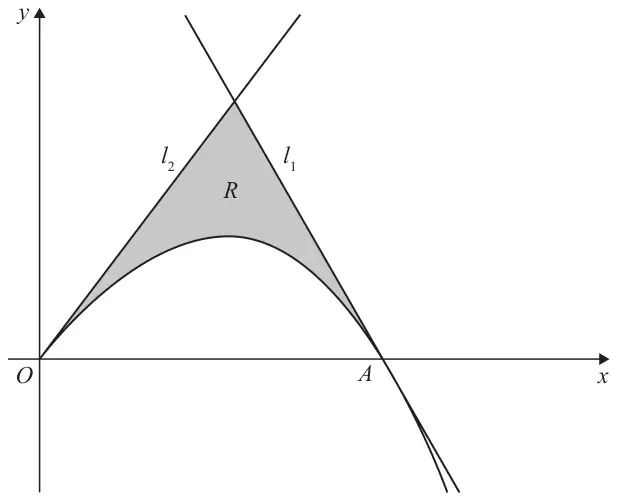
Figure 3: curve from O rising to a maximum and crossing the x-axis at A; tangent l1 at A and line l2 through O meet above the curve, with the shaded region R between them and the curve
Figure 3

In this question you must show all stages of your working.

Solutions relying entirely on calculator technology are not acceptable.

Figure 3 shows a sketch of part of the curve with equation

\[y = 8x - x^{\frac{5}{2}} \qquad x \geqslant 0\]

The curve crosses the \(x\)-axis at the point \(A\).

(a) Verify that the \(x\) coordinate of \(A\) is 4 (1)

The line \(l_1\) is the tangent to the curve at \(A\).

(b) Use calculus to show that an equation of line \(l_1\) is\[12x + y = 48\] (3)

The line \(l_2\) has equation \(y = 8x\)

The region \(R\), shown shaded in Figure 3, is bounded by the curve, the line \(l_1\) and the line \(l_2\)

(c) Use algebraic integration to find the exact area of \(R\). (5)

June 2024 Paper 1 Q7

EdexcelCurrent spec8 marksIntegrationModelling

7.

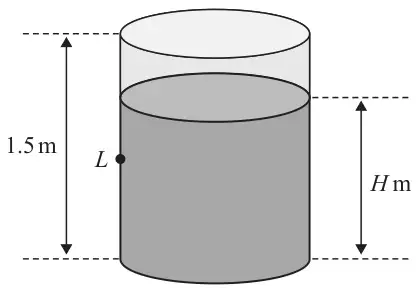
Figure 2: cylindrical tank of height 1.5 m, partly filled with water to depth H m, with a small hole at point L in the side
Figure 2

Diagram not drawn to scale.

Figure 2 shows a cylindrical tank of height 1.5 m.

Initially the tank is full of water.

The water starts to leak from a small hole, at a point \(L\), in the side of the tank.

While the tank is leaking, the depth, \(H\) metres, of the water in the tank is modelled by the differential equation

\[\frac{\mathrm{d}H}{\mathrm{d}t} = -0.12\mathrm{e}^{-0.2t}\]

where \(t\) hours is the time after the leak starts.

Using the model,

(a) show that\[H = A\mathrm{e}^{-0.2t} + B\]where \(A\) and \(B\) are constants to be found, (3)
(b) find the time taken for the depth of the water to decrease to 1.2 m. Give your answer in hours and minutes, to the nearest minute. (3)

In the long term, the water level in the tank falls to the same height as the hole.

(c) Find, according to the model, the height of the hole from the bottom of the tank. (2)

June 2025 Paper 1 Q17

AQACurrent spec10 marksIntegrationLogs & Exponentials

17

(a) Use the substitution \(u = \mathrm{e}^{x} + 1\) to show that\[\int \frac{\mathrm{e}^{2x}}{\mathrm{e}^{x} + 1}\,\mathrm{d}x = \mathrm{e}^{x} - \ln\left(\mathrm{e}^{x} + 1\right) + k\] [5 marks]
(b) Solve the differential equation\[\left(\frac{\mathrm{e}^{x} + 1}{\mathrm{e}^{2x}}\right)\frac{\mathrm{d}y}{\mathrm{d}x} = \cos^2 y\]given that \(y = \pi\) when \(x = 0\)

Write your answer in the form

\[\tan y = \mathrm{e}^{x} + \ln\left(\frac{A}{\mathrm{e}^{x} + 1}\right) + B\]

where \(A\) and \(B\) are constants to be found.

[5 marks]

June 2025 Paper 1 Q14

AQACurrent spec8 marksIntegrationTrigonometry

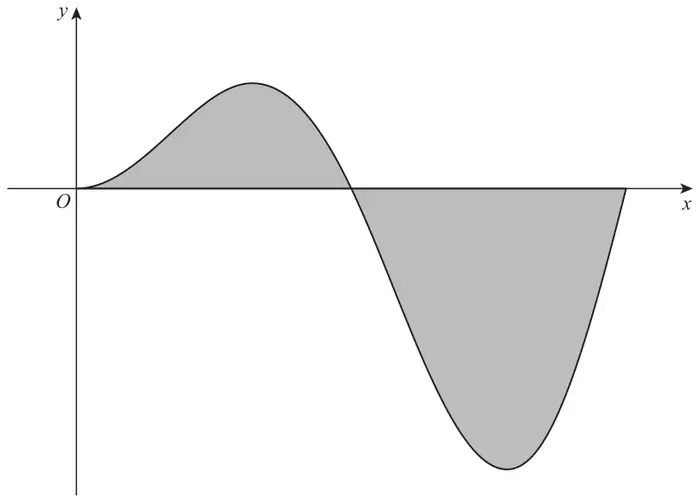
14 The graph of \(y = 4x\sin 2x\) for \(0 \leqslant x \leqslant \pi\) is shown below.

Graph of y = 4x sin 2x for 0 ≤ x ≤ π: a shaded region above the x-axis from O to where the curve crosses the axis, and a larger shaded region below the x-axis from there to x = π

Show that the shaded area enclosed by the \(x\)-axis and the curve is \(k\pi\), where \(k\) is an integer to be found.

Fully justify your answer. [8 marks]

June 2025 Paper 3 Q8

AQACurrent spec7 marksAlgebraic FractionsIntegration

8

(a) The expression\[\frac{x}{2x^2 + 3x + 1}\]can be written in the form\[\frac{A}{x + 1} + \frac{B}{2x + 1}\]

Find the value of \(A\) and the value of \(B\)

[3 marks]
(b) Use your answer to part (a) to show that\[\int_0^4 \frac{x}{2x^2 + 3x + 1}\,\mathrm{d}x = \ln q\]

where \(q\) is a rational number to be found.

[4 marks]

June 2025 Paper 1 Q5

AQACurrent spec3 marksIntegration

5 Find \(\displaystyle\int \left(4x - 3 + x^{-\frac{1}{2}}\right)\mathrm{d}x\) [3 marks]

June 2024 Paper 1 Q20

AQACurrent spec10 marksIntegrationModelling

20 A gardener stores rainwater in a cylindrical container.

The container has a height of 130 centimetres.

The gardener empties the water from the container through a hose.

The hose is attached 5 centimetres from the bottom of the container.

At time \(t\) minutes after the hose is switched on, the depth of water, \(h\) centimetres, in the container decreases at a rate which is proportional to \(h - 5\)

Initially the container of water is full, and the depth of water is decreasing at a rate of 1.5 centimetres per minute.

(a) Show that\[\frac{\mathrm{d}h}{\mathrm{d}t} = -0.012(h - 5)\] [3 marks]
(b) Solve the differential equation\[\frac{\mathrm{d}h}{\mathrm{d}t} = -0.012(h - 5)\]to find an expression for \(h\) in terms of \(t\) [5 marks]
(c) Find the time taken for the container to be half empty.

Give your answer to the nearest minute. [2 marks]

June 2024 Paper 1 Q18

AQACurrent spec11 marksIntegration

18

(a) Use a suitable substitution to show that\[\int_0^4 (4x + 1)(2x + 1)^{\frac{1}{2}}\,\mathrm{d}x\]can be written as\[\frac{1}{2}\int_a^9 \left(2u^{\frac{3}{2}} - u^{\frac{1}{2}}\right)\mathrm{d}u\]where \(a\) is a constant to be found. [5 marks]
(b) Hence, or otherwise, show that\[\int_0^4 (4x + 1)(2x + 1)^{\frac{1}{2}}\,\mathrm{d}x = \frac{1322}{15}\] [4 marks]
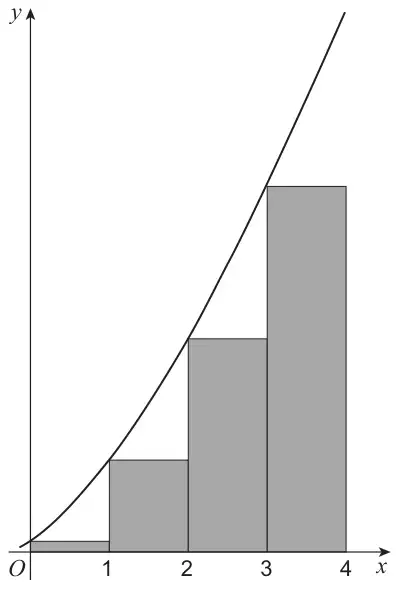
(c) A graph has the equation\[y = (4x + 1)\sqrt{2x + 1}\]A student uses four rectangles to approximate the area under the graph between the lines \(x = 0\) and \(x = 4\)

The rectangles are all the same width.

All the rectangles are drawn under the curve as shown in the diagram below.

Increasing curve y = (4x + 1)√(2x + 1) from x = 0 to x = 4, with four shaded rectangles of width 1 drawn under the curve, each with height equal to the curve value at its left edge

The total area of the four rectangles is \(A\)

The student decides to improve their approximation by increasing the number of rectangles used.

Explain why the value of the student’s improved approximation will be greater than \(A\), but less than \(\dfrac{1322}{15}\) [2 marks]

June 2024 Paper 3 Q11

AQACurrent spec10 marksIntegration

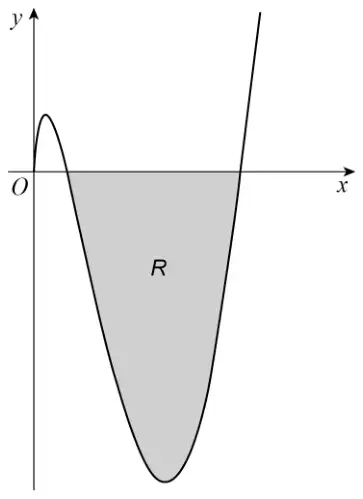
11 The curve \(C\) with equation

\[y = \left(x^2 - 8x\right)\ln x\]

is defined for \(x \gt 0\) and is shown in the diagram below.

The curve C rising from O to a small maximum, falling below the x-axis to a minimum, then rising steeply; the region R between the curve and the x-axis, below the x-axis, is shaded

The shaded region, \(R\), lies below the \(x\)-axis and is bounded by \(C\) and the \(x\)-axis.

Show that the area of \(R\) can be written as

\[p + q\ln 2\]

where \(p\) and \(q\) are rational numbers to be found. [10 marks]

June 2024 Paper 3 Q6

AQACurrent spec5 marksIntegration

6

(a) Find \(\displaystyle\int \left(6x^2 - \frac{5}{\sqrt{x}}\right) \mathrm{d}x\) [3 marks]
(b) The gradient of a curve is given by\[\frac{\mathrm{d}y}{\mathrm{d}x} = 6x^2 - \frac{5}{\sqrt{x}}\]

The curve passes through the point (4, 90).

Find the equation of the curve. [2 marks]

June 2024 Paper 2 Q2

AQACurrent spec1 markIntegration

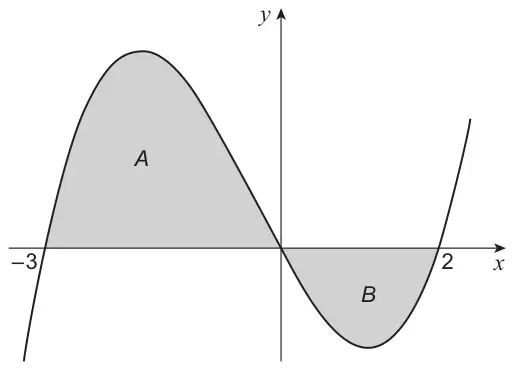
2 The graph of \(y = \mathrm{f}(x)\) intersects the \(x\)-axis at \((-3, 0)\), \((0, 0)\) and \((2, 0)\) as shown in the diagram below.

Cubic curve crossing the x-axis at −3, 0 and 2; shaded region A above the x-axis between −3 and 0, shaded region B below the x-axis between 0 and 2

The shaded region \(A\) has an area of 189

The shaded region \(B\) has an area of 64

Find the value of \(\displaystyle\int_{-3}^{2} \mathrm{f}(x)\,\mathrm{d}x\)

Circle your answer. [1 mark]

  • \(-253\)
  • \(-125\)
  • \(125\)
  • \(253\)

June 2023 Paper 1 Q16

AQACurrent spec14 marksAlgebraic FractionsIntegration

16

(a) Given that\[\frac{1}{16 - 9x^2} \equiv \frac{A}{4 - 3x} + \frac{B}{4 + 3x}\]find the values of \(A\) and \(B\) [3 marks]
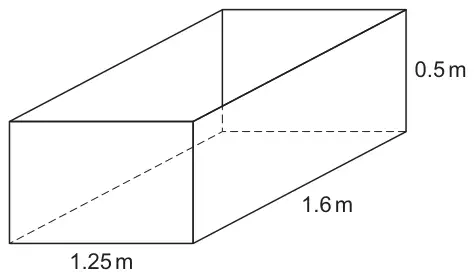
(b) An empty container, in the shape of a cuboid, has length 1.6 metres, width 1.25 metres and depth 0.5 metres, as shown in the diagram below.
Cuboid container with width 1.25 m, length 1.6 m and depth 0.5 m marked

The container has a small hole in the bottom.

Water is poured into the container at a rate of 0.16 cubic metres per minute.

At time \(t\) minutes after the container starts to be filled, the depth of water is \(d\) metres and water leaks out at a rate of \(0.36d^2\) cubic metres per minute.

At time \(t\) minutes after the container starts to be filled, the volume of water in the container is \(V\) cubic metres.

(i) Show that\[\frac{\mathrm{d}V}{\mathrm{d}t} = \frac{16 - 9V^2}{100}\] [4 marks]
(ii) Hence, find \(t\) in terms of \(V\) [5 marks]
(iii) Determine how long it takes to fill the container with water.

Give your answer to the nearest minute. [2 marks]

June 2023 Paper 1 Q14

AQACurrent spec11 marksIntegrationSequences & Series

14

(a)
(i) Given that\[y = 2^x\]write down \(\dfrac{\mathrm{d}y}{\mathrm{d}x}\) [1 mark]
(ii) Hence find\[\int 2^x\,\mathrm{d}x\] [2 marks]
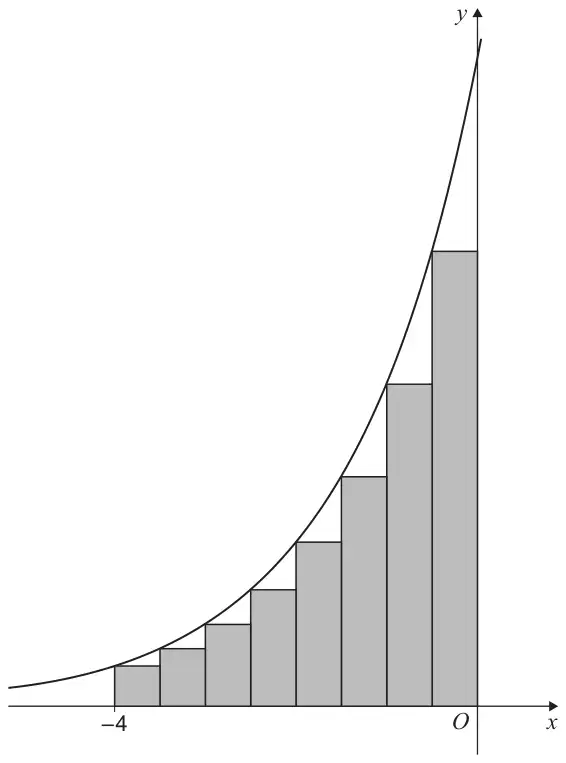
(b) The area, \(A\), bounded by the curve with equation \(y = 2^x\), the \(x\)-axis, the \(y\)-axis and the line \(x = -4\) is approximated using eight rectangles of equal width as shown in the diagram below.
Graph of y = 2^x with eight shaded rectangles of equal width under the curve between x = −4 and O, each rectangle lying below the curve, increasing in height from left to right
(i) Show that the exact area of the largest rectangle is \(\dfrac{\sqrt{2}}{4}\) [2 marks]
(ii) The areas of these rectangles form a geometric sequence with common ratio \(\dfrac{\sqrt{2}}{2}\)

Find the exact value of the total area of the eight rectangles.

Give your answer in the form \(k\left(1 + \sqrt{2}\right)\) where \(k\) is a rational number. [3 marks]

(iii) More accurate approximations for \(A\) can be found by increasing the number, \(n\), of rectangles used.

Find the exact value of the limit of the approximations for \(A\) as \(n \to \infty\) [3 marks]

June 2023 Paper 1 Q8

AQACurrent spec6 marksIntegration

8 Show that

\[\int_0^{\frac{\pi}{2}} (x\sin 4x)\,\mathrm{d}x = -\frac{\pi}{8}\]

[6 marks]

June 2023 Paper 3 Q8

AQACurrent spec7 marksIntegration

8 Use the substitution \(u = x^5 + 2\) to show that

\[\int_0^1 \frac{x^9}{(x^5 + 2)^3}\,\mathrm{d}x = \frac{1}{180}\]

[7 marks]

June 2023 Paper 2 Q2

AQACurrent spec1 markIntegration

2 It is given that

\[\int_0^6 \mathrm{f}(x)\,\mathrm{d}x = 20 \quad \text{and} \quad \int_3^6 \mathrm{f}(x)\,\mathrm{d}x = -10\]

Find the value of \(\displaystyle\int_0^3 \mathrm{f}(x)\,\mathrm{d}x\)

Circle your answer. [1 mark]

  • \(-30\)
  • \(-10\)
  • \(10\)
  • \(30\)

June 2022 Paper 1 Q15

AQACurrent spec16 marksIntegrationTrigonometry

15

(a) Given that\[y = \operatorname{cosec}\theta\]
(i) Express \(y\) in terms of \(\sin\theta\). [1 mark]
(ii) Hence, prove that\[\frac{\mathrm{d}y}{\mathrm{d}\theta} = -\operatorname{cosec}\theta\cot\theta\] [3 marks]
(iii) Show that\[\frac{\sqrt{y^2 - 1}}{y} = \cos\theta \qquad \text{for } 0 \lt \theta \lt \frac{\pi}{2}\] [3 marks]
(b)
(i) Use the substitution\[x = 2\operatorname{cosec} u\]to show that\[\int \frac{1}{x^2\sqrt{x^2 - 4}}\,\mathrm{d}x \qquad \text{for } x \gt 2\]can be written as\[k\int \sin u\,\mathrm{d}u\]where \(k\) is a constant to be found. [6 marks]
(ii) Hence, show\[\int \frac{1}{x^2\sqrt{x^2 - 4}}\,\mathrm{d}x = \frac{\sqrt{x^2 - 4}}{4x} + c \qquad \text{for } x \gt 2\]where \(c\) is a constant. [3 marks]

June 2022 Paper 1 Q14

AQACurrent spec9 marksIntegrationNumerical Methods

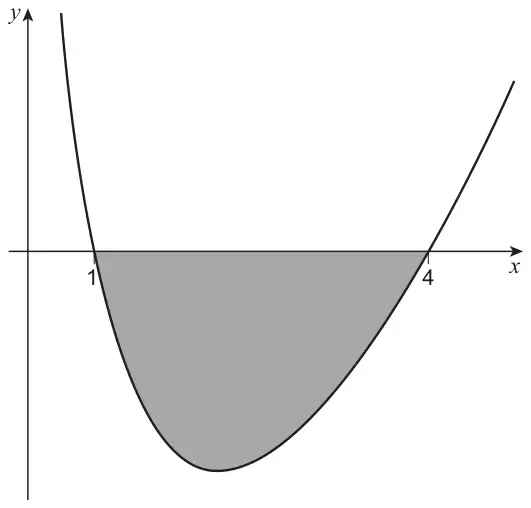
14 The region bounded by the curve

\[y = (2x - 8)\ln x\]

and the \(x\)-axis is shaded in the diagram below.

Curve y = (2x − 8) ln x crossing the x-axis at 1 and 4; the region between the curve and the x-axis from 1 to 4, below the x-axis, is shaded
(a) Use the trapezium rule with 5 ordinates to find an estimate for the area of the shaded region.

Give your answer correct to three significant figures. [3 marks]

(b) Show that the exact area is given by\[32\ln 2 - \frac{33}{2}\]

Fully justify your answer. [6 marks]

June 2022 Paper 2 Q10

AQACurrent spec15 marksIntegrationModelling

10 A gardener has a greenhouse containing 900 tomato plants.

The gardener notices that some of the tomato plants are damaged by insects.

Initially there are 25 damaged tomato plants.

The number of tomato plants damaged by insects is increasing by 32% each day.

(a) The total number of plants damaged by insects, \(x\), is modelled by\[x = A \times B^t\]where \(A\) and \(B\) are constants and \(t\) is the number of days after the gardener first noticed the damaged plants.
(i) Use this model to find the total number of plants damaged by insects 5 days after the gardener noticed the damaged plants. [3 marks]
(ii) Explain why this model is not realistic in the long term. [2 marks]
(b) A refined model assumes the rate of increase of the number of plants damaged by insects is given by\[\frac{\mathrm{d}x}{\mathrm{d}t} = \frac{x(900 - x)}{2700}\]
(i) Show that\[\int \left(\frac{A}{x} + \frac{B}{900 - x}\right)\mathrm{d}x = \int \mathrm{d}t\]where \(A\) and \(B\) are positive integers to be found. [3 marks]
(ii) Hence, find \(t\) in terms of \(x\). [5 marks]
(iii) Hence, find the number of days it takes from when the damage is first noticed until half of the plants are damaged by the insects. [2 marks]

June 2022 Paper 2 Q5

AQACurrent spec6 marksBinomial ExpansionIntegration

5 The binomial expansion of \((2 + 5x)^4\) is given by

\[(2 + 5x)^4 = A + 160x + Bx^2 + 1000x^3 + 625x^4\]
(a) Find the value of \(A\) and the value of \(B\). [2 marks]
(b) Show that\[(2 + 5x)^4 - (2 - 5x)^4 = Cx + Dx^3\]where \(C\) and \(D\) are constants to be found. [2 marks]
(c) Hence, or otherwise, find\[\int \left((2 + 5x)^4 - (2 - 5x)^4\right)\mathrm{d}x\] [2 marks]

June 2022 Paper 3 Q4

AQACurrent spec2 marksIntegration

4 Find

\[\int \left(x^2 + x^{\frac{1}{2}}\right)\mathrm{d}x\]

[2 marks]

June 2022 Paper 3 Q2

AQACurrent spec1 markIntegration

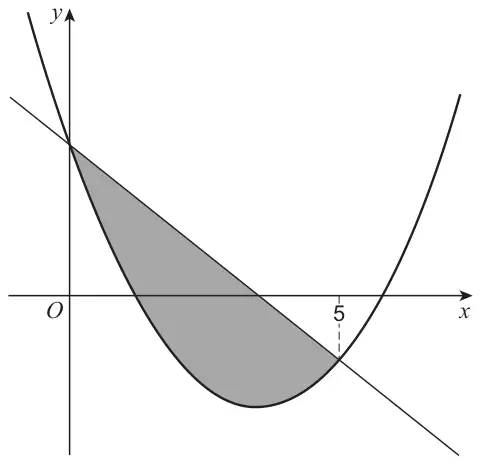
2 The shaded region, shown in the diagram below, is defined by

\[x^2 - 7x + 7 \leqslant y \leqslant 7 - 2x\]
A U-shaped parabola and a straight line with negative gradient meeting on the positive y-axis and again where x = 5 (below the x-axis); the region between the line (above) and the parabola (below) for x from 0 to 5 is shaded

Identify which of the following gives the area of the shaded region.

Tick (✓) one box. [1 mark]

  • \(\displaystyle\int (7 - 2x)\,\mathrm{d}x - \int (x^2 - 7x + 7)\,\mathrm{d}x\)
  • \(\displaystyle\int_0^5 (x^2 - 5x)\,\mathrm{d}x\)
  • \(\displaystyle\int_0^5 (5x - x^2)\,\mathrm{d}x\)
  • \(\displaystyle\int_0^5 (x^2 - 9x + 14)\,\mathrm{d}x\)

June 2025 Paper 1 Q12

OCR ACurrent spec11 marksAlgebraic FractionsIntegration

12

(a) Express \(\dfrac{2 + 4x}{x(1 + x)(1 - x)}\) in partial fractions. [4]

The gradient of a curve is given by \(\dfrac{\mathrm{d}y}{\mathrm{d}x} = \dfrac{2 + 4x}{x(1 + x)(1 - x)\tan y}\) and the curve passes through the point \(\left(\frac{1}{2}, \frac{1}{4}\pi\right)\).

(b) Show that the equation of the curve can be written in the form \(\cos y = \mathrm{f}(x)\), where \(\mathrm{f}(x)\) is fully simplified. [7]

June 2025 Paper 1 Q10

OCR ACurrent spec12 marksIntegrationLogs & Exponentials

10 The graph of \(y = \mathrm{e}^x\) can be transformed to the graph of \(y = \mathrm{e}^{2x-1}\) by a stretch parallel to the \(x\)-axis followed by a translation.

(a)
(i) State the scale factor of the stretch. [1]
(ii) Give full details of the translation. [2]

Alternatively the graph of \(y = \mathrm{e}^x\) can be transformed to the graph of \(y = \mathrm{e}^{2x-1}\) by a stretch parallel to the \(x\)-axis and a stretch parallel to the \(y\)-axis.

(b) State the scale factor of the stretch parallel to the \(y\)-axis. [1]

The point \(P\) lies on the curve \(y = \mathrm{e}^{2x-1}\) and has \(x\)-coordinate of \(\frac{1}{2}\).

(c) Show that the tangent to the curve \(y = \mathrm{e}^{2x-1}\) at \(P\) has equation \(y = 2x\). [4]
(d) Find the exact area enclosed by the curve \(y = \mathrm{e}^{2x-1}\), the tangent to the curve at \(P\) and the \(y\)-axis. [4]

June 2025 Paper 2 Q8

OCR ACurrent spec5 marksIntegration

8

In this question you must show detailed reasoning.

Use integration by parts to find the exact value of \(\displaystyle\int_0^{\frac{1}{2}} \ln(3 - 2x)\,\mathrm{d}x\). [5]

June 2025 Paper 3 Q5

OCR ACurrent spec14 marksIntegrationNumerical Methods

5

(a) Use the substitution \(u = \cos x\) to show that
\(\displaystyle\int \frac{1 + \cos x}{\sin x}\,\mathrm{d}x = \ln(1 - \cos x) + c\). [4]
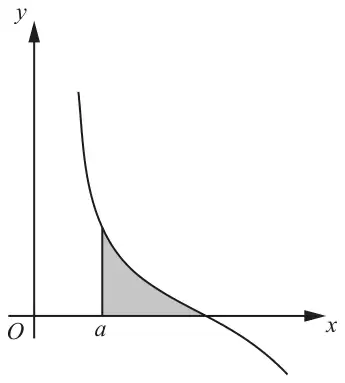
Fig. 1: part of a curve decreasing from top left, crossing the positive x-axis; the region under the curve between x = a and the point where the curve crosses the x-axis is shaded
Fig. 1

Fig. 1 shows part of the curve \(y = \dfrac{1 + \cos x}{\sin x}\).

The shaded region is bounded by the curve, the \(x\)-axis, and the line \(x = a\).

You are given that the area of the shaded region is \(a\) square units.

(b) Show that the value of \(a\) satisfies the equation \(a - \cos^{-1}\left(1 - 2\mathrm{e}^{-a}\right) = 0\). [4]
(c) Show by calculation that the value of \(a\) lies between 1.1 and 1.2. [2]
(d) Use the iterative formula
\(a_{n+1} = \cos^{-1}\left(1 - 2\mathrm{e}^{-a_n}\right)\),
with starting value \(a_1 = 1.2\), to find the value of \(a\) correct to 2 decimal places. Show the result of each step of the iterative process. [2]
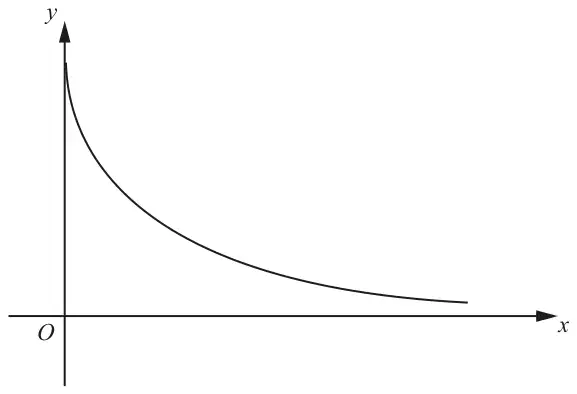
Fig. 2: a curve starting high on the positive y-axis and decreasing towards the positive x-axis as x increases, staying above the x-axis
Fig. 2

Fig. 2 shows the curve \(y = \cos^{-1}\left(1 - 2\mathrm{e}^{-x}\right)\).

(e) Explain why the gradient of the curve \(y = \cos^{-1}\left(1 - 2\mathrm{e}^{-x}\right)\) at the point where \(x = a\), where \(a\) is the value found in part (d), lies in the interval \((-1, 0)\). [2]

June 2025 Paper 2 Q3

OCR ACurrent spec7 marksIntegrationNumerical Methods

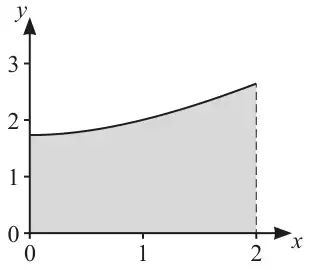
3 The diagram shows part of the curve with equation \(y = \sqrt{x^2 + 3}\), between \(x = 0\) and \(x = 2\).

Graph of y = square root of (x squared + 3) from x = 0 to x = 2, with the region under the curve shaded down to the x-axis and bounded by a dashed line at x = 2
(a)
(i) Use the trapezium rule, with intervals of 0.5, to determine an approximation to the area of the shaded region. [3]
(ii) Use rectangles with the same intervals as in part (i) to determine lower and upper bounds for the exact area of the shaded region. [2]
(b) Write an expression for the exact area of the shaded region in terms of a limit, involving \(x\) and intervals of width \(\delta x\). [2]

June 2024 Paper 1 Q12

OCR ACurrent spec11 marksIntegrationParametric Equations

12 In this question you must show detailed reasoning.

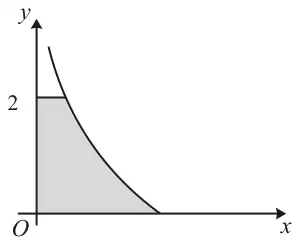
Decreasing curve crossing the line y = 2 near the y-axis and meeting the positive x-axis; the region between the curve, the x-axis, the y-axis and the line y = 2 is shaded

The diagram shows the curve with parametric equations \(x = \dfrac{2}{(2t + 1)^4}\), \(y = 2t^2 + 3t\) for \(t \geqslant 0\).

The shaded region is enclosed by the curve, the \(x\)-axis, the \(y\)-axis and the line \(y = 2\).

(a) Show that the area of the shaded region is given by \(\displaystyle\int_a^b \frac{8t + 6}{(2t + 1)^4}\,\mathrm{d}t\), where \(a\) and \(b\) are constants to be determined. [5]
(b) Determine the exact area of the shaded region. [6]

June 2024 Paper 2 Q5

OCR ACurrent spec8 marksIntegrationModelling

5 A scientist is monitoring the decline in the population of a certain endangered species of animal in an area where their natural habitat has been damaged.

As a model, the scientist proposes that the rate of decline per year of the population is given by \(\dfrac{1}{80}P^2\), where \(P\) is the size of the population \(t\) years after the start of the modelling.

(a) Explain how this model gives rise to the differential equation\[\frac{\mathrm{d}P}{\mathrm{d}t} = -\frac{1}{80}P^2.\] [1]

The scientist notes that at the start of the monitoring the population is 120.

(b) Use the model to determine an expression for \(P\) in terms of \(t\). [4]
(c) Use the model to determine the time it takes for the population to reach 10. [2]

The model predicts that the population will never reach zero.

(d) By considering the case when \(t \geqslant 160\), or otherwise, comment on the validity of the model for large values of \(t\). [1]

June 2024 Paper 3 Q5

OCR ACurrent spec13 marksDifferentiationIntegration

5

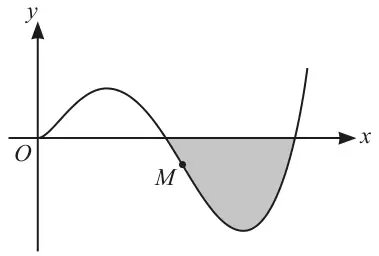
Curve through the origin O rising to a maximum, then falling to cross the x-axis, passing through the point of inflection M below the axis, reaching a minimum and rising to cross the x-axis again; the region between the curve and the x-axis below the axis is shaded

The diagram shows the curve with equation \(y = \left(x^3 - 2x^2\right)\ln x\). The curve has a point of inflection at the point \(M\).

(a)
(i) Show that the \(x\)-coordinate of \(M\) satisfies the equation \[x = \frac{6 + (4 - 6x)\ln x}{5}.\] [5]
(ii) Use an iterative formula, based on the equation in part (a)(i), to determine the \(x\)-coordinate of \(M\) correct to 2 decimal places. Use an initial value of 1.1 and show the result of each step of the iterative process. [2]
(b) Determine the exact area of the shaded region, giving your answer in the form \(p\ln q - r\), where \(p\) and \(r\) are positive rational numbers and \(q\) is a positive integer. [6]

June 2024 Paper 2 Q4

OCR ACurrent spec10 marksIntegrationNumerical Methods

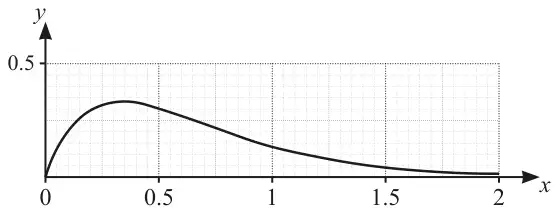
4 The diagram shows part of the graph of \(y = x\mathrm{e}^{1-3x}\).

Graph of y = x e to the power 1 minus 3x for x from 0 to 2: rises from the origin to a maximum of about 0.33 near x = 0.33, then decreases towards the x-axis; grid lines at 0.5 intervals
(a) Use the sign change method to determine, correct to 2 decimal places, the root of the equation \(x\mathrm{e}^{1-3x} - 0.2 = 0\), that lies between \(x = 0.5\) and \(x = 1\). [3]
(b) Determine the exact \(x\)-coordinate of the maximum point of the curve \(y = x\mathrm{e}^{1-3x}\). [3]
(c) In this question you must show detailed reasoning.
Determine the exact area of the region enclosed by the curve \(y = x\mathrm{e}^{1-3x}\), the \(x\)-axis and the line \(x = 1\). [4]

June 2024 Paper 1 Q1

OCR ACurrent spec7 marksIntegrationNumerical Methods

1

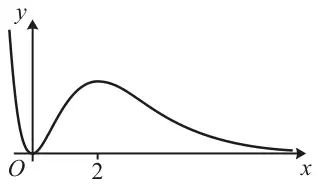
Curve y = x squared e to the minus x: touches the x-axis at O, rises to a maximum at x = 2, then decreases towards the x-axis

The diagram shows part of the curve \(y = x^2\mathrm{e}^{-x}\).

(a) Use the trapezium rule with 4 intervals of equal width to find an estimate for \(\displaystyle\int_0^2 x^2\mathrm{e}^{-x}\,\mathrm{d}x\).
Give your answer correct to 3 significant figures. [4]
(b) Explain how the trapezium rule could be used to obtain a more accurate estimate for \(\displaystyle\int_0^2 x^2\mathrm{e}^{-x}\,\mathrm{d}x\). [1]
(c) Explain why it is not clear from the diagram whether the value from part (a) is an under-estimate or an over-estimate for \(\displaystyle\int_0^2 x^2\mathrm{e}^{-x}\,\mathrm{d}x\). [2]

June 2023 Paper 1 Q12

OCR ACurrent spec10 marksAlgebraic FractionsIntegration

12

(a) Use the substitution \(u = \mathrm{e}^x - 2\) to show that \[\int \frac{7\mathrm{e}^x - 8}{\left(\mathrm{e}^x - 2\right)^2}\,\mathrm{d}x = \int \frac{7u + 6}{u^2(u + 2)}\,\mathrm{d}u.\] [3]
(b) Hence show that \[\int_{\ln 4}^{\ln 6} \frac{7\mathrm{e}^x - 8}{\left(\mathrm{e}^x - 2\right)^2}\,\mathrm{d}x = a + \ln b\] where \(a\) and \(b\) are rational numbers to be determined. [7]

June 2023 Paper 3 Q7

OCR ACurrent spec12 marksIntegrationNumerical Methods

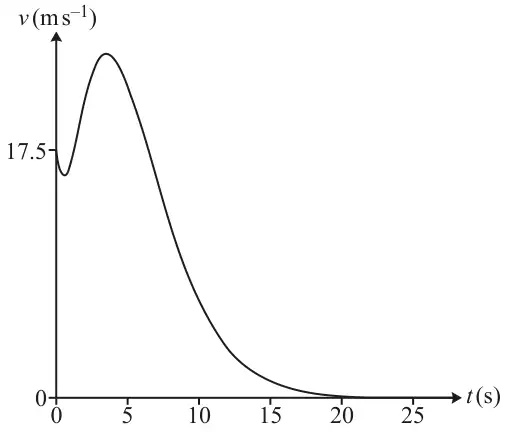
7 A car \(C\) is moving horizontally in a straight line with velocity \(v\,\mathrm{m\,s^{-1}}\) at time \(t\) seconds, where \(v \gt 0\) and \(t \geqslant 0\). The acceleration, \(a\,\mathrm{m\,s^{-2}}\), of \(C\) is modelled by the equation

\(a = v\left(\dfrac{8t}{7 + 4t^2} - \dfrac{1}{2}\right).\)

(a) In this question you must show detailed reasoning.
Find the times when the acceleration of \(C\) is zero. [3]

At \(t = 0\) the velocity of \(C\) is \(17.5\,\mathrm{m\,s^{-1}}\) and at \(t = T\) the velocity of \(C\) is \(5\,\mathrm{m\,s^{-1}}\).

(b) By setting up and solving a differential equation, show that \(T\) satisfies the equation
\(T = 2\ln\left(\dfrac{7 + 4T^2}{2}\right).\) [6]
(c) Use an iterative formula, based on the equation in part (b), to find the value of \(T\), giving your answer correct to 4 significant figures. Use an initial value of 11.25 and show the result of each step of the iteration process. [2]
(d) The diagram below shows the velocity-time graph for the motion of \(C\).
Velocity-time graph, v in m s^-1 against t in s from 0 to 25: v starts at 17.5, dips slightly, rises to a maximum at about t = 3.5, then decreases, levelling off towards 0 by about t = 20
Find the time taken for \(C\) to decelerate from travelling at its maximum speed until it is travelling at \(5\,\mathrm{m\,s^{-1}}\). [1]

June 2023 Paper 3 Q5

OCR ACurrent spec9 marksIntegrationParametric Equations

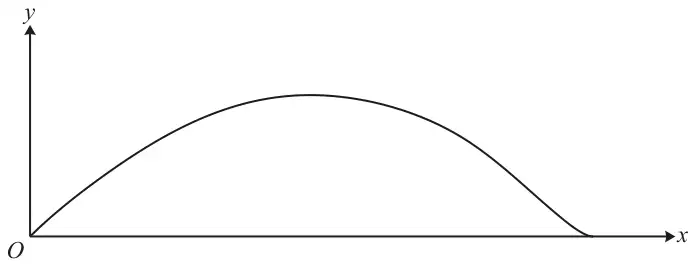
5 A mathematics department is designing a new emblem to place on the walls outside its classrooms. The design for the emblem is shown in the diagram below.

Axes x and y with origin O: a curve starts at O, rises to a single maximum, then falls and meets the x-axis tangentially further along

The emblem is modelled by the region between the \(x\)-axis and the curve with parametric equations

\(x = 1 + 0.2t - \cos t, \qquad y = k\sin^2 t,\)

where \(k\) is a positive constant and \(0 \leqslant t \leqslant \pi\).

Lengths are in metres and the area of the emblem must be \(1\,\mathrm{m}^2\).

(a) Show that \(\displaystyle k\int_0^{\pi} (0.2 + \sin t - 0.2\cos^2 t - \sin t\cos^2 t)\,\mathrm{d}t = 1\). [3]
(b) Determine the exact value of \(k\). [6]

June 2023 Paper 1 Q3

OCR ACurrent spec7 marksDifferentiationIntegration

3

(a) Given that \(\mathrm{f}(x) = x^2 + 2x\), use differentiation from first principles to show that \(\mathrm{f}'(x) = 2x + 2\). [4]
(b) The gradient of a curve is given by \(\dfrac{\mathrm{d}y}{\mathrm{d}x} = 2x + 2\) and the curve passes through the point \((-1, 5)\).
Find the equation of the curve. [3]

June 2023 Paper 2 Q3

OCR ACurrent spec3 marksIntegrationLogs & Exponentials

3 In this question you must show detailed reasoning.

Find the exact area of the region enclosed by the curve \(y = \dfrac{1}{x + 2}\), the two axes and the line \(x = 2.5\). [3]

June 2022 Paper 1 Q11

OCR ACurrent spec9 marksIntegrationLogs & Exponentials

11 The gradient function of a curve is given by \(\dfrac{\mathrm{d}y}{\mathrm{d}x} = \dfrac{3x^2\ln x}{\mathrm{e}^{3y}}\).

The curve passes through the point \((\mathrm{e}, 1)\).

(a) Find the equation of this curve, giving your answer in the form \(\mathrm{e}^{3y} = \mathrm{f}(x)\). [6]
(b) Show that, when \(x = \mathrm{e}^2\), the \(y\)-coordinate of this curve can be written as \(y = a + \tfrac{1}{3}\ln\left(b\mathrm{e}^3 + c\right)\), where \(a\), \(b\) and \(c\) are constants to be determined. [3]

June 2022 Paper 1 Q9

OCR ACurrent spec7 marksIntegrationTrigonometry

9 Use the substitution \(x = 2\sin\theta\) to show that \(\displaystyle\int_1^{\sqrt{3}} \sqrt{4 - x^2}\,\mathrm{d}x = \tfrac{1}{3}\pi\). [7]

June 2022 Paper 2 Q8

OCR ACurrent spec7 marksDifferentiationIntegration

8

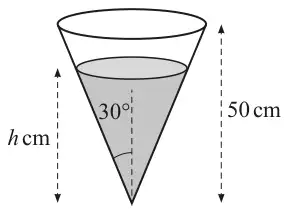
An inverted cone of height 50 cm, partly filled with water to depth h cm; the semi-vertical angle at the bottom vertex is 30 degrees

The diagram shows a water tank which is shaped as an inverted cone with semi-vertical angle \(30^\circ\) and height 50 cm. Initially the tank is full, and the depth of the water is 50 cm.

Water flows out of a small hole at the bottom of the tank. The rate at which the water flows out is modelled by \(\dfrac{\mathrm{d}V}{\mathrm{d}t} = -2h\), where \(V\,\mathrm{cm}^3\) is the volume of water remaining and \(h\) cm is the depth of water in the tank \(t\) seconds after the water begins to flow out.

Determine the time taken for the tank to become empty.

[For a cone with base radius \(r\) and height \(h\) the volume \(V\) is given by \(\frac{1}{3}\pi r^2h\).] [7]

June 2022 Paper 3 Q6

OCR ACurrent spec8 marksIntegrationLogs & Exponentials

6 In this question you must show detailed reasoning.

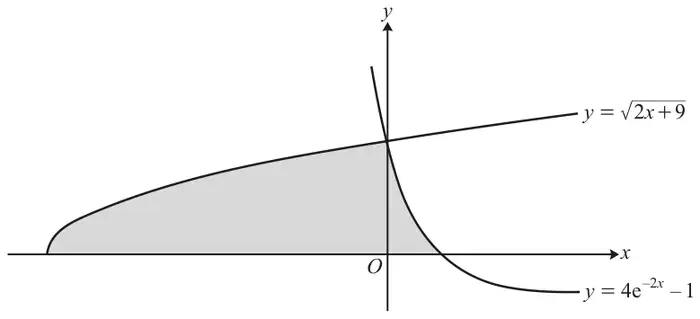
Curves y = √(2x + 9) and y = 4e^(−2x) − 1 meeting on the y-axis; the shaded region lies above the x-axis, under y = √(2x + 9) to the left of the y-axis and under y = 4e^(−2x) − 1 to the right of it

The diagram shows the curves \(y = \sqrt{2x + 9}\) and \(y = 4\mathrm{e}^{-2x} - 1\) which intersect on the \(y\)-axis. The shaded region is bounded by the curves and the \(x\)-axis.

Determine the area of the shaded region, giving your answer in the form \(p + q\ln 2\) where \(p\) and \(q\) are constants to be determined. [8]

June 2022 Paper 2 Q3

OCR ACurrent spec10 marksIntegration

3

(a) Amaya and Ben integrated \((1 + x)^2\), with respect to \(x\), using different methods, as follows.
Amaya:\(\displaystyle\int (1 + x)^2\,\mathrm{d}x = \frac{(1 + x)^3}{3} + c\)\(= \tfrac{1}{3} + x + x^2 + \tfrac{1}{3}x^3 + c\)
Ben:\(\displaystyle\int (1 + x)^2\,\mathrm{d}x = \int (1 + 2x + x^2)\,\mathrm{d}x\)\(= x + x^2 + \tfrac{1}{3}x^3 + c\)
Charlie said that, because these answers are different, at least one of them must be wrong.
Explain whether you agree with Charlie’s statement. [1]
(b) You are given that \(a\) is a constant greater than 1.
(i) Find \(\displaystyle\int_1^a \frac{1}{(1 + x)^2}\,\mathrm{d}x\), giving your answer as a single fraction in terms of the constant \(a\). [3]
(ii) You are given that the area enclosed by the curve \(y = \dfrac{1}{(1 + x)^2}\), the \(x\)-axis and the lines \(x = 1\) and \(x = a\) is equal to \(\dfrac{1}{3}\).
Determine the value of \(a\). [2]
(c) In this question you must show detailed reasoning.
Find the exact value of \(\displaystyle\int_0^{\frac{1}{12}\pi} \frac{\cos 2x}{\sin 2x + 2}\,\mathrm{d}x\), giving your answer in its simplest form. [4]

June 2022 Paper 1 Q1

OCR ACurrent spec6 marksIntegrationNumerical Methods

1

Curve y = square root of (x squared minus 1): starts on the x-axis at x = 1 and rises, getting less steep as x increases

The diagram shows part of the curve \(y = \sqrt{x^2 - 1}\).

(a) Use the trapezium rule with 4 intervals to find an estimate for \(\displaystyle\int_1^3 \sqrt{x^2 - 1}\,\mathrm{d}x\).
Give your answer correct to 3 significant figures. [4]
(b) State whether the value from part (a) is an under-estimate or an over-estimate, giving a reason for your answer. [1]
(c) Explain how the trapezium rule could be used to obtain a more accurate estimate. [1]

October 2021 Paper 1 Q12

OCR ACurrent spec13 marksIntegrationModelling

12 A cake is cooling so that, \(t\) minutes after it is removed from an oven, its temperature is \(\theta\,{}^\circ\mathrm{C}\).
When the cake is removed from the oven, its temperature is \(160\,{}^\circ\mathrm{C}\). After 10 minutes its temperature has fallen to \(125\,{}^\circ\mathrm{C}\).

(a) In a simple model, the rate of decrease of the temperature of the cake is assumed to be constant.
(i) Write down a differential equation for this model. [1]
(ii) Solve this differential equation to find \(\theta\) in terms of \(t\). [2]
(iii) State one limitation of this model. [1]
(b) In a revised model, the rate of decrease of the temperature of the cake is proportional to the difference between the temperature of the cake and the temperature of the room. The temperature of the room is a constant \(20\,{}^\circ\mathrm{C}\).
(i) Write down a differential equation for this revised model. [1]
(ii) Solve this differential equation to find \(\theta\) in terms of \(t\). [6]
(c) The cake can be decorated when its temperature is \(25\,{}^\circ\mathrm{C}\). Find the difference in time between when the two models would predict that the cake can be decorated, giving your answer correct to the nearest minute. [2]

October 2021 Paper 1 Q11

OCR ACurrent spec12 marksDifferentiationIntegration

11

(a) Use the substitution \(u^2 = x^2 + 3\) to show that \(\displaystyle\int \frac{4x^3}{\sqrt{x^2 + 3}}\,\mathrm{d}x = \tfrac{4}{3}(x^2 - 6)\sqrt{x^2 + 3} + c\). [5]
(b) In this question you must show detailed reasoning.
Part of a curve starting at the origin O, flat at first and then rising with increasing steepness for positive x
The graph shows part of the curve \(y = \dfrac{4x^3}{\sqrt{x^2 + 2}}\).
Find the exact area enclosed by the curve \(y = \dfrac{4x^3}{\sqrt{x^2 + 3}}\), the normal to this curve at the point \((1, 2)\) and the \(x\)-axis. [7]

October 2021 Paper 3 Q8

OCR ACurrent spec11 marksDifferentiationIntegration

8

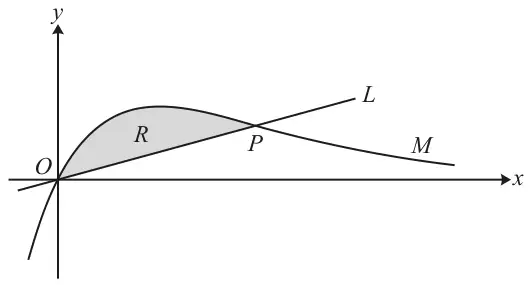
Curve M through the origin O rising to a maximum and then decreasing towards the x-axis; straight line L through O meets M again at P; the region R between the curve and the line, from O to P, is shaded

The diagram shows the curve \(M\) with equation \(y = x\mathrm{e}^{-2x}\).

(a) Show that \(M\) has a point of inflection at the point \(P\) where \(x = 1\). [5]

The line \(L\) passes through the origin \(O\) and the point \(P\). The shaded region \(R\) is enclosed by the curve \(M\) and the line \(L\).

(b) Show that the area of \(R\) is given by \[\tfrac{1}{4}\left(a + b\mathrm{e}^{-2}\right),\] where \(a\) and \(b\) are integers to be determined. [6]

October 2021 Paper 3 Q7

7 A curve \(C\) in the \(x\)-\(y\) plane has the property that the gradient of the tangent at the point \(P(x, y)\) is three times the gradient of the line joining the point \((3, 2)\) to \(P\).

(a) Express this property in the form of a differential equation. [2]

It is given that \(C\) passes through the point \((4, 3)\) and that \(x \gt 3\) and \(y \gt 2\) at all points on \(C\).

(b) Determine the equation of \(C\) giving your answer in the form \(y = \mathrm{f}(x)\). [4]

The curve \(C\) may be obtained by a transformation of part of the curve \(y = x^3\).

(c) Describe fully this transformation. [2]

October 2021 Paper 2 Q6

OCR ACurrent spec5 marksIntegration

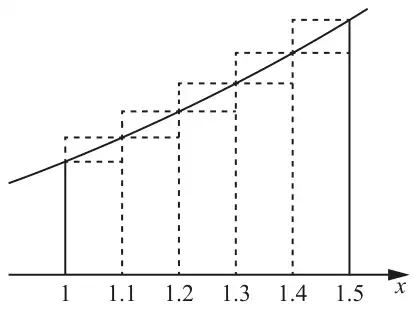
6 Alex is investigating the area, \(A\), under the graph of \(y = x^2\) between \(x = 1\) and \(x = 1.5\). They draw the graph, together with rectangles of width \(\delta x = 0.1\), and varying heights \(y\).

Graph of y = x squared from x = 1 to x = 1.5 with five strips of width 0.1 marked at 1, 1.1, 1.2, 1.3, 1.4, 1.5; each strip has a lower rectangle under the curve and an upper rectangle above it, drawn with dashed lines
(a) Use the rectangles in the diagram to show that lower and upper bounds for the area \(A\) are 0.73 and 0.855 respectively. [1]
(b) Alex finds lower and upper bounds for the area \(A\), using widths \(\delta x\) of decreasing size.
The results are shown in the table. Where relevant, values are given correct to 3 significant figures.
Width \(\delta x\)0.10.050.0250.0125
Lower bound for area \(A\)0.730.7610.7760.784
Upper bound for area \(A\)0.8550.8230.8070.799
Use Alex’s results to estimate the value of \(A\) correct to 2 significant figures. Give a brief justification for your estimate. [2]
(c) Write down an expression, in terms of \(y\) and \(\delta x\), for the exact value of the area \(A\). [2]

June 2025 Paper 2 Q16

OCR MEICurrent spec9 marksIntegrationModelling

16 In this question you must show detailed reasoning

The population of puffins on a remote island is estimated to be \(P = 58.5\), where \(P\) is measured in thousands of birds.

Just after this estimate is made there is a serious oil spill in the area. It is noted that there is a rapid decline in the population of puffins on the island.

The situation is modelled by the differential equation

\(\dfrac{\mathrm{d}P}{\mathrm{d}t} = (72t - 108)\mathrm{e}^{-0.8t}\), where \(t\) is the time in years after the pollution incident.

(a) Determine an expression for \(P\) in terms of \(t\). [7]
(b) Determine whether, according to the model, \(P\) will recover to 58.5. You may assume that \(\displaystyle\lim_{t\to\infty} t\mathrm{e}^{-0.8t} = 0\). [2]

June 2025 Paper 2 Q14

OCR MEICurrent spec15 marksDifferentiationIntegration

14 The equation of a curve is \(y = \dfrac{16}{x^2} + \dfrac{3}{x}\).

(a) Determine the coordinates of the point where the curve cuts the \(x\)-axis. [2]
(b)
(i) Find \(\dfrac{\mathrm{d}y}{\mathrm{d}x}\). [2]
(ii) Hence determine the exact coordinates of the stationary point on the curve \(y = \dfrac{16}{x^2} + \dfrac{3}{x}\). [2]
(c)
(i) Find \(\dfrac{\mathrm{d}^2y}{\mathrm{d}x^2}\). [2]
(ii) Hence determine the set of values of \(x\) for which the curve \(y = \dfrac{16}{x^2} + \dfrac{3}{x}\) is concave downwards. [2]

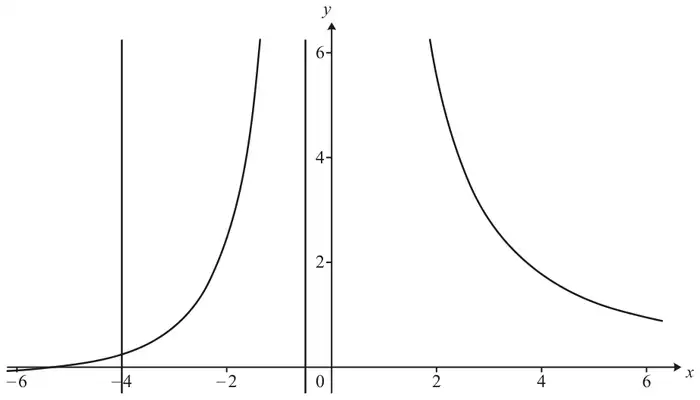
The diagram shows parts of the curve \(y = \dfrac{16}{x^2} + \dfrac{3}{x}\), the line \(x = -4\) and the line \(x = -\dfrac{1}{2}\).

Graph of y = 16/x^2 + 3/x with vertical lines x = -4 and x = -1/2; the curve crosses the negative x-axis left of -4 and rises steeply towards the y-axis
(d) Determine the exact area bounded by the curve \(y = \dfrac{16}{x^2} + \dfrac{3}{x}\), the \(x\)-axis and the lines \(x = -4\) and \(x = -\dfrac{1}{2}\). Give your answer in the form \(a + b\ln 2\), where \(a\) and \(b\) are constants to be determined. [5]

June 2025 Paper 1 Q7

OCR MEICurrent spec7 marksIntegration

7 In this question you must show detailed reasoning.

Show that the area of the finite region enclosed by the curves \(y = x^2 - 7x + 2\) and \(y = 14 - 9x - x^2\) is \(\frac{125}{3}\). [7]

June 2024 Paper 2 Q16

OCR MEICurrent spec12 marksAlgebraic FractionsIntegration

16 In this question you must show detailed reasoning.

Find the particular solution of the differential equation

\[\frac{\mathrm{d}y}{\mathrm{d}x} = \frac{9y}{(x-1)(x+2)},\]

given that \(x = 2\) when \(y = 16\). [12]

June 2024 Paper 1 Q8

OCR MEICurrent spec6 marksIntegrationRadians

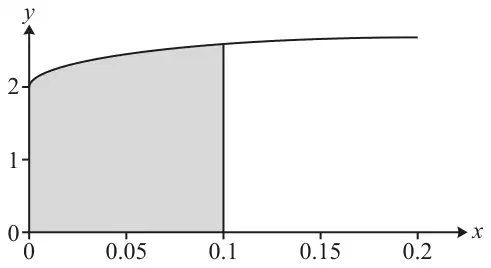
8 The equation of a curve is \(y = \sqrt{\sin 4x} + 2\cos 2x\), where \(x\) is in radians.

(a) Show that, for small values of \(x\), \(y \approx 2\sqrt{x} + 2 - 4x^2\). [2]

The diagram shows the region bounded by the curve \(y = \sqrt{\sin 4x} + 2\cos 2x\), the axes and the line \(x = 0.1\).

Graph of the curve for x from 0 to 0.2, starting at y = 2 and rising slowly; the region under the curve between x = 0 and x = 0.1 is shaded
(b) In this question you must show detailed reasoning.
Use the approximation in part (a) to estimate the area of this region. [4]

June 2024 Paper 3 Q5

OCR MEICurrent spec6 marksIntegration

5 In this question you must show detailed reasoning.

Using the substitution \(u = x + 1\), find the value of the positive integer \(c\) such that

\(\displaystyle\int_c^{c+4} \frac{x}{(x + 1)^2}\,\mathrm{d}x = \ln 3 - \frac{1}{3}\). [6]

June 2024 Paper 3 Q3

OCR MEICurrent spec4 marksIntegration

3 In this question you must show detailed reasoning.

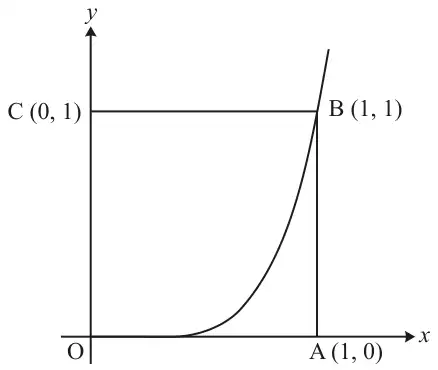
The diagram shows the curve with equation \(y = x^5\) and the square OABC where the points A, B and C have coordinates \((1, 0)\), \((1, 1)\) and \((0, 1)\) respectively.

The curve cuts the square into two parts.

The curve y = x to the power 5 from O through B(1, 1), with the square OABC where A is (1, 0) and C is (0, 1)

Show that the relationship between the areas of the two parts of the square is

\(\dfrac{\text{Area to left of curve}}{\text{Area below curve}} = 5\). [4]

June 2023 Paper 3 Q14

OCR MEICurrent spec3 marksIntegrationLogs & Exponentials

14

The questions in this section refer to the article on the Insert. You should read the article before attempting the questions.

The relevant parts of the article “Approximating series” are reproduced below; the line numbers are those printed on the Insert.

Line 31
Applying Euler’s approximate summation formula to the harmonic series

Lines 32–33
Using Euler’s approximate summation for the harmonic series gives
\(\displaystyle\sum_{r=1}^{n}\frac{1}{r} \approx \int_1^n \frac{1}{x}\,\mathrm{d}x + \frac{1}{2}\left(\frac{1}{n} + 1\right) + \frac{1}{12}\left(1 - \frac{1}{2}\right) - \frac{1}{12}\left(\frac{1}{n} - \frac{1}{n+1}\right)\).

Line 34
This simplifies to \(\displaystyle\sum_{r=1}^{n}\frac{1}{r} \approx \ln n + \frac{13}{24} + \frac{6n+5}{12n(n+1)}\).

Show that the expression given in line 33 simplifies to \(\displaystyle\sum_{r=1}^{n}\frac{1}{r} \approx \ln n + \frac{13}{24} + \frac{6n+5}{12n(n+1)}\), as given in line 34. [3]

June 2023 Paper 3 Q13

OCR MEICurrent spec4 marksIntegrationSequences & Series

13

The questions in this section refer to the article on the Insert. You should read the article before attempting the questions.

The relevant parts of the article “Approximating series” are reproduced below; the line numbers are those printed on the Insert.

Lines 4–5
The sum of the squares of the first \(n\) natural numbers, \(1^2 + 2^2 + 3^2 + \ldots + n^2\), can be expressed exactly as a formula, \(\displaystyle\sum_{r=1}^{n} r^2 = \frac{n(n+1)(2n+1)}{6}\).

Line 10
Euler’s approximate summation formula

Lines 11–13
In 1741, the mathematician Leonhard Euler published an approximate formula for summing a series. In modern notation, this can be expressed as follows.
\(\displaystyle\sum_{r=1}^{n}\mathrm{f}(r) \approx \int_1^n \mathrm{f}(x)\,\mathrm{d}x + \frac{\mathrm{f}(n) + \mathrm{f}(1)}{2} + \frac{\mathrm{f}(1) - \mathrm{f}(2)}{12} - \frac{\mathrm{f}(n) - \mathrm{f}(n+1)}{12}\)

Prove that Euler’s approximate formula, as given in line 13, when applied to \(\displaystyle\sum_{r=1}^{n} r^2\) gives exactly \(\dfrac{n(n+1)(2n+1)}{6}\). [4]

June 2023 Paper 3 Q12

OCR MEICurrent spec3 marksIntegrationNumerical Methods

12

The questions in this section refer to the article on the Insert. You should read the article before attempting the questions.

The relevant parts of the article “Approximating series” are reproduced below; the line numbers are those printed on the Insert.

Lines 17–19
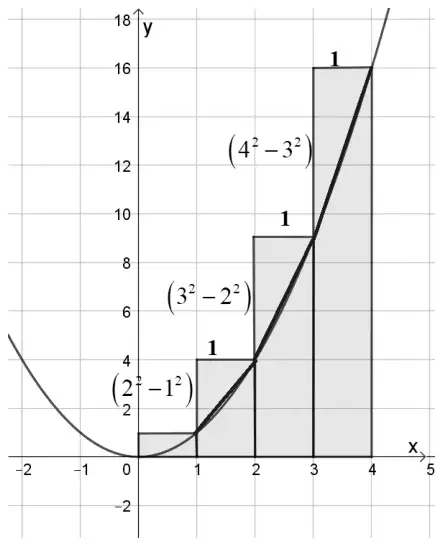
Euler’s formula relates a sum of terms to an integral, and this can be illustrated by considering a suitable graph. For the sum of the squares of natural numbers, this is the graph of \(y = x^2\). The diagram shows this curve, with four shaded rectangles of areas \(1^2\), \(2^2\), \(3^2\) and \(4^2\).

Graph of y = x squared for x from −2 to 5 with four shaded rectangles of width 1 on [0, 1], [1, 2], [2, 3] and [3, 4], of heights 1, 4, 9 and 16, each with its top-right corner on the curve

Lines 20–21
Euler’s approximate formula for this case is as follows.
\(\displaystyle\sum_{r=1}^{4} r^2 \approx \int_1^4 x^2\,\mathrm{d}x + \frac{4^2 + 1^2}{2} + \frac{1^2 - 2^2}{12} - \frac{4^2 - 5^2}{12}\)

Lines 22–25
The integral gives the area under the curve between \(x = 1\) and \(x = 4\). It is clear that the integral is smaller than \(\sum_{r=1}^{4} r^2\) so something needs to be added to the integral to get the same answer as the series. The rectangle for \(1^2\) needs to be added on and so do the parts of the other three rectangles that are above the curve.

Lines 26–27
Approximating the curve by a series of straight lines gives three triangles to be added on. These have areas \(\dfrac{2^2 - 1^2}{2}\), \(\dfrac{3^2 - 2^2}{2}\) and \(\dfrac{4^2 - 3^2}{2}\).

Lines 28–30
This gives an approximation for the series of \(\displaystyle\int_1^4 x^2\,\mathrm{d}x + 1^2 + \frac{2^2 - 1^2}{2} + \frac{3^2 - 2^2}{2} + \frac{4^2 - 3^2}{2}\) which simplifies to \(\displaystyle\int_1^4 x^2\,\mathrm{d}x + \frac{4^2 + 1^2}{2}\). The final two terms in Euler’s approximate formula are to correct for the curve not being a series of straight lines.

With the aid of a suitable diagram, show that the three triangles referred to in line 26 have the areas given in line 27. [3]

June 2023 Paper 2 Q11

OCR MEICurrent spec6 marksDifferentiationIntegration

11 In this question you must show detailed reasoning.

The variables \(x\) and \(y\) are such that \(\dfrac{\mathrm{d}y}{\mathrm{d}x}\) is directly proportional to the square root of \(x\).

When \(x = 4\), \(\dfrac{\mathrm{d}y}{\mathrm{d}x} = 3\).

(a) Find \(\dfrac{\mathrm{d}y}{\mathrm{d}x}\) in terms of \(x\). [3]

When \(x = 4\), \(y = 10\).

(b) Find \(y\) in terms of \(x\). [3]

June 2023 Paper 3 Q11

OCR MEICurrent spec3 marksIntegrationSequences & Series

11

The questions in this section refer to the article on the Insert. You should read the article before attempting the questions.

The relevant parts of the article “Approximating series” are reproduced below; the line numbers are those printed on the Insert.

Line 10
Euler’s approximate summation formula

Lines 11–13
In 1741, the mathematician Leonhard Euler published an approximate formula for summing a series. In modern notation, this can be expressed as follows.
\(\displaystyle\sum_{r=1}^{n}\mathrm{f}(r) \approx \int_1^n \mathrm{f}(x)\,\mathrm{d}x + \frac{\mathrm{f}(n) + \mathrm{f}(1)}{2} + \frac{\mathrm{f}(1) - \mathrm{f}(2)}{12} - \frac{\mathrm{f}(n) - \mathrm{f}(n+1)}{12}\)

(a) Evaluate \(\displaystyle\sum_{r=1}^{5} r^2\). [1]
(b) Show that Euler’s approximate formula, as given in line 13, gives the exact value of \(\displaystyle\sum_{r=1}^{5} r^2\). [2]

June 2023 Paper 2 Q10

OCR MEICurrent spec5 marksIntegration

10 Determine the exact value of \(\displaystyle\int_0^{\frac{\pi}{4}} 4x\cos 2x\,\mathrm{d}x\). [5]

June 2023 Paper 1 Q9

OCR MEICurrent spec10 marksIntegrationLogs & Exponentials

9 The gradient of a curve is given by \(\dfrac{\mathrm{d}y}{\mathrm{d}x} = \mathrm{e}^{x} - 4\mathrm{e}^{-x}\).

(a) Show that the \(x\)-coordinate of any point on the curve at which the gradient is 3 satisfies the equation \(\left(\mathrm{e}^{x}\right)^2 - 3\mathrm{e}^{x} - 4 = 0\). [2]
(b) Hence show that there is only one point on the curve at which the gradient is 3, stating the exact value of its \(x\)-coordinate. [3]
(c) The curve passes through the point \((0, 0)\).
Show that when \(x = 1\) the curve is below the \(x\)-axis. [5]

June 2023 Paper 1 Q3

OCR MEICurrent spec3 marksIntegration

3 Find \(\displaystyle\int \left(2x^4 - x\sqrt{x}\right)\mathrm{d}x\). [3]

June 2022 Paper 2 Q14

OCR MEICurrent spec8 marksIntegrationNumerical Methods

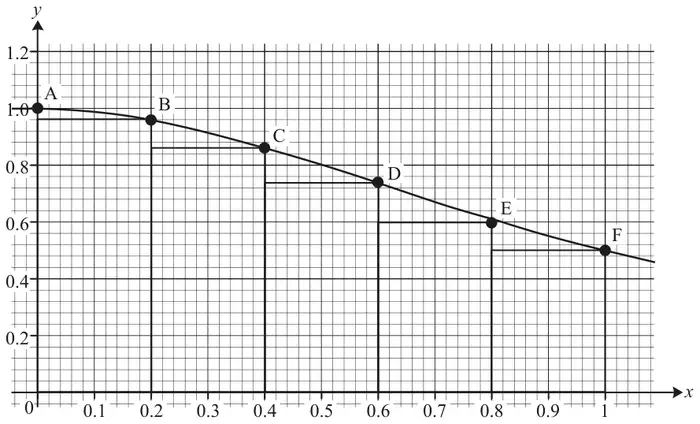
14 Fig. 14.1 shows the curve with equation \(y = \dfrac{1}{1+x^2}\), together with 5 rectangles of equal width.

Fig. 14.1: the curve y = 1/(1+x^2) for x from 0 to 1 through points A, B, C, D, E, F at x = 0, 0.2, 0.4, 0.6, 0.8, 1, with 5 rectangles of width 0.2 lying under the curve and the horizontal lines at the left-hand heights
Fig. 14.1

Fig. 14.2 shows the coordinates of the points A, B, C, D, E and F.

PointABCDEF
\(x\)00.20.40.60.81
\(y\)10.961540.862070.735290.609760.5

Fig. 14.2

(a) Use the 5 rectangles shown in Fig. 14.1 and the information in Fig. 14.2 to show that a lower bound for \(\displaystyle\int_0^1 \frac{1}{1+x^2}\,\mathrm{d}x\) is 0.7337, correct to 4 decimal places. [2]
(b) Use the 5 rectangles shown in Fig. 14.1 and the information in Fig. 14.2 to calculate an upper bound for \(\displaystyle\int_0^1 \frac{1}{1+x^2}\,\mathrm{d}x\) correct to 4 decimal places. [2]
(c) Hence find the length of the interval in which your answers to parts (a) and (b) indicate the value of \(\displaystyle\int_0^1 \frac{1}{1+x^2}\,\mathrm{d}x\) lies. [1]

Amit uses \(n\) rectangles, each of width \(\dfrac{1}{n}\), to calculate upper and lower bounds for \(\displaystyle\int_0^1 \frac{1}{1+x^2}\,\mathrm{d}x\), using different values of \(n\). His results are shown in Fig. 14.3.

\(n\)102040
upper bound0.809980.797790.79162
lower bound0.759980.772790.77912

Fig. 14.3

(d) Find the length of the smallest interval in which Amit now knows \(\displaystyle\int_0^1 \frac{1}{1+x^2}\,\mathrm{d}x\) lies. [2]
(e) Without doing any calculation, explain how Amit could find a smaller interval which contains the value of \(\displaystyle\int_0^1 \frac{1}{1+x^2}\,\mathrm{d}x\). [1]

June 2022 Paper 1 Q11

OCR MEICurrent spec6 marksIntegration

11 Given that \(k\) is a positive constant, show that \(\displaystyle\int_{k}^{2k} \frac{2}{(2x+k)^2}\,\mathrm{d}x\) is inversely proportional to \(k\). [6]

June 2022 Paper 3 Q7

OCR MEICurrent spec12 marksBinomial ExpansionIntegration

7 A student is trying to find the binomial expansion of \(\sqrt{1 - x^3}\).

She gets the first three terms as \(1 - \dfrac{x^3}{2} + \dfrac{x^6}{8}\).

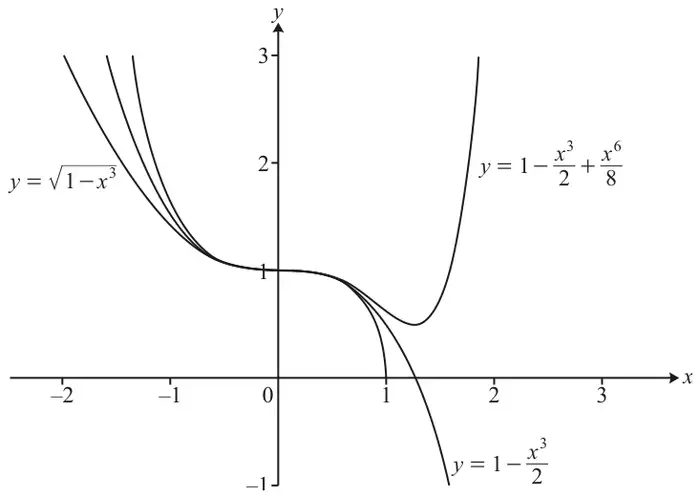
She draws the graphs of the curves \(y = \sqrt{1 - x^3}\), \(y = 1 - \dfrac{x^3}{2}\) and \(y = 1 - \dfrac{x^3}{2} + \dfrac{x^6}{8}\) using software.

Graphs for x from about −2 to 3. All three curves pass through (0, 1) and are close together near there. y = √(1 − x³) is defined only for x ≤ 1 and meets the x-axis at x = 1. y = 1 − x³/2 crosses the x-axis between 1 and 2 and continues downwards. y = 1 − x³/2 + x⁶/8 has a minimum at about (1.3, 0.5) and then rises steeply. For negative x all three rise, the three-term curve most steeply.
(a) Explain why \(1 - \dfrac{x^3}{2} + \dfrac{x^6}{8} \geqslant 1 - \dfrac{x^3}{2}\) for all values of \(x\). [1]
(b) Explain why the graphs suggest that the student has made a mistake in the binomial expansion. [1]
(c) Find the first four terms in the binomial expansion of \(\sqrt{1 - x^3}\). [3]
(d) State the set of values of \(x\) for which the binomial expansion in part (c) is valid. [1]
(e) Sketch the curve \(y = 2.5\sqrt{1 - x^3}\) on the grid in the Printed Answer Booklet. [2]
(f) In this question you must show detailed reasoning.
The end of a bus shelter is modelled by the area between the curve \(y = 2.5\sqrt{1 - x^3}\), the lines \(x = -0.75\), \(x = 0.75\) and the \(x\)-axis. Lengths are in metres.
Calculate, using your answer to part (c), an approximation for the area of the end of the bus shelter as given by this model. [4]

June 2022 Paper 3 Q6

OCR MEICurrent spec8 marksIntegrationModelling

6 A hot drink is cooling. The temperature of the drink at time \(t\) minutes is \(T\,{}^\circ\mathrm{C}\).

The rate of decrease in temperature of the drink is proportional to \((T - 20)\).

(a) Write down a differential equation to describe the temperature of the drink as a function of time. [2]
(b) When \(t = 0\), the temperature of the drink is \(90\,{}^\circ\mathrm{C}\) and the temperature is decreasing at a rate of \(4.9\,{}^\circ\mathrm{C}\) per minute.
Determine how long it takes for the drink to cool from \(90\,{}^\circ\mathrm{C}\) to \(40\,{}^\circ\mathrm{C}\). [6]

October 2021 Paper 2 Q16

OCR MEICurrent spec8 marksIntegration

16 In this question you must show detailed reasoning.

Find \(\displaystyle\int \frac{x}{1+\sqrt{x}}\,\mathrm{d}x\). [8]

October 2021 Paper 1 Q11

OCR MEICurrent spec11 marksIntegrationModelling

11 A balloon is being inflated. The balloon is modelled as a sphere with radius \(x\) cm at time \(t\) s. The volume \(V\,\text{cm}^3\) is given by \(V = \frac{4}{3}\pi x^3\).

The rate of increase of volume is inversely proportional to the radius of the balloon. Initially, when \(t = 0\), the radius of the balloon is 5 cm and the volume of the balloon is increasing at a rate of \(21\,\text{cm}^3\,\text{s}^{-1}\).

(a) Show that \(x\) satisfies the differential equation \(\dfrac{\mathrm{d}x}{\mathrm{d}t} = \dfrac{105}{4\pi x^3}\). [5]
(b) Find the radius of the balloon after two minutes. [5]
(c) Explain why the model may not be suitable for very large values of \(t\). [1]

October 2021 Paper 3 Q10

OCR MEICurrent spec9 marksAlgebraic FractionsIntegration

10

(a) Express \(\dfrac{1}{(4x + 1)(x + 1)}\) in partial fractions. [3]
(b) A curve passes through the point \((0, 2)\) and satisfies the differential equation
\(\dfrac{\mathrm{d}y}{\mathrm{d}x} = \dfrac{y}{(4x + 1)(x + 1)}\), for \(x > -\dfrac{1}{4}\).
Show by integration that \(y = A\left(\dfrac{4x + 1}{x + 1}\right)^B\) where \(A\) and \(B\) are constants to be determined. [6]

October 2021 Paper 3 Q9

OCR MEICurrent spec11 marksIntegration

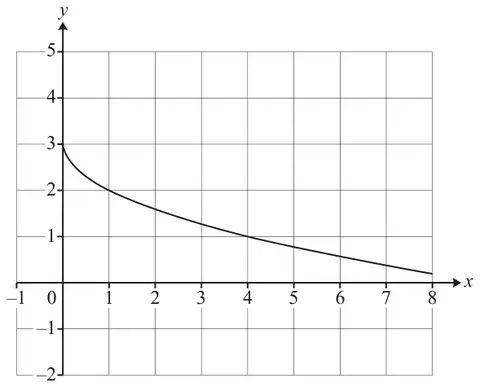
9 The diagram shows the curve \(y = 3 - \sqrt{x}\).

Grid with the curve y = 3 − √x starting at (0, 3) and decreasing slowly towards the x-axis; grid with x from −1 to 8 and y from −2 to 5
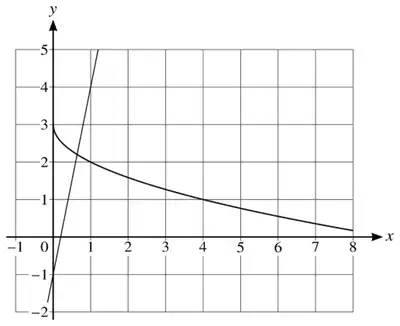
(a) Draw the line \(y = 5x - 1\) on the copy of the diagram in the Printed Answer Booklet. [1]
(b) In this question you must show detailed reasoning.
Determine the exact area of the region bounded by the curve \(y = 3 - \sqrt{x}\), the lines \(y = 5x - 1\) and \(x = 4\) and the \(x\)-axis. [10]

October 2021 Paper 3 Q7

OCR MEICurrent spec3 marksIntegration

7 Determine \(\displaystyle\int x\cos 2x\,\mathrm{d}x\). [3]

October 2020 Paper 2 Q14

OCR MEICurrent spec8 marksIntegrationTrigonometry

14 In this question you must show detailed reasoning.

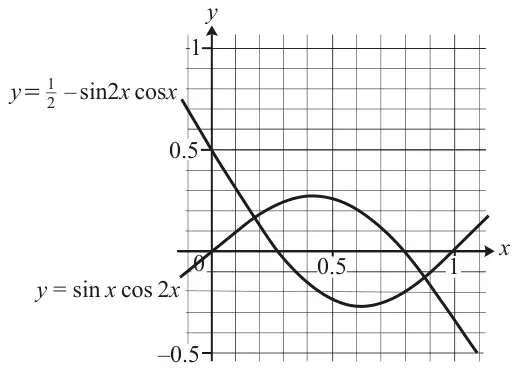
Fig. 14 shows the graphs of \(y = \sin x\cos 2x\) and \(y = \frac{1}{2} - \sin 2x\cos x\).

Fig. 14: graphs of y = sin x cos 2x and y = 1/2 - sin 2x cos x for x from 0 to about 1.1, crossing at two points between which the first curve is above the second
Fig. 14

Use integration to find the area between the two curves, giving your answer in an exact form. [8]

October 2020 Paper 3 Q10

OCR MEICurrent spec2 marksIntegrationLogs & Exponentials

10

The questions in this section refer to the article on the Insert. You should read the article before attempting the questions.

The relevant parts of the article “Which is bigger?” are reproduced below; the line numbers are those printed on the Insert.

Lines 31–34
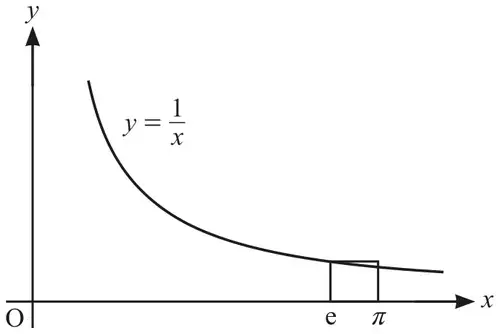
An indirect method, using calculus, enables us to prove that \(\mathrm{e}^{\pi}\) is larger than \(\pi^{\mathrm{e}}\). Fig. C2 shows the curve \(y = \dfrac{1}{x}\) in the first quadrant together with the rectangle with vertices at the points \((\mathrm{e}, 0)\), \(\left(\mathrm{e}, \dfrac{1}{\mathrm{e}}\right)\), \(\left(\pi, \dfrac{1}{\mathrm{e}}\right)\) and \((\pi, 0)\). We use the fact that the area under the curve between e and \(\pi\) is less than the area of this rectangle.

Fig. C2: the curve y = 1/x in the first quadrant, with a narrow rectangle on the x-axis between x = e and x = π whose top edge passes through the curve at x = e
Fig. C2

Line 35
The area of the rectangle is \(\dfrac{1}{\mathrm{e}}(\pi - \mathrm{e})\)

Line 36
\(\displaystyle\int_{\mathrm{e}}^{\pi} \frac{1}{x}\,\mathrm{d}x < \frac{1}{\mathrm{e}}(\pi - \mathrm{e})\)

Line 37
\(\ln\pi - 1 < \dfrac{\pi}{\mathrm{e}} - 1\)

Line 38
\(\ln\pi < \dfrac{\pi}{\mathrm{e}}\)

In this question you must show detailed reasoning.

Show that \(\displaystyle\int_{\mathrm{e}}^{\pi} \frac{1}{x}\,\mathrm{d}x = \ln\pi - 1\) as given in line 37. [2]

October 2020 Paper 3 Q8

OCR MEICurrent spec16 marksDifferentiationIntegration

8

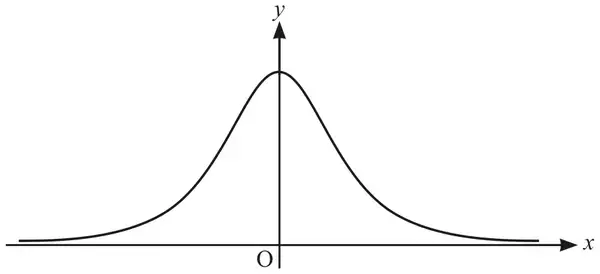
(a) The curve \(y = \dfrac{1}{\left(1 + x^2\right)^2}\) is shown in Fig. 8.
Fig. 8: bell-shaped curve symmetrical about the y-axis, with a maximum on the y-axis, approaching the x-axis on both sides
Fig. 8
(i) Show that \(\dfrac{\mathrm{d}^2y}{\mathrm{d}x^2} = \dfrac{20x^2 - 4}{\left(1 + x^2\right)^4}\). [5]
(ii) In this question you must show detailed reasoning.
Find the set of values of \(x\) for which the curve is concave downwards. [3]
(b) Use the substitution \(x = \tan\theta\) to find the exact value of \(\displaystyle\int_{-1}^{1} \frac{1}{\left(1 + x^2\right)^2}\,\mathrm{d}x\). [8]

October 2020 Paper 3 Q7

OCR MEICurrent spec9 marksAlgebraic FractionsIntegration

7

(a) Express \(\dfrac{1}{x} + \dfrac{1}{A - x}\) as a single fraction. [1]

The population of fish in a lake is modelled by the differential equation

\(\dfrac{\mathrm{d}x}{\mathrm{d}t} = \dfrac{x(400 - x)}{400}\)

where \(x\) is the number of fish and \(t\) is the time in years.

When \(t = 0\), \(x = 100\).

(b) In this question you must show detailed reasoning.
Find the number of fish in the lake when \(t = 10\), as predicted by the model. [8]