
June 2022 Paper 2 Q8
8
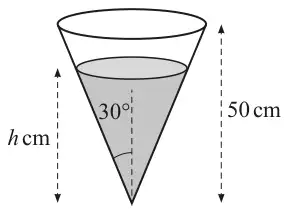
The diagram shows a water tank which is shaped as an inverted cone with semi-vertical angle \(30^\circ\) and height 50 cm. Initially the tank is full, and the depth of the water is 50 cm.
Water flows out of a small hole at the bottom of the tank. The rate at which the water flows out is modelled by \(\dfrac{\mathrm{d}V}{\mathrm{d}t} = -2h\), where \(V\,\mathrm{cm}^3\) is the volume of water remaining and \(h\) cm is the depth of water in the tank \(t\) seconds after the water begins to flow out.
Determine the time taken for the tank to become empty.
[For a cone with base radius \(r\) and height \(h\) the volume \(V\) is given by \(\frac{1}{3}\pi r^2h\).] [7]
| Scheme | Marks | AO |
|---|---|---|
| Summary method: Express \(V\) in terms of \(h\) | B1 | 3.3 |
| Differentiate \(V\) with respect to \(h\) | M1 | 3.4 |
| Attempt chain rule, | M1 | |
| Attempt separate variables | M1 | |
| Correct integrals | A1 | |
| Substitute correct limits | M1 | |
| Answer | A1 | |
| [7] |
Notes
B1: Correct substitution
M1: NOT if \(h = 50\) or \(r = 50\tan 30\) used
M1: Resulting equation must involve exactly 2 variables
M1: Their equation must involve exactly 2 variables
A1: Ignore limits
M1: Integrals must be of correct forms (see examples below)
Note 1 Candidates who substitute numerical values for \(h\) or \(V\) or \(r\) may be able to score the 2nd and/or 3rd M1 marks, but probably nothing else. See the example of this below.
Note 2. There is a special case for candidates who use \(r = h\sin 30\) (answer \(\frac{625\pi}{4}\) or 491).
These can score all 4 M-marks and the final A1
Note 3. The chain rule may be used to find \(\frac{\mathrm{d}V}{\mathrm{d}t}\) or \(\frac{\mathrm{d}h}{\mathrm{d}t}\) or \(\frac{\mathrm{d}V}{\mathrm{d}h}\) or \(\frac{\mathrm{d}V}{\mathrm{d}r}\) or other derivatives. Two of the example methods below illustrate use of \(\frac{\mathrm{d}V}{\mathrm{d}t}\) and \(\frac{\mathrm{d}V}{\mathrm{d}r}\), but use of other derivatives can also lead to correct methods.
Example method 1
| Scheme | Marks | AO |
|---|---|---|
| \(V = \frac{\pi}{3}(h\tan 30^\circ)^2h\) or \(V = \frac{\pi}{3}\left(\dfrac{h}{\sqrt{3}}\right)^2h\) oe | B1 | 3.3 |
| \(\dfrac{\mathrm{d}V}{\mathrm{d}h} = \dfrac{\pi}{3}h^2\) | M1 | 3.4 |
| \(\dfrac{\mathrm{d}V}{\mathrm{d}t} = \dfrac{\pi}{3}h^2\dfrac{\mathrm{d}h}{\mathrm{d}t}\) oe or \(\dfrac{\mathrm{d}h}{\mathrm{d}t} = \dfrac{3}{\pi h^2}\dfrac{\mathrm{d}V}{\mathrm{d}t}\) \(\left(\text{“}\dfrac{\pi}{3}h^2\dfrac{\mathrm{d}h}{\mathrm{d}t}\text{”} = -2h\right.\) oe or \(\left.\dfrac{\mathrm{d}h}{\mathrm{d}t} = \dfrac{-6}{\pi h}\right)\) | M1 | 2.1 |
| \(\displaystyle\pi\int_{50}^{0} h\,\mathrm{d}h = -\int_0^t 6\,\mathrm{d}t\) oe | M1 | 1.1 |
| \(\left[\dfrac{\pi h^2}{2}\right]_{50}^{0} = \left[-6t\right]_0^t\) oe | A1 | 2.1 |
| \(-\pi \times \dfrac{50^2}{2} = -6t\) | M1 | 1.1 |
| Time \(= \dfrac{625\pi}{3}\) secs or 654 secs (3 sf) oe | A1 | 3.4 |
B1: or \(V = \frac{\pi}{9}h^3\) oe
M1: Attempt differentiate their \(V\) in terms of \(h\) only
NOT if \(h = 50\) or \(r = 50\tan 30\) used.
M1: Attempt use chain rule for \(\frac{\mathrm{d}V}{\mathrm{d}t}\) or \(\frac{\mathrm{d}h}{\mathrm{d}t}\) in terms of \(t\) & \(h\) only
(Set their \(\frac{\mathrm{d}V}{\mathrm{d}t} = -2h\))
M1: Attempt separate variables in their equation in terms of \(h\) and \(t\) only (not \(V\) or \(r\)). Integral signs not essential
A1: Correct integrals, any limits or none
M1: Substitute correct limits into integrals of forms \(ah^2\) & \(bt\)
OR substitute \(t = 0\) & \(h = 50\) to find \(c\) and substitute \(h = 0\)
A1: Allow without secs or 10.9 mins or 10 mins 54 secs
or:
SC. Use of \(r = h\sin 30\) (answer \(\frac{625\pi}{4}\) or 491) can score all 4 M-marks and final A1
Example method 2
| Scheme | Marks | AO |
|---|---|---|
| \(V = \dfrac{\pi}{3}r^2\dfrac{r}{\tan 30^\circ}\) or \(V = \dfrac{\pi}{\sqrt{3}}r^3\) oe | B1 | |
| \(\dfrac{\mathrm{d}V}{\mathrm{d}r} = \sqrt{3}\pi r^2\) | M1 | |
| \(\dfrac{\mathrm{d}V}{\mathrm{d}t} = \sqrt{3}\pi r^2\dfrac{\mathrm{d}r}{\mathrm{d}t}\) oe \(\left(\text{“}\sqrt{3}\pi r^2\dfrac{\mathrm{d}r}{\mathrm{d}t}\text{”} = -2r\sqrt{3}\text{ oe}\right)\) | M1 | |
| \(\displaystyle\pi\int_{\frac{50}{\sqrt{3}}}^{0} r\,\mathrm{d}r = -\int_0^t 2\,\mathrm{d}t\) oe | M1 | |
| \(\left[\dfrac{\pi r^2}{2}\right]_{\frac{50}{\sqrt{3}}}^{0} = \left[-2t\right]_0^t\) oe | A1 | |
| \(-\dfrac{\pi \times 50^2}{6} = -2t\) | M1 | |
| Time \(= \dfrac{625\pi}{3}\) secs or 654 secs (3 sf) oe | A1 | 3.4 |
B1: Subst \(h = \dfrac{r}{\tan 30^\circ}\) into correct formula for \(V\)
M1: Attempt use chain rule to find \(\frac{\mathrm{d}V}{\mathrm{d}t}\) or \(\frac{\mathrm{d}r}{\mathrm{d}t}\) in terms of \(t\) and \(r\)
(Set their \(\frac{\mathrm{d}V}{\mathrm{d}t} = -2r\sqrt{3}\) oe)
M1: Attempt separate variables in their equation in terms of \(r\) and \(t\) only (not \(V\) or \(h\)). Integral signs not essential
A1: Correct integrals, any limits or none
M1: Substitute correct limits into integrals of the form \(ar^2\) & \(bt\)
OR substitute \(t = 0\) & \(r = \frac{50}{\sqrt{3}}\) to find \(c\) and substitute \(r = 0\)
A1: Allow without secs or 10.9 mins or 10 mins 54 secs
SC. Use of \(r = h\sin 30\) (answer 491) can score M4A1
Example method 3 (NOT using chain rule)
This method is different from the summary method above
| Scheme | Marks | AO |
|---|---|---|
| \(V = \frac{\pi}{3}(h\tan 30^\circ)^2h\) or \(V = \frac{\pi}{3}\left(\dfrac{h}{\sqrt{3}}\right)^2h\) oe | B1 | 3.3 |
| \(h = \sqrt[3]{\dfrac{9V}{\pi}}\) | M1 | |
| \(\dfrac{\mathrm{d}V}{\mathrm{d}t} = -2 \times \sqrt[3]{\dfrac{9V}{\pi}}\) | M1 | |
| \(\displaystyle\sqrt[3]{\frac{\pi}{9}}\int_{\frac{\pi 50^3}{9}}^{0} V^{-1/3}\,\mathrm{d}V = -2\left[t\right]_0^t\) | M1 | |
| \(\displaystyle\sqrt[3]{\frac{\pi}{9}} \times \frac{3}{2}\left[V^{2/3}\right]_{\frac{\pi 50^3}{9}}^{0} = -2t\) | A1 | |
| \(\displaystyle -\sqrt[3]{\frac{\pi}{9}} \times \frac{3}{2} \times \left(\frac{\pi 50^3}{9}\right)^{2/3} = -2t\) | M1 | |
| Time \(= \dfrac{625\pi}{3}\) secs or 654 secs (3 sf) oe | A1 |
B1: or \(V = \frac{\pi}{9}h^3\) oe
M1: Allow \(h = kV^{1/3}\)
M1: \(\frac{\mathrm{d}V}{\mathrm{d}t} = -2 \times\)(their \(h\) in terms of \(V\))
M1: Attempt separate variables in their equation in terms of \(V\) and \(t\) only (not \(h\) or \(r\)). Integral signs not essential
A1: Correct integrals, any limits or none
M1: Substitute correct limits into integrals of forms \(aV^{2/3}\) & \(bt\)
OR substitute \(t = 0\) & \(V = \frac{\pi 50^3}{9}\) to find \(c\) and substitute \(V = 0\)
A1: Allow without secs or 10.9 mins or 10 mins 54 secs
or:
SC. Use of \(r = h\sin 30\) (answer \(\frac{625\pi}{4}\) or 491) can score all 4 M-marks and final A1
Example incorrect method
| Scheme | Marks |
|---|---|
| \(r = 50/\sqrt{3}\) \(V = \dfrac{\pi}{3} \times 2500 \times \dfrac{h}{3}\) | B0 |
| \(\dfrac{\mathrm{d}V}{\mathrm{d}h} = \dfrac{2500\pi}{9}\) | M0 |
| \(\dfrac{\mathrm{d}V}{\mathrm{d}h} = \dfrac{\mathrm{d}V}{\mathrm{d}t} \times \dfrac{\mathrm{d}t}{\mathrm{d}h}\) \(\dfrac{2500\pi}{9} = -2h\dfrac{\mathrm{d}t}{\mathrm{d}h}\) | M1 |
| \(\dfrac{\mathrm{d}h}{h} = -\dfrac{18}{2500\pi}\,\mathrm{d}t\) | M1 |