(a) Use a suitable substitution to show that\[\int_0^4 (4x + 1)(2x + 1)^{\frac{1}{2}}\,\mathrm{d}x\]can be written as\[\frac{1}{2}\int_a^9 \left(2u^{\frac{3}{2}} - u^{\frac{1}{2}}\right)\mathrm{d}u\]where \(a\) is a constant to be found. [5 marks]
(b) Hence, or otherwise, show that\[\int_0^4 (4x + 1)(2x + 1)^{\frac{1}{2}}\,\mathrm{d}x = \frac{1322}{15}\] [4 marks]
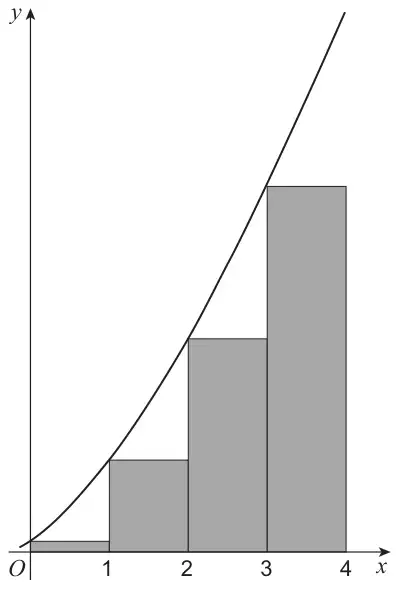
(c) A graph has the equation\[y = (4x + 1)\sqrt{2x + 1}\]A student uses four rectangles to approximate the area under the graph between the lines \(x = 0\) and \(x = 4\)
The rectangles are all the same width.
All the rectangles are drawn under the curve as shown in the diagram below.
The total area of the four rectangles is \(A\)
The student decides to improve their approximation by increasing the number of rectangles used.
Explain why the value of the student’s improved approximation will be greater than \(A\), but less than \(\dfrac{1322}{15}\) [2 marks]
Mark scheme (a)
Scheme
Marks
AO
Selects the substitution \(u = 2x + 1\) and differentiates or uses it to replace \(2x + 1\) in the integrand.
B1
3.1a
Differentiates their substitution and uses the result to replace \(\mathrm{d}x\) in the integral.
M1
1.1a
Makes a complete substitution to write the integrand in terms of \(u\) leading to an integrand of the form \(A(2u - k)u^{\frac{1}{2}}\) Or FT their substitution \(u = (2x + 1)^{\frac{1}{2}}\) or \(u^2 = 2x + 1\) leading to an integrand of the form \(A\left(2u^2 - 1\right)u^2\)
M1
3.1a
Obtains correct lower limit for their substitution
M1
1.1a
Completes a reasoned argument to show the required result with \(a\) = 1
Integrates to obtain \(\dfrac{1}{2}\,\dfrac{4u^{\frac{5}{2}}}{5}\) or \(\dfrac{4u^{\frac{5}{2}}}{5}\) or \(-\dfrac{1}{2}\,\dfrac{2u^{\frac{3}{2}}}{3}\) or \(\dfrac{2u^{\frac{3}{2}}}{3}\)
M1
1.1a
Obtains \(\dfrac{1}{2}\left(\dfrac{4u^{\frac{5}{2}}}{5} - \dfrac{2u^{\frac{3}{2}}}{3}\right)\) or \(\dfrac{4u^{\frac{5}{2}}}{5} - \dfrac{2u^{\frac{3}{2}}}{3}\)
A1
1.1b
Substitutes limits explicitly into their integrated expression of the form \(Au^{\frac{5}{2}} - Bu^{\frac{3}{2}}\) Where A and B are both positive
FT their non-zero \(a\)
Condone omission of powers on substitution of 1
M1
1.1a
Completes argument to show the given result with no unrecovered slips.