
June 2025 Paper 2 Q15
15.
In this question you must show all stages of your working.
Solutions relying on calculator technology are not acceptable.
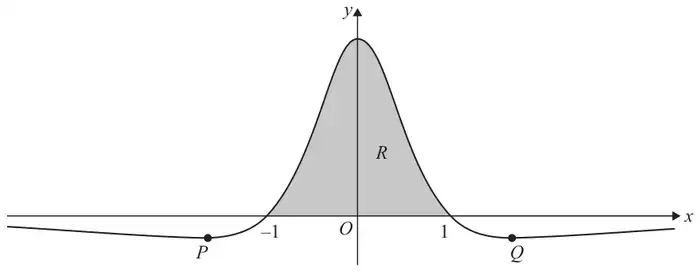
Figure 5 shows a sketch of part of the curve with equation \(y = \mathrm{f}(x)\), where\[\mathrm{f}(x) = \frac{1 - x^2}{\left(1 + x^2\right)^2}\]
The curve
- intersects the \(x\)-axis at \(-1\) and 1
- has minimum turning points at \(P\) and \(Q\)
as shown in Figure 5.
The finite region \(R\), shown shaded in Figure 5, is bounded by the \(x\)-axis and the curve.
| Scheme | Marks | AO |
|---|---|---|
| \(\left(\mathrm{f}^{\prime}(x) =\right)\ \dfrac{\lambda x\left(1 + x^2\right)^2 - \mu x\left(1 - x^2\right)\left(1 + x^2\right)}{\left(1 + x^2\right)^4}\) | M1 | 1.1b |
| \(= \dfrac{-2x\left(1 + x^2\right)^2 - 4x\left(1 - x^2\right)\left(1 + x^2\right)}{\left(1 + x^2\right)^4}\) | A1 | 1.1b |
| e.g. \(\dfrac{-2x\left(1 + x^2\right) - 4x\left(1 - x^2\right)}{\left(1 + x^2\right)^3} = 0\) \(\Rightarrow \left(1 + x^2\right) + 2\left(1 - x^2\right) = 0\) \(\Rightarrow 3 - x^2 = 0\) or e.g. \(= \dfrac{-2x\left(1 + x^2\right)\left[\left(1 + x^2\right) + 2\left(1 - x^2\right)\right]}{\left(1 + x^2\right)^4}\) \(= \dfrac{-2x\left(1 + x^2\right)\left(3 - x^2\right)}{\left(1 + x^2\right)^4}\) | dM1 | 3.1a |
| e.g. \(3 - x^2 = 0\) or \(2x\left(1 + x^2\right)\left(x^2 - 3\right) = 0\) \(\Rightarrow x = \ldots \Rightarrow y = \ldots\) | ddM1 | 2.1 |
| \(\left(-\sqrt{3}, -\dfrac{1}{8}\right)\) | A1 | 2.3 |
| (5) |
Notes
There may be other valid ways to differentiate or to solve the resulting equation.
M1: Attempts the quotient rule to achieve \(\dfrac{\pm\lambda x\left(1 + x^2\right)^2 \pm \mu x\left(1 - x^2\right)\left(1 + x^2\right)}{\left(1 + x^2\right)^4}\)
but condone \(\dfrac{\pm\lambda x\left(1 + x^2\right)^2 \pm \mu x\left(1 - x^2\right)\left(1 + x^2\right)}{\left(1 + x^2\right)^2}\) provided an incorrect quotient rule is not seen.
Alternatively, attempts the product rule on \(\mathrm{f}(x) = \left(1 - x^2\right)\left(1 + x^2\right)^{-2}\) to achieve \(\pm\lambda x\left(1 + x^2\right)^{-2} \pm \mu x\left(1 - x^2\right)\left(1 + x^2\right)^{-3}\)
There may be attempts at splitting the numerator to \(\mathrm{f}(x) = \left(1 + x^2\right)^{-2} - x^2\left(1 + x^2\right)^{-2}\) which should differentiate to \(\pm\lambda x\left(1 + x^2\right)^{-3} \pm \mu x\left(1 + x^2\right)^{-2} \pm \gamma x^3\left(1 + x^2\right)^{-3}\)
In all cases, do not penalise signs of \(\lambda\), \(\mu\) and/or \(\gamma\) unless an incorrect quotient rule or an incorrect product rule is stated.
Any occurrences of \(\left(1 + x^2\right)^2\) may be replaced with \(1 + 2x^2 + x^4\)
There is no need for a LHS e.g. \(\mathrm{f}^{\prime}(x) =\) to be present so ignore an incorrect LHS.
Invisible brackets may be recovered/implied by later work.
A1: Correct differentiation. May be unsimplified. Ignore absence of (or incorrect) LHS.
The correct derivative using the quotient rule is \(= \dfrac{-2x\left(1 + x^2\right)^2 - 4x\left(1 - x^2\right)\left(1 + x^2\right)}{\left(1 + x^2\right)^4}\) o.e.
using the product rule is \(-2x\left(1 + x^2\right)^{-2} - 4x\left(1 - x^2\right)\left(1 + x^2\right)^{-3}\) o.e.
and splitting the numerator is \(-4x\left(1 + x^2\right)^{-3} - 2x\left(1 + x^2\right)^{-2} + 4x^3\left(1 + x^2\right)^{-3}\) o.e.
You may need to check carefully for equivalent derivatives and ISW after a correct expression is seen. Note that some candidates may set = 0 at the start and may omit the denominator as a result – send to review if you are unsure in such cases.
dM1: Attempts to reduce the expression to a suitable form so that the roots can be found, either by cancelling a factor of \(\left(1 + x^2\right)\) and simplifying the other brackets
e.g. \(\dfrac{-2x\left(1 + x^2\right) - 4x\left(1 - x^2\right)}{\left(1 + x^2\right)^3} \rightarrow\) e.g. \(\dfrac{-6x + 2x^3}{\left(1 + x^2\right)^3}\) or \(\dfrac{2x\left(x^2 - 3\right)}{\left(1 + x^2\right)^3}\) or \(2x\left(x^2 - 3\right)\ (= 0)\)
or by attempting to take \(x\), \(\left(1 + x^2\right)\) or \(\pm 2x\left(1 + x^2\right)\) out as a factor and simplify the other brackets. If they only take out a factor of \(x\) then they must have \(x\left(\pm Ax^4 \pm Bx^2 \pm C\right)\)
e.g. \(\dfrac{-2x\left(1 + x^2\right)\left[\left(1 + x^2\right) + 2\left(1 - x^2\right)\right]}{\left(1 + x^2\right)^4} \rightarrow\) e.g. \(\dfrac{-2x\left(1 + x^2\right)\left(3 - x^2\right)}{\left(1 + x^2\right)^4}\) or \(\dfrac{x\left(2x^4 - 4x^2 - 6\right)}{\left(1 + x^2\right)^4}\)
Depends on the first M mark.
Note: they might attempt to expand the brackets first, or set = 0 and multiply through by \(\left(1 + x^2\right)^k\) and/or divide through by \(x\) or \(2x\) at any stage.
Do not be concerned if any factors of \(\left(1 + x^2\right)\), \(x\) or 2 go “missing” during their work.
The = 0 does not explicitly need to be seen.
Look for \(\pm\dfrac{2x\left(1 + x^2\right)\left(Ax^2 + B\right)}{\left(1 + x^2\right)^k}\) or \(\pm\dfrac{\left(1 + x^2\right)\left(Ax^3 + Bx\right)}{\left(1 + x^2\right)^k}\) or \(\pm\dfrac{x\left(Ax^4 + Bx^2 + C\right)}{\left(1 + x^2\right)^k}\) where
- \(k\) may be 0, 1, 2, 3 or 4
- \(A\) and \(B\) (and \(C\) if present) are non-zero
- any of \(2x\) or \(\left(1 + x^2\right)\) in the numerator and/or \(\left(1 + x^2\right)^k\) in the denominator may be absent
ddM1: Attempts to solve their numerator set = 0 using a valid non-calculator method and uses a solution for \(x\) to find a corresponding value for \(y\).
The substitution may be implied by their value of \(y\) but, if not, the substitution must be seen.
- For either \(Ax^2 + B\) or \(Ax^3 + Bx\), we require \(A \neq B\) and \(A \times B \lt 0\) From either expression they can write down their \(x = \pm\sqrt{\dfrac{-B}{A}}\) without working.
- For \(Ax^4 + Bx^2 + C\) they must show a valid non-calculator method for solving the quartic, treating it as a quadratic in \(x^2\) and using the usual rules for solving a quadratic algebraically, e.g. \(a = x^2 \rightarrow 2a^2 - 4a - 6\ (= 0) \rightarrow (a + 1)(2a - 6)\ (= 0) \rightarrow x = \pm\sqrt{3}\). They must reach a value for \(x\) (and not just \(x^2\)) as well as finding a value for \(y\).
Dependent on both previous method marks. They must use a value for \(x\) that is not \(-1\), 0 or 1.
A1: Deduces the correct exact coordinates for \(P\) \(\left(-\sqrt{3}, -\dfrac{1}{8}\right)\) o.e. \(\left(-\sqrt{3}, -0.125\right)\)
Requires all the previous marks to have been scored.
Condone \(x = -\sqrt{3}\), \(y = -0.125\) or e.g. \(-\sqrt{3}, -\dfrac{1}{8}\)
If there is more than one pair of coordinates given, then the correct coordinates must be clearly selected or any others clearly rejected.
Ignore any mistakes that occur if they multiply out the denominator \(\left(1 + x^2\right)^4\) after differentiation.
| Scheme | Marks | AO |
|---|---|---|
| \(x = -1 \Rightarrow \alpha = -\dfrac{\pi}{4}\) and \(x = 1 \Rightarrow \beta = \dfrac{\pi}{4}\) | B1 | 2.2a |
| \(\dfrac{\mathrm{d}x}{\mathrm{d}\theta} = \sec^2\theta\) | B1 | 1.1b |
| \(\displaystyle\int \dfrac{1 - x^2}{\left(1 + x^2\right)^2}\,\mathrm{d}x = \int \dfrac{1 - \tan^2\theta}{\left(1 + \tan^2\theta\right)^2}\text{``}\sec^2\theta\text{''}\,\mathrm{d}\theta\) or \(= \displaystyle\int \dfrac{1 - \tan^2\theta}{\sec^4\theta}\text{``}\sec^2\theta\text{''}\,\mathrm{d}\theta\) | M1 | 1.1b |
| \(= \displaystyle\int \left(1 - \tan^2\theta\right)\cos^2\theta\,\mathrm{d}\theta\) \(= \displaystyle\int \left(1 - \dfrac{\sin^2\theta}{\cos^2\theta}\right)\cos^2\theta\,\mathrm{d}\theta\) \(= \displaystyle\int \left(\cos^2\theta - \sin^2\theta\right)\,\mathrm{d}\theta\) or \(= \displaystyle\int \dfrac{2 - 1 - \tan^2\theta}{\sec^2\theta}\,\mathrm{d}\theta\) \(= \displaystyle\int \left(\dfrac{2}{\sec^2\theta} - \dfrac{1 + \tan^2\theta}{\sec^2\theta}\right)\,\mathrm{d}\theta\) \(= \displaystyle\int \left(2\cos^2\theta - 1\right)\,\mathrm{d}\theta\) | dM1 | 3.1a |
| \(= \displaystyle\int \cos 2\theta\,\mathrm{d}\theta\) * | A1* | 2.1 |
| (5) |
Notes
Mark parts (b) and (c) together.
B1: Deduces the correct limits for the integral in \(\theta\) which may be seen separately as side working or within their integral work. This mark cannot be scored working in degrees.
Allow \(\dfrac{3\pi}{4}\) instead of \(-\dfrac{\pi}{4}\) but not decimal approximations.
B1: \(\dfrac{\mathrm{d}x}{\mathrm{d}\theta} = \sec^2\theta\) or equivalent e.g. \(\dfrac{\mathrm{d}x}{\mathrm{d}\theta} = 1 + x^2\) or \(\dfrac{\cos^2\theta - -\sin^2\theta}{\cos^2\theta}\) (coming from \(x = \dfrac{\sin\theta}{\cos\theta}\)) but must be correct, so not e.g. \(\dfrac{\mathrm{d}x}{\mathrm{d}\theta} = \sec^2 x\) unless recovered.
M1: Makes a complete attempt at using the substitution \(x = \tan\theta\)
Requires:
- An attempt at using \(\dfrac{\mathrm{d}x}{\mathrm{d}\theta}\) to replace \(\mathrm{d}x\) with \(\mathrm{d}\theta\) either way round, so if \(\dfrac{\mathrm{d}x}{\mathrm{d}\theta} = \mathrm{g}(\theta)\) allow either \(\mathrm{d}x = \mathrm{g}(\theta)\{\mathrm{d}\theta\}\) or \(\mathrm{d}x = \dfrac{1}{\mathrm{g}(\theta)}\{\mathrm{d}\theta\}\). \(\dfrac{\mathrm{d}x}{\mathrm{d}\theta}\) must be a function of \(\theta\) and not a constant.
- All terms in \(x\) replaced with \(\tan\theta\) (or \(1 + x^2\) with \(\sec^2\theta\))
Condone the absence of \(\mathrm{d}\theta\) but \(\mathrm{d}x\) must no longer be present.
Condone if they fail to square the denominator or e.g. a slip in missing a \(\theta\)
Use of notation such as \(\mathrm{d}(\tan\theta)\) is correct but does not score the M1 until replaced with \(\sec^2\theta\{\mathrm{d}\theta\}\) or their derivative of \(\tan\theta\) (which must not be a constant multiple of \(\tan\theta\)).
dM1: Uses trigonometric identities e.g. \(\pm 1 \pm \tan^2\theta = \pm\sec^2\theta\), \(\tan\theta = \dfrac{\sin\theta}{\cos\theta}\), \(\sec\theta = \dfrac{1}{\cos\theta}\), \(\pm\cos^2\theta \pm \sin^2\theta = \pm 1\) to simplify the integral to an expression of the form \(\pm a\sin^2\theta \pm b\cos^2\theta \pm c\) where one of \(a\), \(b\) or \(c\) may be 0.
The algebra should essentially be correct but condone e.g. sign slips or errors collecting terms.
Alternatively, e.g. \(\displaystyle\int \dfrac{1 - \tan^2\theta}{1 + \tan^2\theta}\,\mathrm{d}\theta = \int \dfrac{\cos^2\theta - \sin^2\theta}{\cos^2\theta + \sin^2\theta}\,\mathrm{d}\theta = \int \dfrac{\cos^2\theta - \sin^2\theta}{1}\,\mathrm{d}\theta\)
They must have replaced \(\mathrm{d}x\) with \(\mathrm{d}\theta\) the correct way round for this mark, so if \(\dfrac{\mathrm{d}x}{\mathrm{d}\theta} = \mathrm{g}(\theta)\) then they must have \(\mathrm{d}x = \mathrm{g}(\theta)\{\mathrm{d}\theta\}\) and not \(\mathrm{d}x = \dfrac{1}{\mathrm{g}(\theta)}\{\mathrm{d}\theta\}\)
It is acceptable to replace e.g. \(\tan^2\theta\cos^2\theta\) with \(\sin^2\theta\)
Dependent on the previous method mark.
A1*: cso Arrives at \(\displaystyle\int \cos 2\theta\,\mathrm{d}\theta\) with sufficient working shown and no incorrect work ignoring limits. The final line must be fully correct, including the integral sign and \(\mathrm{d}\theta\) (ignoring limits). Note that this may be seen in part (c) and may score the mark.
All trigonometric identities must be fully correct.
Condone one or two slips in a missing \(\theta\) but not frequent omissions.
Condone missing integral signs in their intermediate work, but it must be present on the final line.
\(\mathrm{d}x\) must be replaced with \(\mathrm{d}\theta\) at some stage before the final line but does not need to be present in every intermediate line of working.
Condone notational errors throughout e.g. \(\sin\theta^2\) provided they are recovered.
This mark is independent from any work to do with limits, i.e., B0B1M1dM1A1* is possible.
| Scheme | Marks | AO |
|---|---|---|
| \(\displaystyle\int \cos 2\theta\,\mathrm{d}\theta = \dfrac{1}{2}\sin 2\theta\) | M1 | 1.1b |
| \(\left[\dfrac{1}{2}\sin 2\theta\right]_{\text{``}{-}\frac{\pi}{4}\text{''}}^{\text{``}\frac{\pi}{4}\text{''}} = \dfrac{1}{2}\sin\left(2 \times \dfrac{\pi}{4}\right) - \dfrac{1}{2}\sin\left(2 \times -\dfrac{\pi}{4}\right)\) | dM1 | 1.1b |
| \(= 1\) | A1 | 2.1 |
| (3) | ||
| (13 marks) |
Notes
Mark parts (b) and (c) together.
M1: \(\displaystyle\int \cos 2\theta\,\mathrm{d}\theta \rightarrow \pm\dfrac{1}{2}\sin 2\theta\ \{+c\}\)
dM1: Substitutes their changed limits (not 1 and \(-1\)) into \(\pm\dfrac{1}{2}\sin 2\theta\) and subtracts either way round.
May be implied e.g. \(\dfrac{1}{2} + \dfrac{1}{2}\) provided they have the correct limits.
Dependent on the previous method mark.
A1: Area of 1 found following correct work. This mark requires clear substitution of the correct limits into \(\dfrac{1}{2}\sin 2\theta\) the correct way round. If they have the limits the wrong way round and achieve an answer of \(-1\) they cannot just make the answer positive for this mark.
They may use limits from 0 to \(\dfrac{\pi}{4}\) and multiply their result by 2.
\(\dfrac{3\pi}{4}\) may be used in place of \(-\dfrac{\pi}{4}\) as the lower limit which is acceptable.
Condone any spurious integral symbol accompanying \(\dfrac{1}{2}\sin 2\theta\)
The substitution may be implied by e.g. \(\dfrac{1}{2} - -\dfrac{1}{2}\) or \(\dfrac{1}{2}\sin\left(\dfrac{\pi}{2}\right) - \dfrac{1}{2}\sin\left(-\dfrac{\pi}{2}\right)\) but must follow sight of \(\dfrac{1}{2}\sin 2\theta\)
Condone use of limits \(-45\) and 45 (degrees) the correct way round for full marks in part (c).
Note that use of a calculator on the original integral will give the correct answer. An answer of 1 scores no marks without evidence of scoring both method marks above including the substitution.