(a) Given that\[\frac{1}{16 - 9x^2} \equiv \frac{A}{4 - 3x} + \frac{B}{4 + 3x}\]find the values of \(A\) and \(B\) [3 marks]
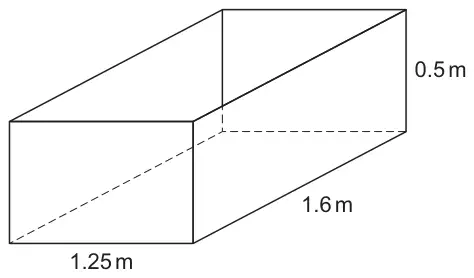
(b) An empty container, in the shape of a cuboid, has length 1.6 metres, width 1.25 metres and depth 0.5 metres, as shown in the diagram below.
The container has a small hole in the bottom.
Water is poured into the container at a rate of 0.16 cubic metres per minute.
At time \(t\) minutes after the container starts to be filled, the depth of water is \(d\) metres and water leaks out at a rate of \(0.36d^2\) cubic metres per minute.
At time \(t\) minutes after the container starts to be filled, the volume of water in the container is \(V\) cubic metres.
(i) Show that\[\frac{\mathrm{d}V}{\mathrm{d}t} = \frac{16 - 9V^2}{100}\] [4 marks]
(ii) Hence, find \(t\) in terms of \(V\) [5 marks]
(iii) Determine how long it takes to fill the container with water.
Give your answer to the nearest minute. [2 marks]
Mark scheme (a)
Scheme
Marks
AO
Uses a suitable method and finds a value for \(A\) or \(B\). For example Rearranges and substitutes values or compares coefficients Or Uses cover-up method Or Uses inspection PI by \(A\) correct or \(B\) correct.
M1
1.1a
Obtains \(A = \dfrac{1}{8}\)
A1
1.1b
Obtains \(B = \dfrac{1}{8}\)
A1
1.1b
(3)
Typical solution
\[\frac{1}{(4 - 3x)(4 + 3x)} \equiv \frac{A}{4 - 3x} + \frac{B}{4 + 3x}\]\[1 \equiv A(4 + 3x) + B(4 - 3x)\]\[\text{Let } x = -\frac{4}{3}\]\[1 \equiv 8B \Rightarrow B = \frac{1}{8}\]\[\text{comparing } x \text{ terms } A = B = \frac{1}{8}\]
Mark scheme (b)
Scheme
Marks
AO
(i) Forms differential equation using \(\dfrac{\mathrm{d}V}{\mathrm{d}t} = \pm 0.16 \pm 0.36d^2\)
M1
3.3
Obtains \(V = 1.25 \times 1.6d\) OE
B1
3.1b
Substitutes their expression for d into \(\dfrac{\mathrm{d}V}{\mathrm{d}t} = \pm 0.16 \pm 0.36d^2\) to obtain a differential equation in \(V\) and \(t\) only.
M1
3.1a
Completes reasoned argument to show the given result. AG
R1
2.1
(4)
(ii) Rearranges to obtain one of the following:\[\begin{gathered} \frac{P}{16 - 9V^2}\,\mathrm{d}V = \frac{1}{Q}\,\mathrm{d}t \\ \frac{P}{16 - 9V^2}\frac{\mathrm{d}V}{\mathrm{d}t} = \frac{1}{Q} \\ \frac{P}{16 - 9V^2} = \frac{1}{Q}\frac{\mathrm{d}t}{\mathrm{d}V} \end{gathered}\]where \(P \times Q = 100\) If their P = 100 no need to see \(\dfrac{1}{Q}\) explicit with d\(t\)
May include integral signs PI \(\displaystyle\int \frac{100}{16 - 9V^2}\,\mathrm{d}V = t\)
B1
3.1a
Integrates their constant integrand correctly with respect to \(t\). Follow through any constant.
B1F
1.1b
Writes \(\displaystyle\int \frac{1}{16 - 9V^2}\,\mathrm{d}V\) as \(\displaystyle\int \frac{A}{4 - 3V} + \frac{B}{4 + 3V}\,\mathrm{d}V\) Condone missing \(\mathrm{d}V\) PI by \(-\dfrac{A}{3}\ln(4 - 3V) + \dfrac{B}{3}\ln(4 + 3V)\)
M1
3.1a
Integrates their partial fractions correctly to obtain \(-\dfrac{A}{3}\ln(4 - 3V) + \dfrac{B}{3}\ln(4 + 3V) \quad (+c)\) OE Their \(A\) and \(B\) may be correctly inside the natural logs for example \(\dfrac{1}{24}\left(-\ln(32 - 24V) + \ln(32 + 24V)\right)\)
A1F
1.1b
Completes argument, including demonstrating that the constant of integration is zero.
R1
2.1
(5)
(iii) Obtains a value for \(t\) by substituting \(V = 1\) into their expression for \(t\) from their final answer from b(ii) PI by 8 minutes from a correct answer from b(ii)
M1
3.4
Obtains 8 minutes following a correct answer in b(ii) Condone missing units
We'd like to use Google Analytics cookies to count visits and see which pages help most. They're optional, and the site works exactly the same either way. Privacy policy