
June 2024 Paper 2 Q4
4 The diagram shows part of the graph of \(y = x\mathrm{e}^{1-3x}\).
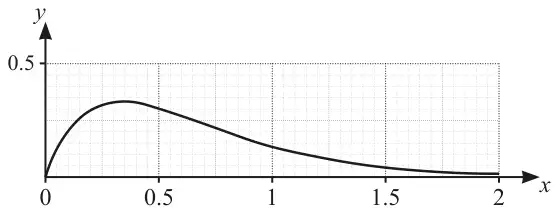
Determine the exact area of the region enclosed by the curve \(y = x\mathrm{e}^{1-3x}\), the \(x\)-axis and the line \(x = 1\). [4]
| Scheme | Marks | AO |
|---|---|---|
| \(x\mathrm{e}^{1-3x} - 0.2\) evaluated for any two values of \(x\) that give results with opposite signs. | M1 | 3.1a |
| \(x = 0.79\) (2dp) | B1 | 1.1 |
| (\(x = 0.79\) to 2 dp) because the change of sign occurs between 0.785 and 0.795. | A1 | 2.2a |
| [3] |
Notes
M1: Values of iterates not needed, i.e. condone \(\lt 0\) and \(\gt 0\) etc. but signs (and values if given) must be correct to 1sf – see table.
B1: cao (Allow this mark even with no/insufficient working).
A1: By showing two values between 0.785-0.795 with opposite signs
Values of iterates not needed, i.e. condone \(\lt 0\) and \(\gt 0\) etc, but if given must be correct to 1sf
e.g. \(x = 0.79 \Rightarrow y = 0.0007\) and \(x = 0.795 \Rightarrow y = -0.0009\)
| \(x\) | \(x\mathrm{e}^{1-3x} - 0.2\) |
|---|---|
| 0.1 | 0.00138 |
| 0.5 | 0.10327 |
| 0.7 | 0.03301 |
| 0.75 | 0.01488 |
| 0.78 | 0.00424 |
| 0.785 | 0.00249 |
| 0.786 | 0.00214 |
| 0.787 | 0.00179 |
| 0.788 | 0.00144 |
| 0.789 | 0.00109 |
| 0.79 | 0.00074 |
| 0.791 | 0.00040 |
| 0.792 | 0.00005 |
| 0.793 | −0.00030 |
| 0.794 | −0.00065 |
| 0.795 | −0.00099 |
| 0.796 | −0.00134 |
| 0.797 | −0.00169 |
| 0.798 | −0.00203 |
| 0.799 | −0.00238 |
| 0.8 | −0.00272 |
| 1 | −0.06466 |
(Note that exact root is 0.792…)
| Scheme | Marks | AO |
|---|---|---|
| \(\dfrac{\mathrm{d}y}{\mathrm{d}x} = \mathrm{e}^{1-3x} + x(-3)\mathrm{e}^{1-3x}\ (= 0)\) | M1 | 3.1a |
| \(\mathrm{e}^{1-3x}\) is never 0, hence can divide by it \(\left(\mathrm{e}^{1-3x}(1 - 3x) = 0\right)\) \((\rightarrow\ 1 - 3x = 0)\) | B1 | 2.1 |
| \(x = \dfrac{1}{3}\) | A1 | 1.1 |
| [3] |
Notes
M1: For an attempt at differentiating using the product rule, with at least one term correct (their derivative must have two terms).
B1: May be implied by not giving a corresponding solution (provided another solution for \(x\) is reached). (NB this mark can be gained following M0 provided their derivative has \(\mathrm{e}^{1-3x}\) as a factor)
A1: Not decimal, www (i.e. must come from a correct derivative)
| Scheme | Marks | AO |
|---|---|---|
| DR \(\displaystyle\int_0^1 x\mathrm{e}^{1-3x}\,\mathrm{d}x = \left[x\frac{\mathrm{e}^{1-3x}}{-3}\right]_0^1 - \int_0^1 \frac{\mathrm{e}^{1-3x}}{-3}\,\mathrm{d}x\) oe | M1 | 3.1a |
| A1 for both terms correct | A1 | 2.1 |
| \(\displaystyle = \left[x\frac{\mathrm{e}^{1-3x}}{-3}\right]_0^1 - \left[\frac{\mathrm{e}^{1-3x}}{9}\right]_0^1\) | A1 | 2.1 |
| \(= \dfrac{1}{9}\mathrm{e} - \dfrac{4}{9}\mathrm{e}^{-2}\) or \(\dfrac{\mathrm{e}^3 - 4}{9\mathrm{e}^2}\) oe | A1 | 1.1 |
| [4] |
Notes
M1: M1 for attempting integration by parts with at least one term correct, must see limits (condone swapped limits, may appear later). Must have two terms.
A1: A1 for both terms correct after 2nd integral performed
A1: Need not be simplified, isw any incorrect attempts to simplify