
June 2024 Paper 3 Q5
5
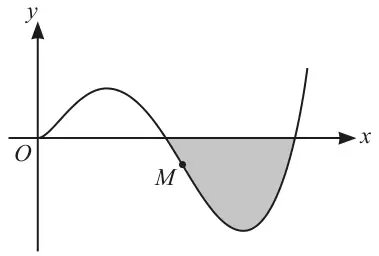
The diagram shows the curve with equation \(y = \left(x^3 - 2x^2\right)\ln x\). The curve has a point of inflection at the point \(M\).
| Scheme | Marks | AO |
|---|---|---|
| (i) \(y = \left(x^3 - 2x^2\right)\ln x \Rightarrow \dfrac{\mathrm{d}y}{\mathrm{d}x} = \ldots\) | M1 | 2.1 |
| \(\dfrac{\mathrm{d}y}{\mathrm{d}x} = \left(x^3 - 2x^2\right)\left(\dfrac{1}{x}\right) + \left(3x^2 - 4x\right)\ln x\) | A1 | 1.1 |
| \(\dfrac{\mathrm{d}^2y}{\mathrm{d}x^2} = 2x - 2 + \dfrac{3x^2 - 4x}{x} + (6x - 4)\ln x\) | A1 | 1.1 |
| \(\dfrac{\mathrm{d}^2y}{\mathrm{d}x^2} = 0 \Rightarrow 2x - 2 + \dfrac{3x^2 - 4x}{x} + (6x - 4)\ln x = 0\) | M1 | 1.1 |
| \(5x - 6 = (4 - 6x)\ln x \Rightarrow x = \dfrac{6 + (4 - 6x)\ln x}{5}\) | A1 | 2.2a |
| [5] | ||
| (ii) \(x_{n+1} = \dfrac{6 + (4 - 6x_n)\ln x_n}{5}\) \(x_1 = 1.1\) \(x_2 = 1.150438\ldots\) \(x_3 = 1.118643\ldots\) \(x_4 = 1.139191\ldots\) \(x_5 = 1.126105\ldots\) \(x_6 = 1.134521\ldots\) | B1 | 1.1 |
| \(x\)-coordinate of \(M\) is 1.13 | B1 | 2.2a |
| [2] |
Notes
(a)(i)
M1: M1 for attempt to differentiate using the product rule (oe) – answer must be of the form \(\left(x^3 - 2x^2\right) \times \dfrac{k_1}{x} + \left(k_2x^2 + k_3x\right)\ln x\) for non-zero constants \(k_1, k_2, k_3\)
Condone invisible brackets for this mark
A1: A1 for a correct first derivative (allow un-simplified)
Condone invisible brackets but only if correctly recovered at some stage
A1: A1 for a correct second derivative (allow un-simplified)
Condone invisible brackets but only if correctly recovered at some stage
M1: Setting the second derivative (which if simplified would be of the form \(ax + b + (cx + d)\ln x\) with non-zero constants \(a\), \(b\), \(c\) and \(d\)) equal to zero
A1: AG – so sufficient working must be shown – at least one intermediate line of working from second derivative set equal to zero to given answer
Any errors seen (e.g. any missing/invisible brackets) is A0
(a)(ii)
B1: Uses given result and given starting value (of 1.1) to obtain correct \(x_2\) and \(x_3\) (so first two iterations after the initial value of 1.1) to at least 2 dp (rot) – but all stated values in these two terms must be correct
B1: Must be stated to 2 dp only – not dependent on the first B mark – can be awarded if either of \(x_2\) and \(x_3\) are incorrect (assume that the iterative process corrected itself or a slip in the candidate writing down an earlier value)
Must be clear that \(x\) is 1.13 (and not the final term shown in the iterative process e.g. \(x_6 = 1.13\) only is B0) – this mark can be awarded from using alternative iterative methods e.g. Newton-Raphson
| Scheme | Marks | AO |
|---|---|---|
| Curve crosses the \(x\)-axis at 1 and 2 | B1* | 3.1a |
| \(\displaystyle\int \left(x^3 - 2x^2\right)\ln x\,\mathrm{d}x = \ldots\) | M1* | 2.1 |
| \(\displaystyle = \left(\frac{1}{4}x^4 - \frac{2}{3}x^3\right)\ln x - \int \left(\frac{1}{4}x^4 - \frac{2}{3}x^3\right)\left(\frac{1}{x}\right)\mathrm{d}x\) | A1 | 1.1 |
| \(\displaystyle = \left(\frac{x^4}{4} - \frac{2x^3}{3}\right)\ln x - \frac{x^4}{16} + \frac{2x^3}{9}\ (+c)\) | A1 | 1.1 |
| \(\displaystyle \left\{\left(\frac{16}{4} - \frac{16}{3}\right)\ln 2 - 1 + \frac{16}{9}\right\} - \left\{0 - \frac{1}{16} + \frac{2}{9}\right\}\) | M1dep* | 1.1 |
| \(\displaystyle \int_1^2 \left(x^3 - 2x^2\right)\ln x\,\mathrm{d}x = -\frac{4}{3}\ln 2 + \frac{89}{144}\) \(\displaystyle \Rightarrow \text{Area} = \frac{4}{3}\ln 2 - \frac{89}{144}\) | A1 | 3.2a |
| [6] |
Notes
B1*: Correct \(x\)-intercepts (soi) – ignore mention of \(x = 0\)
Could be seen as limits on integral(s)
M1*: M1 for attempt at integration by parts – must be of the form \(\left(ax^4 + bx^3\right)\ln x \pm \int \left(cx^4 + dx^3\right) \times \frac{1}{x}\,(\mathrm{d}x)\) for non-zero constants \(a\), \(b\), \(c\) and \(d\)
Limits not required for this and the next two A marks (so condone incorrect limits too for these 3 marks)
A1: correct first application (allow un-simplified)
\(\mathrm{d}x\) not required and integral sign(s) can be implied
A1: cao (allow un-simplified)
M1dep*: Uses correct limits completely correctly \(\pm(F(2) - F(1))\) in their fully integrated expression – need not be simplified (or equivalent)
Do not condone invisible brackets unless recovered
A1: Must be of this form but allow exact equivalents (for example, \(\frac{1}{3}\ln 16 - \frac{89}{144}\)) but the \(p\) and \(r\) must be positive rational numbers and \(q\) must be a positive integer
For reference – one possibility is: \(p = \frac{4}{3}, q = 2, r = \frac{89}{144}\)
These values do not need to be stated explicitly
Be aware of those who consider \(\int_1^2 \left(2x^2 - x^3\right)\ln x\,\mathrm{d}x\) which is correct