
October 2020 Paper 3 Q8
8
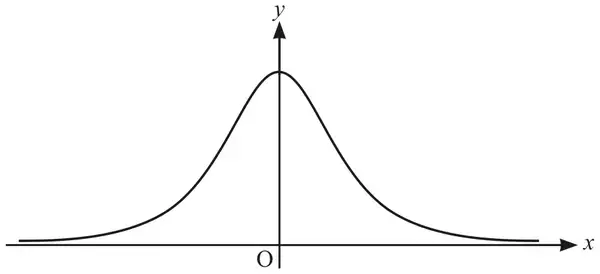
Find the set of values of \(x\) for which the curve is concave downwards. [3]
| Scheme | Marks | AO |
|---|---|---|
| (i) \(\dfrac{\mathrm{d}y}{\mathrm{d}x} = \dfrac{-4x}{\left(x^2 + 1\right)^3}\) | M1 A1 | 1.1a 1.1 |
| \(\dfrac{\mathrm{d}^2y}{\mathrm{d}x^2} = \dfrac{-4\left(x^2 + 1\right)^3 + 4x.2x.3\left(x^2 + 1\right)^2}{\left(x^2 + 1\right)^6}\) | M1 A1 | 1.1a 1.1 |
| \(\dfrac{\mathrm{d}^2y}{\mathrm{d}x^2} = \dfrac{-4\left(x^2 + 1\right) + 24x^2}{\left(x^2 + 1\right)^4}\) \(\Rightarrow \dfrac{\mathrm{d}^2y}{\mathrm{d}x^2} = \dfrac{20x^2 - 4}{\left(x^2 + 1\right)^4}\) | A1 | 2.1 |
| [5] | ||
| (ii) DR For concave downwards, \(\dfrac{20x^2 - 4}{\left(x^2 + 1\right)^4} < 0\) so \(20x^2 - 4 < 0\) | M1 | 2.2a |
| \(5x^2 < 1\) so \(x^2 < \frac{1}{5}\) | M1 | 1.1 |
| \(-\dfrac{1}{\sqrt{5}} < x < \dfrac{1}{\sqrt{5}}\) | A1 | 2.5 |
| [3] |
Notes
(i) M1: Attempt to differentiate
chain or quotient or product rule
(i) A1: Correct first derivative
Don’t have to simplify
(i) M1: Attempt to use quotient rule to find second derivative
For each M1 allow one error
(i) A1: Any correct expression for second derivative
(i) A1: Simplifying expression for second derivative by cancelling \((x^2 + 1)\) and correct completion (AG)
(ii) M1: Or \(x = \pm\dfrac{1}{\sqrt{5}}\)
Condone \(x^2 > \frac{1}{5}\) following \(y'' > 0\) for M1
(ii) A1: Correct solution correctly expressed
Allow decimals (\(\pm 0.447\))
| Scheme | Marks | AO |
|---|---|---|
| \(\dfrac{\mathrm{d}x}{\mathrm{d}\theta} = \sec^2\theta\) | M1 | 1.1a |
| \(\displaystyle\int_{x=-1}^{x=1} \frac{\sec^2\theta}{\left(1 + \tan^2\theta\right)^2}\,\mathrm{d}\theta\) | M1 | 1.1 |
| \(\displaystyle\int_{-\frac{\pi}{4}}^{\frac{\pi}{4}} \frac{\sec^2\theta}{\left(1 + \tan^2\theta\right)^2}\,\mathrm{d}\theta\) | M1 | 1.1 |
| \(\displaystyle\int_{-\frac{\pi}{4}}^{\frac{\pi}{4}} \frac{1}{\sec^2\theta}\,\mathrm{d}\theta\) | M1 | 2.2a |
| \(\displaystyle\int_{-\frac{\pi}{4}}^{\frac{\pi}{4}} \cos^2\theta\,\mathrm{d}\theta\) | M1 | 1.1 |
| \(\displaystyle\int_{-\frac{\pi}{4}}^{\frac{\pi}{4}} \frac{1}{2}(\cos 2\theta + 1)\,\mathrm{d}\theta\) | M1 | 3.1a |
| \(\dfrac{1}{2}\left[\dfrac{1}{2}\sin 2\theta + \theta\right]_{-\frac{\pi}{4}}^{\frac{\pi}{4}}\) | M1 | 1.1 |
| \(\dfrac{1}{2}\left(1 + \dfrac{\pi}{2}\right) = \dfrac{1}{2} + \dfrac{\pi}{4}\) | A1 | 2.1 |
| [8] |
Notes
M1: o.e.
Condone \(\sec^2 x\)
M1: Substitution for either \(x\) or \(\mathrm{d}x\) (limits may be missing)
M1: Limits (may be done at any point)
M1: Use of \(1 + \tan^2\theta = \sec^2\theta\)
M1: Use of \(\sec\theta = \dfrac{1}{\cos\theta}\)
M1: Use of \(\cos 2\theta = 2\cos^2\theta - 1\)
M1: Integration. Must include at least one trig term. Limits may be wrong or missing
A1: Exact form