Sketching & Transforming Graphs

Edexcel

AQA

OCR A

OCR MEI

June 2025 Paper 2 Q12

12.
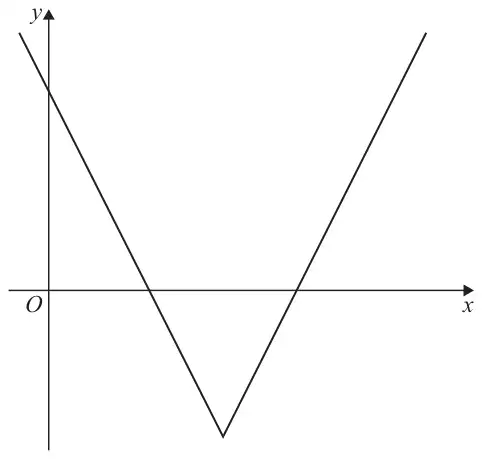
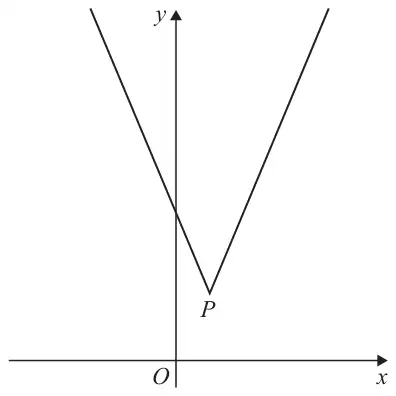
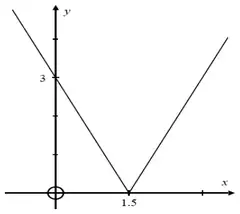
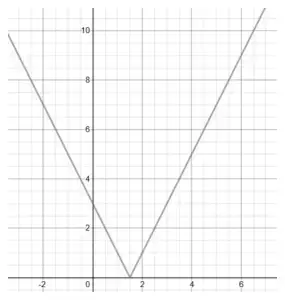
Figure 3: a V-shaped graph y = f(x) with its vertex below the x-axis to the right of the y-axis; the left branch crosses the positive y-axis and both branches cross the positive x-axis
Figure 3

Figure 3 shows a sketch of the graph with equation \(y = \mathrm{f}(x)\) where\[\mathrm{f}(x) = 4\left|x - 3\right| - 5 \qquad x \in \mathbb{R}\]

Given that \(a\) is a constant and \(\left|a\right| = 1\)

(a) find the possible values of \(\mathrm{f}(a)\) (2)

The function g is defined by\[\mathrm{g}(x) = 2x + 17 \qquad x \in \mathbb{R}\]

(b) Find the range of \(\mathrm{gf}(x)\) (2)

The function h is defined by\[\mathrm{h}(x) = kx \qquad x \in \mathbb{R}\]where \(k\) is a constant.

Given that the equation \(\mathrm{f}(x) = \mathrm{h}(x)\) has no solutions,

(c) find the range of values of \(k\). (4)

June 2025 Paper 1 Q7

7.

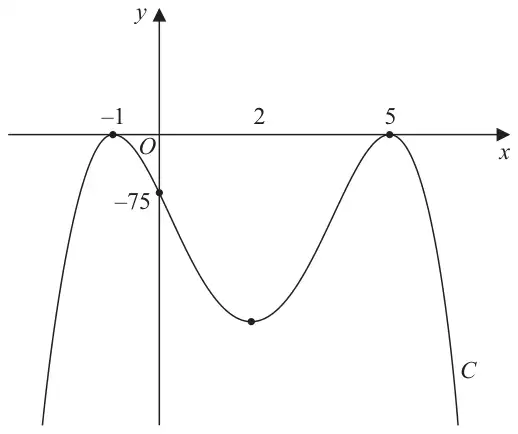
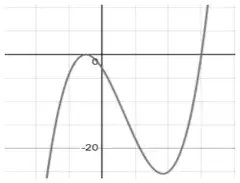
Figure 1: quartic curve C touching the x-axis at maximum points x = −1 and x = 5, crossing the y-axis at −75, with a minimum point at x = 2
Figure 1

Figure 1 shows a sketch of a curve \(C\) with equation \(y = \mathrm{f}(x)\), where \(\mathrm{f}(x)\) is a quartic expression in \(x\).

The curve

  • has maximum turning points at \((-1,\ 0)\) and \((5,\ 0)\)
  • crosses the \(y\)-axis at \((0,\ -75)\)
  • has a minimum turning point at \(x = 2\)
(a) Find the set of values of \(x\) for which\[\mathrm{f}^{\prime}(x) \geqslant 0\]writing your answer in set notation. (2)
(b) Find the equation of \(C\). You may leave your answer in factorised form. (3)

The curve \(C_1\) has equation \(y = \mathrm{f}(x) + k\), where \(k\) is a constant.

Given that the graph of \(C_1\) intersects the \(x\)-axis at exactly four places,

(c) find the range of possible values for \(k\). (2)

June 2025 Paper 1 Q1

1. The point \(P(6,\ -4)\) lies on the curve with equation \(y = \mathrm{f}(x),\ x \in \mathbb{R}\)

Find the point to which \(P\) is mapped when the curve with equation \(y = \mathrm{f}(x)\) is transformed to the curve with equation

(a) \(y = \mathrm{f}(x+2)\) (1)
(b) \(y = \mathrm{f}^{-1}(x)\) (1)
(c) \(y = 2\lvert\mathrm{f}(x)\rvert - 3\) (2)

June 2024 Paper 1 Q6

6.

Figure 1: V-shaped graph of y = 3|x − 2| + 5 with vertex P above the positive x-axis, crossing the positive y-axis
Figure 1

Figure 1 shows a sketch of the graph with equation

\[y = 3\lvert x-2 \rvert + 5\]

The vertex of the graph is at the point \(P\), shown in Figure 1.

(a) Find the coordinates of \(P\). (2)
(b) Solve the equation\[16 - 4x = 3\lvert x-2 \rvert + 5\] (2)

A line \(l\) has equation \(y = kx + 4\) where \(k\) is a constant.

Given that \(l\) intersects \(y = 3\lvert x-2 \rvert + 5\) at 2 distinct points,

(c) find the range of values of \(k\). (2)

June 2024 Paper 2 Q3

EdexcelCurrent spec4 marksSketching & Transforming Graphs

3. The point \(P(3, -2)\) lies on the curve with equation \(y = \mathrm{f}(x),\ x \in \mathbb{R}\)

Find the coordinates of the point to which \(P\) is mapped when the curve with equation \(y = \mathrm{f}(x)\) is transformed to the curve with equation

(i) \(y = \mathrm{f}(x-2)\)
(ii) \(y = \mathrm{f}(2x)\)
(iii) \(y = 3\mathrm{f}(-x) + 5\) (4)

June 2025 Paper 3 Q9

9

(a) Describe a sequence of two transformations which maps the graph with equation\[y = \frac{1}{x}\]onto the graph with equation\[y = \frac{3}{x - 4}\] [2 marks]
(b) State the equation of the vertical asymptote of the graph with equation\[y = \frac{3}{x - 4}\] [1 mark]
(c) A student is attempting to use a change of sign to determine if the equation\[\frac{3}{x - 4} = x\]has a solution between 3 and 5

The student correctly writes

\[\frac{3}{x - 4} = x \Leftrightarrow \frac{3}{x - 4} - x = 0\]\[\text{Let } \mathrm{f}(x) = \frac{3}{x - 4} - x\]\[\mathrm{f}(3) = -6 \lt 0 \ \text{ and } \ \mathrm{f}(5) = -2 \lt 0\]

The student then incorrectly states:

“Since there is no change of sign, there is no solution between 3 and 5”

Give two reasons why the student’s argument is invalid.

[2 marks]

June 2025 Paper 1 Q7

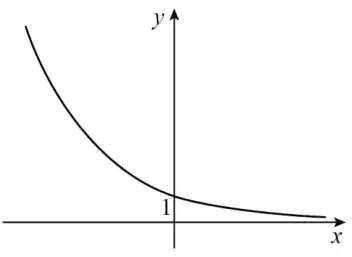
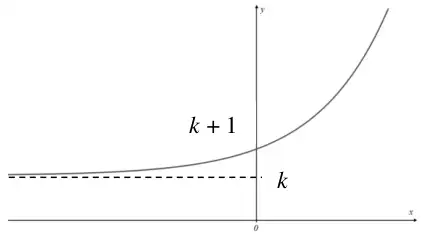
7 It is given that \(0 \lt a \lt 1\)

Sketch the graph with equation

\[y = a^{x}\]

on the axes below. [2 marks]

Blank axes: x-axis and y-axis meeting at the origin O

June 2025 Paper 3 Q5

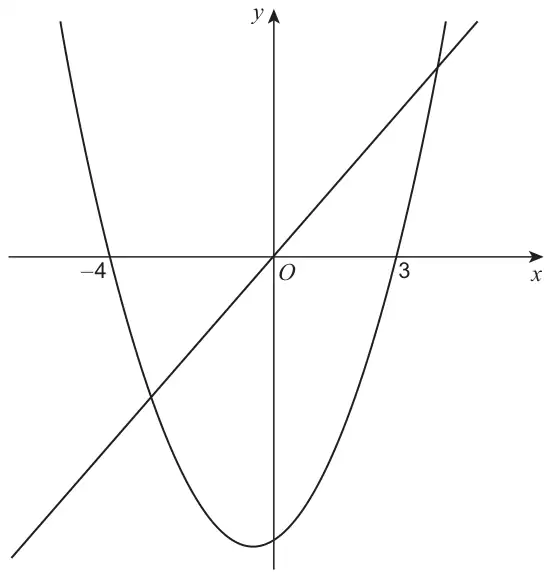
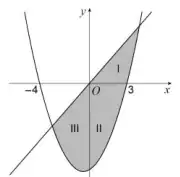
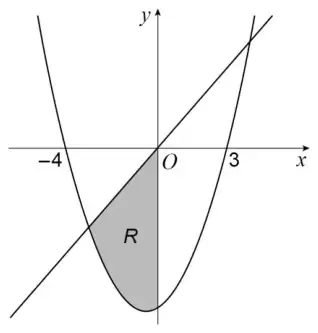
5 The diagram shows the graphs of \(y = 2x\) and \(y = (x - 3)(x + 4)\).

The line y = 2x through the origin and the U-shaped parabola y = (x − 3)(x + 4) crossing the x-axis at −4 and 3; the line meets the parabola twice

The region R is defined by the inequalities

\[(x - 3)(x + 4) \leqslant y \leqslant 2x \ \textbf{ and } \ x \leqslant 0\]

Shade the region R on the diagram. [2 marks]

June 2025 Paper 2 Q1

1 Describe the single transformation which maps the curve with the equation

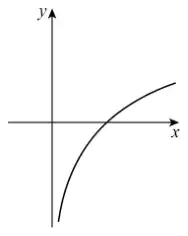
\[y = \ln x\]

onto the curve with the equation

\[y = 2\ln x\]

Tick (✓) one box. [1 mark]

  • Stretch, scale factor 2, parallel to the \(y\)-axis
  • Stretch, scale factor \(\dfrac{1}{2}\), parallel to the \(x\)-axis
  • Translation \(\begin{bmatrix}2\\0\end{bmatrix}\)
  • Translation \(\begin{bmatrix}0\\2\end{bmatrix}\)

June 2024 Paper 1 Q11

11 It is given that

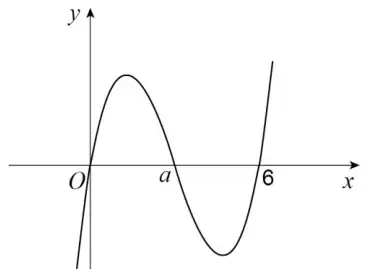
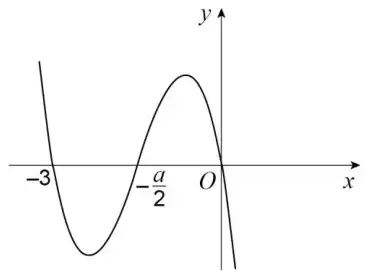
\[\mathrm{f}(x) = x(x - a)(x - 6)\]

where \(0 \lt a \lt 6\)

(a) Sketch the graph of \(y = \mathrm{f}(x)\) on the axes below. [3 marks]
(b) Sketch the graph of \(y = \mathrm{f}(-2x)\) on the axes below. [2 marks]

June 2023 Paper 3 Q6

6

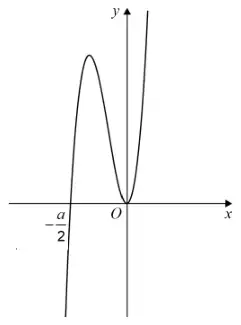
(a) Sketch the curve with equation\[y = x^2(2x + a)\]

where \(a \gt 0\) [3 marks]

(b) The polynomial \(\mathrm{p}(x)\) is given by\[\mathrm{p}(x) = x^2(2x + a) + 36\]
(i) It is given that \(x + 3\) is a factor of \(\mathrm{p}(x)\)

Use the factor theorem to show \(a = 2\) [2 marks]

(ii) State the transformation which maps the curve with equation\[y = x^2(2x + 2)\]

onto the curve with equation

\[y = x^2(2x + 2) + 36\] [2 marks]
(iii) The polynomial \(x^2(2x + 2) + 36\) can be written as \((x + 3)(2x^2 + bx + c)\)

Without finding the values of \(b\) and \(c\), use your answers to parts (a) and (b)(ii) to explain why

\[b^2 \lt 8c\] [2 marks]

June 2023 Paper 1 Q3

3 The curve with equation \(y = \ln x\) is transformed by a stretch parallel to the \(x\)-axis with scale factor 2

Find the equation of the transformed curve.

Circle your answer. [1 mark]

  • \(y = \dfrac{1}{2}\ln x\)
  • \(y = 2\ln x\)
  • \(y = \ln\dfrac{x}{2}\)
  • \(y = \ln 2x\)

June 2022 Paper 1 Q11

11 The polynomial \(\mathrm{p}(x)\) is given by

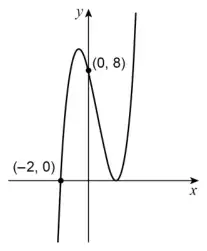
\[\mathrm{p}(x) = x^3 + (b + 2)x^2 + 2(b + 2)x + 8\]

where \(b\) is a constant.

(a) Use the factor theorem to prove that \((x + 2)\) is a factor of \(\mathrm{p}(x)\) for all values of \(b\). [3 marks]
(b) The graph of \(y = \mathrm{p}(x)\) meets the \(x\)-axis at exactly two points.
(i) Sketch a possible graph of \(y = \mathrm{p}(x)\) [3 marks]
(ii) Given \(\mathrm{p}(x)\) can be written as\[\mathrm{p}(x) = (x + 2)(x^2 + bx + 4)\]find the value of \(b\).

Fully justify your answer. [4 marks]

June 2022 Paper 2 Q8

AQACurrent spec5 marksSketching & Transforming Graphs

8

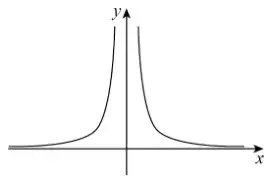
(a) Sketch the graph of \(y = \dfrac{1}{x^2}\) [2 marks]
(b) The graph of \(y = \dfrac{1}{x^2}\) can be transformed onto the graph of \(y = \dfrac{9}{x^2}\) using a stretch in one direction.

Beth thinks the stretch should be in the \(y\)-direction.

Paul thinks the stretch should be in the \(x\)-direction.

State, giving reasons for your answer, whether Beth is correct, Paul is correct, both are correct or neither is correct. [3 marks]

June 2022 Paper 1 Q7

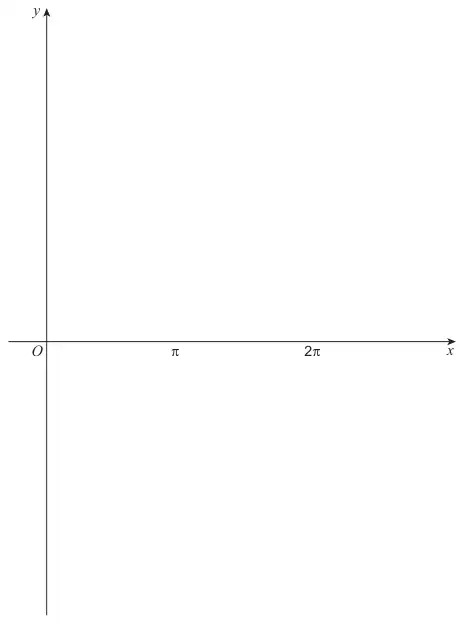
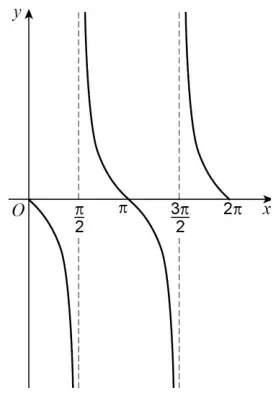
7 Sketch the graph of

\[y = \cot\left(x - \frac{\pi}{2}\right)\]

for \(0 \leqslant x \leqslant 2\pi\) [3 marks]

Blank axes for the sketch: x-axis marked O, π and 2π; y-axis above and below the x-axis

June 2022 Paper 3 Q5

5

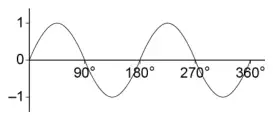
(a) Sketch the graph of\[y = \sin 2x\]for \(0^\circ \leqslant x \leqslant 360^\circ\) [2 marks]
Axes for the sketch: x-axis marked O, 90°, 180°, 270° and 360°; y-axis above and below the x-axis
(b) The equation\[\sin 2x = A\]has exactly two solutions for \(0^\circ \leqslant x \leqslant 360^\circ\)

State the possible values of \(A\). [1 mark]

June 2022 Paper 1 Q4

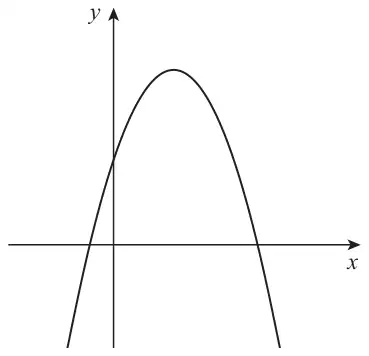
4 The graph of

\[y = \mathrm{f}(x)\]

where

\[\mathrm{f}(x) = ax^2 + bx + c\]

is shown in Figure 1.

Figure 1: an n-shaped parabola crossing the negative x-axis and the positive x-axis, with its maximum to the right of the y-axis and a positive y-intercept
Figure 1

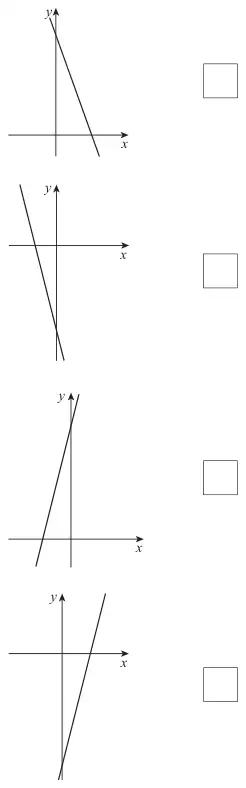
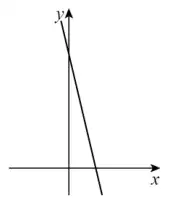
Which of the following shows the graph of \(y = \mathrm{f}^{\prime}(x)\)?

Tick (✓) one box. [1 mark]

Four straight-line graphs, each with a tick box, from top to bottom: 1st negative gradient, positive y-intercept, crossing the positive x-axis; 2nd negative gradient, negative y-intercept, crossing the negative x-axis; 3rd positive gradient, positive y-intercept, crossing the negative x-axis; 4th positive gradient, negative y-intercept, crossing the positive x-axis

June 2022 Paper 1 Q3

3 The curve

\[y = \log_4 x\]

is transformed by a stretch, scale factor 2, parallel to the \(y\)-axis.

State the equation of the curve after it has been transformed.

Circle your answer. [1 mark]

  • \(y = \dfrac{1}{2}\log_4 x\)
  • \(y = 2\log_4 x\)
  • \(y = \log_4 2x\)
  • \(y = \log_8 x\)

June 2025 Paper 1 Q2

2

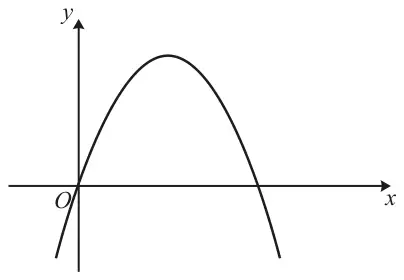
Sketch of an n-shaped curve through the origin O, crossing the positive x-axis, with a maximum point above the positive x-axis

The diagram shows the curve \(y = ax(x-b)\), where \(a\) and \(b\) are constants and \(b \gt 0\).

(a) Given that the curve has a stationary point at \(x = 3\), state the value of \(b\). [1]
(b) Given also that the stationary point at \(x = 3\) is a maximum, state what can be deduced about the value of \(a\). [1]
(c) Find the \(y\)-coordinate of the stationary point, giving your answer in terms of \(a\). [1]
(d) State the range of values of \(x\) for which the curve is increasing. [1]

June 2025 Paper 3 Q2

OCR ACurrent spec4 marksSketching & Transforming Graphs

2

(a) The curve \(y = \dfrac{1}{x^3}\) is translated by 4 units in the positive \(x\)-direction.
Write down the equation of the curve after it has been translated. [2]
(b) The curve \(y = 5x^2\) is stretched parallel to the \(y\)-axis with scale factor 4.

The point on the curve \(y = 5x^2\) with \(x\)-coordinate 3 is transformed to the point \(P\).

Write down the coordinates of \(P\). [2]

June 2024 Paper 2 Q3

3 The function f is defined by \(\mathrm{f}(x) = x^3 - x^2 - 5x - 3\).

(a) Show that \((x - 3)\) is a factor of \(\mathrm{f}(x)\). [1]
(b) Factorise \(\mathrm{f}(x)\) completely. [2]

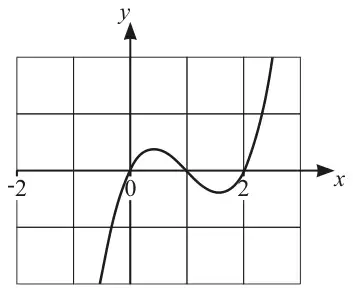
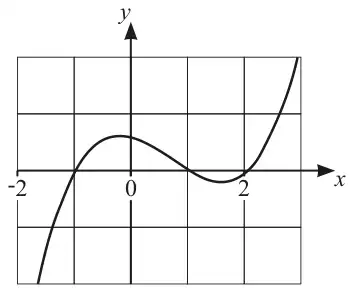
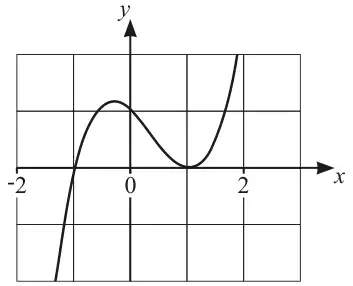
Three students attempted to draw the graph of \(y = (x - a)(x - 1)(x + 1)\), each using a different value of the constant \(a\). Not all of their graphs were correct. Their graphs are given in the diagrams below. Copies of the diagrams are provided in the Printed Answer Booklet.

(c) Underneath each diagram in the Printed Answer Booklet,
  • either give the value of \(a\) for which this is the correct graph of \(y = \mathrm{f}(x)\),
  • or, if there is no value of \(a\) for which this graph is correct, write “No value of \(a\)”. [3]
Fig. 1.1: cubic curve on a grid from x = -2 to 3, crossing the x-axis at 0, 1 and 2, with a maximum between 0 and 1 and a minimum between 1 and 2
Fig. 1.1
Fig. 1.2: cubic curve on a grid crossing the x-axis at -1, with a maximum near x = 0, crossing at 1, a minimum between 1 and 2, and crossing at 2
Fig. 1.2
Fig. 1.3: cubic curve on a grid crossing the x-axis at -1, with a maximum just left of the y-axis, touching the x-axis at 1 and then rising
Fig. 1.3

June 2024 Paper 1 Q2

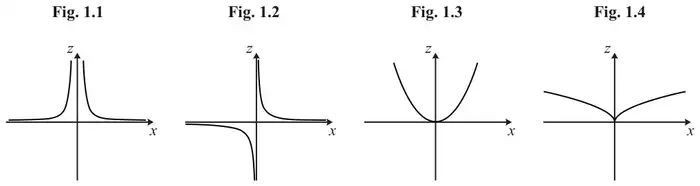
2 You are given that \(y\) is inversely proportional to \(x^6\) and \(z\) is directly proportional to the cube root of \(y\).

(a)
(i) Find an equation for \(z\) in terms of \(x\) and \(k\), where \(k\) is a constant of proportionality. [2]
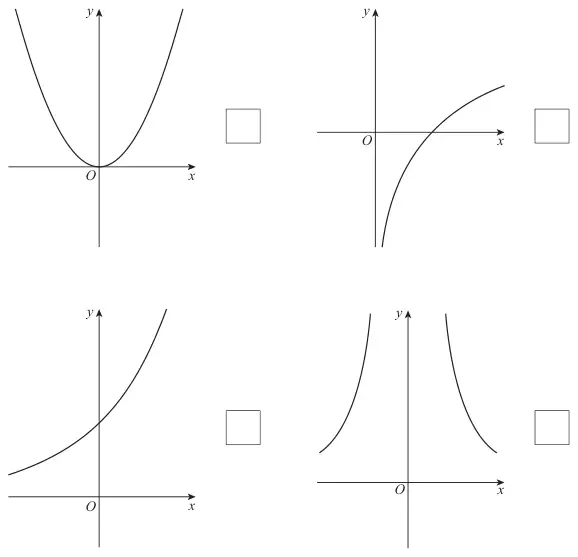
(ii) State which of the diagrams below could represent the graph of \(z\) against \(x\). [1]
Fig. 1.1 to Fig. 1.4: four sketches of z against x. Fig. 1.1: two branches above the x-axis, both rising steeply towards the z-axis. Fig. 1.2: reciprocal-type curve, positive for x greater than 0 and negative for x less than 0. Fig. 1.3: U-shaped curve through the origin. Fig. 1.4: curve through the origin rising on both sides, flattening as x increases
(b) Given that \(z = 3\) when \(x = 4\), determine the values of \(x\) when \(z = 12\). [3]

June 2023 Paper 3 Q3

3 The cubic polynomial \(\mathrm{f}(x)\) is defined by \(\mathrm{f}(x) = x^3 + px + q\), where \(p\) and \(q\) are constants.

(a)
(i) Given that \(\mathrm{f}'(2) = 13\), find the value of \(p\). [2]
(ii) Given also that \((x - 2)\) is a factor of \(\mathrm{f}(x)\), find the value of \(q\). [2]

The curve \(y = \mathrm{f}(x)\) is translated by the vector \(\begin{pmatrix} 2 \\ -3 \end{pmatrix}\).

(b) Using the values from part (a), determine the equation of the curve after it has been translated. Give your answer in the form \(y = x^3 + ax^2 + bx + c\), where \(a\), \(b\) and \(c\) are integers to be found. [4]

June 2022 Paper 1 Q5

5

(a) The graph of \(y = 2^x\) can be transformed to the graph of \(y = 2^{x+4}\) either by a translation or by a stretch.
(i) Give full details of the translation. [2]
(ii) Give full details of the stretch. [2]
(b) In this question you must show detailed reasoning.
Solve the equation \(\log_2(8x) = 1 - \log_2(1 - x)\). [4]

June 2022 Paper 1 Q3

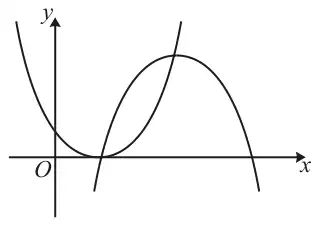
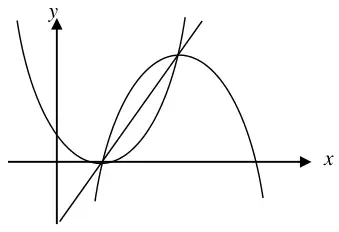
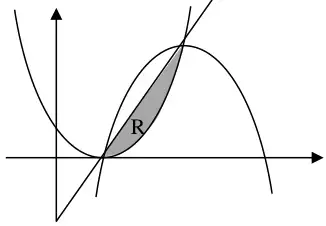
3

(a) In this question you must show detailed reasoning.
Find the coordinates of the points of intersection of the curves with equations \(y = x^2 - 2x + 1\) and \(y = -x^2 + 6x - 5\). [4]
(b) The diagram shows the curves \(y = x^2 - 2x + 1\) and \(y = -x^2 + 6x - 5\).
This diagram is repeated in the Printed Answer Booklet.
The U-shaped curve y = x squared minus 2x plus 1 touching the x-axis at x = 1, and the n-shaped curve y = minus x squared plus 6x minus 5 crossing the x-axis at x = 1 and further right; the curves meet at x = 1 and again near the top of the n-shaped curve
On the diagram in the Printed Answer Booklet, draw the line \(y = 2x - 2\). [2]
(c) Show on your diagram in the Printed Answer Booklet the region of the \(x\)-\(y\) plane within which all three of the following inequalities are satisfied. \[y \geqslant x^2 - 2x + 1 \qquad y \leqslant -x^2 + 6x - 5 \qquad y \leqslant 2x - 2\] You should indicate the region for which all the inequalities hold by labelling the region \(R\). [1]

June 2022 Paper 3 Q2

2

(a) Give full details of the single transformation that transforms the graph of \(y = x^3\) to the graph of \(y = x^3 - 8\). [2]

The function f is defined by \(\mathrm{f}(x) = x^3 - 8\).

(b) Find an expression for \(\mathrm{f}^{-1}(x)\). [2]
(c) State how the graphs of \(y = \mathrm{f}(x)\) and \(y = \mathrm{f}^{-1}(x)\) are related geometrically. [1]

October 2021 Paper 3 Q7

7 A curve \(C\) in the \(x\)-\(y\) plane has the property that the gradient of the tangent at the point \(P(x, y)\) is three times the gradient of the line joining the point \((3, 2)\) to \(P\).

(a) Express this property in the form of a differential equation. [2]

It is given that \(C\) passes through the point \((4, 3)\) and that \(x \gt 3\) and \(y \gt 2\) at all points on \(C\).

(b) Determine the equation of \(C\) giving your answer in the form \(y = \mathrm{f}(x)\). [4]

The curve \(C\) may be obtained by a transformation of part of the curve \(y = x^3\).

(c) Describe fully this transformation. [2]

October 2021 Paper 1 Q5

5

(a) The graph of the function \(y = \mathrm{f}(x)\) passes through the point \(P\) with coordinates \((2, 6)\), and is a one-one function. State the coordinates of the point corresponding to \(P\) on each of the following curves.
(i) \(y = \mathrm{f}(x) + 3\) [1]
(ii) \(y = 2\mathrm{f}(3x - 1)\) [2]
(iii) \(y = \mathrm{f}^{-1}(x)\) [1]
(b)
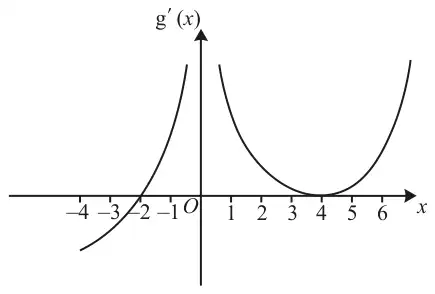
Graph of g'(x): a branch for x less than 0 rising from below the x-axis, crossing it at x = -2 and rising steeply towards the vertical axis; a second branch for x greater than 0 falling from high near the vertical axis, touching the x-axis at x = 4 and rising again
The diagram shows part of the graph of \(y = \mathrm{g}'(x)\). This is the graph of the gradient function of \(y = \mathrm{g}(x)\). The graph intersects the \(x\)-axis at \(x = -2\) and \(x = 4\).
(i) State the \(x\)-coordinate of any stationary points on the graph of \(y = \mathrm{g}(x)\). [1]
(ii) State the set of values of \(x\) for which \(y = \mathrm{g}(x)\) is a decreasing function. [1]
(iii) State the \(x\)-coordinate of any points of inflection on the graph of \(y = \mathrm{g}(x)\). [1]

October 2021 Paper 3 Q4

4

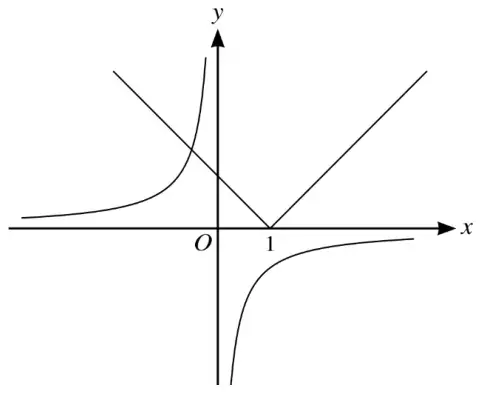
(a) Sketch, on a single diagram, the following graphs.
  • \(y = |x - 1|\)
  • \(y = \dfrac{k}{x}\), where \(k\) is a negative constant
[2]
(b) Hence explain why the equation \(x|x - 1| = k\) has exactly one real root for any negative value of \(k\). [1]
(c) Determine the real root of the equation \(x|x - 1| = -6\). [2]

October 2021 Paper 3 Q1

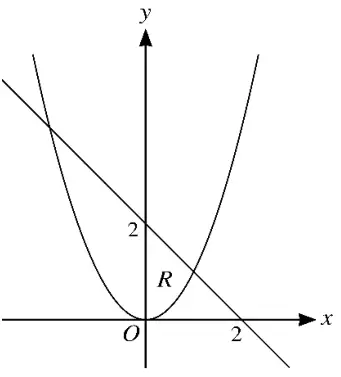
1 Show in a sketch the region of the \(x\)-\(y\) plane within which all three of the following inequalities hold.

\(y \geqslant x^2,\quad x + y \leqslant 2,\quad x \geqslant 0.\)

You should indicate the region for which the inequalities hold by labelling the region \(R\). [3]

June 2025 Paper 3 Q12

12

The questions in this section refer to the article on the Insert. You should read the article before attempting the questions.

The relevant parts of the article “The trisectrix of Maclaurin” are reproduced below; the line numbers are those printed on the Insert.

Lines 6–7
In 1742, Colin Maclaurin first studied a curve which can be used to trisect an angle. The curve is called the Trisectrix of Maclaurin.

Lines 8–9
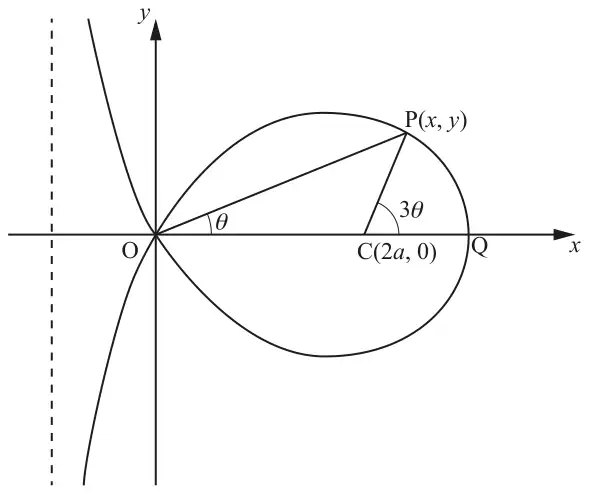
The equation of the curve in cartesian form is \(y^2 = \dfrac{x^2(3a-x)}{a+x}\), where \(a\) is a constant. The curve is shown in Fig. C2 below. Only values of \(a > 0\) are considered in this article.

Lines 10–11
It can be shown that everywhere on the curve \(\dfrac{3a-x}{a+x} \geqslant 0\). It follows that \(3a - x \geqslant 0\) and \(a + x > 0\).

Line 12
The curve has the trisection property illustrated in Fig. C2.

Fig. C2: the trisectrix with a loop through O and Q(right of C(2a, 0)), branches going to infinity near the dashed vertical asymptote left of the y-axis; P(x, y) on the loop, OP at angle θ and CP at angle 3θ to the x-axis
Fig. C2

Lines 14–16
The point C has coordinates \((2a, 0)\) and Q is the point where the curve crosses the positive \(x\)-axis. The point P is a general point \((x, y)\) on the loop of the curve. The origin of the coordinate system is denoted by O.

Line 17
The dashed line is an asymptote to the curve.

Lines 18–19
If the line CP makes an angle \(3\theta\) with the positive \(x\)-axis then the line OP makes an angle \(\theta\) with the positive \(x\)-axis. Angles are measured anticlockwise from the positive \(x\)-axis.

(a) Show that for the point on the curve where \(x = 0\), \(\dfrac{3a-x}{a+x} \geqslant 0\) as given in line 10. [1]
(b) Use the equation of the curve given in line 8 to show that for all points on the curve where \(x \neq 0\), \(\dfrac{3a-x}{a+x} \geqslant 0\) as given in line 10. [1]
(c) Show that it follows that \(3a - x \geqslant 0\) and \(a + x > 0\), as given in lines 10 and 11, for values of \(a > 0\). [3]
(d) Hence find, in terms of \(a\) where \(a > 0\), the range of values of \(x\) for points on the curve \(y^2 = \dfrac{x^2(3a-x)}{a+x}\). [1]
(e) Find the equation of the asymptote to the curve. [1]

June 2025 Paper 2 Q6

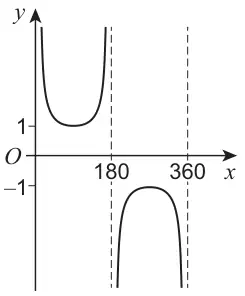
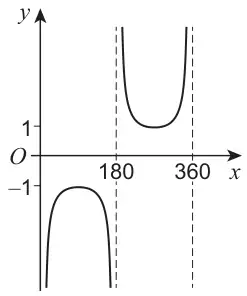
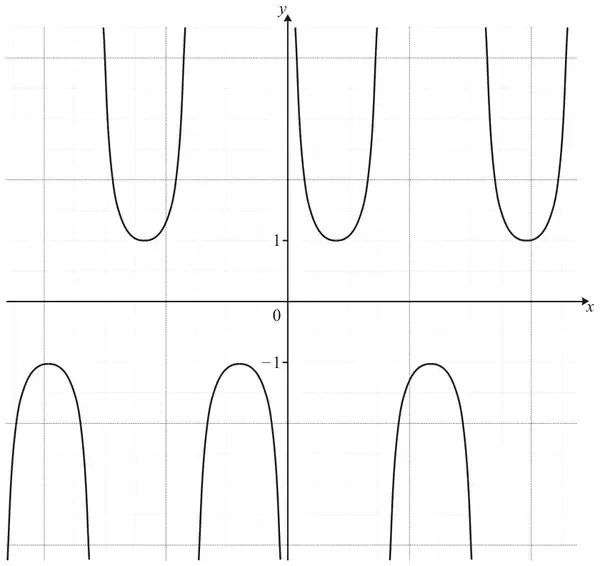
6 The diagram shows part of the graph of \(\mathrm{f}(x) = \operatorname{cosec} 2x\).

Graph of y = cosec 2x on a grid: U-shaped branches with minimum value 1 above the x-axis and inverted branches with maximum value -1 below it
(a) State which of the following is the equation of the curve \(y = \dfrac{1}{\mathrm{f}(x)}\).
\(y = \cos 2x \qquad y = \operatorname{cosec}(-2x) \qquad y = -\operatorname{cosec} 2x \qquad y = \sin 2x\) [1]
(b) State the exact equations of the asymptotes of \(y = \operatorname{cosec} 2x\) for \(0 \leqslant x \leqslant \pi\). [1]

June 2025 Paper 2 Q4

4

(a) Use the factor theorem to show that \((x-3)\) is a factor of \(4x^3 - 8x^2 - 11x - 3\). [1]
(b) Hence show that \(4x^3 - 8x^2 - 11x - 3 = (x-3)(ax+b)^2\), where \(a\) and \(b\) are integers to be determined. [2]
(c) Sketch the graph of \(y = 4x^3 - 8x^2 - 11x - 3\) on the axes in the Printed Answer Booklet. [2]

June 2025 Paper 1 Q1

1

(a) Sketch the function \(y = |2x-3|\). [2]
(b) In this question you must show detailed reasoning.
Solve the equation \(|2x-3| = 4-x\). [3]

June 2024 Paper 3 Q18

18 This question refers to the article on the Insert, “Tangents and normals to a quadratic curve”. The relevant extract (lines 11 to 20) is reproduced here.

The general quadratic curve has equation \(y = ax^2 + bx + c\). The tangents at any two points P and Q on this curve also cross at a point whose \(x\)-coordinate is equal to the mean of the \(x\)-coordinates of P and Q. So if P has \(x\)-coordinate \(x_\mathrm{P}\) and Q has \(x\)-coordinate \(x_\mathrm{Q}\) then the \(x\)-coordinate of the intersection point of the tangents is \(\dfrac{x_\mathrm{P} + x_\mathrm{Q}}{2}\). The \(y\)-coordinate of the intersection point can be shown to be \(ax_\mathrm{P}x_\mathrm{Q} + b\left(\frac{x_\mathrm{P}+x_\mathrm{Q}}{2}\right) + c\). This is equivalent to \(a\left(\frac{x_\mathrm{P}+x_\mathrm{Q}}{2}\right)^2 + b\left(\frac{x_\mathrm{P}+x_\mathrm{Q}}{2}\right) + c - a\left(\frac{x_\mathrm{P}-x_\mathrm{Q}}{2}\right)^2\). The formula \(ax_\mathrm{P}x_\mathrm{Q} + b\left(\frac{x_\mathrm{P}+x_\mathrm{Q}}{2}\right) + c\) looks simpler but \(y = a\left(\frac{x_\mathrm{P}+x_\mathrm{Q}}{2}\right)^2 + b\left(\frac{x_\mathrm{P}+x_\mathrm{Q}}{2}\right) + c - a\left(\frac{x_\mathrm{P}-x_\mathrm{Q}}{2}\right)^2\) is in terms of the \(x\)-coordinate of the point of intersection, apart from the last term. For pairs of points with \(x_\mathrm{P} - x_\mathrm{Q} = h\) where \(h\) is a constant, the point of intersection of the tangents lies on the curve \(y = ax^2 + bx + c - \dfrac{ah^2}{4}\). This curve is a translation of the original curve \(y = ax^2 + bx + c\).

A student is investigating the intersection points of tangents to the curve \(y = 6x^2 - 7x + 1\). She uses software to draw tangents at pairs of points with \(x\)-coordinates differing by 5.

Find the equation of the curve that all the intersection points lie on. [2]

June 2024 Paper 3 Q10

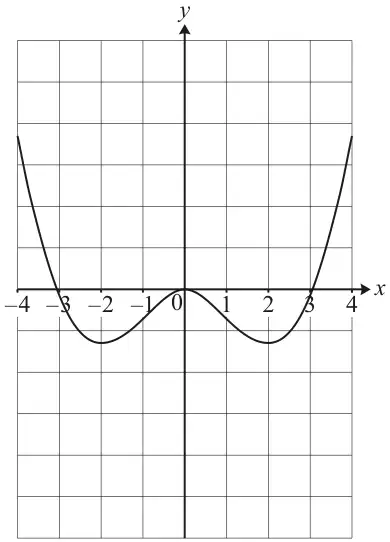
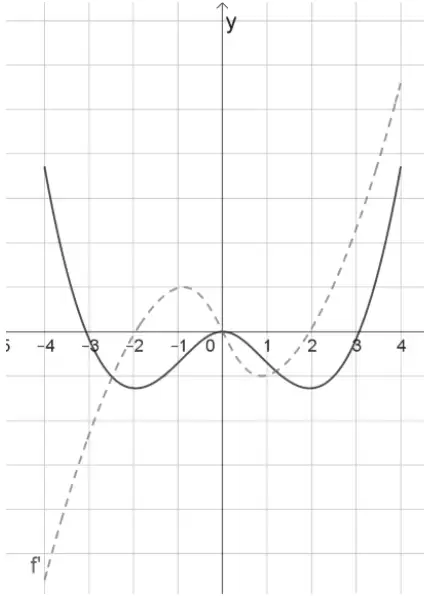
10 The diagram below shows the curve \(y = \mathrm{f}(x)\).

Curve y = f(x) on a grid with x from -4 to 4: it crosses the x-axis at -3, 0 and 3, with minimum points near x = -2 and x = 2 and a maximum at the origin

Sketch the graph of the gradient function, \(y = \mathrm{f}^{\prime}(x)\), on the copy of the diagram in the Printed Answer Booklet. [3]

June 2024 Paper 1 Q5

5

(a) Make \(y\) the subject of the formula \(\log_{10}(y-k) = x\log_{10}2\), where \(k\) is a positive constant. [2]
(b) Sketch the graph of \(y\) against \(x\). [3]

June 2024 Paper 2 Q2

2 The equation of a curve is \(y = \mathrm{e}^x\). The curve is subject to a translation \(\begin{pmatrix}3\\0\end{pmatrix}\) and a stretch scale factor 2 parallel to the \(y\)-axis.

Write down the equation of the new curve. [2]

June 2022 Paper 2 Q16

16 The equation of a curve is

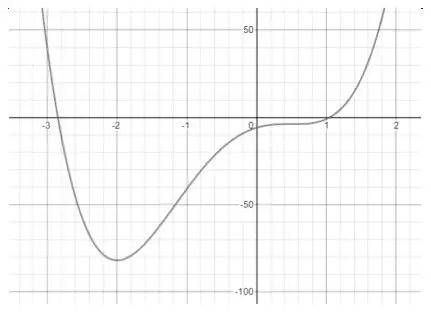
\(y = 6x^4 + 8x^3 - 21x^2 + 12x - 6\).

(a) In this question you must show detailed reasoning.
Determine
  • The coordinates of the stationary points on the curve.
  • The nature of the stationary points on the curve.
  • The \(x\)-coordinate of the non-stationary point of inflection on the curve.
[12]
(b) On the axes in the Printed Answer Booklet, sketch the curve whose equation is
\(y = 6x^4 + 8x^3 - 21x^2 + 12x - 6\). [3]

June 2022 Paper 1 Q3

3

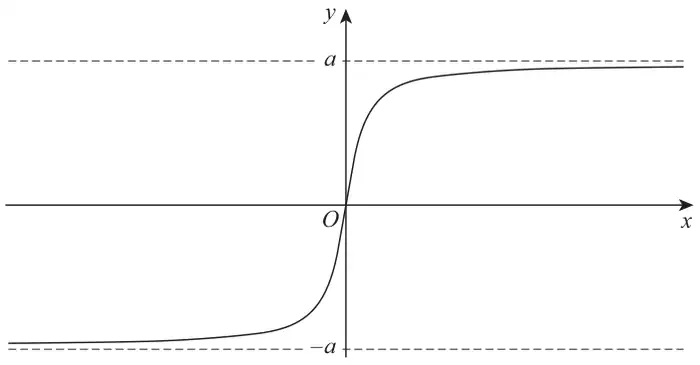
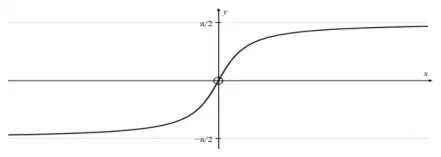
(a) Sketch the graph of \(y = \arctan x\) where \(x\) is in radians. [2]
(b) In this question you must show detailed reasoning.
Find all points of intersection of the curves \(y = 3\sin x\cos x\) and \(y = \cos^2 x\) for \(-\pi \leqslant x \leqslant \pi\). [6]

June 2022 Paper 2 Q3

3

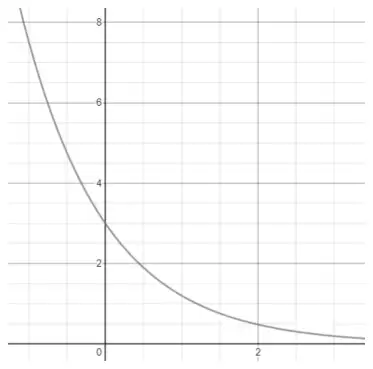
(a) On the axes in the Printed Answer Booklet, sketch the curve with equation \(y = 3 \times 0.4^x\). [3]
(b) Given that \(3 \times 0.4^x = 0.8\), determine the value of \(x\) correct to 3 significant figures. [3]

October 2021 Paper 2 Q14

14 The equation of a curve is

\(y = x^2(x-2)^3\).

(a) Find \(\dfrac{\mathrm{d}y}{\mathrm{d}x}\), giving your answer in factorised form. [4]
(b) Determine the coordinates of the stationary points on the curve. [4]

In part (c) you may use the result \(\dfrac{\mathrm{d}^2y}{\mathrm{d}x^2} = 4(x-2)(5x^2 - 8x + 2)\).

(c) Determine the nature of the stationary points on the curve. [3]
(d) Sketch the curve. [2]

October 2021 Paper 3 Q8

OCR MEICurrent spec3 marksSketching & Transforming Graphs

8 For a particular value of \(a\), the curve \(y = \dfrac{a}{x^2}\) passes through the point \((3, 1)\).

Find the coordinates of all the other points on the curve where both the \(x\)-coordinate and the \(y\)-coordinate are integers. [3]

October 2021 Paper 2 Q4

4 Sketch the graph of \(y = |2x - 3|\). [3]

October 2021 Paper 1 Q3

3

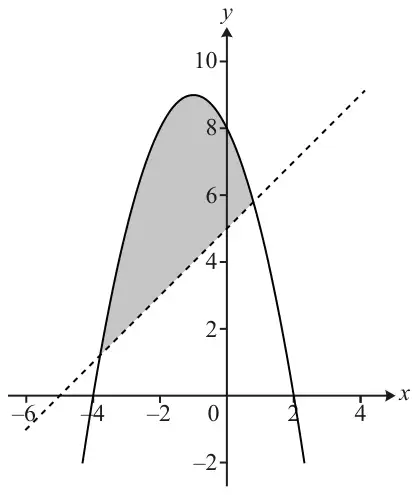
(a) The diagram shows the line \(y = x + 5\) and the curve \(y = 8 - 2x - x^2\). The shaded region is the finite region between the line and the curve. The curved part of the boundary is included in the region but the straight part is not included.

Write down the inequalities that define the shaded region. [2]
Graph of the parabola y = 8 − 2x − x² (solid) and the line y = x + 5 (dashed); the finite region between them, above the line and below the curve, is shaded
(b) In this question you must show detailed reasoning.
Solve the inequality \(8 - 2x - x^2 > x + 5\) giving your answer in exact form. [3]

October 2021 Paper 2 Q1

OCR MEICurrent spec2 marksSketching & Transforming Graphs

1 The equation of a curve is \(y = 4x^2 + 8x + 1\).

The curve is stretched parallel to the \(x\)-axis with scale factor 2.

Find the equation of the new curve, giving your answer in the form \(y = ax^2 + bx + c\), where \(a\), \(b\) and \(c\) are integers to be determined. [2]

October 2021 Paper 3 Q1

1

(a) Express \(x^2 + 8x + 2\) in the form \((x + a)^2 + b\). [2]
(b) Write down the coordinates of the turning point of the curve \(y = x^2 + 8x + 2\). [1]
(c) State the transformation(s) which map(s) the curve \(y = x^2\) onto the curve \(y = x^2 + 8x + 2\). [2]