
June 2022 Paper 1 Q11
11 The polynomial \(\mathrm{p}(x)\) is given by
\[\mathrm{p}(x) = x^3 + (b + 2)x^2 + 2(b + 2)x + 8\]where \(b\) is a constant.
(a) Use the factor theorem to prove that \((x + 2)\) is a factor of \(\mathrm{p}(x)\) for all values of \(b\). [3 marks]
(b) The graph of \(y = \mathrm{p}(x)\) meets the \(x\)-axis at exactly two points.
(i) Sketch a possible graph of \(y = \mathrm{p}(x)\) [3 marks]
(ii) Given \(\mathrm{p}(x)\) can be written as\[\mathrm{p}(x) = (x + 2)(x^2 + bx + 4)\]find the value of \(b\).
Fully justify your answer. [4 marks]
| Scheme | Marks | AO |
|---|---|---|
| Substitutes \(x = -2\) into \(\mathrm{p}(x)\) Condone missing brackets | M1 | 1.1a |
| Demonstrates clearly that \(\mathrm{p}(-2) = 0\) Must see numerical evaluation of powers of \(-2\) and either \(-8 + 4b + 8 - 4b - 8 + 8 = 0\) or \(-8 + 4(b + 2) - 4(b + 2) + 8 = 0\) or \(-8 + (b + 2)(4 - 4) + 8 = 0\) | A1 | 2.1 |
| Concludes and states that \((x + 2)\) is a factor for all/any values of \(b\) | R1 | 2.4 |
| (3) |
Typical solution
\[\mathrm{p}(-2) = (-2)^3 + (b + 2)(-2)^2 + 2(b + 2)(-2) + 8\]\[= -8 + 4b + 8 - 4b - 8 + 8\]\[= 0\]Hence \((x + 2)\) is a factor of \(\mathrm{p}(x)\) for all values of \(b\)
| Scheme | Marks | AO |
|---|---|---|
| (i) Sketches cubic graph with correct orientation and two turning points | B1 | 1.2 |
| Sketches any cubic that would only ever meet the \(x\)-axis at exactly two points | M1 | 2.2a |
Sketches a correctly orientated cubic graph that has a
| A1 | 1.1b |
| (3) | ||
| (ii) Deduces a pair of possible factors of \((x^2 + bx + 4)\) Either \((x + 2)^2\) or \((x - 2)^2\) or \((x + 1)(x + 4)\) or \((x - 1)(x - 4)\) or Uses \(b^2 - 4ac\) OE PI \(b = 4\) or \(b = -4\) or \(b^2 - 16\) seen | M1 | 2.2a |
| Identifies the quadratic factor as \((x - 2)^2\) or Obtains \(b^2 - 16 = 0\) OE PI by \(b = \pm 4\) or \(b = -4\) | R1 | 2.1 |
| Obtains either \(b = \pm 4\) or \(b = -4\) | M1 | 1.1a |
| Rejects \(b = 4\) giving a reason and concludes \(b = -4\) Valid reasons would be:
| R1 | 2.4 |
| (4) | ||
| (10 marks) |
Typical solution
(i)
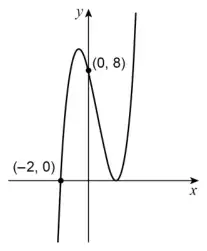
(ii)
\[b^2 - 4ac = 0\]\[b^2 - 16 = 0\]\[\Rightarrow b = \pm 4\]\(b = 4\) gives only one point of intersection
\[\therefore b = -4\]