Polynomials

Edexcel

AQA

OCR A

OCR MEI

June 2025 Paper 1 Q12

EdexcelCurrent spec8 marksAlgebraic FractionsPolynomials

12.

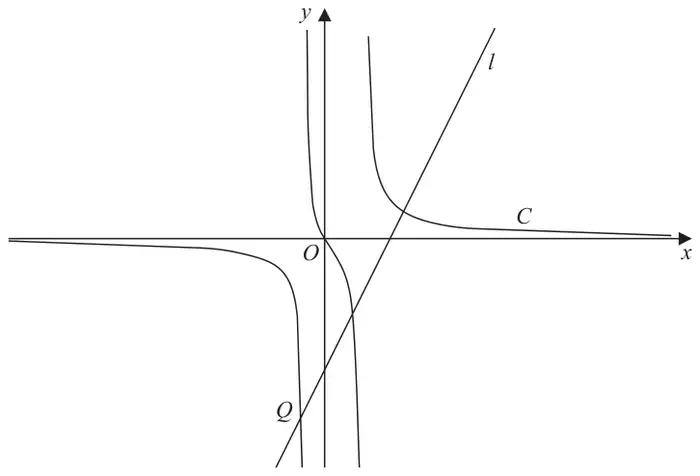
Figure 3: curve C with vertical asymptotes either side of the y-axis and the x-axis as a horizontal asymptote, passing through O; straight line l crosses C at a point in the first quadrant and at Q in the third quadrant
Figure 3

Figure 3 shows a sketch of the curve \(C\) with equation

\[y = \frac{15x}{(2x+3)(x-3)} \qquad\qquad x \neq -\frac{3}{2} \quad x \neq 3\]

and the straight line \(l\) with equation

\[y = 2x - 10\]
(a) Verify that \(C\) and \(l\) intersect where \(x = 6\) (2)

The curve and line also intersect at the point \(Q\) shown in Figure 3.

(b) Show that the \(x\) coordinate of \(Q\) is a solution of\[4x^3 - 26x^2 - 3x + 90 = 0\] (2)
(c) Using algebra and showing all stages of working, find the exact \(x\) coordinate of \(Q\). (4)

June 2025 Paper 2 Q8

EdexcelCurrent spec9 marksDifferentiationPolynomials

8.

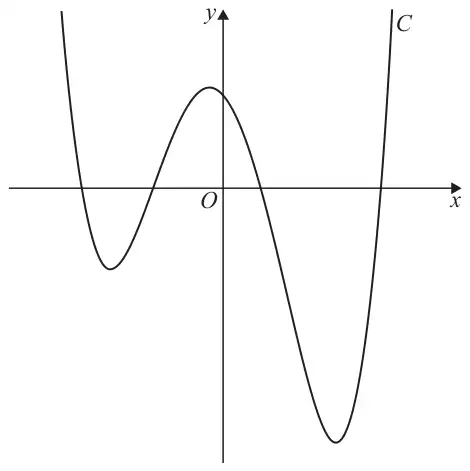
Figure 2: a quartic curve C with two local minima and a local maximum just to the left of the y-axis; C crosses the x-axis at four points, two negative and two positive
Figure 2

\[\mathrm{f}(x) = x^4 + \frac{1}{3}x^3 - 8x^2 + ax + \frac{17}{3}\]where \(a\) is a constant.

Figure 2 shows a sketch of the curve \(C\) with equation \(y = \mathrm{f}(x)\)

Given that \(C\) has a local maximum at \(x = -\dfrac{1}{4}\)

(a) show that \(a = -4\) (4)
(b) find the exact \(y\) coordinate of the local maximum. (1)

The equation \(\mathrm{f}(x) = k\), where \(k\) is a constant, has 4 distinct solutions.

(c) Using algebra and showing all stages of your working, find the range of values of \(k\). Give the answer using set notation.

(Solutions relying on calculator technology are not acceptable.)

(4)

June 2025 Paper 1 Q7

7.

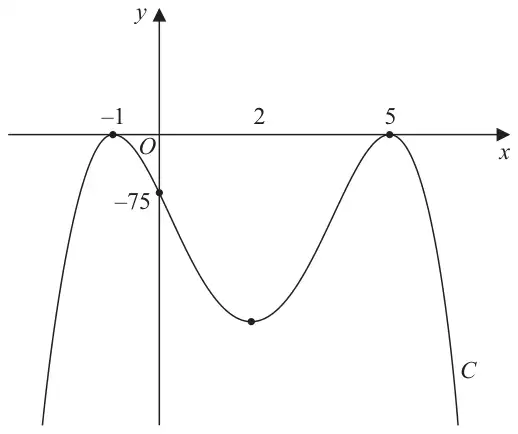
Figure 1: quartic curve C touching the x-axis at maximum points x = −1 and x = 5, crossing the y-axis at −75, with a minimum point at x = 2
Figure 1

Figure 1 shows a sketch of a curve \(C\) with equation \(y = \mathrm{f}(x)\), where \(\mathrm{f}(x)\) is a quartic expression in \(x\).

The curve

  • has maximum turning points at \((-1,\ 0)\) and \((5,\ 0)\)
  • crosses the \(y\)-axis at \((0,\ -75)\)
  • has a minimum turning point at \(x = 2\)
(a) Find the set of values of \(x\) for which\[\mathrm{f}^{\prime}(x) \geqslant 0\]writing your answer in set notation. (2)
(b) Find the equation of \(C\). You may leave your answer in factorised form. (3)

The curve \(C_1\) has equation \(y = \mathrm{f}(x) + k\), where \(k\) is a constant.

Given that the graph of \(C_1\) intersects the \(x\)-axis at exactly four places,

(c) find the range of possible values for \(k\). (2)

June 2025 Paper 2 Q7

EdexcelCurrent spec4 marksAlgebraic FractionsPolynomials

7. Given that\[\frac{3x^3 - 8x^2 - 6x - 11}{(x + 1)(x - 3)} \equiv Ax + B + \frac{C}{x + 1} + \frac{D}{x - 3} \qquad x \in \mathbb{R} \quad x \neq -1, 3\]find the value of each of the constants \(A\), \(B\), \(C\) and \(D\). (4)

June 2025 Paper 1 Q4

EdexcelCurrent spec5 marksPolynomialsQuadratics

4. Given that

  • \(\mathrm{f}(x) = 2x^3 + 3x^2 - 16x + 16\)
  • \(\mathrm{f}(-4) = 0\)
(a) write \(\mathrm{f}(x)\) in the form\[(x + a)Q(x)\]where \(a\) is a constant and \(Q(x)\) is a quadratic expression. (3)
(b) Hence prove that \(-4\) is the only real root of the equation\[\mathrm{f}(x) = 0\](Solutions relying on calculator technology are not acceptable.) (2)

June 2025 Paper 2 Q1

EdexcelCurrent spec3 marksPolynomials

1.

In this question you must show all stages of your working.

Solutions relying on calculator technology are not acceptable.

Factorise completely\[2x^3 - 24x^2 + 40x\](3)

June 2024 Paper 1 Q1

EdexcelCurrent spec3 marksPolynomials

1. \[\mathrm{g}(x) = 3x^3 - 20x^2 + (k+17)x + k\]

where \(k\) is a constant.

Given that \((x-3)\) is a factor of \(\mathrm{g}(x)\), find the value of \(k\). (3)

June 2025 Paper 2 Q7

AQACurrent spec9 marksDifferentiationPolynomials

7 The point \(A\) lies on the curve with equation

\[y = x^3 + px^2 + qx + 12\]
(a) Given that \(A\) has coordinates \((-5, 37)\), show that\[5p - q = 30\] [2 marks]
(b) Given that \(A\) is a stationary point, show that\[10p - q = 75\] [3 marks]
(c) Hence find the value of \(p\) and the value of \(q\) [1 mark]
(d) The curve with equation\[y = x^3 + px^2 + qx + 12\]has a second stationary point \(B\)

Find the coordinates of \(B\)

Fully justify your answer.

[3 marks]

June 2024 Paper 1 Q13

AQACurrent spec6 marksPolynomialsProof

13

(a) It is given that\[\mathrm{P}(x) = 4x^3 + 8x^2 + 11x + 4\]Use the factor theorem to show that \((2x + 1)\) is a factor of \(\mathrm{P}(x)\) [2 marks]
(b) Express \(\mathrm{P}(x)\) in the form\[\mathrm{P}(x) = (2x + 1)(ax^2 + bx + c)\]where \(a\), \(b\) and \(c\) are constants to be found. [2 marks]
(c) Given that \(n\) is a positive integer, use your answer to part (b) to explain why \(4n^3 + 8n^2 + 11n + 4\) is never prime. [2 marks]

June 2024 Paper 1 Q11

11 It is given that

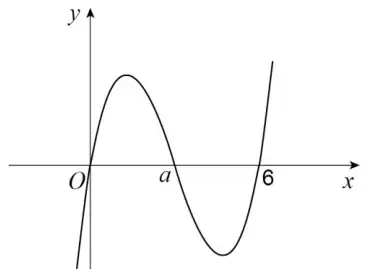
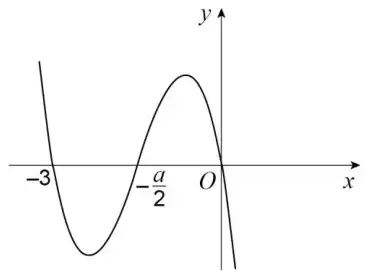
\[\mathrm{f}(x) = x(x - a)(x - 6)\]

where \(0 \lt a \lt 6\)

(a) Sketch the graph of \(y = \mathrm{f}(x)\) on the axes below. [3 marks]
(b) Sketch the graph of \(y = \mathrm{f}(-2x)\) on the axes below. [2 marks]

June 2023 Paper 3 Q6

6

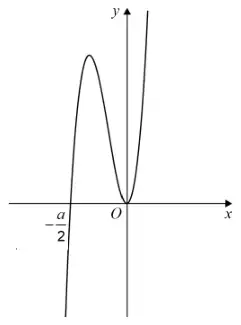
(a) Sketch the curve with equation\[y = x^2(2x + a)\]

where \(a \gt 0\) [3 marks]

(b) The polynomial \(\mathrm{p}(x)\) is given by\[\mathrm{p}(x) = x^2(2x + a) + 36\]
(i) It is given that \(x + 3\) is a factor of \(\mathrm{p}(x)\)

Use the factor theorem to show \(a = 2\) [2 marks]

(ii) State the transformation which maps the curve with equation\[y = x^2(2x + 2)\]

onto the curve with equation

\[y = x^2(2x + 2) + 36\] [2 marks]
(iii) The polynomial \(x^2(2x + 2) + 36\) can be written as \((x + 3)(2x^2 + bx + c)\)

Without finding the values of \(b\) and \(c\), use your answers to parts (a) and (b)(ii) to explain why

\[b^2 \lt 8c\] [2 marks]

June 2022 Paper 1 Q11

11 The polynomial \(\mathrm{p}(x)\) is given by

\[\mathrm{p}(x) = x^3 + (b + 2)x^2 + 2(b + 2)x + 8\]

where \(b\) is a constant.

(a) Use the factor theorem to prove that \((x + 2)\) is a factor of \(\mathrm{p}(x)\) for all values of \(b\). [3 marks]
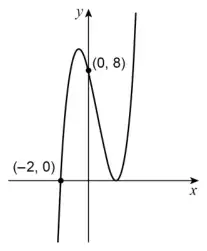
(b) The graph of \(y = \mathrm{p}(x)\) meets the \(x\)-axis at exactly two points.
(i) Sketch a possible graph of \(y = \mathrm{p}(x)\) [3 marks]
(ii) Given \(\mathrm{p}(x)\) can be written as\[\mathrm{p}(x) = (x + 2)(x^2 + bx + 4)\]find the value of \(b\).

Fully justify your answer. [4 marks]

June 2024 Paper 1 Q6

OCR ACurrent spec8 marksLogs & ExponentialsPolynomials

6 In this question you must show detailed reasoning.

The cubic polynomial \(\mathrm{f}(x)\) is defined by \(\mathrm{f}(x) = 4x^3 - 25x^2 - 58x + 16\).

(a) Show that \(x = \tfrac{1}{4}\) is a root of the equation \(\mathrm{f}(x) = 0\). [1]
(b) Hence express \(\mathrm{f}(x)\) as the product of a linear factor and a quadratic factor, with all terms in the factors having integer coefficients. [3]
(c) Solve the equation \(4\mathrm{e}^{3y} - 25\mathrm{e}^{2y} - 58\mathrm{e}^{y} + 16 = 0\), giving each root in the form \(y = k\ln 2\) where \(k\) is a constant. [4]

June 2024 Paper 2 Q6

OCR ACurrent spec10 marksPolynomialsTrigonometry

6 In this question you must show detailed reasoning.

(a)
(i) Use the formula for \(\cos(A + B)\), and the double angle formulae, to show that \(\cos 3\theta = 4\cos^3\theta - 3\cos\theta\). [2]
(ii) Use this result to solve the equation \(4\cos^3\theta - 3\cos\theta - \dfrac{\sqrt{2}}{2} = 0\) for \(0^\circ \leqslant \theta \leqslant 180^\circ\). [3]
(b)
(i) Show that \(\left(x + \dfrac{\sqrt{2}}{2}\right)\left(4x^2 - 2\sqrt{2}x - 1\right) = 4x^3 - 3x - \dfrac{\sqrt{2}}{2}\). [1]
(ii) Hence find the exact roots of the equation \(4x^3 - 3x - \dfrac{\sqrt{2}}{2} = 0\). [2]
(c) Use the results from parts (a)(ii) and (b)(ii) to show that \(\cos 15^\circ = \dfrac{\sqrt{2} + \sqrt{6}}{4}\). [2]

June 2024 Paper 2 Q3

3 The function f is defined by \(\mathrm{f}(x) = x^3 - x^2 - 5x - 3\).

(a) Show that \((x - 3)\) is a factor of \(\mathrm{f}(x)\). [1]
(b) Factorise \(\mathrm{f}(x)\) completely. [2]

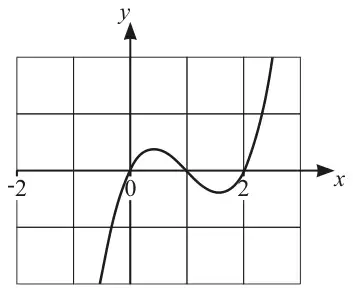
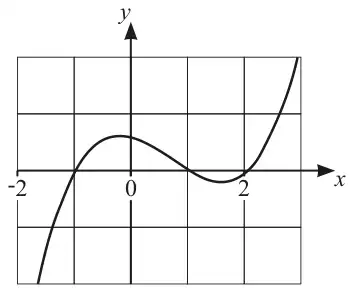
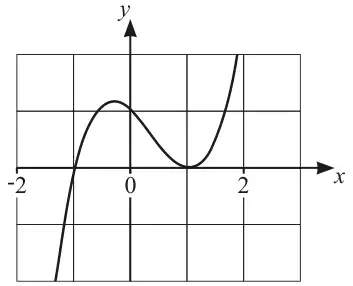
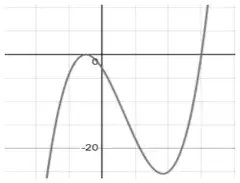
Three students attempted to draw the graph of \(y = (x - a)(x - 1)(x + 1)\), each using a different value of the constant \(a\). Not all of their graphs were correct. Their graphs are given in the diagrams below. Copies of the diagrams are provided in the Printed Answer Booklet.

(c) Underneath each diagram in the Printed Answer Booklet,
  • either give the value of \(a\) for which this is the correct graph of \(y = \mathrm{f}(x)\),
  • or, if there is no value of \(a\) for which this graph is correct, write “No value of \(a\)”. [3]
Fig. 1.1: cubic curve on a grid from x = -2 to 3, crossing the x-axis at 0, 1 and 2, with a maximum between 0 and 1 and a minimum between 1 and 2
Fig. 1.1
Fig. 1.2: cubic curve on a grid crossing the x-axis at -1, with a maximum near x = 0, crossing at 1, a minimum between 1 and 2, and crossing at 2
Fig. 1.2
Fig. 1.3: cubic curve on a grid crossing the x-axis at -1, with a maximum just left of the y-axis, touching the x-axis at 1 and then rising
Fig. 1.3

June 2023 Paper 3 Q3

3 The cubic polynomial \(\mathrm{f}(x)\) is defined by \(\mathrm{f}(x) = x^3 + px + q\), where \(p\) and \(q\) are constants.

(a)
(i) Given that \(\mathrm{f}'(2) = 13\), find the value of \(p\). [2]
(ii) Given also that \((x - 2)\) is a factor of \(\mathrm{f}(x)\), find the value of \(q\). [2]

The curve \(y = \mathrm{f}(x)\) is translated by the vector \(\begin{pmatrix} 2 \\ -3 \end{pmatrix}\).

(b) Using the values from part (a), determine the equation of the curve after it has been translated. Give your answer in the form \(y = x^3 + ax^2 + bx + c\), where \(a\), \(b\) and \(c\) are integers to be found. [4]

October 2021 Paper 2 Q8

OCR ACurrent spec6 marksPolynomialsProof

8 The number \(K\) is defined by \(K = n^3 + 1\), where \(n\) is an integer greater than 2.

(a) Given that \(n^3 + 1 \equiv (n + 1)(n^2 + bn + c)\), find the constants \(b\) and \(c\). [1]
(b) Prove that \(K\) has at least two distinct factors other than 1 and \(K\). [5]

October 2021 Paper 1 Q4

OCR ACurrent spec7 marksLogs & ExponentialsPolynomials

4 In this question you must show detailed reasoning.

The cubic polynomial \(\mathrm{f}(x)\) is defined by \(\mathrm{f}(x) = 2x^3 - 3x^2 - 11x + 6\).

(a) Use the factor theorem to show that \((2x - 1)\) is a factor of \(\mathrm{f}(x)\). [1]
(b) Express \(\mathrm{f}(x)\) in fully factorised form. [3]
(c) Hence solve the equation \(2 \times 8^y - 3 \times 4^y - 11 \times 2^y + 6 = 0\). [3]

June 2025 Paper 2 Q4

4

(a) Use the factor theorem to show that \((x-3)\) is a factor of \(4x^3 - 8x^2 - 11x - 3\). [1]
(b) Hence show that \(4x^3 - 8x^2 - 11x - 3 = (x-3)(ax+b)^2\), where \(a\) and \(b\) are integers to be determined. [2]
(c) Sketch the graph of \(y = 4x^3 - 8x^2 - 11x - 3\) on the axes in the Printed Answer Booklet. [2]

June 2023 Paper 3 Q4

OCR MEICurrent spec4 marksPolynomials

4 In this question you must show detailed reasoning.

Find the coordinates of the points where the curve \(y = x^3 - 2x^2 - 5x + 6\) crosses the \(x\)-axis. [4]

October 2020 Paper 1 Q7

OCR MEICurrent spec6 marksPolynomials

7 In this question you must show detailed reasoning.

The function \(\mathrm{f}(x)\) is defined by \(\mathrm{f}(x) = x^3 + x^2 - 8x - 12\) for all values of \(x\).

(a) Use the factor theorem to show that \((x+2)\) is a factor of \(\mathrm{f}(x)\). [2]
(b) Solve the equation \(\mathrm{f}(x) = 0\). [4]