
June 2025 Paper 2 Q8
8.
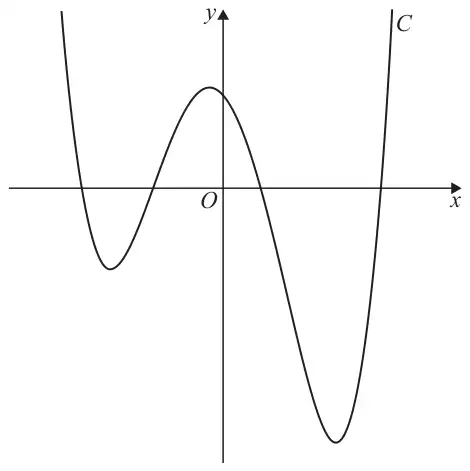
\[\mathrm{f}(x) = x^4 + \frac{1}{3}x^3 - 8x^2 + ax + \frac{17}{3}\]where \(a\) is a constant.
Figure 2 shows a sketch of the curve \(C\) with equation \(y = \mathrm{f}(x)\)
Given that \(C\) has a local maximum at \(x = -\dfrac{1}{4}\)
The equation \(\mathrm{f}(x) = k\), where \(k\) is a constant, has 4 distinct solutions.
(Solutions relying on calculator technology are not acceptable.)
(4)| Scheme | Marks | AO |
|---|---|---|
| \(x^4 \rightarrow \ldots x^3\) or \(\ldots x^3 \rightarrow \ldots x^2\) or \(\ldots x^2 \rightarrow \ldots x\) or \(ax \rightarrow a\) | M1 | 1.1b |
| \(\left(\mathrm{f}^{\prime}(x) =\right)\ 4x^3 + x^2 - 16x + a\) | A1 | 1.1b |
| \(\left(\mathrm{f}^{\prime}\left(-\dfrac{1}{4}\right) =\right)\ 4\left(-\dfrac{1}{4}\right)^3 + \left(\pm\dfrac{1}{4}\right)^2 - 16\left(-\dfrac{1}{4}\right) + a = 0\) \(\Rightarrow a = \ldots\) | dM1 | 3.1a |
| \(a = -4\) * | A1* | 2.1 |
| (4) |
Notes
The first two marks are the same for all approaches.
M1: Reduces the power by one for any term in \(\mathrm{f}(x)\). Look for \(x^n \rightarrow x^{n-1}\) and allow for \(ax \rightarrow a\) including \(ax^1 \rightarrow ax^0\) or \(-4x \rightarrow -4\)
A1: Correct differentiation \(\left(\mathrm{f}^{\prime}(x) =\right)\ 4x^3 + x^2 - 16x + a\) or \(4x^3 + x^2 - 16x - 4\)
Ignore the absence of the LHS. May be in terms of \(a\) or have \(-4\) substituted at this point as above.
Main Scheme
dM1: Substitutes \(x = -\dfrac{1}{4}\) into their \(\mathrm{f}^{\prime}(x)\), sets = 0 (= 0 may be implied) and solves for \(a\).
Condone \(4 + a = 0\) as evidence of substitution for the dM1 only.
This mark is not available if their \(\mathrm{f}^{\prime}(x)\) does not have a term with \(a\) in it using this approach.
A1*: cso Requires:
- a correct derivative
- correct substitution of \(x = -\dfrac{1}{4}\) into \(\mathrm{f}^{\prime}(x)\) and set = 0 (now the = 0 must be seen somewhere for this mark). Each term does not need to be evaluated.
- achieves \(a = -4\)
For the A1*, evidence of correct substitution might be \(-\dfrac{1}{16} + \dfrac{1}{16} + 4 + a = 0\) but not \(4 + a = 0\)
Condone invisible brackets around \(-\dfrac{1}{4}\) provided this is recovered before the given answer e.g. \(-\dfrac{1}{4}^2\) recovered to \(+\dfrac{1}{16}\)
Alt 1: Verification
dM1: Substitutes \(x = -\dfrac{1}{4}\) and \(a = -4\) into their \(\mathrm{f}^{\prime}(x)\), and finds a value.
The \(a = -4\) may already have been substituted into \(\mathrm{f}(x)\) as above.
A1*: cso Requires:
- a correct derivative
- correct substitution of \(x = -\dfrac{1}{4}\) into \(\mathrm{f}^{\prime}(x)\) and use of \(a = -4\) (at some stage) to achieve \(\mathrm{f}^{\prime}\left(-\dfrac{1}{4}\right) = \ldots = 0\). The substitution must be embedded in \(\mathrm{f}^{\prime}(x)\) or evaluated in an intermediate step e.g. \(-\dfrac{1}{16} + \dfrac{1}{16} + 4 - 4\) before the = 0
- a minimal conclusion e.g. “hence proven” or “\(\therefore a = -4\)” or e.g. a tick.
but not e.g. “max = \(-\dfrac{1}{4}\)” or just “0 = 0”
Alt 2: Algebraic division
dM1: Attempts to divide their \(\mathrm{f}^{\prime}(x)\) by \((4x + 1)\) \(\left(\text{or } \left(x + \dfrac{1}{4}\right)\right)\), achieves a linear remainder in \(a\) only, sets = 0 and achieves a value for \(a\). Condone slips in their calculations.
As a minimum, expect to see \(x^2 + \lambda x + \mu\) \(\left(\text{or } 4x^2 + \lambda x + \mu\right)\) as their quotient (with \(\mu \neq 0\)) leading to a linear remainder in \(a\) only set = 0 leading to a value for \(a\).
A1*: cso Requires:
- a correct derivative
- correct quotient \(x^2 - 4\) \(\left(\text{or } \left(4x^2 - 16\right)\right)\) and correct remainder \(a + 4\) set = 0
- achieves \(a = -4\)
| Scheme | Marks | AO |
|---|---|---|
| \(\dfrac{4735}{768}\) | B1 | 1.1b |
| (1) |
Notes
B1: \(\dfrac{4735}{768}\) cao Allow exact equivalents e.g. \(6\dfrac{127}{768}\) or the recurring decimal \(6.16536458\dot{3}\)
There is no need to see a calculation. Decimal approximations e.g. \(6.1653645833\ldots\) score B0.
| Scheme | Marks | AO |
|---|---|---|
| \(\left(\mathrm{f}^{\prime}(x) =\right)\ 4x^3 + x^2 - 16x - 4 = (4x + 1)\left(x^2 + \ldots\right)\) | M1 | 3.1a |
| \(= (4x + 1)\left(x^2 - 4\right)\) or e.g. \(\dfrac{4x^3 + x^2 - 16x - 4}{4x + 1} = x^2 - 4\) | A1 | 1.1b |
| \(\mathrm{f}(\text{``}{-}2\text{''}) = \ldots(-5)\) \(\Rightarrow \text{``}{-}5\text{''} \lt k \lt \text{``}\dfrac{4735}{768}\text{''}\) | M1 | 2.1 |
| \(\left\{k \in \mathbb{R} : -5 \lt k \lt \text{``}\dfrac{4735}{768}\text{''}\right\}\) | A1ft | 2.5 |
| (4) | ||
| (9 marks) |
Notes
Note: Candidates who do not score the first M mark may score maximum M0A0M1A1ft via the special case at the end of the mark scheme for part (c).
M1: For the key step in using the factor theorem to take \((4x + 1)\) or \(\left(x + \dfrac{1}{4}\right)\) out as a factor of their \(\mathrm{f}^{\prime}(x)\), not \(\mathrm{f}(x)\). Look for \((4x + 1)\left(x^2 + \lambda x - 4\right)\) or \((4x + 1)\left(x^2 \pm \mu\right)\) or \(\left(x + \dfrac{1}{4}\right)\left(4x^2 \pm \mu\right)\) or \(\left(x + \dfrac{1}{4}\right)\left(4x^2 \pm \lambda x - 16\right)\) (where the \(\lambda\) or \(\mu\) is a constant) either by inspection or division.
If they attempt division in (a) then they must use their quotient in (c) to score the marks.
They may “spot” that one of \(\mathrm{f}^{\prime}(\pm 2) = 0\) and factor out \((x \pm 2)\left(4x^2 + \lambda x \pm 2\right)\) without evidence that \(\mathrm{f}^{\prime}(\pm 2) = 0\)
There must be some factorisation or algebraic division present – not just roots stated from a calculator.
A1: Correct factorisation of the cubic to a linear and quadratic product, so
\((4x + 1)\left(x^2 - 4\right)\) or \(\left(x + \dfrac{1}{4}\right)\left(4x^2 - 16\right)\) or \((x - 2)\left(4x^2 + 9x + 2\right)\) or \((x + 2)\left(4x^2 - 7x - 2\right)\)
or for the correct quadratic seen e.g. \(x^2 - 4\) or \(4x^2 - 16\) (which may be the quotient in their algebraic division and may come from their work in (a) provided it is used in (c)).
There is no need to complete the long division if the appropriate quotient is found.
Note that proceeding directly to \((4x + 1)(x - 2)(x + 2)\) does not score either mark without sight of the e.g. \((4x + 1)\left(x^2 - 4\right)\) but they can score the final 2 marks via the special case.
Similarly, proceeding directly to \(\left(x + \dfrac{1}{4}\right)(2x - 4)(2x + 4)\) or \(4\left(x + \dfrac{1}{4}\right)(x - 2)(x + 2)\) does not score either mark without sight of \(\left(x + \dfrac{1}{4}\right)\left(4x^2 - 16\right)\) but they can score marks via the SC.
M1: Solves their quadratic factor = 0, substitutes one of these solutions (not \(x = -\dfrac{1}{4}\)) into \(\mathrm{f}(x)\) to find a value and selects the inside region between this and their answer to (b).
If their quadratic is of the form \(Ax^2 - B\) then they can write down their solution for \(x\) but if it is a 3TQ then they must find their value of \(x\) using the usual non-calculator rules.
Condone “incorrect” factorisation following the correct quadratic leading to \(x = \pm 2\)
e.g. \(\left(x + \dfrac{1}{4}\right)\left(4x^2 - 16\right) \rightarrow \left(x + \dfrac{1}{4}\right)(x - 2)(x + 2) = 0 \rightarrow x = \pm 2\)
\(y\) (or \(k\)) \(= -5\) (or \(-\dfrac{47}{3}\)) with nothing else can imply substitution of \(x = -2\) (or 2)
Note that if they “spot” that \(\mathrm{f}^{\prime}(\pm 2) = 0\) earlier then they can go straight to substitution.
Condone the use of \(y\) but not \(x\) in their region. Condone e.g. \(k \gt -5, k \lt \text{``}\dfrac{4735}{768}\text{''}\) for this mark.
Condone the use of \(\leqslant\) in place of \(\lt\) for this mark. Note that \(\left(2, -\dfrac{47}{3}\right)\) is the other minimum.
A1ft: \(\left\{k : -5 \lt k \lt \text{``}\dfrac{4735}{768}\text{''}\right\}\) Requires correct use of set notation but condone absence of \(\in \mathbb{R}\)
Follow through on their upper limit from (b) which may be a decimal but must be positive.
Must be strict inequalities i.e. not include the end points and must now be in terms of \(k\).
Other acceptable notation includes: \(k \in \left(-5, \text{``}\dfrac{4735}{768}\text{''}\right)\), \(\{k, k \gt -5\} \cap \left\{k, k \lt \text{``}\dfrac{4735}{768}\text{''}\right\}\)
Condone \(\left\{k : k \gt -5 \cap k \lt \text{``}\dfrac{4735}{768}\text{''}\right\}\) or \(\left\{-5 \lt k \lt \text{``}\dfrac{4735}{768}\text{''}\right\}\)
Do not allow e.g. \(\{k : k \gt -5\} \cup \left\{k : k \lt \text{``}\dfrac{4735}{768}\text{''}\right\}\) or just \(-5 \lt k \lt \text{``}\dfrac{4735}{768}\text{''}\)
SC: Candidates that have not scored the first M1 may go on to score the final two marks by finding an acceptable range between \(-5\) and \(\text{``}\dfrac{4735}{768}\text{''}\).
Use of their “\(-5\)” or “\(-\dfrac{47}{3}\)”, coming from \(x = \pm 2\), (or \(-5\) or \(-\dfrac{47}{3}\) directly from a calculator) with \(\text{``}\dfrac{4735}{768}\text{''}\) will score M1 if the inside region is selected. A correct \(\left\{k : -5 \lt k \lt \text{``}\dfrac{4735}{768}\text{''}\right\}\) will score A1ft
There is no need to see any working to achieve the \(-5\) (or \(-\dfrac{47}{3}\)).
All the relevant guidance regarding the region in the M1 and A1ft notes above continues to apply. e.g. for the M1 we will condone the use of \(y\) but not \(x\) in their region while for the A1ft we require use of \(k\).
For example:
- \(\left\{k : -5 \lt k \lt \text{``}\dfrac{4735}{768}\text{''}\right\}\) without scoring the first M scores M0A0M1A1ft
- \(\text{``}{-}5\text{''} \lt k \lt \text{``}\dfrac{4735}{768}\text{''}\) without scoring the first M scores M0A0M1A0ft
- \(\left\{k : \text{``}{-}\dfrac{47}{3}\text{''} \lt k \lt \text{``}\dfrac{4735}{768}\text{''}\right\}\) without scoring the first M scores M0A0M1A0ft