
June 2025 Paper 1 Q12
12.
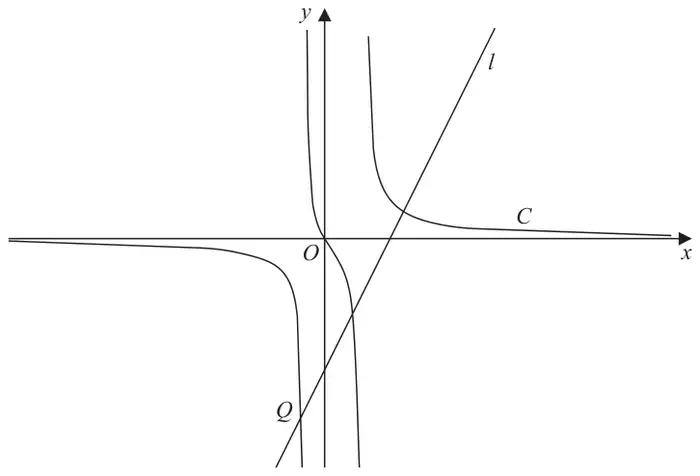
Figure 3 shows a sketch of the curve \(C\) with equation
\[y = \frac{15x}{(2x+3)(x-3)} \qquad\qquad x \neq -\frac{3}{2} \quad x \neq 3\]and the straight line \(l\) with equation
\[y = 2x - 10\]The curve and line also intersect at the point \(Q\) shown in Figure 3.
| Scheme | Marks | AO |
|---|---|---|
| e.g. Substitutes \(x = 6\) into both \((y =)\ \dfrac{15x}{(2x+3)(x-3)}\) and \((y =)\ 2x - 10\) and finds the \(y\) values for both | M1 | 1.1b |
| e.g. Achieves 2 for both and makes a valid conclusion * | A1* | 2.4 |
| (2) |
Notes
Must be seen in (a) to score
M1: Examples to verify include:
- substitutes \(x = 6\) into both \((y =)\ \dfrac{15x}{(2x+3)(x-3)}\) and \((y =)\ 2x - 10\) and finds the \(y\) values for both
- substitutes \(x = 6\) into one of the two equations to find \(y = 2\) and then substitutes this into the other equation and solves to find \(x\)
- sets \(\dfrac{15x}{(2x+3)(x-3)} = 2x - 10 \Rightarrow\) cubic equation (=0 implied) and either substitutes \(x = 6\) into the expression, attempts \(\mathrm{f}(6)\) or else attempts to divide the cubic = 0 by \((x - 6)\).
Condone without calculations for this mark only. i.e. \(\mathrm{f}(6) = 0\)
Condone slips for this mark in any of the outlined approaches. There may be variations of these as well.
A1*: Correct calculations must be seen with a minimal conclusion that they intersect
e.g. \(\dfrac{15 \times 6}{(2 \times 6 + 3)(6 - 3)} = 2\) and \(12 - 10 = 2\) so they intersect (allow eg meet/cross/intercept)
e.g. \(\dfrac{15 \times 6}{(2 \times 6 + 3)(6 - 3)} = 2 \Rightarrow 2 = 2x - 10 \Rightarrow x = 6\) so they intersect
Acceptable alternatives are:
\(\mathrm{f}(x) = 4x^3 - 26x^2 - 3x + 90,\ \mathrm{f}(6) = 4 \times 6^3 - 26 \times 6^2 - 3 \times 6 + 90 = 0 \Rightarrow\) so they intersect
\(\mathrm{f}(x) = 4x^3 - 26x^2 - 3x + 90 \Rightarrow (x - 6)(4x^2 - 2x - 15)\) so \(x = 6\) is a root so they intersect
OR \((x - 6)\) is a factor hence they intersect
Only accept verified, QED etc if there is a preamble mentioning intersection about how it will be shown.
Special case: (\(\mathrm{f}(x) = 4x^3 - 26x^2 - 3x + 90 = 0\) o.e.) \(\Rightarrow\) awrt \(-1.7\), 6, awrt 2.2 Scores M1A0 with or without a conclusion. Requires all 3 roots.
| Scheme | Marks | AO |
|---|---|---|
| Sets \(\dfrac{15x}{(2x+3)(x-3)} = 2x - 10\) and attempts to cross multiply | M1 | 1.1b |
| \(4x^3 - 26x^2 - 3x + 90 = 0\) * | A1* | 2.1 |
| (2) |
Notes
Work seen in (a) must be used in (b) to score
M1: Sets \(\dfrac{15x}{(2x+3)(x-3)} = 2x - 10\) and attempts to cross multiply to form a cubic equation.
Score for \(15x = (2x - 10)(2x + 3)(x - 3)\) or may be implied by an attempt to multiply two of the three brackets out e.g. \(15x = (2x - 10)(2x^2 - 3x - 9)\) or
\(15x = (x - 3)(4x^2 - 14x - 30)\) or \(15x = (2x + 3)(2x^2 - 16x + 30)\) (may be unsimplified)
Condone slips provided the intention is clear.
Condone invisible brackets to be implied by further work which is not the given answer.
Do not allow this mark to be scored for proceeding straight from \(\dfrac{15x}{(2x+3)(x-3)} = 2x - 10\) to a simplified expression of \(15x = 4x^3 - 26x^2 + 12x + 90\)
A1*: Achieves the given answer with sufficient intermediate steps seen and no errors including invisible brackets in the main body of their solution (ignore “side workings”)
Expect to see on the right hand side the product of a linear and a quadratic expression and an expression with all of the brackets multiplied out before simplifying to the given answer.
e.g.
\(\Rightarrow 4x^3 - 26x^2 - 3x + 90 = 0\) * which is A1*
| Scheme | Marks | AO |
|---|---|---|
| Deduces that \((x - 6)\) is a factor and attempts to divide | M1 | 2.1 |
| \(4x^3 - 26x^2 - 3x + 90 = (x - 6)\left(4x^2 - 2x - 15\right)\) | A1 | 1.1b |
| Solves their \(4x^2 - 2x - 15\) using suitable method | M1 | 1.1b |
| Deduces \(x = \dfrac{1 - \sqrt{61}}{4}\) (see note) | A1 | 2.2a |
| (4) | ||
| (8 marks) |
Notes
Work seen in (a) or (b) must be used in (c) to score
M1: For the key step in dividing the cubic by \((x - 6)\). There are various methods or ways to present their solution so typically methods
- by inspection look for first and last terms e.g. \((x - 6)(4x^2 \pm \ldots x \pm 15)\)
- by division look for a three term quadratic quotient of \(4x^2 - 2x \pm \ldots\)
A1: \(4x^3 - 26x^2 - 3x + 90 = (x - 6)\left(4x^2 - 2x - 15\right)\) This may be implied by sight of \(\left(4x^2 - 2x - 15\right)\) in their working.
M1: Whilst not dependent on the previous method mark, it does require an attempt at dividing by \((x - 6)\) however poor to achieve a three term quadratic factor
Solves their \(4x^2 - 2x - 15 = 0\) using either the quadratic formula or completing the square. Usual rules apply for solving a quadratic. It cannot be scored for stating the roots directly via use of a calculator which is M0A0
A1: \((x =)\ \dfrac{1 - \sqrt{61}}{4}\) or exact equivalent e.g. \(\dfrac{1}{4} - \sqrt{\dfrac{61}{16}}\)
The root \((x =)\ \dfrac{1 + \sqrt{61}}{4}\) must be rejected if found. Isw if they put their exact value in decimal form.