
June 2025 Paper 1 Q7
7.
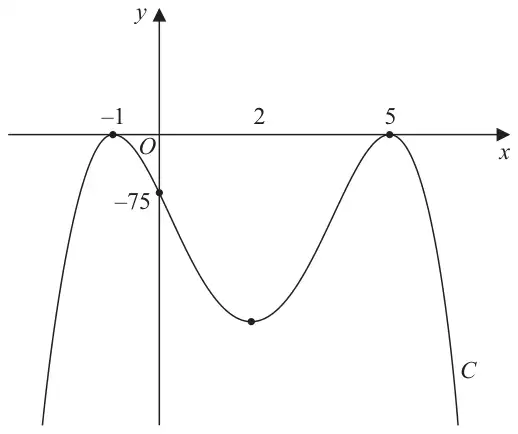
Figure 1 shows a sketch of a curve \(C\) with equation \(y = \mathrm{f}(x)\), where \(\mathrm{f}(x)\) is a quartic expression in \(x\).
The curve
- has maximum turning points at \((-1,\ 0)\) and \((5,\ 0)\)
- crosses the \(y\)-axis at \((0,\ -75)\)
- has a minimum turning point at \(x = 2\)
The curve \(C_1\) has equation \(y = \mathrm{f}(x) + k\), where \(k\) is a constant.
Given that the graph of \(C_1\) intersects the \(x\)-axis at exactly four places,
| Scheme | Marks | AO |
|---|---|---|
| Either \(x \leqslant -1\) or \(2 \leqslant x \leqslant 5\) | M1 | 2.2a |
| Both \(\{x : x \in \mathbb{R}, x \leqslant -1\} \cup \{x : x \in \mathbb{R}, 2 \leqslant x \leqslant 5\}\) o.e. | A1 | 2.5 |
| (2) |
Notes
M1: Either
- \(x \leqslant -1\) o.e. e.g. \(-1 \geqslant x\)
- \(2 \leqslant x \leqslant 5\) o.e.
but condone use of strict inequalities anywhere for this mark.
e.g. \(2 \lt x \lt 5\) or \(2 \lt x \leqslant 5\) or \(2 \leqslant x \lt 5\) May also write e.g. \(x \lt 5\) and \(x \gt 2\) which scores M1 but not "\(x \lt 5\) or \(x \gt 2\)"
Allow interval notation such as e.g. \([2, 5]\) or \((-\infty, -1]\) or condone e.g. \((2, 5)\)
Ignore incorrect inequality statements not related to the one which is valid.
e.g. “\(2 \leqslant x \lt 5\) and \(x \gt -1\)” which scores M1 for the first inequality.
A1: Requires \(\{\ \}\) and \(\cup\)
\(\{x : x \leqslant -1\} \cup \{x : 2 \leqslant x \leqslant 5\}\) or \(\{x \mid x \leqslant -1\} \cup \{x \mid 2 \leqslant x \leqslant 5\}\) either way round
but condone \(\{x \leqslant -1\} \cup \{2 \leqslant x \leqslant 5\}\), \(\{x \leqslant -1 \cup 2 \leqslant x \leqslant 5\}\).
Allow e.g. \(\{x : x \leqslant -1\} \cup \{x : 2 \leqslant x \cap x \leqslant 5\}\)
Use of \(\cap\) to join the two separate regions is A0
It is acceptable (but not required) to mention \(\mathbb{R}\)
e.g. \(\{x : x \in \mathbb{R}, x \leqslant -1\} \cup \{x : x \in \mathbb{R}, 2 \leqslant x \leqslant 5\}\)
Condone use of a lower limit written as e.g. \(\{x : -\infty \leqslant x \leqslant -1\} \cup \{x : 2 \leqslant x \leqslant 5\}\)
| Scheme | Marks | AO |
|---|---|---|
| States \((y =)\ \alpha(x+1)^2(x-5)^2\) or \((\mathrm{f}(x) =)\ \alpha(x+1)^2(x-5)^2\) | M1 | 1.1b |
| Substitutes \((0,\ -75)\) into \(y = \alpha(x+1)^2(x-5)^2\) and attempts to find the value for \(\alpha\) | dM1 | 3.1a |
| \(y = -3(x+1)^2(x-5)^2\) o.e. | A1 | 2.1 |
| (3) |
Notes
Note a correct equation written down scores all 3 marks.
A correct expression but missing e.g. \(y = \ldots\) or \(\mathrm{f}(x) = \ldots\) scores M1dM1A0
M1: Forms the equation of the form \((y =)\ \alpha(x+1)^2(x-5)^2\). Condone \(\alpha = 1\)
Award for sight of \(\alpha(x+1)^2(x-5)^2\) even with \(\alpha = 1\) i.e. \((x+1)^2(x-5)^2\)
dM1: Substitutes \((0,\ -75)\) into the form \(y = \alpha(x+1)^2(x-5)^2\) and attempts to find the value for \(\alpha\). It is dependent on the previous method mark.
A1: \(y = -3(x+1)^2(x-5)^2\) o.e. (e.g. \(y = -3x^4 + 24x^3 - 18x^2 - 120x - 75\))
isw after a correct answer. Condone \(\mathrm{f}(x) = -3(x+1)^2(x-5)^2\) but not \(C = -3(x+1)^2(x-5)^2\)
A correct equation scores all 3 marks. Allow if seen in (c)
isw if they attempt to multiply out.
Alternative I part (b):
Using the form \(y = ax^4 + bx^3 + cx^2 + dx + e\), then setting up and solving simultaneous equations.
There are various versions of this but can be marked similarly.
M1: Sets \(e\) equal to \(-75\) (may just be seen in their equation) and forms three correct different equations in \(a\), \(b\), \(c\) and \(d\) which may be unsimplified.
Note that the form \(y = ax^4 + bx^3 + cx^2 + dx + e\) is M0 until e is set equal to \(-75\)
There are 5 equations that can be formed, only 3 are necessary for this mark.
Do not condone slips.
| Using \((-1,\ 0)\) | \(\Rightarrow 0 = a - b + c - d - 75\) o.e. |
| Using \((5,\ 0)\) | \(\Rightarrow 0 = 625a + 125b + 25c + 5d - 75\) o.e. |
| Using \(\dfrac{\mathrm{d}y}{\mathrm{d}x} = 0\) at \(x = 2\) | \(\Rightarrow 0 = 32a + 12b + 4c + d\) o.e. |
| Using \(\dfrac{\mathrm{d}y}{\mathrm{d}x} = 0\) at \(x = -1\) | \(\Rightarrow 0 = -4a + 3b - 2c + d\) o.e. |
| Using \(\dfrac{\mathrm{d}y}{\mathrm{d}x} = 0\) at \(x = 5\) | \(\Rightarrow 0 = 500a + 75b + 10c + d\) o.e. |
dM1: Forms four correct different equations and solves to find values for \(a\), \(b\), \(c\) and \(d\). You do not need to be concerned by the process of solving. A calculator can be used to solve the equations.
A1: \(y = -3x^4 + 24x^3 - 18x^2 - 120x - 75\) o.e. isw if they attempt to factorise but withhold this mark if they e.g. divide all terms by 3.
Condone \(\mathrm{f}(x) = \ldots\) but not \(C = \ldots\)
A correct equation scores all 3 marks. Allow if seen in (c)
Alternative II part (b): Uses the form \(y = (x+1)(x-5)(ax^2 + bx + c)\)
M1: Substitutes \(x = 0,\ y = -75\) \(-75 = -5c \Rightarrow c = 15\), multiplies out, differentiates
\(\Rightarrow \dfrac{\mathrm{d}y}{\mathrm{d}x} = (2x - 4)(ax^2 + bx + 15) + (x^2 - 4x - 5)(2ax + b)\)
and forms a correct equation in \(a\) and \(b\) which may be unsimplified.
| Using \(\dfrac{\mathrm{d}y}{\mathrm{d}x} = 0\) at \(x = 2\) | \(\Rightarrow 0 = 4a + b\) o.e. |
| Using \(\dfrac{\mathrm{d}y}{\mathrm{d}x} = 0\) at \(x = -1\) | \(\Rightarrow 0 = a - b + 15\) o.e. |
| Using \(\dfrac{\mathrm{d}y}{\mathrm{d}x} = 0\) at \(x = 5\) | \(\Rightarrow 0 = 5a + b + 3 = 0\) o.e. |
dM1: Forms two correct different equations and solves to find values for \(a\) and \(b\). You do not need to be concerned by the process of solving. A calculator can be used to solve the equations.
A1: \(y = (x+1)(x-5)(-3x^2 + 12x + 15)\) o.e. isw if they attempt to multiply out or factorise
Condone \(\mathrm{f}(x) = \ldots\) but not \(C = \ldots\) but withhold this mark if they e.g. divide all terms by 3. A correct equation scores all 3 marks. Allow if seen in (c)
Alternative III part (b): Uses \(\dfrac{\mathrm{d}y}{\mathrm{d}x} = \beta(x+1)(x-2)(x-5)\) (\(\beta\) may be 1) and integrates.
M1: Integrates \(\left(\dfrac{\mathrm{d}y}{\mathrm{d}x} =\right) \beta(x+1)(x-2)(x-5)\) to \((y =)\ \beta\left(\dfrac{1}{4}x^4 - 2x^3 + \dfrac{3}{2}x^2 + 10x + k\right)\) and forms one correct equation using either \((0,\ -75)\): \(-75 = \beta k\) (allow \(-75 = k\))
\((-1,\ 0)\): \(0 = \beta\left(\dfrac{1}{4} + 2 + \dfrac{3}{2} - 10 + k\right)\) \((5,\ 0)\): \(0 = \beta\left(\dfrac{625}{4} - 250 + \dfrac{75}{2} + 50 + k\right)\)
dM1: Forms a different equation using one of \((0,\ -75),\ (-1,\ 0),\ (5,\ 0)\) and solves to find values for \(\beta\) and \(k\). You do not need to be concerned by the process of solving. A calculator can be used to solve the equations.
A1: \(y = -12\left(\dfrac{1}{4}x^4 - 2x^3 + \dfrac{3}{2}x^2 + 10x + \dfrac{25}{4}\right)\) o.e. isw if they attempt to multiply out or factorise
Condone \(\mathrm{f}(x) = \ldots\) but not \(C = \ldots\) but withhold this mark if they e.g. divide all terms by 3. A correct equation scores all 3 marks. Allow if seen in (c)
| Scheme | Marks | AO |
|---|---|---|
| Substitutes \(x = 2\) into their \(y = -3(x+1)^2(x-5)^2 \Rightarrow y = (-243)\) | M1 | 2.1 |
| \(0 \lt k \lt 243\) | A1ft | 1.1b |
| (2) | ||
| (7 marks) |
Notes
M1: Substitutes \(x = 2\) into their \(y = -3(x+1)^2(x-5)^2\) (must be a quartic in any form) and proceeds to find a value for \(y\). Sight of their \(\pm y\) (or \(\pm 243\)) scores M1.
You may need to check this on your calculator if only a value is seen.
A1ft: \(0 \lt k \lt 243\) o.e. ft on their negative \(y\) value at \(x = 2\).
Allow use of set notation, interval notation and allow e.g. \(k \lt 243,\ k \gt 0\) but do not allow OR or \(\cup\). Do not accept \(0 \leqslant k \leqslant 243\) o.e.
If there are multiple attempts at describing the region, mark what appears to be their final answer.
This mark can only be scored if they have a negative quartic graph function
i.e. \(\alpha \lt 0\) for their \(y = \alpha(x+1)^2(x-5)^2\) or \(a \lt 0\) for their \(y = ax^4 + bx^3 + cx^2 + dx + e\)