(a) The graph of the function \(y = \mathrm{f}(x)\) passes through the point \(P\) with coordinates \((2, 6)\), and is a one-one function. State the coordinates of the point corresponding to \(P\) on each of the following curves.
(i) \(y = \mathrm{f}(x) + 3\) [1]
(ii) \(y = 2\mathrm{f}(3x - 1)\) [2]
(iii) \(y = \mathrm{f}^{-1}(x)\) [1]
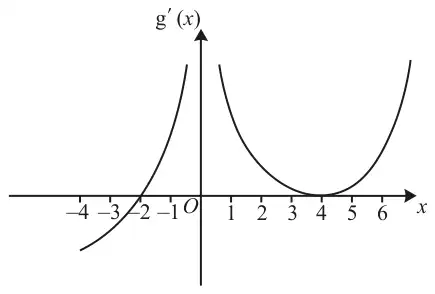
(b) The diagram shows part of the graph of \(y = \mathrm{g}'(x)\). This is the graph of the gradient function of \(y = \mathrm{g}(x)\). The graph intersects the \(x\)-axis at \(x = -2\) and \(x = 4\).
(i) State the \(x\)-coordinate of any stationary points on the graph of \(y = \mathrm{g}(x)\). [1]
(ii) State the set of values of \(x\) for which \(y = \mathrm{g}(x)\) is a decreasing function. [1]
(iii) State the \(x\)-coordinate of any points of inflection on the graph of \(y = \mathrm{g}(x)\). [1]
Mark scheme (a)
Scheme
Marks
AO
(i) \((2, 9)\)
B1
1.1
[1]
(ii) \((1, 12)\)
B1 B1
3.1a 1.1
[2]
(iii) \((6, 2)\)
B1
1.2
[1]
Notes
(a)(i)B1: Correct coordinate And no others
(a)(ii)B1: Correct \(x\)-coordinate B1: Correct \(y\)-coordinate If more than one solution given then award B1 if either co-ordinate is consistent in all solutions
(a)(iii)B1: Correct coordinate And no others
Mark scheme (b)
Scheme
Marks
AO
(i) \(x = -2\), \(x = 4\)
B1
3.1a
[1]
(ii) \(x \lt -2\)
B1
1.2
[1]
(iii) \(x = 4\)
B1
1.2
[1]
Notes
(b)(i)B1: Both \(x\)-coordinates correct, and no others Ignore any attempt at \(y\) values
(b)(ii)B1: Correct inequality, and no others Allow \(\leqslant\) Could be written in set notation
(b)(iii)B1: Correct \(x\)-coordinate, and no others Ignore any attempt at \(y\) values