
June 2024 Paper 1 Q2
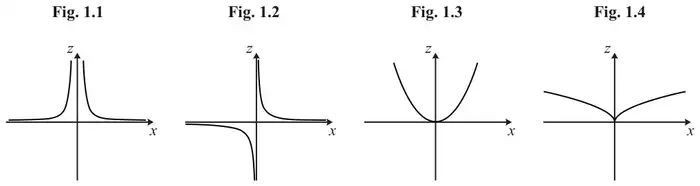
2 You are given that \(y\) is inversely proportional to \(x^6\) and \(z\) is directly proportional to the cube root of \(y\).
| Scheme | Marks | AO |
|---|---|---|
| (i) \(y = \dfrac{a}{x^6}\quad z = b\sqrt[3]{y}\) | M1 | 3.1a |
| Hence \(z = k\sqrt[3]{\dfrac{1}{x^6}}\) Equation is \(z = \dfrac{k}{x^2}\) | A1 | 2.1 |
| [2] | ||
| (ii) Identify Fig. 1.1 | B1 | 3.2a |
| [1] |
Notes
(a)(i)
M1: Attempt at least one equation, involving a constant of proportionality.
Allow BOD if the constants of proportionality are the same in two equations.
Allow \(\propto\) to be used.
A1: Correct simplified equation seen.
Equation must be simplified, so A0 for eg \(z = k\sqrt[3]{\dfrac{1}{x^6}}\)
Must involve just a single constant of proportionality ie \(k\)
A0 if the same constant of proportionality was used in both initial equations, or if \(k\) was used in either of the initial equations.
(a)(ii)
B1: Not dependent on correct equation in (i).
B0 if more than one Fig. identified.
| Scheme | Marks | AO |
|---|---|---|
| \(3 = \dfrac{k}{16}\) \(k = 48\) | M1* | 1.1 |
| \(\dfrac{48}{x^2} = 12\) \(x^2 = 4\) | M1d* | 1.1 |
| \(x = \pm 2\) | A1 | 1.1 |
| [3] |
Notes
M1*: Use \(x = 4\) and \(z = 3\) to attempt to find \(k\) from their equation of proportionality.
Their equation must involve \(x\), \(z\) and \(k\)
As far as attempting \(k\)
M1d*: Attempt to find \(x\) using \(z = 12\) and their numerical \(k\). Dependent on previous M1.
Their equation involving \(x\), \(z\) and their \(k\)
Attempt at least one value of \(x\)
A1: Both values required.
Must have had correct final equation in (a)(i), but could follow A0 if constants of proportionality were not dealt with correctly.