
June 2024 Paper 3 Q7
7
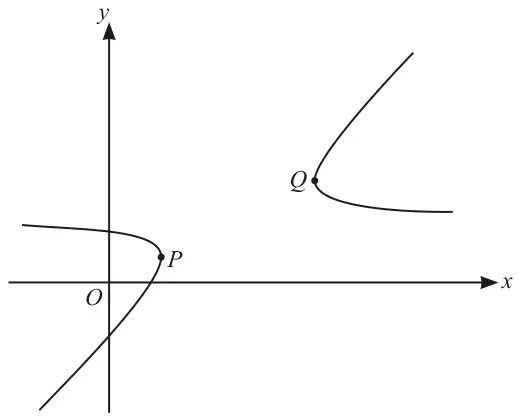
The diagram shows the curve \(5x - 2xy + 2y^2 - k = 0\), where \(k\) is a positive integer.
At the points \(P\) and \(Q\) on the curve, the tangents to the curve are parallel to the \(y\)-axis.
Given that the difference in the \(y\)-coordinates of \(P\) and \(Q\) is 3, determine the \(x\)-coordinates of \(P\) and \(Q\). [7]
| Scheme | Marks | AO |
|---|---|---|
| For reference: \(5x - 2xy + 2y^2 - k = 0\) Attempt at implicit differentiation wrt \(x\) | M1* | 2.1 |
| \(5 - 2y - 2x\dfrac{\mathrm{d}y}{\mathrm{d}x} + 4y\dfrac{\mathrm{d}y}{\mathrm{d}x} = 0\) | A1 | 1.1 |
| \(\dfrac{\mathrm{d}y}{\mathrm{d}x} = \dfrac{2y - 5}{4y - 2x}\) so at \(P\) and \(Q\), \(4y - 2x = 0\) | M1dep* | 3.1a |
| \(5x - 2xy + 2y^2 - k\,[= 0]\) \(\Rightarrow 5(2y) - 2(2y)y + 2y^2 - k\,[= 0]\) \(\Rightarrow 2y^2 - 10y + k\,[= 0]\) | M1 | 1.1 |
| Difference in \(y\) values is 3 so \(\dfrac{\sqrt{100 - 8k}}{2} = 3\) \(\left(\text{or } \dfrac{10 + \sqrt{100 - 8k}}{4} - \dfrac{10 - \sqrt{100 - 8k}}{4} = 3\right)\) | M1 | 1.1 |
| \(k = 8\) | A1 | 1.1 |
| \(x_P = 2,\ x_Q = 8\) | A1 | 2.2a |
| [7] |
Notes
M1*: Either \(\dfrac{\mathrm{d}}{\mathrm{d}x}(2xy) = 2y + 2x\dfrac{\mathrm{d}y}{\mathrm{d}x}\) or \(\dfrac{\mathrm{d}}{\mathrm{d}x}\left(y^2\right) = 2y\dfrac{\mathrm{d}y}{\mathrm{d}x}\)
Attempt at implicit differentiation wrt \(x\)
A1: Correct equation (any form) – allow = 0 implied by later working
Setting derivative equal to \(y'\) is A0
M1dep*: Set the denominator of their \(\dfrac{\mathrm{d}y}{\mathrm{d}x}\) equal to zero (oe)
Denominator must be linear in both \(x\) and \(y\)
M1: Eliminate \(x\) correctly and simplify to a 3TQ quadratic in \(y\) (if correct: \(2y^2 - 10y + k = 0\)) or eliminate \(y\) correctly to form a 3TQ quadratic in \(x\) (if correct: \(x^2 - 10x + 2k = 0\))
Dependent on both previous M marks – condone sign slips only in simplification
M1: Setting up the equation for diff. in \(y\) \(\dfrac{\sqrt{b^2 - 4ac}}{a} = \pm 3\), LHS of equation must be correct following through from their 3TQ (the constant term for their 3TQ in \(y\) must contain \(k\))
Dependent on first two M marks – if considering diff. in \(x\) values = 3 then M0
Correct \(k\) or both \(y\)’s www is M1 A1
A1: www (can be implied by correct \(y\)-values)
\(y_P = 1, y_Q = 4\)
A1: Both correct www – do not penalise \(x_P = 8, x_Q = 2\)
Dependent on all previous marks
Alternative for the first 3 marks (implicit differentiation wrt \(y\))
| Scheme | Marks |
|---|---|
| Attempt at implicit differentiation wrt \(y\) | M1 |
| \(5\dfrac{\mathrm{d}x}{\mathrm{d}y} - 2x - 2y\dfrac{\mathrm{d}x}{\mathrm{d}y} + 4y = 0\) | A1 |
| \(\dfrac{\mathrm{d}x}{\mathrm{d}y} = \dfrac{4y - 2x}{2y - 5}\) so at \(P\) and \(Q\), \(4y - 2x = 0\) | M1 |
M1: Either \(\dfrac{\mathrm{d}}{\mathrm{d}x}(2xy) = 2x + 2y\dfrac{\mathrm{d}x}{\mathrm{d}y}\) or \(\dfrac{\mathrm{d}}{\mathrm{d}y}(5x) = 5\dfrac{\mathrm{d}x}{\mathrm{d}y}\)
A1: Correct equation (any form) – allow = 0 implied by later working
Setting derivative equal to \(x'\) is A0
M1: Set the numerator of their \(\dfrac{\mathrm{d}x}{\mathrm{d}y} = 0\) oe
Alternative for the first 4 marks (making \(x\) the subject, diff. wrt \(y\))
| Scheme | Marks |
|---|---|
| \(5x - 2xy + 2y^2 - k = 0 \Rightarrow x = \dfrac{k - 2y^2}{5 - 2y}\) | M1* |
| \(\dfrac{\mathrm{d}x}{\mathrm{d}y} = \dfrac{(5 - 2y)(-4y) - (k - 2y^2)(-2)}{(5 - 2y)^2}\) | A1 |
| \((5 - 2y)(-4y) - (k - 2y^2)(-2) = 0\) | M1dep* |
| \(-20y + 8y^2 + 2k - 4y^2 = 0\) \(\Rightarrow 2y^2 - 10y + k = 0\) | M1 |
M1*: Makes \(x\) the subject – must be of the form \(x = \dfrac{\mathrm{f}(y)}{\mathrm{g}(y)}\) where \(\mathrm{f}(y)\) is a two-term quadratic fn. in \(y\) and \(\mathrm{g}(y)\) is a two-term linear fn. in \(y\)
A1: Correct derivative (allow un-simplified)
Any equivalent correct form
M1dep*: Set the numerator of their \(\dfrac{\mathrm{d}x}{\mathrm{d}y}\) equal to zero (oe) where \(\dfrac{\mathrm{d}x}{\mathrm{d}y} = \dfrac{\mathrm{g}(y) \times \mathrm{f}'(y) \pm \mathrm{f}(y) \times \mathrm{g}'(y)}{(\mathrm{g}(y))^2}\)
Where \(\mathrm{f}(y)\) and \(\mathrm{g}(y)\) are as defined in the first M mark and derivatives follow through correctly from their f and g
M1: Simplify to a 3TQ quadratic in \(y\) (if correct: \(2y^2 - 10y + k = 0\))
Dependent on both previous M marks – condone sign slips only in simplification to 3 TQ in \(y\)
Alternative 1 for the fourth M mark (roots of polynomials)
| Scheme | Marks |
|---|---|
| If correct: \(2y^2 - 10y + k\,[= 0]\) Difference in \(y\) values is 3 therefore if the \(y\) roots are \(\alpha, 3 + \alpha\) then \(\alpha + (3 + \alpha) = -\dfrac{-10}{2}\) \((\alpha = 1 \Rightarrow y = 1, 4)\) If using this method, then candidates do not need to find \(k\), so the penultimate A mark is for the correct two \(y\) values (1 and 4) | M1 |
M1: Using \(\sum\alpha = -\dfrac{b}{a}\) correctly for their 3TQ in \(y\) with roots that differ by 3
Could use e.g. \(\alpha, \alpha - 3\) etc.
Dependent on first two M marks
Alternative 2 for the fourth M mark (difference in \(x\)-values)
| Scheme | Marks |
|---|---|
| Difference in \(y\)-values is 3 therefore the difference in \(x\) values is 6 (from \(4y - 2x = 0\)) Therefore, as \(x^2 - 10x + 2k = 0\) \(\Rightarrow \sqrt{100 - 8k} = 6\) \(\left(\text{or } \dfrac{10 + \sqrt{100 - 8k}}{2} - \dfrac{10 - \sqrt{100 - 8k}}{2} = 6\right)\) | M1 |
M1: Setting up the equation for diff. in \(x\) \(\dfrac{\sqrt{b^2 - 4ac}}{a} = \pm\)their 6, with their 6 from their \(4(3) - 2x = 0\), LHS of equation must be correct following through from their 3TQ (the constant term for their 3TQ in \(x\) must contain \(k\))
Dependent on first two M marks