
June 2022 Paper 1 Q3
3
Find all points of intersection of the curves \(y = 3\sin x\cos x\) and \(y = \cos^2 x\) for \(-\pi \leqslant x \leqslant \pi\). [6]
| Scheme | Marks | AO |
|---|---|---|
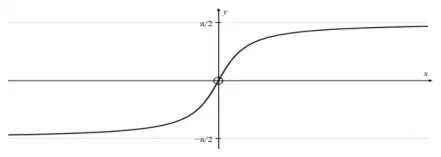 | B1 B1 | 1.1b 1.1b |
| [2] |
Notes
B1: General shape with horizontal asymptotes
Allow if asymptote not drawn provided the intention is clear
Must be a one-to-one function
B1: \(y\)-values \(\pm\dfrac{\pi}{2}\) seen
| Scheme | Marks | AO |
|---|---|---|
| DR Graphs intersect when \(3\sin x\cos x = \cos^2 x\) | M1 | 1.1a |
| Either \(\cos x = 0\) | M1 | 1.1b |
| giving \(x = -\dfrac{\pi}{2}, \dfrac{\pi}{2}\) | A1 | 2.1 |
| or \(3\sin x = \cos x\) giving \(\tan x = \frac{1}{3}\) | M1 | 2.1 |
| \(x = 0.322,\ x = -2.82\) to 3 s.f. | A1 | 2.1 |
| When \(x = 0.322\) or \(x = -2.82\), \(y = 0.9\) [So the points of intersection are \((0.322, 0.9), (-2.82, 0.9), \left(-\frac{\pi}{2}, 0\right), \left(\frac{\pi}{2}, 0\right)\)] | A1 | 2.1 |
| [6] |
Notes
M1: soi
M1: Attempt to solve \(\cos x = 0\)
A1: Both values in radians needed
M1: Allow for \(x = \tan^{-1}\frac{1}{3}\)
A1: Both values in radians to at least 2 s.f. needed. Do not award if additional values inside the interval \([-\pi, \pi]\)
Ignore additional values outside the interval \([-\pi, \pi]\).
SC1 award for \(18.4^\circ\) and \(-161.6^\circ\) if \(90^\circ\) already seen
A1: Allow awrt 0.90
Notice 0.9 is exact.
Alternative method
| Scheme | Marks |
|---|---|
| DR Graphs intersect when \(3\sin x\cos x = \cos^2 x\) | M1 |
| Either \(\cos x = 0\) | M1 |
| giving \(x = -\dfrac{\pi}{2}, \dfrac{\pi}{2}\) | A1 |
| Or \(3\sin x = \cos x\) Squaring gives \(9\sin^2 x = \cos^2 x = 1 - \sin^2 x\) \(10\sin^2 x = 1\) \(\sin x = \pm\sqrt{0.1}\) \(x = -2.820, -0.322, 0.322, 2.820\) | M1 |
| Select genuine roots 0.322, \(-2.820\) | A1 |
| When \(x = 0.322\) or \(x = -2.82\), \(y = 0.9\) [So the points of intersection are \(\left(-\frac{\pi}{2}, 0\right), \left(\frac{\pi}{2}, 0\right), (0.322, 0.9), (-2.820, 0.9)\)] | A1 |
M1: soi
M1: Attempt to solve \(\cos x = 0\)
A1: Both values in radians needed
M1: Complete method for finding at least one value for \(\sin x\)
A1: Both correct roots and no others in the range
A1: Allow awrt 0.90
Notice 0.9 is exact.