June 2025 Paper 2 Q12
12.
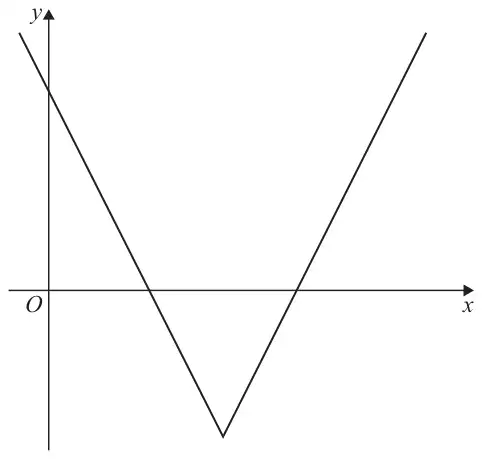
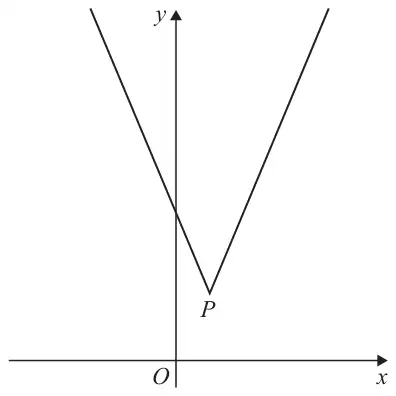
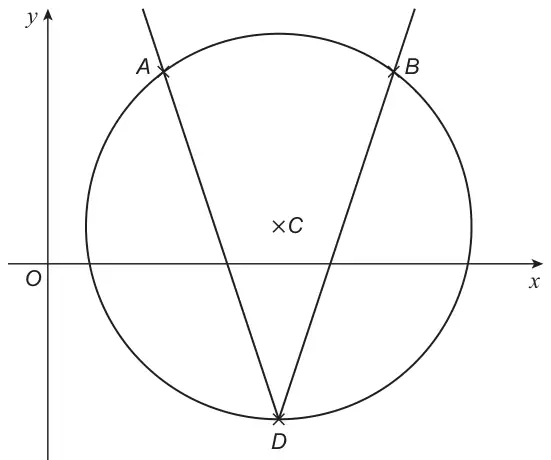
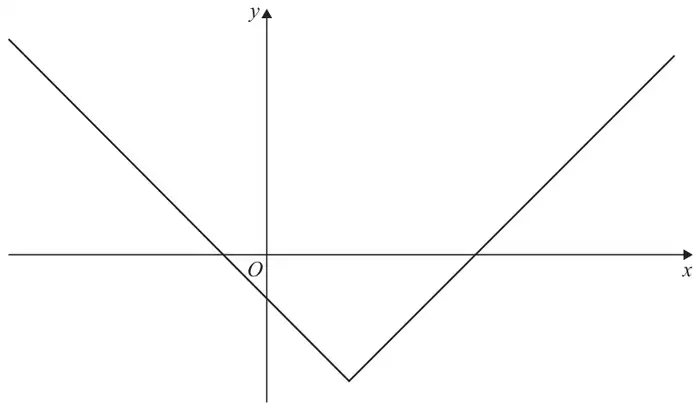
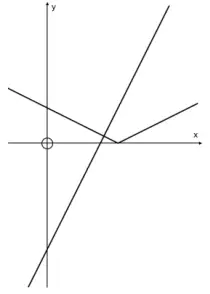
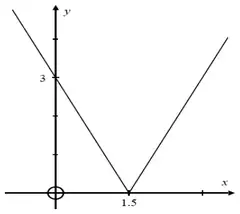
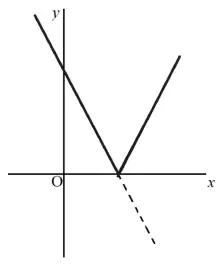
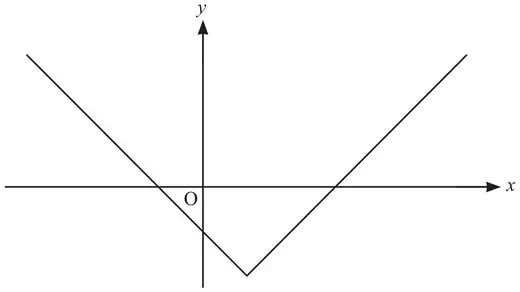
Figure 3 shows a sketch of the graph with equation \(y = \mathrm{f}(x)\) where\[\mathrm{f}(x) = 4\left|x - 3\right| - 5 \qquad x \in \mathbb{R}\]
Given that \(a\) is a constant and \(\left|a\right| = 1\)
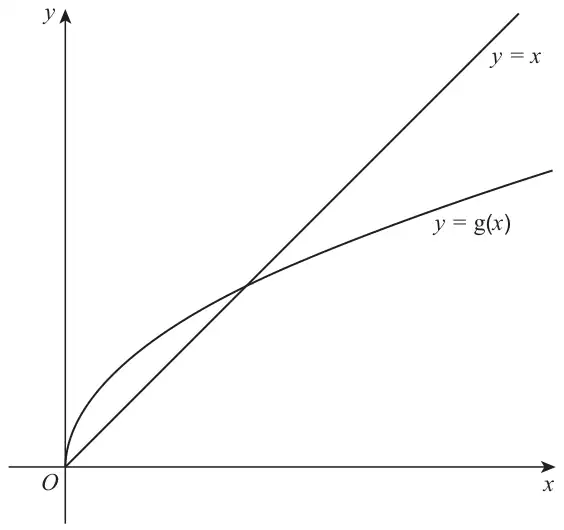
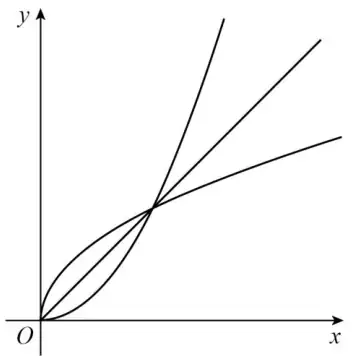
The function g is defined by\[\mathrm{g}(x) = 2x + 17 \qquad x \in \mathbb{R}\]
The function h is defined by\[\mathrm{h}(x) = kx \qquad x \in \mathbb{R}\]where \(k\) is a constant.
Given that the equation \(\mathrm{f}(x) = \mathrm{h}(x)\) has no solutions,
| Scheme | Marks | AO |
|---|---|---|
| \(4\left|1 - 3\right| - 5 = \ldots\) or \(4\left|-1 - 3\right| - 5 = \ldots\) | M1 | 1.1b |
| 3 and 11 | A1 | 1.1b |
| (2) |
Notes
M1: Attempts \(4\left|1 - 3\right| - 5 = \ldots\) or \(4\left|-1 - 3\right| - 5 = \ldots\) proceeding to a value.
Either correct value (3 or 11) that is clearly their answer can imply the M mark.
Alternatively, attempts any of \(-4(-1 - 3) - 5\) or \(-4(1 - 3) - 5\) or \(-4(-1) + 7\) or \(-4(1) + 7\) i.e. without the modulus signs using the ‘left’ branch of the function.
A1: Both 3 and 11 found and no other values that are clearly meant to be their answers (i.e. ignore reference to \(a = 1\) or \(a = -1\)). Accept “3, 11” or “3 or 11” or “3 and 11” or {3, 11} but not (3, 11). Condone \(y = 3, 11\) but not \(x = 3, 11\).
| Scheme | Marks | AO |
|---|---|---|
| \(2(-5) + 17 = \ldots\) | M1 | 1.1b |
| \(\mathrm{gf}(x) \geqslant 7\) | A1 | 2.2a |
| (2) |
Notes
M1: Attempts \(2(-5) + 17\) which may be implied by sight of 7 used in their range, including in an incorrect range e.g. \(\mathrm{f}(x) \gt 7\)
Alternatively, attempts \(\mathrm{gf}(x) = 2\left(4\left|x - 3\right| - 5\right) + 17\ \left(= 8\left|x - 3\right| + \text{``}7\text{''}\right)\) and replaces \(\left|x - 3\right|\) with 0 or \(x\) with 3 or simply deduces the minimum value of their “7” in this case.
Must be an attempt at gf and not fg.
A1: Deduces the range \(\mathrm{gf}(x) \geqslant 7\) using correct notation.
Condone \(y \geqslant 7\) but not e.g. \(x \geqslant 7\) or \(\mathrm{g}(x) \geqslant 7\) or \(\mathrm{f}(x) \geqslant 7\) or \(\mathrm{fg}(x) \geqslant 7\)
Other acceptable notation includes: \(\mathrm{gf}(x) \in [7, \infty)\)
Do not accept \(\mathrm{gf}(x) \in [7, \infty]\) or \(\mathrm{gf}(x) \in (7, \infty)\)
| Scheme | Marks | AO |
|---|---|---|
| \(k \ldots -4\) | B1 | 2.2a |
| Minimum at \((3, -5)\) so \(k \ldots -\dfrac{5}{3}\) | M1 | 3.1a |
| \(k \lt \text{``}{-}\dfrac{5}{3}\text{''}\) | A1ft | 1.1b |
| A1 | 2.5 | |
| (4) | ||
| (8 marks) |
Notes
B1: Deduces \(k \ldots -4\) allow any equality or inequality here. Condone \(k \ldots \pm 4\) (but not just \(k \ldots 4\)) and condone e.g. “gradient … – 4”
May be seen coming from e.g. \(kx = -4x + 7 \rightarrow (k + 4)x = 7\) or \(x = \dfrac{7}{k + 4}\) which is acceptable but see the note below. Should not be \(x\) or \(y\) for this mark but may be \(m\).
Note: Finding the ‘discriminant’ of a linear equation e.g. \((k + 4)x - 7 = 0\) in order to obtain \(k \ldots -4\) is invalid and cannot earn either the B1 or the final A1 mark unless there is an alternative valid reason given.
M1: Attempts to use the vertex to find the (upper) limit for \(k\). Look for \(\dfrac{\pm 5}{\pm 3}\) but allow this mark to be scored for \(\dfrac{\pm B}{\pm A}\) if there is clear evidence that they think the vertex is at \((A, B)\)
Allow use of \(m\), \(x\), \(y\) or another variable for this mark.
Alt 1 via squaring and the discriminant
\[\begin{aligned}kx = 4\left|x - 3\right| - 5 &\Rightarrow kx + 5 = 4\left|x - 3\right|\\&\Rightarrow k^2x^2 + 10kx + 25 = 16\left(x^2 - 6x + 9\right)\\&\Rightarrow \left(k^2 - 16\right)x^2 + (10k + 96)x - 119 = 0\\&\Rightarrow (10k + 96)^2 - 4\left(k^2 - 16\right)(-119) = 0\\&\Rightarrow 576k^2 + 1920k + 1600 = 0 \Rightarrow k = -\frac{5}{3}\end{aligned}\]
Scores M1 for setting \(kx = 4\left|x - 3\right| - 5\), isolating \(\left|x - 3\right|\) (or \(4\left|x - 3\right|\)), squaring both sides, using \(b^2 - 4ac \ldots 0\) where … is any equality or inequality, and solving the resulting 3TQ using the usual rules and may be by calculator, leading to a value for \(k\).
Condone slips in expanding the brackets.
Alt 2 via solving simultaneous equations
\[\begin{aligned}&\text{e.g. } kx = 4(x - 3) - 5 \Rightarrow x = \frac{-17}{k - 4}\\&kx = 4(3 - x) - 5 \Rightarrow (k + 4)x = 7\\&\Rightarrow (k + 4)\left(\frac{-17}{k - 4}\right) = 7 \Rightarrow k = -\frac{5}{3}\end{aligned}\]
Scores M1 for setting \(kx = 4(x - 3) - 5\) and \(kx = 4(3 - x) - 5\), eliminating \(x\), and solving for \(k\)
A1ft: Uses their value of \(k\), found using one of the above methods, as the upper end of the range for \(k\), i.e., \(k \lt \text{``}{-}\dfrac{5}{3}\text{''}\) which may be seen as part of their range. Condone \(k \leqslant \text{``}{-}\dfrac{5}{3}\text{''}\) for this mark.
Score once seen as an upper limit and do not withhold if they then incorrectly combine as e.g. \(-\dfrac{5}{3} \lt k \lt -4\)
Condone the use of \(m\) for this mark, but not \(x\) or \(y\).
A1: \(-4 \leqslant k \lt -\dfrac{5}{3}\) o.e. and no other solutions seen. Their range must use \(k\) and not e.g. \(x\), \(y\) or \(m\).
Other acceptable notation includes: \(k \in \left[-4, -\dfrac{5}{3}\right)\), “\(k \lt -\dfrac{5}{3}\) and \(k \geqslant -4\)”, \(k \lt -\dfrac{5}{3} \cap k \geqslant -4\)
Do not accept e.g. “\(k \lt -\dfrac{5}{3}\), \(k \geqslant -4\)” or “\(k \lt -\dfrac{5}{3}\) or \(k \geqslant -4\)” or “\(k \lt -\dfrac{5}{3} \cup k \geqslant -4\)”
Allow \(-1.\dot{6}\) but not \(-1.6\) or \(-1.6\ldots\) for \(-\dfrac{5}{3}\)