\[\begin{aligned}&\mathrm{f}(x) = x^2 + 5 &&\qquad x \in \mathbb{R}\\ &\mathrm{g}(x) = \sqrt{x} &&\qquad x \geqslant 0\end{aligned}\]
(a) Using set notation, state the range of f [2 marks]
(b) Determine whether f has an inverse.
Fully justify your answer.
[2 marks]
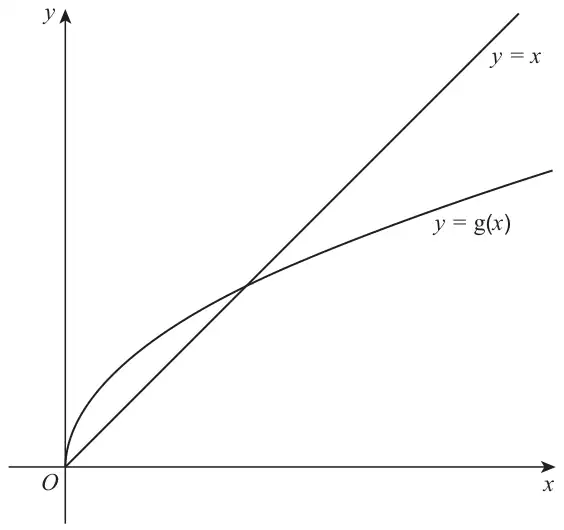
(c) The graph of \(y = \mathrm{g}(x)\), and the line with equation \(y = x\), are shown on the diagram below.
Sketch the graph of \(y = \mathrm{g}^{-1}(x)\) on the diagram.
[2 marks]
(d) The composite function gf is denoted by h
(i) Write down an expression for \(\mathrm{h}(x)\) [1 mark]
(ii) State the range of h [1 mark]
Mark scheme (a)
Scheme
Marks
AO
Deduces \(\geqslant 5\) or \(\gt 5\)
M1
2.2a
Writes the correct range using correct set notation Acceptable examples include: \(\{x : x \geqslant 5\}\) \(\{\mathrm{f}(x) : \mathrm{f}(x) \geqslant 5\}\) \([5, \infty)\) Ignore anything before \([5, \infty)\)
A1
2.5
(2)
Typical solution
Range \(\{y : y \geqslant 5\}\)
Mark scheme (b)
Scheme
Marks
AO
Demonstrates that f is many to one. This could be evidenced by a sketch of the graph of \(y = \mathrm{f}(x)\) demonstrating the horizontal line test, or by giving two \(x\)-values which result in the same value of \(\mathrm{f}(x)\), or states \(\mathrm{f}(-x) = \mathrm{f}(x)\)
E1
2.4
Explains that f is many to one or that f is not one to one and deduces that f does not have an inverse
E1
2.2a
(2)
Typical solution
\(\mathrm{f}(-1) = 6 = \mathrm{f}(1)\)
\(\therefore\) f is many to one, so it does not have an inverse
Mark scheme (c)
Scheme
Marks
AO
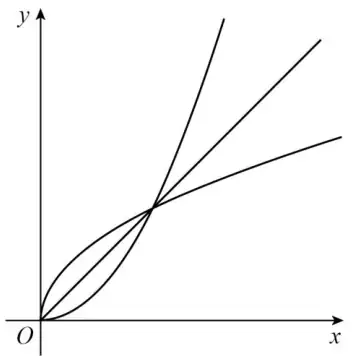
Draws a convex curve between the origin and (1,1) There should be no doubt that their graph intersects (1,1) Ignore anything outside of quadrant 1
M1
1.1a
Sketches a fully correct graph of \(y = x^2\) for \(x \geqslant 0\) Their curve must be in quadrant 1 only.
A1
1.1b
(2)
Typical solution
Mark scheme (d)
Scheme
Marks
AO
(i) Obtains \(\sqrt{x^2 + 5}\) No ISW
B1
1.1b
(1)
(ii) Deduces the range of h Accept \(y \geqslant \sqrt{5}\), \(\mathrm{gf}(x) \geqslant \sqrt{5}\) Condone \(\mathrm{h} \geqslant \sqrt{5}\), \(\mathrm{gf} \geqslant \sqrt{5}\) Or accept set notation in ACF