June 2024 Paper 1 Q8
8
| Scheme | Marks | AO |
|---|---|---|
| \(x \lt 0\) | B1 | 2.2a |
| [1] |
Notes
B1: Correct inequality
B0 for \(x \leqslant 0\)
Could use interval notation ie \((-\infty, 0)\)
Condone an incorrect attempt at set notation, as long as intention is clear
| Scheme | Marks | AO |
|---|---|---|
| (i) max value is 19 (from \(n = -9\)) | B1 | 1.1 |
| [1] | ||
| (ii) min value is 1 (from \(n = 0\) and/or 1) | B1 | 1.1 |
| [1] |
Notes
(b)(i) B1: State correct value, and no other
Value of \(n\) not required, but B0 if 19 comes from a clearly incorrect \(n\)
B0 if additional solution
B0 for \(n \leqslant 19\)
(b)(ii) B1: State correct value, and no other
Value of \(n\) not required, but B0 if 1 comes from a clearly incorrect \(n\)
B0 if additional solution
B0 for \(n \geqslant 1\)
| Scheme | Marks | AO |
|---|---|---|
| (i) \(\tfrac{1}{2}x - 1 = 2x - 3\) \(x = \tfrac{4}{3}\) | B1 | 1.1 |
| \(\tfrac{1}{2}x - 1 = -2x + 3\) | M1 | 1.1 |
| \(x = \tfrac{8}{5}\) | A1 | 1.1 |
| [3] | ||
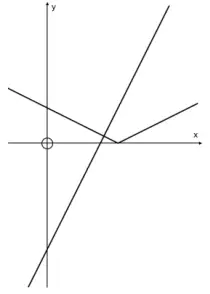
| (ii) \(x = \tfrac{8}{5}\) only, as \(2 \times \tfrac{4}{3} - 3 = -\tfrac{1}{3}\) but modulus cannot be equal to a negative value, so not a valid solution OR Sketch graphs of both functions and identify \(x = \tfrac{8}{5}\) as the single point of intersection OR State that the gradient of the straight line is greater than the gradient of the (positive part) of the modulus graph so will only be one point of intersection, namely \(x = \tfrac{8}{5}\) | B1 | 2.3 |
| [1] |
Notes
(c)(i)
B1: Obtain \(x = \tfrac{4}{3}\) oe
M1: Attempt to solve equation with all signs reversed on one side of the equation, or square both sides and attempt to solve
M0 for eg \(\tfrac{1}{2}x - 1 = -2x - 3\)
A1: Obtain \(x = \tfrac{8}{5}\) oe
Maximum of 2 marks if additional solutions
Alternative method
| Scheme | Marks |
|---|---|
| \(\left(\tfrac{1}{2}x - 1\right)^2 = (2x - 3)^2\) \(\tfrac{1}{4}x^2 - x + 1 = 4x^2 - 12x + 9\) \(15x^2 - 44x + 32 = 0\) \((3x - 4)(5x - 8) = 0\) | M1 |
| \(x = \tfrac{4}{3}\) | A1 |
| \(x = \tfrac{8}{5}\) | A1 |
M1: Square both sides to obtain two 3 term quadratics, and attempt to solve
Possibly BC
A1: Obtain \(x = \tfrac{4}{3}\)
A1: Obtain \(x = \tfrac{8}{5}\)
Maximum of 2 marks if additional solutions
(c)(ii)
B1: State \(x = \tfrac{8}{5}\), with reason as to why other solution is not valid
Both values of \(x\) must be correct ie no FT
For the sketch method: the gradient of \(y = 2x - 3\) must be clearly greater than the gradient of \(y = \tfrac{1}{2}x - 1\)
Correct sketch, but no scale needed (ISW any incorrect intercepts), but intercept of the lines must be to the left of the minimum point