
June 2024 Paper 1 Q17
17 The function \(\mathrm{f}\) is defined by
\[\mathrm{f}(x) = |x| + 1 \text{ for } x \in \mathbb{R}\]The function \(\mathrm{g}\) is defined by
\[\mathrm{g}(x) = \ln x\]where \(\mathrm{g}\) has its greatest possible domain.
(a) Using set notation, state the range of \(\mathrm{f}\) [2 marks]
(b) State the domain of \(\mathrm{g}\) [1 mark]
(c) The composite function \(\mathrm{h}\) is given by\[\mathrm{h}(x) = \mathrm{gf}(x) \text{ for } x \in \mathbb{R}\]
(i) Write down an expression for \(\mathrm{h}(x)\) in terms of \(x\) [1 mark]
(ii) Determine if \(\mathrm{h}\) has an inverse.
Fully justify your answer. [2 marks]
| Scheme | Marks | AO |
|---|---|---|
| Deduces correct region eg \(\mathrm{f}(x) \geqslant 1\) or \(y \geqslant 1\) Condone \(\mathrm{f}(x) \gt 1\) or \(y \gt 1\) | M1 | 2.2a |
| Obtains correct answer in set notation eg \(\{x : x \geqslant 1\}\) \(\{\mathrm{f}(x) : \mathrm{f}(x) \geqslant 1\}\) \([1, \infty)\) | A1 | 2.5 |
| (2) |
Typical solution
\[\{y : y \geqslant 1\}\]| Scheme | Marks | AO |
|---|---|---|
| Obtains \(\{x : x \gt 0\}\) or \((0, \infty)\) Accept \(\{y : y \gt 0\}\) but not \(y \gt 0\) | B1 | 1.1b |
| (1) |
Typical solution
\[x \gt 0\]| Scheme | Marks | AO |
|---|---|---|
| (i) Obtains \(\ln\left(|x| + 1\right)\) Accept \(\ln\left||x| + 1\right|\) ISW | B1 | 1.1b |
| (1) | ||
| (ii) States that \(\mathrm{h}\) does not have an inverse And States that \(\mathrm{h}\) is not one-to-one or that \(\mathrm{h}\) is many-to-one | E1 | 2.2a |
| Explains why \(\mathrm{h}\) is not one-to-one or why \(\mathrm{h}\) is many-to-one For example Gives two \(x\) values such that \(\mathrm{h}(x_1) = \mathrm{h}(x_2)\) Or Explains that using the positive and negative of the same \(x\)-value will result in the same \(y\)-value Or Sketches a graph of y=h(x) with a horizontal line meeting the curve in two places. eg 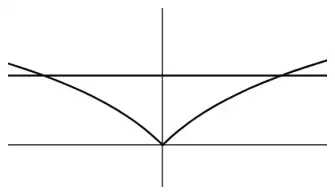 States that \(\mathrm{f}\) is many-to-one and that \(\mathrm{h}\) is a function of \(\mathrm{f}\). | E1 | 2.4 |
| (2) | ||
| (6 marks) |
Typical solution
(i)
\[\mathrm{h}(x) = \ln\left(|x| + 1\right)\](ii)
The function \(\mathrm{h}\) does not have an inverse as \(\mathrm{h}\) is not one-to-one.
For example
\[\mathrm{h}(1) = \ln 2\]and
\[\mathrm{h}(-1) = \ln 2\]