Sequences & Series

Edexcel

AQA

OCR A

OCR MEI

June 2025 Paper 1 Q3

EdexcelCurrent spec5 marksSequences & Series

3. The first three terms of an arithmetic sequence are

\[6k,\ 10 \ \text{ and } \ 2k\]

where \(k\) is a constant.

(a) Find the value of \(k\). (2)
(b) Hence find the value of the sum of the first 50 terms of this sequence. (3)

June 2024 Paper 1 Q9

EdexcelCurrent spec6 marksLogs & ExponentialsSequences & Series

9. The first 3 terms of a geometric sequence are

\[3^{4k-5} \qquad 9^{7-2k} \qquad 3^{2(k-1)}\]

where \(k\) is a constant.

(a) Using algebra and making your reasoning clear, prove that \(k = \dfrac{5}{2}\) (3)
(b) Hence find the sum to infinity of the geometric sequence. (3)

June 2024 Paper 2 Q4

EdexcelCurrent spec5 marksSequences & Series

4. A sequence \(u_1, u_2, u_3, \ldots\) is defined by

\[\begin{aligned}u_{n+1} &= ku_n - 5\\ u_1 &= 6\end{aligned}\]

where \(k\) is a positive constant.

Given that \(u_3 = -1\)

(a) show that\[6k^2 - 5k - 4 = 0\] (2)
(b) Hence
(i) find the value of \(k\),
(ii) find the value of \(\displaystyle\sum_{r=1}^{3} u_r\) (3)

June 2024 Paper 2 Q2

EdexcelCurrent spec5 marksModellingSequences & Series

2. Jamie takes out an interest-free loan of £8100

Jamie makes a payment every month to pay back the loan.

Jamie repays £400 in month 1, £390 in month 2, £380 in month 3, and so on, so that the amounts repaid each month form an arithmetic sequence.

(a) Show that Jamie repays £290 in month 12 (1)

After Jamie’s \(N\)th payment, the loan is completely paid back.

(b) Show that \(N^2 - 81N + 1620 = 0\) (2)
(c) Hence find the value of \(N\). (2)

June 2025 Paper 1 Q9

AQACurrent spec10 marksQuadraticsSequences & Series

9

(a) A geometric series, \(S\), has second term 60

The common ratio of \(S\) is 0.2

Find the exact value of the sum of the first five terms of \(S\)

[4 marks]
(b) A different geometric series, \(T\), has second term 60 and positive common ratio \(r\)

The sum to infinity of \(T\) is \(T_{\infty}\)

(i) Show that\[T_{\infty} = \frac{60}{r - r^2}\] [2 marks]
(ii) Find the maximum value of \(r - r^2\) [2 marks]
(iii) Hence find the range of possible values of \(T_{\infty}\)

Fully justify your answer.

[2 marks]

June 2025 Paper 3 Q7

AQACurrent spec3 marksSequences & Series

7 Solve the equation

\[\sum_{r=1}^{3} (ar + 5) = 57\]

to find the value of \(a\) [3 marks]

June 2025 Paper 1 Q6

AQACurrent spec2 marksSequences & Series

6 An arithmetic series has first term 3 and common difference \(-0.5\)

Find the sum of the first 250 terms. [2 marks]

June 2025 Paper 1 Q2

AQACurrent spec1 markSequences & Series

2 A sequence is defined by

\[x_{n+1} = -\frac{1}{4}x_n \quad \text{with} \quad x_1 = 32\]

The first four terms of the sequence are

\[32,\quad -8,\quad 2,\quad -0.5\]

Which one of the following can be used to describe this sequence?

Circle your answer. [1 mark]

  • Convergent
  • Decreasing
  • Increasing
  • Periodic

June 2024 Paper 1 Q12

AQACurrent spec5 marksSequences & Series

12 The terms, \(u_n\), of a periodic sequence are defined by

\[u_1 = 3 \quad \text{and} \quad u_{n+1} = \frac{-6}{u_n}\]
(a) Find \(u_2\), \(u_3\) and \(u_4\) [2 marks]
(b) State the period of the sequence. [1 mark]
(c) Find the value of \(\displaystyle\sum_{n=1}^{101} u_n\) [2 marks]

June 2024 Paper 1 Q10

AQACurrent spec6 marksModellingSequences & Series

10

(a) An arithmetic sequence has 300 terms.

The first term of the sequence is \(-7\) and the last term is 32

Find the sum of the 300 terms. [2 marks]

(b) A school holds a raffle at its summer fair.

There are nine prizes.

The total value of the prizes is £1260

The values of the prizes form an arithmetic sequence.

The top prize has the highest value, and the bottom prize has the least value.

The value of the top prize is six times the value of the bottom prize.

Find the value of the top prize. [4 marks]

June 2024 Paper 2 Q7

AQACurrent spec5 marksModellingSequences & Series

7 On the first day of each month, Kate pays £50 into a savings account.

Interest is paid on the total amount in the account on the last day of each month.

The interest rate is 0.2%

At the end of the \(n\)th month, the total amount of money in Kate’s savings account is £\(T_n\)

Kate correctly calculates \(T_1\) and \(T_2\) as shown below:

\[T_1 = 50 \times 1.002 = 50.10\]\[\begin{aligned} T_2 &= (T_1 + 50) \times 1.002 \\ &= \big((50 \times 1.002) + 50\big) \times 1.002 \\ &= 50 \times 1.002^2 + 50 \times 1.002 \\ &\approx 100.30 \end{aligned}\]
(a) Show that \(T_3\) is given by\[T_3 = 50 \times 1.002^3 + 50 \times 1.002^2 + 50 \times 1.002\] [1 mark]
(b) Kate uses her method to correctly calculate how much money she can expect to have in her savings account at the end of 10 years.
(i) Find the amount of money Kate expects to have in her savings account at the end of 10 years. [3 marks]
(ii) The amount of money in Kate’s savings account at the end of 10 years may not be the amount she has correctly calculated.

Explain why. [1 mark]

June 2024 Paper 3 Q1

AQACurrent spec1 markSequences & Series

1 Each of the series below shows the first four terms of a geometric series.

Identify the only one of these geometric series that is convergent. [1 mark]

Tick (✓) one box.

  • \(0.1 + 0.2 + 0.4 + 0.8 + \ldots\)
  • \(1 - 1 + 1 - 1 + \ldots\)
  • \(128 - 64 + 32 - 16 + \ldots\)
  • \(1 + 2 + 4 + 8 + \ldots\)

June 2023 Paper 1 Q14

AQACurrent spec11 marksIntegrationSequences & Series

14

(a)
(i) Given that\[y = 2^x\]write down \(\dfrac{\mathrm{d}y}{\mathrm{d}x}\) [1 mark]
(ii) Hence find\[\int 2^x\,\mathrm{d}x\] [2 marks]
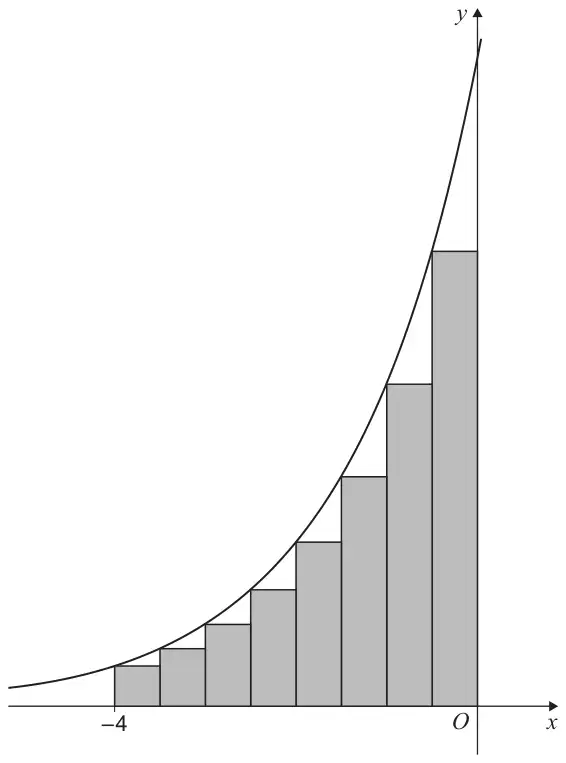
(b) The area, \(A\), bounded by the curve with equation \(y = 2^x\), the \(x\)-axis, the \(y\)-axis and the line \(x = -4\) is approximated using eight rectangles of equal width as shown in the diagram below.
Graph of y = 2^x with eight shaded rectangles of equal width under the curve between x = −4 and O, each rectangle lying below the curve, increasing in height from left to right
(i) Show that the exact area of the largest rectangle is \(\dfrac{\sqrt{2}}{4}\) [2 marks]
(ii) The areas of these rectangles form a geometric sequence with common ratio \(\dfrac{\sqrt{2}}{2}\)

Find the exact value of the total area of the eight rectangles.

Give your answer in the form \(k\left(1 + \sqrt{2}\right)\) where \(k\) is a rational number. [3 marks]

(iii) More accurate approximations for \(A\) can be found by increasing the number, \(n\), of rectangles used.

Find the exact value of the limit of the approximations for \(A\) as \(n \to \infty\) [3 marks]

June 2023 Paper 1 Q11

AQACurrent spec9 marksSequences & Series

11 The \(n\)th term of a sequence is \(u_n\)

The sequence is defined by

\[u_{n+1} = pu_n + 70\]

where \(u_1 = 400\) and \(p\) is a constant.

(a) Find an expression, in terms of \(p\), for \(u_2\) [1 mark]
(b) It is given that \(u_3 = 382\)
(i) Show that \(p\) satisfies the equation\[200p^2 + 35p - 156 = 0\] [3 marks]
(ii) It is given that the sequence is a decreasing sequence.

Find the value of \(u_4\) and the value of \(u_5\) [3 marks]

(c) The limit of \(u_n\) as \(n\) tends to infinity is \(L\)
(i) Write down an equation for \(L\) [1 mark]
(ii) Find the value of \(L\) [1 mark]

June 2023 Paper 2 Q5

AQACurrent spec7 marksModellingSequences & Series

5 Ziad is training to become a long-distance swimmer.

He trains every day by swimming lengths at his local pool.

The length of the pool is 25 metres.

Each day he increases the number of lengths that he swims by four.

On his first day of training, Ziad swims 10 lengths of the pool.

(a) Write down an expression for the number of lengths Ziad will swim on his \(n\)th day of training. [1 mark]
(b)
(i) Ziad’s target is to be able to swim at least 3000 metres in one day.

Determine the minimum number of days he will need to train to reach his target. [3 marks]

(ii) Ziad’s coach claims that when he reaches his target he will have covered a total distance of over 50 000 metres.

Determine if Ziad’s coach is correct. [3 marks]

June 2022 Paper 1 Q12

AQACurrent spec8 marksSequences & SeriesTrigonometry

12

(a) A geometric sequence has first term 1 and common ratio \(\dfrac{1}{2}\)
(i) Find the sum to infinity of the sequence. [2 marks]
(ii) Hence, or otherwise, evaluate\[\sum_{n=1}^{\infty} (\sin 30^\circ)^n\] [2 marks]
(b) Find the smallest positive exact value of \(\theta\), in radians, which satisfies the equation\[\sum_{n=0}^{\infty} (\cos\theta)^n = 2 - \sqrt{2}\] [4 marks]

June 2022 Paper 1 Q9

AQACurrent spec9 marksSequences & Series

9 The first three terms of an arithmetic sequence are given by

\[2x + 5 \qquad 5x + 1 \qquad 6x + 7\]
(a) Show that \(x = 5\) is the only value which gives an arithmetic sequence. [3 marks]
(b)
(i) Write down the value of the first term of the sequence. [1 mark]
(ii) Find the value of the common difference of the sequence. [1 mark]
(c) The sum of the first \(N\) terms of the arithmetic sequence is \(S_N\) where\[S_N \lt 100\,000\]\[S_{N+1} \gt 100\,000\]

Find the value of \(N\). [4 marks]

June 2025 Paper 2 Q7

OCR ACurrent spec5 marksSequences & Series

7 An arithmetic progression has first term \(a\) and common difference \(d\), where \(a\) and \(d\) are non-zero. The first, third and fourth terms of the arithmetic progression are consecutive terms of a geometric progression with common ratio \(r\).

(a)
(i) Show that \(r = \dfrac{a + 2d}{a}\). [1]
(ii) Find \(d\) in terms of \(a\). [2]
(b) Find the common ratio of the geometric progression. [2]

June 2025 Paper 1 Q3

OCR ACurrent spec6 marksSequences & Series

3

(a) A sequence has terms \(u_1, u_2, u_3, \ldots\) defined by \(u_1 = 3\) and \(u_{n+1} = u_n^{\,2} - 5\) for \(n \geqslant 1\).
(i) Find the values of \(u_2\), \(u_3\) and \(u_4\). [2]
(ii) Describe the behaviour of the sequence. [1]
(b) The second, third and fourth terms of a geometric progression are 12, 8 and \(\frac{16}{3}\).

Determine the sum to infinity of this geometric progression. [3]

June 2024 Paper 1 Q10

OCR ACurrent spec8 marksQuadraticsSequences & Series

10 In this question you must show detailed reasoning.

The first three terms of a convergent geometric progression are \(2x + 3\), \(x + 9\) and \(2x - 6\) respectively.

Determine the sum to infinity of this geometric progression. [8]

June 2024 Paper 2 Q7

OCR ACurrent spec8 marksProofSequences & Series

7 Two arithmetic progressions, \(A\) and \(B\), each have 100 terms denoted by \(a_i\) and \(b_i\) respectively, where \(i = 1, 2, 3, \ldots 100\).

The common difference of \(A\) is \(d\), where \(d\) is a positive integer.

The two progressions have the following properties.

  • \(a_1 = b_{100} = 4\)
  • \(b_1 = a_{100}\)
(a) You are given that there is at least one value of \(i\) for which \(b_i = 10 + a_i\).
Show that, in this case,\[i = \frac{101}{2} - \frac{5}{d}.\] [6]
(b) Hence show that it is impossible for the equation \(b_i = 10 + a_i\) to hold unless \(d\) takes certain values, which should be stated. [2]

June 2024 Paper 1 Q4

OCR ACurrent spec6 marksSequences & Series

4 A sequence has terms \(u_1, u_2, u_3, \ldots\) defined by \(u_1 = 2\) and \(u_{n+1} = 1 - \dfrac{1}{u_n}\) for \(n \geqslant 1\).

(a) Find the values of \(u_2\), \(u_3\) and \(u_4\). [2]
(b) Describe the behaviour of the sequence. [1]
(c) Given that \(\displaystyle\sum_{n=1}^{k} u_n = 73\), determine the value of \(k\). [3]

June 2023 Paper 1 Q11

OCR ACurrent spec12 marksLogs & ExponentialsSequences & Series

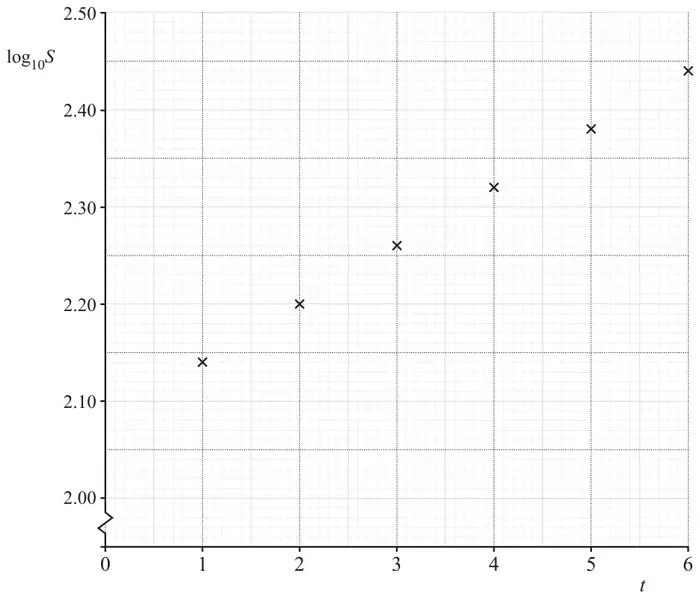
11 The owners of an online shop believe that their sales can be modelled by \(S = ab^t\), where \(a\) and \(b\) are both positive constants, \(S\) is the number of items sold in a month and \(t\) is the number of complete months since starting their online shop.

The sales for the first six months are recorded, and the values of \(\log_{10}S\) are plotted against \(t\) in the graph below. The graph is repeated in the Printed Answer Booklet.

Graph of log base 10 of S against t for t from 0 to 6, vertical axis from 2.00 to 2.50: six crosses at t = 1, 2, 3, 4, 5, 6 with log S = 2.14, 2.20, 2.26, 2.32, 2.38, 2.44, lying on a straight line
(a) Explain why the graph suggests that the given model is appropriate. [3]

The owners believe that \(a = 120\) and \(b = 1.15\) are good estimates for the parameters in the model.

(b) Show that the graph supports these estimates for the parameters. [2]
(c) Use the model \(S = 120 \times 1.15^t\) to predict the number of items sold in the seventh month after opening. [2]
(d)
(i) Use the model \(S = 120 \times 1.15^t\) to predict the number of months after opening when the total number of items sold after opening will first exceed 70 000. [4]
(ii) Comment on how reliable this prediction may be. [1]

June 2023 Paper 3 Q6

OCR ACurrent spec6 marksSequences & SeriesTrigonometry

6 The first, third and fourth terms of an arithmetic progression are \(u_1\), \(u_3\) and \(u_4\) respectively, where

\(u_1 = 2\sin\theta, \qquad u_3 = -\sqrt{3}\cos\theta, \qquad u_4 = \frac{7}{2}\sin\theta,\)

and \(\frac{1}{2}\pi \lt \theta \lt \pi\).

(a) Determine the exact value of \(\theta\). [3]
(b) Hence determine the value of \(\displaystyle\sum_{r=1}^{100} u_r\). [3]

June 2022 Paper 2 Q4

OCR ACurrent spec5 marksModellingSequences & Series

4 An artist is creating a design for a large painting. The design includes a set of steps of varying heights. In the painting the lowest step has height 20 cm and the height of each other step is 5% less than the height of the step immediately below it.

In the painting the total height of the steps is 205 cm, correct to the nearest centimetre.

Determine the number of steps in the design. [5]

June 2022 Paper 3 Q4

OCR ACurrent spec8 marksSequences & Series

4 The positive integers \(x\), \(y\) and \(z\) are the first, second and third terms, respectively, of an arithmetic progression with common difference \(-4\).

Also, \(x\), \(\dfrac{15}{y}\) and \(z\) are the first, second and third terms, respectively, of a geometric progression.

(a) Show that \(y\) satisfies the equation \(y^4 - 16y^2 - 225 = 0\). [4]
(b) Hence determine the sum to infinity of the geometric progression. [4]

October 2021 Paper 2 Q3

OCR ACurrent spec6 marksSequences & Series

3 The 15th term of an arithmetic sequence is 88. The sum of the first 10 terms is 310.

Determine the first term and the common difference. [6]

October 2021 Paper 3 Q3

OCR ACurrent spec5 marksSequences & Series

3 An arithmetic progression has first term 2 and common difference \(d\), where \(d \neq 0\). The first, third and thirteenth terms of this progression are also the first, second and third terms, respectively, of a geometric progression.

By determining \(d\), show that the arithmetic progression is an increasing sequence. [5]

June 2025 Paper 3 Q11

OCR MEICurrent spec5 marksProofSequences & Series

11 The \(n\)th term of a sequence is defined by \(a_n = \dfrac{1}{\sqrt{n+1} - 1} - \dfrac{1}{\sqrt{n+1} + 1}\), for \(n \geqslant 1\).

(a) Prove that every term in the sequence, \(a_n\), is a rational number. [3]
(b) Determine whether the sequence is increasing, decreasing or neither. [2]

June 2025 Paper 2 Q5

OCR MEICurrent spec3 marksProofSequences & Series

5 Prove that the sum of the first \(n\) positive odd numbers is a square number. [3]

June 2025 Paper 3 Q4

OCR MEICurrent spec3 marksSequences & Series

4 The first term of a geometric sequence is 6.
The fourth term is \(\frac{2}{9}\).
The sequence is infinite.

Find the sum of the associated series. [3]

June 2025 Paper 1 Q3

OCR MEICurrent spec4 marksSequences & Series

3

(a) Evaluate \[\sum_{r=1}^{4} \frac{1}{r}\] giving your answer as a fraction in its lowest terms. [1]
(b) Write the sum \(1+3+5+7+9\) in a similar way to the series in part (a). [2]
(c) Explain why the sum to infinity of \(1+3+5+7+9+\ldots\) is not well defined. [1]

June 2024 Paper 1 Q11

OCR MEICurrent spec8 marksSequences & Series

11 The first three terms of a geometric sequence are \(5k - 2\), \(3k - 6\), \(k + 2\), where \(k\) is a constant.

(a) Show that \(k\) satisfies the equation \(k^2 - 11k + 10 = 0\). [3]
(b) When \(k\) takes the smaller of the two possible values, find the sum of the first 20 terms of the sequence. [3]
(c) When \(k\) takes the larger of the two possible values, find the sum to infinity of the sequence. [2]

June 2024 Paper 2 Q7

OCR MEICurrent spec6 marksSequences & Series

7 A sequence is defined by the recurrence relation

\(u_{k+1} = u_k + 5\) with \(u_1 = -2\).

(a) Write down the values of \(u_2\), \(u_3\), and \(u_4\). [1]
(b) Explain whether this sequence is divergent or convergent. [1]
(c) Determine the value of \(u_{30}\). [2]
(d) Determine the value of \(\sum_{k=1}^{30} u_k\). [2]

June 2023 Paper 3 Q15

OCR MEICurrent spec2 marksLogs & ExponentialsSequences & Series

15

The questions in this section refer to the article on the Insert. You should read the article before attempting the questions.

The relevant parts of the article “Approximating series” are reproduced below; the line numbers are those printed on the Insert.

Line 34
This simplifies to \(\displaystyle\sum_{r=1}^{n}\frac{1}{r} \approx \ln n + \frac{13}{24} + \frac{6n+5}{12n(n+1)}\).

The expression given in line 34 is used to calculate \(\displaystyle\sum_{r=1}^{6}\frac{1}{r}\).

Show that the error in the result is less than 1.5% of the true value. [2]

June 2023 Paper 1 Q14

OCR MEICurrent spec6 marksLogs & ExponentialsSequences & Series

14

(a) Use the laws of logarithms to show that \(\log_{10}200 - \log_{10}20\) is equal to 1. [2]

The first three terms of a sequence are \(\log_{10}20,\ \log_{10}200,\ \log_{10}2000\).

(b) Show that the sequence is arithmetic. [2]
(c) Find the exact value of the sum of the first 50 terms of this sequence. [2]

June 2023 Paper 3 Q13

OCR MEICurrent spec4 marksIntegrationSequences & Series

13

The questions in this section refer to the article on the Insert. You should read the article before attempting the questions.

The relevant parts of the article “Approximating series” are reproduced below; the line numbers are those printed on the Insert.

Lines 4–5
The sum of the squares of the first \(n\) natural numbers, \(1^2 + 2^2 + 3^2 + \ldots + n^2\), can be expressed exactly as a formula, \(\displaystyle\sum_{r=1}^{n} r^2 = \frac{n(n+1)(2n+1)}{6}\).

Line 10
Euler’s approximate summation formula

Lines 11–13
In 1741, the mathematician Leonhard Euler published an approximate formula for summing a series. In modern notation, this can be expressed as follows.
\(\displaystyle\sum_{r=1}^{n}\mathrm{f}(r) \approx \int_1^n \mathrm{f}(x)\,\mathrm{d}x + \frac{\mathrm{f}(n) + \mathrm{f}(1)}{2} + \frac{\mathrm{f}(1) - \mathrm{f}(2)}{12} - \frac{\mathrm{f}(n) - \mathrm{f}(n+1)}{12}\)

Prove that Euler’s approximate formula, as given in line 13, when applied to \(\displaystyle\sum_{r=1}^{n} r^2\) gives exactly \(\dfrac{n(n+1)(2n+1)}{6}\). [4]

June 2023 Paper 3 Q11

OCR MEICurrent spec3 marksIntegrationSequences & Series

11

The questions in this section refer to the article on the Insert. You should read the article before attempting the questions.

The relevant parts of the article “Approximating series” are reproduced below; the line numbers are those printed on the Insert.

Line 10
Euler’s approximate summation formula

Lines 11–13
In 1741, the mathematician Leonhard Euler published an approximate formula for summing a series. In modern notation, this can be expressed as follows.
\(\displaystyle\sum_{r=1}^{n}\mathrm{f}(r) \approx \int_1^n \mathrm{f}(x)\,\mathrm{d}x + \frac{\mathrm{f}(n) + \mathrm{f}(1)}{2} + \frac{\mathrm{f}(1) - \mathrm{f}(2)}{12} - \frac{\mathrm{f}(n) - \mathrm{f}(n+1)}{12}\)

(a) Evaluate \(\displaystyle\sum_{r=1}^{5} r^2\). [1]
(b) Show that Euler’s approximate formula, as given in line 13, gives the exact value of \(\displaystyle\sum_{r=1}^{5} r^2\). [2]

June 2023 Paper 2 Q1

OCR MEICurrent spec3 marksSequences & Series

1 Determine the sum of the infinite geometric series \(9 - 3 + 1 - \frac{1}{3} + \frac{1}{9} + \ldots\) [3]

June 2022 Paper 3 Q3

OCR MEICurrent spec4 marksProofSequences & Series

3 An infinite sequence \(a_1, a_2, a_3, \ldots\) is defined by \(a_n = \dfrac{n}{n+1}\), for all positive integers \(n\).

(a) Find the limit of the sequence. [1]
(b) Prove that this is an increasing sequence. [3]

October 2021 Paper 3 Q6

OCR MEICurrent spec4 marksQuadraticsSequences & Series

6 In this question you must show detailed reasoning.

Show that \(\displaystyle\sum_{r=1}^{3} \frac{1}{\sqrt{r+1} + \sqrt{r}} = 1\). [4]

October 2021 Paper 1 Q4

OCR MEICurrent spec6 marksSequences & Series

4

(a) The first four terms of a sequence are 2, 3, 0, 3 and the subsequent terms are given by \(a_{k+4} = a_k\).
(i) State what type of sequence this is. [1]
(ii) Find \(\displaystyle\sum_{k=1}^{200} a_k\). [1]
(b) A different sequence is given by \(u_n = b^n\) where \(b\) is a constant and \(n \geqslant 1\).
(i) State the set of values of \(b\) for which this is a divergent sequence. [2]
(ii) In the case where \(b = \frac{1}{3}\), find the sum of all the terms in the sequence. [2]

October 2020 Paper 2 Q5

OCR MEICurrent spec3 marksSequences & Series

5 The first \(n\) terms of an arithmetic series are

\(17 + 28 + 39 + \ldots + 281 + 292\).

(a) Find the value of \(n\). [1]
(b) Find the sum of these \(n\) terms. [2]

October 2020 Paper 3 Q3

OCR MEICurrent spec3 marksModellingSequences & Series

3 A particular phone battery will last 10 hours when it is first used. Every time it is recharged, it will only last 98% of its previous time.

Find the maximum total length of use for the battery. [3]

October 2020 Paper 3 Q1

OCR MEICurrent spec2 marksSequences & Series

1 Find the value of \(\displaystyle\sum_{r=1}^{5} 2^r(r-1)\). [2]