Radians

Edexcel

AQA

OCR A

OCR MEI

June 2025 Paper 1 Q15

EdexcelCurrent spec9 marksDifferentiationRadians

15.

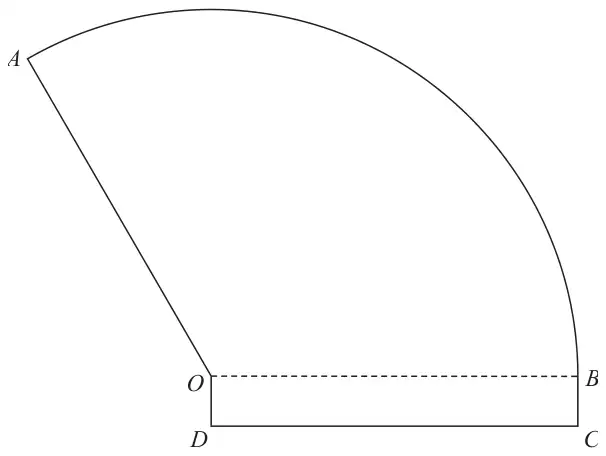
Figure 4: plan view: sector AOB of a circle centre O with rectangle OBCD joined below radius OB (OB shown dashed)
Figure 4

Figure 4 shows the plan view for the design of a stage.

The shape of this design consists of a sector of a circle \(AOB\) joined to a rectangle \(OBCD\).

Given that

  • the radius of the sector is \(r\) metres and angle \(AOB\) is \(\theta\) radians
  • the length and width of the rectangle are \(r\) metres and \(\dfrac{1}{10}r\) metres respectively
  • the total area of the stage is 240 m\(^2\)
(a) show that the perimeter of the stage, \(P\) metres, is given by\[P = 2r + \frac{480}{r}\]You must make your method clear. (4)

Using algebraic differentiation,

(b) find the value of \(r\) for which \(P\) has a stationary value. (3)
(c) Prove, by further differentiation, that this value of \(r\) gives the minimum perimeter of the stage. (2)

June 2025 Paper 2 Q6

EdexcelCurrent spec6 marksRadiansTrigonometry

6.

In this question you must show detailed reasoning.

(a) Given that \(x\) is small and in radians, use the small angle approximation for \(\cos\theta\) to show that\[1 - \cos^2(2x) \approx 4x^2 - 4x^4\] (2)
(b) Given that \(x\) is small and in radians, use
  • the answer to part (a)
  • the small angle approximations for \(\sin\theta\) and \(\tan\theta\)
to show that\[\frac{1 - \cos^2(2x)}{\sin\left(\frac{x}{3}\right)\tan\left(\frac{x}{2}\right)} \approx a + bx^2\]where \(a\) and \(b\) are constants to be found. (2)
(c) Hence, given that \(x\) is very small, deduce an approximate value for\[\frac{1 - \cos^2(2x)}{\sin\left(\frac{x}{3}\right)\tan\left(\frac{x}{2}\right)}\]giving a reason for your answer. (2)

June 2025 Paper 2 Q4

EdexcelCurrent spec5 marksRadiansTrigonometry

4.

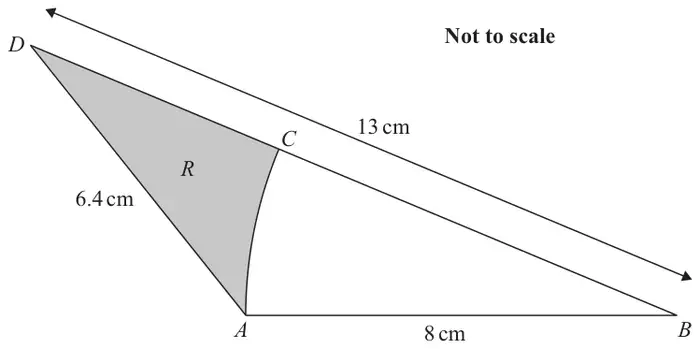
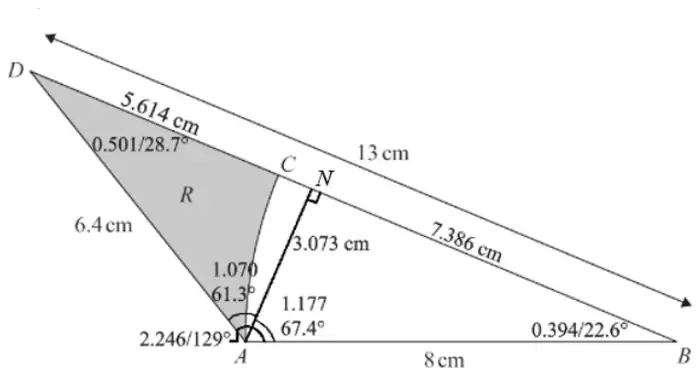
Figure 1: triangle ABD, not to scale, with AD = 6.4 cm, BD = 13 cm, AB = 8 cm; arc AC of a circle centre B with C on BD; region R shaded between DA, DC and the arc
Figure 1

The shape \(ABCD\), shown in Figure 1, consists of a triangle \(ABD\) containing a sector \(ABC\) of a circle with centre \(B\).

Given that

  • \(AD = 6.4\) cm
  • \(BD = 13\) cm
  • \(BA = BC = 8\) cm
(a) show that angle \(ABC = 0.394\) radians to 3 significant figures. (2)

The region \(R\), shown shaded in Figure 1, is bounded by the line \(CD\), the line \(DA\) and the arc \(AC\).

(b) Find the area of \(R\), giving the answer in cm\(^2\) to 3 significant figures.
You must make your method clear. (3)

June 2024 Paper 1 Q11

EdexcelCurrent spec4 marksRadiansTrigonometry

11.

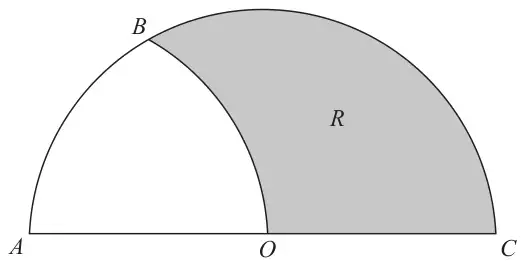
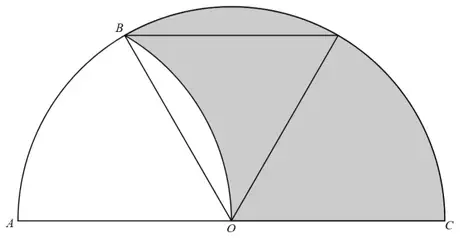
Figure 4: semicircle ABCOA on diameter AC with centre O; arc OB centred at A; shaded region R between arc OB, arc BC and line OC
Figure 4

Figure 4 shows the design of a badge.

The shape \(ABCOA\) is a semicircle with centre \(O\) and diameter 10 cm.

\(OB\) is the arc of a circle with centre \(A\) and radius 5 cm.

The region \(R\), shown shaded in Figure 4, is bounded by the arc \(OB\), the arc \(BC\) and the line \(OC\).

Find the exact area of \(R\).

Give your answer in the form \(\left(a\sqrt{3} + b\pi\right)\text{ cm}^2\), where \(a\) and \(b\) are rational numbers. (4)

June 2024 Paper 2 Q5

EdexcelCurrent spec3 marksRadiansTrigonometry

5. Given that \(\theta\) is small and in radians, use the small angle approximations to find an approximate numerical value of\[\frac{\theta\tan 2\theta}{1 - \cos 3\theta}\] (3)

June 2025 Paper 1 Q8

AQACurrent spec5 marksRadiansTrigonometry

8 Show that, for small values of \(\boldsymbol{x}\), the graph with equation

\[y = \frac{4 + \sin 5x - 3\cos 2x}{1 + 2\tan x}\]

can be approximated by the straight line with equation of the form

\[y = ax + 1\]

where \(a\) is a constant to be found. [5 marks]

June 2025 Paper 2 Q5

AQACurrent spec2 marksRadians

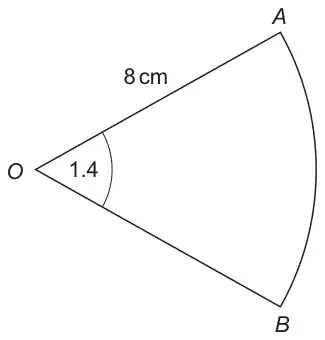
5 The diagram shows a sector \(AOB\) of a circle with centre \(O\) and radius 8 cm.

Sector AOB with centre O, radius OA = 8 cm and angle 1.4 at O

The angle \(AOB\) is 1.4 radians.

Find the area of the sector. [2 marks]

June 2024 Paper 1 Q9

AQACurrent spec5 marksRadians

9

(a) Show that, for small values of \(\theta\) measured in radians\[\cos 4\theta + 2\sin 3\theta - \tan 2\theta \approx A + B\theta + C\theta^2\]where \(A\), \(B\) and \(C\) are constants to be found. [3 marks]
(b) Use your answer to part (a) to find an approximation for\[\cos 0.28 + 2\sin 0.21 - \tan 0.14\]Give your answer to three decimal places. [2 marks]

June 2024 Paper 3 Q5

AQACurrent spec3 marksRadians

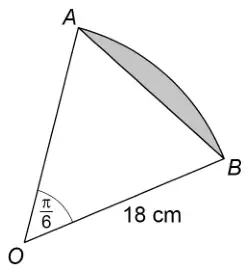
5 The diagram below shows a sector of a circle \(OAB\).

The chord \(AB\) divides the sector into a triangle and a shaded segment.

Angle \(AOB\) is \(\dfrac{\pi}{6}\) radians.

The radius of the sector is 18 cm.

Sector OAB with angle π/6 at O and radius 18 cm; the segment between chord AB and arc AB is shaded

Show that the area of the shaded segment is

\[k(\pi - 3)\text{ cm}^2\]

where \(k\) is an integer to be found. [3 marks]

June 2023 Paper 3 Q7

AQACurrent spec14 marksDifferentiationRadians

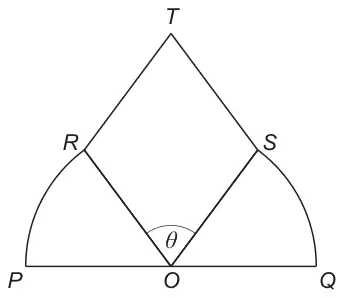
7 A new design for a company logo is to be made from two sectors of a circle, \(ORP\) and \(OQS\), and a rhombus \(OSTR\), as shown in the diagram below.

Logo made of sector ORP on the left, sector OQS on the right and rhombus OSTR on top, with P, O and Q on a horizontal line and angle ROS marked θ at O

The points \(P\), \(O\) and \(Q\) lie on a straight line and the angle \(ROS\) is \(\theta\) radians.

A large copy of the logo, with \(PQ = 5\) metres, is to be put on a wall.

(a) Show that the area of the logo, \(A\) square metres, is given by\[A = \frac{25}{8}(\pi - \theta + 2\sin\theta)\] [4 marks]
(b)
(i) Show that the maximum value of \(A\) occurs when \(\theta = \dfrac{\pi}{3}\)

Fully justify your answer. [6 marks]

(ii) Find the exact maximum value of \(A\) [2 marks]
(c) Without further calculation, state how your answers to parts (b)(i) and (b)(ii) would change if \(PQ\) were increased to 10 metres. [2 marks]

June 2023 Paper 1 Q4

AQACurrent spec1 markRadians

4 Given that \(\theta\) is a small angle, find an approximation for \(\cos 2\theta\)

Circle your answer. [1 mark]

  • \(1 - \dfrac{\theta^2}{2}\)
  • \(2 - 2\theta^2\)
  • \(1 - 2\theta^2\)
  • \(1 - \theta^2\)

June 2022 Paper 1 Q10

AQACurrent spec12 marksNumerical MethodsRadians

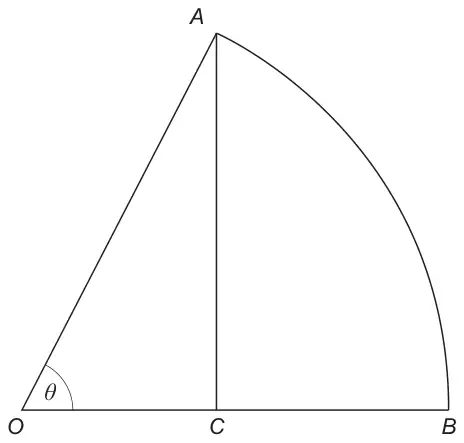
10 The diagram shows a sector of a circle \(OAB\).

Sector OAB with angle θ at O; C is on OB with AC perpendicular to OB

The point \(C\) lies on \(OB\) such that \(AC\) is perpendicular to \(OB\).

Angle \(AOB\) is \(\theta\) radians.

(a) Given the area of the triangle \(OAC\) is half the area of the sector \(OAB\), show that\[\theta = \sin 2\theta\] [4 marks]
(b) Use a suitable change of sign to show that a solution to the equation\[\theta = \sin 2\theta\]lies in the interval given by \(\theta \in \left[\dfrac{\pi}{5}, \dfrac{2\pi}{5}\right]\) [2 marks]
(c) The Newton-Raphson method is used to find an approximate solution to the equation\[\theta = \sin 2\theta\]
(i) Using \(\theta_1 = \dfrac{\pi}{5}\) as a first approximation for \(\theta\) apply the Newton-Raphson method twice to find the value of \(\theta_3\)

Give your answer to three decimal places. [3 marks]

(ii) Explain how a more accurate approximation for \(\theta\) can be found using the Newton-Raphson method. [1 mark]
(iii) Explain why using \(\theta_1 = \dfrac{\pi}{6}\) as a first approximation in the Newton-Raphson method does not lead to a solution for \(\theta\). [2 marks]

June 2022 Paper 1 Q6

AQACurrent spec6 marksBinomial ExpansionRadians

6

(a) Find the first two terms, in ascending powers of \(x\), of the binomial expansion of\[\left(1 - \frac{x}{2}\right)^{\frac{1}{2}}\] [2 marks]
(b) Hence, for small values of \(x\), show that\[\sin 4x + \sqrt{\cos x} \approx A + Bx + Cx^2\]where \(A\), \(B\) and \(C\) are constants to be found. [4 marks]

June 2025 Paper 1 Q6

OCR ACurrent spec8 marksRadiansTrigonometry

6

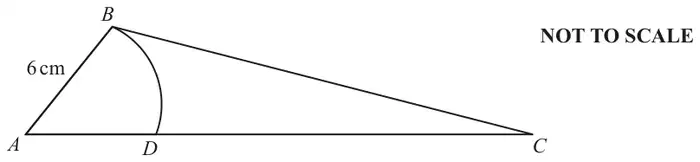
Triangle ABC with AB = 6 cm; an arc BD centred at A meets AC at D. Not to scale.

The diagram shows a triangle \(ABC\). The arc \(BD\) is part of a circle with centre \(A\) and radius 6 cm.

The area of the sector \(ABD\) is \(14.4\ \text{cm}^2\).

(a) Show that angle \(BAD\) is 0.8 radians. [1]

The area of the triangle \(ABC\) is three times the area of the sector \(ABD\).

(b) Find the length \(AC\). [2]
(c) Find the perimeter of the region \(BCD\). [5]

June 2024 Paper 3 Q4

OCR ACurrent spec9 marksRadiansTrigonometry

4

(a) Show that the equation \(2\cot^2 x - 9\,\mathrm{cosec}\,x - 3 = 0\) can be expressed in the form
\(5\sin^2 x + 9\sin x - 2 = 0\). [3]
(b)
(i) In this question you must show detailed reasoning.
Hence solve, for \(0 \lt \theta \lt \pi\),
\(2\cot^2 2\theta - 9\,\mathrm{cosec}\,2\theta - 3 = 0\).
Give your answers correct to 3 decimal places. [4]

The small angle approximation for \(\sin 2\theta\) is used to find an approximation for the smallest positive solution of the equation \(2\cot^2 2\theta - 9\,\mathrm{cosec}\,2\theta - 3 = 0\).

(ii) Show that this approximate solution is accurate to 2 decimal places. [2]

June 2024 Paper 3 Q2

OCR ACurrent spec5 marksQuadraticsRadians

2 In this question you must show detailed reasoning.

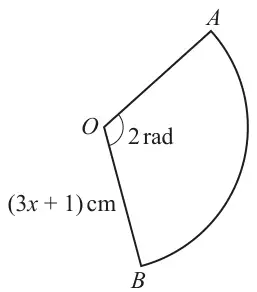
Sector AOB of a circle with centre O, radius OB labelled (3x + 1) cm and angle AOB labelled 2 rad

The diagram shows a sector \(AOB\) of a circle with centre \(O\) and radius \((3x+1)\,\mathrm{cm}\). The angle \(AOB\) is 2 radians. The area of sector \(AOB\) is less than \((44x - 7)\,\mathrm{cm}^2\).

Find the set of possible values of \(x\). Give your answer in set notation. [5]

June 2022 Paper 1 Q10

OCR ACurrent spec12 marksNumerical MethodsRadians

10

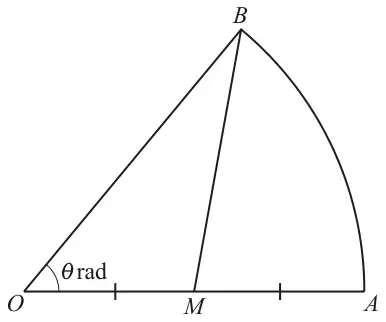
Sector OAB with centre O and angle AOB of theta radians at O; M is the mid-point of OA, marked by equal-length tick marks; the line MB is drawn

The diagram shows a sector \(OAB\) of a circle with centre \(O\) and radius \(OA\). The angle \(AOB\) is \(\theta\) radians. \(M\) is the mid-point of \(OA\). The ratio of areas \(OMB : MAB\) is 2:3.

(a) Show that \(\theta = 1.25\sin\theta\). [4]

The equation \(\theta = 1.25\sin\theta\) has only one root for \(\theta \gt 0\).

(b) This root can be found by using the iterative formula \(\theta_{n+1} = 1.25\sin\theta_n\) with a starting value of \(\theta_1 = 0.5\).
  • Write down the values of \(\theta_2\), \(\theta_3\) and \(\theta_4\).
  • Hence find the value of this root correct to 3 significant figures. [3]
(c) The diagram in the Printed Answer Booklet shows the graph of \(y = 1.25\sin\theta\), for \(0 \leqslant \theta \leqslant \pi\).
  • Use this diagram to show how the iterative process used in (b) converges to this root.
  • State the type of convergence. [3]
(d) Draw a suitable diagram to show why using an iterative process with the formula \(\theta_{n+1} = \sin^{-1}(0.8\theta_n)\) does not converge to the root found in (b). [2]

October 2021 Paper 2 Q7

OCR ACurrent spec4 marksDifferentiationRadians

7 Differentiate \(\cos x\) with respect to \(x\), from first principles. [4]

June 2025 Paper 1 Q4

OCR MEICurrent spec4 marksRadians

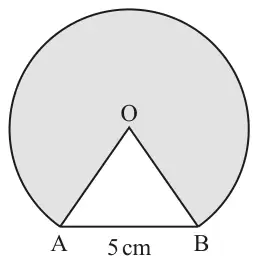
4 The diagram shows part of a circle with centre O and radius 5 cm. The circle passes through the points A and B. The length AB is 5 cm.

Circle with centre O; triangle OAB with AB = 5 cm; the major sector outside the triangle is shaded

Calculate the area of the shaded region. [4]

June 2024 Paper 1 Q8

OCR MEICurrent spec6 marksIntegrationRadians

8 The equation of a curve is \(y = \sqrt{\sin 4x} + 2\cos 2x\), where \(x\) is in radians.

(a) Show that, for small values of \(x\), \(y \approx 2\sqrt{x} + 2 - 4x^2\). [2]

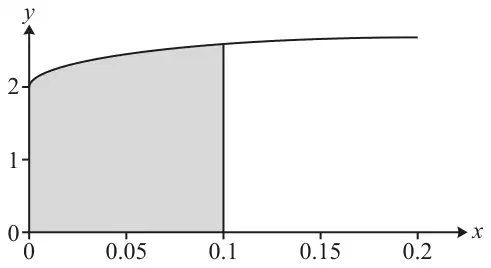
The diagram shows the region bounded by the curve \(y = \sqrt{\sin 4x} + 2\cos 2x\), the axes and the line \(x = 0.1\).

Graph of the curve for x from 0 to 0.2, starting at y = 2 and rising slowly; the region under the curve between x = 0 and x = 0.1 is shaded
(b) In this question you must show detailed reasoning.
Use the approximation in part (a) to estimate the area of this region. [4]

June 2024 Paper 2 Q4

OCR MEICurrent spec5 marksRadiansTrigonometry

4

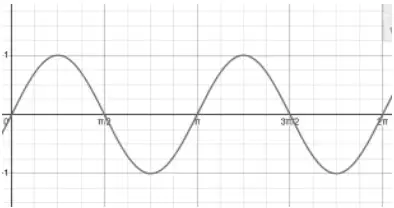
(a) On the axes in the Printed Answer Booklet, sketch the graph of \(y = \sin 2\theta\) for \(0 \leqslant \theta \leqslant 2\pi\). [2]
(b) Solve the equation \(\sin 2\theta = -\dfrac{1}{2}\) for \(0 \leqslant \theta \leqslant 2\pi\). [3]

June 2023 Paper 3 Q7

OCR MEICurrent spec6 marksQuadraticsRadians

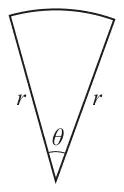
7 A wire, 10 cm long, is bent to form the perimeter of a sector of a circle, as shown in the diagram. The radius is \(r\) cm and the angle at the centre is \(\theta\) radians.

A sector of a circle with two radii labelled r and angle θ at the centre

Determine the maximum possible area of the sector, showing that it is a maximum. [6]

June 2022 Paper 3 Q11

OCR MEICurrent spec3 marksRadiansTrigonometry

11

The questions in this section refer to the article on the Insert. You should read the article before attempting the questions.

The relevant parts of the article “Approximating the sine function” are reproduced below; the line numbers are those printed on the Insert.

Line 22
A better approximation

Lines 23–28
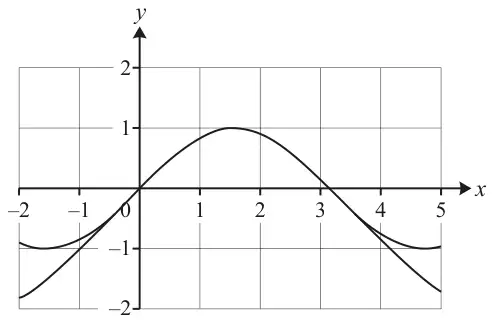
The approximation \(\sin x \approx \dfrac{16x(\pi - x)}{5\pi^2 - 4x(\pi - x)}\) was discovered by an Indian mathematician named Bhaskara in the 7th century. It is not known how Bhaskara derived the formula but it can be seen that the curve \(y = \dfrac{16x(\pi - x)}{5\pi^2 - 4x(\pi - x)}\) is symmetrical about \(x = \frac{\pi}{2}\) and goes through the points \((0, 0)\), \(\left(\frac{\pi}{2}, 1\right)\) and \((\pi, 0)\). Fig. C4 shows the curves \(y = \sin x\) and \(y = \dfrac{16x(\pi - x)}{5\pi^2 - 4x(\pi - x)}\). Radians were not in use until the 18th century; Bhaskara gave the formula for an angle \(\theta\) degrees as \(\sin\theta \approx \dfrac{4\theta(180 - \theta)}{40500 - \theta(180 - \theta)}\).

Graph on a grid, x from −2 to 5 and y from −2 to 2, showing y = sin x and the Bhaskara curve, which almost coincide between x = 0 and x = π and separate outside that interval.
Fig. C4

Show that, for the angle \(45^\circ\), the formula \(\sin\theta \approx \dfrac{4\theta(180 - \theta)}{40500 - \theta(180 - \theta)}\) given in line 28 gives the same approximation for the sine of the angle as the formula \(\sin x \approx \dfrac{16x(\pi - x)}{5\pi^2 - 4x(\pi - x)}\) given in line 23. [3]

June 2022 Paper 3 Q9

OCR MEICurrent spec2 marksDifferentiationRadians

9

The questions in this section refer to the article on the Insert. You should read the article before attempting the questions.

The relevant parts of the article “Approximating the sine function” are reproduced below; the line numbers are those printed on the Insert.

Line 1
Small angles

Lines 2–5
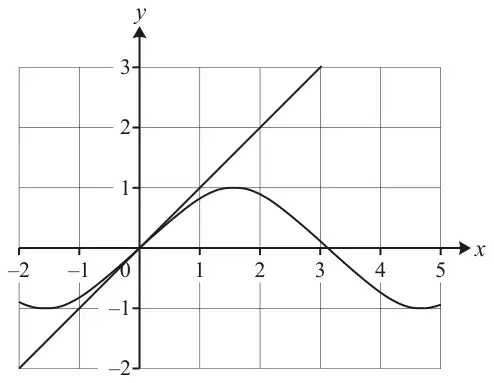
For a small angle \(x\) radians, the approximation \(\sin x \approx x\) is valid. The curve \(y = \sin x\) and the straight line \(y = x\) are shown in Fig. C1.1. Fig. C1.2 shows the curve \(y = x - \sin x\). Inspection of the graphs suggests that \(x\) is a reasonable approximation for \(\sin x\) for \(-0.5 \leqslant x \leqslant 0.5\) and also that \(y = x\) has the same gradient as \(y = \sin x\) when \(x = 0\).

Graph on a grid, x from −2 to 5 and y from −2 to 3, showing y = sin x and the straight line y = x, which touch at the origin.
Fig. C1.1
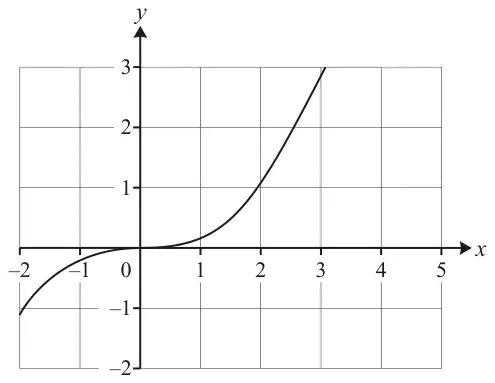
Graph on a grid, x from −2 to 5 and y from −2 to 3, showing y = x − sin x: flat through the origin, rising to about (3, 3) and falling to about (−2, −1.1).
Fig. C1.2

Show that \(y = x\) has the same gradient as \(y = \sin x\) when \(x = 0\), as stated in line 5. [2]

October 2021 Paper 2 Q2

OCR MEICurrent spec3 marksRadians

2

(a) Write \(65^\circ\) in radians, giving your answer in the form \(k\pi\), where \(k\) is a fraction in its lowest terms. [2]
(b) Write 0.211 radians in degrees, giving your answer correct to 1 decimal place. [1]

October 2020 Paper 2 Q10

OCR MEICurrent spec9 marksNumerical MethodsRadians

10 In this question you must show detailed reasoning.

The equation of a curve is

\(y = \dfrac{\sin 2x - x}{x\sin x}\).

(a) Use the small angle approximation given in the list of formulae on pages 2–3 of this question paper to show that
\(\displaystyle\int_{0.01}^{0.05} y\,\mathrm{d}x \approx \ln 5\). [4]
(b) Use the same small angle approximation to show that
\(\dfrac{\mathrm{d}y}{\mathrm{d}x} \approx -10000\) at the point where \(x = 0.01\). [2]

The equation \(y = 0\) has a root near \(x = 1\). Joan uses the Newton-Raphson method to find this root. The output from the spreadsheet she uses is shown in Fig. 10.1.

\(n\)01234567
\(x_n\)10.9585090.9500840.9482610.947860.9477720.9477530.947748

Fig. 10.1

Joan carries out some analysis of this output. The results are shown in Fig. 10.2.

\(x\)\(y\)
0.9477475–7.79967E–07
0.9477485–2.90821E–06
\(x\)\(y\)
0.9477454.54066E–06
0.947755–1.67417E–05

Fig. 10.2

(c) Consider the information in Fig. 10.1 and Fig. 10.2.
  • Write 4.54066E–06 in standard mathematical notation.
  • State the value of the root as accurately as you can, justifying your answer.
[3]

October 2020 Paper 2 Q2

OCR MEICurrent spec3 marksRadians

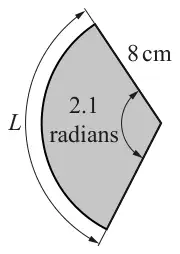
2 Fig. 2 shows a sector of a circle of radius 8 cm.

The angle of the sector is 2.1 radians.

Fig. 2: shaded sector with radius 8 cm, angle 2.1 radians and arc length L
Fig. 2
(a) Calculate the length of the arc \(L\). [1]
(b) Calculate the area of the sector. [2]