(a) Find, in ascending powers of \(x\), the first four terms of the binomial expansion of\[(1-9x)^{\frac{1}{2}}\]giving each term in simplest form. (3)
(b) Give a reason why \(x = -\dfrac{2}{9}\) should not be used in the expansion to find an approximation to \(\sqrt{3}\) (1)
Mark scheme (a)
Scheme
Marks
AO
\(\dfrac{\tfrac{1}{2}\left(\tfrac{1}{2}-1\right)}{2!}(\pm 9x)^2\) or \(\dfrac{\tfrac{1}{2}\left(\tfrac{1}{2}-1\right)\left(\tfrac{1}{2}-2\right)}{3!}(-9x)^3\)
M1: For an attempt at the binomial expansion with \(n = \dfrac{1}{2}\) and obtains the correct structure for term 3 or term 4. Award for the correct coefficient with the correct power of \(x\).
e.g. \(\dfrac{\left(\frac{1}{2}\right)\left(-\frac{1}{2}\right)}{2!}(\lambda x)^2\) or \(\dfrac{\left(\frac{1}{2}\right)\left(-\frac{1}{2}\right)\left(-\frac{3}{2}\right)}{3!}(\lambda x)^3\) where \(\lambda \neq 1\)
Condone missing or incorrect brackets around the \(x\) terms but the binomial coefficients must be correct. Allow 2! and/or 3! or 2 and/or 6.
Do not allow notation such as \(\begin{pmatrix}\frac{1}{2}\\1\end{pmatrix}, \begin{pmatrix}\frac{1}{2}\\2\end{pmatrix}\) unless these are interpreted correctly.
A1: Correct unsimplified expression as shown but the bracketing must be correct unless any missing brackets are implied by subsequent work. May be implied by a correct simplified expression.
OR allow this mark for at least 2 correct simplified terms from \(-\dfrac{9}{2}x, -\dfrac{81}{8}x^2\) and \(-\dfrac{729}{16}x^3\)
A1: \(1 - \dfrac{9}{2}x - \dfrac{81}{8}x^2 - \dfrac{729}{16}x^3\) or simplified equivalent. Correct answer with no working can score full marks. Ignore any extra terms and allow the terms to be listed or in a different order. Apply isw once a correct expansion is seen. Condone \(+-\) (equivalent to listing). Allow recovery if applicable e.g. if an “\(x\)” is lost then “reappears”.
Allow decimal equivalents \(1 - 4.5x - 10.125x^2 - 45.5625x^3\) provided they are exact.
Note: You may see attempts via direct expansion, but these will be scored using the main scheme, ignoring absence of powers on the 1s. The below attempts both score first M1A1. If you are unsure, send to review.
Expansion is valid for \(|x| \lt \dfrac{1}{9}\) and \(x = -\dfrac{2}{9}\) is outside this range.
B1
2.4
(1)
(4 marks)
Notes
B1: Expansion is valid for \(|x| \lt \dfrac{1}{9}\) or \(|x| \leqslant \dfrac{1}{9}\) and \(x = -\dfrac{2}{9}\) is outside this range.
Requires:
an acceptable range of validity given
an acceptable comparison of \(-\dfrac{2}{9}\) or \(\dfrac{2}{9}\) with their range leading to e.g. “not valid”.
Examples of acceptable alternatives include:
(Valid for) \(|9x| \lt 1\) or \(|9x| \leqslant 1\) and as \(9x = -2\) (the expansion is) not valid.
(Valid for) \(|x| \lt \dfrac{1}{9}\) or \(|x| \leqslant \dfrac{1}{9}\) and as \(\dfrac{2}{9} \gt \dfrac{1}{9}\) \(\left(\text{or } -\dfrac{2}{9} \lt -\dfrac{1}{9}\right)\) the expansion is not valid.
(Valid for) \(-\dfrac{1}{9} \lt x \lt \dfrac{1}{9}\) and \(x = -\dfrac{2}{9}\) is too small/big (condoned as minimally acceptable).
(Series converges for) \(\lvert -9x \rvert \leqslant 1\) and as \(-9x = 2\) the series will diverge.
(Valid for) \(|x| \lt \dfrac{1}{9}\) but \(\left|-\dfrac{2}{9}\right| \gt \dfrac{1}{9}\) so \(-\dfrac{2}{9}\) cannot be used.
Do not accept vague statements such as "it is too big", "it is outside the range" without any mention of what the range is. \(-\dfrac{2}{9} \lt -\dfrac{1}{9}\) alone is insufficient evidence (without any mention of what the range is) and scores B0. An attempt to evaluate the expansion and compare with \(\sqrt{3}\) is not acceptable on its own.
6 The first four terms in ascending powers of \(x\) of the binomial expansion of
\[(2 - 3x)^5\]
are given by
\[32 + px + qx^2 - 1080x^3\]
where \(p\) and \(q\) are constants.
(a) Find the value of \(p\) and the value of \(q\) [2 marks]
(b) Hence find an approximation for \(1.94^5\)
Give your answer to five decimal places.
[2 marks]
Mark scheme (a)
Scheme
Marks
AO
Uses \({}^5C_1 \times 2^4 \times (-3x)\) or \(2^5 \times 5 \times \left(-\dfrac{3}{2}x\right)\) or \({}^5C_2 \times 2^3 \times (-3x)^2\) or \(2^5 \times 10 \times \left(-\dfrac{3}{2}x\right)^2\) with or without \(x\) PI by correct answer or \(-240x\) or \(720x^2\)
M1
1.1a
Obtains \(p = -240\) and \(q = 720\) Allow if seen in \(\ldots - 240x + 720x^2 \ldots\) Condone \(p = -240x\) and \(q = 720x^2\)
(i) Find the binomial expansion of \((1 + 3x)^{-1}\) up to and including the term in \(x^2\) [2 marks]
(ii) Show that the first three terms in the binomial expansion of\[\frac{1}{2 - 3x}\]form a geometric sequence and state the common ratio. [5 marks]
(b) It is given that\[\frac{36x}{(1 + 3x)(2 - 3x)} \equiv \frac{P}{(2 - 3x)} + \frac{Q}{(1 + 3x)}\]where \(P\) and \(Q\) are integers.
Find the value of \(P\) and the value of \(Q\) [3 marks]
(c)
(i) Using your answers to parts (a) and (b), find the binomial expansion of\[\frac{12x}{(1 + 3x)(2 - 3x)}\]up to and including the term in \(x^2\) [2 marks]
(ii) Find the range of values of \(x\) for which the binomial expansion of\[\frac{12x}{(1 + 3x)(2 - 3x)}\]is valid. [1 mark]
Mark scheme (a)
Scheme
Marks
AO
(i) Obtains \(1 + (-1)(3x) + \dfrac{(-1)(-2)(3x)^2}{2!}\) OE with at least two terms correct
M1
1.1a
Obtains \(1 - 3x + 9x^2\)
A1
1.1b
(2)
(ii) Writes fraction as \((2 - 3x)^{-1}\) PI by \(\dfrac{1}{2} + \dfrac{3}{4}x + \dfrac{9}{8}x^2\)
B1
1.1b
Factorises to obtain the form \(2^{-1}(1 - Ax)^{-1}\) PI by \(\dfrac{1}{2} + \dfrac{3}{4}x + \dfrac{9}{8}x^2\)
M1
1.1a
Expands \(\left(1 - \dfrac{3x}{2}\right)^{-1}\) to obtain \(1 + (-1)\left(\pm\dfrac{3x}{2}\right) + \dfrac{(-1)(-2)}{2!}\left(\pm\dfrac{3x}{2}\right)^2\) OE Condone one sign error
M1
1.1a
Completes a correct argument to show \(\dfrac{1}{2 - 3x} \approx \dfrac{1}{2} + \dfrac{3}{4}x + \dfrac{9}{8}x^2\)
\(\dfrac{1}{2}\), \(\dfrac{3}{4}x\) and \(\dfrac{9}{8}x^2\) form a geometric sequence with common ratio \(\dfrac{3}{2}x\)
Mark scheme (b)
Scheme
Marks
AO
Uses a valid method to find \(P\) or \(Q\) Substitution of \(x = -\dfrac{1}{3}\) or \(x = \dfrac{2}{3}\) Or Rearranging and substitution or comparison of coefficients
(i) Multiplies their \(P\) by their expansion in (a)(ii) and multiplies their \(Q\) by their expansion in (a)(i) Condone a sign error Or Multiplies their \(\dfrac{P}{3}\) by their expansion in (a)(ii) and multiplies their \(\dfrac{Q}{3}\) by their expansion in (a)(i) Condone a sign error Or Writes the product of 12\(x\) or 36\(x\) with their three-term expansion in (a)(i) and their three-term expansion in (a)(ii) Condone a sign error
(a) Find the first three terms, in ascending powers of \(x\), in the expansion of\[(2 + kx)^5\]where \(k\) is a positive constant. [3 marks]
(b) Hence, given that the coefficient of \(x\) is four times the coefficient of \(x^2\), find the value of \(k\) [2 marks]
Mark scheme (a)
Scheme
Marks
AO
Obtains the correct constant term 32
B1
1.1b
Obtains \(5 \times 16kx\) or \(10 \times 8(kx)^2\) OE PI by \(\dfrac{5k}{2}x\) or \(\dfrac{5 \times 4}{2!}\left(\dfrac{kx}{2}\right)^2\)
M1
1.1a
Obtains \(32 + 80kx + 80k^2x^2\ (+\ldots)\) Accept list of correct terms. No ISW If more terms are given it must be obvious which are their first three terms.
A1
1.1b
(3)
Typical solution
\[(2 + kx)^5 = 32 + 80kx + 80k^2x^2 + \ldots\]
Mark scheme (b)
Scheme
Marks
AO
Forms the equation their \(Ak = 4 \times\) their \(Bk^2\) OE May recover if \(x\) is initially included.
M1
3.1a
Deduces \(k = \dfrac{1}{4}\) only Or their \(k =\) their \(\dfrac{A}{4B}\) Justification of rejection \(k = 0\) not required.
(a) Find the first three terms, in ascending powers of \(x\), of the binomial expansion of\[(1 + x)^{-\frac{1}{2}}\] [2 marks]
(b) A student substitutes \(x = 2\) into the expansion of \((1 + x)^{-\frac{1}{2}}\) to find an approximation for \(\dfrac{1}{\sqrt{3}}\)
Explain the mistake in the student’s approach. [1 mark]
(c) By substituting \(x = -\dfrac{1}{4}\) in your expansion for \((1 + x)^{-\frac{1}{2}}\) find an approximation for \(\dfrac{1}{\sqrt{3}}\)
Give your answer to three significant figures. [3 marks]
Mark scheme (a)
Scheme
Marks
AO
Uses the binomial expansion to obtain either \(\left(-\dfrac{1}{2}\right)x\) or \(\dfrac{\left(-\dfrac{1}{2}\right)\left(-\dfrac{3}{2}\right)x^2}{2!}\) OE
M1
1.1a
Obtains \(1 - \dfrac{1}{2}x + \dfrac{3}{8}x^2\) Must have evaluated coefficients – allow equivalent fractions.
Explains that the expansion is only valid for \(|x| \lt 1\) OE Accept that the expansion is not valid for \(|x| \gt 1\) Must include the word valid or invalid.
E1
2.3
(1)
Typical solution
The expansion is valid for \(|x| \lt 1\)
Mark scheme (c)
Scheme
Marks
AO
Substitutes \(x = -\dfrac{1}{4}\) into their answer to part (a)
M1
1.1a
Obtains \(\dfrac{147}{128}\) AWRT 1.148 Condone 1.15 if a fully correct substituted expansion is seen.
A1
1.1b
Deduces the value 0.574 AWRT 0.574 or Deduces the value 0.580 AWRT 0.580
(a) Find the first two terms, in ascending powers of \(x\), of the binomial expansion of\[\left(1 - \frac{x}{2}\right)^{\frac{1}{2}}\] [2 marks]
(b) Hence, for small values of \(x\), show that\[\sin 4x + \sqrt{\cos x} \approx A + Bx + Cx^2\]where \(A\), \(B\) and \(C\) are constants to be found. [4 marks]
Mark scheme (a)
Scheme
Marks
AO
Expands to obtain the first two terms Can be unsimplified Condone sign error
M1
1.1a
Obtains \(1 - \dfrac{1}{4}x\) OE Accept if listed as two separate terms. Ignore any extra terms
States or uses at least one small angle approximation correctly either \(\sin kx \approx kx\) or \(\sqrt{\cos x} \approx \sqrt{1 - \dfrac{x^2}{2}}\)
M1
3.1a
Uses both small angle approximations correctly for sine and cosine \(\sin kx \approx kx\) and \(\sqrt{\cos x} \approx \sqrt{1 - \dfrac{x^2}{2}}\) Must have eliminated all trig expressions Inconsistent variables for angles must eventually be consistent to be awarded A1
A1
1.1b
Uses their expansion from (a) Must have replaced \(x\) with \(x^2\) or Applies binomial theorem correctly to \(\left(1 - \dfrac{x^2}{2}\right)^{\frac{1}{2}}\) ignore any extra terms
M1
3.1a
Completes argument to obtain \(4x + \left(1 - \dfrac{x^2}{4}\right)\) or \(1 + 4x - \dfrac{1}{4}x^2\) Accept any order of terms Ignore higher powers of \(x\) Must be in terms of \(x\) Do not ISW
Obtains the expansion of \((2 - 5x)^4 = A - 160x + Bx^2 - 1000x^3 + 625x^4\) Accept \(A\) and \(B\) unsubstituted or their \(A\) and \(B\) Or Uses a valid method and obtains one of \(C = 320\) or \(D = 2000\)
M1
1.1a
Completes reasoned argument to show \((2 + 5x)^4 - (2 - 5x)^4 = 320x + 2000x^3\) Accept \(A\) and \(B\) unsubstituted or their \(A\) and \(B\) Must finish with \(320x + 2000x^3\) don’t accept just \(C = 320\) and \(D = 2000\)
Integrates one term correctly Accept \(C\) and \(D\) unsubstituted or their \(C\) and \(D\) Or Uses reverse of chain rule to obtain at least one term of the form \(P(2 \pm 5x)^5\), \(P = \pm\dfrac{1}{5}\) or \(\pm\dfrac{1}{25}\)
M1
1.1a
Obtains \(\dfrac{320}{2}x^2 + \dfrac{2000}{4}x^4 + c\) FT \(C\) and \(D\) unsubstituted or their \(C\) and \(D\) Or \(\dfrac{(2 + 5x)^5}{5 \times 5} + \dfrac{(2 - 5x)^5}{5 \times 5} + c\) Condone missing \(+c\)
B1: Correct first two terms. Possibly unsimplified
M1: Attempt third term. Must be expanding \(\left(1 + \frac{1}{2}x\right)^{-3}\). Allow \(\frac{1}{2}x^2\) for \(\left(\frac{1}{2}x\right)^2\)
A1: Obtain correct third term. Possibly unsimplified
B1FT: Multiply their three term expansion by \(\frac{1}{8}\). Bracket expanded and coefficients simplified Terms could be listed or summed If B1M1A1 awarded, but attempt to simplify then goes wrong, B1FT is not also awarded ISW once correct expansion seen
M1: Attempt expansion of \((1 + 4x)^{\frac{1}{2}}\). To obtain \(1 + 2x + kx^2\) (allow unsimplified)
A1: Obtain correct, simplified, expansion. Ignore any terms beyond \(x^2\)
M1: Attempt product of their two expansions ie their answer to (a) and their attempt at \((1 + 4x)^{\frac{1}{2}}\) ‘Hence’ so M0 for division attempts To obtain attempts at the six relevant terms (ie 1 constant term, 2 terms in \(x\) and 3 terms in \(x^2\), but not necessarily all correct) Ignore higher powers
A1: Obtain correct three terms. Terms could be listed or summed
B1*: Both conditions correct oe eg \(-2 \lt x \lt 2\) and \(-\frac{1}{4} \lt x \lt \frac{1}{4}\) Allow \(\left|\frac{1}{2}x\right| \lt 1\) and/or \(|4x| \lt 1\) oe ie conditions on \(|kx|\) not \(|x|\) \(|x| \lt \frac{1}{4}\) could also be \(|x| \leqslant \frac{1}{4}\) oe, as \(n \gt 0\)
B1dep*: Correct conclusion; reason needed that identifies that \(|x| \lt \frac{1}{4}\) is contained within \(|x| \lt 2\) eg \(|x| \lt \frac{1}{4}\) is a subset of \(|x| \lt 2\) eg nested interval eg \(\frac{1}{4} \lt 2\)
Must now be \(|x| \lt \frac{1}{4}\) not \(|4x| \lt 1\) B0 for vague statements such as ‘so that both are valid’ without any further clarification Or \(|x| \leqslant \frac{1}{4}\)
(a) Expand \((3 - 2x)^{-2}\) in ascending powers of \(x\) up to and including the term in \(x^2\). [4]
(b) State the set of values of \(x\) for which this expansion is valid. [1]
(c) When \(\dfrac{a + x}{(3 - 2x)^2}\) is expanded in ascending powers of \(x\), the coefficient of \(x\) is zero. Determine the value of the constant \(a\). [2]
B1: For reference: \(\frac{1}{9}\left(1 - \frac{2}{3}x\right)^{-2}\) - soi or for \(3^{-2}(1 + \ldots)^{-2}\)
B1FT: Correct first two terms follow through their \(k\) – allow un-simplified \(k \ne \pm 1, \pm 2\) - if correct \(k = -\frac{2}{3}\)
B1FT: Correct third term following through their \(k\) – allow un-simplified but must imply that the third term contains their \(k^2\) - for correct \(k\) condone \(\frac{2 \times 3}{2!}\left(\frac{2}{3}x\right)^2\) (or similar for their \(k\) if negative) \(k \ne \pm 1, \pm 2\) Condone \(\frac{2 \times 3}{2!}(kx)^2\) and 2 for 2!
B1: Or correct equivalent e.g. \(\frac{1}{27}\left(3 + 4x + 4x^2\right)\), \(\frac{1}{9} + \frac{4}{27}x + \frac{4}{27}x^2\), etc. ISW after correct expansion seen Ignore higher order terms if found – a correct answer scores all 4 marks www
Mark scheme (b)
Scheme
Marks
AO
\(|x| \lt \frac{3}{2}\)
B1
2.5
[1]
Notes
B1: oe, for example, \(-\frac{3}{2} \lt x \lt \frac{3}{2}\) - allow \(-\frac{3}{2} \leqslant x \lt \frac{3}{2}\) but not \(-\frac{3}{2} \leqslant x \leqslant \frac{3}{2}\) (or any inequality that includes the \(\frac{3}{2}\)) - ISW once correct inequality seen. Allow \(\left[-\frac{3}{2}, \frac{3}{2}\right)\) or \(\left(-\frac{3}{2}, \frac{3}{2}\right)\) oe but not \(\left[0, \frac{3}{2}\right)\) (or equivalents in set notation) \(-\frac{3}{2} \lt |x| \lt \frac{3}{2}\) is B0 but \(0 \leqslant |x| \lt \frac{3}{2}\) is B1 Note that \(|2x| \lt 3\) only is B0 (must be in terms of \(x\))
\(\frac{4}{3}a + 1 = 0 \Rightarrow a = -\frac{3}{4}\)
B1FT
2.2a
[2]
Notes
B1FT: Finding correct coefficient of \(x\) or the \(x\) term for their \((p + qx + \ldots)(a + x)\) - FT their \(p\) and \(q\) from part (a) (so their \(x\)-coefficient must be \(p + aq\)). Allow embedded in an expansion e.g. \(= \frac{1}{9}\left(\ldots + \left(\frac{4}{3}a + 1\right)x + \ldots\right)\) or \(= \frac{1}{9}\left(\ldots + \frac{4}{3}ax + x + \ldots\right)\) This mark can be implied by the correct answer for \(a\) (or on the FT as detailed in the next mark)
B1FT: Follow through \(-\dfrac{\textit{their}\text{ constant term}}{\textit{their}\text{ coefficient of }x}\) from part (a)
(a) Find the first three terms in the expansion of \((4 + 3x)^{\frac{3}{2}}\) in ascending powers of \(x\). [4]
(b) State the range of values of \(x\) for which the expansion in part (a) is valid. [1]
(c) In the expansion of \((4 + 3x)^{\frac{3}{2}}(1 + ax)^2\) the coefficient of \(x^2\) is \(\dfrac{107}{16}\). Determine the possible values of the constant \(a\). [4]
B1: Correct first two terms Allow unsimplified Expect \(1 + \frac{9}{8}x\)
M1: Attempt third term Condone lack of brackets when attempting to square ie \(\frac{3}{4}x^2\) Coefficient must be \(\dfrac{\left(\frac{3}{2}\right)\left(\frac{1}{2}\right)}{2}\) or equiv
A1: Obtain correct third term Allow unsimplified \(\frac{3}{4}x^2\) is A0 unless recovered by later work Expect \(\frac{27}{128}x^2\)
B1FT: Multiply their 3 term expansion by 8 Bracket expanded and coefficients simplified If B1M1A1 awarded, but attempt to simplify then goes wrong, B1FT is not also awarded ISW once correct expansion seen
Mark scheme (b)
Scheme
Marks
AO
\(|x| \lt \frac{4}{3}\) or \(-\frac{4}{3} \lt x \lt \frac{4}{3}\)
B1
1.1
[1]
Notes
B1: Could also be \(|x| \leqslant \frac{4}{3}\) or \(-\frac{4}{3} \leqslant x \leqslant \frac{4}{3}\), as \(n \gt 0\) Must be condition for \(x\), not \(kx\)
Mark scheme (c)
Scheme
Marks
AO
\(\left(8 + 9x + \frac{27}{16}x^2\right)\left(1 + 2ax + a^2x^2\right)\) coeff of \(x^2\) is \(8a^2 + 18a + \frac{27}{16}\)
M1: Expand \((1 + ax)^2\) and attempt at least one coeff of \(x^2\) Allow \(ax\) as middle term, and/or \(ax^2\) as third term Attempt at \(x^2\) term could be part of a fuller expansion
M1: Attempt all three coeff of \(x^2\), and no others If part of fuller expansion then M1 awarded when only three relevant terms used
A1: Equate to \(\frac{107}{16}\) to obtain correct quadratic aef, including unsimplified A0 if a mix of terms and coefficients, but can be recovered
A1: Solve quadratic, possibly BC, to obtain \(a = -\frac{5}{2}\) and \(a = \frac{1}{4}\)
B1: Obtain \(243 + 810x\) Condone \(3^5 + 810x\) Allow terms not written as a sum eg written separately, or linked with a comma
M1: Attempt at least one further term – product of correct binomial coeff, power of 3 and attempted power of \(2x\), with powers totalling 5 Binomial coeff must be numerical; \({}^5\mathrm{C}_2\) is not yet enough Allow BOD if brackets missing when index is applied to \(2x\), even if never recovered eg \(540x^2\) or \(180x^3\)
A1: Obtain correct third term Coefficient simplified Terms separate, listed or summed
A1: Obtain correct fourth term Coefficient simplified Could be separate term, part of a list or part of a sum If expanding brackets then mark as above, but all 5 sets of brackets must be considered (allow irrelevant terms to be discarded)
Alternative method: expanding \(\left[3\left(1 + \frac{2}{3}x\right)\right]^5\)
Scheme
Marks
\(243 + 810x\) or \(243\left(1 + \frac{10}{3}x\right)\)
B1
\(243\left(\frac{40}{9}x^2\right)\) or \(243\left(\frac{80}{27}x^3\right)\)
M1
Either 3rd or 4th term correct
A1
\(243 + 810x + 1080x^2 + 720x^3\)
A1
B1: First two terms correct Allow with 243 still outside the bracket
M1: Attempt one further term Condone just 3 not \(3^5\) being used, but must be the correct binomial coeff and an attempt at the correct power of \(\frac{2}{3}x\), but allow BOD if no brackets
A1: Either 3rd or 4th term correct Allow with 243 still outside the bracket
A1: Fully correct expansion With the 243 now multiplied into the expansion
Mark scheme (b)
Scheme
Marks
AO
\(x = y + 2y^2\)
B1
3.1a
\(1080(y + 2y^2)^2 + 720(y + 2y^2)^3\)
M1
1.1a
\(4320y^3 + 720y^3\)
M1
1.1a
coeff of \(y^3\) is 5040
A1
1.1
[4]
Notes
B1: Identify correct substitution Could be stated, or implied by use in their binomial expansion
M1: Attempt to use binomial from (a) with their 2 term substitution Must substitute into at least the \(x^2\) and \(x^3\) terms from their (a) Allow M1 if using \(2y + 4y^2\) as their substitution
M1: Attempt expansion to obtain the two relevant terms in \(y^3\) M0 if any other \(y^3\) terms Expect 4(their 1080) and (their 720) Allow M1 if using \(2y + 4y^2\) as their substitution - expect 16(their 1080) and 8(their 720)
A1: Allow \(5040y^3\) Ignore any other non-cubic terms
Alternative method 1: attempting binomial expansion of \((3 + (2y + 4y^2))^5\) or \(((3 + 2y) + 4y^2)^5\)
M1: Attempt to use all 5 brackets An attempt to use all 5 is sufficient
M1: Attempt all products that would give a \(y\)-cubed term Condone additional terms, even those that would give another \(y^3\) term Irrelevant terms (ie powers greater than 3) may never be seen
A1: Obtain correct terms or coefficients, with no more than one incorrect They must have attempted all of the expected \(y^3\) terms, and no more, with no more than one coefficient error If \((3 + 2y + 4y^2)^4 \times (3 + 2y + 4y^2)\) then expect \(2880 + 1296 + 864\), If \((3 + 2y + 4y^2)^3 \times (3 + 2y + 4y^2)^2\) then expect \(1368 + 1728 + 1512 + 432\) If they have not yet combined like terms then this A mark can only be implied by a later correct answer or relevant correct combination of terms
B1: Obtain correct first two terms Allow unsimplified second term, including product of two fractions
M1: Attempt third term in expansion of \(\left(1 - \frac{3}{8}x\right)^{\frac{1}{3}}\) Allow BOD if no brackets, even if never recovered Allow BOD if no negative sign
A1: Correct third term Allow unsimplified fraction as coefficient, but must be single term
B1FT: Correct expansion of \((8 - 3x)^{\frac{1}{3}}\) FT as 2 x their expansion (at least two terms) Bracket expanded and fractions simplified
Mark scheme (b)
Scheme
Marks
AO
\(|x| \lt \frac{8}{3}\)
B1
1.2
[1]
Notes
B1: Allow any equivalent eg \(-\frac{8}{3} \lt x \lt \frac{8}{3}\) Must be strict inequality Must be condition for \(x\), so B0 for \(|3x| \lt 8\)
M1: Attempt first three terms of expansion Must be expanding \((1 + 2x)^{-2}\) Allow BOD if no brackets on \(2x\), even if never recovered
A1: Obtain correct first three terms Allow unsimplified fraction for coeff of third term
M1: Attempt all 3 relevant products Finding 3 appropriate terms from the product of two 3-term quadratics If part of full expansion then M1 when reqd 3 products and no others are combined
A1: Any exact equivalent, including 24.96875 Condone \(x^2\) still present
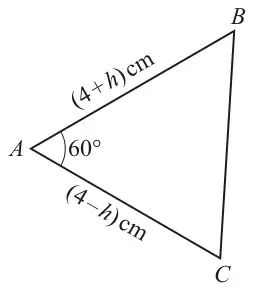
The diagram shows triangle \(ABC\) in which angle \(A\) is \(60^\circ\) and the lengths of \(AB\) and \(AC\) are \((4 + h)\,\mathrm{cm}\) and \((4 - h)\,\mathrm{cm}\) respectively.
(a) Show that the length of \(BC\) is \(p\,\mathrm{cm}\) where \[p^2 = 16 + 3h^2.\] [2]
(b) Hence show that, when \(h\) is small, \(p \approx 4 + \lambda h^2 + \mu h^4\), where \(\lambda\) and \(\mu\) are rational numbers whose values are to be determined. [4]
SC if candidates assume that \(p = 4 + \lambda h^2 + \mu h^4\) and then substitute into \(p^2 = 16 + 3h^2\) to find \(\lambda\) and \(\mu\) then B1 for correct \(\lambda\) and B1 for correct \(\mu\) (so 2/4 max.)
M1: Use of binomial expansion as far as \(1 + \frac{1}{2}(3x)\) soi by correct answer, nfww
M1: Full expansion up to quadratic term. Condone e.g. \(3x^2\) but not \(x^2\) soi by correct answer
A1: Allow exact decimals: \(1 + 1.5x - 1.125x^2\) Ignore cubic and higher order terms. Mark final answer isw writing terms as a list after correct answer seen, but A0 if correct answer spoilt by further manipulation
Mark scheme (b)
Scheme
Marks
AO
Valid for \(|x| < \frac{1}{3}\)
B1
1.1
[1]
Notes
B1: OR \(-\frac{1}{3} < x < \frac{1}{3}\) OR \(x < \frac{1}{3} \cap x > -\frac{1}{3}\) Condone \(|x| \leqslant \frac{1}{3}\) or \(-\frac{1}{3} \leqslant x \leqslant \frac{1}{3}\) (as \(n > 0\)) Must be \(x\) not e.g. \(3x\) Mark final answer
M1: two of the first three terms correct; ignore terms in \(x^3\) and above; may be embedded; must see at least substitution for third term
A1: may be unsimplified; may be embedded
A1: all three terms correct; ignore exra terms
if M0 allow SCB1 for \(\left(1 + \frac{1}{2}x - \frac{1}{4}x^2\right)\) following the equivalent method with use of \(\frac{3x}{2}\); may see eg \(2 + x - \frac{1}{2}x^2\)
if M0 allow SCB2 for correct expansion not fully supported
if M1A0 allow SCB1 for correct expansion not fully supported
Mark scheme (b)
Scheme
Marks
AO
\(|x| \lt \frac{8}{3}\) or \(-\frac{8}{3} \lt x \lt \frac{8}{3}\)
B1FT
2.5
[1]
Notes
B1FT: allow \(|x| \leqslant \frac{8}{3}\) or \(-\frac{8}{3} \leqslant x \leqslant \frac{8}{3}\); mark the final answer FT their \(\left(1 + \frac{a}{b}x\right)\)
7 A student is trying to find the binomial expansion of \(\sqrt{1 - x^3}\).
She gets the first three terms as \(1 - \dfrac{x^3}{2} + \dfrac{x^6}{8}\).
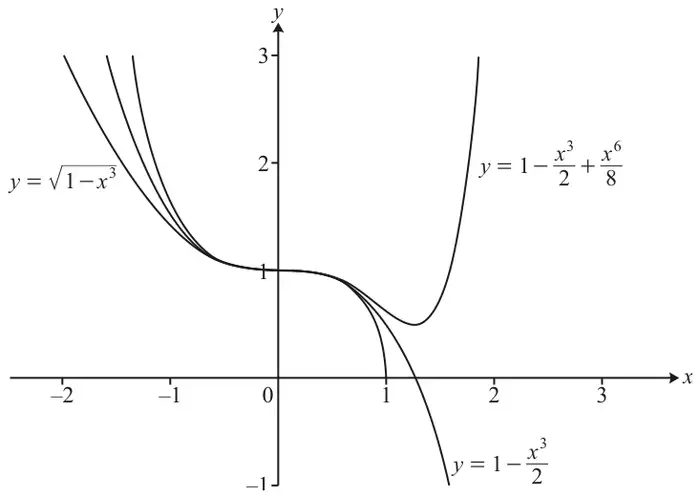
She draws the graphs of the curves \(y = \sqrt{1 - x^3}\), \(y = 1 - \dfrac{x^3}{2}\) and \(y = 1 - \dfrac{x^3}{2} + \dfrac{x^6}{8}\) using software.
(a) Explain why \(1 - \dfrac{x^3}{2} + \dfrac{x^6}{8} \geqslant 1 - \dfrac{x^3}{2}\) for all values of \(x\). [1]
(b) Explain why the graphs suggest that the student has made a mistake in the binomial expansion. [1]
(c) Find the first four terms in the binomial expansion of \(\sqrt{1 - x^3}\). [3]
(d) State the set of values of \(x\) for which the binomial expansion in part (c) is valid. [1]
(e) Sketch the curve \(y = 2.5\sqrt{1 - x^3}\) on the grid in the Printed Answer Booklet. [2]
(f)In this question you must show detailed reasoning. The end of a bus shelter is modelled by the area between the curve \(y = 2.5\sqrt{1 - x^3}\), the lines \(x = -0.75\), \(x = 0.75\) and the \(x\)-axis. Lengths are in metres. Calculate, using your answer to part (c), an approximation for the area of the end of the bus shelter as given by this model. [4]
Mark scheme (a)
Scheme
Marks
AO
\(\dfrac{x^6}{8} \geqslant 0\) or \(x^6 \geqslant 0\)
B1
2.4
[1]
Notes
B1: Do not accept \(\dfrac{x^6}{8}\) is always positive (ie \(> 0\))
Mark scheme (b)
Scheme
Marks
AO
The expansion with two terms is a better approximation than the one with three terms but it should be the other way round.
E1
2.3
[1]
Notes
E1: O.E. See exemplars
Exemplars for 7b
Accept (eg) The 3-term expansion is further away than the one with 2 terms The 3-term expansion moves away from the 2-term expansion The 3-term expansion is on the wrong side of the graph of the 2-term expansion The 3-term expansion goes up at the end The 3-term expansion should be more accurate than a 2-term expansion [and it isn’t] The 3-term expansion moves away from the other 2
Do not accept (eg) They don’t follow the same shape
M1: For their expression from 7(c) in an integration. Condone \(\mathrm{d}x\) missing. 2.5 and limits needed but may be seen later
M1: For integrating their expression (3 terms or more) allow one error Limits could be wrong or missing here
M1: For attempt at their limits substituted into their integrand. Substitution must be seen.
A1: AWRT 3.74 from correct working. Must include units. 1.495 will probably get either M2 or M3 Annotate final page
Special Case If trapezium rule used on original function allow M1 A1 maximum Likely answers If 2 strips used: \(3.71\ \mathrm{m}^2\) If 3 strips used: \(3.72\ \mathrm{m}^2\) If 6 strips used: \(3.73\ \mathrm{m}^2\)