
June 2024 Paper 1 Q7
7.
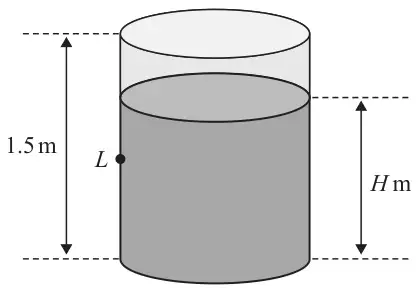
Diagram not drawn to scale.
Figure 2 shows a cylindrical tank of height 1.5 m.
Initially the tank is full of water.
The water starts to leak from a small hole, at a point \(L\), in the side of the tank.
While the tank is leaking, the depth, \(H\) metres, of the water in the tank is modelled by the differential equation
\[\frac{\mathrm{d}H}{\mathrm{d}t} = -0.12\mathrm{e}^{-0.2t}\]where \(t\) hours is the time after the leak starts.
Using the model,
In the long term, the water level in the tank falls to the same height as the hole.
| Scheme | Marks | AO |
|---|---|---|
| \(\{H=\}\,0.6\mathrm{e}^{-0.2t}\,\{+c\}\) | M1 | 1.1b |
| \(t = 0, H = 1.5 \Rightarrow 1.5 = \text{``}0.6\text{''} + c\) \(\Rightarrow c = 0.9\) | dM1 | 3.4 |
| \(\Rightarrow H = 0.6\mathrm{e}^{-0.2t} + 0.9\) | A1 | 2.1 |
| (3) |
Notes
M1: Attempts integration to achieve \(\{H=\}\,k\,\mathrm{e}^{-0.2t}\,\{+c\}\) with \(k\) a numerical constant \(\neq -0.12\)
Note that we will condone \(k = (-0.2)(-0.12)\ \{= 0.024\}\)
If they divide by \(-0.12\) first before integrating they need \(aH = b\mathrm{e}^{-0.2t}\,\{+c\}\) with \(a\) and \(b\) numerical and \(b \neq 1\). Condone a spurious integral symbol remaining after integration.
dM1: Uses \(t = 0, H = 1.5\) and a model of the form \(H = k\,\mathrm{e}^{-0.2t} + c\) (or \(aH = b\mathrm{e}^{-0.2t} + c\)) to find the value of the constant \(c\). They cannot just “make up” a value for \(k\).
Do not be concerned with their processing to find \(c\) but they cannot just state \(B\) (or \(c\)) is 0.
For reference if they divide by \(-0.12\) first they should reach \(-\dfrac{25}{3}H = -5\mathrm{e}^{-0.2t} - 7.5\) o.e.
A1: Correct complete equation in the required form: \(H = 0.6\mathrm{e}^{-0.2t} + 0.9\) with the \(H\) = present.
May be awarded if seen at the start of (b) but not in (c). Condone \(-\dfrac{1}{5}\) in place of \(-0.2\)
Finding correct values for \(A\) and \(B\) is insufficient for this mark.
Allow exact equivalents but they must be in the required form, e.g. \(H = \dfrac{6}{10}\mathrm{e}^{-0.2t} + \dfrac{9}{10}\)
A minimally acceptable answer is \(\{H=\}\,0.6\mathrm{e}^{-0.2t} + c \rightarrow H = 0.6\mathrm{e}^{-0.2t} + 0.9\) score M1dM1A1.
Note: sight of differentiating the given form to e.g. \(\dfrac{\mathrm{d}H}{\mathrm{d}t} = -0.2A\mathrm{e}^{-0.2t}\) in their working without clear evidence of integration of the original differential equation should be marked using the special case below.
SC: For candidates starting with the given answer \(H = A\mathrm{e}^{-0.2t} + B\) it is possible to use \(\dfrac{\mathrm{d}H}{\mathrm{d}t} = -0.2A\mathrm{e}^{-0.2t} = -0.12\mathrm{e}^{-0.2t}\) to deduce that \(A = 0.6\). This can be awarded SC M1dM0A0
If they go on to find \(B\) as in the main scheme then this can be awarded SC M1dM1A0
Answer with no working scores 110.
Note: If the special case is applied they may go on to achieve the rest of the marks in (b) and (c).
| Scheme | Marks | AO |
|---|---|---|
| \(1.2 = 0.6\mathrm{e}^{-0.2t} + 0.9 \Rightarrow 0.6\mathrm{e}^{-0.2t} = 0.3\) | M1 | 3.4 |
| \(\mathrm{e}^{-0.2t} = \dfrac{1}{2}\) \(\Rightarrow t = -5\ln\left(\dfrac{1}{2}\right)\) | dM1 | 1.1b |
| \(\{t=\}\) 3 hours 28 minutes | A1 | 3.2a |
| (3) |
Notes
Note: \(A\) and \(B\) must be numbers but may be “made up” if they did not have an answer to (a).
M1: Uses \(H = 1.2\) in a model of the form \(H = A\mathrm{e}^{-0.2t} + B,\ B \neq 0\) and rearranges to make \(A\mathrm{e}^{\pm 0.2t}\) or \(\mathrm{e}^{\pm 0.2t}\) the subject. Condone slips in rearranging, e.g. dividing the LHS by 0.9 instead of subtracting 0.9. Rearranging first before substituting is acceptable but they must get to \(A\mathrm{e}^{\pm 0.2t}\) or \(\mathrm{e}^{\pm 0.2t}\) as the subject.
dM1: Correct use of ln to make \(t\) the subject. Requires \(A \gt 0,\ 0 \lt B \lt 1.2\) and \(\mathrm{e}^{\pm 0.2t} = \lambda \gt 0\)
If they had a negative value for \(A\) in part (a) they cannot just make it positive at this stage.
Any of \(5\ln 2\) or \(-5\ln\dfrac{1}{2}\) or awrt 3.46 or awrt 3.47 following a correct equation will imply M1dM1.
If they do not show their method for an incorrect \(H = A\mathrm{e}^{-0.2t} + B\) with \(A \gt 0,\ 0 \lt B \lt 1.2\) you may need to check their value for \(t \gt 0\) as it may imply M1dM1.
A1: Correct time in hours and minutes \(\{t=\}\) 3 hours 28 minutes, but condone e.g. 3h 28m
Must come from correct values of \(A\) and \(B\) in (a).
Note: If their \(B = 0\) then they should end up with \(t = -3.46\ldots\) however, they did not score the first M1. They cannot “recover” this by making it positive and finding \(t =\) 3 hours 28 minutes.
| Scheme | Marks | AO |
|---|---|---|
| {As \(t\) gets large \(H \rightarrow\)} 0.9 | M1 | 3.1b |
| 0.9 m or 90 cm | A1ft | 2.2b |
| (2) | ||
| (8 marks) |
Notes
Note that 0.9 or 0.9m must come from a correct value of \(B\) in (a) to score any marks.
M1: Identifies the requirement to establish the limit as \(t\) tends to infinity.
It can be implied by stating that \(H = A\mathrm{e}^{-0.2t} + B \rightarrow B\) or \(\left(\lim\limits_{t \to \infty}\left[0.6\mathrm{e}^{-0.2t} + 0.9\right]\right) = 0.9\)
Stating “\(B\)” on its own will score this mark.
Substituting a large value is M0 unless it leads to their value for \(B\) at which point the A1 is available as well.
A1ft: Correct height including units. Follow through on their value of \(B\) where \(0 \lt B \lt 1.2\)
Correct ft height including units implies M1A1, while e.g. 0.9 (no units) would imply M1A0.
Evidence of an incorrect method such as \(1.5 - 0.6\mathrm{e}^{-0.2(0)} = 0.9\) m scores M0A0.
Misreading as \(\dfrac{\mathrm{d}H}{\mathrm{d}t} = -0.12\mathrm{e}^{0.2t}\) can score a maximum (a) 110 (b) 100 (c) 10.