
June 2022 Paper 1 Q8
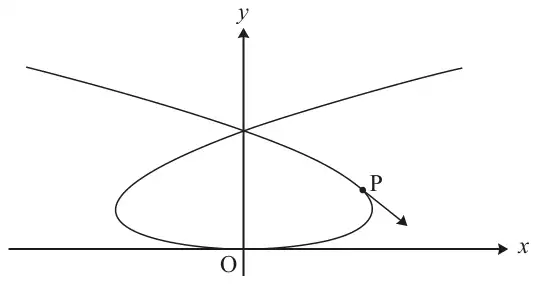
8 A particle moves in the \(x\)-\(y\) plane so that its position at time \(t\) s is given by \(x = t^3 - 8t,\ y = t^2\) for \(-3.5 \lt t \lt 3.5\). The units of distance are metres. The graph shows the path of the particle and the direction of travel at the point P \((8, 4)\).
| Scheme | Marks | AO |
|---|---|---|
| \(\dfrac{\mathrm{d}x}{\mathrm{d}t} = 3t^2 - 8,\quad \dfrac{\mathrm{d}y}{\mathrm{d}t} = 2t\) | M1* | 1.1a |
| \(\dfrac{\mathrm{d}y}{\mathrm{d}x} = \dfrac{2t}{3t^2 - 8}\) | M1 (dep) A1 | 1.1b 1.1b |
| [3] |
Notes
M1*: attempt to differentiate both parametric equations
Only allow for a complete method for finding \(\frac{\mathrm{d}y}{\mathrm{d}x}\) in terms of \(t\) using the cartesian equation of the curve
M1: Combine their derivatives to find \(\frac{\mathrm{d}y}{\mathrm{d}x}\). Do not allow for reciprocal
A1: cao
| Scheme | Marks | AO |
|---|---|---|
| AG \(t^3 - 8t = 8\) and \(t^2 = 4\) gives \(t = -2\) | M1 | 3.1a |
| \(\dfrac{\mathrm{d}y}{\mathrm{d}x} = \dfrac{2(-2)}{3(-2)^2 - 8} = -1\) | E1 | 1.1b |
| [2] |
Notes
M1: Attempt to establish the value of \(t\) at \((8, 4)\). Allow for \(\pm 2\) or 2 stated
Allow for \(y = 4\) used in \(\dfrac{\mathrm{d}y}{\mathrm{d}x} = \dfrac{2\sqrt{y}}{3y - 8}\) for the M mark only
E1: AG the negativity must be clearly established from correct working
Alternative
| Scheme | Marks |
|---|---|
| When \(\dfrac{\mathrm{d}y}{\mathrm{d}x} = \dfrac{2t}{3t^2 - 8} = -1\) giving \(3t^2 + 2t - 8 = 0\) \(t = \frac{4}{3}\) or \(t = -2\) | M1 |
| When \(t = -2\) the coordinates are \(\left((-2)^3 - 8(-2), (-2)^2\right) = (8, 4)\) [which is P] | E1 |
M1: Uses the value of the derivative to find the value of \(t\) at P.
E1: Allow without reference to \(t = \dfrac{4}{3}\)
| Scheme | Marks | AO |
|---|---|---|
| \(\dfrac{\mathrm{d}y}{\mathrm{d}x} = \dfrac{2t}{3t^2 - 8} = -1\) giving \(3t^2 + 2t - 8 = 0\) | M1 | 1.1a |
| \(t = \frac{4}{3}\) or [\(t = -2\) is the point P] | A1 | 3.2a |
| [2] |
Notes
M1: Equating their \(\frac{\mathrm{d}y}{\mathrm{d}x}\) to \(-1\) and rearranging to form quadratic equation
A1: allow www
\(-2\) need not be seen but if seen must be rejected
| Scheme | Marks | AO |
|---|---|---|
| Substitute \(t^2 = y\) | M1 | 1.1a |
| \(x = t^3 - 8t \Rightarrow x^2 = t^6 - 16t^4 + 64t^2\) | A1 | 1.1b |
| \(\Rightarrow x^2 = y^3 - 16y^2 + 64y\) | A1 | 2.1 |
| [3] |
Notes
A1: Allow for \(x^2 = t^2\left(t^2 - 8\right)^2\)
Alternative method
| Scheme | Marks |
|---|---|
| Substitute \(t = \pm y^{\frac{1}{2}}\) | M1 |
| \(x = \pm\left(y^{\frac{3}{2}} - 8y^{\frac{1}{2}}\right)\) | A1 |
| \(x^2 = y(y - 8)^2 = \left[y^3 - 16y^2 + 64y\right]\) | A1 |
M1: Substituting for \(t\) in their equation for \(x\); allow without \(\pm\)
A1: Soi Allow without \(\pm\)
A1: must be in the form \(x^2 = \ldots\) from fully correct working
Need not be simplified. Do not award if \(\pm\) not seen at all