
June 2024 Paper 2 Q14
14. The circle \(C_1\) has equation
\[x^2 + y^2 - 6x + 14y + 33 = 0\]A different circle \(C_2\)
- has centre with coordinates \((-6, -8)\)
- has radius \(k\), where \(k\) is a constant
Given that \(C_1\) and \(C_2\) intersect at 2 distinct points,
| Scheme | Marks | AO |
|---|---|---|
| (i) Centre is \((3, -7)\) | B1 | 1.1b |
| (ii) \((x-3)^2 + (y+7)^2 = 49 + 9 - 33 \Rightarrow r^2 = \ldots(25)\) | M1 | 1.1b |
| \(r = 5\) | A1 | 1.1b |
| (3) |
Notes
(a)(i)
B1: Correct centre. Allow as a coordinate pair or written separately e.g. \(x = 3,\ y = -7\) or as a column vector \(\begin{pmatrix}3\\-7\end{pmatrix}\)
Condone missing brackets e.g. 3, \(-7\) but do not allow coordinates the wrong way round.
(ii)
M1: Uses a correct strategy to find the radius or radius\(^2\)
Requires an attempt at: \((x \pm 3)^2 + (y \pm 7)^2 - 3^2 - 7^2 \pm 33 = 0 \Rightarrow (x \pm 3)^2 + (y \pm 7)^2 = \alpha,\ \alpha \gt 0\)
Award for \((x \pm 3)^2 + (y \pm 7)^2 - a^2 - b^2 \pm 33 = 0 \Rightarrow (x \pm 3)^2 + (y \pm 7)^2 = \alpha,\ \alpha \gt 0\) with at least one of \(a = 3\) or \(b = 7\) (or 9 or 49)
You may see an attempt at "\(f^2 + g^2 - c\)" or \(\sqrt{\text{``}f^2 + g^2 - c\text{''}}\) e.g. "\(3^2 + 7^2 \pm 33\)" or \(\sqrt{\text{``}3^2 + 7^2 \pm 33\text{''}}\)
A1: Correct radius of 5. Do not allow \(\pm 5\) or \(\sqrt{25}\).
May be scored following \((x \pm 3)^2 + (y \pm 7)^2 = 25\)
Correct answers only in (a) scores B1M1A1
| Scheme | Marks | AO |
|---|---|---|
| Distance between centres \(= \sqrt{(3+6)^2 + (-7+8)^2} = \sqrt{82}\) | M1 A1ft | 3.1a 1.1b |
| \(\text{``}\sqrt{82}\text{''} - \text{``}5\text{''}\) or \(\text{``}\sqrt{82}\text{''} + \text{``}5\text{''}\) | dM1 | 3.1a |
| \(\sqrt{82} - 5\) and \(\sqrt{82} + 5\) | A1 | 2.2a |
| \(\left\{k : \sqrt{82} - 5 \lt k\right\} \cap \left\{k : k \lt \sqrt{82} + 5\right\}\) or e.g. \(\left\{k : \sqrt{82} - 5 \lt k \lt \sqrt{82} + 5\right\}\) | A1 | 2.5 |
| (5) | ||
| (8 marks) |
Notes
M1: Uses Pythagoras correctly on their centre from part (a) and the given centre to find the distance between the centres.
Look for \(\sqrt{\left(-6 - (\text{their } x)\right)^2 + \left(-8 - (\text{their } y)\right)^2}\) or e.g. \(\sqrt{\left((\text{their } x) - (-6)\right)^2 + \left((\text{their } y) - (-8)\right)^2}\) but condone one sign slip with their coordinates if the intention is clear.
A1ft: Correct distance or follow through their centre from part (a).
This may be implied by their value. Condone the use of decimals so allow 3sf accuracy e.g. awrt 9.06 for \(\sqrt{82}\) or you may need to check their value following an incorrect centre in (a)(i). Not e.g. \(\pm\sqrt{82}\) unless the positive root is subsequently used.
dM1: Correct strategy for one of the limits. E.g. adds or subtracts their 5 to their distance between centres.
A1: Correct limits. There is no follow through but allow decimals to 3sf e.g. awrt 4.06 and awrt 14.1
A1: Correct answer with exact values using set notation.
Allow as shown in the main scheme but also allow equivalent set notation e.g.
\(\left\{k : k \in \mathbb{R}, \sqrt{82} - 5 \lt k \lt \sqrt{82} + 5\right\},\ \left\{k :\ \sqrt{82} - 5 \lt k \lt \sqrt{82} + 5\right\},\ k \in \left(\sqrt{82} - 5,\ \sqrt{82} + 5\right)\)
and allow “|” for “:” and allow the “\(k\):” or “\(k \in\)” to be missing
e.g. \(\left\{\sqrt{82} - 5 \lt k \lt \sqrt{82} + 5\right\}\) and \(\left(\sqrt{82} - 5,\ \sqrt{82} + 5\right)\) are both acceptable.
But \(\left\{k : k \lt \sqrt{82} + 5\right\} \cup \left\{k : k \gt \sqrt{82} - 5\right\}\) or \(\left\{k :\ k \lt \sqrt{82} - 5,\ k \lt \sqrt{82} + 5\right\}\) score A0
Do not allow solutions not in set notation such as \(\sqrt{82} - 5 \lt k \lt \sqrt{82} + 5\)
Correct answers with no working should be sent to review.
Scenario for part (b) for reference:
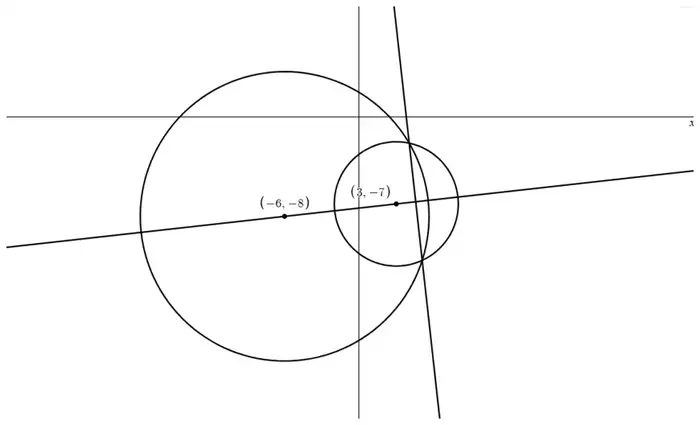
Algebraic approach for part (b):
\[\begin{gathered}x^2 + y^2 - 6x + 14y + 33 = x^2 + 12x + 36 + y^2 + 16y + 64 - k^2\\\Rightarrow 18x + 2y + 67 - k^2 = 0 \Rightarrow y = \frac{k^2 - 67}{2} - 9x\\(x-3)^2 + (y+7)^2 = 25 \Rightarrow x^2 - 6x + 9 + \left(\frac{k^2 - 67}{2} - 9x + 7\right)^2 = 25\\\Rightarrow 82x^2 + 471x - 9k^2x + \frac{k^4 - 106k^2 + 2745}{4} = 0\\\textbf{When circles touch } \boldsymbol{b^2 - 4ac = 0}\\\Rightarrow \left(471 - 9k^2\right)^2 - 4 \times 82\left(\frac{k^4 - 106k^2 + 2745}{4}\right) = 0\\\Rightarrow k^4 - 214k^2 + 3249 = 0\\\Rightarrow \left(k^2 - 10k - 57\right)\left(k^2 + 10k - 57\right) = 0\\\Rightarrow k = 5 + \sqrt{82},\ 5 - \sqrt{82},\ -5 + \sqrt{82},\ -5 - \sqrt{82}\\k = \underline{5 + \sqrt{82},\ -5 + \sqrt{82}}\end{gathered}\]We will mark this as follows:
M1: This requires a valid strategy that:
- solves the 2 circle equations simultaneously to find \(y\) in terms of \(x\) and \(k\), or \(x\) in terms of \(y\) and \(k\)
- substitutes for \(y\) or \(x\) into one of the circle equations to obtain an equation in \(x\) and \(k\) only, or \(y\) and \(k\) only,
- attempts \(b^2 - 4ac = 0\) or e.g. \(b^2 - 4ac \gt 0\) or equivalent to obtain an equation in \(k\) only. You do not need to look at the details of their algebra.
A1: Correct simplified 3TQ in \(k^2\)
dM1: Solves their 3TQ in \(k^2\) by any correct method including a calculator to find \(k\).
A1: Both correct values for \(k\) (exact or decimals as in the main scheme) (they may have extras which can be ignored)
A1: As main scheme (exact and in set notation)
Note that work such as
\[(x+6)^2 + (y+8)^2 = k^2 \Rightarrow x + 6 + y + 8 = k\]is not a valid strategy as it greatly simplifies the problem and would generally score no marks.
Implicit differentiation approach for part (b):
\[\begin{gathered}x^2 + y^2 - 6x + 14y + 33 = 0 \Rightarrow 2x + 2y\frac{\mathrm{d}y}{\mathrm{d}x} - 6 + 14\frac{\mathrm{d}y}{\mathrm{d}x} = 0 \Rightarrow \frac{\mathrm{d}y}{\mathrm{d}x} = \frac{6 - 2x}{2y + 14}\\\frac{3 - x}{y + 7} = -\frac{x + 6}{y + 8} \Rightarrow (3 - x)(y + 8) = -(x + 6)(y + 7) \Rightarrow x = 9y + 66\\(9y + 66)^2 + y^2 - 6(9y + 66) + 14y + 33 = 0 \Rightarrow 82y^2 + 1148y + 3993 = 0\\\left(\text{or } 82x^2 - 492x - 1287 = 0\right)\\y = \frac{-574 \pm 5\sqrt{82}}{82} \Rightarrow x = \frac{246 \pm 45\sqrt{82}}{82}\end{gathered}\]\[\left(\frac{246 + 45\sqrt{82}}{82}, \frac{-574 + 5\sqrt{82}}{82}\right) \rightarrow \left(\frac{246 + 45\sqrt{82}}{82} + 6\right)^2 + \left(\frac{-574 + 5\sqrt{82}}{82} + 8\right)^2 = k^2\]\[\Rightarrow k^2 = 107 + 10\sqrt{82} \Rightarrow k = 5 + \sqrt{82}\]\[\text{Then the same for } \left(\frac{246 - 45\sqrt{82}}{82}, \frac{-574 - 5\sqrt{82}}{82}\right) \rightarrow k = -5 + \sqrt{82}\]We will mark this as follows:
M1: This requires a valid strategy that:
- differentiates the equations of both circles implicitly and equates the derivatives to obtain an equation connecting \(y\) and \(x\). (Note that the equation connecting \(y\) and \(x\) is the common equation through the centres which can also be found from using the coordinates of the centres)
- substitutes for \(x\) or \(y\) into the equation for \(C_1\) to obtain an equation in one variable
A1: Correct 3TQ in \(y\) or \(x\)
dM1: This requires:
- solves their 3TQ in \(y\) or \(x\) by any correct means including a calculator and finds at least one point of intersection
- substitutes this point into \(C_2\) and proceeds to a value for \(k\)
A1: Correct values for \(k\) (exact or decimals as in the main scheme)
A1: As main scheme (exact and in set notation)