
June 2023 Paper 2 Q6
6 A circle has centre \(C\) which lies on the \(x\)-axis, as shown in the diagram. The line \(y = x\) meets the circle at \(A\) and \(B\). The midpoint of \(AB\) is \(M\).
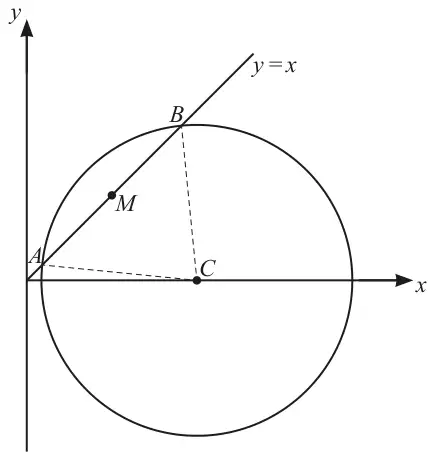
The equation of the circle is \(x^2 - 6x + y^2 + a = 0\), where \(a\) is a constant.
Show that the area of triangle \(ABC\) is \(\frac{3}{2}\sqrt{9 - 2a}\). [7]
| Scheme | Marks | AO |
|---|---|---|
| DR \(2x^2 - 6x + a = 0\) | M1 | 3.1a |
| At \(A\): \(x = \dfrac{6 + \sqrt{36 - 8a}}{4} = \dfrac{3 - \sqrt{9 - 2a}}{2}\) At \(B\): \(x = \dfrac{3 + \sqrt{9 - 2a}}{2}\) | A1 | 2.2a |
| At \(M\): \(x = \dfrac{3}{2}\) | A1 | 1.1 |
| \(CM^2 = \left(3 - \frac{3}{2}\right)^2 + \left(\frac{3}{2}\right)^2\quad \left(= \frac{9}{2}\right)\) | M1 | 2.1 |
| \(BA^2 = \left(\sqrt{9 - 2a}\right)^2 + \left(\sqrt{9 - 2a}\right)^2\) \(\left(= 2\left(\sqrt{9 - 2a}\right)^2\right)\) | M1 | 1.1 |
| Area \(= \dfrac{1}{2} \times CM \times BA\) | M1 | 1.1 |
| \(\frac{1}{2} \times \sqrt{2}\sqrt{9 - 2a} \times \frac{3}{\sqrt{2}}\quad \left(= 3\sqrt{\frac{9 - 2a}{4}}\right)\) AG | A1 | 1.1 |
| [7] |
Notes
In this question, if candidates attempt more than one method, review all their working to identify which is their ‘final’ or ‘substantially most complete’ answer, then apply one scheme only.
Candidates cannot gain marks from more than one scheme.
M1: Substitute \(y = x\) into equation of circle (need not be simplified – may see this quadratic in \(y\))
A1: A1 for either correct (condone if not specifically identified as \(A\) or \(B\) – may see \(y =\) these values)
M1: Attempt \(CM\) using their values (method must be correct)
May see \(CM = \frac{3\sqrt{2}}{2}\)
M1: Attempt \(BA\) using their values (method must be correct)
May see just \(\sqrt{2(9 - 2a)}\) oe, e.g. \(\sqrt{18 - 4a}\)
Alternative: \(AM = \sqrt{\frac{9}{2} - a}\) (and then \(\text{Area} = 2 \times \frac{1}{2} \times CM \times AM\))
M1: Attempt at area, in terms of \(a\)
A1: Must see correct expression before answer
Alternative Method
| Scheme | Marks |
|---|---|
| DR \((x - 3)^2 + y^2 = 9 - a\) \(C\) is (3, 0); radius \(= \sqrt{9 - a}\) | M1 A1 |
| \(CM = (3\cos 45 =)\ \dfrac{3}{\sqrt{2}}\) | B1 |
| \(AM^2 = (9 - a) - \left(\dfrac{3}{\sqrt{2}}\right)^2\quad \left(= \frac{9}{2} - a\right)\) | M1 |
| Area \(= AM \times CM\) or \(\dfrac{1}{2}AB \times CM\) | M1 |
| \(= \sqrt{\dfrac{9}{2} - a} \times \dfrac{3}{\sqrt{2}}\) oe | A1FT |
| \(= \sqrt{\dfrac{9 - 2a}{2}} \times \dfrac{3}{\sqrt{2}}\quad \left(= 3\sqrt{\dfrac{9 - 2a}{4}}\right)\) AG | A1 |
M1: Attempt complete the square for \(x\)
A1: Both soi
B1: Possibly coming from \(\dfrac{|3 - 0|}{\sqrt{1^2 + 1^2}}\)
M1: Their radius2 (in terms of \(a\)) – their \(CM^2\)
M1: Attempted in terms of \(a\)
A1FT: FT their \(AM\) or \(AB\) (in terms of \(a\)), and their \(CM\)
A1: Must see one correct intermediate step
Alternative method for last three marks
| Scheme | Marks |
|---|---|
| Area \(= \dfrac{1}{2}AB \times r \times \sin BAC\) | M1 |
| \(= \sqrt{\dfrac{9}{2} - a} \times \sqrt{9 - a} \times \left(\dfrac{3}{\sqrt{2}} \div \sqrt{9 - a}\right)\) | A1FT |
| \(= \sqrt{\dfrac{9 - 2a}{2}} \times \dfrac{3}{\sqrt{2}}\quad \left(= 3\sqrt{\dfrac{9 - 2a}{4}}\right)\) AG | A1 |
M1: Attempted in terms of \(a\)
A1FT: FT their \(r\) and \(AM\) or \(AB\) (in terms of \(a\)), and their \(CM\)
A1: Must see one correct intermediate step
Alternative method for last three marks
| Scheme | Marks |
|---|---|
| Area \(= \dfrac{1}{2}r \times r \times \sin BCA\) | M1 |
| \(= \sqrt{9 - a} \times \sqrt{9 - a} \times 2\left(\sqrt{\frac{9}{2} - a} \div \sqrt{9 - a}\right)\left(\frac{3}{\sqrt{2}} \div \sqrt{9 - a}\right)\) | A1FT |
| \(= \sqrt{\frac{9 - 2a}{2}} \times \frac{3}{\sqrt{2}}\quad \left(= 3\sqrt{\frac{9 - 2a}{4}}\right)\) AG | A1 |
M1: Attempted in terms of \(a\)
A1FT: FT their \(r\) and \(AM\) or \(AB\) (in terms of \(a\)), and their \(CM\) (using double angle formula for \(\sin BCA\))
A1: Must see one correct intermediate step
| Scheme | Marks | AO |
|---|---|---|
| (i) \(\left(3\sqrt{\frac{9 - 2a}{4}} = 0 \Rightarrow\right)\ a = \dfrac{9}{2}\) | B1 | 2.2a |
| [1] | ||
| (ii) \(y = x\) is a tangent to the circle or \(A\) and \(B\) are coincident oe | B1 | 3.2a |
| [1] |
Notes
(b)(i)
B1: oe
(b)(ii)
B1: Must see this geometrical answer (accept e.g. the line touches the circle)
Accept a diagram that clearly shows the line is a tangent
| Scheme | Marks | AO |
|---|---|---|
| Line \(y = x\) does not meet circle | B1 | 3.2a |
| [1] |
Notes
B1: Must see this geometrical answer (condone BOD for ‘the line does not touch the circle’)
Accept a diagram that clearly shows the line does not meet the circle