14This question refers to the article on the Insert, “Tangents and normals to a quadratic curve”. The relevant extract (lines 21 to 28) is reproduced here.
Normals
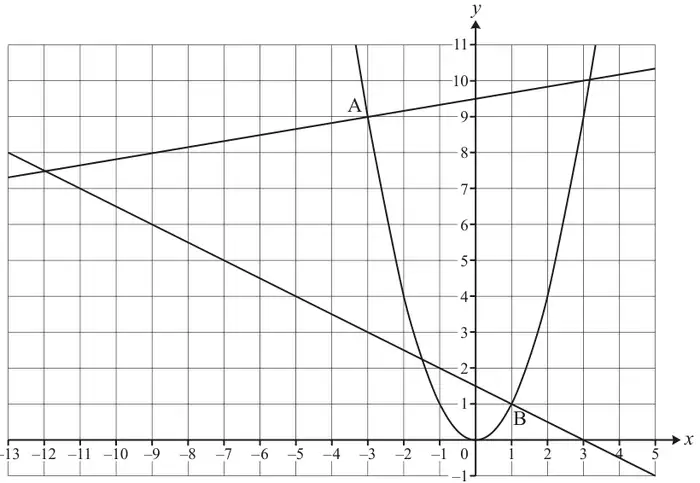
Fig. C2 shows the curve \(y = x^2\) together with normals to the curve at points A \((-3, 9)\) and B \((1, 1)\). The normals cross at the point \((-12, 7.5)\).
Fig. C2
For the curve \(y = x^2\), the coordinates of the point of intersection are not as simply related to the coordinates of A and B as in the case of the tangents. The equation of the normal at the point \((t, t^2)\) is \(y = -\tfrac{x}{2t} + t^2 + \tfrac{1}{2}\). The normals at points \((t_1, t_1^2)\) and \((t_2, t_2^2)\) cross when \(x = -2t_1t_2(t_1 + t_2)\) and \(y = t_1^2 + t_2^2 + t_1t_2 + \tfrac{1}{2}\).
Substitute appropriate values of \(t_1\) and \(t_2\) to verify that the expression \(t_1^2 + t_2^2 + t_1t_2 + \tfrac{1}{2}\) gives the correct value for the \(y\)-coordinate of the point of intersection of the normals at the points A and B in Fig. C2. [1]
B1: Convincingly showing that the formula gives 7.5
Additional guidance
Candidates must use \(t_1\) and \(t_2\) with values 1 and -3 and show the substitution to get to 7.5 for the B1. Using -1 and 3 is not correct and scores B0.