
June 2023 Paper 2 Q5
5 In this question you must show detailed reasoning.
The function f is defined by \(\mathrm{f}(x) = \cos x + \sqrt{3}\sin x\) with domain \(0 \leqslant x \leqslant 2\pi\).
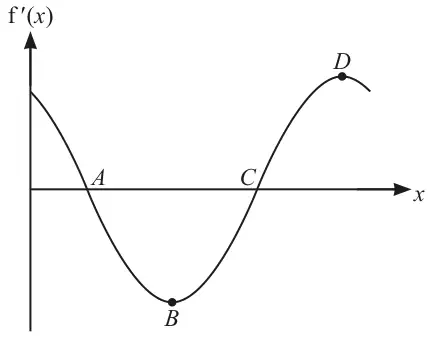
The diagram shows the graph of the gradient function \(y = \mathrm{f}'(x)\) for the domain \(0 \leqslant x \leqslant 2\pi\).
| Scheme | Marks | AO |
|---|---|---|
| (i) \(\mathrm{f}'(x) = -\sin x + \sqrt{3}\cos x\) | M1 | 3.1a |
| \(\tan x = \sqrt{3}\) | M1 | 1.1 |
| \(x = \frac{1}{3}\pi\) | A1 | 1.1 |
| or \(\frac{4}{3}\pi\) | A1 | 1.1 |
| [4] | ||
| (ii) \(\mathrm{f}''(x) = -\cos x - \sqrt{3}\sin x\) or… | M1 | 3.1a |
| \(\tan x = -\frac{1}{\sqrt{3}}\) | A1 | 1.1 |
| \(x = \frac{5}{6}\pi\) or \(x = \frac{11}{6}\pi\) | A1 | 1.1 |
| [3] |
Notes
(a)(i)
M1: Attempt differentiate \(\mathrm{f}(x)\), allow sign errors but both trig functions must be changed.
oe e.g. \(2\cos\left(x + \frac{\pi}{6}\right)\)
M1: Setting their \(\mathrm{f}'(x) = 0\) and correctly manipulating to reach an equation in a single trig function (e.g. \(4\cos^2 x = 1\) or \(4\sin^2 x = 3\)) do not allow incorrect working e.g. \(a - b = 0 \Rightarrow a^2 - b^2 = 0\)
A1: www, must be in radians (allow decimal 1.05 3sf)
A1: www, must be in radians (allow decimal 4.19 3sf), and for this mark have no other solutions in the given range (ignore any outside)
SC B1 for each correct solution (max [2/4]) if insufficient or no working shown, but not from incorrect working.
If both solutions given correctly in degrees (60°, 240°) then can get M1M1SCB1 (max [3/4])
(a)(ii)
M1: Attempt to differentiate their \(\mathrm{f}'(x)\) (allow sign errors but both trig functions must be changed), setting their \(\mathrm{f}''(x) = 0\) and attempting to manipulate. May see \(\mathrm{f}''(x) = -2\sin\left(x + \frac{\pi}{6}\right)\)
A1: For correctly reaching an equation in a single trig function (oe, may see \(4\sin^2 x = 1\) or \(4\cos^2 x = 3\))
Not from incorrect working e.g. \(a - b = 0 \Rightarrow a^2 - b^2 = 0\)
A1: www, for both correct in radians (allow decimals 2.62, 5.76 3sf)
SC B1 for both correct solutions (max [1/3]) if insufficient or no working shown, but not from incorrect working.
Answers in degrees can get M1A1A0 (max [2/3])
| Scheme | Marks | AO |
|---|---|---|
| \(A\): \(\left(\frac{1}{3}\pi, 0\right)\) AND \(C\): \(\left(\frac{4}{3}\pi, 0\right)\) | B1FT | 1.1 |
| \(B\): \(\left(\frac{5}{6}\pi, -2\right)\) AND \(D\): \(\left(\frac{11}{6}\pi, 2\right)\) | B1FT | 1.1 |
| [2] |
Notes
B1FT: FT their \(x\)-values in radians or degrees from (a)(i), both with \(y = 0\)
Both must be correctly labelled with \(A\) and \(C\), allow decimals 3sf
B1FT: FT their \(x\)-values in radians or degrees from (a)(ii), with both \(y = -2\) and \(y = 2\) correct
Both must be correctly labelled with \(B\) and \(D\), allow decimals 3sf
If neither mark awarded then can get one of (max [1/2]):
- SC B1FT for any two correct pairs \(x\) and \(y\), correctly labelled
- SC B1FT for all four \(x\)-coords, correctly labelled and in ascending order (only if 2 distinct answers given in both (a)(i) and (a)(ii))
- SC B1FT for all four \(y\)-coords, correctly labelled
| Scheme | Marks | AO |
|---|---|---|
| (i) Where the graph (of \(\mathrm{f}'(x)\)) is above the \(x\)-axis or the graph is positive | B1 | 2.4 |
| [1] | ||
| (ii) \(0 \leqslant x \lt \frac{1}{3}\pi,\ \frac{4}{3}\pi \lt x \leqslant 2\pi\) | B1 | 2.2a |
| \(\left\{x : 0 \leqslant x \lt \frac{1}{3}\pi\right\} \cup \left\{x : \frac{4}{3}\pi \lt x \leqslant 2\pi\right\}\) Or \(\left[0, \frac{1}{3}\pi\right) \cup \left(\frac{4}{3}\pi, 2\pi\right]\) | B1 | 2.5 |
| [2] |
Notes
(c)(i)
B1: Must reference the graph – do not accept just ‘gradient is positive’ or just ‘\(\mathrm{f}'(x) \gt 0\)’
(c)(ii)
B1: Both intervals correctly identified, ignore set notation for this mark
cao (values must be correct) but condone any clear indication of both correct intervals e.g. \(0 \to \frac{\pi}{3}\) and \(\frac{4\pi}{3} \to 2\pi\) (allow decimals)
Accept any combination of \(\leqslant\) and \(\lt\) or ( ) and [ ]
B1: Writing their answer in correct set notation, values may be incorrect for this mark but there must be two separate intervals.
Allow single-tailed inequalities as long as written in correct set notation, e.g. \(\left\{x : x \lt \frac{\pi}{3}\right\} \cup \left\{x : x \gt \frac{4\pi}{3}\right\}\)
Accept any combination of \(\leqslant\) and \(\lt\) or ( ) and [ ] but do not accept \(\cap\) instead of \(\cup\).