
June 2025 Paper 3 Q6
6 The compound angle formulae for \(\sin(A + B)\) and \(\sin(A - B)\) are
\(\sin(A + B) = \sin A\cos B + \cos A\sin B\) and
\(\sin(A - B) = \sin A\cos B - \cos A\sin B\).
\(\sin C - \sin D = 2\cos\left(\dfrac{C + D}{2}\right)\sin\left(\dfrac{C - D}{2}\right)\). [1]
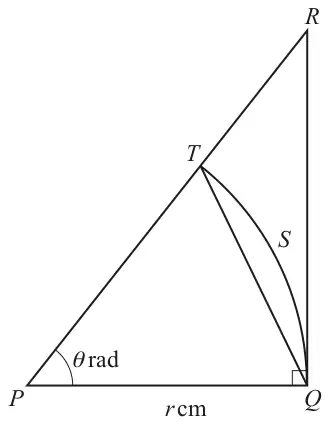
The diagram shows a right-angled triangle \(PQR\) with \(PQ = r\) cm. The angle \(QPR\) is \(\theta\) radians. The diagram also shows the sector \(PQST\) of a circle with centre \(P\) and radius \(r\) cm. The line segment \(QT\) is a chord of the sector \(PQST\).
\(1 \lt \dfrac{\theta}{\sin\theta} \lt \dfrac{1}{\cos\theta}\). [4]
A student attempts to use the result regarding the derivative of \(\sin x\) to find the derivative of \(\cos x\). The student’s attempt is shown below.
| Let | \(y = \cos x\), where \(x\) is measured in radians. |
| \(y = \sin\left(\dfrac{\pi}{2} - x\right)\) | |
| so | \(\dfrac{\mathrm{d}y}{\mathrm{d}x} = \cos\left(\dfrac{\pi}{2} - x\right)\) |
| but | \(\sin x \equiv \cos\left(\dfrac{\pi}{2} - x\right)\) |
| therefore | \(\dfrac{\mathrm{d}y}{\mathrm{d}x} = \sin x\). |
| Scheme | Marks | AO |
|---|---|---|
| \(A = \dfrac{C + D}{2}, B = \dfrac{C - D}{2}\) and \(\sin C - \sin D = 2\cos A\sin B\) \(\sin C - \sin D = 2\cos\left(\dfrac{C + D}{2}\right)\sin\left(\dfrac{C - D}{2}\right)\) | B1 | 2.1 |
| [1] |
Notes
B1: AG Must see as a minimum the following three components:
[1]: the correct expressions for \(A\) and \(B\) stated explicitly (not just in a final answer or as part of trig. expressions) or \(2\cos\left(\dfrac{A + B + A - B}{2}\right)\sin\left(\dfrac{A + B - (A - B)}{2}\right) = 2\cos A\sin B\) (if working right to left)
[2]: \(\sin C - \sin D = 2\cos A\sin B\)
[3]: the given answer or both \(\sin C - \sin D = 2\cos A\sin B\) and \(2\cos A\sin B = 2\cos\left(\dfrac{C + D}{2}\right)\sin\left(\dfrac{C - D}{2}\right)\) (so linking the two parts of the given answer explicitly via the expression \(2\cos A\sin B\))
| Scheme | Marks | AO |
|---|---|---|
| \(QR = r\tan\theta\) or \(PR = \dfrac{r}{\cos\theta}\) | B1* | 3.1a |
| \((\Delta PQR =)\ \frac{1}{2}r(r\tan\theta)\) or \(\frac{1}{2}r\left(\dfrac{r}{\cos\theta}\right)\sin\theta\) \((\Delta PQT =)\ \frac{1}{2}r^2\sin\theta\) or (sector \(PQST =\)) \(\frac{1}{2}r^2\theta\) | B1* | 1.1 |
| \(\frac{1}{2}r^2\sin\theta \lt \frac{1}{2}r^2\theta \lt \frac{1}{2}r^2\tan\theta\) | B1dep* | 2.1 |
| \(\sin\theta \lt \theta \lt \dfrac{\sin\theta}{\cos\theta} \Rightarrow 1 \lt \dfrac{\theta}{\sin\theta} \lt \dfrac{1}{\cos\theta}\) | B1 | 2.2a |
| [4] |
Notes
B1*: Can be implied by the correct expression for the area of \(\Delta PQR\)
B1 for either expression soi in the area of \(\Delta PQR\)
B1*: One correct area expression
B1dep*: Correct sandwich inequality in terms of \(r\) and \(\theta\) - must be seen at some point in this form and not just as separate inequalities
This result with no working scores B3 but \(\sin\theta \lt \theta \lt \tan\theta\) with no working is no marks
B1: AG – www sufficient working seen therefore tan must be replaced with \(\dfrac{\sin}{\cos}\) and therefore \(\sin\theta \lt \theta \lt \tan\theta \Rightarrow 1 \lt \dfrac{\theta}{\sin\theta} \lt \dfrac{1}{\cos\theta}\) is B0
Dependent on all previous B marks
| Scheme | Marks | AO |
|---|---|---|
| (i) \(\cos\theta \lt \dfrac{\sin\theta}{\theta} \lt 1\) | B1 | 3.1a |
| [1] | ||
| (ii) 1 | B1 | 2.2a |
| [1] |
Notes
(c)(i)
B1: or \(1 \gt \dfrac{\sin\theta}{\theta} \gt \cos\theta\) but not as two separate inequalities (unless correctly brought together)
condone \(\dfrac{\cos\theta}{1} \lt \dfrac{\sin\theta}{\theta} \lt 1\)
(c)(ii)
B1: Ignore any working seen but B0 if implying \(\lt 1\), \(\gt 1\) etc.
| Scheme | Marks | AO |
|---|---|---|
| \(\left(\dfrac{\mathrm{f}(x + h) - \mathrm{f}(x)}{h} =\right) \dfrac{\sin(x + h) - \sin x}{h}\) | B1* | 2.1 |
| \(= \dfrac{2\cos\left(\frac{2x + h}{2}\right)\sin\left(\frac{h}{2}\right)}{h}\) | M1dep* | 1.1 |
| \(\displaystyle\lim_{h \to 0} \frac{\mathrm{f}(x + h) - \mathrm{f}(x)}{h} = \cos x \times \lim_{h \to 0}\left[\frac{2}{h}\sin\left(\frac{h}{2}\right)\right]\) | A1 | 1.1 |
| \(\displaystyle= \cos x \times \lim_{h \to 0}\left[\frac{\sin\left(\frac{h}{2}\right)}{\frac{h}{2}}\right] = \cos x\) (as from part (c)(ii) \(\displaystyle\lim_{\theta \to 0} \frac{\sin\theta}{\theta} = 1\) therefore \(\dfrac{\mathrm{d}}{\mathrm{d}x}(\sin x) = \cos x\)) | A1 | 2.2a |
| [4] |
Notes
B1*: cao
Denominator must be simplified to \(h\)
M1dep*: Using the given expression for \(\sin C - \sin D\) from part (a) with \(C = x + h\) and \(D = x\) – allow un-simplified
If not using result from part (a) then M0
A1: Using the result that \(\displaystyle\lim_{h \to 0}\cos\left(\frac{2x + h}{2}\right) = \cos x\) to obtain \(\displaystyle\cos x \times \lim_{h \to 0}\left[\frac{2}{h}\sin\left(\frac{h}{2}\right)\right]\)
Must see limit present for this A mark
A1: Re-writing \(\dfrac{2}{h}\sin\left(\dfrac{h}{2}\right)\) so that the result from part (c)(ii) can be applied and obtaining the correct derivative
Or equivalent limit argument e.g. \(\displaystyle\lim_{h \to 0}\left(\frac{\sin\left(\frac{1}{2}h\right)}{h}\right) = \frac{1}{2}\)
| Scheme | Marks | AO |
|---|---|---|
| The line \(\dfrac{\mathrm{d}y}{\mathrm{d}x} = \cos\left(\dfrac{\pi}{2} - x\right)\) is incorrect; (by the chain rule) it should be \(\dfrac{\mathrm{d}y}{\mathrm{d}x} = -\cos\left(\dfrac{\pi}{2} - x\right)\) | B1 | 2.3 |
| [1] |
Notes
B1: Clearly identify the error made e.g. stating that it should be \(-\cos\left(\frac{\pi}{2} - x\right)\) or ‘the student forgot to multiply \(\cos\left(\frac{\pi}{2} - x\right)\) by \(-1\)’ or ‘\(\sin\left(\frac{\pi}{2} - x\right)\) does not differentiate to \(\cos\left(\frac{\pi}{2} - x\right)\)’ oe
B0 for ‘the student forgot to multiply by \(-1\)’ only
B0 for ‘the student forgot to divide \(\cos\left(\frac{\pi}{2} - x\right)\) by \(-1\)’
Just stating that the derivative should be \(-\sin x\) is B0
If mentioning that ‘the student forgot to multiply/include the \(-1\)’ then it must be clear this is on line 3