
October 2021 Paper 3 Q12
12
The questions in this section refer to the article on the Insert. You should read the article before attempting the questions.
The relevant parts of the article “Adding arctangents” are reproduced below; the line numbers are those printed on the Insert.
Line 7
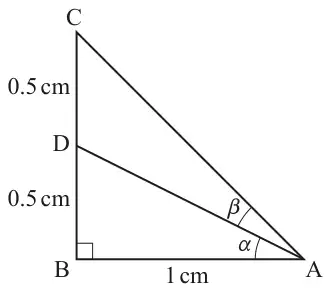
It can be shown that \(\arctan\left(\frac{1}{2}\right) + \arctan\left(\frac{1}{3}\right) = \arctan 1\).Fig. C1 Lines 8–11
Consider the diagram in Fig. C1.
Triangle ABC is right-angled at B.
AB = BC = 1 cm.
D is the midpoint of BC.Line 12
Using triangle ABD, \(\tan\alpha = \dfrac{\mathrm{DB}}{\mathrm{BA}} = \dfrac{1}{2}\) so \(\alpha = \arctan\left(\dfrac{1}{2}\right)\).Line 13
Using triangle ABC, \(\tan(\alpha + \beta) = 1\) so \(\alpha + \beta = \arctan 1\).Line 14
Hence \(\tan(\alpha + \beta) = \dfrac{\tan\alpha + \tan\beta}{1 - \tan\alpha\tan\beta} = 1\).Lines 15–16
Using \(\tan\alpha = \dfrac{1}{2}\) and finding \(\tan\beta\), it follows that \(\beta = \arctan\left(\dfrac{1}{3}\right)\),
which gives the required result that \(\arctan\left(\frac{1}{2}\right) + \arctan\left(\frac{1}{3}\right) = \arctan 1\).
Show that \(\beta = \arctan\left(\dfrac{1}{3}\right)\), as given in line 15. [3]
| Scheme | Marks | AO |
|---|---|---|
| \(\dfrac{\tan\alpha + \tan\beta}{1 - \tan\alpha\tan\beta} = 1 \Rightarrow \dfrac{\frac{1}{2} + \tan\beta}{1 - \frac{1}{2}\tan\beta} = 1\) | M1 | 1.1a |
| \(\frac{1}{2} + \tan\beta = 1 - \frac{1}{2}\tan\beta\) | M1 | 1.1 |
| \(1.5\tan\beta = 0.5 \Rightarrow \tan\beta = \dfrac{0.5}{1.5} = \dfrac{1}{3} \Rightarrow \beta = \arctan\left(\dfrac{1}{3}\right)\) | E1 | 2.1 |
| [3] |
Notes
M1: Use of \(\tan(\alpha + \beta)\)
Accept valid alternative solutions
M1: Rearranging
E1: Convincing completion. AG
Approximate solutions with decimal angles do not score