
C1 June 2012 Q8
8.\[4x - 5 - x^2 = q - (x + p)^2\]where \(p\) and \(q\) are integers.
| Scheme | Marks |
|---|---|
| \(4x - 5 - x^2 = q - (x + p)^2,\ \ p,\ q\) are integers. | |
| \(\{4x - 5 - x^2 =\}\ -\left[x^2 - 4x + 5\right] = -\left[(x - 2)^2 - 4 + 5\right] = -\left[(x - 2)^2 + 1\right]\) | M1 |
| \(= -1 - (x - 2)^2\) | A1 A1 |
| (3) |
Notes
(corrected from the printed mark scheme: the first line restates the identity as \(q - (x - p)^2\); the question has \(q - (x + p)^2\), so \(p = -2\))
M1: for an attempt to complete the square eg: \(\pm(\pm x \pm 2)^2 \pm k - 5,\ k \neq 0\) or \(\pm(\pm x \pm 2)^2 \pm \lambda,\ \lambda \neq -5\) seen or implied in working.
1st A1: for \(p = -2\) or for \(\pm\alpha - (x - 2)^2\), \(\alpha\) can be 0.
2nd A1: for \(q = -1\)
Note: Allow M1A1A1 for a correct written down expression of \(-1 - (x - 2)^2\) Ignore \(-1 - (x - 2)^2 = 0\).Note: If a candidate states either \(p = -2\) or \(q = -1\) or writes \(\pm k - (x - 2)^2\) then imply the M1 mark.
Note: A candidate who writes down with no working \(p = 2,\ q = \) (a value which is not \(-1\)) gets M0A0A0.
Note: Writing \((x - 2)^2 - 1\), followed by \(p = -2,\ q = -1\) is M1A1A0.
Alternative 1 to (a)
\(\{4x - 5 - x^2 =\}\ -\left[x^2 - 4x\right] - 5 = -\left[(x - 2)^2 - 4\right] - 5 = -(x - 2)^2 + 4 - 5 = -1 - (x - 2)^2\)
Alternative2 to (a)
\(q - (x + p)^2 = q - (x^2 + 2px + p^2) = -x^2 - 2px + q - p^2\)
Compare \(x\) terms: \(\quad -2p = 4 \Rightarrow \underline{p = -2}\)
Compare constant terms: \(\quad q - p^2 = -5 \Rightarrow q - 4 = -5 \Rightarrow \underline{q = -1}\)
M1: Either \(\pm 2p = 4\) or \(q \pm p^2 = -5\); 1st A1: for \(p = -2\); 2nd A1: for \(q = -1\)
Alternative 3 to (a)
Negating \(4x - 5 - x^2\) gives \(x^2 - 4x + 5\)
So, \(x^2 - 4x + 5 = (x - 2)^2 - 4 + 5\ \left\{= (x - 2)^2 + 1\right\}\) M1 for \(\pm(\pm x \pm 2)^2 \pm k + 5\)
then stating \(p = -2\) is 1st A1 and/or \(q = -1\) is 2nd A1.
or writing \(-1 - (x - 2)^2\) is A1A1.
Special Case for part (a):
\(q - (x + p)^2 = q - (x^2 + 2px + p^2) = -x^2 - 2px + q - p^2 = 4x - 5 - x^2\)
\(\Rightarrow -2px + q - p^2 = 4x - 5 \ \Rightarrow\ q - p^2 + 5 = 4x + 2px \ \Rightarrow\ q - p^2 + 5 = x(4 + 2p)\)
\(\Rightarrow x = \dfrac{q - p^2 + 5}{4 + 2p} \ \Rightarrow\ p \neq -2\) scores Special Case M1A1A1 only once \(p \neq -2\) achieved.
| Scheme | Marks |
|---|---|
| \(\{\text{"}b^2 - 4ac\text{"} =\}\ 4^2 - 4(-1)(-5) \qquad \{= 16 - 20\}\) | M1 |
| \(= -4\) | A1 |
| (2) |
Notes
M1: for correctly substituting any two of \(a = -1,\ b = 4,\ c = -5\) into \(b^2 - 4ac\) if this is quoted.
If \(b^2 - 4ac\) is not quoted then the substitution must be correct.
Substitution into \(b^2 < 4ac\) or \(b^2 = 4ac\) or \(b^2 > 4ac\) is M0.
A1: for \(-4\) only.
If they write \(-4 < 0\) treat the \(< 0\) as ISW and award A1. If they write \(-4 \geqslant 0\) then score A0.
So substituting into \(b^2 - 4ac < 0\) leading to \(-4 < 0\) can score M1A1
Note: Award M0 if the candidate uses the quadratic formula UNLESS they later go on to identify that the discriminant is the result of \(b^2 - 4ac\).
Beware: A number of candidates are writing up their solution to part (b) at the bottom of the second page. So please look!
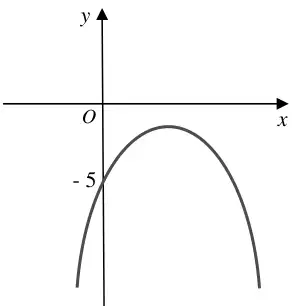
| Scheme | Marks |
|---|---|
| Correct \(\cap\) shape | M1 |
| Maximum within the 4th quadrant | A1 |
| Curve cuts through -5 or \((0, -5)\) marked on the \(y\)-axis | B1 |
| (3) | |
| (8 marks) |
Notes
M1: Correct \(\cap\) shape in any quadrant.
A1: The maximum must be within the fourth quadrant to award this mark.
B1: Curve (and not line!) cuts through -5 or \((0, -5)\) marked on the \(y\)-axis
Allow \((-5, 0)\) rather than \((0, -5)\) if marked in the “correct” place on the \(y\)-axis.
If the curve cuts through the negative \(y\)-axis and this is not marked, then you can recover \((0, -5)\) from the candidate’s working in part (c). You are not allowed to recover this point, though, from a table of values.