
June 2025 Paper 2 Q7
7
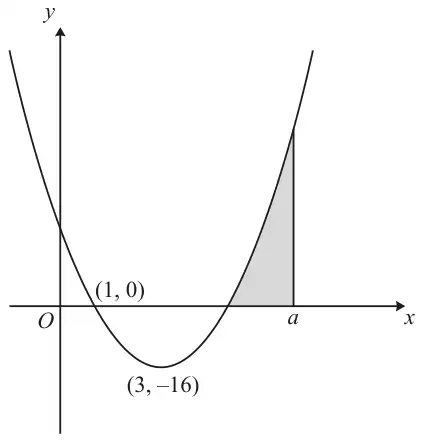
The diagram shows the curve with equation \(y = \mathrm{f}(x)\) where \(\mathrm{f}(x)\) is a quadratic function. The curve intersects the \(x\)-axis at the point \((1, 0)\) and has its minimum at the point \((3, -16)\).
The shaded region is enclosed by the curve, the \(x\)-axis, and the line \(x = a\). The area of the shaded region is \(\tfrac{100}{3}\) units\(^2\).
| Scheme | Marks | AO |
|---|---|---|
| \((y =)\ k(x \pm 3)^2 \pm 16\) | M1* | 2.1 |
| \(0 = k(1 - 3)^2 - 16 \Rightarrow k = \ldots\) | M1dep* | 1.1 |
| \(y = 4(x - 3)^2 - 16 \Rightarrow y = 4(x^2 - 6x + 9) - 16\) so \(\mathrm{f}(x) = 4x^2 - 24x + 20\) or \(y = 4x^2 - 24x + 20\) | A1 | 1.1 |
| [3] |
Notes
M1*: Using the given minimum point \((3, -16)\) to form an expression with (unknown) constant \(k\) with \(k \neq 1\)
M1dep*: Using \((1, 0)\) to find \(k\)
If correct \(k = 4\)
A1: AG – sufficient working must be shown
Alternative method 1
| Scheme | Marks |
|---|---|
| \((y =)\ ax^2 + bx + c\) \((y' =)\ 2ax + b\) therefore \(2a(3) + b = 0\) | M1 |
| Either \(a + b + c = 0\) or \(a(3)^2 + 3b + c = -16\) | B1 |
| Solving correctly leading to \(a = 4, b = -24, c = 20\) | A1 |
M1: Using the fact that the minimum point is when \(x = 3\) to obtain an equation in \(a\) and \(b\)
Allow a single slip when differentiating
B1: A correct equation in \(a\), \(b\) and \(c\) using either \((1, 0)\) or \((3, -16)\)
A1: AG – sufficient working must be shown
Alternative method 2
| Scheme | Marks |
|---|---|
| \(4 - 24 + 20 = 0\) (therefore, the curve passes through the point \((1, 0)\)) | B1 |
| \((y' =)\ 8x - 24\) and at a stationary point \(y' = 0\) therefore \(8x - 24 = 0\) leading to \(x = \ldots\) | M1 |
| \(x = 3 \Rightarrow y = 4(3)^2 - 24(3) + 20\) so \(y = -16\) | A1 |
B1: Convincingly showing that the given curve passes through \((1, 0)\)
M1: Differentiate given equation, set equal to zero and solve for \(x\)
Allow a single slip when differentiating
A1: AG – convincingly show that there is a stationary point at \((3, -16)\)
Alternative method 3
| Scheme | Marks |
|---|---|
| \(y = 4x^2 - 24x + 20\) \(= 4[x^2 - 6x] + 20\) \(= 4[(x - 3)^2 - 9] + 20\) \(= 4(x - 3)^2 - 36 + 20\) | M1 |
| \(= 4(x - 3)^2 - 16\) so, there is a stationary point at \((3, -16)\) | A1 |
| \(4 - 24 + 20 = 0\) (therefore, the curve passes through the point \((1, 0)\)) | B1 |
M1: Attempt to complete the square on given quadratic
Also possible to obtain \((2x - 6)^2 - 16\)
Allow sign errors only
A1: Correctly showing that \((3, -16)\) is a stationary point on the curve
B1: Convincingly showing that the given curve passes through \((1, 0)\)
or \(4(1 - 3)^2 - 16 = 16 - 16 = 0\)
Alternative method 4
| Scheme | Marks |
|---|---|
| The (quadratic) curve crosses the axis where \(x = 5\) | B1 |
| \(y = k(x - 1)(x - 5)\) \(-16 = k(3 - 1)(3 - 5) \Rightarrow k = \ldots\) | M1 |
| \(k = 4 \Rightarrow y = 4(x - 1)(x - 5)\) \(y = 4(x^2 - 6x + 5)\) \(y = 4x^2 - 24x + 20\) | A1 |
B1: soi eg by symmetry
M1: Substitutes \((3, -16)\) in an equation of the form \(y = k(x - 1)(x - a)\) to find \(k\)
Where \(k \neq 1\) and \(k \gt 0\) and \(a \gt 3\)
A1: AG – sufficient working must be shown
| Scheme | Marks | AO |
|---|---|---|
| Curve also intersects the \(x\)-axis at 5 | B1 | 3.1a |
| \(\displaystyle\int 4x^2 - 24x + 20\,\mathrm{d}x\) | M1* | 1.1 |
| \(= \dfrac{4}{3}x^3 - \dfrac{24}{2}x^2 + 20x\ (+c)\) | A1 | 1.1 |
| \(\left(\dfrac{4}{3}a^3 - 12a^2 + 20a\right) - \left(\dfrac{4}{3}(5)^3 - 12(5)^2 + 20(5)\right) = \dfrac{100}{3}\) | M1dep* | 2.1 |
| \(a^3 - 9a^2 + 15a = 0\) so (\(a = 0\) or) \(a = \dfrac{9 \pm \sqrt{21}}{2}\) | M1 | 1.1 |
| \(a = \dfrac{9 + \sqrt{21}}{2}\) as \(a \gt 5\) | A1 | 3.2a |
| [6] |
Notes
B1: BC or by symmetry/inspection
M1*: Attempt to integrate – at least one term with power increased by 1 and a change in coefficient of that term.
Ignore limits for the first M1 A1
SC \(\int x^2 - 6x + 5\,\mathrm{d}x\) scores B1M1*M1dep*M1 max 4 out of 6
A1: Correct integration (allow unsimplified)
M1dep*: Set up a cubic equation in \(a\) using correct limits and the given \(\tfrac{100}{3}\)
Must be applying limits correctly (but allow one slip)
M1: BC solves their 3 (or 4) term cubic – if correct equation then allow the stating of only the correct value for this mark. If incorrect cubic then must state all possible real roots for this mark.
Can be awarded for inexact solutions
Dependent on both previous M marks
If correct \(a = 0\), 6.7912…, 2.20871…
A1: Correct exact root together with justification.