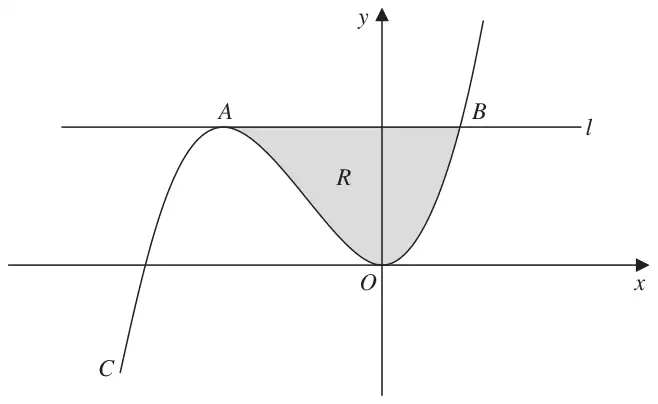
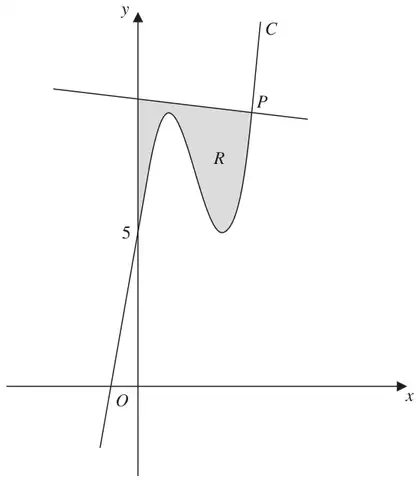
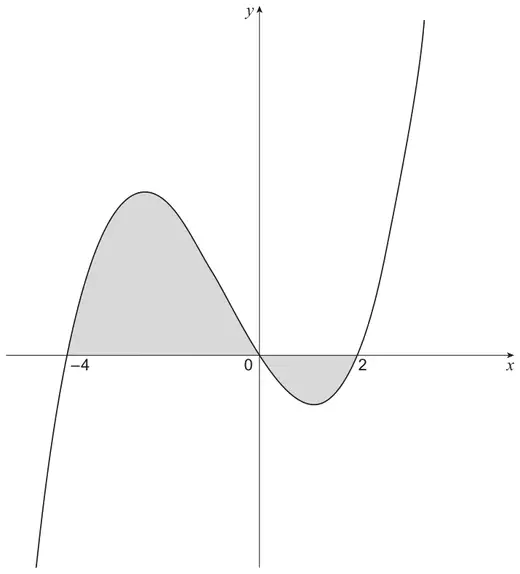
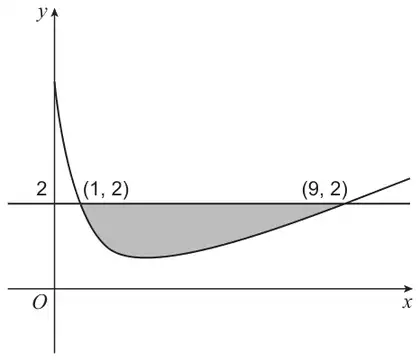
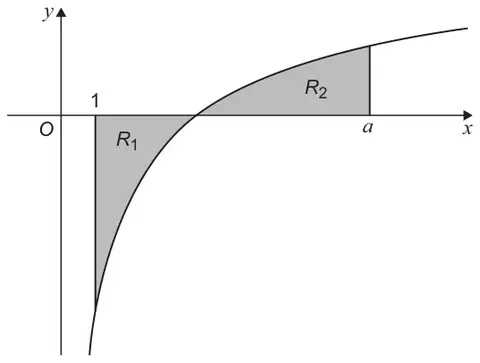
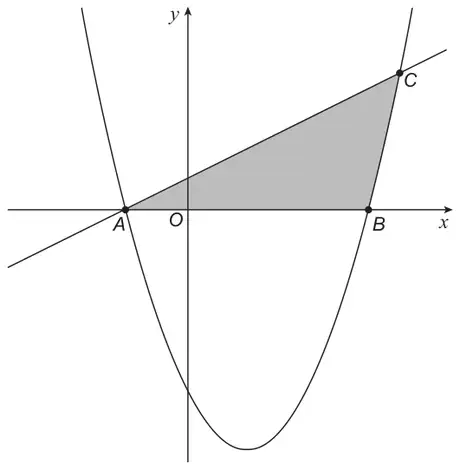
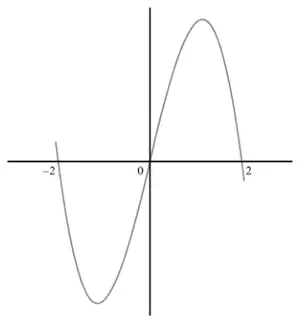
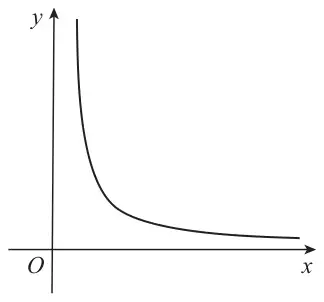
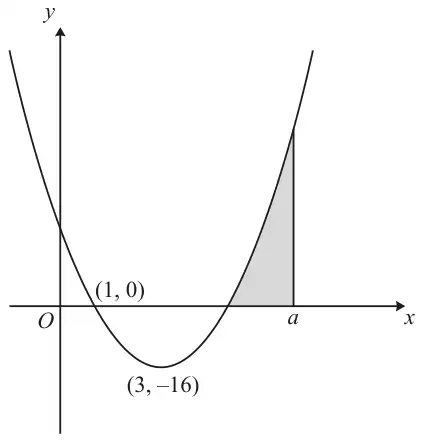
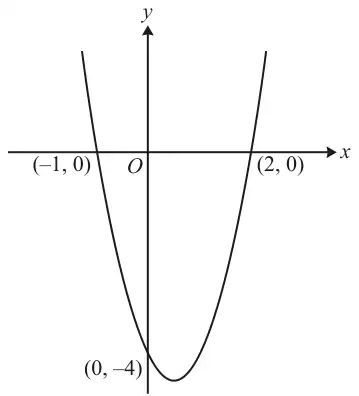
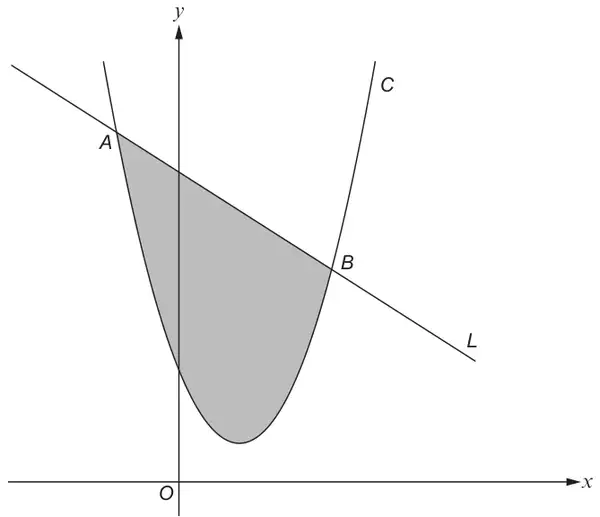
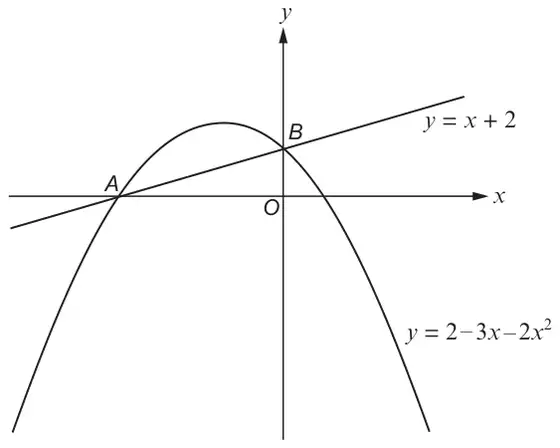
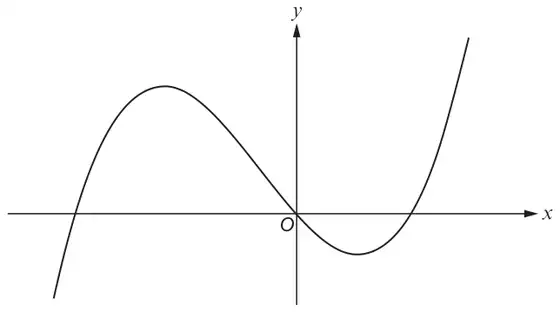
Note that some candidates are clearly not understanding the demand in part (a) and score no marks there. They do, however, start (b) from scratch and effectively answer part (a) there – in such cases we will allow work in (b) to score in (a). If there is no labelling of parts, mark in the order presented.
(a) Notes
M1: Attempts to split the fraction up and obtains at least one correct index. Allow this mark even if they have more than 2 terms and allow the terms to be seen in isolation. e.g. \(\dfrac{x^5 - 12x^{\frac{1}{2}}}{4x} = \ldots x^4 + \ldots\) or \(\dfrac{x^5 - 12x^{\frac{1}{2}}}{4x} = \ldots + \ldots x^{-\frac{1}{2}}\) Allow equivalents for \(x^{-\frac{1}{2}}\) e.g. \(\dfrac{1}{x^{\frac{1}{2}}}\) or \(\dfrac{1}{\sqrt{x}}\). Score as soon as one of these terms is seen.
A1: One correct simplified term so either \(\dfrac{1}{4}x^4\) or \(-3x^{-\frac{1}{2}}\). Allow equivalent simplified expressions e.g. \(0.25x^4,\ -\dfrac{3}{x^{\frac{1}{2}}},\ -\dfrac{3}{\sqrt{x}}\) Score as soon as one of these simplified terms is seen then isw.
A1: \(\dfrac{1}{4}x^4 - 3x^{-\frac{1}{2}}\) or equivalent as one simplified expression e.g. \(0.25x^4 - \dfrac{3}{\sqrt{x}}\) or e.g. \(\dfrac{1}{4}x^4 - \dfrac{3}{x^{\frac{1}{2}}}\) Condone \(\dfrac{1}{4}x^4 + -3x^{-\frac{1}{2}}\) Do not apply isw for this mark. E.g. many candidates are reaching \(\dfrac{1}{4}x^4 - 3x^{-\frac{1}{2}}\) and stating \(\dfrac{1}{4}x^4 - 3x^{-\frac{1}{2}} = x^4 - 12x^{-\frac{1}{2}}\) and this scores M1A1A0. But isw can be applied if they simply miscopy their work rather than “change” it. Apply isw for \(\dfrac{1}{4}x^4 - 3x^{-\frac{1}{2}} = 0\)
Correct answer only scores full marks in (a)
Mark scheme (b)
Scheme
Marks
AO
\(\dfrac{1}{4}x^4 \to \ldots x^5\) or \(-3x^{-\frac{1}{2}} \to \ldots x^{\frac{1}{2}}\)
M1
1.1b
\(\dfrac{1}{20}x^5\) or \(-6x^{\frac{1}{2}}\)
A1ft
1.1b
\(\dfrac{1}{20}x^5 - 6x^{\frac{1}{2}} + c\)
A1
2.1
(3)
Notes
Note that some candidates are clearly not understanding the demand in part (a) and score no marks there. They do, however, start (b) from scratch and effectively answer part (a) there – in such cases we will allow work in (b) to score in (a). If there is no labelling of parts, mark in the order presented.
(b) Notes
M1: Increases the power of \(x\) by one for at least one of their terms. Look for \(x^n \to \ldots x^{n+1}\) or if they obtain a term \(\dfrac{\ldots}{x}\) and integrate to \(\ldots\ln x\) then allow M1 if \(x^n \to \ldots x^{n+1}\) is not seen. Allow the indices to be unprocessed e.g. \(x^4 \to x^{4+1}\) Do not allow this mark if they have differentiated in (a) and then integrate their derivative in (b)
A1ft: One term correct, which may be unsimplified. Allow follow through on their answers to (a). Allow the indices to be unprocessed and condone spurious integral signs e.g. \(\displaystyle\int \frac{1}{4}x^4 - 3x^{-\frac{1}{2}}\,\mathrm{d}x = \int \frac{1}{20}x^5 - 6x^{\frac{1}{2}}\)
A1: cao with simplified terms and including the \(+c\) but condone spurious integral signs e.g. \(\displaystyle\int \frac{1}{4}x^4 - 3x^{-\frac{1}{2}}\,\mathrm{d}x = \int \frac{1}{20}x^5 - 6x^{\frac{1}{2}} + c\) Allow e.g. \(0.05x^5 - 6\sqrt{x} + c\) Isw can be applied here once a correct answer is seen.
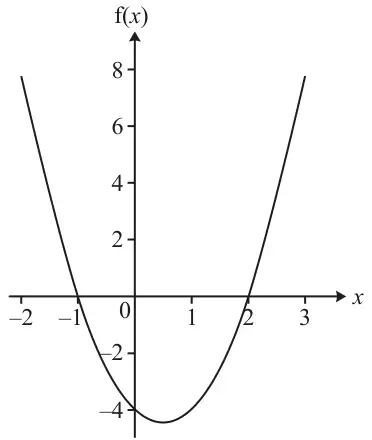
e.g. \(3x^2 - 14 = -2 \Rightarrow 3x^2 = 12 \Rightarrow x = \ldots\)
dM1
1.1b
\(x = 2\) only *
A1*
2.2a
(3)
Notes
(a) On EPEN this is M1A1A1* we are marking this as M1dM1A1*
M1: Differentiates the cubic to achieve \(px^2 + q\) and sets equal to \(-2\). Note setting the linear and cubic equations equal to each other and solving is M0 (no use of calculus) but, they may differentiate \(\pm(\text{cubic} - \text{line})\) to achieve \(px^2 + q\) and set equal to 0 which is M1. Alternatively, in either approach, differentiates to achieve \(px^2 + q\) and substitutes in \(x = 2\)
dM1: Proceeds from their equation to find a real value for \(x\) with at least one intermediate stage of working. e.g. \(px^2 = -q \Rightarrow x = \ldots\) or e.g. via factorisation \((3)(x + 2)(x - 2) = 0 \Rightarrow x = \ldots\) Accept proceeding directly to \(x = \sqrt{\dfrac{14 - 2}{3}}\) or \(\pm 2\) In the alternative, it is for substituting in 2 into their \(3(2)^2 - 14 = \ldots\) or \(3(2)^2 - 12 = \ldots\)
A1*: 2 only (the solution of \(-2\) does not need to be found) \(\pm 2\) without selecting 2/ rejecting -2 is A0*. In the alternative they conclude that \(x = 2\).
Mark scheme (b)
Scheme
Marks
AO
e.g. Substitutes \(x = -4\) into \(y = x^3 - 14x + 23\) and \(y = -2x + 7\)
M1
1.1b
Correct solution + conclusion * (see notes)
A1*
2.4
(2)
Notes
Work may be seen in (a) but must be used in (b) to score
M1: Mark the general method / do not be concerned by slips in their working. Either e.g.
substitutes \(x = -4\) into \(y = x^3 - 14x + 23\) and \(y = -2x + 7\). Sight of \(-4\) embedded in the equations is sufficient.
substitutes \(x = -4\) into one equation to find \(y\) and then uses this value to find \(x\) in the other equation.
equates the cubic and the linear expressions, rearranges (= 0) and then
substitutes \(x = -4\) into the equation or expression
factorises using \((x - 2)^2\) to find a linear factor (e.g. inspection / division)
algebraically divides by \((x + 4)\) at some point to get a remainder of 0
factorises using \((x - 2)\) to find a quadratic factor which they attempt to factorise
A1*:A correct solution with conclusion but allow recovery of missing/invisible brackets. Either
finds \(y = 15\) when \(x = -4\) for both equations
finds \(y = 15\) using one equation and uses this to find that \(x = -4\) for the other
verifies that \(x = -4\) is a solution of the cubic – linear = 0 with no errors seen.
solves cubic – linear = 0 and finds the linear factor \((x + 4)\) leading to the root \(x = -4\)
There must be a conclusion: if they find \(x = -4\) then a tick, QED, underline, proven. If they find e.g. \(y = 15\) for both they must state \(x = -4\) e.g.“(same \(y\) values so) \(x = -4\)” Note that stating the coordinates \((-4,\ 15)\) is insufficient.
No integration seen (using the integration button on a calculator) will score 0 marks
M1: Integrates the equation of the curve or in the alternative method it is for integrating curve-line and achieving at least two terms with a correct index out of \(\ldots x^4 \pm \ldots x^2 \pm \ldots x\) Also look out for a transformation approach translating the cubic down 3 units and integrating \(\displaystyle\int \left(x^3 - 14x + 20\right)\mathrm{d}x = \frac{x^4}{4} - 7x^2 + 20x\)
A1: \(\dfrac{x^4}{4} - 7x^2 + 23x\) or \(\dfrac{x^4}{4} - 6x^2 + 16x\) (ignore any constant of integration). Allow unsimplified but the indices must be processed. Look out for \(\dfrac{x^4}{4} - 7x^2 + 20x\) if the cubic has been translated down 3 units. Do not penalise poor notation for this mark.
dM1: Correct limits of 2 and \(-4\) used for their integral (which may be for the line or curve). It is dependent on the previous method mark. Evidence of substituting in 2 and \(-4\) into their integrated expression must be seen. (e.g. \(22 - (-140)\)). In the alternative method the dM1 (and next dM1) are scored at the same time for substituting in the correct limits.
dM1: Correct strategy to find the shaded area. It is dependent on the first method mark only but the limits must be correct. In the alternative method this mark is scored for sight of 2 and \(-4\) for their integral which do not have to be substituted in. The method to find any areas e.g. trapezium, rectangle, triangle must be correct and the method of adding or subtracting to find the shaded area must be correct. Condone slips in evaluating. Note using the transformation approach they will need to subtract the area of the triangle \(0.5 \times 6 \times (15 - 3)\)
A1*: 108 following from a rigorous argument showing all stages and correct notation used when integrating (the integral sign and the d\(x\) either side of their expression seen at least once and should not be present after integration has been completed)
M1: For separating the fraction into two separate terms. Award for one correct index (which does not need to be processed. e.g. \(\ldots x^{\frac{1}{2} - 2}\)) Note \(-\dfrac{3}{x^2}\) is insufficient. They must write as \(\ldots x^{-2}\) or may be implied by further work. Beware of candidates who integrate the numerator and denominator which results in a correct index but is an incorrect method and scores M0A0dM0A0
A1: \(2x^{-\frac{3}{2}} - 3x^{-2}\) o.e. where the indices have been processed (may be implied by further work)
dM1: For raising the power by one on at least one term with a correct index. It is dependent on the previous method mark. The index does not need to be processed. e.g. \(\ldots x^{-\frac{3}{2}} \to \ldots x^{-\frac{3}{2} + 1}\). It is not for \(+c\).
A1: All correct, simplified and on one line including \(+\ c\). Allow other simplified equivalent terms such eg. \(-\dfrac{4}{\sqrt{x}}\) for \(-4x^{-\frac{1}{2}}\) or e.g. \(\dfrac{3}{x}\) for \(3x^{-1}\) but do not allow e.g. \(+-4x^{-\frac{1}{2}}\) or \(-\dfrac{4}{1}x^{-\frac{1}{2}}\) Award once a correct expression is seen and isw but if there is any additional/incorrect notation and no correct expression has been seen on its own, withhold the final mark. e.g. \(\displaystyle\int -4x^{-\frac{1}{2}} + 3x^{-1} + c\,\mathrm{d}x\) or \(-4x^{-\frac{1}{2}} + 3x^{-1} + c = 0\) with no correct expression seen earlier are both A0. Ignore \(y = \ldots\)
M1: For attempting integration by parts and achieving the correct structure for the intermediate stage e.g. \(\displaystyle \pm(\ldots x^{\frac{1}{2}} \pm \ldots)x^{-1} \pm \int x^{-\frac{3}{2}}\,\mathrm{d}x\) or equivalent. Indices do not need to be processed e.g. \(\displaystyle x^{-2}\left(\ldots x^{\frac{3}{2}} \pm \ldots x\right) \pm \int \ldots x^{-3}\left(\ldots x^{\frac{3}{2}} \pm \ldots x\right)\mathrm{d}x\)
dM1: For completing the integration by parts method achieving at least one term with a correct index (the index does not need to be processed) and terms with the same index do not need to be collected for this mark
Full and complete method using the given information \(\mathrm{f}^{\prime}(4) = 0\) and \(\mathrm{f}(4) = 3\) in order to find values for \(a\) and \(b\) Note: \(a = -15\) and \(b = 14\)
M1: For the key step in setting \(\mathrm{f}^{\prime}(4) = 0 \Rightarrow 16 + 2a + b = 0\) to set up an equation in \(a\) and \(b\). Condone slips.
M1: For attempting to integrate \(\mathrm{f}^{\prime}(x)\). Award for \(x^n \to x^{n+1}\) or \(b \to bx\) This may come after finding values for \(a\) or \(b\) or both.
A1ft: \(\{\mathrm{f}(x) =\}\, 2x^2 + \dfrac{2}{3}ax^{\frac{3}{2}} + bx\ \{+c\}\) or, e.g., \(\{\mathrm{f}(x) =\}\, 2x^2 + \dfrac{2}{3}ax^{\frac{3}{2}} + (-16 - 2a)x\ \{+c\}\) Allow ft on their \(b\) in terms of \(a\) if they substituted in from their \(\mathrm{f}^{\prime}(4) = 0 \Rightarrow 16 + 2a + b = 0\) Do not ft if they have a value(s) for \(a\) or \(b\) This may be left unsimplified but the indices must be processed. isw once the mark is awarded. Condone the omission of the \(+ c\) This accuracy mark requires only the previous M mark to be scored.
B1: Deduces that the constant term in \(\mathrm{f}(x)\) is \(-5\). Note that deducing \(b = -5\) is B0. It must be the constant in a changed function.
ddM1: For a complete strategy to find values for both \(a\) and \(b\). Do not be concerned about the logistics of how they solve the simultaneous equations – this may be done on a calculator. Note: \(a = -15\) and \(b = 14\) This is dependent on both previous method marks and so must include use of both
A1: \(\{\mathrm{f}(x) =\}\, 2x^2 - 10x^{\frac{3}{2}} + 14x - 5\) or exact simplified equivalent, e.g., use of \(x\sqrt{x}\) in place of \(x^{\frac{3}{2}}\) Apply isw once a correct expression is seen.
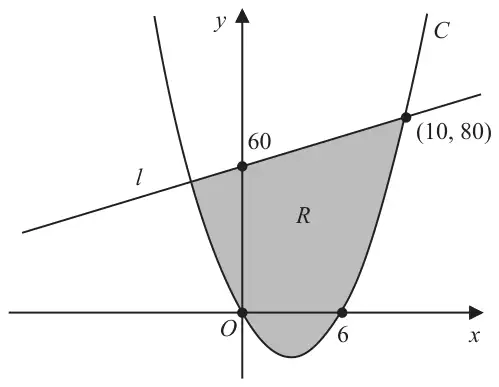
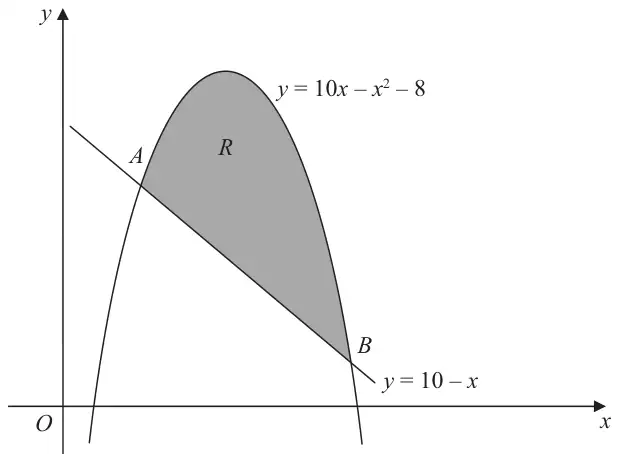
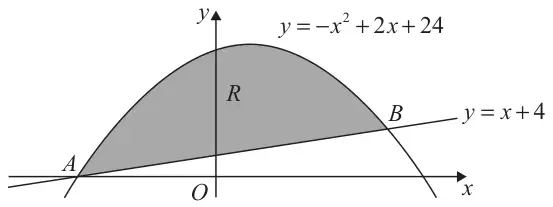
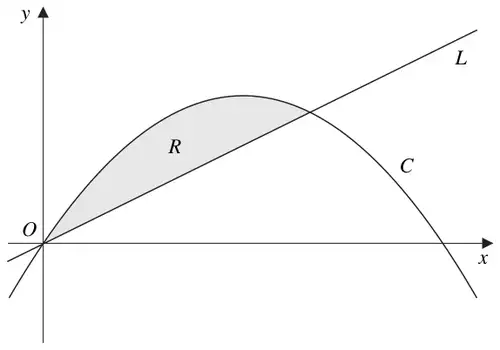
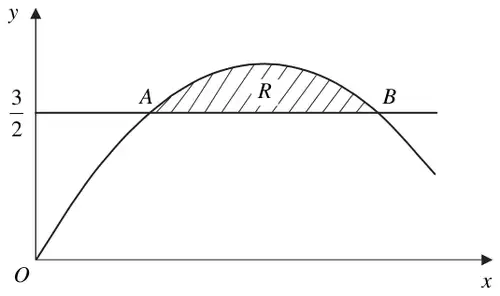
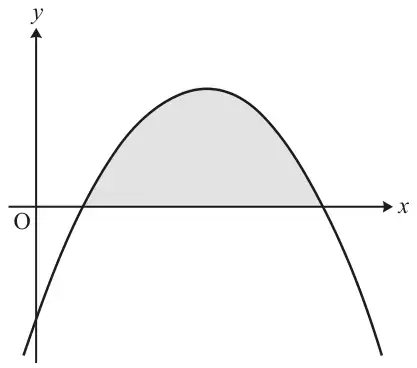
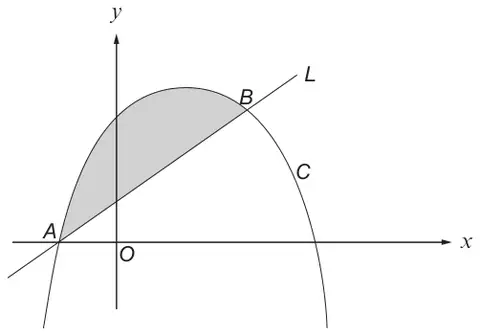
Figure 3 shows a sketch of a curve \(C\) and a straight line \(l\).
Given that
\(C\) has equation \(y = \mathrm{f}(x)\) where \(\mathrm{f}(x)\) is a quadratic expression in \(x\)
\(C\) cuts the \(x\)-axis at 0 and 6
\(l\) cuts the \(y\)-axis at 60 and intersects \(C\) at the point \((10, 80)\)
use inequalities to define the region \(R\) shown shaded in Figure 3. (5)
Mark scheme
Scheme
Marks
AO
Complete method to find the RHS of an equation for \(l\) e.g., Attempts gradient = \(\dfrac{80 - 60}{10}\{= 2\}\) and uses intercept = 60
M1
1.1b
\(\{y =\}\, 2x + 60\)
A1
1.1b
Deduces the RHS of the equation for \(C\) is \(\{y =\}\, ax(x - 6)\) and attempts to use \((10, 80)\) to find the value of \(a\)
M1
3.1a
Equation of \(C\) is \(\{y =\}\, 2x(x - 6)\)
A1
1.1b
\(2x(x - 6) \leqslant y \leqslant 2x + 60\)
B1ft
2.5
(5)
(5 marks)
Notes
M1: Complete attempt to use the given information to find an equation or inequality for \(l\), which may be \(l =\) or have no LHS. \(y - 80 = 2(x - 10)\) is acceptable for this mark.
A1: \(\{y =\}\, 2x + 60\) This is not scored by \(y - 80 = 2(x - 10)\)
M1: Deduces the RHS of the equation of \(C\) is \(\{y =\}\, ax(x - 6),\ a \neq 1,\) and attempts to use \((10, 80)\) to find the value of \(a\) which may be implied. Again, there may be no LHS. Other possible and more lengthy alternatives include: 1) Setting the RHS to be \(\{y =\}\, a(x - 3)^2 + b\) and using \((0, 0)\) and \((10, 80)\) to find \(a\) and \(b\) 2) Setting the RHS to be \(\{y =\}\, px^2 + qx\) and using \((6, 0)\) and \((10, 80)\) to find \(p\) and \(q\)
A1: \(\{y =\}\, 2x(x - 6)\) or alternative such as \(\{y =\}\, 2(x - 3)^2 - 18\) or \(\{y =\}\, 2x^2 - 12x\) This may be implied by an inequality \(y \ldots 2x(x - 6)\) and may be seen as, e.g., \(C = 2x(x - 6)\)
B1ft: \(\text{``}2x(x - 6)\text{''} \leqslant y \leqslant \text{``}2x + 60\text{''}\) o.e. must follow from their \(l\) and \(C\) and apply isw Follow through only on a quadratic for \(C\) and a straight line for \(l\) Do not allow a mixture of inequalities, i.e., \(\lt\) with \(\leqslant\) Allow \(2x^2 - 12x \lt y \lt 2x + 60\) or as separate inequalities \(y \gt 2x(x - 6),\ y \lt 2x + 60\) Do not allow \(2x(x - 6) \lt R \lt 2x + 60\) or \(2x(x - 6) \lt \mathrm{f}(x) \lt 2x + 60\) or \(2x(x - 6) \lt 2x + 60\) Ignore any reference to \(-3 \lt x \lt 10\) Note: \(y = 2x + 60\) and \(y = 2x(x - 6)\) incorrectly expanded to \(y = 2x^2 - 12\) followed by \(2x^2 - 12 \leqslant y \leqslant 2x + 60\) would score 11110
In this question you must show all stages of your working.
Solutions relying on calculator technology are not acceptable.
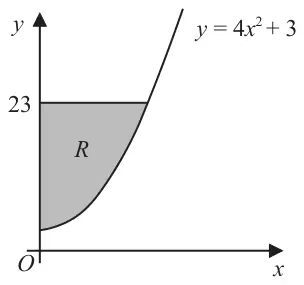
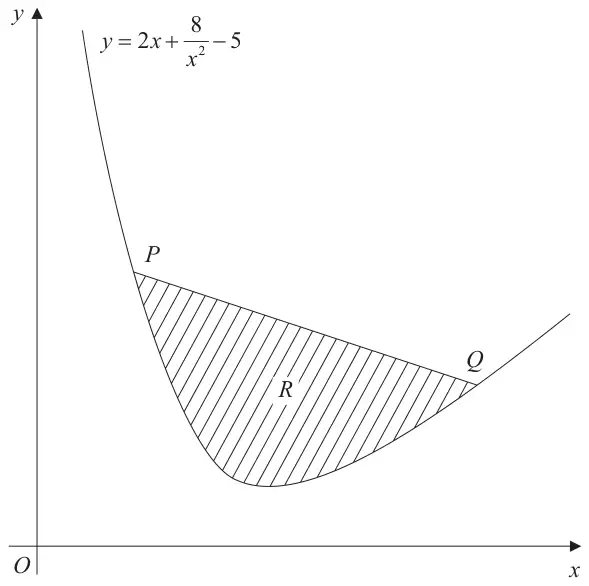
Figure 2
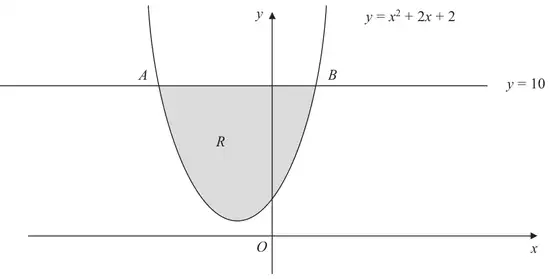
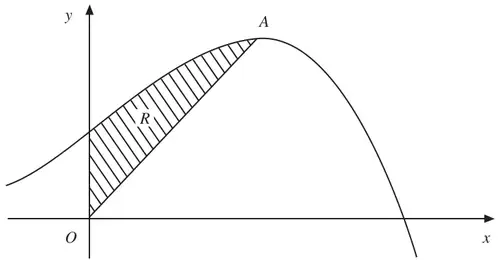
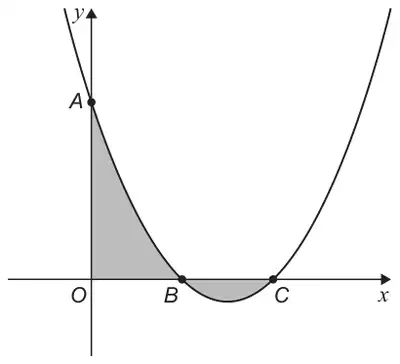
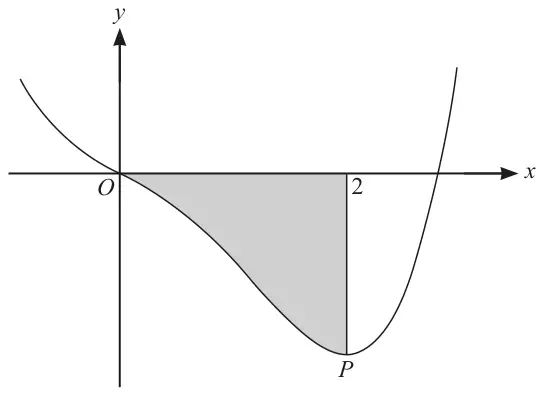
The finite region \(R\), shown shaded in Figure 2, is bounded by the curve with equation \(y = 4x^2 + 3\), the \(y\)-axis and the line with equation \(y = 23\)
Show that the exact area of \(R\) is \(k\sqrt{5}\) where \(k\) is a rational constant to be found. (5)
Full method of finding the area of \(R\) e.g. \(23\sqrt{5} - \left[\dfrac{4}{3}x^3 + 3x\right]_0^{\sqrt{5}} = \ldots\) e.g. \(\left[20x - \dfrac{4}{3}x^3\right]_0^{\sqrt{5}} = \ldots\)
M1
2.1
\(\Rightarrow \text{Area } R = \dfrac{40}{3}\sqrt{5}\)
A1
1.1b
(5)
(5 marks)
Notes
B1: States or uses the upper limit \(\sqrt{5}\) Score when seen as the solution \(x = \sqrt{5}\)
M1: Attempts to integrate \(4x^2 + 3\) or \(\pm\left(23 - \left(4x^2 + 3\right)\right)\) which may be simplified. Look for one term from \(4x^2 + 3\) with \(x^n \to x^{n+1}\) It is not sufficient just to integrate 23.
A1: Correct integration. Ignore any \(+c\) or spurious integral signs. Indices must be processed. Look for \(\displaystyle\int 4x^2 + 3\,\{\mathrm{d}x\} = \frac{4}{3}x^3 + 3x\) or \(\displaystyle\pm\int 20 - 4x^2\,\{\mathrm{d}x\} = \pm\left(20x - \frac{4}{3}x^3\right)\) if (line – curve) or (curve – line) used.
M1: Full and complete method to find the area of \(R\) including the substitution of their upper limit. The upper limit must come from an attempt to solve \(4x^2 + 3 = 23\) The lower limit might not be seen but if seen it should be 0. See scheme for two possible ways. Condone a sign slip if (line – curve) or (curve – line) used.
A1: \(\dfrac{40}{3}\sqrt{5}\) following correct algebraic integration. If using (curve – line) then allow recovery but they must make the \(-\dfrac{40}{3}\sqrt{5}\) positive.
Alternative using \(\displaystyle\int x\,\mathrm{d}y\)
B1: States or uses limits 3 and 23. It must be for a clear attempt to integrate with respect to \(y\)
M1: Attempts to rearrange to \(x =\) and integrate \(\sqrt{\dfrac{y - 3}{4}}\) condoning slips on the rearrangement. Look for \(\ldots(y \pm 3)^{\frac{1}{2}} \to \ldots(y \pm 3)^{\frac{3}{2}}\)
A1: Correct integration \(\displaystyle\int \frac{(y - 3)^{\frac{1}{2}}}{2}\,\{\mathrm{d}y\} = \frac{1}{3}(y - 3)^{\frac{3}{2}}\) Ignore any \(+c\) or spurious integral signs.
M1: Full and complete method to find the area of \(R\) including the substitution of their limits. In this case it would be for substituting 23 and 3 and subtracting either way round into their changed expression in terms of \(y\)
A1: \(\dfrac{40}{3}\sqrt{5}\) following correct algebraic integration.
Calculators: If no algebraic differentiation seen then maximum in a) is M0A0B1M1A0*
M1: \(x^n \to x^{n-1}\) seen at least once \(\ldots x^2 \to \ldots x^1,\ \ldots x^{\frac{1}{2}} \to \ldots x^{-\frac{1}{2}},\ 3 \to 0\). Also accept on sight of eg \(\ldots x^{\frac{1}{2}} \to \ldots x^{\frac{1}{2} - 1}\)
A1: \(\dfrac{2}{3}x - x^{-\frac{1}{2}}\) or any unsimplified equivalent (indices must be processed) accept the use of \(0.\dot{6}x\) but not rounded or ambiguous values eg \(0.6x\) or eg \(0.66\ldots x\)
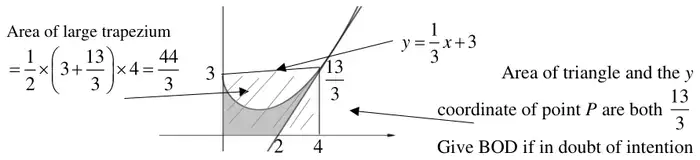
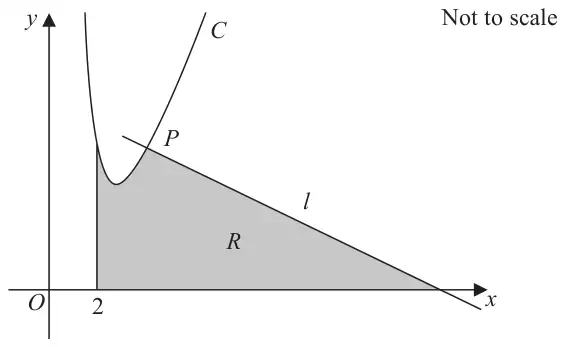
B1: Correct \(y\) coordinate of \(P\). May be seen embedded in an attempt of the equation of \(l\)
M1: Fully correct strategy for an equation for \(l\). Look for \(y - \text{``}\dfrac{13}{3}\text{''} = \text{``}\dfrac{13}{6}\text{''}(x - 4)\) where their \(\dfrac{13}{6}\) is from differentiating the equation of the curve and substituting in \(x = 4\) into their \(\dfrac{\mathrm{d}y}{\mathrm{d}x}\) and the \(y\) coordinate is from substituting \(x = 4\) into the given equation. If they use \(y = mx + c\) they must proceed as far as \(c = \ldots\) to score this mark. Do not allow this mark if they use a perpendicular gradient.
Area of \(R\) is \(\left[\dfrac{x^3}{9} - \dfrac{4}{3}x^{\frac{3}{2}} + 3x\right]_0^4 - \dfrac{1}{2} \times (4 - \text{``}2\text{''}) \times \text{``}\dfrac{13}{3}\text{''} = \dfrac{76}{9} - \dfrac{13}{3}\)
M1
3.1a
\(= \dfrac{37}{9}\)
A1
1.1b
(5)
(10 marks)
Notes
Calculators: If no algebraic integration seen then maximum in b) is M0A0B1M1A0
M1: \(x^n \to x^{n+1}\) seen at least once. Eg \(\ldots x^2 \to \ldots x^3,\ \ldots x^{\frac{1}{2}} \to \ldots x^{\frac{3}{2}},\ 3 \to 3x^1\). Allow eg \(\ldots x^2 \to \ldots x^{2+1}\) The \(+c\) is not a valid term for this mark.
A1: \(\dfrac{x^3}{9} - \dfrac{4}{3}x^{\frac{3}{2}} + 3x\) or any unsimplified equivalent (indices must be processed) accept the use of exact decimals for \(\dfrac{1}{9}\) \((0.\dot{1})\) and \(-\dfrac{4}{3}\) \((-1.\dot{3})\) but not rounded or ambiguous values.
B1: Deduces the correct value for \(x\) for the intersection of \(l\) with the \(x\)-axis. May be seen indicated on Figure 2.
M1: Fully correct strategy for the area. This needs to include
a correct attempt at the area of the triangle using their values (could use integration)
a correct attempt at the area under the curve using 0 and 4 in their integrated expression
the two values subtracted.
Be aware of those who mix up using the \(y\)-coordinate of \(P\) and the gradient at \(P\) which is M0. The values embedded in an expression is sufficient to score this mark.
A1: \(\dfrac{37}{9}\) or exact equivalent eg \(4\dfrac{1}{9}\) or \(4.\dot{1}\) but not \(4.111\ldots\) isw after a correct answer
Be aware of other strategies to find the area \(R\)
eg Finding the area under the curve between 0 and 2 and then the difference between the curve and the straight line between 2 and 4:\[\int_0^2 \frac{x^2}{3} - 2\sqrt{x} + 3\ \mathrm{d}x + \int_2^4 \frac{x^2}{3} - 2\sqrt{x} - \frac{13}{6}x + \frac{22}{3}\ \mathrm{d}x\]
M1 \(x^n \to x^{n+1}\) seen at least once on either integral (or on the equation of the line \(y = \dfrac{1}{3}x + 3\))
A1 for correct integration of either integral \(\dfrac{x^3}{9} - \dfrac{4}{3}x^{\frac{3}{2}} + 3x\) or \(\dfrac{x^3}{9} - \dfrac{4}{3}x^{\frac{3}{2}} - \dfrac{13}{12}x^2 + \dfrac{22}{3}x\) (may be unsimplified/uncollected terms but the indices must be processed with/without the \(+C\))
B1 Correct value for \(x\) can be seen from the top of the first integral (or bottom value of the second integral)
M1 Correct strategy for the area eg.\[\left[\dfrac{x^3}{9} - \dfrac{4}{3}x^{\frac{3}{2}} + 3x\right]_0^2 + \left[\dfrac{x^3}{9} - \dfrac{4}{3}x^{\frac{3}{2}} - \dfrac{13}{12}x^2 + \dfrac{22}{3}x\right]_2^4 = \frac{62}{9} - \frac{4}{3}(2)^{\frac{3}{2}} + \frac{76}{9} - \frac{101}{9} + \frac{4}{3}(2)^{\frac{3}{2}}\]
A1: \(\dfrac{37}{9}\) or exact equivalent eg \(4\dfrac{1}{9}\) or \(4.\dot{1}\) but not 4.1 or \(4.111\ldots\)
You could also see use of the area of a trapezium and/or the use of the line \(y = \dfrac{1}{3}x + 3\) to find other areas which could be combined or used as part of the strategy to find \(R\). Ignore areas which are not used. The marks should still be able to be applied as per the scheme
Area of trapezium – (Area between \(y = \dfrac{1}{3}x + 3\) and curve \(C\) + area of triangle)\[= \frac{44}{3} - \frac{56}{9} - \frac{13}{3} = \frac{37}{9}\]
M1: For raising any correct power of \(x\) by 1 including \(5 \to 5x\) (not for \(+\,c\)) Also allow eg \(x^3 \to x^{3+1}\)
A1: For 2 correct non-fractional power terms (allow unsimplified coefficients) and may appear on separate lines. The indices must be processed. The \(+\,c\) does not count as a correct term here. Condone the 1 appearing as a power or denominator such as \(\dfrac{5x^1}{1}\) for this mark.
A1: For the correct fractional power term (allow unsimplified) Allow eg \(+-2 \times 1.5\sqrt{x^1}\). Also allow fractions within fractions for this mark such as \(\dfrac{\frac{3}{2}}{\frac{1}{2}}x^{\frac{1}{2}}\)
A1: All correct and simplified and on one line including \(+\,c\). Allow \(-3\sqrt{x}\) or \(-\sqrt{9x}\) for \(-3x^{\frac{1}{2}}\). Do not accept \(+-3x^{\frac{1}{2}}\) for this mark. Award once a correct expression is seen and isw but if there is any additional/incorrect notation and no correct expression has been seen on its own, withhold the final mark. Eg. \(\displaystyle\int 2x^4 - 3x^{\frac{1}{2}} + 5x + c\ \mathrm{d}x\) or \(2x^4 - 3x^{\frac{1}{2}} + 5x + c = 0\) with no correct expression seen earlier are both A0.
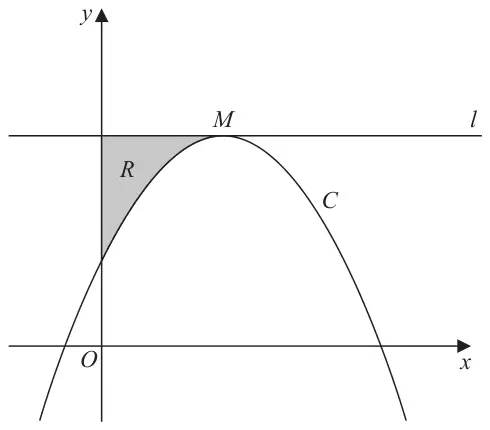
M1: Attempts to take out a common factor and complete the square. Award for \(-3(x \pm 2)^2 + \ldots\) Alternatively attempt to compare \(-3x^2 + 12x + 8\) to \(ax^2 + 2abx + ab^2 + c\) to find values of a and b
A1: Proceeds to a form \(-3(x - 2)^2 + \ldots\) or via comparison finds \(a = -3, b = -2\)
A1: \(-3(x - 2)^2 + 20\)
Mark scheme (b)
Scheme
Marks
AO
Coordinates of \(M = (2, 20)\)
B1ft B1ft
1.1b 2.2a
(2)
Notes
B1ft: One correct coordinate
B1ft: Correct coordinates. Allow as \(x = \ldots,\ y = \ldots\) Follow through on their \((-b, c)\)
Method to find \(R =\) their \(\displaystyle 2 \times 20 - \int_0^2 \left(-3x^2 + 12x + 8\right)\mathrm{d}x\)
M1
3.1a
\(R = 40 - \left[-2^3 + 24 + 16\right]\)
dM1
1.1b
\(= 8\)
A1
1.1b
(5)
(10 marks)
Notes
M1: Attempts to integrate. Award for any correct index
A1: \(\displaystyle\int -3x^2 + 12x + 8\,\mathrm{d}x = -x^3 + 6x^2 + 8x\ (+\,c)\) (which may be unsimplified)
M1: Method to find area of \(R\). Look for their \(\displaystyle 2 \times \text{``}20\text{''} - \int_0^{\text{``}2\text{''}} \mathrm{f}(x)\,\mathrm{d}x\)
dM1: Correct application of limits on their integrated function. Their 2 must be used
Correct method of solving Eg. \(36 - 12\sqrt{k} = 20 \Rightarrow k =\)
dM1
3.1a
\(\Rightarrow k = \dfrac{16}{9}\) oe
A1
1.1b
(4)
(4 marks)
Notes
M1: For setting \(\left[ax^{\frac{1}{2}}\right]_k^9 = 20\)
A1: A correct equation involving \(k\) Eg. \(36 - 12\sqrt{k} = 20\) (corrected from the printed mark scheme: printed as "involving \(p\)")
dM1: For a whole strategy to find \(k\). In the scheme it is awarded for setting \(\left[ax^{\frac{1}{2}}\right]_k^9 = 20\), using both limits and proceeding using correct index work to find \(k\). It cannot be scored if \(k^{\frac{1}{2}} \lt 0\)
M1: Attempts to divide to form a sum of terms. Implied by two terms with one correct index. \(\displaystyle\int \frac{3x^4}{2x^3} - \frac{4}{2x^3}\,\mathrm{d}x\) scores this mark.
A1: \(\displaystyle\int \frac{3}{2}x - 2x^{-3}\,\mathrm{d}x\) o.e such as \(\displaystyle\frac{1}{2}\int \left(3x - 4x^{-3}\right)\mathrm{d}x\). The indices must have been processed on both terms. Condone spurious notation or lack of the integral sign for this mark.
dM1: For the full strategy to integrate the expression. It requires two terms with one correct index. Look for \(= ax^p + bx^q\) where \(p = 2\) or \(q = -2\)
A1: Correct answer \(\dfrac{3}{4}x^2 + \dfrac{1}{x^2} + c\) o.e. such as \(\dfrac{3}{4}x^2 + x^{-2} + c\)
\(\mathrm{g}(5) = 0 \Rightarrow (x - 5)\) is a factor, hence \(\mathrm{g}(x)\) is divisible by \((x - 5)\).
A1
2.4
(2)
Notes
M1: Attempts to calculate \(\mathrm{g}(5)\) Attempted division by \((x - 5)\) is M0 Look for evidence of embedded values or two correct terms of \(\mathrm{g}(5) = 250 + 25 - 205 - 70 = \ldots\)
A1: Correct calculation, reason and conclusion. It must follow M1. Accept, for example, \(\mathrm{g}(5) = 0 \Rightarrow (x - 5)\) is a factor, hence divisible by \((x - 5)\) \(\mathrm{g}(5) = 0 \Rightarrow (x - 5)\) is a factor ✓ Do not allow if candidate states \(\mathrm{f}(5) = 0 \Rightarrow (x - 5)\) is a factor, hence divisible by \((x - 5)\) (It is not f) \(\mathrm{g}(x) = 0 \Rightarrow (x - 5)\) is a factor (It is not g(x) and there is no conclusion) This may be seen in a preamble before finding \(\mathrm{g}(5) = 0\) but in these cases there must be a minimal statement ie QED, "proved", tick etc.
M1: Attempts to find the quadratic factor by inspection (correct coefficients of first term and ± last term) or by division (correct coefficients of first term and ± second term). Allow this to be scored from division in part (a)
A1: \((2x^2 + 11x + 14)\) You may not see the \((x - 5)\) which can be condoned
dM1: Correct attempt to factorise their \((2x^2 + 11x + 14)\)
A1: \((\mathrm{g}(x) =)\ (x - 5)(2x + 7)(x + 2)\) or \((\mathrm{g}(x) =)\ (x - 5)(x + 3.5)(2x + 4)\) It is for the product of factors and not just a statement of the three factors Attempts with calculators via the three roots are likely to score 0 marks. The question was "Hence" so the two M’s must be awarded.
Deduces the need to use \(\displaystyle\int_{-2}^{5} \mathrm{g}(x)\,\mathrm{d}x\) \(-\dfrac{1525}{3} - \dfrac{190}{3}\)
M1
2.2a
Area = \(571\frac{2}{3}\)
A1
2.1
(4)
(10 marks)
Notes
M1: For \(x^n \to x^{n+1}\) for any of the terms in \(x\) for \(\mathrm{g}(x)\) so \(2x^3 \to \ldots x^4,\ x^2 \to \ldots x^3,\ -41x \to \ldots x^2,\ -70 \to \ldots x\)
A1: \(\displaystyle\int 2x^3 + x^2 - 41x - 70\,\mathrm{d}x = \frac{1}{2}x^4 + \frac{1}{3}x^3 - \frac{41}{2}x^2 - 70x\) which may be left unsimplified (ignore any reference to \(+C\))
M1: Deduces the need to use \(\displaystyle\int_{-2}^{5} \mathrm{g}(x)\,\mathrm{d}x\). This may be awarded from the limits on their integral (either way round) or from embedded values which can be subtracted either way round.
A1: For clear work showing all algebraic steps leading to area = \(571\frac{2}{3}\) oe So allow \(\displaystyle\int_{-2}^{5} 2x^3 + x^2 - 41x - 70\,\mathrm{d}x = \left[\frac{1}{2}x^4 + \frac{1}{3}x^3 - \frac{41}{2}x^2 - 70x\right]_{-2}^{5} = -\frac{1715}{3} \Rightarrow \text{area} = \frac{1715}{3}\) for 4 marks Condone spurious notation, as long as the algebraic steps are correct. If they find \(\displaystyle\int_{-2}^{5} \mathrm{g}(x)\,\mathrm{d}x\) then withhold the final mark if they just write a positive value to this integral since \(\displaystyle\int_{-2}^{5} \mathrm{g}(x)\,\mathrm{d}x = -\dfrac{1715}{3}\)
Note \(\displaystyle\int_{-2}^{5} 2x^3 + x^2 - 41x - 70\,\mathrm{d}x \Rightarrow \frac{1715}{3}\) with no algebraic integration seen scores M0A0M1A0
M1: For a correct method of solving. This could be as the scheme, treating as a quadratic in \(\sqrt{k}\) and using allowable method to solve including factorisation, formula etc. Allow values for \(\sqrt{k}\) to be just written down, e.g. allow \(\sqrt{k} = \pm\dfrac{4}{3}, (\pm 3)\) Alternatively score for rearranging to \(5\sqrt{k} = 12 - 3k\) and then squaring to get \(\ldots k = (12 - 3k)^2\)
A1: \(\sqrt{k} = \dfrac{4}{3}, (-3)\) Or in the alt method it is for reaching a correct 3TQ equation \(9k^2 - 97k + 144 = 0\)
dM1: For solving to find at least one value for \(k\). It is dependent upon the first M mark. In the main method it is scored for squaring their value(s) of \(\sqrt{k}\) In the alternative scored for solving their 3TQ by an appropriate method
A1: Full and rigorous method leading to \(k = \dfrac{16}{9}\) only. The 9 must be rejected.
Area \(= \dfrac{1}{2}(4)^4 - \dfrac{17}{3}(4)^3 + 20(4)^2\)
M1
1.1b
\(= \dfrac{256}{3}\) *
A1*
2.1
(7)
(7 marks)
Notes
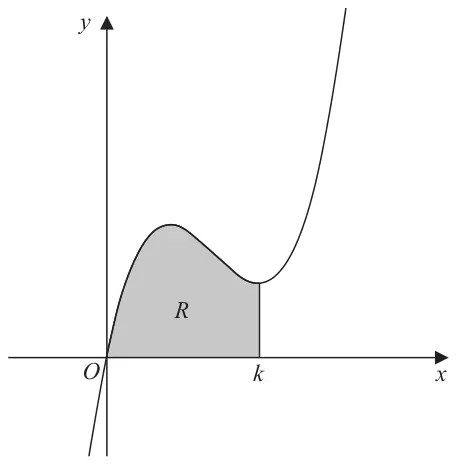
M1: An overall problem -solving method mark to find the minimum point. To score this you need to see
an attempt to differentiate with at least two correct terms
an attempt to set their \(\dfrac{\mathrm{d}y}{\mathrm{d}x} = 0\) and then solve to find \(x\). Don’t be overly concerned by the mechanics of this solution
(corrected from the printed mark scheme: the scheme says “the \(x\) coordinate of \(A\)”, but there is no point \(A\) in this question; it means the minimum point at \(x = k\))
B1: \(\left(\dfrac{\mathrm{d}y}{\mathrm{d}x} =\right) 6x^2 - 34x + 40\) which may be unsimplified
M1: Sets their \(\dfrac{\mathrm{d}y}{\mathrm{d}x} = 0\), which must be a 3TQ in \(x\), and attempts to solve via factorisation, formula or calculator. If a calculator is used to find the roots, they must be correct for their quadratic. If \(\dfrac{\mathrm{d}y}{\mathrm{d}x}\) is correct allow them to just choose the root 4 for M1 A1. Condone \((x - 4)\left(x - \dfrac{5}{3}\right)\)
A1: Chooses \(x = 4\) This may be awarded from the upper limit in their integral
B1: \(\displaystyle\int 2x^3 - 17x^2 + 40x\,\mathrm{d}x = \left[\frac{1}{2}x^4 - \frac{17}{3}x^3 + 20x^2\right]\) which may be unsimplified
M1: Correct attempt at area. There may be slips on the integration but expect two correct terms The upper limit used must be their larger solution of \(\dfrac{\mathrm{d}y}{\mathrm{d}x} = 0\) and the lower limit used must be 0. So if their roots are 6 and 10, then they must use 10 and 0. If only one value is found then the limits must be 0 to that value. Expect to see embedded or calculated values. Don’t accept \(\displaystyle\int_0^4 2x^3 - 17x^2 + 40x\,\mathrm{d}x = \frac{256}{3}\) without seeing the integration and the embedded or calculated values
A1*: Area \(= \dfrac{256}{3}\) with correct notation and no errors. Note that this is a given answer.
For correct notation expect to see
\(\dfrac{\mathrm{d}y}{\mathrm{d}x}\) or \(\dfrac{\mathrm{d}}{\mathrm{d}x}\) used correctly at least once. If \(\mathrm{f}(x)\) is used accept \(\mathrm{f}^{\prime}(x)\). Condone \(y^{\prime}\)
\(\displaystyle\int 2x^3 - 17x^2 + 40x\,\mathrm{d}x\) used correctly at least once with or without the limits.
M1: For \(x^n \to x^{n+1}\) for either \(x^{-3}\) or \(x^1\). This can be implied by the sight of either \(x^{-2}\) or \(x^2\). Condone "unprocessed" values here. Eg. \(x^{-3+1}\) and \(x^{1+1}\)
A1: Either term correct (un simplified). Accept \(4 \times \dfrac{x^{-2}}{-2}\) or \(k\dfrac{x^2}{2}\) with the indices processed.
A1: Correct (and simplified) with \(+c\). Ignore spurious notation e.g. answer appearing with an \(\int\) sign or with \(\mathrm{d}x\) on the end. Accept \(-\dfrac{2}{x^2} + \dfrac{1}{2}kx^2 + c\) or exact simplified equivalent such as \(-2x^{-2} + k\dfrac{x^2}{2} + c\)
\(7.5 + \dfrac{15}{8}k = 8 \Rightarrow k = \ldots\)
dM1
1.1b
\(k = \dfrac{4}{15}\) oe
A1
1.1b
(3)
(6 marks)
Notes
M1: For substituting both limits into their \(-\dfrac{2}{x^2} + \dfrac{1}{2}kx^2\), subtracting either way around and setting equal to 8. Allow this when using a changed function. (so the M in part (a) may not have been awarded). Condone missing brackets. Take care here as substituting 2 into the original function gives the same result as the integrated function so you will have to consider both limits.
dM1: For solving a linear equation in \(k\). It is dependent upon the previous M only Don’t be too concerned by the mechanics here. Allow for a linear equation in \(k\) leading to \(k =\)
A1: \(k = \dfrac{4}{15}\) or exact equivalent. Allow for \(\dfrac{m}{n}\) where \(m\) and \(n\) are integers and \(\dfrac{m}{n} = \dfrac{4}{15}\) Condone the recurring decimal \(0.2\dot{6}\) but not 0.266 or 0.267 Please remember to isw after a correct answer
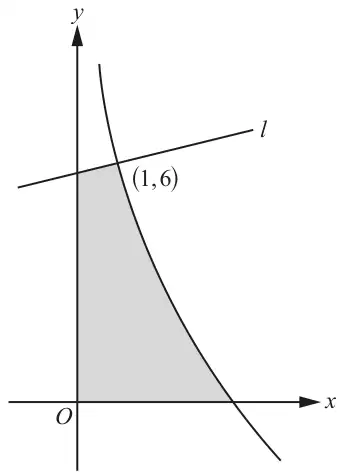
For a correct method of attempting to find Either the equation of the normal: this requires substituting \(x = 4\) in their \(\dfrac{\mathrm{d}y}{\mathrm{d}x} = -\dfrac{64}{x^3} + 3 = (2)\), then using the perpendicular gradient rule to find the equation of normal \(y - 6 = \text{``}{-\dfrac{1}{2}}\text{''}(x - 4)\) Or where the equation of the normal at (4,6) cuts the \(x\) - axis. As above but may not see equation of normal. Eg \(0 - 6 = \text{``}{-\dfrac{1}{2}}\text{''}(x - 4) \Rightarrow x = \ldots\) or an attempt using just gradients \(\text{``}{-\dfrac{1}{2}}\text{''} = \dfrac{6}{a - 4} \Rightarrow a = \ldots\)
dM1
2.1
Normal cuts the \(x\)-axis at \(x = 16\)
A1
1.1b
For the complete strategy of finding the values of the two key areas. Points that must be seen are
There must be an attempt to find the area under the curve by integrating between 2 and 4
There must be an attempt to find the area of a triangle using \(\dfrac{1}{2} \times (\text{‘}16\text{’} - 4) \times 6\) or \(\displaystyle\int_4^{\text{``}16\text{''}} \left(\text{``}{-\dfrac{1}{2}x + 8}\text{''}\right)\mathrm{d}x\)
dM1: Method of finding either the equation of the normal at (4, 6). or where the equation of the normal at (4, 6) cuts the \(x\) - axis See scheme. It is dependent upon having gained the M mark for differentiation.
A1: Normal cuts the \(x\)-axis at \(x = 16\)
The next 5 marks are for finding the area \(R\)
M1: For the complete strategy of finding the values of two key areas. See scheme
M1: Integrates \(\displaystyle\int \frac{32}{x^2} + 3x - 8\,\mathrm{d}x\) raising the power of at least one index
A1: \(\displaystyle\int \frac{32}{x^2} + 3x - 8\,\mathrm{d}x = -\frac{32}{x} + \frac{3}{2}x^2 - 8x\) which may be unsimplified
dM1: Area \(= \left[-\dfrac{32}{x} + \dfrac{3}{2}x^2 - 8x\right]_2^4 = (-16) - (-26) = (10)\) It is dependent upon having scored the M mark for integration, for substituting in both 4 and 2 and subtracting either way around. The above line shows the minimum allowed working for a correct answer.
A1*: Shows that the area under curve = 46. No errors or omissions are allowed
Alternative
A number of candidates are equating the line and the curve (or subtracting the line from the curve) The last 5 marks are scored as follows.
M1: For the complete strategy of finding the values of the two key areas. Points that must be seen are
There must be an attempt to find the area BETWEEN the line and the curve either way around by integrating between 2 and 4
There must be an attempt to find the area of a triangle using \(\dfrac{1}{2} \times (\text{‘}16\text{’} - 2) \times \left(-\dfrac{1}{2} \times 2 + 8\right)\) or via integration \(\displaystyle\int_2^{16} \left(\text{``}{-\dfrac{1}{2}x + 8}\text{''}\right)\mathrm{d}x\)
M1: Integrates \(\displaystyle\int \left(\text{``}{-\dfrac{1}{2}x + 8}\text{''}\right) - \left(\dfrac{32}{x^2} + 3x - 8\right)\mathrm{d}x\) either way around and raises the power of at least one index by one
A1: \(\pm\left(-\dfrac{32}{x} + \dfrac{7}{4}x^2 - 16x\right)\) must be correct
dM1: Area \(= \displaystyle\int_2^4 \left(\text{``}{-\dfrac{1}{2}x + 8}\text{''}\right) - \left(\dfrac{32}{x^2} + 3x - 8\right)\mathrm{d}x = \ldots\ldots\) either way around
A1: Area \(= 49 - 3 = 46\)
NB: Watch for candidates who calculate the area under the curve between 2 and 4 = 10 and subtract this from the large triangle = 56. They will lose both the strategy mark and the answer mark.
NB. Watch for students who use their calculators to do the majority of the work. Please send these items to review
M1: Allow for raising power by one. \(x^n \to x^{n+1}\) Award for any correct power including sight of \(1x\)
A1: Correct two ‘non fractional power’ terms (may be un-simplified at this stage)
A1: Correct ‘fractional power’ term (may be un-simplified at this stage)
A1: Completely correct, simplified and including constant of integration seen on one line. Simplification is expected for full marks. Accept correct exact equivalent expressions such as \(\dfrac{x^4}{6} - 4x\sqrt{x} + 1x^1 + c\) Accept \(\dfrac{x^4 - 24x^{\frac{3}{2}} + 6x}{6} + c\) Remember to isw after a correct answer. Condone poor notation. Eg answer given as \(\displaystyle\int \frac{1}{6}x^4 - 4x^{\frac{3}{2}} + x + c\)
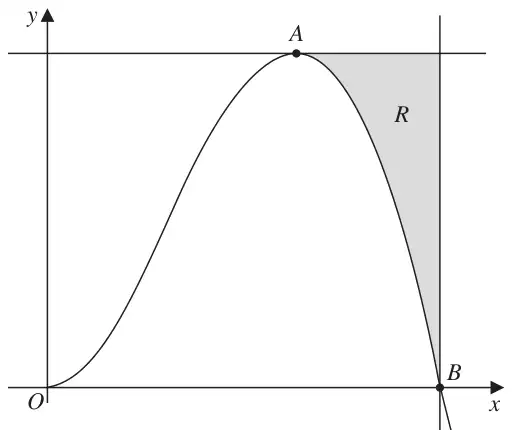
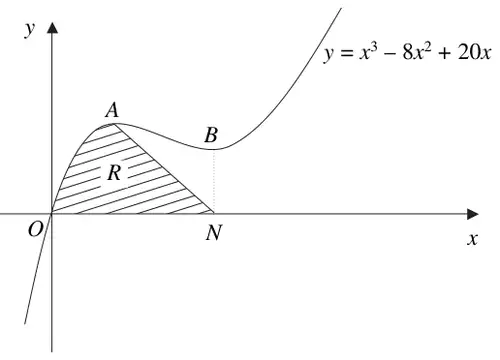
Figure 3 shows a sketch of part of the curve with equation\[y = 7x^2(5 - 2\sqrt{x}), \qquad x \geqslant 0\]The curve has a turning point at the point \(A\), where \(x > 0\), as shown in Figure 3.
(a) Using calculus, find the coordinates of the point \(A\). (5)
The curve crosses the \(x\)-axis at the point \(B\), as shown in Figure 3.
(b) Use algebra to find the \(x\) coordinate of the point \(B\). (2)
The finite region \(R\), shown shaded in Figure 3, is bounded by the curve, the line through \(A\) parallel to the \(x\)-axis and the line through \(B\) parallel to the \(y\)-axis.
(c) Use integration to find the area of the region \(R\), giving your answer to 2 decimal places. (5)
Put \(\dfrac{\mathrm{d}y}{\mathrm{d}x} = 0\) to give \(70x - 35x^{\frac{3}{2}} = 0\) so \(x^{\frac{1}{2}} = 2\)
M1
\(x = 4\) \(y = 112\)
A1 A1
(5)
Notes
M1: Attempt at differentiation after multiplying out - may be awarded for \(70x\) term correct (If product rule is used it must be of correct form i.e. \(\dfrac{\mathrm{d}y}{\mathrm{d}x} = 7x^2\left(-2kx^{k-1}\right) + 14x(5 - 2x^k)\) )
A1: the derivative must be completely correct but may be unsimplified For product rule this is \(\dfrac{\mathrm{d}y}{\mathrm{d}x} = 7x^2\left(-x^{-\frac{1}{2}}\right) + 14x(5 - 2\sqrt{x})\)
M1: uses derivative = 0 to find \(x^k =\) or \(x =\) with correct work for their equation (even without fractional powers)
A1: obtains \(x = 4\) then
A1: for \(y = 112\) (may be credited if seen in part (a) or in part(c))
Mark scheme (b)
Scheme
Marks
(Way 1) When \(y = 0\), \(35x^2 = 14x^{\frac{5}{2}}\) and \(x^{\frac{1}{2}} = \dfrac{35}{14}\) or \(5 = 2\sqrt{x}\) so \(\sqrt{x} = \dfrac{5}{2}\)
M1
\(x = \dfrac{25}{4}\)
A1
(2)
(Way 2) When \(y = 0\), \(35x^2 = 14x^{\frac{5}{2}}\) so \(1225x^4 = 196x^5\) or \(5 = 2\sqrt{x}\) so \(25 = 4x\)
M1
\(x = \dfrac{25}{4}\) or \(x = \dfrac{1225}{196}\)
A1
(2)
Notes
Way 1 (Dividing first)
M1: Puts \(y = 0\) and obtains expression of the form \(x^k = A\) (where \(k\) is not equal to 1) after correct algebra for their equation (may be a sign slip)
A1: Obtains \(x = 6.25\) or equivalent correct answer
Way 2 (dealing with fractional power first i.e. Squaring)
M1: Puts \(y = 0\) and squares each term correctly for their equation obtaining expression of the form \(A^2x^m = B^2x^n\) after correct algebra
A1: Obtains \(x = 6.25\) or equivalent correct answer
\(\left[(112x) - \left(\dfrac{35}{3}x^3 - 4x^{\frac{7}{2}}\right)\right]_{\text{"}4\text{"}}^{\text{"}\frac{25}{4}\text{"}}\) with correct use of limits
dM1
Integrated their 112 to give \(112x\) with correct use of limits
ddM1
79.77
A1
(5)
[12]
Notes
Way 1
M1: Correct integration of one of their terms – e.g. see \(x^2\) term integrated correctly (not just raised power)
A1ft: completely correct integral for their power which must have been a fraction (may be unsimplified)
dM1: (dependent on previous M) substituting their 25/4 and their 4 and subtracting
ddM1 (depends on both method marks) Correct method to obtain shaded area so their rectangle minus their area under curve
A1: Accept answers which round to 79.77
Way 2
M1: Attempt at integration – \(x^2\) term integrated correctly
A1ft: completely correct integral for second and their third terms (provided one has a fractional power) (ignore sign errors) (may be unsimplified)
dM1: (dependent on previous M) substituting their 25/4 and their 4 and subtracting (either way)
ddM1 (depends on both method marks) Correct method to obtain shaded area so their 112 integrated correctly and correct signs for the other two terms in the integrand
A1: Accept answers which round to 79.77
Answer with no working – send to review
If they have the wrong fractional power on their second term after expansion in part (a) (usually 3/2), all the method marks are available throughout the question and the A1ft is available in (c). The A mark in part (b) may also be accessible. Maximum score is likely to be 8/12
If they have the trivial power 1 on their second term, then two method marks are available in (a) and three method marks are available in part (c) Maximum score is likely to be 5/12
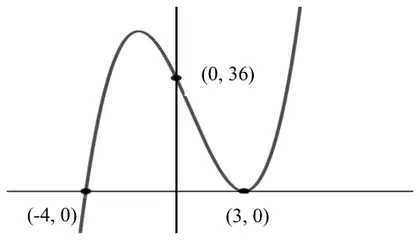
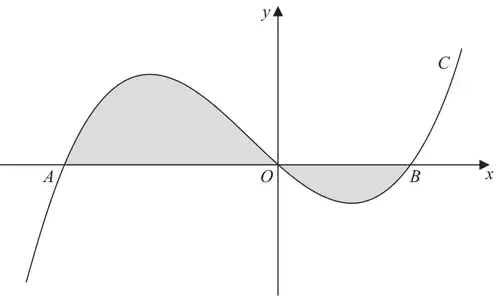
9. The curve \(C\) has equation \(y = \mathrm{f}(x)\), where\[\mathrm{f}^{\prime}(x) = (x - 3)(3x + 5)\]Given that the point \(P\,(1, 20)\) lies on \(C\),
(a) find \(\mathrm{f}(x)\), simplifying each term. (5)
(b) Show that\[\mathrm{f}(x) = (x - 3)^2(x + A)\]where \(A\) is a constant to be found. (3)
(c) Sketch the graph of \(C\). Show clearly the coordinates of the points where \(C\) cuts or meets the \(x\)-axis and where \(C\) cuts the \(y\)-axis. (4)
B1: Correct expansion simplified or un-simplified.
M1: \(x^n \to x^{n+1}\) for any term. Follow through on incorrect indices but not for “+ \(c\)”
A1: All terms correct. Need not be simplified. No need for \(+\,c\) here.
dM1: Substitutes \(x = 1\) and \(y = 20\) into their \(\mathrm{f}(x)\) to find \(c\). Must have \(+\,c\) at this stage. Dependent on the first method mark.
A1: Cao \(\left(\mathrm{f}(x) =\right)x^3 - 2x^2 - 15x + 36\) (All together and on one line)
M1: Expands \((x - 3)^2(x + A)\) and compares coefficients with their \(\mathrm{f}(x)\) from part (a) to form 3 equations and attempts to solve at least two of them in an attempt to show that \(A\) is the same in each case or substitutes their \(A\) to show that the coefficients are the same.
A1: Fully correct proof – must use all 3 coefficients
M1: Expands \((x - 3)^2(x + \text{"}4\text{"})\) fully in an attempt to show that the expansion gives the same expression found as found in part (a)
A1: Fully correct proof (Condone invisible brackets here e.g. around \(x + 4\) provided sufficient working is shown)
Way 3
Scheme
Marks
\(A = 4\)
B1
\(\left(x^3 - 2x^2 - 15x + 36\right)\div\left(x - 3\right) = x^2 + x - 12\) \(\left(x^2 + x - 12\right)\div\left(x - 3\right) = x + 4\) or \(\left(x^2 + x - 12\right) = \left(x + 4\right)\left(x - 3\right)\)
M1A1
B1: Correct value (may be implied)
M1: Divides their \(\mathrm{f}(x)\) from part (a) by \((x - 3)\) and divides their quotient by \((x - 3)\) in an attempt to establish the value of \(A\). Alternatively divides their \(\mathrm{f}(x)\) from part (a) by \((x - 3)^2\) (Allow \(x^2 \pm 6x \pm 9\)) in an attempt to establish the value of \(A\).
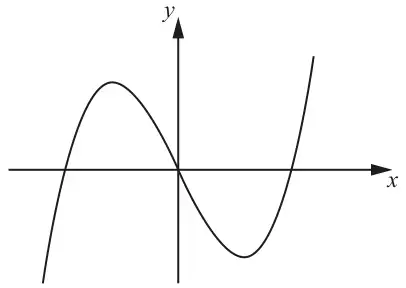
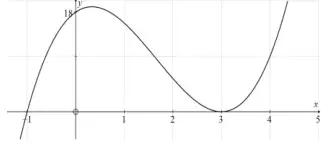
A positive cubic shape. Its position is not important but must be a curve and not straight lines and the “ends” must not clearly turn back in on themselves.
B1
Touches at the point (3, 0) (could be a maximum). Accept 3 marked on the \(x\)-axis and accept (0, 3) as long as it is in the correct place. Allow (3, 0) in the body of the script but it must correspond with the sketch. If ambiguous, the sketch takes precedence.
B1
Crosses or reaches the \(x\)-axis at \(\left(-4, 0\right)\). Accept \(-4\) marked on the \(x\)-axis and accept (0, -4) as long as it is in the correct place. FT on their \(-A\) from part (b) and allow “–\(A\)” and allow a “made up” \(A\). Allow \(\left(-4, 0\right)\) in the body of the script but it must correspond with the sketch. If ambiguous, the sketch takes precedence.
B1ft
Crosses the \(y\)-axis at (0, 36) and with a maximum in the second quadrant. Accept 36 marked on the \(y\) – axis and accept (36, 0) as long as it is in the correct place. FT on their numerical ‘\(c\)’ from part (a) only. Allow (0, 36) in the body of the script but it must correspond with the sketch. If ambiguous, the sketch takes precedence.
(a) find \(\displaystyle\int y\,\mathrm{d}x\), simplifying each term. (3)
(b)
(i) Find \(\dfrac{\mathrm{d}y}{\mathrm{d}x}\)
(ii) Hence find the value of \(x\) such that \(\dfrac{\mathrm{d}y}{\mathrm{d}x} = 0\)
(4)
Mark scheme (a)
Scheme
Marks
\(2x^{1.5} - 3x^2 + 4x + c\)
M1A1A1
Ignore any spurious integral signs.
(3)
Notes
M1: For \(x^n \to x^{n+1}\) i.e. \(x^{1.5}\) or \(x^2\) or \(x\) seen (not for “+ \(c\)”)
A1: For two out of three terms correct un-simplified or simplified (Ignore \(+\,c\) for this mark)
A1: cao \(2x^{1.5} - 3x^2 + 4x + c\). All correct and simplified and on one line including “+ c”. Allow \(\sqrt{x^3}\) for \(x^{1.5}\) but not \(x^1\) for \(x\).
Mark scheme (b)
Scheme
Marks
Mark (b)(i) and (ii) together and must be differentiating the original function not their answer to part (a)
(i) \(\dfrac{3}{2}x^{-0.5} - 6\)
M1A1
(2)
(ii) \(\dfrac{3}{2}x^{-0.5} - 6 = 0 \Rightarrow x^n = \ldots\)
M1
\(x = \dfrac{1}{16}\) cso
A1
(2)
(7 marks)
Notes
(b)(i)
M1: For \(x^n \to x^{n-1}\) i.e. \(x^{0.5} \to x^{-0.5}\) or \(6x \to 6\)
A1: For \(\dfrac{3}{2}x^{-0.5} - 6\) or equivalent. May be un-simplified. Allow \(\dfrac{3/2}{\sqrt{x}} - 6\).
(b)(ii)
M1: Sets their \(\dfrac{\mathrm{d}y}{\mathrm{d}x} = 0\) (may be implied by their working) and reaches \(x^n = C\) (including \(n = 1\)) with correct processing allowing sign errors only – this may be implied by e.g. \(\sqrt{x} = \dfrac{1}{4}\) or \(\dfrac{1}{\sqrt{x}} = 4\).
A1: Allow equivalent fractions e.g. \(\dfrac{9}{144}\) or 0.0625. If other solutions are given (e.g. likely to be \(x = 0\) or \(x = -1/16\)) then this mark should be withheld.
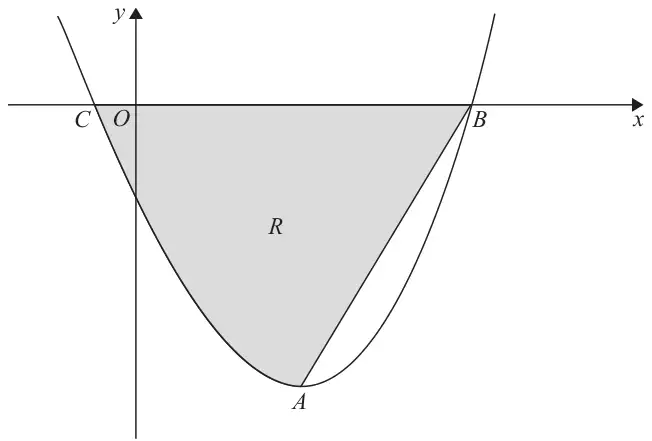
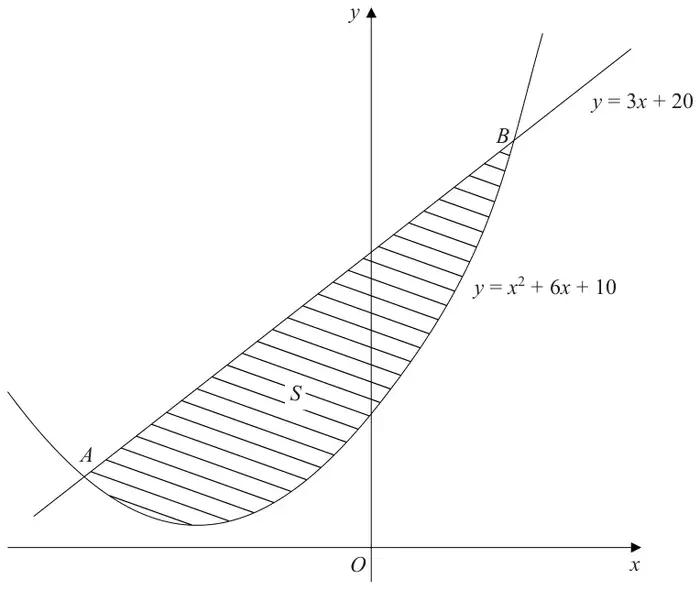
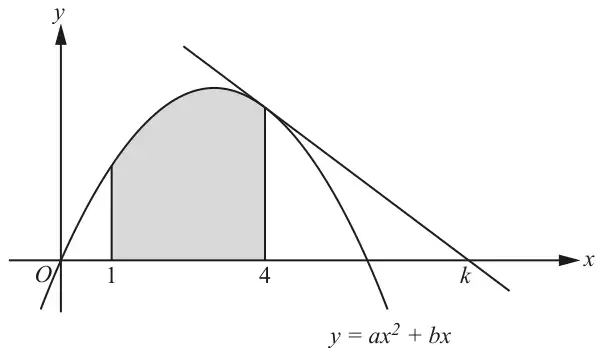
Figure 2 shows a sketch of part of the curve with equation\[y = 4x^3 + 9x^2 - 30x - 8, \quad -0.5 \leqslant x \leqslant 2.2\]The curve has a turning point at the point \(A\).
(a) Using calculus, show that the \(x\) coordinate of \(A\) is 1 (3)
The curve crosses the \(x\)-axis at the points \(B\,(2, 0)\) and \(C\left(-\dfrac{1}{4}, 0\right)\)
The finite region \(R\), shown shaded in Figure 2, is bounded by the curve, the line \(AB\), and the \(x\)-axis.
(b) Use integration to find the area of the finite region \(R\), giving your answer to 2 decimal places. (7)
Either Substitute \(x = 1\) to give \(\dfrac{\mathrm{d}y}{\mathrm{d}x} = 12 + 18 - 30 = 0\) Or Solve \(\dfrac{\mathrm{d}y}{\mathrm{d}x} = 12x^2 + 18x - 30 = 0\) to give \(x =\)
A1
Either So turning point (all correct work so far) Or Deduce \(x = 1\) from correct work
A1cso
(3)
Notes
M1: Attempt at differentiation - all powers reduced by 1 with \(8 \to 0\).
A1: the derivative must be correct and uses derivative = 0 to find \(x\) or substitutes \(x = 1\) to give 0. Ignore any reference to the other root \((-5/2)\) for this mark.
A1cso: obtains \(x = 1\) from correct work, or deduces turning point (if substitution used – may be implied by a preamble e.g. \(\mathrm{d}y/\mathrm{d}x = 0\) at T.P.)
N.B. If their factorisation or their second root is incorrect then award A0cso. If however their factorisation/roots are correct, it is not necessary for them to comment that \(-2.5\) is outside the range given.
Mark scheme (b)
Scheme
Marks
Way 1 When \(x = 1,\ y = 4 + 9 - 30 - 8 = -25\)
B1
Area of triangle \(ABP = \tfrac{1}{2} \times 1 \times 25 = 12.5\) (Where \(P\) is at \((1, 0)\))
So Area \(= \text{"}\textit{their } 12.5\text{"} + \text{"}\textit{their } 20\tfrac{5}{256}\text{"}\) or “12.5” + “20.02” or “12.5” + \(\text{"}\textit{their } \dfrac{5125}{256}\text{"}\)
ddM1
\(= 32.52\) (NOT \(-32.52\) )
A1
(7)
[10]
Less efficient alternative methods for first two marks in part (b) with Way 1 or 2
Scheme
Marks
For first mark: Finding equation of the line \(AB\) as \(y = 25x - 50\) as this implies the \(-25\)
B1
For second mark: Integrating to find triangle area \(\displaystyle\int_1^2 (25x - 50)\,\mathrm{d}x = \left[\frac{25}{2}x^2 - 50x\right]_1^2 = -50 + 37.5 = -12.5\) so area is 12.5
B1
Then mark as before if they use Method in original scheme
Way 2
Scheme
Marks
Way 2: Those who use area for original curve between -1/4 and 2 and subtract area between line and curve between 1 and 2 have a correct (long) method . The first B1 (if \(y = -25\) is not seen) is for equation of straight line \(y = 25x - 50\)
B1
The second B1 may be implied by final answer correct, or 4.5 seen for area of “segment shaped” region between line and curve, or by area between line and axis/triangle found as 12.5
B1
\(\displaystyle\int (4x^3 + 9x^2 - 55x + 42)\,\mathrm{d}x = x^4 + \frac{9}{3}x^3 - \frac{55x^2}{2} + 42x\ \{+c\}\) (or integration as in Way 1)
M1A1
The dM1 is for correct use of the different correct limits for each of the two areas: i.e. \(\left[x^4 + 3x^3 - 15x^2 - 8x\right]_{-\frac{1}{4}}^{2} = (16 + 24 - 60 - 16) - \left(\left(-\dfrac{1}{4}\right)^4 + 3\left(-\dfrac{1}{4}\right)^3 - 15\left(-\dfrac{1}{4}\right)^2 - 8\left(-\dfrac{1}{4}\right)\right)\) And \(\left[x^4 + \dfrac{9}{3}x^3 - \dfrac{55x^2}{2} + 42x\right]_1^2 = 16 + 24 - 110 + 84 - (1 + 3 - 27.5 + 42)\)
dM1
So Area =their \(\left[x^4 + 3x^3 - 15x^2 - 8x\right]_{-\frac{1}{4}}^{2}\) minus their \(\left[x^4 + \dfrac{9}{3}x^3 - \dfrac{55x^2}{2} + 42x\right]_1^2\) i.e. \(\text{"}\textit{their } 37.0195\text{"} - \text{"}\textit{their } 4.5\text{"}\) (with both sets of limits correct for the integral)
ddM1
Reaching \(= 32.52\) (NOT \(-32.52\) )
A1
NB: Those who attempt curve – line wrongly with limits \(-1/4\) to 2 may earn M1A1 for correct integration of their cubic. Usually e.g. \(\displaystyle\int (4x^3 + 9x^2 - 55x + 42)\,\mathrm{d}x = x^4 + \frac{9}{3}x^3 - \frac{55x^2}{2} + 42x\ \{+c\}\) (They will not earn any of the last 3 marks) They may also get first B1 mark for the correct equation of the straight line (usually seen but may be implied by correct line −curve equation) and second B1 if they also use limits 1 and 2 to obtain 4.5 (or find the triangle area 12.5).
M1A1
Notes
Way 1:
B1: Obtains \(y = -25\) when \(x = 1\) (may be seen anywhere – even in (a)) or finds correct equation of line is \(y = 25x - 50\)
B1: Obtains area of triangle = 12.5 (may be seen anywhere). Allow \(-12.5\). Accept \(\tfrac{1}{2} \times 1 \times 25\)
M1: Attempt at integration of cubic; two correct terms for their integration. No limits needed
A1: completely correct integral for the cubic (may be unsimplified)
dM1: We are looking for the start of a correct method here (dependent on previous M). It is for substituting 1 and -1/4 and subtracting. May use 2 and -1/4 and also 2 and 1 AND subtract (which is equivalent)
ddM1 (depends on both method marks) Correct method to obtain shaded area so adds two positive numbers (areas) together – one is area of triangle, the other is area of region obtained from integration of correct function with correct limits (may add two negatives then makes positive)
Way 2: This is a long method and needs to be a correct method
B1: Finds \(y = -25\) at \(x = 1\) ,or correct equation of line is \(y = 25x - 50\)
B1: May be implied where WAY 2 is used and final correct answer obtained so award of final A1 results in the award of this B1. It may also be implied by correct integration of line equation or of curve minus line expression between limits 1 and 2. So if only slip is final subtraction (giving final A0, this mark may still be awarded) So may be implied by 4.5 seen for area of “segment shaped” region between line and curve.
M1: Attempt at integration of given cubic or after attempt at subtracting their line equation (no limits needed). Two correct terms needed
A1: Completely correct integral for their cubic (may be unsimplified) – may have wrong coefficients of \(x\) and wrong constant term through errors in subtraction
dM1:Use limits for original curve between -1/4 and 2 and use limits of 1 and 2 for area between line and curve– needs completely correct limits– see scheme- this is dependent on two integrations
ddM1: (depends on both method marks) Subtracts \(\text{"}\textit{their } 37.0195\text{"} - \text{"}\textit{their } 4.5\text{"}\) Needs consistency of signs.
A1: 32.52 or awrt 32.52 e.g. \(32\dfrac{133}{256}\) NB: This correct answer implies the second B mark
(Trapezium rule gets no marks after first two B marks) The first two B marks may be given wherever seen. The integration of a cubic gives the following M1 and correct integration of their cubic \(\displaystyle\int (4x^3 + 9x^2 + Ax + B)\,\mathrm{d}x = x^4 + \frac{9}{3}x^3 + \frac{Ax^2}{2} + Bx\ \{+c\}\) gives the A1
7. The curve \(C\) has equation \(y = \mathrm{f}(x)\), \(x > 0\), where\[\mathrm{f}^{\prime}(x) = 30 + \frac{6 - 5x^2}{\sqrt{x}}\]Given that the point \(P(4, -8)\) lies on \(C\),
(a) find the equation of the tangent to \(C\) at \(P\), giving your answer in the form \(y = mx + c\), where \(m\) and \(c\) are constants. (4)
(b) Find \(\mathrm{f}(x)\), giving each term in its simplest form. (5)
\(y - (-8) = \text{"}-7\text{"}\times(x - 4)\) or \(y = \text{"}-7\text{"}x + c \Rightarrow -8 = \text{"}-7\text{"}\times 4 + c \Rightarrow c = \ldots\)
M1
\(y = -7x + 20\)
A1
(4)
Notes
M1: Attempts to substitutes \(x = 4\) into \(\mathrm{f}^{\prime}(x) = 30 + \dfrac{6 - 5x^2}{\sqrt{x}}\) or their algebraically manipulated \(\mathrm{f}^{\prime}(x)\)
A1: Gradient = \(-7\)
M1: Attempts an equation of a tangent using their numeric \(\mathrm{f}^{\prime}(4)\) which has come from substituting \(x = 4\) into the given \(\mathrm{f}^{\prime}(x)\) or their algebraically manipulated \(\mathrm{f}^{\prime}(x)\) and \(\left(4, -8\right)\) with the 4 and -8 correctly placed. If using \(y = mx + c\), must reach as far as \(c = \ldots\)
A1: Cao. Allow \(y = 20 - 7x\) and allow the “\(y =\)” to become “detached” but it must be present at some stage. E.g. \(y = \ldots\) \(\phantom{y} = -7x + 20\)
Mark scheme (b)
Scheme
Marks
Allow the marks in (b) to score in (a) i.e. mark (a) and (b) together
M1: \(30 \to 30x\) or \(\dfrac{6}{\sqrt{x}} \to \alpha x^{\frac{1}{2}}\) or \(-\dfrac{5x^2}{\sqrt{x}} \to \beta x^{\frac{5}{2}}\) (these cases only)
A1: Any 2 correct terms which can be simplified or un-simplified. This includes the powers – so allow \(-\tfrac{1}{2} + 1\) for \(\tfrac{1}{2}\) and allow \(\tfrac{3}{2} + 1\) for \(\tfrac{5}{2}\) (With or without \(+\,c\))
A1: All 3 terms correct which can be simplified or un-simplified. (With or without \(+\,c\))
M1: Substitutes \(x = 4, \mathrm{f}(x) = -8\) into their \(\mathrm{f}(x)\) (not \(\mathrm{f}^{\prime}(x)\)) i.e. a changed \(\mathrm{f}^{\prime}(x)\) containing \(+c\) and rearranges to obtain a value or numerical expression for \(c\).
A1: Cao and cso (Allow \(\sqrt{x}\) for \(x^{\frac{1}{2}}\) and e.g. \(\sqrt{x^5}\) or \(x^2\sqrt{x}\) for \(x^{\frac{5}{2}}\)). Isw here so as soon as you see the correct answer, award this mark. Note that the “\(\mathrm{f}(x) =\)” is not needed.
\(2\times\dfrac{x^{5+1}}{6}\) or \(-\dfrac{1}{4}\times\dfrac{x^{-3+1}}{-2}\)
A1
Two of: \(\dfrac{1}{3}x^6,\ \dfrac{1}{8}x^{-2},\ -5x\)
A1
\(\dfrac{1}{3}x^6 + \dfrac{1}{8}x^{-2} - 5x + c\)
A1
(4 marks)
Notes
M1: Raises any of their powers by 1. E.g. \(x^5 \to x^6\) or \(x^{-3} \to x^{-2}\) or \(k \to kx\) or \(x^{\text{their }n} \to x^{\text{their }n+1}\). Allow the powers to be un-simplified e.g. \(x^5 \to x^{5+1}\) or \(x^{-3} \to x^{-3+1}\) or \(kx^0 \to kx^{0+1}\).
A1: Any one of the first two terms correct simplified or un-simplified.
A1: Any two correct simplified terms. Accept \(+\dfrac{1}{8x^2}\) for \(+\dfrac{1}{8}x^{-2}\) but not \(x^1\) for \(x\). Accept 0.125 for \(\dfrac{1}{8}\) but \(\dfrac{1}{3}\) would clearly need to be identified as 0.3 recurring.
A1: All correct and simplified and including \(+\,c\) all on one line. Accept \(+\dfrac{1}{8x^2}\) for \(+\dfrac{1}{8}x^{-2}\) but not \(x^1\) for \(x\). Apply isw here.
M1 Either \(3x \to \pm\lambda x^2\) or \(x^{\frac{3}{2}} \to \pm\mu x^{\frac{5}{2}}\), \(\lambda, \mu \neq 0\)
1st A1 At least one term correctly integrated. Can be simplified or un-simplified but power must be simplified. Then isw.
2nd A1 Both terms correctly integrated. Can be un-simplified (as in the scheme) but the \(n\)+1 in each denominator and power should be a single number. (e.g. 2 – not 1+1) Ignore subsequent work if there are errors simplifying. Ignore the omission of “\(+ c\)”. Ignore integral signs in their answer.
Mark scheme (b)
Scheme
Marks
\(0 = 3x - x^{\frac{3}{2}} \Rightarrow 0 = 3 - x^{\frac{1}{2}}\) or \(0 = x\left(3 - x^{\frac{1}{2}}\right) \Rightarrow x = \ldots\) Sets \(y = 0\), in order to find the correct \(x^{\frac{1}{2}} = 3\) or \(x = 9\)
\(= \left(\dfrac{3(9)^2}{2} - \left(\dfrac{2}{5}\right)(9)^{\frac{5}{2}}\right) - \{0\}\) Applies the limit 9 on an integrated function with no wrong lower limit.
ddM1
\(\left\{= \left(\dfrac{243}{2} - \dfrac{486}{5}\right) - \{0\}\right\} = \dfrac{243}{10}\) or 24.3
A1 oe
(3)
6
Notes
1st M1 Sets \(y = 0\), and reaches the correct \(x^{\frac{1}{2}} = 3\) or \(x = 9\) (isw if \(x^{\frac{1}{2}} = 3\) is followed by \(x = \sqrt{3}\)) Just seeing \(x = \sqrt{3}\) without the correct \(x^{\frac{1}{2}} = 3\) gains M0. May just see \(x = 9\). Use of trapezium rule to find area is M0A0 as hence implies integration needed.
ddM1 This mark is dependent on the two previous method marks and needs both to have been awarded. Sees the limit 9 substituted in an integrated function. (Do not follow through their value of \(x\)) Do not need to see MINUS 0 but if another value is used as lower limit – this is M0. This mark may be implied by 9 in the limit and a correct answer.
A1 \(\dfrac{243}{10}\) or 24.3
Common Error \(0 = 3x - x^{\frac{3}{2}} \Rightarrow x^{\frac{1}{2}} = 3\) so \(x = \sqrt{3}\) Then uses limit \(\sqrt{3}\) etc gains M1 M0 A0 so 1/3
M1: \(x^n \to x^{n+1}\). One power increased by 1 but not for just + \(c\). This could be for \(3 \to 3x\) or for \(x^n \to x^{n+1}\) on what they think \(\dfrac{1}{\sqrt{x}}\) is as a power of \(x\).
A1: One of these 3 terms correct. Allow un-simplified e.g. \(\dfrac{2x^{4+1}}{4+1},\ -\dfrac{4x^{-\frac{1}{2}+1}}{-\frac{1}{2}+1},\ 3x^1\)
A1: Two of these 3 terms correct. Allow un-simplified e.g. \(\dfrac{2x^{4+1}}{4+1},\ -\dfrac{4x^{-\frac{1}{2}+1}}{-\frac{1}{2}+1},\ 3x^1\)
A1:Complete fully correct simplified expression appearing all on one line with constant. Allow 0.4 for \(\dfrac{2}{5}\). Do not allow \(3x^1\) for \(3x\) Allow \(\sqrt{x}\) or \(x^{0.5}\) for \(x^{\frac{1}{2}}\)
Ignore any spurious integral signs and ignore subsequent working following a fully correct answer.
A1: Two terms in \(x\) correct, simplification is not required in coefficients or powers
A1: All terms in \(x\) correct. Simplification not required in coefficients or powers and + c is not required
M1: Sub \(x = 4\), \(y = 9\) into \(\mathrm{f}(x)\) to obtain a value for \(c\). If no + \(c\) then M0. Use of \(x = 9\), \(y = 4\) is M0.
A1: Accept equivalents but must be simplified e.g. \(\mathrm{f}(x) = x^{\frac{3}{2}} - 4.5\sqrt{x} + 2x + 2\) Must be all ‘on one line’ and simplified. Allow \(x\sqrt{x}\) for \(x^{\frac{3}{2}}\)
Mark scheme (b)
Scheme
Marks
Gradient of normal is \(-\dfrac{1}{2} \Rightarrow\) Gradient of tangent = +2
M1: Gradient of \(2y + x = 0\) is \(\pm\dfrac{1}{2}\,(m) \Rightarrow \dfrac{\mathrm{d}y}{\mathrm{d}x} = -\dfrac{1}{\pm\frac{1}{2}}\)
A1: Gradient of tangent = +2 (May be implied)
The A1 may be implied by \(\dfrac{-1}{\frac{3\sqrt{x}}{2} - \frac{9}{4\sqrt{x}} + 2} = -\dfrac{1}{2}\)
M1: Sets the given \(\mathrm{f}^{\prime}(x)\) or their \(\mathrm{f}^{\prime}(x)\) = their changed \(m\) and not their \(m\) where \(m\) has come from \(2y + x = 0\)
M1: \(\times 4\sqrt{x}\) or equivalent correct algebraic processing (allow sign/arithmetic errors only) and attempt to solve to obtain a value for \(x\). If \(\mathrm{f}^{\prime}(x) \neq 2\) they need to be solving a three term quadratic in \(\sqrt{x}\) correctly and square to obtain a value for \(x\). Must be using the given \(\mathrm{f}^{\prime}(x)\) for this mark.
A1: \(x = \tfrac{3}{2}\) (1.5) Accept equivalents e.g . \(x = \tfrac{9}{6}\) If any ‘extra’ values are not rejected, score A0.
Beware \(\dfrac{-1}{\frac{3\sqrt{x}}{2} - \frac{9}{4\sqrt{x}} + 2} = -\dfrac{1}{2} \Rightarrow \dfrac{-2}{3\sqrt{x}} + \dfrac{4\sqrt{x}}{9} - \dfrac{1}{2} = -\dfrac{1}{2}\) etc. leads to the correct answer and could score M1A1M1M0(incorrect processing)A0
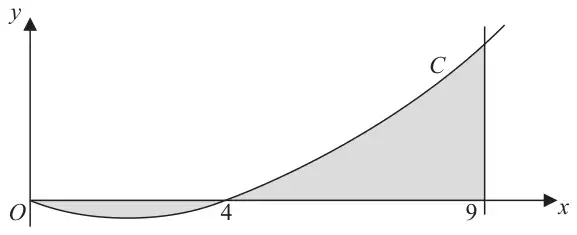
(a) Find\[\int 10x\left(x^{\frac{1}{2}} - 2\right)\mathrm{d}x\]giving each term in its simplest form. (4)
Figure 2
Figure 2 shows a sketch of part of the curve \(C\) with equation\[y = 10x\left(x^{\frac{1}{2}} - 2\right), \quad x \geqslant 0\]
The curve \(C\) starts at the origin and crosses the \(x\)-axis at the point \((4, 0)\).
The area, shown shaded in Figure 2, consists of two finite regions and is bounded by the curve \(C\), the \(x\)-axis and the line \(x = 9\)
(b) Use your answer from part (a) to find the total area of the shaded regions. (5)
Mark scheme (a)
Scheme
Marks
May mark (a) and (b) together
Expands to give \(10x^{\frac{3}{2}} - 20x\)
B1
Integrates to give \(\dfrac{10}{\text{"}\frac{5}{2}\text{"}}x^{\text{"}\frac{5}{2}\text{"}} + \dfrac{-\text{"}20\text{"}x^2}{2}\ (+c)\)
M1 A1ft
Simplifies to \(4x^{\frac{5}{2}} - 10x^2 (+c)\)
A1cao
(4)
Notes
(a) B1: Expands the bracket correctly
M1: Correct integration process on at least one term after attempt at multiplication. (Follow correct expansion or one slip resulting in \(10x^k - 20x\) where \(k\) may be \(\tfrac{1}{2}\) or \(\tfrac{5}{2}\) or resulting in \(10x^{\frac{3}{2}} - Bx\), where \(B\) may be 2 or 5) So \(x^{\frac{3}{2}} \to \dfrac{x^{\frac{5}{2}}}{\frac{5}{2}}\) or \(x^{\frac{1}{2}} \to \dfrac{x^{\frac{3}{2}}}{\frac{3}{2}}\) or \(x^{\frac{5}{2}} \to \dfrac{x^{\frac{7}{2}}}{\frac{7}{2}}\) and/or \(x \to \dfrac{x^2}{2}\).
A1: Correct unsimplified follow through for both terms of their integration. Does not need (+ \(c\))
A1: Must be simplified and correct– allow answer in scheme or \(4x^{2\frac{1}{2}} - 10x^2\). Does not need (+ \(c\) )
Mark scheme (b)
Scheme
Marks
Use limits 0 and 4 either way round on their integrated function (may only see 4 substituted)
M1
Use limits 4 and 9 either way round on their integrated function
dM1
Obtains either \(\pm -32\) or \(\pm 194\) needs at least one of the previous M marks for this to be awarded
A1
(So area \(= \left|\displaystyle\int_0^4 y\,\mathrm{d}x\right| + \int_4^9 y\,\mathrm{d}x\) ) i.e. \(32 + 194, = 226\)
ddM1,A1
(5)
[9]
Notes
(b) M1: (does not depend on first method mark) Attempt to substitute 4 into their integral (however obtained but must not be differentiated) or seeing their evaluated number (usually 32) is enough – do not need to see minus zero.
dM1: (depends on first method mark in (a)) Attempt to subtract either way round using the limits 4 and 9 \(A \times 9^{\frac{5}{2}} - B \times 9^2\) with \(A \times 4^{\frac{5}{2}} - B \times 4^2\) is enough – or seeing 162 –( -32) {but not 162 – 32 }
A1: At least one of the values ( 32 and 194) correct (needs just one of the two previous M marks in (b)) or may see 162 + 32 + 32 or 162 + 64 or may be implied by correct final answer if not evaluated until last line of working
ddM1: Adds 32 and 194 (may see 162 + 32 + 32 or may be implied by correct final answer if not evaluated until last line of working). This depends on everything being correct to this point.
A1cao: Final answer of 226 not ( - 226)
Common errors: \(4 \times 4^{\frac{5}{2}} - 10 \times 4^2 + 4 \times 9^{\frac{5}{2}} - 10 \times 9^2 - 4 \times 4^{\frac{5}{2}} - 10 \times 4^2 = \pm 162\) obtains M1 M1 A0 (neither 32 nor 194 seen and final answer incorrect) then M0 A0 so 2/5 Uses correct limits to obtain -32 +162 +32 = +/-162 is M1 M1 A1 (32 seen) M0 A0 so 3/5
Special case: In part (b) Uses limits 9 and 0 = 972 – 810 - 0 = 162 M0 M1 A0 M0A0 scores 1/5 This also applies if 4 never seen.
8.\[\frac{\mathrm{d}y}{\mathrm{d}x} = 6x^{-\frac{1}{2}} + x\sqrt{x}, \qquad x > 0\]Given that \(y = 37\) at \(x = 4\), find \(y\) in terms of \(x\), giving each term in its simplest form. (7)
B1: \(x\sqrt{x} = x^{\frac{3}{2}}\). This may be implied by \(+\dfrac{x^{\frac{5}{2}}}{\frac{5}{2}}\) oe in the subsequent work.
M1: \(x^n \to x^{n+1}\) in at least one case so see either \(x^{\frac{1}{2}}\) or \(x^{\frac{5}{2}}\) or both
A1: One term integrated correctly. It does not have to be simplified Eg. \(\dfrac{6}{\frac{1}{2}}x^{\frac{1}{2}}\) or \(+\dfrac{x^{\frac{5}{2}}}{\frac{5}{2}}\). No need for \(+c\)
A1: Other term integrated correctly. See above. No need to simplify nor for \(+c\). Need to see \(\dfrac{6}{\frac{1}{2}}x^{\frac{1}{2}} + \dfrac{x^{\frac{5}{2}}}{\frac{5}{2}}\) or a simplified correct version
M1: Substitute \(x = 4\), \(y = 37\) to produce an equation in \(c\).
A1: Correctly calculates \(c = \dfrac{1}{5}\) or equivalent e.g. 0.2
Substitutes limits of 2 and \(-4\) into an “integrated function” and subtracts either way round. Or substitutes limits of 0 and \(-4\) and 2 and 0 into an “integrated function” and subtracts either way round and adds the two results.
\(= \dfrac{21}{2}\)
A1
\(\{\text{At } x = -4,\ y = -8 + 12 = 4\ \text{ or at } x = 2,\ y = 1 + 3 = 4\}\)
Area of Rectangle \(= 6 \times 4 = 24\) or Area of Rectangles \(= 4 \times 4 = 16\) and \(2 \times 4 = 8\)
M1
Evidence of \((4 - -2) \times\) their \(y_{-4}\) or \((4 - -2) \times\) their \(y_2\) or Evidence of \(4 \times\) their \(y_{-4}\) and \(2 \times\) their \(y_2\)
So, area\((\mathrm{R}) = 24 - \dfrac{21}{2} = \dfrac{27}{2}\)
dddM1A1
(7)
Total 7
Notes
M1: \(x^n \to x^{n+1}\) on either term
A1: \(\dfrac{x^4}{32} + \dfrac{x^3}{4}\). Any correct simplified or un-simplified form. (+ c not required)
A1: \(\dfrac{21}{2}\) or 10.5
dddM1: Area rectangle – integrated answer. Dependent on all previous method marks and requires: Rectangle > integration > 0
A1: \(\dfrac{27}{2}\) or 13.5
Alternative:
Scheme
Marks
\(\pm\displaystyle\int \text{"their4"} - \left(\frac{1}{8}x^3 + \frac{3}{4}x^2\right)\mathrm{d}x\) Line – curve. Condone missing brackets and allow either way round.
4th M1
\(= 4x - \dfrac{x^4}{32} - \dfrac{x^3}{4}\ \{+c\}\) M1: \(x^n \to x^{n+1}\) on either curve term A1ft: “\(-\dfrac{x^4}{32} - \dfrac{x^3}{4}\).” Any correct simplified or un-simplified form of their curve terms, follow through sign errors. (+ c not required)
1st M1, 1st A1ft
\(\left[\ \right]_{-4}^{2} = \underline{\underline{\left(8 - \dfrac{16}{32} - \dfrac{8}{4}\right) - \left(-16 - \dfrac{256}{32} - \dfrac{(-64)}{4}\right)}}\) 2nd M1 Substitutes limits of 2 and \(-4\) into an “integrated curve” and subtracts either way round. 3rd M1 for \(\pm(\text{"}8\text{"} - \text{"}{-16}\text{"})\) Substitutes limits into the ‘line part’ and subtracts either way round. 2nd A1 for correct \(\pm\) (underlined expression). Now needs to be correct but allow \(\pm\) the correct expression.
2nd M1, 3rd M1 2nd A1
\(= \dfrac{27}{2}\) A1: \(\dfrac{27}{2}\) or 13.5
3rd A1
If the final answer is -13.5 you can withhold the final A1 If -13.5 then “becomes” +13.5 allow the A1
M1: For \(x^n \to x^{n+1}\). ie. \(x^6\) or \(x^{\frac{1}{2}}\) or \(\left(\sqrt{x}\right)\) seen Do not award for integrating their answer to part (a)
A1: For either \(2\dfrac{x^6}{6}\) or \(6\times\dfrac{x^{\frac{1}{2}}}{\frac{1}{2}}\) or simplified or unsimplified equivalents
A1: For fully correct and simplified answer with \(+c\).
10. A curve with equation \(y = \mathrm{f}(x)\) passes through the point \((4, 25)\).
Given that\[\mathrm{f}^{\prime}(x) = \frac{3}{8}x^2 - 10x^{-\frac{1}{2}} + 1, \qquad x > 0\]
(a) find \(\mathrm{f}(x)\), simplifying each term. (5)
(b) Find an equation of the normal to the curve at the point \((4, 25)\). Give your answer in the form \(ax + by + c = 0\), where \(a\), \(b\) and \(c\) are integers to be found. (5)
Substitute \(x = 4,\ y = 25 \Rightarrow 25 = 8 - 40 + 4 + c \Rightarrow c =\)
M1
\(\left(\mathrm{f}(x)\right) = \dfrac{x^3}{8} - 20x^{\frac{1}{2}} + x + 53\)
A1
(5)
Notes
M1: Attempt to integrate \(x^n \to x^{n+1}\)
A1: Term in \(x^3\) or term in \(x^{\frac{1}{2}}\) correct, coefficient need not be simplified, no need for \(+x\) nor \(+c\)
A1: ALL three terms correct, coefficients need not be simplified, no need for \(+c\)
M1: For using \(x = 4\), \(y = 25\) in their \(\mathrm{f}(x)\) to form a linear equation in \(c\) and attempt to find \(c\)
A1: \(= \dfrac{x^3}{8} - 20x^{\frac{1}{2}} + x + 53\) cao (all coefficients and powers must be simplified to give this answer- do not need a left hand side and if there is one it may be \(\mathrm{f}(x)\) or \(y\)). Need full expression with 53 These marks need to be scored in part (a)
Gradient of tangent \(= 2 \Rightarrow\) Gradient of normal is \(-1/2\)
dM1
Substitute \(x = 4\), \(y = 25\) into line equation with their changed gradient e.g. \(y - 25 = -\dfrac{1}{2}(x - 4)\)
dM1
\(\pm k(2y + x - 54) = 0\) o.e. (but must have integer coefficients)
A1cso
(5)
(10 marks)
Notes
M1: Attempt to substitute \(x = 4\) into \(\mathrm{f}^{\prime}(x)\) must be in part (b)
A1: \(\mathrm{f}^{\prime}(x) = 2\) at \(x = 4\)
dM1: (Dependent on first method mark in part (b)) Using \(m_1\times m_2 = -1\) to find the gradient of the normal from their tangent gradient (Give mark if gradient of 1 becomes -1 as they will lose accuracy)
dM1: (Dependent on first method mark in part (b)) Attempt to find the equation of the normal (not tangent). Eg use \(x = 4\), \(y = 25\) in \(y =\) ‘\(-1/2\)’\(x + c\) to find a value of \(c\) or use ‘\(-\dfrac{1}{2}\)’\(= \dfrac{y - 25}{x - 4}\) with their adapted gradient.
A1: cso \(\pm k(2y + x - 54) = 0\) (where \(k\) is any integer)
4. Use integration to find\[\int_1^{\sqrt{3}} \left(\frac{x^3}{6} + \frac{1}{3x^2}\right) \mathrm{d}x\]giving your answer in the form \(a + b\sqrt{3}\), where \(a\) and \(b\) are constants to be determined. (5)
Note that some candidates may change the function prior to integrating e.g. \(\displaystyle\int \frac{x^3}{6} + \frac{1}{3x^2}\,\mathrm{d}x = \int 3x^5 + 6\,\mathrm{d}x\) in which case allow the M1 if \(x^n \to x^{n+1}\) for their changed function and allow the M1 for limits if scored
This final mark is cao and cso – there must have been no previous errors
Total 5
Notes
M1: \(x^n \to x^{n+1}\)
A1: At least one of either \(\dfrac{x^4}{6(4)}\) or \(\dfrac{x^{-1}}{(3)(-1)}\).
A1: \(\dfrac{x^4}{6(4)} + \dfrac{x^{-1}}{(3)(-1)}\) or equivalent. e.g. \(\dfrac{\;\frac{x^4}{6}\;}{4} + \dfrac{\;\frac{x^{-1}}{3}\;}{-1}\) (they will lose the final mark if they cannot deal with this correctly)
2nd dM1: For using limits of \(\sqrt{3}\) and 1 on an integrated expression and subtracting the correct way round. The 2nd M1 is dependent on the 1st M1 being awarded.
A1cso: \(\dfrac{2}{3} - \dfrac{1}{9}\sqrt{3}\) or \(a = \dfrac{2}{3}\) and \(b = -\dfrac{1}{9}\). Allow equivalent fractions for \(a\) and/or \(b\) and 0.6 recurring and/or 0.1 recurring but do not allow \(\dfrac{6 - \sqrt{3}}{9}\)
M1: \(x^n \to x^{n+1}\) so \(x^3 \to x^4\) or \(4 \to 4x\) or \(4x^1\)
A1: This is for either term with coefficient unsimplified (power must be simplified) – so \(\dfrac{8}{4}x^4\) or \(4x\) (accept \(4x^1\))
A1: Fully correct simplified solution with \(c\) i.e. \(2x^4 + 4x + c\) [allow \(2x^4 + 4x + cx^0\)]
If the answer is given as \(\displaystyle\int 2x^4 + 4x + c\), with an integral sign – having never been seen as the fully correct simplified answer without an integral sign – then give M1A1A0 but allow anything before the = sign e.g. \(y = 2x^4 + 4x + c\), \(\mathrm{f}(x) = 2x^4 + 4x + c\), \(\displaystyle\int = 2x^4 + 4x + c\), etc….
If this answer is followed by (for example) \(x^4 + 2x + k\) then treat this as isw (ignore subsequent work) If they follow it by finding a value for \(c\), also isw, provided correct answer with \(c\) has been seen and credited
M1: \(x^n \to x^{n+1}\) in any one term. For this M to be scored there must have been an attempt to expand the brackets and obtain a quadratic expression
A1: Correct (unsimplified) expression for \(\mathrm{f}(x)\), no need for +c. Accept \(3\dfrac{x^3}{3} - 2\dfrac{x^2}{2} - 8x\)
M1: Substitutes \(x\)=3 and \(y\)=6 into their f(\(x\)) containing a constant ‘\(c\)’ and proceed to find its value.
A1: Cso \(\mathrm{f}(x) = x^3 - x^2 - 8x + 12\). Allow \(y = ..\) Do not accept an answer produced from part (b)
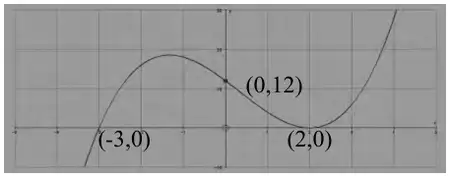
B1: States \(p = 3\) This may be obtained from subbing (3,6) into \(\mathrm{f}(x) = (x - 2)^2(x + p)\)
M1: Multiplies out a pair of brackets first, usually \((x - 2)^2\) and then attempts to multiply by the third. The minimum criteria should be the first multiplication is a 3T quadratic with correct first and last terms and the second is a 4T cubic with correct first and last terms. Accept an expression involving \(p\) for M1 \((x - 2)^2(x + p) = (x^2 + ..x + 4)(x + p) = x^3 + ..x^2 + ..x + 4p\)
A1: cso \(\mathrm{f}(x) = x^3 - x^2 - 8x + 12\), which must be the same as their answer for part (a)
Candidates who have experienced Core 2 could take their answer to (a) and factorise. The mark scheme can be applied with M1 for division by \((x - 2)\) and further factorisation of the quotient
\[\begin{array}{r} x^2\phantom{+\ldots\ldots\ldots} \\ x - 2\,\big)\overline{\,x^3 + \ldots\ldots\ldots} \end{array}\]
Alternatively the candidate could divide by \((x^2 - 4x + 4)\) to obtain \((x + ..)\)
The A1 is scored for \(\mathrm{f}(x) = (x - 2)^2(x + 3)\) The B1 is awarded for a statement of \(p = 3\) and not just \((x - 2)^2(x + 3)\)
Mark scheme (c)
Scheme
Marks
Shape
B1
Min at \((2, 0)\)
B1
Crosses \(x\)- axis at \((-3, 0)\)
B1ft
Crosses \(y\)- axis at \((0, 12)\)
B1
(4)
(12 marks)
Notes
B1: Shape \(+x^3\) graph with one maximum and one minimum. Its position is not important for this mark. It must appear to tend to + infinity at the rhs and – infinity at the lhs. The curve must extend beyond its ‘maximum’ point and minimum points. Eg. These are NOT acceptable.
B1: There is a turning point at \((2, 0)\). Accept 2 marked as a maximum or minimum on the \(x\)- axis.
B1ft: Graph crosses the \(x\)- axis at \((-3, 0)\). Accept −3 marked at the point where the curve crosses the \(x\)-axis. You may follow through on their values of ‘\(-p\)’ as long as \(p < 2\)
B1: Graph crosses the \(y\)-axis at \((0, 12)\). Accept 12 marked on the \(y\)- axis.
M1: Correct method for trapezium including limits. An attempt to integrate their rearrangement of the normal with the limits 0 and 4. A1: Correct numerical expression
M1: \(x^n \to x^{n+1}\) A1: Correct integration
M1: Use of limits 0 and 4 in a changed function and subtracts (either way round)
M1: Trapezium – Integral or Integral - Trapezium A1: Cso
If the only error in this method is to do (Curve – Line) then only penalise the final mark – i.e. they get -80/9
(7)
M1A1: Allow (Curve – Line) for both marks. In either case, the A1 should not be awarded if brackets are missing unless a correct expression is implied by later work.
M2: \(x^n \to x^{n+1}\) on both line and curve. Second and third M’s, second A. A1: Correct integration
M1: Use of limits 0 and 4 in a changed function and subtracts (either way round)
M1: Correct attempt to split into 2 separate terms or fractions. May be implied by one correct term. Divides by \(x^{\frac{1}{2}}\) or multiplies by \(x^{-\frac{1}{2}}\).
A1: \(x^{\frac{1}{2}} + 9x^{-\frac{1}{2}}\) or equivalent
M1: Independent method mark for \(x^n \to x^{n+1}\) on separate terms
A1: Allow un-simplified answers. No requirement for + c here
M1: Substitutes \(x = 9\) and \(y = 0\) into their integrated expression leading to a value for \(c\). If no \(c\) at this stage M0A0 follows unless their method implies that they are correctly finding a constant of integration.
A1: There is no requirement to simplify their \(\mathrm{f}(x)\) so accept any correct un-simplified form.
M1: Sets \(\mathrm{f}^{\prime}(x) = \dfrac{x + 9}{\sqrt{x}} = 10\) and multiplies by \(\sqrt{x}\). The terms in \(x\) must be in the numerator. E.g. allow \(\dfrac{x + 9}{10} = \sqrt{x}\)
dM1: Correct attempt to solve a relevant 3TQ in \(\sqrt{x}\) leading to solution for \(\sqrt{x}\). Dependent on the previous M1.
A1, B1: Note that the \(x = 1\) solution could be just written down and is B1 but must come from a correct equation.
M1: Sets \(\dfrac{x + 9}{\sqrt{x}} = 10\), squares and multiplies by \(x\). They must be setting either the original \(\mathrm{f}^{\prime}(x) = 10\) or an equivalent correct expression = 10
dM1: Correct attempt to solve a relevant 3TQ leading to solution for \(x\). Dependent on the previous M1.
A1, B1: Note that the \(x = 1\) solution could be just written down and is B1 but must come from a correct equation.
The line with equation \(y = 10\) cuts the curve with equation \(y = x^2 + 2x + 2\) at the points \(A\) and \(B\) as shown in Figure 1. The figure is not drawn to scale.
(a) Find by calculation the \(x\)-coordinate of \(A\) and the \(x\)-coordinate of \(B\). (2)
The shaded region \(R\) is bounded by the line with equation \(y = 10\) and the curve as shown in Figure 1.
(b) Use calculus to find the exact area of \(R\). (7)
A1: Two correct integrations( ft slips subtracting in Way 2)
A1: All 3 terms correct (penalise subtraction errors here in Way 2)
M1: Substitute their limits from (a) into the integrated function and subtract (either way round)
B1: Way 1:Find area under the line by integration or area of rectangle – should be 60 here (no follow through) Way 2: (implied by final correct answer in second method)
M1: Subtract one area from the other (implied by subtraction of functions in second method)- award even after differentiation
A1: Must be 36 not \(-36\).
Special case 1: Combines both methods. Uses Way 2 integration, but continues after reaching “36”to subtract “36” from rectangle giving answer as “24” This loses final M1 A1
Special case 2: Integrates \(\left(x^2 + 2x - 8\right)\) between limits \(-4\) and 2 to get -36 and then changes sign and obtains 36. Do not award final A mark – so M1A1A1M1B1M1A0 If the answer is left as -36, then M1A1A1M1B0M1A0
N.B. Allow full marks for modulus used earlier in working e.g. \(\left|\displaystyle\int_{-4}^{2} x^2 + 2x + 2\,\mathrm{d}x - \int_{-4}^{2} 10\,\mathrm{d}x\right|\) (corrected from the printed mark scheme, which shows \(x^2 + 2x - 2\) here)
\((\mathrm{f}(x) =) -9x^{-1} - 6x + \dfrac{x^3}{3} +\) their \(c\)
A1ft
Note that if they integrate in (b), no marks there but if they then go on to use their integration in (c), the marks for integration are available.
(5)
(10 marks)
Notes
M1: \(x^n \to x^{n+1}\) on separate terms at least once. (Differentiating is M0)
A1ft: \(-9x^{-1} + Ax + \dfrac{Bx^3}{3}\ (+c)\) with numerical \(A\) and \(B\), \(A, B \neq 0\)
M1: Uses \(x = -3\) and \(y = 10\) in what they think is \(\mathrm{f}(x)\) (They may have differentiated here) but it must be a changed function i.e. not the original \(\mathrm{f}^{\prime}(x)\), to form a linear equation in \(c\) and attempts to find \(c\). No + \(c\) gets M0 and A0 unless their method implies that they are correctly finding a constant.
A1: cso
A1ft: Follow through their \(c\) in an otherwise (possibly un-simplified) correct expression. Allow \(-\dfrac{9}{x}\) for \(-9x^{-1}\) or even \(\dfrac{9x^{-1}}{-1}\).
Figure 3 shows a sketch of part of the curve \(C\) with equation\[y = x(x + 4)(x - 2)\]The curve \(C\) crosses the \(x\)-axis at the origin \(O\) and at the points \(A\) and \(B\).
(a) Write down the \(x\)-coordinates of the points \(A\) and \(B\). (1)
The finite region, shown shaded in Figure 3, is bounded by the curve \(C\) and the \(x\)-axis.
(b) Use integration to find the total area of the finite region shown shaded in Figure 3. (7)
Mark scheme (a)
Scheme
Marks
Seeing \(-4\) and 2.
B1
(1)
Notes
B1: Need both \(-4\) and 2. May see \((-4,0)\) and \((2,0)\) (correct) but allow \((0,-4)\) and \((0, 2)\) or \(A = -4\), \(B = 2\) or indeed any indication of -4 and 2 – check graph also
One integral \(= \pm 42\dfrac{2}{3}\) (42.6 or awrt 42.7 ) or other integral \(= \pm 6\dfrac{2}{3}\) (6.6 or awrt 6.7)
A1
Hence Area \(= \text{"}their\,42\dfrac{2}{3}\text{"} + \text{"}their\,6\dfrac{2}{3}\text{"}\) or Area \(= \text{"}their\,42\dfrac{2}{3}\text{"} - \text{"}{-their}\,6\dfrac{2}{3}\text{"}\)
dM1
\(= 49\dfrac{1}{3}\) or 49.3 or \(\dfrac{148}{3}\) (NOT \(-\dfrac{148}{3}\))
A1
(An answer of \(= 49\dfrac{1}{3}\) may not get the final two marks – check solution carefully)
(7)
[8]
Notes
B1: Multiplies out cubic correctly (terms may not be collected, but if they are, mark collected terms here)
M1: Tries to integrate their expansion with \(x^n \to x^{n+1}\) for at least one of the terms
A1ft: completely correct integral following through from their CUBIC expansion (if only quadratic or quartic this is A0)
dM1: (dependent on previous M) substituting EITHER -\(a\) and 0 and subtracting either way round OR similarly for 0 and \(b\). If their limits \(-a\) and \(b\) are used in ONE integral, apply the Special Case below.
A1: Obtain either \(\pm 42\dfrac{2}{3}\) (or 42.6 or awrt 42.7)from the integral from -4 to 0or \(\pm 6\dfrac{2}{3}\) (6.6 or awrt 6.7) from the integral from 0 to 2; NO follow through on their cubic (allow decimal or improper equivalents \(\dfrac{128}{3}\) or \(\dfrac{20}{3}\) ) isw such as subtracting from rectangles. This will be penalized in the next two marks, which will be M0A0.
dM1 (depends on first method mark) Correct method to obtain shaded area so adds two positive numbers (areas) together or uses their positive value minus their negative value, obtained from two separate definite integrals.
A1: Allow 49.3, 49.33, 49.333 etc. Must follow correct logical work with no errors seen. For full marks on this question there must be two definite integrals, from -4 to 0 and from 0 to 2, though the evaluations for 0 may not be seen. (Trapezium rule gets no marks after first two B marks)
Special Case: one integral only from \(-a\) to \(b\): B1M1A1 available as before, then \(\left[\dfrac{x^4}{4} + \dfrac{2x^3}{3} - \dfrac{8x^2}{2}\right]_{-4}^{2} = \left(4 + \dfrac{16}{3} - 16\right) - \left(64 - \dfrac{128}{3} - 64\right) = -6\tfrac{2}{3} + 42\dfrac{2}{3} = \ldots.\) dM1 for correct use of their limits \(-a\) and \(b\) and subtracting either way round. A1 for 36: NO follow through. Final M and A marks not available. Max 5/7 for part (b)
M1: Some attempt to integrate: \(x^n \to x^{n+1}\) on at least one term. (not for + c) (If they think \(\dfrac{3}{\sqrt{x}}\) is \(3x^{\frac{1}{2}}\) you can still award the method mark for \(x^{\frac{1}{2}} \to x^{\frac{3}{2}}\)
A1: \(\dfrac{10x^5}{5}\) and \(\dfrac{-4x^2}{2}\) or better
A1: \(-\dfrac{3x^{\frac{1}{2}}}{\frac{1}{2}}\) or better
A1: Each term correct and simplified and the + \(c\) all appearing together on the same line. Allow \(\sqrt{x}\) for \(x^{\frac{1}{2}}\). Ignore any spurious integral or signs and/or d\(y\)/d\(x\)’s.
Do not apply isw. If they obtain the correct answer and then e.g. divide by 2 they lose the last mark.
8.\[\frac{\mathrm{d}y}{\mathrm{d}x} = -x^3 + \frac{4x - 5}{2x^3}, \qquad x \neq 0\]Given that \(y = 7\) at \(x = 1\), find \(y\) in terms of \(x\), giving each term in its simplest form. (6)
\((y =) \quad -\dfrac{1}{4}x^4 + \dfrac{\text{"}2\text{"}x^{-1}}{(-1)} - \text{"}\left(\dfrac{5}{2}\right)\text{"}\dfrac{x^{-2}}{(-2)}\ (+c)\) Raises power correctly on any one term. Any two follow through terms correct.
M1 A1ft
\((y =) \quad -\dfrac{1}{4}x^4 + \dfrac{2x^{-1}}{(-1)} - \dfrac{5}{2}\dfrac{x^{-2}}{(-2)}\ (+c)\) This is not follow through – must be correct
A1
Given that \(y = 7\), at \(x = 1\), then \(7 = -\tfrac{1}{4} - 2 + \tfrac{5}{4} + c \Rightarrow c =\)
M1
So, \((y =) \quad -\dfrac{1}{4}x^4 - 2x^{-1} + \dfrac{5}{4}x^{-2} + c,\ c = 8\) or \((y =) -\dfrac{1}{4}x^4 - 2x^{-1} + \dfrac{5}{4}x^{-2} + 8\)
A1
(6 marks)
Notes
M1: Expresses as three term polynomial with powers 3, −2 and −3. Allow slips in coefficients. This may be implied by later integration having all three powers 4, −1 and −2.
M1: An attempt to integrate at least one term so \(x^n \to x^{n+1}\) (not a term in the numerator or denominator)
A1ft: Any two integrations are correct – coefficients may be unsimplified (follow through errors in coefficients only here) so should have two of the powers 4, −1 and −2 after integration – depends on 2nd method mark only. There should be a maximum of three terms here.
A1: Correct three terms – coefficients may be unsimplified- do not need constant for this mark Depends on both Method marks
M1:Need constant for this mark. Uses \(y = 7\) and \(x = 1\) in their changed expression in order to find \(c\), and attempt to find \(c\). This mark is available even after there is suggestion of differentiation.
A1: Need all four correct terms to be simplified and need \(c = 8\) here.
7. The point \(P\,(4, -1)\) lies on the curve \(C\) with equation \(y = \mathrm{f}(x)\), \(x > 0\), and\[\mathrm{f}^{\prime}(x) = \frac{1}{2}x - \frac{6}{\sqrt{x}} + 3\]
(a) Find the equation of the tangent to \(C\) at the point \(P\), giving your answer in the form \(y = mx + c\), where \(m\) and \(c\) are integers. (4)
(b) Find \(\mathrm{f}(x)\). (4)
Mark scheme (a)
Scheme
Marks
\(P(4, -1)\) lies on \(C\) where \(\mathrm{f}^{\prime}(x) = \dfrac{1}{2}x - \dfrac{6}{\sqrt{x}} + 3,\ x > 0\)
1st M1: for clear attempt at \(\mathrm{f}^{\prime}(4)\).
1st A1: for obtaining 2 from \(\mathrm{f}^{\prime}(4)\).
2nd dM1: for \(y - {-1} = \left(\text{their } \mathrm{f}^{\prime}(4)\right)(x - 4)\) or \(\dfrac{y - {-1}}{x - 4} = \left(\text{their } \mathrm{f}^{\prime}(4)\right)\) or full method of \(y = mx + c\), with \(x = 4\), \(y = -1\) and their \(\mathrm{f}^{\prime}(4)\) to find a value for \(c\). Note: this method mark is dependent on the first method mark being awarded.
2nd A1: for \(y = 2x - 9\) or \(y = -9 + 2x\)
Note: This work needs to be contained in part (a) only.
Mark scheme (b)
Scheme
Marks
\(\mathrm{f}(x) = \dfrac{x^{1+1}}{2(2)} - \dfrac{6x^{-\frac{1}{2}+1}}{\left(\frac{1}{2}\right)} + 3x\,(+\,c)\) or equivalent.
M1 A1
\(\{\mathrm{f}(4) = -1 \Rightarrow\}\ \dfrac{16}{4} - 12(2) + 3(4) + c = -1\) \(\{4 - 24 + 12 + c = -1 \ \Rightarrow\ c = 7\}\)
dM1
So, \(\{\mathrm{f}(x) =\}\ \dfrac{x^2}{2(2)} - \dfrac{6x^{\frac{1}{2}}}{\left(\frac{1}{2}\right)} + 3x + 7\)
1st M1: for a clear attempt to integrate \(\mathrm{f}^{\prime}(x)\) with at least one correct application of \(x^n \to x^{n+1}\) on \(\mathrm{f}^{\prime}(x) = \dfrac{1}{2}x - \dfrac{6}{\sqrt{x}} + 3\). So seeing either \(\dfrac{1}{2}x \to \pm\lambda x^{1+1}\) or \(-\dfrac{6}{\sqrt{x}} \to \pm\mu x^{-\frac{1}{2}+1}\) or \(3 \to 3x^{0+1}\) is M1.
1st A1: for correct un-simplified coefficients and powers (or equivalent) with or without \(+\,c\).
2nd dM1: for use of \(x = 4\) and \(y = -1\) in an integrated equation to form a linear equation in \(c\) equal to -1. ie: applying \(\mathrm{f}(4) = -1\). This mark is dependent on the first method mark being awarded.
A1: For \(\{\mathrm{f}(x) =\}\ \dfrac{x^2}{2(2)} - \dfrac{6x^{\frac{1}{2}}}{\left(\frac{1}{2}\right)} + 3x + 7\) stated on one line where coefficients can be un-simplified or simplified, but must contain one term powers. Note this mark is for correct solution only.
Note: For a candidate attempting to find f(x) in part (a) If it is clear that they understand that they are finding \(\mathrm{f}(x)\) in part (a); ie. by writing \(\mathrm{f}(x) = \ldots\) or \(y = \ldots\) then you can give credit for this working in part (b).
Figure 2 shows the line with equation \(y = 10 - x\) and the curve with equation \(y = 10x - x^2 - 8\)
The line and the curve intersect at the points \(A\) and \(B\), and \(O\) is the origin.
(a) Calculate the coordinates of \(A\) and the coordinates of \(B\). (5)
The shaded area \(R\) is bounded by the line and the curve, as shown in Figure 2.
(b) Calculate the exact area of \(R\). (7)
Mark scheme (a)
Scheme
Marks
Method 1
Or (eliminating x)
Puts \(10 - x = 10x - x^2 - 8\) and rearranges to give three term quadratic
Or puts \(y = 10(10 - y) - (10 - y)^2 - 8\) and rearranges to give three term quadratic
M1
Solves their “\(x^2 - 11x + 18 = 0\)” using acceptable method as in general principles to give \(x =\)
Solves their “\(y^2 - 9y + 8 = 0\)” using acceptable method as in general principles to give \(y =\)
M1
Obtains \(x = 2\), \(x = 9\) (may be on diagram or in part (b) in limits)
Obtains \(y = 8\), \(y = 1\) (may be on diagram)
A1
Substitutes their \(x\) into a given equation to give \(y =\) (may be on diagram)
Substitutes their \(y\) into a given equation to give \(x =\) (may be on diagram or in part (b))
M1
\(y = 8,\ y = 1\)
\(x = 2,\ x = 9\)
A1
(5)
Notes
First M1: See scheme Second M1: See notes relating to solving quadratics Third M1: This may be awarded if one substitution is made
Two correct Answers following tables of values, or from Graphical calculator are 5/5 Just one pair of correct coordinates – no working or from table is M0M0A0M1A0
\(= 90 - \dfrac{4}{3} = 88\tfrac{2}{3}\) or \(\tfrac{266}{3}\)
Area of trapezium \(= \tfrac{1}{2}(8 + 1)(9 - 2) = 31.5\)
B1
So area of \(R\) is \(88\tfrac{2}{3} - 31.5 = 57\tfrac{1}{6}\) or \(\tfrac{343}{6}\)
M1A1 cao
(7)
12 marks
Notes
M1: \(x^n \to x^{n + 1}\) for any one term. 1st A1: at least two out of three terms correct 2nd A1: All three correct
dM1: Substitutes 9 and 2 (or limits from part(a)) into an “integrated function” and subtracts, either way round
(NB: If candidate changes all signs to get \(\displaystyle\int (-10x + x^2 + 8)\,\mathrm{d}x = -\frac{10x^2}{2} + \frac{x^3}{3} + 8x\ \{+ c\}\) This is M1 A1 A1 Then uses limits dM1 and trapezium is B1 Needs to change sign of value obtained from integration for final M1A1 so \(-88\tfrac{2}{3} - 31.5\) is M0A0 )
B1: Obtains 31.5 for area under line using any correct method (could be integration) or triangle minus triangle \(\tfrac{1}{2} \times 8 \times 8 - \tfrac{1}{2}\) or rectangle plus triangle [may be implied by correct 57 1/6 ]
M1: Their Area under curve – Their Area under line (if integrate both need same limits)
A1: Accept 57.16recurring but not 57.16
Method 2 for (b)
Scheme
Marks
Area of \(R = \displaystyle\int_2^9 (10x - x^2 - 8) - (10 - x)\,\mathrm{d}x\) 3rd M1 (in (b) ): Uses difference between two functions in integral.
\(\displaystyle\int_2^9 -x^2 + 11x - 18\,\mathrm{d}x = -\frac{x^3}{3} + \frac{11x^2}{2} - 18x\ \{+ c\}\) M: \(x^n \to x^{n + 1}\) for any one term. A1 at least two out of these three simplified terms. Correct integration. (Ignore \(+ c\)).
M1 A1 A1
\(\left[-\dfrac{x^3}{3} + \dfrac{11x^2}{2} - 18x\right]_2^9 = (\ldots\ldots) - (\ldots\ldots)\) Substitutes 9 and 2 (or limits from part(a)) into an “integrated function” and subtracts, either way round.
dM1
This mark is implied by final answer which rounds to 57.2
B1
See above working(allow bracketing errors) to decide to award 3rd M1 mark for (b) here:
M1
\(40.5 - \left(-16\tfrac{2}{3}\right) = 57\tfrac{1}{6}\) cao
This mark is implied by final answer which rounds to 57.2 (not -57.2)
B1
Difference of functions implied (see above expression)
M1
\(40.5 - \left(-16\tfrac{2}{3}\right) = 57\tfrac{1}{6}\) cao
A1
(7)
Special Case 2
Integrates expression in \(y\) e.g. “\(y^2 - 9y + 8 = 0\)”: This can have first M1 in part (b) and no other marks. (It is not a method for finding this area)
Notes
Take away trapezium again having used Method 2 loses last two marks
Common Error: Integrates \(-x^2 + 9x - 18\) is likely to be M1A1A0dM1B0M1A0 Integrates \(2 - 11x - x^2\) is likely to e M1A0A0dM1B0M1A0 Writing \(\displaystyle\int_2^9 (10x - x^2 - 8) - (10 - x)\,\mathrm{d}x\) only earns final M mark
M1: for some attempt to integrate a term in \(x\): \(x^n \to x^{n+1}\) So seeing either \(6x^2 \to \pm\lambda x^3\) or \(\dfrac{2}{x^2} \to \pm\mu x^{-1}\) or \(5 \to 5x\) is M1.
1st A1: for a correct un-simplified \(x^3\) or \(x^{-1}\) \(\left(\text{or } \dfrac{1}{x}\right)\) term.
2nd A1: for both \(x^3\) and \(x^{-1}\) terms correct and simplified on the same line. Ie. \(2x^3 - 2x^{-1}\) or \(2x^3 - \dfrac{2}{x}\).
3rd A1: for \(+\,5x + c\). Also allow \(+\,5x^1 + c\). This needs to be written on the same line. Ignore the incorrect use of the integral sign in candidates’ responses.
Note: If a candidate scores M1A1A1A1 and their answer is NOT ON THE SAME LINE then withhold the final accuracy mark.
7. A curve with equation \(y = \mathrm{f}(x)\) passes through the point \((2, 10)\). Given that\[\mathrm{f}^{\prime}(x) = 3x^2 - 3x + 5\]find the value of \(\mathrm{f}(1)\). (5)
1st M1: for attempt to integrate \(x^n \to x^{n+1}\)
1st A1: all correct, possibly unsimplified. Ignore \(+c\) here.
2nd M1: for using \(x = 2\) and \(\mathrm{f}(2) = 10\) to form a linear equation in \(c\). Allow sign errors. They should be substituting into a changed expression
2nd A1: for \(c = -2\)
3rd A1ft: for \(\dfrac{9}{2} + c\) Follow through their numerical \(c\) (\(\neq 0\)) This mark is dependent on 1st M1 and 1st A1 only.
1. Given that \(y = x^4 + 6x^{\frac{1}{2}}\), find in their simplest form
(a) \(\dfrac{\mathrm{d}y}{\mathrm{d}x}\) (3)
(b) \(\displaystyle\int y\,\mathrm{d}x\) (3)
Mark scheme (a)
Scheme
Marks
\(4x^3 + 3x^{-\frac{1}{2}}\)
M1A1A1
(3)
Notes
M1: for \(x^n \to x^{n-1}\) i.e. \(x^3\) or \(x^{-\frac{1}{2}}\) seen
1st A1: for \(4x^3\) or \(6\times\tfrac{1}{2}\times x^{-\frac{1}{2}}\) (o.e.) (ignore any \(+\,c\) for this mark)
2nd A1: for simplified terms i.e. both \(4x^3\) and \(3x^{-\frac{1}{2}}\) or \(\dfrac{3}{\sqrt{x}}\) and no \(+c\) \(\left[\dfrac{3}{1}x^{-\frac{1}{2}}\text{ is A0}\right]\) Apply ISW here and award marks when first seen
Mark scheme (b)
Scheme
Marks
\(\dfrac{x^5}{5} + 4x^{\frac{3}{2}} + C\)
M1A1A1
(3)
(6 marks)
Notes
M1: for \(x^n \to x^{n+1}\) applied to \(y\) only so \(x^5\) or \(x^{\frac{3}{2}}\) seen. Do not award for integrating their answer to part (a)
1st A1: for \(\dfrac{x^5}{5}\) or \(\dfrac{6x^{\frac{3}{2}}}{\frac{3}{2}}\) (or better). Allow \(1/5x^5\) here but not for 2nd A1
2nd A1: for fully correct and simplified answer with \(+C\). Allow \((1/5)x^5\) If \(+\,C\) appears earlier but not on a line where 2nd A1 could be scored then A0
\(x^2 - x - 20\ \{= 0\} \Rightarrow (x - 5)(x + 4)\ \{= 0\} \Rightarrow x = \ldots\) Attempt to solve a resulting quadratic to give \(x =\) their values.
M1
So, \(x = 5, -4\) Both \(x = 5\) and \(x = -4\).
A1
So corresponding \(y\)-values are \(y = 9\) and \(y = 0\). See notes below.
B1ft
[4]
Notes
1st B1: For correctly eliminating either \(x\) or \(y\). Candidates will usually write \(-x^2 + 2x + 24 = x + 4\). This mark can be implied by the resulting quadratic.
M1: For solving their quadratic (which must be different to \(-x^2 + 2x + 24\)) to give \(x = \ldots\) See introduction for Method mark for solving a 3TQ. It must result from some attempt to eliminate one of the variables. A1: For both \(x = 5\) and \(x = -4\).
2nd B1ft: For correctly substituting their values of \(x\) in equation of line or parabola to give both correct ft \(y\)-values. (You may have to get your calculators out if they substitute their \(x\) into \(y = -x^2 + 2x + 24\)).
Note: For \(x = 5, -4 \Rightarrow y = 9\) and \(y = 0 \Rightarrow\) eg. \((-4, 9)\) and \((5, 0)\), award B1 isw. If the candidate gives additional answers to \((-4, 0)\) and \((5, 9)\), then withhold the final B1 mark.
Special Case: Award SC: B0M0A0B1 for \(\{A\}(-4, 0)\). You may see this point marked on the diagram. Note: SC: B0M0A0B1 for solving \(0 = -x^2 + 2x + 24\) to give \(\{A\}(-4, 0)\) and/or \((6, 10)\).
\(y^2 - 9y\ \{= 0\} \Rightarrow y(y - 9)\ \{= 0\} \Rightarrow y = \ldots\) Attempt to solve a resulting quadratic to give \(y =\) their values.
M1
So, \(y = 0, 9\) Both \(y = 0\) and \(y = 9\).
A1
So corresponding \(y\)-values are \(x = -4\) and \(x = 5\). See notes below.
B1ft
[4]
2nd B1ft: For correctly substituting their values of \(y\) in equation of line or parabola to give both correct ft \(x\)-values.
Mark scheme (b)
Scheme
Marks
\(\left\{\displaystyle\int (-x^2 + 2x + 24)\,\mathrm{d}x\right\} = \underline{-\dfrac{x^3}{3} + \dfrac{2x^2}{2} + 24x}\ \{+ c\}\) M1: \(x^n \to x^{n + 1}\) for any one term. 1st A1 at least two out of three terms. 2nd A1 for correct answer.
M1A1A1
\(\left[-\dfrac{x^3}{3} + \dfrac{2x^2}{2} + 24x\right]_{-4}^{5} = (\ldots\ldots) - (\ldots\ldots)\) Substitutes 5 and \(-4\) (or their limits from part(a)) into an “integrated function” and subtracts, either way round.
Area of \(\Delta = \tfrac{1}{2}(9)(9) = 40.5\) Uses correct method for finding area of triangle.
M1
So area of \(R\) is \(162 - 40.5 = 121.5\) Area under curve – Area of triangle.
M1
121.5
A1 oe cao
[7]
11
Notes
Note: Do not give marks for working in part (b) which would be creditable in part (a).
1st M1 for an attempt to integrate meaning that \(x^n \to x^{n + 1}\) for at least one of the terms. Note that \(24 \to 24x\) is sufficient for M1.
1st A1 at least two out of three terms correctly integrated. 2nd A1 for correct integration only and no follow through. Ignore the use of a \(\text{‘}+ c\text{’}\).
2nd M1: Note that this method mark is dependent upon the award of the first M1 mark in part (b). Substitutes 5 and \(-4\) (and not 4 if the candidate has stated \(x = -4\) in part (a).) (or the limits the candidate has found from part(a)) into an “integrated function” and subtracts, either way round. Allow one slip!
3rd M1: Area of triangle \(= \dfrac{1}{2}(\text{their } x_2 - \text{their } x_1)(\text{their } y_2)\) or Area of triangle \(= \displaystyle\int_{x_1}^{x_2} x + 4\ \{\mathrm{d}x\}\). Where \(x_1 =\) their \(-4\), \(x_2 =\) their 5 and \(y_2 =\) their \(y\) usually found in part (a).
4th M1: Area under curve – Area under triangle, where both Area under curve \(\gt 0\) and Area under triangle \(\gt 0\) and Area under curve \(\gt\) Area under triangle.
Area of \(R = \displaystyle\int_{-4}^{5} (-x^2 + 2x + 24) - (x + 4)\,\mathrm{d}x\) 3rd M1: Uses integral of \((x + 4)\) with correct ft limits. 4th M1: Uses “curve” – “line” function with correct ft limits.
\(= -\dfrac{x^3}{3} + \dfrac{x^2}{2} + 20x\ \{+ c\}\) M: \(x^n \to x^{n + 1}\) for any one term. A1 at least two out of three terms. Correct answer (Ignore \(+ c\)).
M1 A1ft A1
\(\left[-\dfrac{x^3}{3} + \dfrac{x^2}{2} + 20x\right]_{-4}^{5} = (\ldots\ldots) - (\ldots\ldots)\) Substitutes 5 and \(-4\) (or their limits from part(a)) into an “integrated function” and subtracts, either way round.
See above working to decide to award 3rd M1 mark here:
M1
See above working to decide to award 4th M1 mark here:
M1
So area of \(R\) is \(= 121.5\) 121.5
A1 oe cao
[7]
1st M1 for an attempt to integrate meaning that \(x^n \to x^{n + 1}\) for at least one of the terms. Note that \(20 \to 20x\) is sufficient for M1.
1st A1 at least two out of three terms correctly ft. Note this accuracy mark is ft in Way 2. 2nd A1 for correct integration only and no follow through. Ignore the use of a \(\text{‘}+ c\text{’}\). Allow 2nd A1 also for \(-\dfrac{x^3}{3} + \dfrac{2x^2}{2} + 24x - \left(\dfrac{x^2}{2} + 4x\right)\). Note that \(\dfrac{2x^2}{2} - \dfrac{x^2}{2}\) or \(24x - 4x\) only counts as one integrated term for the 1st A1 mark. Do not allow any extra terms for the 2nd A1 mark.
2nd M1: Note that this method mark is dependent upon the award of the first M1 mark in part (b). Substitutes 5 and \(-4\) (and not 4 if the candidate has stated \(x = -4\) in part (a).) (or the limits the candidate has found from part(a)) into an “integrated function” and subtracts, either way round. Allow one slip!
3rd M1: Uses the integral of \((x + 4)\) with correct ft limits of their \(x_1\) and their \(x_2\) (usually found in part (a)) {where \((x_1, y_1) = (-4, 0)\) and \((x_2, y_2) = (5, 9)\).} This mark is usually found in the first line of the candidate’s working in part (b).
4th M1: Uses “curve” – “line” function with correct ft (usually found in part (a)) limits. Subtraction must be correct way round. This mark is usually found in the first line of the candidate’s working in part (b). Allow \(\displaystyle\int_{-4}^{5} (-x^2 + 2x + 24) - x + 4\ \{\mathrm{d}x\}\) for this method mark.
3rd A1: 121.5 oe cao.
Note: SPECIAL CASE for this alternative method Area of \(R = \displaystyle\int_{-4}^{5} (x^2 - x - 20)\,\mathrm{d}x = \left[\frac{x^3}{3} - \frac{x^2}{2} - 20x\right]_{-4}^{5} = \left(\frac{125}{3} - \frac{25}{2} - 100\right) - \left(-\frac{64}{3} - 8 + 80\right)\) The working so far would score SPECIAL CASE M1A1A1M1M1M0A0. The candidate may then go on to state that \(= \left(-70\dfrac{5}{6}\right) - \left(50\dfrac{2}{3}\right) = -\dfrac{243}{2}\) If the candidate then multiplies their answer by \(-1\) then they would gain the 4th M1 and 121.5 would gain the final A1 mark.
Alternative Methods for obtaining the M1 mark for use of limits
There are two alternative methods can candidates can apply for finding “162”.
(b) 1st M: Attempt to integrate \(x^n \to x^{n+1}\) (for either term) 1st A: ft their \(p\) and \(q\), but terms need not be simplified (\(+C\) not required for this mark) 2nd M: Using \(x = 4\) and \(y = 90\) to form an equation in \(C\). 2nd A: cao 3rd A: answer as shown with simplified correct coefficients and powers – but follow through their value for \(C\)
If there is a ’restart’ in part (b) it can be marked independently of part (a), but marks for part (a) cannot be scored for work seen in (b).
Numerator and denominator integrated separately: First M mark cannot be awarded so only mark available is second M mark. So 1 out of 5 marks.
2. Given that \(y = 2x^5 + 7 + \dfrac{1}{x^3}\), \(x \neq 0\), find, in their simplest form,
(a) \(\dfrac{\mathrm{d}y}{\mathrm{d}x}\), (3)
(b) \(\displaystyle\int y\,\mathrm{d}x\). (4)
Mark scheme (a)
Scheme
Marks
\(\dfrac{\mathrm{d}y}{\mathrm{d}x} = 10x^4 - 3x^{-4}\) or \(10x^4 - \dfrac{3}{x^4}\)
M1 A1 A1
(3)
Notes
(a) M1: Attempt to differentiate \(x^n \to x^{n-1}\) (for any of the 3 terms) i.e. \(ax^4\) or \(ax^{-4}\), where \(a\) is any non-zero constant or the 7 differentiated to give 0 is sufficient evidence for M1
Figure 1 shows a sketch of part of the curve \(C\) with equation\[y = (x + 1)(x - 5)\]The curve crosses the \(x\)-axis at the points \(A\) and \(B\).
(a) Write down the \(x\)-coordinates of \(A\) and \(B\). (1)
The finite region \(R\), shown shaded in Figure 1, is bounded by \(C\) and the \(x\)-axis.
(b) Use integration to find the area of \(R\). (6)
Mark scheme (a)
Scheme
Marks
Seeing \(-1\) and 5. (See note below.)
B1
(1)
Notes
B1: for \(-1\) and 5. Note that \((-1, 0)\) and \((5, 0)\) are acceptable for B1. Also allow \((0, -1)\) and \((0, 5)\) generously for B1. Note that if a candidate writes down that \(A: (5, 0)\), \(B: (-1, 0)\), (ie \(A\) and \(B\) interchanged,) then B0. Also allow values inserted in the correct position on the \(x\)-axis of the graph.
Mark scheme (b)
Scheme
Marks
\((x + 1)(x - 5) = \underline{x^2 - 4x - 5}\) or \(\underline{x^2 - 5x + x - 5}\)
B1
\(\displaystyle\int (x^2 - 4x - 5)\,\mathrm{d}x = \frac{x^3}{3} - \frac{4x^2}{2} - 5x\ \{+ c\}\) M: \(x^n \to x^{n + 1}\) for any one term. 1st A1 at least two out of three terms correctly ft.
M1A1ft A1
\(\left[\dfrac{x^3}{3} - \dfrac{4x^2}{2} - 5x\right]_{-1}^{5} = (\ldots\ldots) - (\ldots\ldots)\) Substitutes 5 and \(-1\) (or limits from part(a)) into an “integrated function” and subtracts, either way round.
Hence, Area \(= 36\) Final answer must be 36, not \(-36\)
A1
(6)
[7]
Notes
B1 for \(x^2 - 4x - 5\) or \(x^2 - 5x + x - 5\). If you believe that the candidate is applying the Way 2 method then \(-x^2 + 4x + 5\) or \(-x^2 + 5x - x + 5\) would then be fine for B1.
1st M1 for an attempt to integrate meaning that \(x^n \to x^{n + 1}\) for at least one of the terms. Note that \(-5 \to 5x\) is sufficient for M1.
1st A1 at least two out of three terms correctly ft from their multiplied out brackets.
2nd A1 for correct integration only and no follow through. Ignore the use of a \(\text{‘}+ c\text{’}\). Allow 2nd A1 also for \(\dfrac{x^3}{3} - \dfrac{5x^2}{2} + \dfrac{x^2}{2} - 5x\). Note that \(-\dfrac{5x^2}{2} + \dfrac{x^2}{2}\) only counts as one integrated term for the 1st A1 mark. Do not allow any extra terms for the 2nd A1 mark.
2nd M1: Note that this method mark is dependent upon the award of the first M1 mark in part (b). Substitutes 5 and \(-1\) (and not 1 if the candidate has stated \(x = -1\) in part (a).) (or the limits the candidate has found from part(a)) into an “integrated function” and subtracts, either way round.
3rd A1: For a final answer of 36, not \(-36\).
Note: An alternative method exists where the candidate states from the outset that \(\text{Area}(R) = -\displaystyle\int_{-1}^{5} \left(x^2 - 4x - 5\right)\mathrm{d}x\) is detailed in the Appendix (shown below as Way 2). (Corrected from the printed mark scheme: the integrand is printed as \(x^2 - 4x + 5\).)
Alternative (b) Way 2
Scheme
Marks
\((x + 1)(x - 5) = \underline{x^2 - 4x - 5}\) or \(\underline{x^2 - 5x + x - 5}\) Can be implied by later working.
B1
\(-\displaystyle\int (x^2 - 4x - 5)\,\mathrm{d}x = -\frac{x^3}{3} + \frac{4x^2}{2} + 5x\ \{+ c\}\) M: \(x^n \to x^{n + 1}\) for any one term. 1st A1 any two out of three terms correctly ft.
M1A1ft A1
\(\left[-\dfrac{x^3}{3} + \dfrac{4x^2}{2} + 5x\right]_{-1}^{5} = (\ldots\ldots) - (\ldots\ldots)\) Substitutes 5 and \(-1\) (or limits from part(a)) into an “integrated function” and subtracts, either way round.
M1: for some attempt to integrate: \(x^n \to x^{n+1}\) i.e \(ax^6\) or \(ax^3\) or \(ax^{\frac{4}{3}}\) or \(ax^{1\frac{1}{3}}\), where \(a\) is a non zero constant
1st A1: for \(\dfrac{12x^6}{6}\) or better
2nd A1: for \(-\dfrac{3x^3}{3}\) or better
3rd A1: for \(\dfrac{4x^{\frac{4}{3}}}{\frac{4}{3}}\) or better
4th A1: for each term correct and simplified and the \(+c\) occurring in the final answer
11. The curve \(C\) has equation \(y = \mathrm{f}(x),\ \ x > 0\), where\[\frac{\mathrm{d}y}{\mathrm{d}x} = 3x - \frac{5}{\sqrt{x}} - 2\]Given that the point \(P\,(4, 5)\) lies on \(C\), find
(a) \(\mathrm{f}(x)\), (5)
(b) an equation of the tangent to \(C\) at the point \(P\), giving your answer in the form \(ax + by + c = 0\), where \(a\), \(b\) and \(c\) are integers. (4)
1st M1: for an attempt to integrate \(x^n \to x^{n+1}\)
1st A1: for at least 2 correct terms in \(x\) (unsimplified)
2nd A1: for all 3 terms in \(x\) correct (condone missing \(+c\) at this point). Needn’t be simplified
2nd M1: for using the point \((4, 5)\) to form a linear equation for \(c\). Must use \(x = 4\) and \(y = 5\) and have no \(x\) term and the function must have “changed”.
3rd A1: for \(c = 9\). The final expression is not required.
Equation is: \(\qquad y - 5 = \dfrac{15}{2}(x - 4)\)
M1A1
\(\underline{2y - 15x + 50 = 0} \qquad\) o.e.
A1
(4)
(9 marks)
Notes
1st M1: for an attempt to evaluate \(\mathrm{f}^{\prime}(4)\). Some correct use of \(x = 4\) in \(\mathrm{f}^{\prime}(x)\) but condone slips. They must therefore have at least \(3\times 4\) or \(-\tfrac{5}{2}\) and clearly be using \(\mathrm{f}^{\prime}(x)\) with \(x = 4\). Award this mark wherever it is seen.
2nd M1: for using their value of \(m\) [or their \(-\dfrac{1}{m}\)] (provided it clearly comes from using \(x = 4\) in \(\mathrm{f}^{\prime}(x)\)) to form an equation of the line through \((4,5)\). Allow this mark for an attempt at a normal or tangent. Their \(m\) must be numerical. Use of \(y = mx + c\) scores this mark when \(c\) is found.
1st A1: for any correct expression for the equation of the line
2nd A1: for any correct equation with integer coefficients. An “=” is required. e.g. \(2y = 15x - 50\) etc as long as the equation is correct and has integer coefficients.
Normal Attempt at normal can score both M marks in (b) but A0A0
At \(x = 2\), \(\dfrac{\mathrm{d}y}{\mathrm{d}x} = 0\), so \(12 - 40 + k = 0\qquad k = 28\) (*) N.B. The ‘= 0’ must be seen at some stage to score the final mark.
A1 cso
(3)
Notes
Alternatively: (using \(k = 28\)) \(\dfrac{\mathrm{d}y}{\mathrm{d}x} = 3x^2 - 20x + 28\) (M1 A1) ‘Assuming’ \(k = 28\) only scores the final cso mark if there is justification that \(\dfrac{\mathrm{d}y}{\mathrm{d}x} = 0\) at \(x = 2\) represents the maximum turning point.
(a) M: \(x^n \to cx^{n-1}\) (\(c\) constant, \(c \neq 0\) ) for one term, seen in part (a).
\(\left[\dfrac{x^4}{4} - \dfrac{10x^3}{3} + 14x^2\right]_0^2 = \ldots\qquad \left(= 4 - \dfrac{80}{3} + 56 = \dfrac{100}{3}\right)\) (With limits 0 to 2, substitute the limit 2 into a 'changed function')
M1
\(y\)-coordinate of \(P = 8 - 40 + 56 = 24\) Allow if seen in part (a) (The B1 for 24 may be scored by implication from later working)
B1
Area of rectangle \(= 2 \times (\text{their } y\text{-coordinate of } P)\) Area of \(R = (\text{their } 48) - \left(\text{their } \dfrac{100}{3}\right)\quad = \dfrac{44}{3}\quad \left(14\dfrac{2}{3}\ \text{or}\ 14.\dot{6}\right)\) If the subtraction is the ‘wrong way round’, the final A mark is lost.
M1 A1
(6)
9
Notes
(b) 1st M: \(x^n \to cx^{n+1}\) (\(c\) constant, \(c \neq 0\) ) for one term. Integrating the gradient function loses this M mark.
2ndM: Requires use of limits 0 and 2, with 2 substituted into a ‘changed function’. (It may, for example, have been differentiated).
Final M: Subtract their values either way round. This mark is dependent on the use of calculus and a correct method attempt for the area of the rectangle.
A1: Must be exact, not 14.67 or similar, but isw after seeing, say, \(\dfrac{44}{3}\).
Alternative: (effectively finding area of rectangle by integration)\[\int\left\{24 - (x^3 - 10x^2 + 28x)\right\}\mathrm{d}x = 24x - \left(\frac{x^4}{4} - \frac{10x^3}{3} + \frac{28x^2}{2}\right),\ \text{etc.}\]This can be marked equivalently, with the 1st A being for integrating the same 3 terms correctly. The 3rd M (for subtraction) will be scored at the same stage as the 2nd M. If the subtraction is the ‘wrong way round’, the final A mark is lost.
M1: for some attempt to integrate a term in \(x\): \(x^n \to x^{n+1}\)
1st A1: for correct, possibly un-simplified \(x^4\) or \(x^{\frac{3}{2}}\) term. e.g. \(\dfrac{8x^4}{4}\) or \(\dfrac{6x^{\frac{3}{2}}}{\frac{3}{2}}\)
2nd A1: for both \(2x^4\) and \(4x^{\frac{3}{2}}\) terms correct and simplified on the same line N.B. some candidates write \(4\sqrt{x^3}\) or \(4x^{1\frac{1}{2}}\) which are, of course, fine for A1
3rd A1: for \(-5x + c\). Accept \(-5x^1 + c\). The \(+c\) must appear on the same line as the \(-5x\) N.B. We do not need to see one line with a fully correct integral
Ignore ISW (ignore incorrect subsequent working) if a correct answer is followed by an incorrect version.
Condone poor use of notation e.g. \(\displaystyle\int 2x^4 + 4x^{\frac{3}{2}} - 5x + c\) will score full marks.
The finite region \(R\) is bounded by \(LN\), \(LM\) and the curve \(C\) as shown in Figure 2.
(d) Use your answer to part (c) to find the exact value of the area of \(R\). (5)
Mark scheme (a)
Scheme
Marks
Puts \(y = 0\) and attempts to solve quadratic e.g. \((x - 4)(x - 1) = 0\)
M1
Points are (1,0) and (4, 0)
A1
(2)
Notes
M1 for attempt to find \(L\) and \(M\) A1 Accept \(x = 1\) and \(x = 4\) , then isw or accept \(L\) =(1,0) , \(M\) = (4,0) Do not accept \(L\) = 1, \(M\) = 4 nor (0 , 1), (0 , 4) (unless subsequent work) Do not need to distinguish \(L\) and \(M\). Answers imply M1A1.
Mark scheme (b)
Scheme
Marks
\(x = 5\) gives \(y\) = 25 - 25 + 4 and so (5, 4) lies on the curve
B1cso
(1)
Notes
See substitution, working should be shown, need conclusion which could be just \(y = 4\) or a tick. Allow \(y\) = 25 - 25 + 4 = 4 But not 25 - 25 + 4 = 4. ( \(y = 4\) may appear at start) Usually 0 = 0 or 4 = 4 is B0
M1 for attempt to integrate \(x^2 \to kx^3\), \(x \to kx^2\) or \(4 \to 4x\) A1 for correct integration of all three terms (do not need constant) isw. Mark correct work when seen. So e.g. \(\tfrac{1}{3}x^3 - \tfrac{5}{2}x^2 + 4x\) is A1 then \(2x^3 - 15x^2 + 24x\) would be ignored as subsequent work.
Mark scheme (d)
Scheme
Marks
Area of triangle \(= \tfrac{1}{2} \times 4 \times 4 = 8\) or \(\displaystyle\int(x - 1)\,\mathrm{d}x = \tfrac{1}{2}x^2 - x\) with limits 1 and 5 to give 8
B1
Area under the curve \(= \displaystyle\int_4^5\qquad \tfrac{1}{3} \times 5^3 - \tfrac{5}{2} \times 5^2 + 4 \times 5\quad \left[= -\frac{5}{6}\right]\)
\(\displaystyle\int_4^5 = -\frac{5}{6} - -\frac{8}{3} = \frac{11}{6}\) or equivalent (allow 1.83 or 1.8 here)
A1 cao
Area of \(R = 8 - \dfrac{11}{6} = 6\tfrac{1}{6}\) or \(\dfrac{37}{6}\) or \(6.16^r\) (not 6.17)
A1 cao
(5)
[10]
Notes
B1 for this triangle only (not triangle \(LMN\)) 1st M1 for substituting 5 into their changed function 2nd M1 for substituting 4 into their changed function
Alternative method
\(\displaystyle\int_1^5 (x - 1) - (x^2 - 5x + 4)\,\mathrm{d}x + \int_1^4 x^2 - 5x + 4\,\mathrm{d}x\) can lead to correct answer Constructs \(\displaystyle\int_1^5 (x - 1) - (x^2 - 5x + 4)\,\mathrm{d}x\) is B1 M1 for substituting 5 and 1 and subtracting in first integral M1 for substituting 4 and 1 and subtracting in second integral A1 for answer to first integral i.e. \(\tfrac{32}{3}\) (allow 10.7) and A1 for final answer as before..
Another alternative
\(\displaystyle\int_4^5 (x - 1) - (x^2 - 5x + 4)\,\mathrm{d}x + \textit{area of triangle LMP}\) Constructs \(\displaystyle\int_4^5 (x - 1) - (x^2 - 5x + 4)\,\mathrm{d}x\) is B1 M1 for substituting 5 and 4 and subtracting in first integral M1 for complete method to find area of triangle (4.5) A1 for answer to first integral i.e. \(\tfrac{5}{3}\) and A1 for final answer as before.
Could also use
\(\displaystyle\int_4^5 (4x - 16) - (x^2 - 5x + 4)\,\mathrm{d}x + \textit{area of triangle LMN}\) Similar scheme to previous one. Triangle has area 6 A1 for finding Integral has value \(\tfrac{1}{6}\) and A1 for final answer as before.
4.\[\frac{\mathrm{d}y}{\mathrm{d}x} = 5x^{-\frac{1}{2}} + x\sqrt{x}, \qquad x > 0\]Given that \(y = 35\) at \(x = 4\), find \(y\) in terms of \(x\), giving each term in its simplest form. (7)
Mark scheme
Scheme
Marks
\(x\sqrt{x} = x^{\frac{3}{2}}\) (Seen, or implied by correct integration)
B1
\(x^{-\frac{1}{2}} \to kx^{\frac{1}{2}}\) or \(x^{\frac{3}{2}} \to kx^{\frac{5}{2}}\) (\(k\) a non-zero constant)
M1
\((y =)\ \dfrac{5x^{\frac{1}{2}}}{\frac{1}{2}} \ldots + \dfrac{x^{\frac{5}{2}}}{\frac{5}{2}} \ (+C)\) (“\(y =\)” and “\(+C\)” are not required for these marks)
A1… A1
\(35 = \dfrac{5\times 4^{\frac{1}{2}}}{\frac{1}{2}} + \dfrac{4^{\frac{5}{2}}}{\frac{5}{2}} + C\) An equation in \(C\) is required (see conditions below). (With their terms simplified or unsimplified).
M1
\(C = \dfrac{11}{5}\) or equivalent \(\ 2\dfrac{1}{5},\ 2.2\)
A1
\(y = 10x^{\frac{1}{2}} + \dfrac{2x^{\frac{5}{2}}}{5} + \dfrac{11}{5}\) (Or equivalent simplified) I.s.w. if necessary, e.g. \(y = 10x^{\frac{1}{2}} + \dfrac{2x^{\frac{5}{2}}}{5} + \dfrac{11}{5} = 50x^{\frac{1}{2}} + 2x^{\frac{5}{2}} + 11\) The final A mark requires an equation “\(y = \ldots\)” with correct \(x\) terms (see below).
A1ft
(7 marks)
Notes
B mark: \(x^{\frac{3}{2}}\) often appears from integration of \(\sqrt{x}\), which is B0.
1st A: Any unsimplified or simplified correct form, e.g. \(\dfrac{5\sqrt{x}}{0.5}\).
2nd A: Any unsimplified or simplified correct form, e.g. \(\dfrac{x^2\sqrt{x}}{2.5},\ \dfrac{2\left(\sqrt{x}\right)^5}{5}\).
2nd M: Attempting to use \(x = 4\) and \(y = 35\) in a changed function (even if differentiated) to form an equation in \(C\).
3rd A: Obtaining \(C = \dfrac{11}{5}\) with no earlier incorrect work.
4th A: Follow-through only the value of \(C\) (i.e. the other terms must be correct). Accept equivalent simplified terms such as \(10\sqrt{x} + 0.4x^2\sqrt{x}\ \ldots\)
M1: for an attempt to differentiate \(x^n \to x^{n-1}\)
1st A1: for \(6x^2\)
2nd A1: for \(-6x^{-3}\) or \(-\dfrac{6}{x^3}\) Condone \(+\,-6x^{-3}\) here. Inclusion of \(+c\) scores A0 here.
If part (b) is attempted first and this is clearly labelled then apply the scheme and allow the marks. Otherwise assume the first solution is for part (a).
M1: for some attempt to integrate an \(x\) term of the given \(y\). \(\quad x^n \to x^{n+1}\)
1st A1: for both \(x\) terms correct but unsimplified- as printed or better. Ignore \(+c\) here
2nd A1: for both \(x\) terms correct and simplified and \(+c\). Accept \(-\dfrac{3}{x}\) but NOT \(+\,-3x^{-1}\) Condone the \(+c\) appearing on the first (unsimplified) line but missing on the final (simplified) line
Apply ISW if a correct answer is seen
If part (b) is attempted first and this is clearly labelled then apply the scheme and allow the marks. Otherwise assume the first solution is for part (a).
1st M1 for attempt to integrate \(x \to kx^2\) or \(x^{\frac{1}{2}} \to kx^{\frac{3}{2}}\).
1st A1 for \(\dfrac{2x^2}{2}\) or a simplified version.
2nd A1 for \(\dfrac{3x^{\frac{3}{2}}}{\left(\frac{3}{2}\right)}\) or \(\dfrac{3x\sqrt{x}}{\left(\frac{3}{2}\right)}\) or a simplified version.
Ignore + \(C\), if seen, but two correct terms and an extra non-constant term scores M1A1A0.
2nd M1 for correct use of correct limits ('top' – 'bottom'). Must be used in a 'changed function', not just the original. (The changed function may have been found by differentiation).
Ignore 'poor notation' (e.g. missing integral signs) if the intention is clear.
No working: The answer 29 with no working scores M0A0A0M1A0 (1 mark).
4. A curve has equation \(y = \mathrm{f}(x)\) and passes through the point \((4, 22)\).
Given that\[\mathrm{f}^{\prime}(x) = 3x^2 - 3x^{\frac{1}{2}} - 7,\]use integration to find \(\mathrm{f}(x)\), giving each term in its simplest form. (5)
1st M1: for an attempt to integrate (\(x^3\) or \(x^{\frac{3}{2}}\) seen). The \(x\) term is insufficient for this mark and similarly the \(+\,c\) is insufficient.
1st A1: for \(\dfrac{3}{3}x^3\) or \(-\dfrac{3x^{\frac{3}{2}}}{\frac{3}{2}}\) (An unsimplified or simplified correct form)
2nd A1: for all three \(x\) terms correct and simplified… (the simplification may be seen later). The \(+\,c\) is not required for this mark. Allow \(-7x^1\), but not \(-\dfrac{7x^1}{1}\).
2nd M1: for an attempt to use \(x = 4\) and \(y = 22\) in a changed function (even if differentiated) to form an equation in \(c\).
3rd A1: for \(c = 2\) with no earlier incorrect work (a final expression for \(\mathrm{f}(x)\) is not required).
M1 needs expansion, there may be a slip involving a sign or simple arithmetical error e.g. \(1 \times 4 = 5\), but there needs to be a ‘constant’ an ‘\(x\) term’ and an ‘\(x^2\) term’. The \(x\) terms do not need to be collected. (Need not be seen if next line correct)
Attempt to integrate means that \(x^n \to x^{n+1}\) for at least one of the terms, then M1 is awarded ( even 4 becoming \(4x\) is sufficient) – one correct power sufficient.
A1 is for correct answer only, not follow through. But allow \(2x^2 - \tfrac{1}{2}x^2\) or any correct equivalent. Allow + c, and even allow an evaluated extra constant term.
M1: Substitute limit 4 and limit –1 into a changed function (must be –1) and indicate subtraction (either way round).
A1 must be exact, not 20.83 or similar. If recurring indicated can have the mark. Negative area, even if subsequently positive loses the A mark.
Special cases
(i) Uses calculator method: M1 for expansion (if seen) M1 for limits if answer correct, so 0 , 1 or 2 marks out of 5 is possible (Most likely M0 M0 A0 M1 A0 ) (ii) Uses trapezium rule : not exact, no calculus – 0/5 unless expansion mark M1 gained. (iii) Using original method, but then change all signs after expansion is likely to lead to: M1 M1 A0, M1 A0 i.e. 3/5
M1: for an attempt to integrate \(x^n \to x^{n+1}\) (i.e. \(ax^6\) or \(ax^4\) or \(ax\), where \(a\) is any non-zero constant). Also, this M mark can be scored for just the \(+\,c\) (seen at some stage), even if no other terms are correct.
1st A1: for \(2x^6\)
2nd A1: for \(-2x^4\)
3rd A1: for \(3x + c\) (or \(3x + k\), etc., any appropriate letter can be used as the constant) Allow \(3x^1 + c\), but not \(\dfrac{3x^1}{1} + c\).
Note that the A marks can be awarded at separate stages, e.g. \(\dfrac{12}{6}x^6 - 2x^4 + 3x\) scores 2nd A1 \(\dfrac{12}{6}x^6 - 2x^4 + 3x + c\) scores 3rd A1 \(2x^6 - 2x^4 + 3x\) scores 1st A1 (even though the \(c\) has now been lost).
Remember that all the A marks are dependent on the M mark.
If applicable, isw (ignore subsequent working) after a correct answer is seen.
Ignore wrong notation if the intention is clear, e.g. Answer \(\displaystyle\int 2x^6 - 2x^4 + 3x + c\,\mathrm{d}x\).
1st M1: for some correct integration, one correct \(x\) term as printed or better Trying \(\dfrac{\int u}{\int v}\) loses the first M mark but could pick up the second.
1st A1: for two correct \(x\) terms, un-simplified, as printed or better
2nd A1: for a fully correct expression. Terms need not be simplified and \(+c\) is not required. No \(+\,c\) loses the next 3 marks
2nd M1: for using \(x = 3\) and \(y = 20\) in their expression for \(\mathrm{f}(x)\) \(\left[\neq\dfrac{\mathrm{d}y}{\mathrm{d}x}\right]\) to form a linear equation for \(c\)
3rd A1: for \(c = -4\)
4th A1ft: for an expression for \(y\) with simplified \(x\) terms: \(\dfrac{9}{x}\) for \(9x^{-1}\) is OK . Condone missing “\(y =\)” Follow through their numerical value of \(c\) only.
The final mark may also be scored by verifying that \(\dfrac{\mathrm{d}y}{\mathrm{d}x} = 0\) at \(x = 2\).
Mark scheme (b)
Scheme
Marks
Area of triangle \(= \dfrac{1}{2}\times 2\times 22\) (M: Correct method to find area of triangle) (Area = 22 with no working is acceptable)
M1 A1
\(\displaystyle\int 10 + 8x + x^2 - x^3\,\mathrm{d}x = 10x + \frac{8x^2}{2} + \frac{x^3}{3} - \frac{x^4}{4}\) (M: \(x^n \to x^{n+1}\) for one of the terms) Only one term correct: M1 A0 A0 2 or 3 terms correct: M1 A1 A0 [Integrating the gradient function loses this M mark.]
M1 A1 A1
\(\left[10x + \dfrac{8x^2}{2} + \dfrac{x^3}{3} - \dfrac{x^4}{4}\right]_0^2 = \ldots\ldots\) (Substitute limit 2 into a ‘changed function’) \(\left(= 20 + 16 + \dfrac{8}{3} - 4\right)\) (This M can be awarded even if the other limit is wrong)
M1
Area of \(R = 34\dfrac{2}{3} - 22 = \dfrac{38}{3}\ \left(= 12\dfrac{2}{3}\right)\) (Or \(12.\dot{6}\)) M: Dependent on use of calculus in (b) and correct overall ‘strategy’: subtract either way round. A: Must be exact, not 12.67 or similar. A negative area at the end, even if subsequently made positive, loses the A mark.
M1 A1
(8)
11
Notes
Alternative:
Eqn. of line \(y = 11x\). (Marks dependent on subsequent use in integration) (M1: Correct method to find equation of line. A1: Simplified form \(y = 11x\))
M1: for an attempt to integrate \(x^n \to x^{n+1}\). Can be given if \(+c\) is only correct term.
1st A1: for \(\dfrac{5}{3}x^3\) or \(2x + c\). Accept \(1\tfrac{2}{3}\) for \(\dfrac{5}{3}\). Do not accept \(\dfrac{2x}{1}\) or \(2x^1\) as final answer
2nd A1: for as printed (no extra or omitted terms). Accept \(1\tfrac{2}{3}\) or \(1.\dot{6}\) for \(\dfrac{5}{3}\) but not 1.6 or 1.67 etc
Give marks for the first time correct answers are seen e.g. \(\dfrac{5}{3}\) that later becomes 1.67, the 1.67 is treated as ISW
At \(x = 4\), \(y = 1\): \(\quad 1 = (2\times 16) - \left(4\times 4^{\frac{3}{2}}\right) - \left(8\times 4^{-1}\right) + C\) Must be in part (a)
M1
\(C = 3\)
A1
(6)
Notes
The first 3 A marks are awarded in the order shown, and the terms must be simplified.
‘Simplified’ coefficient means \(\dfrac{a}{b}\) where \(a\) and \(b\) are integers with no common factors. Only a single + or − sign is allowed (e.g. + − must be replaced by −).
2nd M: Using \(x = 4\) and \(y = 1\) (not \(y = 0\)) to form an eqn in \(C\). (No \(C\) is M0)
Mark scheme (b)
Scheme
Marks
\(\mathrm{f}^{\prime}(4) = 16 - (6\times 2) + \dfrac{8}{16} = \dfrac{9}{2}\ (= m)\) [M: Attempt \(\mathrm{f}^{\prime}(4)\) with the given \(\mathrm{f}^{\prime}\). Must be in part (b)]
M1
Gradient of normal is \(-\dfrac{2}{9}\ \left(= -\dfrac{1}{m}\right)\) [M: Attempt perp. grad. rule. Dependent on the use of their \(\mathrm{f}^{\prime}(x)\)]
M1
Eqn. of normal: \(y - 1 = -\dfrac{2}{9}(x - 4)\) (or any equiv. form, e.g. \(\dfrac{y - 1}{x - 4} = -\dfrac{2}{9}\))
Final answer: gradient \(-\dfrac{1}{\left(\frac{9}{2}\right)}\) or \(-\dfrac{1}{4.5}\) is A0 (but all M marks are available).
(4)
(10 marks)
Notes
2nd M: Dependent upon use of their \(\mathrm{f}^{\prime}(x)\).
3rd M: eqn. of a straight line through (4, 1) with any gradient except 0 or \(\infty\).
Alternative for 3rd M: Using (4, 1) in \(y = mx + c\) to find a value of \(c\), but an equation (general or specific) must be seen.
Having coords the wrong way round, e.g. \(y - 4 = -\dfrac{2}{9}(x - 1)\), loses the 3rd M mark unless a correct general formula is seen, e.g. \(y - y_1 = m(x - x_1)\).
N.B. The A mark is scored for any form of the correct equation… be prepared to apply isw if necessary.
Conclusion: when \(x = 4,\ y = 8\) and when \(x = 0,\ y = 0\),
A1
(3)
Notes
In scheme first A1: need only give \(x = 4\)
If verifying approach used: Verifying \((4, 8)\) satisfies both the line and the curve M1 (attempt at both), Both shown successfully A1 For final A1, \((0, 0)\) needs to be mentioned ; accept “clear from diagram”
Mark scheme (c)
Scheme
Marks
(Area =) \(\displaystyle\int_{(0)}^{(4)} (6x - x^2)\,\mathrm{d}x\) Limits not required
Correct use of correct limits on their result above (see notes on limits) \(\left[\text{“}3x^2 - \dfrac{x^3}{3}\text{”}\right]^4 - \left[\text{“}3x^2 - \dfrac{x^3}{3}\text{”}\right]_0\) with limits substituted \(\left[= 48 - 21\dfrac{1}{3} = 26\dfrac{2}{3}\right]\)
M1
Area of triangle \(= 2\times 8 = 16\) (Can be awarded even if no M scored, i.e. B1)
A1
Shaded area \(= \pm\)(area under curve − area of triangle) applied correctly
Alternative Using Area \(= \pm\displaystyle\int_{(0)}^{(4)} \{(6x - x^2);\ -2x\}\,\mathrm{d}x\) approach
(i) If candidate integrates separately can be marked as main scheme If combine to work with \(= \pm\displaystyle\int_{(0)}^{(4)} (4x - x^2)\,\mathrm{d}x\), first M mark and third M mark \(= (\pm)\left[2x^2 - \dfrac{x^3}{3}\ (+ c)\right]\) A1, Correct use of correct limits on their result second M1, Totally correct, unsimplified \(\pm\) expression (may be implied by correct ans.) A1 \(10\tfrac{2}{3}\) A1 [Allow this if, having given \(-10\tfrac{2}{3}\), they correct it]
M1 for correct use of correct limits: Must substitute correct limits for their strategy into a changed expression and subtract, either way round, e.g \(\pm\left\{\left[\ \right]^4 - \left[\ \right]_0\right\}\) If a long method is used, e,g, finding three areas, this mark only gained for correct strategy and all limits need to be correct for this strategy.
Use of trapezium rule: M0A0MA0, possible A1 for triangle M1 (if correct application of trap. rule from \(x = 0\) to \(x = 4\)) A0
\(x = 5: \qquad 250 - 125 - 60 + C = 65 \qquad C = 0\)
M1 A1
(4)
Notes
1st M1: for attempting to integrate, \(x^n \to x^{n+1}\)
1st A1: for all \(x\) terms correct, need not be simplified. Ignore \(+\,C\) here.
2nd M1: for some use of \(x = 5\) and \(\mathrm{f}(5) = 65\) to form an equation in \(C\) based on their integration. There must be some visible attempt to use \(x = 5\) and \(\mathrm{f}(5) = 65\). No \(+C\) is M0.
2nd A1: for \(C = 0\). This mark cannot be scored unless a suitable equation is seen.
Mark scheme (b)
Scheme
Marks
\(x\left(2x^2 - 5x - 12\right)\) or \(\left(2x^2 + 3x\right)(x - 4)\) or \((2x + 3)\left(x^2 - 4x\right)\)
M1
\(= x(2x + 3)(x - 4) \qquad (*)\)
A1cso
(2)
Notes
M1: for attempting to take out a correct factor or to verify. Allow usual errors on signs. They must get to the equivalent of one of the given partially factorised expressions or, if verifying, \(x\left(2x^2 + 3x - 8x - 12\right)\) i.e. with no errors in signs.
A1cso: for proceeding to printed answer with no incorrect working seen. Comment not required.
This mark is dependent upon a fully correct solution to part (a) so M1A1M0A0M1A0 for (a) & (b). Will be common or M1A1M1A0M1A0. To score 2 in (b) they must score 4 in (a).
Mark scheme (c)
Scheme
Marks
Shape
B1
Through origin
B1
\(\left(-\dfrac{3}{2}, 0\right)\) and \((4, 0)\)
B1
(3)
(9 marks)
Notes
1st B1: for positive \(x^3\) shaped curve (with a max and a min) positioned anywhere.
2nd B1: for any curve that passes through the origin (B0 if it only touches at the origin)
3rd B1: for the two points clearly given as coords or values marked in appropriate places on \(x\) axis. Ignore any extra crossing points (they should have lost first B1). Condone (1.5, 0) if clearly marked on –ve \(x\)-axis. Condone (0, 4) etc if marked on +ve \(x\) axis. Curve can stop (i.e. not pass through) at (-1.5, 0) and (4, 0). A point on the graph overrides coordinates given elsewhere.
3. Given that \(y = 3x^2 + 4\sqrt{x}\), \(x > 0\), find
(a) \(\dfrac{\mathrm{d}y}{\mathrm{d}x}\), (2)
(b) \(\dfrac{\mathrm{d}^2y}{\mathrm{d}x^2}\), (2)
(c) \(\displaystyle\int y\,\mathrm{d}x\). (3)
Mark scheme (a)
Scheme
Marks
\(\left(\dfrac{\mathrm{d}y}{\mathrm{d}x}\right) = \underline{6x^1 + \dfrac{4}{2}x^{-\frac{1}{2}}}\) or \(\left(6x + 2x^{-\frac{1}{2}}\right)\)
M1 A1
(2)
Notes
M1: for some attempt to differentiate: \(x^n \to x^{n-1}\) Condone missing \(\dfrac{\mathrm{d}y}{\mathrm{d}x}\) or \(y = \ldots\)
A1: for both terms correct, as written or better. No \(+\,C\) here. Of course \(\dfrac{2}{\sqrt{x}}\) is acceptable.
Mark scheme (b)
Scheme
Marks
\(\underline{6 + -x^{-\frac{3}{2}}}\) or \(\underline{6 + -1\times x^{-\frac{3}{2}}}\)
M1 A1ft
(2)
Notes
M1: for some attempt to differentiate again. Follow through their \(\dfrac{\mathrm{d}y}{\mathrm{d}x}\), at least one term correct or correct follow through.
A1f.t.: as written or better, follow through must have 2 distinct terms and simplified e.g. \(\dfrac{4}{4} = 1\).
Mark scheme (c)
Scheme
Marks
\(\underline{x^3 + \dfrac{8}{3}x^{\frac{3}{2}} + C}\) A1: \(\tfrac{3}{3}x^3\) or \(\dfrac{4x^{\frac{3}{2}}}{\left(\frac{3}{2}\right)}\) A1: both, simplified and \(+\,C\)
M1 A1 A1
(3)
(7 marks)
Notes
M1: for some attempt to integrate: \(x^n \to x^{n+1}\). Condone misreading \(\dfrac{\mathrm{d}y}{\mathrm{d}x}\) or \(\dfrac{\mathrm{d}^2y}{\mathrm{d}x^2}\) for \(y\). (\(+C\) alone is not sufficient)
1st A1: for either \(\tfrac{3}{3}x^3\) or \(\dfrac{4x^{\frac{3}{2}}}{\left(\frac{3}{2}\right)}\) (or better) \(\dfrac{2}{3}\times 4x^{\frac{3}{2}}\) is OK here too but not for 2nd A1.
2nd A1: for both \(x^3\) and \(\dfrac{8}{3}x^{\frac{3}{2}}\) or \(\dfrac{8}{3}x\sqrt{x}\) i.e. simplified terms and \(+C\) all on one line. \(2\tfrac{2}{3}\) instead of \(\dfrac{8}{3}\) is OK
1. Evaluate \(\displaystyle\int_1^8 \frac{1}{\sqrt{x}}\,\mathrm{d}x\), giving your answer in the form \(a + b\sqrt{2}\), where \(a\) and \(b\) are integers. (4)
Mark scheme
Scheme
Marks
\(\displaystyle\int x^{-\frac{1}{2}}\,\mathrm{d}x = \dfrac{x^{\frac{1}{2}}}{\left(\frac{1}{2}\right)}\) (Or equivalent, such as \(2x^{\frac{1}{2}}\), or \(2\sqrt{x}\))
1st M: \(x^{-\frac{1}{2}} \to kx^{\frac{1}{2}},\ k \neq 0\).
2nd M: Substituting limits 8 and 1 into a ‘changed’ function (i.e. not \(\dfrac{1}{\sqrt{x}}\) or \(x^{-\frac{1}{2}}\)), and subtracting, either way round.
2nd A: This final mark is still scored if \(-2 + 4\sqrt{2}\) is reached via a decimal.
N.B. Integration constant \(+C\) may appear, e.g. \(\left[\dfrac{x^{\frac{1}{2}}}{\left(\frac{1}{2}\right)} + C\right]_1^8 = (2\sqrt{8} + C) - (2 + C) = -2 + 4\sqrt{2}\) (Still full marks) But… a final answer such as \(-2 + 4\sqrt{2} + C\) is A0.
N.B. It will sometimes be necessary to ‘ignore subsequent working’ (isw) after a correct form is seen, e.g. \(\displaystyle\int x^{-\frac{1}{2}}\,\mathrm{d}x = \dfrac{x^{\frac{1}{2}}}{\left(\frac{1}{2}\right)}\) (M1 A1), followed by incorrect simplification \(\displaystyle\int x^{-\frac{1}{2}}\,\mathrm{d}x = \dfrac{x^{\frac{1}{2}}}{\left(\frac{1}{2}\right)} = \frac{1}{2}x^{\frac{1}{2}}\) (still M1 A1)…. The second M mark is still available for substituting 8 and 1 into \(\dfrac{1}{2}x^{\frac{1}{2}}\) and subtracting.
Figure 1 shows a sketch of part of the curve \(C\) with equation\[y = x(x - 1)(x - 5).\]Use calculus to find the total area of the finite region, shown shaded in Figure 1, that is between \(x = 0\) and \(x = 2\) and is bounded by \(C\), the \(x\)-axis and the line \(x = 2\). (9)
\(\therefore\) total area \(= \dfrac{3}{4} + \dfrac{11}{4}\)
M1
\(= \dfrac{7}{2}\) o.e.
A1cso
(9)
Notes
M1: Attempt to multiply out, must be a cubic.
A1: Award A mark for their final version of expansion (but final version does not need to have like terms collected).
M1: Attempt to integrate; \(x^n \to x^{n+1}\). Generous mark for some use of integration, so e.g. \(\displaystyle\int x(x - 1)(x - 5)\,\mathrm{d}x = \frac{x^2}{2}\left(\frac{x^2}{2} - x\right)\left(\frac{x^2}{2} - 5x\right)\) would gain method mark.
A1ft: Ft on their final version of expansion provided it is in the form \(ax^p + bx^q + \ldots\). Integrand must have at least two terms and all terms must be integrated correctly. If they integrate twice (e.g. \(\int_0^1\) and \(\int_1^2\)) and get different answers, take the better of the two.
M1: Substitutes and subtracts (either way round) for one integral. Integral must be a ‘changed’ function. Either 1 and 0, 2 and 1 or 2 and 0. For \(\left[\ \right]_0^1\): \(-\,0\) for bottom limit can be implied (provided that it is 0).
M1: Substitutes and subtracts (either way round) for two integrals. Integral must be a ‘changed’ function. Must have 1 and 0 and 2 and 1 (or 1 and 2). The two integrals do not need to be the same, but they must have come from attempts to integrate the same function.
A1: \(\dfrac{3}{4}\) and \(-\dfrac{11}{4}\) o.e. (if using \(\displaystyle\int_1^2 \mathrm{f}(x)\)) or \(\dfrac{3}{4}\) and \(\dfrac{11}{4}\) o.e. (if using \(\displaystyle\int_2^1 \mathrm{f}(x)\) or \(-\displaystyle\int_1^2 \mathrm{f}(x)\) or \(\displaystyle\int_1^2 -\mathrm{f}(x)\)) where \(\mathrm{f}(x) = \dfrac{x^4}{4} - 2x^3 + \dfrac{5x^2}{2}\). The answer must be consistent with the integral they are using (so \(\displaystyle\int_1^2 \mathrm{f}(x) = \frac{11}{4}\) loses this A and the final A). \(-\dfrac{11}{4}\) may not be seen explicitly. Can be implied by a subsequent line of working.
5th M1: \(\left|\text{their value for } \left[\ \right]_0^1\right| + \left|\text{their value for } \left[\ \right]_1^2\right|\) Dependent on at least one of the values coming from integration (other may come from e.g. trapezium rules). This can be awarded even if both values already positive.
7. The curve \(C\) has equation \(y = \mathrm{f}(x)\), \(x \neq 0\), and the point \(P\,(2, 1)\) lies on \(C\). Given that\[\mathrm{f}^{\prime}(x) = 3x^2 - 6 - \frac{8}{x^2},\]
(a) find \(\mathrm{f}(x)\). (5)
(b) Find an equation for the tangent to \(C\) at the point \(P\), giving your answer in the form \(y = mx + c\), where \(m\) and \(c\) are integers. (4)
Mark scheme (a)
Scheme
Marks
\(3x^2 \to cx^3\) or \(-6 \to cx\) or \(-8x^{-2} \to cx^{-1}\)
\(\left(4 + 3\sqrt{x}\right)\left(4 + 3\sqrt{x}\right)\) seen, or a numerical value of \(k\) seen, \((k \neq 0)\). (The \(k\) value need not be explicitly stated… see below).
M1
\(16 + 24\sqrt{x} + 9x\), or \(k = 24\)
A1cso
(2)
Notes
e.g. \(\left(4 + 3\sqrt{x}\right)\left(4 + 3\sqrt{x}\right)\) alone scores M1 A0, (but not \(\left(4 + 3\sqrt{x}\right)^2\) alone).
e.g \(16 + 12\sqrt{x} + 9x\) scores M1 A0.
\(k = 24\) or \(16 + 24\sqrt{x} + 9x\), with no further evidence, scores full marks M1 A1.
Correct solution only (cso): any wrong working seen loses the A mark.
Mark scheme (b)
Scheme
Marks
\(16 \to cx\) or \(kx^{\frac{1}{2}} \to cx^{\frac{3}{2}}\) or \(9x \to cx^2\)
A1: \(16x + \dfrac{9x^2}{2} + C\). Allow 4.5 or \(4\dfrac{1}{2}\) as equivalent to \(\dfrac{9}{2}\).
A1ft: \(\dfrac{2k}{3}x^{\frac{3}{2}}\) (candidate’s value of \(k\), or general \(k\)).
For this final mark, allow for example \(\dfrac{48}{3}\) as equivalent to 16, but do not allow unsimplified “double fractions” such as \(\dfrac{24}{\left(\frac{3}{2}\right)}\), and do not allow unsimplified “products” such as \(\dfrac{2}{3}\times 24\).
A single term is required, e.g. \(8x^{\frac{3}{2}} + 8x^{\frac{3}{2}}\) is not enough.
An otherwise correct solution with, say, \(C\) missing, followed by an incorrect solution including \(+\,C\) can be awarded full marks (isw, but allowing the \(C\) to appear at any stage).
B1: Acceptable alternatives include \(3x^2 + 6x^1\); \(\;3x^2 + 3\times 2x\); \(\;3x^2 + 6x + 0\) Ignore LHS (e.g. use [whether correct or not] of \(\dfrac{\mathrm{d}y}{\mathrm{d}x}\) and \(\dfrac{\mathrm{d}^2y}{\mathrm{d}x^2}\)) \(3x^2 + 6x + c\) or \(3x^2 + 6x + \text{constant}\) (i.e. the written word constant) is B0
M1: Attempt to differentiate their \(\mathrm{f}'(x)\); \(x^n \to x^{n-1}\). \(x^n \to x^{n-1}\) seen in at least one of the terms. Coefficient of \(x^{\ldots}\) ignored for the method mark. \(x^2 \to x^1\) and \(x \to x^0\) are acceptable.
A1 cao: Acceptable alternatives include \(6x^1 + 6x^0\); \(\;3\times 2x + 3\times 2\) \(6x + 6 + c\) or \(6x + 6 + \text{constant}\) is A0
Examples
\(\mathrm{f}''(x) = 3x^2 + 6x\)
B1 M0 A0
\(\mathrm{f}'(x) = x^2 + 3x\) \(\mathrm{f}''(x) = x + 3\)
M1: Attempt to integrate \(\mathrm{f}(x)\); \(x^n \to x^{n+1}\) Ignore incorrect notation (e.g. inclusion of integral sign)
A1: o.e. Acceptable alternatives include \(\dfrac{x^4}{4} + x^3 + 5x\); \(\;\dfrac{x^4}{4} + \dfrac{3x^3}{3} + 5x^1\); \(\;\dfrac{x^4}{4} + \dfrac{3x^3}{3} + 5x + c\); \(\;\displaystyle\int \frac{x^4}{4} + \frac{3x^3}{3} + 5x\) N.B. If the candidate has written the integral (either \(\dfrac{x^4}{4} + \dfrac{3x^3}{3} + 5x\) or what they think is the integral) in part (a), it may not be rewritten in (b), but the marks may be awarded if the integral is used in (b).
M1: Substituting 2 and 1 into any function other than \(x^3 + 3x^2 + 5\) and subtracting either way round. So using their \(\mathrm{f}'(x)\) or \(\mathrm{f}''(x)\) or \(\int\) their \(\mathrm{f}'(x)\,\mathrm{d}x\) or \(\int\) their \(\mathrm{f}''(x)\,\mathrm{d}x\) will gain the M mark (because none of these will give \(x^3 + 3x^2 + 5\)). Must substitute for all \(x\) s but could make a slip. \(4 + 8 + 10 - \dfrac{1}{4} + 1 + 5\) (for example) is acceptable for evidence of subtraction (‘invisible’ brackets).
A1: o.e. (e.g. \(15\dfrac{3}{4}\), 15.75, \(\tfrac{63}{4}\)) Must be a single number (so \(22 - 6\tfrac{1}{4}\) is A0).
Figure 3 shows a sketch of part of the curve with equation \(y = x^3 - 8x^2 + 20x\). The curve has stationary points \(A\) and \(B\).
(a) Use calculus to find the \(x\)-coordinates of \(A\) and \(B\). (4)
(b) Find the value of \(\dfrac{\mathrm{d}^2y}{\mathrm{d}x^2}\) at \(A\), and hence verify that \(A\) is a maximum. (2)
The line through \(B\) parallel to the \(y\)-axis meets the \(x\)-axis at the point \(N\). The region \(R\), shown shaded in Figure 3, is bounded by the curve, the \(x\)-axis and the line from \(A\) to \(N\).
M1: Attempt second differentiation and substitution of one of the \(x\) values. A1ft: Requires correct second derivative and negative value of the second derivative, but ft from their \(x\) value.
Limits M1: Substituting their lower \(x\) value into a ‘changed’ expression.
Area of triangle M1: Fully correct method. Alternative for the triangle (finding an equation for the straight line then integrating) requires a fully correct method to score the M mark.
Final M1: Fully correct method (beware valid alternatives!)
10. The curve \(C\) with equation \(y = \mathrm{f}(x),\ x \neq 0\), passes through the point \((3, 7\tfrac{1}{2})\).
Given that \(\mathrm{f}^{\prime}(x) = 2x + \dfrac{3}{x^2}\),
(a) find \(\mathrm{f}(x)\). (5)
(b) Verify that \(\mathrm{f}(-2) = 5\). (1)
(c) Find an equation for the tangent to \(C\) at the point \((-2, 5)\), giving your answer in the form \(ax + by + c = 0\), where \(a\), \(b\) and \(c\) are integers. (4)
Mark scheme (a)
Scheme
Marks
\(\mathrm{f}(x) = \dfrac{2x^2}{2} + \dfrac{3x^{-1}}{-1}\ (+c)\) \(-\dfrac{3}{x}\) is OK
M1A1
\((3, 7\tfrac{1}{2})\) gives \(\dfrac{15}{2} = 9 - \dfrac{3}{3} + c\) \(3^2\) or \(3^{-1}\) are OK instead of 9 or \(\tfrac{1}{3}\)
M1A1f.t.
\(c = -\dfrac{1}{2}\)
A1
(5)
Notes
1st M1 for some attempt to integrate \(x^n \to x^{n+1}\)
1st A1 for both \(x\) terms as printed or better. Ignore \((+c)\) here.
2nd M1 for use of \((3, 7\tfrac{1}{2})\) or \((-2, 5)\) to form an equation for \(c\). There must be some correct substitution. No \(+c\) is M0. Some changes in \(x\) terms of function needed.
2nd A1f.t. for a correct equation for \(c\). Follow through their integration. They must tidy up fraction/fraction and signs (e.g. − − to +).
Figure 3 shows the shaded region \(R\) which is bounded by the curve \(y = -2x^2 + 4x\) and the line \(y = \dfrac{3}{2}\). The points \(A\) and \(B\) are the points of intersection of the line and the curve.
Find
(a) the \(x\)-coordinates of the points \(A\) and \(B\), (4)
(b) the exact area of \(R\). (6)
Mark scheme (a)
Scheme
Marks
\(\dfrac{3}{2} = -2x^2 + 4x\)
M1
\(4x^2 - 8x + 3\ (= 0)\)
A1
\((2x - 1)(2x - 3) = 0\)
M1
\(\underline{x = \tfrac{1}{2},\ \tfrac{3}{2}}\)
A1
(4)
Notes
1st M1 for forming a correct equation
1st A1 for a correct 3TQ (condone missing =0 but must have all terms on one side)
2nd M1 for attempting to solve appropriate 3TQ
Mark scheme (b)
Scheme
Marks
Area of \(R = \displaystyle\int_{\frac{1}{2}}^{\frac{3}{2}} \left(-2x^2 + 4x\right)\mathrm{d}x - \frac{3}{2}\) (for \(-\tfrac{3}{2}\))
8. The curve with equation \(y = \mathrm{f}(x)\) passes through the point \((1, 6)\). Given that\[\mathrm{f}^{\prime}(x) = 3 + \frac{5x^2 + 2}{x^{\frac{1}{2}}}, \quad x > 0,\]find \(\mathrm{f}(x)\) and simplify your answer. (7)
Mark scheme
Scheme
Marks
\(\dfrac{5x^2 + 2}{x^{\frac{1}{2}}} = 5x^{\frac{3}{2}} + 2x^{-\frac{1}{2}}\) M1: One term correct. A1: Both terms correct, and no extra terms.
\(6 = 3 + 2 + 4 + C\) Use of \(x = 1\) and \(y = 6\) to form eqn. in \(C\)
M1
\(C = -3\)
A1cso
\(3x + 2x^{\frac{5}{2}} + 4x^{\frac{1}{2}} - 3\) (simplified version required) [or: \(3x + 2\sqrt{x^5} + 4\sqrt{x} - 3\) or equiv.]
A1 (ft \(C\))
(7)
(7 marks)
Notes
For the integration: M1 requires evidence from just one term (e.g. \(3 \to 3x\)), but not just “\(+C\)”. A1ft requires correct integration of at least 3 terms, with at least one of these terms having a fractional power.
Figure 1 shows part of the curve \(C\) with equation \(y = 2x + \dfrac{8}{x^2} - 5,\ x \gt 0\).
The points \(P\) and \(Q\) lie on \(C\) and have \(x\)-coordinates 1 and 4 respectively. The region \(R\), shaded in Figure 1, is bounded by \(C\) and the straight line joining \(P\) and \(Q\).
(a) Find the exact area of \(R\). (8)
(b) Use calculus to show that \(y\) is increasing for \(x \gt 2\). (4)
Area of trapezium \(= \dfrac{1}{2}(5 + 3.5)(4 - 1) \quad (= 12.75)\)
M1
Shaded area \(= 12.75 - 6 = 6.75\) (M: Subtract either way round)
M1 A1
(8)
Notes
Integration: One term wrong M1 A1 A0; two terms wrong M1 A0 A0. Limits: M1 for substituting limits 4 and 1 into a changed function, and subtracting the right way round.
Alternative
\(x = 1:\ y = 5\) and \(x = 4:\ y = 3.5\)
B1
Equation of line: \(y - 5 = -\dfrac{1}{2}(x - 1) \qquad y = \dfrac{11}{2} - \dfrac{1}{2}x\), subsequently used in integration with limits.
3rd M1
\(\left(\dfrac{11}{2} - \dfrac{1}{2}x\right) - \left(2x + \dfrac{8}{x^2} - 5\right)\) (M: Subtract either way round)
4th M1
\(\displaystyle\int\left(\frac{21}{2} - \frac{5x}{2} - 8x^{-2}\right)\mathrm{d}x = \frac{21x}{2} - \frac{5x^2}{4} - \frac{8x^{-1}}{-1}\) (Penalise integration mistakes, not algebra for the ft marks)
Alternative for the last 2 marks in (b): M1: Show that \(x = 2\) is a minimum, using, e.g., 2nd derivative. A1: Conclusion showing understanding of “increasing”, with accurate working.
(a) M1 Attempt to multiply out \((3 - \sqrt{x})^2\). Must have 3 or 4 terms, allow one sign error A1 cso Fully correct solution to printed answer. Penalise wrong working.
use \(y = \dfrac{2}{3}\) and \(x = 1\): \(\dfrac{2}{3} = 18 - 6 + \dfrac{2}{3} + c\)
M1
\(c = -12\)
A1 c.s.o.
So \(y = 18x^{\frac{1}{2}} - 6x + \dfrac{2}{3}x^{\frac{3}{2}} - 12\)
A1f.t.
(6)
(8 marks)
Notes
(b) 1st M1 Some correct integration: \(x^n \to x^{n+1}\) A1 At least 2 correct unsimplified terms Ignore \(+\,c\) A2 All 3 terms correct (unsimplified)
2nd M1 Use of \(y = \dfrac{2}{3}\) and \(x = 1\) to find \(c\). No \(+\,c\) is M0. A1c.s.o. for \(-12\). (o.e.) Award this mark if “\(c = -12\)” stated i.e. not as part of an expression for \(y\)
A1f.t. for 3 simplified \(x\) terms with \(y = \ldots\) and a numerical value for \(c\). Follow through their value of \(c\) but it must be a number.
9. The gradient of the curve \(C\) is given by\[\frac{\mathrm{d}y}{\mathrm{d}x} = (3x - 1)^2.\]The point \(P(1, 4)\) lies on \(C\).
(a) Find an equation of the normal to \(C\) at \(P\). (4)
(b) Find an equation for the curve \(C\) in the form \(y = \mathrm{f}(x)\). (5)
(c) Using \(\dfrac{\mathrm{d}y}{\mathrm{d}x} = (3x - 1)^2\), show that there is no point on \(C\) at which the tangent is parallel to the line \(y = 1 - 2x\). (2)
Mark scheme (a)
Scheme
Marks
Gradient of tangent at \(P\): \(m = 4\), Grad. of normal \(= -\dfrac{1}{m}\ \left(= -\dfrac{1}{4}\right)\)
(corrected from the printed mark scheme: the values in brackets after “use of limits” and “Area of Trapezium” were printed the wrong way round, as \((108\tfrac{1}{2})\) and \((51\tfrac{1}{3})\))
Notes
1st M1 for \(\pm(10 - 3x - x^2)\)
3rd M1 (2nd on ALT) for using their limits, ft their \(x\) values from (a)
(b) Show that\[\int_{-4}^{2} x(x - 2)(x + 4)\,\mathrm{d}x = 36\]
Fully justify your answer. [4 marks]
(c) The curve \(C\) has equation\[y = x(x - 2)(x + 4)\]
A sketch of \(C\) is shown in the diagram.
(i) Explain why your answer to part (b) will not give the total area of the shaded region bounded by \(C\) and the \(x\)-axis. [1 mark]
(ii) Find the total area of the shaded region bounded by \(C\) and the \(x\)-axis. [2 marks]
Mark scheme (a)
Scheme
Marks
AO
Obtains \(x^3 + 2x^2 - 8x\)
B1
1.1b
(1)
Typical solution
\[x^3 + 2x^2 - 8x\]
Mark scheme (b)
Scheme
Marks
AO
Integrates their answer to (a) with at least one term correct
M1
1.1a
Completes integration correctly FT their answer to (a) provided it is a three-term cubic expression
A1F
1.1b
Substitutes limits explicitly into their integrated function and subtracts in the correct order
M1
1.1a
Completes reasoned argument to show that \(\displaystyle\int_{-4}^{2} x(x - 2)(x + 4)\,\mathrm{d}x = 36\) AG Must see a correct expression with all powers evaluated prior to obtaining 36
(i) Explains that part of the area is above and part is below the \(x\)-axis Or Explains that any part below the axis will give a negative value when using integration Do not accept comments that reference negative area
E1
2.3
(1)
(ii) Adds their \(\pm\dfrac{128}{3}\) + their \(\pm\dfrac{20}{3}\) to obtain an answer not equal to 36 OE could be in integral form
M1
2.2a
Obtains \(\dfrac{148}{3}\) OE CAO
A1
1.1b
(2)
(8 marks)
Typical solution
(i)
The area is above and below the axis, so cannot be evaluated as a single integral
Expands \(\dfrac{\mathrm{d}y}{\mathrm{d}x}\) with at least one term correct
M1
1.1a
Obtains \(4x^3 + 4x^2 - 7x + 2\)
A1
1.1b
Integrates their cubic expansion with at least one term correct
M1
3.1a
Integrates their expansion correctly to obtain an expression for \(y\) FT their cubic expansion of \(\dfrac{\mathrm{d}y}{\mathrm{d}x}\) Condone missing \(+\,c\)
A1F
1.1b
Substitutes \(x = 6\) and \(y = 900\) into their quartic equation and finds a value for \(c\)
Integrates \(x - 4\sqrt{x} + 5\), at least one term correct, using their \(b\) value Condone non-substitution of \(a\)
M1
3.1a
Obtains \(\dfrac{1}{2}x^2 - \dfrac{8}{3}x^{\frac{3}{2}} + 5x\) FT their \(b\) value
A1F
1.1b
Substitutes correct limits into their integrated expression, including subtraction
M1
1.1a
Obtains area of \(\dfrac{32}{3}\) OE including 10.6 recurring
A1
1.1b
Finds their integrated area \(-16\) Or \(16 -\) their integrated area Allow area obtained from calculator Provided \(0 \lt\) their integrated area \(\lt 16\)
M1
1.1a
Completes reasoned argument to obtain correct area of \(\dfrac{16}{3}\) AG
Explains or recognises that area is linked to integration
M1
2.4
Equates the answer to part (a) to 0 or Finds intersection point with the \(x\) axis and evaluates an integral between 1 and their \(x\) value. NB Correct \(x\) value is 4
M1
3.1a
Solves \(6a - 24\sqrt{a} + 18 = 0\) to obtain a value for \(a\) or \(\sqrt{a}\) or Equates their area of \(R_1\) to their integrated expression in term of \(a\) for \(R_2\) Must have used a positive value for the area of \(R_1\) NB Correct expression for \(R_2\) is \(6a - 24\sqrt{a} + 24\)
M1
1.1a
Completes a reasoned argument with no errors to deduce \(a = 9\)
R1
2.2a
(4)
(7 marks)
Typical solution
Equal areas, positive and negative, so integral 1 to \(a\) = 0
(ii) Evaluate\[\int_{-2}^{2} (4x - x^3)\,\mathrm{d}x\]
[1 mark]
(b) Using a sketch, explain why the integral in part (a)(ii) does not give the area enclosed between the curve \(y = 4x - x^3\) and the \(x\)-axis. [2 marks]
(c) Find the area enclosed between the curve \(y = 4x - x^3\) and the \(x\)-axis. [2 marks]
Mark scheme (a)
Scheme
Marks
AO
(i) Integrates to obtain terms in \(x^2\) and \(x^4\)
M1
1.1a
Obtains fully correct integral (ISW) Condone omission of \(+c\)
A1
1.1b
(2)
(ii) Obtains answer of 0 nb correct answer can be obtained directly from calculator, if working shown then CSO
B1
1.1b
(1)
Typical solution
(i)
\[2x^2 - \frac{x^4}{4} + c\]
(ii)
\[0\]
Mark scheme (b)
Scheme
Marks
AO
Shows curve with three zeros with correct orientation
B1
1.1b
Explains that the integral for the area below the axis has a negative value (PI) (Allow even if the graph is incorrectly drawn or omitted)
E1
2.4
(2)
Typical solution
The area between -2 and 0 lies below the axis so its integral has a negative value
Mark scheme (c)
Scheme
Marks
AO
Uses \(2 \times \int_0^2 4x - x^3\,dx\) (OE)
Or
Obtains values of 4, and -4 or 4 from two separate integrals
Finds the correct equation of the perpendicular bisector using (−4, 2), or the correct equation of the normal using (2, 0) ACF PI by correct “m & c” pair
M1
3.1a
Completes rigorous argument to show that the perpendicular bisector is the normal. Must include showing normal and bisector have the same gradient and that (2, 0) lies on the bisector, or that (−4, 2) lies on the normal, or that the equations are identical.
States that gradient of normal is \(-\frac{1}{8}\) PI
B1
1.2
Writes down equation of line through (2, 3) with ‘their’ gradient of the normal ACF
M1
1.1a
Substitutes \(x = 0\) or \(y = 0\) into ‘their’ straight line equation to find at least one intercept
M1M1 PI by \(x = 26\) or \(y = 3\frac{1}{4}\)
M1
1.1a
Calculates area of triangle using both ‘their’ intercepts or Calculates area of triangle by using integration of ‘their’ line between \(x = 0\) and \(x =\) ‘their’ \(x\) intercept
M1
1.1a
Obtains correct area as \(\frac{169}{4}\) or \(42\frac{1}{4}\) or 42.25 CAO
The diagram shows the curve with equation \(y = \mathrm{f}(x)\) where \(\mathrm{f}(x)\) is a quadratic function. The curve intersects the \(x\)-axis at the point \((1, 0)\) and has its minimum at the point \((3, -16)\).
(a) Show that \(\mathrm{f}(x) = 4x^2 - 24x + 20\). [3]
The shaded region is enclosed by the curve, the \(x\)-axis, and the line \(x = a\). The area of the shaded region is \(\tfrac{100}{3}\) units\(^2\).
(b) Determine the exact value of the constant \(a\). [6]
M1*: Attempt to integrate – at least one term with power increased by 1 and a change in coefficient of that term. Ignore limits for the first M1 A1 SC \(\int x^2 - 6x + 5\,\mathrm{d}x\) scores B1M1*M1dep*M1 max 4 out of 6
A1: Correct integration (allow unsimplified)
M1dep*: Set up a cubic equation in \(a\) using correct limits and the given \(\tfrac{100}{3}\) Must be applying limits correctly (but allow one slip)
M1: BC solves their 3 (or 4) term cubic – if correct equation then allow the stating of only the correct value for this mark. If incorrect cubic then must state all possible real roots for this mark. Can be awarded for inexact solutions Dependent on both previous M marks If correct \(a = 0\), 6.7912…, 2.20871…
A1: Correct exact root together with justification.
The diagram shows the curve with equation \(y = 5x^4 + ax^3 + bx\), where \(a\) and \(b\) are integers. The curve has a minimum at the point \(P\) where \(x = 2\).
The shaded region is enclosed by the curve, the \(x\)-axis and the line \(x = 2\).
Given that the area of the shaded region is 48 units\(^2\), determine the \(y\)-coordinate of \(P\). [7]
M1*: Attempt to differentiate (at least two terms correct)
M1dep*: Substitutes \(x = 2\) into their derivative and set derivative equal to zero (need not be simplified)
M1*: Attempt to integrate (all terms with powers increased by 1 and at least one term correct)
A1: cao (need not be simplified)
M1dep*: Correct use of limits \(x = 0\) and \(x = 2\) in their integrated expression (need not be simplified) and set equal to \(\pm 48\) (oe). Needs to be in terms of \(a\) and \(b\). For reference (if simplified): \(2a + b = -40\)
\(a^{\frac{1}{2}} \neq -5\) as \(a^{\frac{1}{2}}\) can’t be negative
A1
2.3
\(a^{\frac{1}{2}} = \tfrac{7}{3} \Rightarrow a = \tfrac{49}{9}\)
A1
2.2a
[7]
Notes
M1*:M1 for either term integrated correctly
M1dep*: Correct use of correct limits and equating to 7 – allow one substitution error
M1: Forming a 3TQ in \(a^{\frac{1}{2}}\) Any three-term form (so terms do not need to be on the same side)
M1: Dependent on all previous M marks – correct method for solving for \(a^{\frac{1}{2}}\) Or \(8a^{\frac{1}{2}} = 35 - 3a\) \(9a^2 - 274a + 1225 = 0\) \((9a - 49)(a - 25) = 0\)
A1: Explicit rejection of \(-5\) No specific justification required Explicit rejection of \(a = 25\) No specific justification required
B1: Evidence of factorising or otherwise attempting to solve (=0 not required for this mark)
B1: This mark may be implied by correct limits
M1*: Ignore limits for this mark
A1: Must be seen for this mark (or clear indication of taking modulus) Condone area from [0,−2] as −4 or from [2,0] as +4 but must be consistent with their limits
dM1: By symmetry: Total area = 2 × (their \(A_1\)) or adding together two areas of the same sign from their two integrals (or just 4 + 4)
(a) The quadratic polynomial \(ax^2 + bx\), where \(a\) and \(b\) are constants, is denoted by \(\mathrm{f}(x)\).
Use differentiation from first principles to determine, in terms of \(a\), \(b\) and \(x\), an expression for \(\mathrm{f}'(x)\). [4]
(b)
The diagram shows the quadratic curve \(y = ax^2 + bx\), where \(a\) and \(b\) are constants. The shaded region is enclosed by the curve, the \(x\)-axis and the lines \(x = 1\) and \(x = 4\).
The tangent to the curve at \(x = 4\) intersects the \(x\)-axis at the point with coordinates \((k, 0)\).
Given that the area of the shaded region is 9 units\(^2\), and the gradient of this tangent is \(-\frac{3}{4}\), determine the value of \(k\). [7]
M1*: Attempt to integrate (with at least one term correct)
M1dep*: Correct use of limits \(x = 1\) and \(x = 4\) in their integrated expression (need not be simplified)
M1: Dependent on both previous M marks – setting up an equation in \(a\) and \(b\) using the area of shaded region
B1: Correct equation in \(a\) and \(b\)
A1:BC (oe)
M1: Sets up the equation of the tangent at \(x = 4\) using 4, \(-0.75\) and their \(y\) value at \(x = 4\) (dependent on all previous M marks) or for \(-\dfrac{\text{their } y}{k - 4} = -0.75\) Equation of tangent may have \(y\) set to 0 and \(x\) equal to \(k\)
\(\dfrac{407}{4}\) or \(101.75\) or \(102\) (3 sf)
A1
2.2a
[4]
Notes
M1: State or imply integrating \(\mathrm{f}(x)\) with any limits or none Allow incorrect expansion
A1: A1 for either answer or for \(\dfrac{375}{4}\). BC Allow A1 for \(\pm\dfrac{343}{4}\)
M1: Attempt subtract their integrals with correct limits, one +ve, one –ve ie \(I_1 - I_2\) or \(I_1 + (-I_2)\) or \(I_1 + |I_2|\) dep \(I_2\) being –ve
8In this question you must show detailed reasoning.
The diagram shows part of the graph of \(y = 2x^{\frac{1}{3}} - \dfrac{7}{x^{\frac{1}{3}}}\). The shaded region is enclosed by the curve, the \(x\)-axis and the lines \(x = 8\) and \(x = a\), where \(a \gt 8\).
Given that the area of the shaded region is 45 square units, find the value of \(a\). [9]
Mark scheme
Scheme
Marks
AO
DR \(\displaystyle\int_8^a 2x^{\frac{1}{3}} - 7x^{-\frac{1}{3}}\,\mathrm{d}x = 45\)
(a) Write the expression \(\dfrac{1}{x^2}\left(3 + x^{\frac{5}{2}}\right)\) in the form \(3x^p + x^q\). [1]
(b) A curve has gradient function \(\dfrac{\mathrm{d}y}{\mathrm{d}x} = \dfrac{1}{x^2}\left(3 + x^{\frac{5}{2}}\right)\). The curve passes through the point \((1, -2)\).
12 The diagram shows the graph of \(\mathrm{f}(x) = k(x - p)(x - q)\) where \(k\), \(p\) and \(q\) are constants. The graph passes through the points \((-1, 0)\), \((0, -4)\) and \((2, 0)\).
(a) Find \(\mathrm{f}(x)\) in the form \(ax^2 + bx + c\). [3]
A cubic curve has gradient function \(\mathrm{f}(x)\). This cubic curve passes through the point \((0, 8)\).
(b) Find the equation of the cubic curve. [4]
(c) Determine the coordinates of the stationary points of the cubic curve. [3]
Mark scheme (a)
Scheme
Marks
AO
\(\mathrm{f}(x) = k(x + 1)(x - 2)\)
M1
3.1a
When \(x = 0\), \(\mathrm{f}(x) = -4\) so \(k = 2\)
B1
1.1a
So \(\mathrm{f}(x) = 2x^2 - 2x - 4\)
A1
1.1
[3]
Notes
M1: Uses product of linear terms in an equation. Condone \(k = 1\) used
B1: Allow if \(2x^2\) or \(k = 2\) seen
A1: Correct expanded expression
Alternative method
Scheme
Marks
AO
\((-1, 0)\quad 0 = a - b + c\) \((2, 0)\quad\ \ 0 = 4a + 2b + c\)
M1: Attempting the integration (ignore limits) and obtaining at least two terms of the correct form in \(\alpha x^{\frac{3}{2}} + \beta x^2 + \gamma x\) where \(\alpha, \beta, \gamma \in \mathbb{R}\)
A1: Fully correct integrated expression – coeffs need not be simplified, but they must be correct.
M1: Must show substitution of corrects limits into their integrand of the correct form and subtract the right way – detailed reasoning required. NB \(-4.5 - \left(-\frac{16}{3}\right)\)
A1:At least one line of working required before seeing the final answer Accept equivalents or a decimal – awrt 0.833.
6 Use integration to show that the area bounded by the \(x\)-axis and the curve with equation \(y = (x - 1)^2(x - 3)\) is \(\dfrac{4}{3}\) square units. [6]
(b) Show that \(\displaystyle\int_0^8 x^3\left(15x + \dfrac{11}{\sqrt[3]{x}}\right)\,\mathrm{d}x = a \times 2^{11}\), where \(a\) is a positive integer to be determined. [3]
4. The diagram below shows a sketch of the curve \(C\) with equation \(y=x^2-4x+6\) and the line \(L\) with equation \(y=-x+16\). The curve and the line intersect at the points \(A\) and \(B\).
(a) Find the coordinates of \(A\) and \(B\). [4]
(b) Calculate the area of the shaded region enclosed by \(C\) and \(L\). [6]
Mark scheme (a)
Scheme
Marks
Comments
At \(A\) and \(B\), \(-x+16=x^2-4x+6\)
M1
\(x^2-3x-10=0\)
m1
quadratic in the form \(f(x)=0\)
\((x-5)(x+2)=0\) \(x=-2\) and \(x=5\)
A1
cao, or \((-2,\ 18)\) or \((5,\ 11)\)
\(y=18\) and \(y=11\) \(A(-2,\ 18)\) and \(B(5,\ 11)\)
A1
cao, 2nd correct pair
Mark scheme (b)
Scheme
Marks
Comments
Area of trapezium \(=\frac{1}{2}(18+11)\times 7\) \(=\dfrac{203}{2}=101.5\)
B1
Area under curve \(=\displaystyle\int_{-2}^{5}\left(x^2-4x+6\right)\mathrm{d}x\)
M1
attempt to integrate, at least one index increased by +1 limits not required
\(=\left[\dfrac{x^3}{3}-2x^2+6x\right]_{-2}^{5}\)
A1
correct integration for quadratic, limits not required
14. The diagram below shows a sketch of the curve C with equation \(y=2-3x-2x^2\) and the line L with equation \(y=x+2\). The curve and the line intersect the coordinate axes at the points A and B.
correct use of limits, either \(-6\) and 0, or 0 and 3
\(=216\)
A1
Must be from \(-6\) to 0 Only FT for \(f(x)=x^3-3x^2-18x\) \(\left(\displaystyle\int_{-6}^{0}f(x)\,\mathrm{d}x=-216\right)\) or \(f(x)=x^3+3x^2+18x\) \(\left(\displaystyle\int_{-6}^{0}f(x)\,\mathrm{d}x=-432\right)\)
allow \((+)33.75\), Only FT for \(f(x)=x^3-3x^2-18x\) \(\left(\displaystyle\int_{0}^{3}f(x)\,\mathrm{d}x=-87.75\right)\) or \(f(x)=x^3+3x^2+18x\) \(\left(\displaystyle\int_{0}^{3}f(x)\,\mathrm{d}x=128.25\right)\)
Total area \(=216+\dfrac{135}{4}\)
m1
si
Total area \(=\dfrac{999}{4}=249.75\)
A1
cao
Note
Must be supported by workings.
If M0, award SC1 for sight of 216 and \(\pm 33.75\), OR SC2 for 249.75
11. The diagram below shows a sketch of the curve \(y=f(x)\), where \(f(x)=10x+3x^2-x^3\). The curve intersects the \(x\)-axis at the origin \(O\) and at the points \(A(-2,\ 0)\), \(B(5,\ 0)\). The tangent to the curve at the point \(C(2,\ 24)\) intersects the \(y\)-axis at the point \(D\).
(a) Find the coordinates of \(D\). [5]
(b) Find the area of the shaded region. [6]
(c) Determine the range of values of \(x\) for which \(f(x)\) is an increasing function. [4]
Mark scheme (a)
Scheme
Marks
Comments
\(\dfrac{\mathrm{d}y}{\mathrm{d}x}=10+6x-3x^2\)
M1
At least one correct term
Attempt to find \(\dfrac{\mathrm{d}y}{\mathrm{d}x}\) at \(x=2\)
m1
Grad of tangent at \(C=10\)
A1
cao
Equation of tangent at \(C\) is \(y-24=10(x-2)\)
m1
oe
\(y=10x+4\)
\(D\) is the point \((0,\ 4)\)
A1
cao
Mark scheme (b)
Scheme
Marks
Comments
Area of trapezium \(=\frac{1}{2}(4+24)\times 2\ (=28)\)
B1
ft their \(D(0,k)\), \(0<k<24\)
A under curve \(=\displaystyle\int_0^2\left(10x+3x^2-x^3\right)\mathrm{d}x\)
M1
attempt to integrate, at least one term correct, limits not required
We'd like to use Google Analytics cookies to count visits and see which pages help most. They're optional, and the site works exactly the same either way. Privacy policy