
June 2024 Paper 1 Q12
12 The diagram shows the graph of \(\mathrm{f}(x) = k(x - p)(x - q)\) where \(k\), \(p\) and \(q\) are constants. The graph passes through the points \((-1, 0)\), \((0, -4)\) and \((2, 0)\).
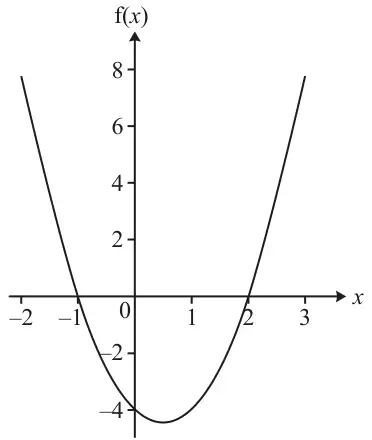
A cubic curve has gradient function \(\mathrm{f}(x)\). This cubic curve passes through the point \((0, 8)\).
| Scheme | Marks | AO |
|---|---|---|
| \(\mathrm{f}(x) = k(x + 1)(x - 2)\) | M1 | 3.1a |
| When \(x = 0\), \(\mathrm{f}(x) = -4\) so \(k = 2\) | B1 | 1.1a |
| So \(\mathrm{f}(x) = 2x^2 - 2x - 4\) | A1 | 1.1 |
| [3] |
Notes
M1: Uses product of linear terms in an equation. Condone \(k = 1\) used
B1: Allow if \(2x^2\) or \(k = 2\) seen
A1: Correct expanded expression
Alternative method
| Scheme | Marks | AO |
|---|---|---|
| \((-1, 0)\quad 0 = a - b + c\) \((2, 0)\quad\ \ 0 = 4a + 2b + c\) | M1 | |
| \(c = -4\) | B1 | |
| \(a = 2,\ b = -2\) gives \(\mathrm{f}(x) = 2x^2 - 2x - 4\) | A1 |
M1: Setting up simultaneous equations for at least \(a\) and \(b\)
B1: Allow for correct constant term or explicit value for \(c\)
A1: Correct expanded expression
| Scheme | Marks | AO |
|---|---|---|
| \(y = \displaystyle\int (2x^2 - 2x - 4)\,\mathrm{d}x\) | M1 | 3.1a |
| \(y = \frac{2}{3}x^3 - x^2 - 4x + c\) | A1FT | 1.1 |
| When \(x = 0,\ y = 8\) | M1 | 1.1a |
| So \(y = \frac{2}{3}x^3 - x^2 - 4x + 8\) | A1 | 1.1 |
| [4] |
Notes
M1: Attempt to integrate their \(\mathrm{f}(x)\)
A1FT: FT their \(\mathrm{f}(x)\). Condone missing \(+c\) and missing \(y =\)
M1: Uses \((0, 8)\) to evaluate \(c\). May be implied by correct constant term
A1: Cao \(y =\) must be seen
| Scheme | Marks | AO |
|---|---|---|
| \(\dfrac{\mathrm{d}y}{\mathrm{d}x} = 0\) when \(x = -1,\ 2\) | M1 | 1.1a |
| \(x = -1 \Rightarrow y = \frac{31}{3}\), so \(\left(-1, \frac{31}{3}\right)\) | A1 | 1.1 |
| and \(x = 2 \Rightarrow y = \frac{4}{3}\), so \(\left(2, \frac{4}{3}\right)\) | A1 | 1.1 |
| [3] |
Notes
M1: Sets \(\mathrm{f}(x)\) or the derivative of their \(y\) to zero and attempts to solve
A1: cao
A1: cao