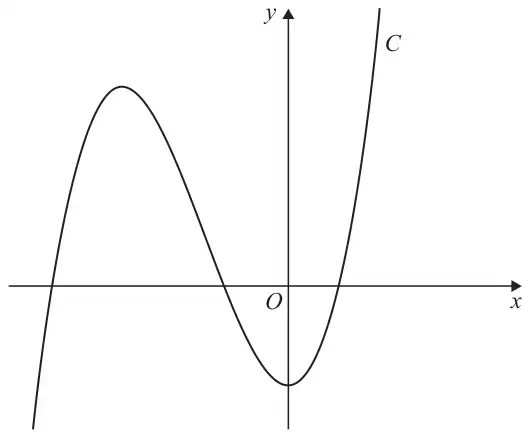
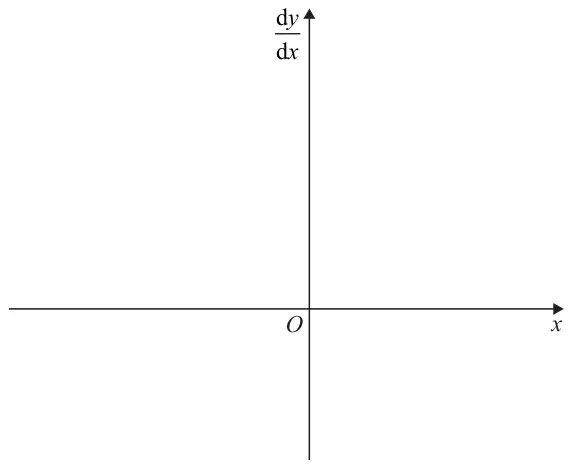
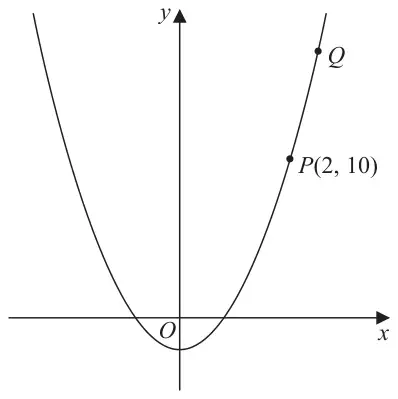
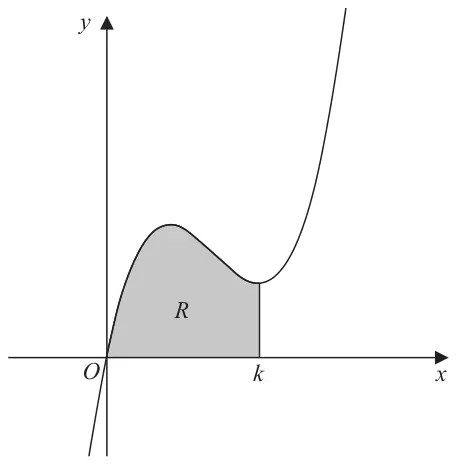
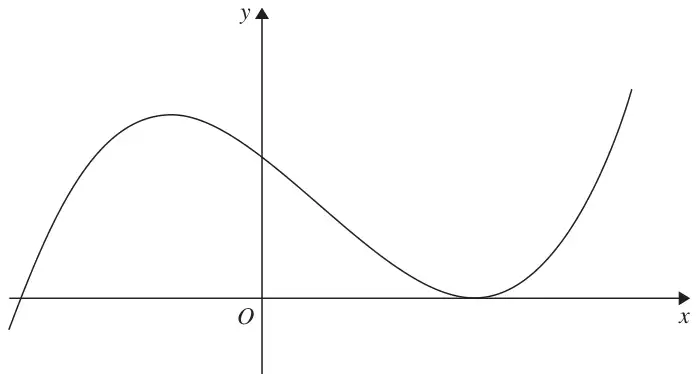
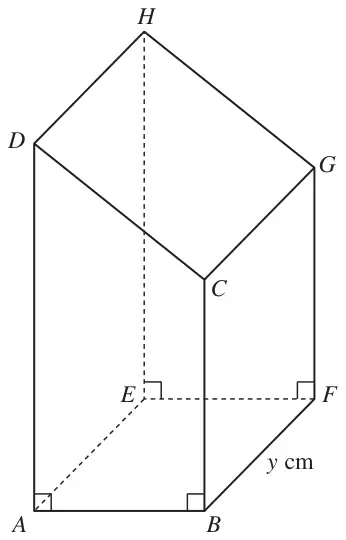
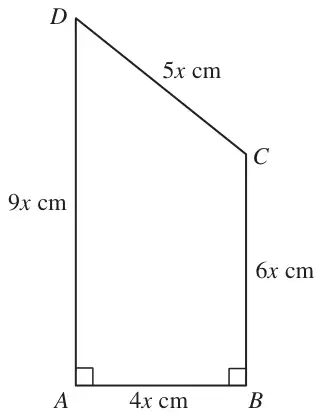
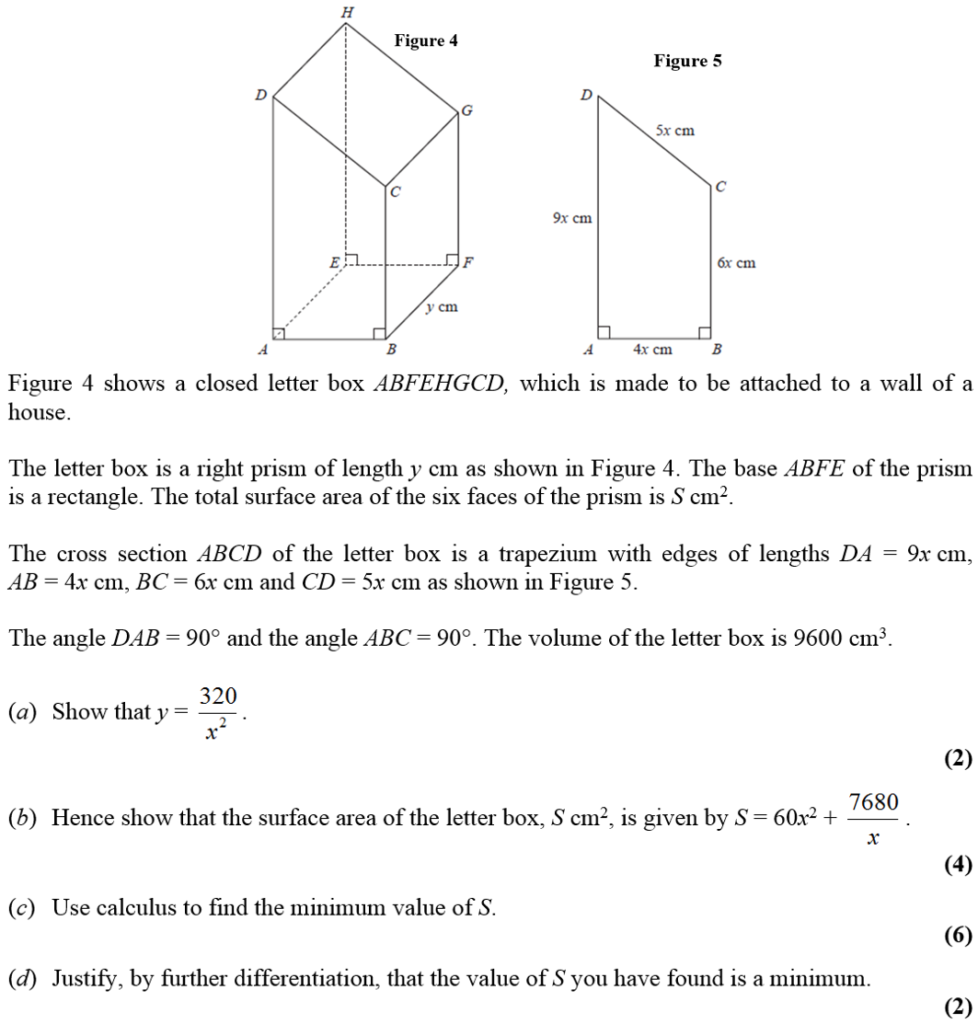
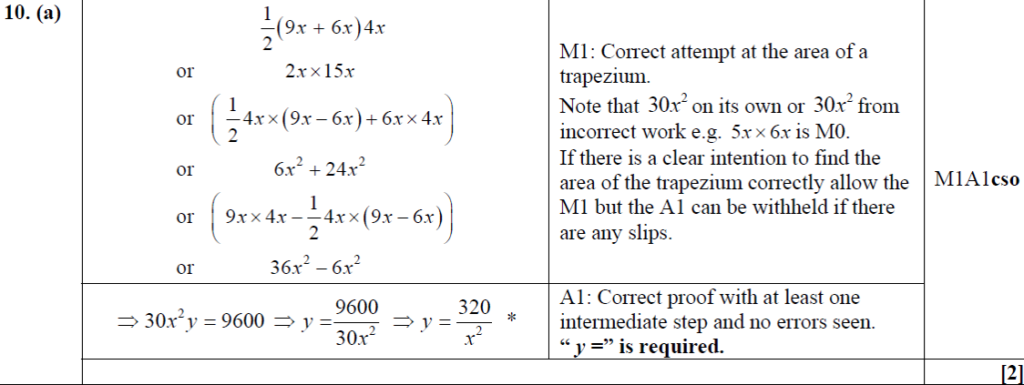
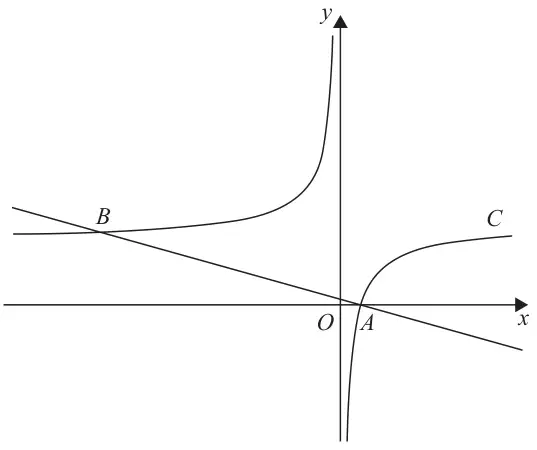
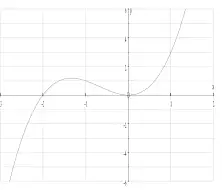
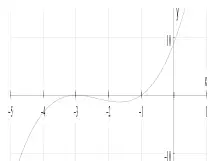
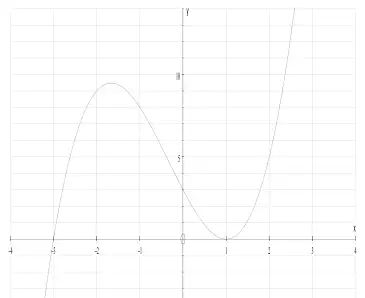
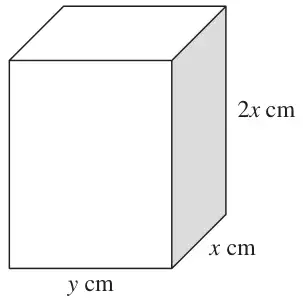
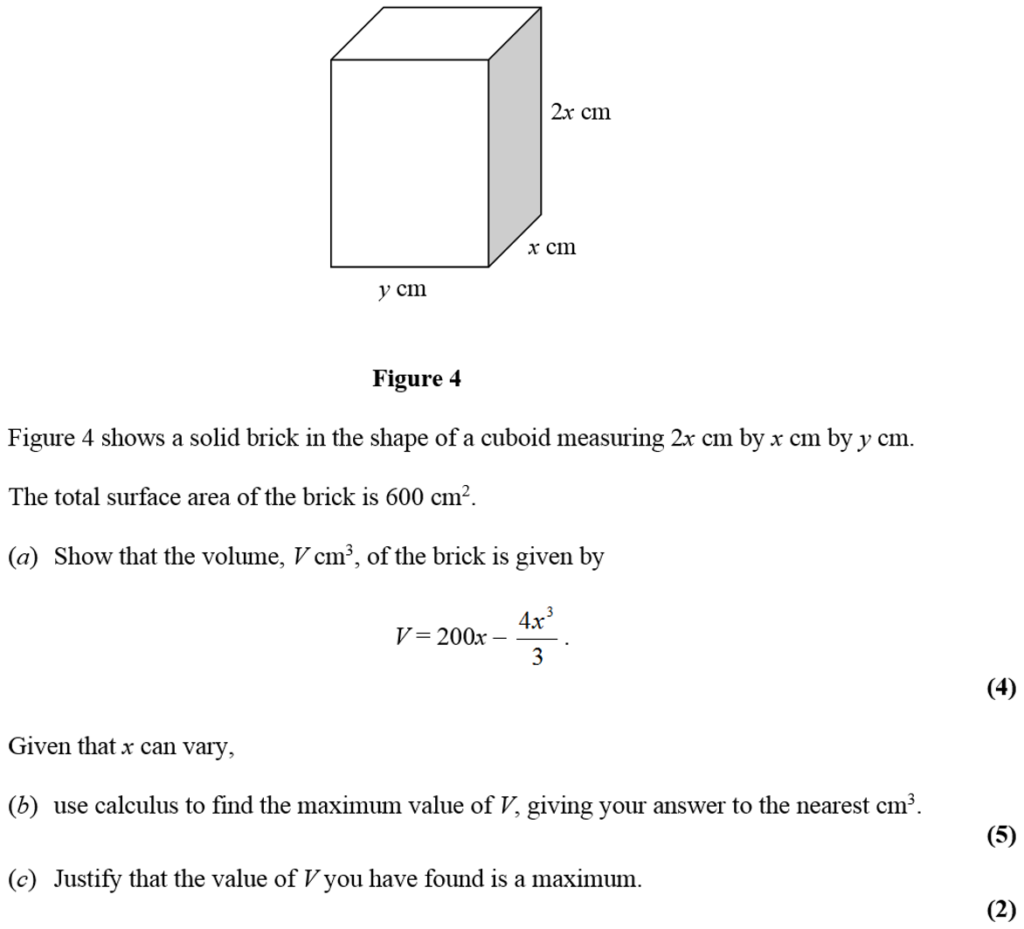
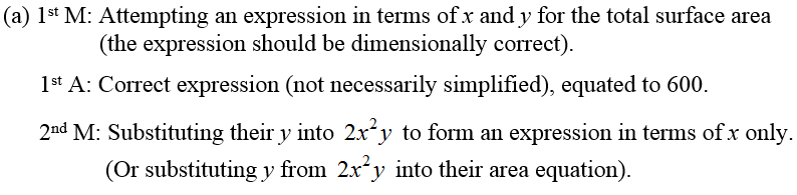
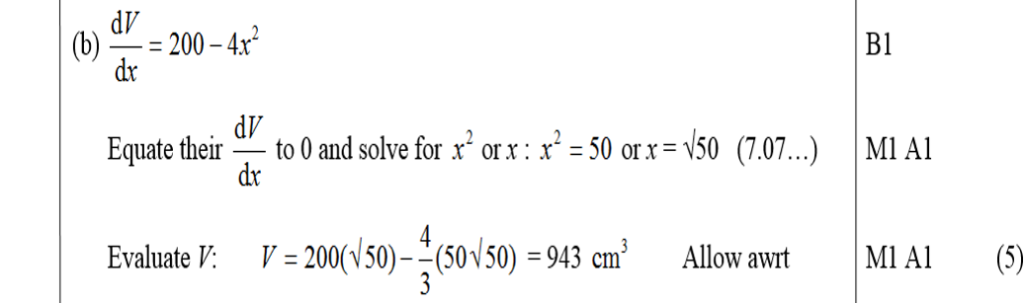
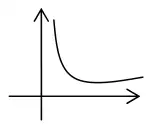
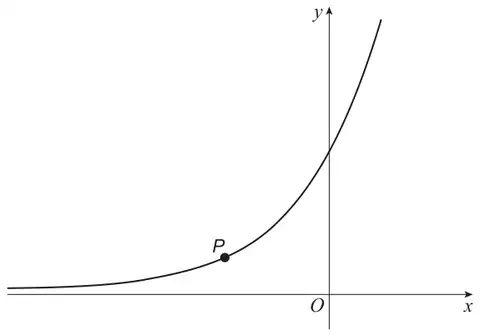
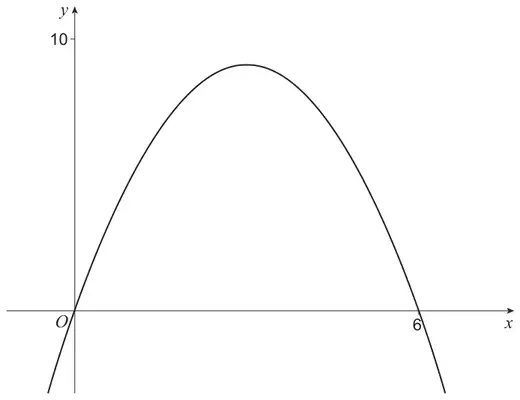
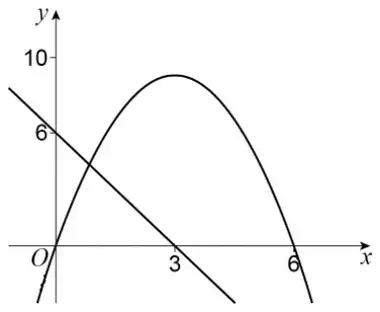
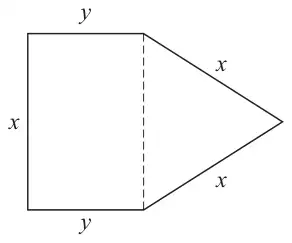
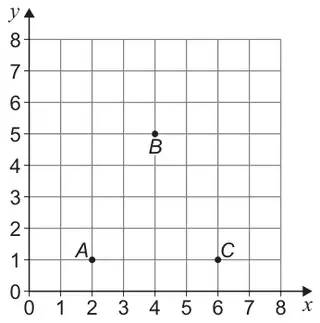
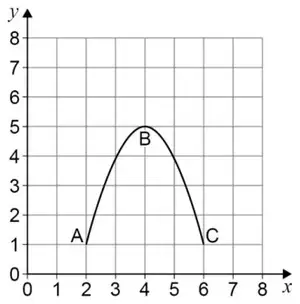
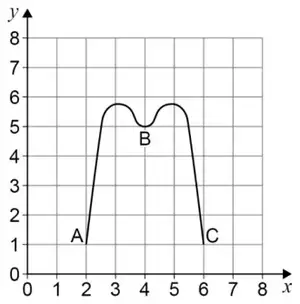
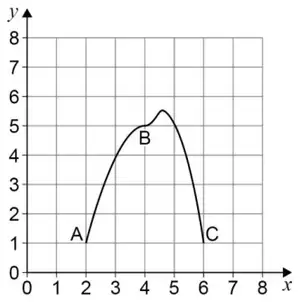
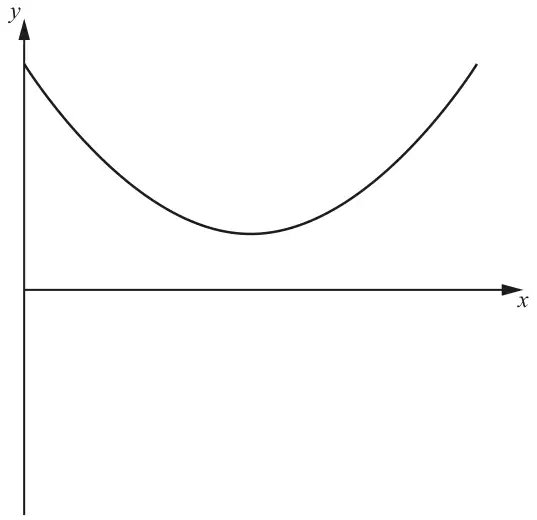
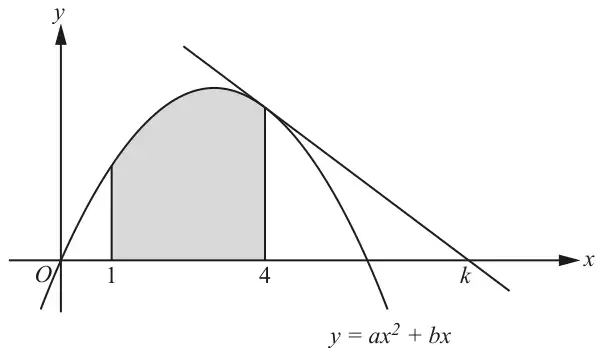
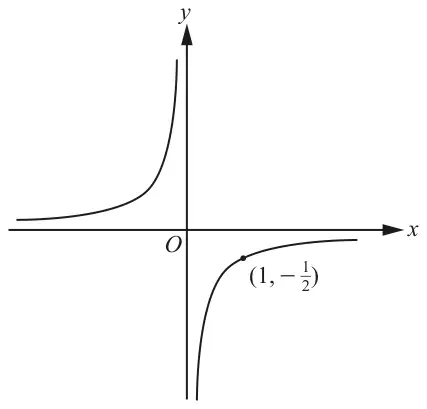
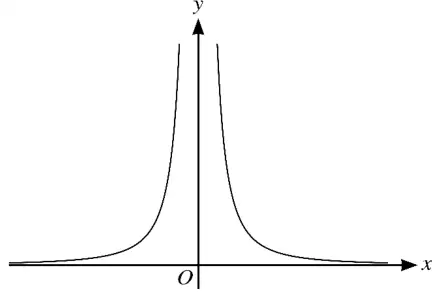
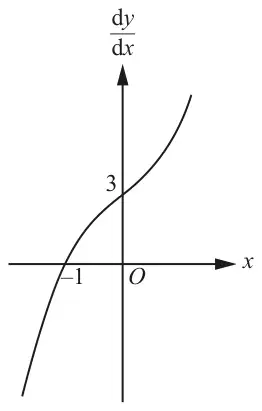
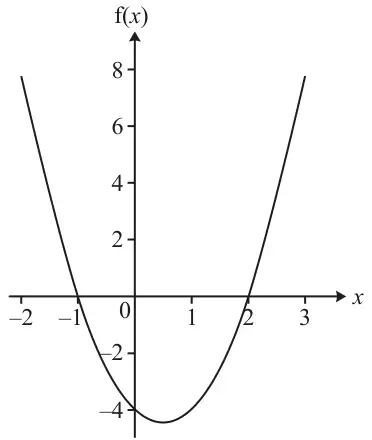
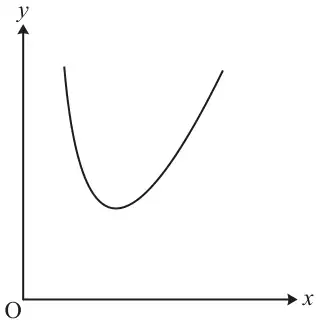
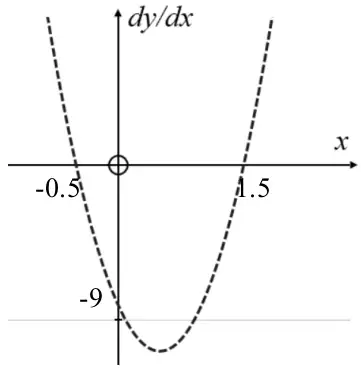
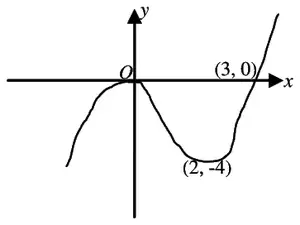
(b) State the correct equation for the gradient function, fully justifying your answer. (2)
Mark scheme (a)
Scheme
Marks
AO
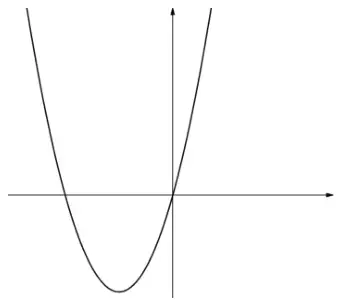
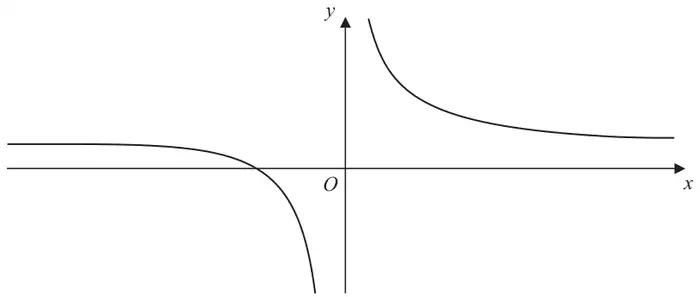
\(\cup\) shaped not \(\cap\) shaped.
B1
1.1b
Crosses the negative \(x\)-axis.
B1
1.1b
Crosses the \(x\)-axis at the origin.
B1
1.1b
(3)
Notes
Look out for the sketch drawn on Figure 5 but Diagram 1 takes precedence.
Ignore any values given at intersection/turning points.
B1: \(\cup\) shaped curve not \(\cap\) shaped. Ignore any roots or lack of roots.
B1: At least one intersection with the negative \(x\)-axis. (May be a straight line) Allow their curve/line to touch for this mark.
B1: A curve intersecting the origin. (May be a straight line) Allow their curve/line to touch for this mark.
Mark scheme (b)
Scheme
Marks
AO
Correctly identifies \(\left(\dfrac{\mathrm{d}y}{\mathrm{d}x} =\right) 3x^2 + 9x\) with one correct justification (see below)
B1
2.2a
It is a positive quadratic with a negative root and a root at the origin.
dB1
2.4
Notes
Look out for the sketch drawn on Figure 5 but Diagram 1 takes precedence.
B1: Deduces that the gradient function is \(\left(\dfrac{\mathrm{d}y}{\mathrm{d}x} =\right) 3x^2 + 9x\) with one valid justification (see below) Allow correct calculations for either roots \(x = -3\) or \(x = 0\) or for the turning point at \(x = -\dfrac{3}{2}\) as a valid justification.
dB1: Explanation that includes
one root being negative or e.g. has a root at \(x = -3\) with no implication of there being more than one negative root
one root being at the origin (or \(O\)) e.g. has a root at \(x = 0\) (condone the \(y\) intercept is 0 but not “it doesn’t have a \(y\) intercept”)
that it is U shaped (or a positive parabola/quadratic or it is the derivative of a positive cubic but not “positive graph/curve”)
Alternatively, allow a complete explanation eliminating each of the other equations. e.g. can’t be:
\((x+1)^2 - 2\) as this doesn’t go through the origin
\(-x(x+7)\) as this is not a U shape
\(x^2 - 5x\) as this doesn’t have a negative root
Or e.g.
the curve has a turning point in quadrant 3 or is at \(\left(-\dfrac{3}{2},\ -\dfrac{27}{4}\right)\)
one root is at the origin
If extra incorrect statements are included they can be ignored. Note B0dB1 is not possible.
In this question you must show all stages of your working.
Solutions relying entirely on calculator technology are not acceptable.
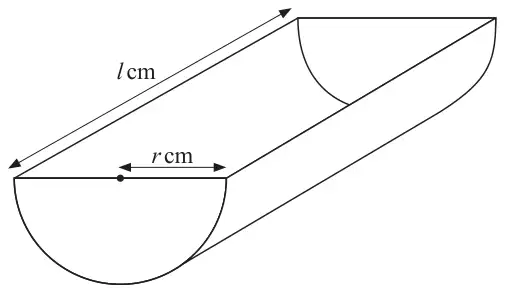
Figure 4
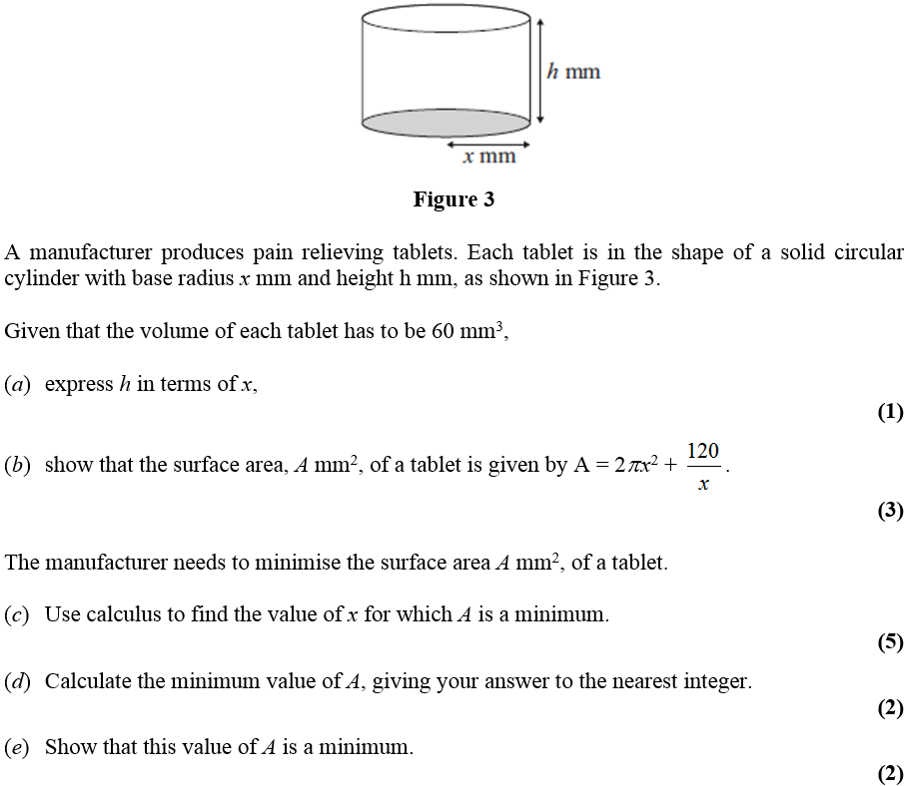
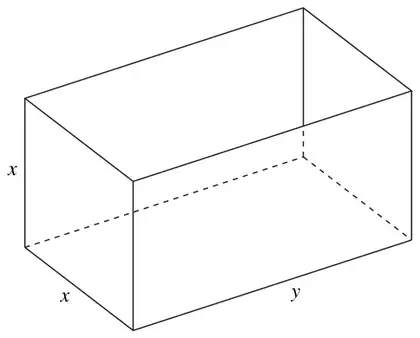
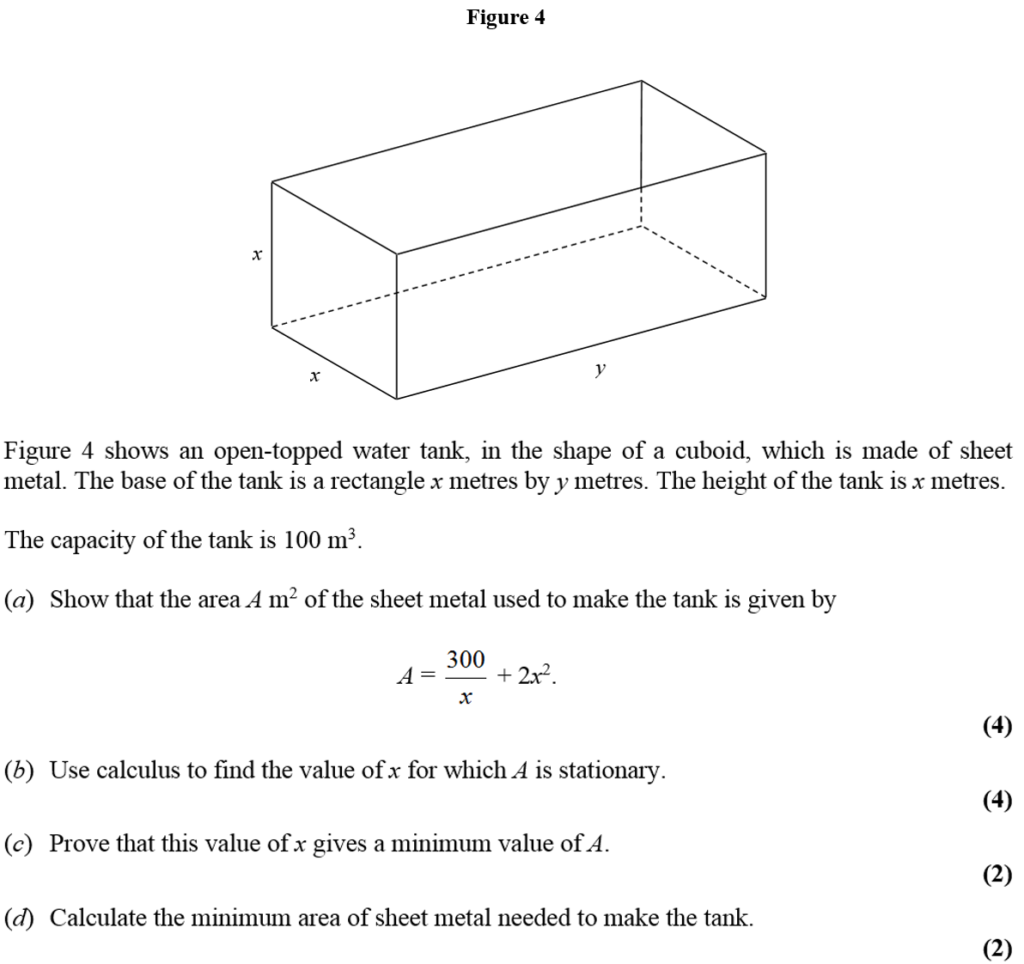
Figure 4 shows a design for a feeding trough.
The trough is modelled as a hollow, semicircular cylinder of radius \(r\) cm and length \(l\) cm.
The trough will be made from sheet metal of negligible thickness.
Given that the capacity of the trough will be \(90\,000\pi\ \text{cm}^3\)
(a) show that the total area, \(A\ \text{cm}^2\), of sheet metal required to make the trough is given by\[A = \frac{180\,000\pi}{r} + \pi r^2\] (4)
(b) Use calculus to find the radius of the trough for which \(A\) is a minimum. (4)
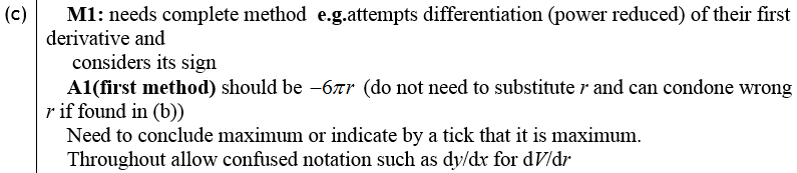
(c) Show that the radius found in part (b) gives the minimum value of \(A\). (2)
Given that the sheet metal costs £30 per square metre
(d) calculate the minimum cost of sheet metal required to make one trough. (2)
(e) State one assumption you have made in calculating your answer to part (d). (1)
Mark scheme (a)
Scheme
Marks
AO
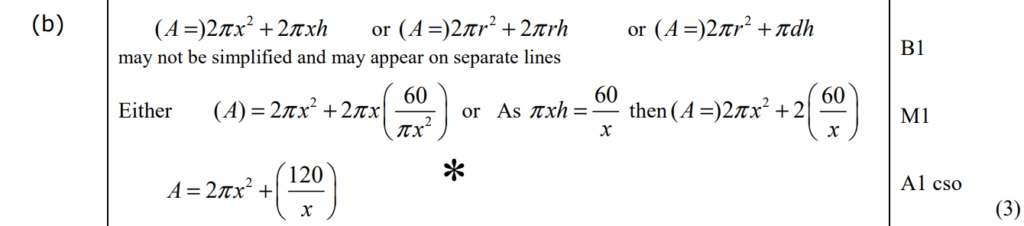
\((V =)\ \dfrac{1}{2}\pi r^2 l = 90\,000\pi\)
B1
1.1b
\((A =)\ \pi r^2 + \pi r l\)
B1
1.1b
\(l = \dfrac{180\,000}{r^2} \Rightarrow A = \pi r^2 + \pi r\left(\dfrac{180\,000}{r^2}\right)\) or e.g. \(\pi r l = \dfrac{180\,000\pi}{r} \Rightarrow A = \pi r^2 + \dfrac{180\,000\pi}{r}\) or e.g. \(rl = \dfrac{180\,000}{r} \Rightarrow A = \pi r^2 + \pi\left(\dfrac{180\,000}{r}\right)\)
M1
1.1b
\((A =)\ \pi r^2 + \dfrac{180\,000\pi}{r}\,*\)
A1*
1.1b
(4)
Notes
In Q11 there are a lot of parts so mark positively and condone mislabelling if they are clearly doing the right thing for a particular part.
(a) Condone use of e.g. \(h\) for \(l\) or e.g. \(R\) for \(r\) as long as the intention is clear.
B1: Correct equation seen for volume: \(\dfrac{1}{2}\pi r^2 l = 90\,000\pi\) or \(\pi r^2 l = 180\,000\pi\) or \(\pi r^2 l = 2(90\,000\pi)\) or \(\dfrac{1}{2}r^2 l = 90\,000\) or \(r^2 l = 180\,000\) or \(r^2 l = 2(90\,000)\) May not be implied by subsequent work.
B1:Correct expression for the area stated in terms of the radius (or diameter) and length: e.g. \((A =)\ \pi r^2 + \pi r l\) but allow equivalent correct expression so that the “ends” are any one of:
\(\pi r^2\)
\(\dfrac{1}{2}\pi r^2 + \dfrac{1}{2}\pi r^2\)
\(\pi\left(\dfrac{d}{2}\right)^2\)
\(\dfrac{2\pi r^2}{2}\)
\(2 \times 0.5\pi r^2\)
And the curved surface area is any one of:
\(\pi r l\)
\(\dfrac{1}{2}(2\pi r l)\)
\(\dfrac{\pi l d}{2}\)
These may be seen separately before being combined at the end. Condone a missing “\(A =\)” for this mark. Cannot be implied.
M1: Rearranges their \(\dfrac{1}{2}\pi r^2 l = 90\,000\pi\) to e.g. \(l = \ldots\) or \(\pi r l = \ldots\) or \(rl = \ldots\) and substitutes in for e.g. \(l\) or \(\pi r l\) or \(rl\) in their formula for the area which must have at least 2 terms, all of which must be dimensionally correct, to obtain an expression in terms of \(r\) only. This mark cannot be implied and substitution needs to be shown, not just the printed answer written down. This may be seen combined at the end.
A1*: cso. The “\(A =\)” does not have to be seen. Ignore any units given. All previous marks must be scored. Isw once a correct answer is reached from correct work.
\(\Rightarrow r = \sqrt[3]{90\,000}\) or \(r =\) awrt 44.8 (cm)
A1
1.1b
(4)
Notes
In Q11 there are a lot of parts so mark positively and condone mislabelling if they are clearly doing the right thing for a particular part.
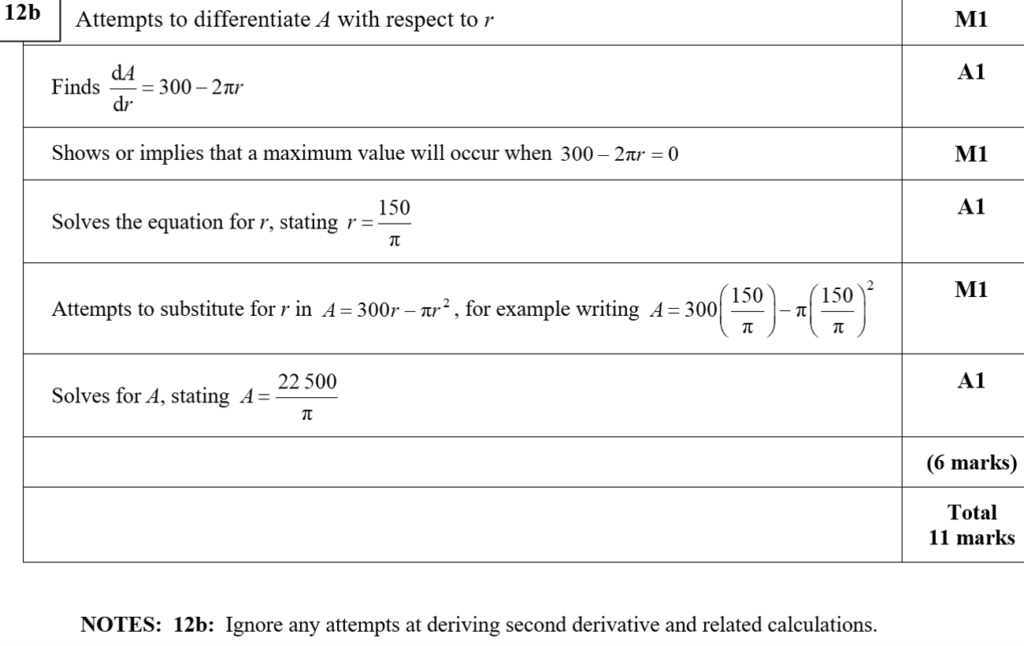
M1: Attempts to differentiate \(A = \pi r^2 + \dfrac{180\,000\pi}{r}\) with respect to \(r\). Award for \(\left(\dfrac{\mathrm{d}A}{\mathrm{d}r} =\right) \ldots r \pm \ldots r^{-2}\)
A1: \(\left\{\dfrac{\mathrm{d}A}{\mathrm{d}r} =\right\} 2\pi r - 180\,000\pi r^{-2}\) Condone \(\dfrac{\mathrm{d}A}{\mathrm{d}r}\) appearing as \(\dfrac{\mathrm{d}y}{\mathrm{d}x}\) or being absent.
dM1: Sets their \(\dfrac{\mathrm{d}A}{\mathrm{d}r} \ldots 0\) where “…” could be an inequality and arrives at a value for \(r\) via \(r^{\pm 3} \ldots k,\ k \gt 0\) where “…” could be an inequality. May be implied by e.g. \(r = \sqrt[3]{\ldots}\) or \(r = \sqrt[-3]{\ldots}\) where “…” > 0 They cannot just go from e.g. \(2\pi r - 180\,000\pi r^{-2} = 0\) straight to a value for \(r\).
A1: Awrt 44.8 or \(\sqrt[3]{90\,000}\) Condone omission of units or use of incorrect units. Do not allow e.g. \(\pm\) 44.8 or e.g. \(r \gt 44.8\)
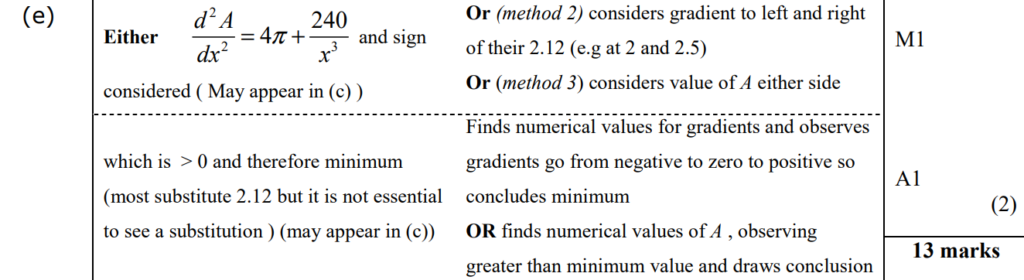
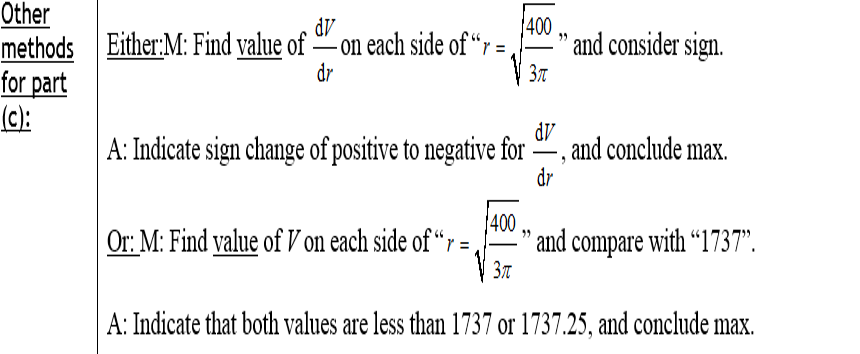
\(\dfrac{\mathrm{d}^2A}{\mathrm{d}r^2} = (+18.8) \gt 0\) hence minimum (value of \(A\))*
A1
2.4
(2)
Notes
In Q11 there are a lot of parts so mark positively and condone mislabelling if they are clearly doing the right thing for a particular part.
M1: Attempts to find \(\dfrac{\mathrm{d}^2A}{\mathrm{d}r^2}\) following on from their \(\dfrac{\mathrm{d}A}{\mathrm{d}r}\) which includes \(\ldots r \to\) constant and \(\ldots r^{-2} \to \ldots r^{-3}\) and attempts to find its value with their \(r\) (may need to check) or considers its sign with reference to their \(r\). Condone slips in substituting as long as the intention is clear.
Alt may consider the value of \(\dfrac{\mathrm{d}A}{\mathrm{d}r}\) either side e.g. \(\left(\dfrac{\mathrm{d}A}{\mathrm{d}r}\right)_{x=44} = -15.6\ldots,\ \left(\dfrac{\mathrm{d}A}{\mathrm{d}r}\right)_{x=45} = 3.49\ldots\)
or may consider the value of \(A\) either side e.g. \((A)_{x=44.8} = 18927,\ (A)_{x=44} = 18934,\ (A)_{x=45} = 18928\)
A1: Fully correct work and conclusion. This requires
correct work in (b) with the correct value of \(r\)
a correct \(\frac{\mathrm{d}^2A}{\mathrm{d}r^2}\)
obtaining \(\frac{\mathrm{d}^2A}{\mathrm{d}r^2} =\) awrt 19 (or \(6\pi\)) (or truncated as 18) which is > 0 or e.g. \(\frac{\mathrm{d}^2A}{\mathrm{d}r^2} \gt 0\) as \(r \gt 0\)
a conclusion that it is the minimum
For the alt it would be for
correct calculations
e.g. gradient goes from negative to positive so minimum
e.g. \(A\) is larger either side of 44.8 so minimum
Mark scheme (d)
Scheme
Marks
AO
Substitutes \(r = 44.8\) into \(A = \pi r^2 + \dfrac{180\,000\pi}{r}\) \(\{=\text{awrt } 18900\}\) Or may be seen embedded in a (possibly incorrect) conversion e.g. substitutes \(r = 44.8\) into \(\dfrac{30}{100^2}\left(\pi r^2 + \dfrac{180\,000\pi}{r}\right)\) \(\{=\text{awrt } 56.8\}\)
M1
3.4
Minimum cost = £56.78
A1
1.1b
(2)
Notes
In Q11 there are a lot of parts so mark positively and condone mislabelling if they are clearly doing the right thing for a particular part.
M1: For a correct method of finding \(A\) or \(\dfrac{30A}{100^2}\) or e.g. \(30A\) from their solution to \(\dfrac{\mathrm{d}A}{\mathrm{d}r} = 0\) May be implied by e.g. 18928 Do not accept attempts using negative values of \(r\).
A1: Minimum cost = £56.78 or £56.79 including units.
Mark scheme (e)
Scheme
Marks
AO
Accept any sensible assumption, e.g.,
The exact amount of metal required can be bought.
No metal goes to waste.
The trough can be made as a perfect (semicircular) cylinder.
It’s possible to cut accurately
Condone
Need to buy a fixed amount
You can’t buy the exact amount of metal
There will be wastage due to the shape
No extra amount of metal is needed
There will be no errors when cutting the metal
The trough will be fully smooth/have no imperfections
Do not allow e.g.
The thickness of the sheet is negligible
B1
3.5a
(1)
(13 marks)
Notes
In Q11 there are a lot of parts so mark positively and condone mislabelling if they are clearly doing the right thing for a particular part.
B1: See main scheme. Do not accept reference to additional work required, such as labour costs, or materials required to weld the metal together.
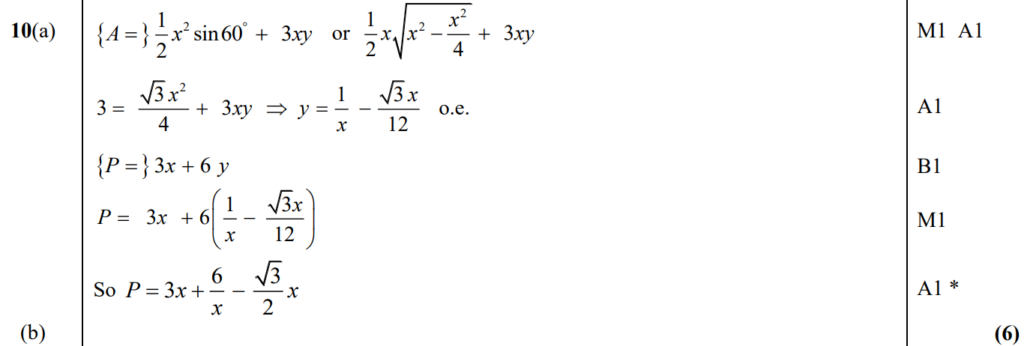
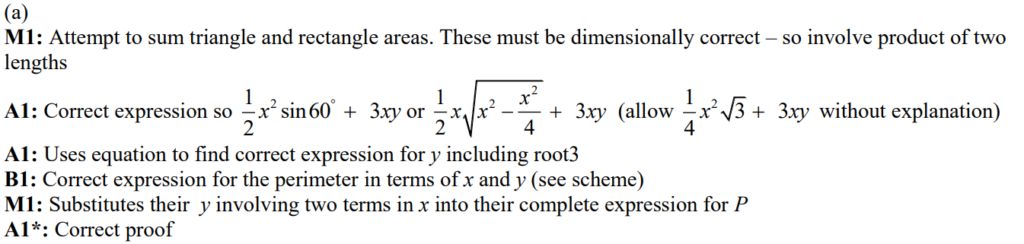
Note that different sections of the perimeter may be completed separately and brought together in a final line. Most marks will only be scored at this point – send to review if unsure.
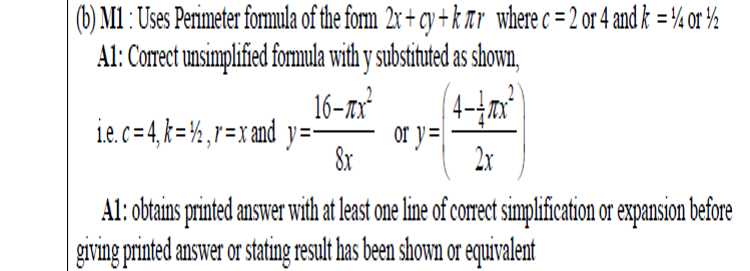
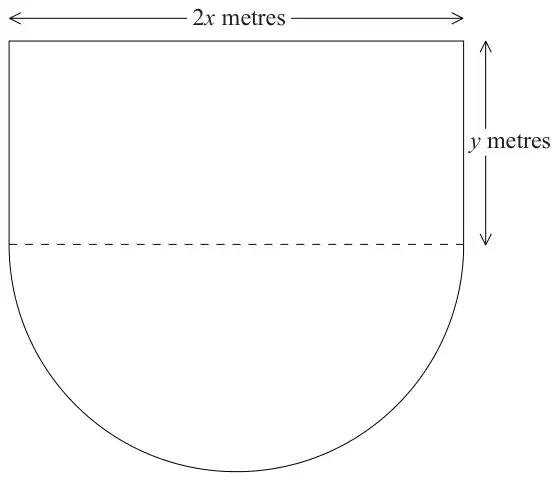
B1: Correct expression for the surface area in terms of \(x\) and \(y\) only (may be in an equivalent form). May be implied by their equation set equal to 100 or their rearranged form.
M1: Sets their expression in \(x\) and \(y\) equal to 100 and rearranges to make \(y\) (or \(2y\) or \(4y\)) the subject. Do not be concerned by the mechanics of their rearrangement. May be implied by further work or can be scored for a different valid substitution into their expression for the perimeter.
B1: Correct expression for the perimeter in terms of \(x\) and \(y\) (may be in an equivalent form) and may be implied by an expression for the perimeter in terms of \(x\) if they have substituted in for their \(y\) straight away (which may be incorrect or have been rearranged incorrectly)
M1: Attempts to substitute their \(y\) into their perimeter to produce an expression or equation in just \(x\). Condone invisible brackets for this mark. Condone slips provided the intention is clear.
A1*: \(P = 2x + \dfrac{200}{x}\) cso (Condone the omission of \(P =\) on the final line if it is seen on an earlier line of working) Allow Perimeter = Do not withhold this mark if missing/invisible brackets are recovered in their working.
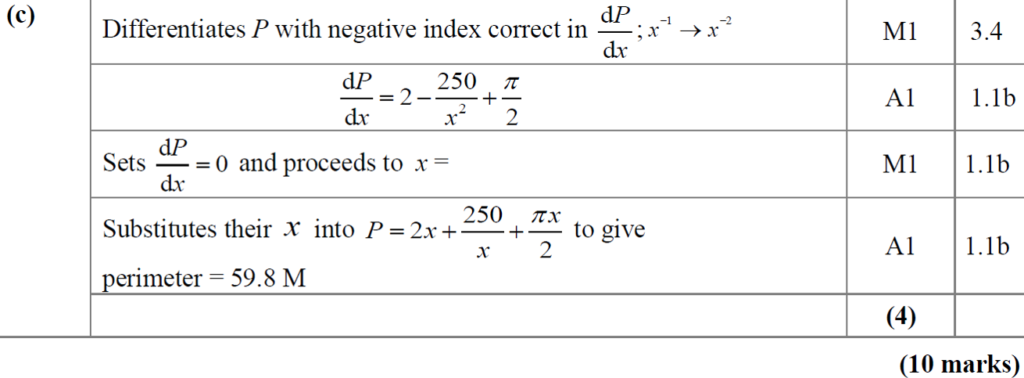
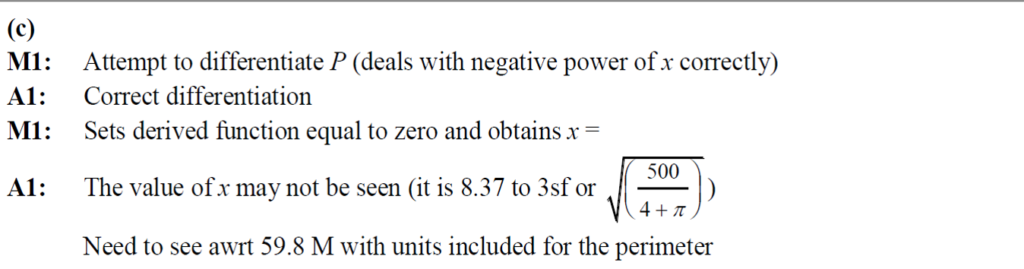
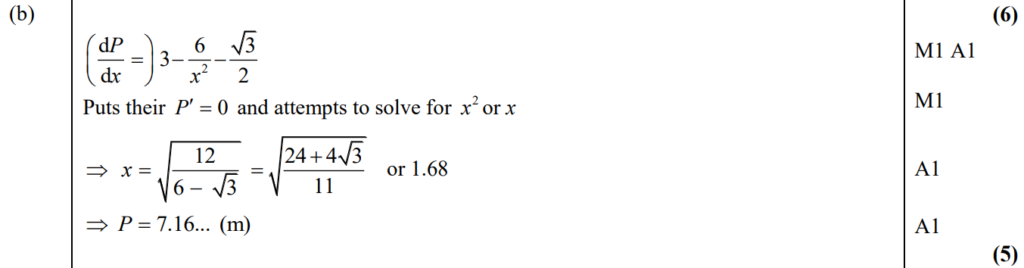
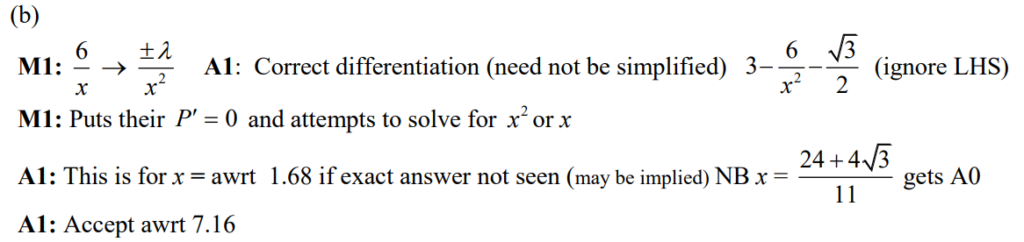
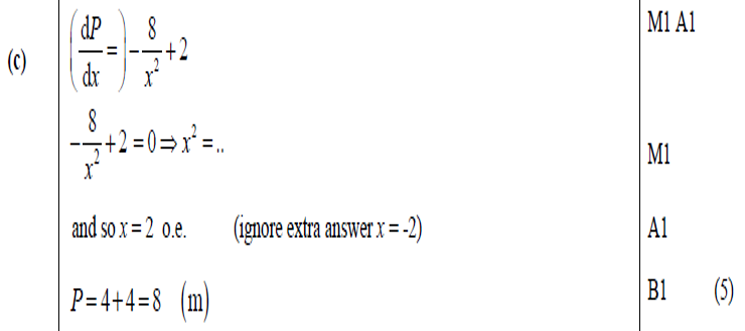
M1: Attempts to differentiate the given expression for \(P\) achieving an answer of the form \(A \pm Bx^{-2}\) Condone candidates who do not achieve the given answer but their derivative differentiates to the required form to score this mark (and possibly dM1)
A1: \(2 - 200x^{-2}\) o.e.
dM1: Sets their derivative of the form \(A - Bx^{-2}\), \(A \times B \gt 0\) equal to 0 and rearranges to find a value for \(x\). It is dependent on the previous method mark. Condone slips in their rearrangement. May proceed directly to the answer.
A1: 10 cao (provided a correct derivative is seen) \(\pm 10\) is A0 isw if they attempt to find \(P\)
e.g. \(\dfrac{\mathrm{d}^2P}{\mathrm{d}x^2}\ (= 0.4) \gt 0\) hence minimum (perimeter)
A1
2.4
(2)
Notes
Note that attempts only evaluating the gradient either side of \(x = 10\) is M0A0
M1: Finds \(\dfrac{\mathrm{d}^2P}{\mathrm{d}x^2}\) of the form \(Ax^{-3}\) o.e. and either considers the sign or evaluates for their positive \(x\)
A1: Requires
\(\left(\dfrac{\mathrm{d}^2P}{\mathrm{d}x^2} =\right) 400x^{-3}\) (condone this mark if \(\dfrac{\mathrm{d}^2y}{\mathrm{d}x^2}\) is written or any other incorrect notation)
reference to \(400x^{-3}\) being \(\gt 0\) for \(x \gt 0\), or by using either a correct calculation (0.4 o.e.), a correct numerical expression or the algebraic expression and referencing that it is \(\gt 0\) for \(x = 10\)
correct conclusion e.g. hence min, shown, tick, QED Condone “minimum value of \(x\)”
Mark scheme (d)
Scheme
Marks
AO
e.g. \(y = \dfrac{400 - \pi \times \text{``}10\text{''}^2}{8 \times \text{``}10\text{''}}\)
M1
3.4
e.g. \(y = 1.07\) (m) so yes this would be suitable
A1
2.2a
(2)
(13 marks)
Notes
M1: Either
substitutes their value of \(x\) into any of their equations involving \(y\) or their expression for \(y\) from part (a) (unless restarted) to find a value for \(y\)
uses their value of \(x\) to find their minimum value of \(P\) using the given expression for \(P\), and then uses their \(x\) and their \(P\) to find a value for \(y\)
attempts to find the value of \(x\) when \(y = 1\) (allow to be solved directly from a calculator once a three-term quadratic has been formed)
attempts to find the value of \(P\) using the given expression for \(P\), their value for \(x\) and \(y = 1\)
Condone slips provided the intention is clear of their intended method.
A1: awrt 1.1 m and concludes would be suitable (yes is sufficient or a tick) Note that “yes suitable because e.g. \(1.07 \gt 0\) is A0” (it had to be greater than 1) If they find the value for \(x\) when \(y = 1\) it requires a correct comparison of awrt 10.1 with 10 so yes suitable If they find the value of \(P\) using \(x = 10\) and \(y = 1\) it requires a correct comparison of awrt 39.7 with 40 so yes suitable
e.g. \(3x^2 - 14 = -2 \Rightarrow 3x^2 = 12 \Rightarrow x = \ldots\)
dM1
1.1b
\(x = 2\) only *
A1*
2.2a
(3)
Notes
(a) On EPEN this is M1A1A1* we are marking this as M1dM1A1*
M1: Differentiates the cubic to achieve \(px^2 + q\) and sets equal to \(-2\). Note setting the linear and cubic equations equal to each other and solving is M0 (no use of calculus) but, they may differentiate \(\pm(\text{cubic} - \text{line})\) to achieve \(px^2 + q\) and set equal to 0 which is M1. Alternatively, in either approach, differentiates to achieve \(px^2 + q\) and substitutes in \(x = 2\)
dM1: Proceeds from their equation to find a real value for \(x\) with at least one intermediate stage of working. e.g. \(px^2 = -q \Rightarrow x = \ldots\) or e.g. via factorisation \((3)(x + 2)(x - 2) = 0 \Rightarrow x = \ldots\) Accept proceeding directly to \(x = \sqrt{\dfrac{14 - 2}{3}}\) or \(\pm 2\) In the alternative, it is for substituting in 2 into their \(3(2)^2 - 14 = \ldots\) or \(3(2)^2 - 12 = \ldots\)
A1*: 2 only (the solution of \(-2\) does not need to be found) \(\pm 2\) without selecting 2/ rejecting -2 is A0*. In the alternative they conclude that \(x = 2\).
Mark scheme (b)
Scheme
Marks
AO
e.g. Substitutes \(x = -4\) into \(y = x^3 - 14x + 23\) and \(y = -2x + 7\)
M1
1.1b
Correct solution + conclusion * (see notes)
A1*
2.4
(2)
Notes
Work may be seen in (a) but must be used in (b) to score
M1: Mark the general method / do not be concerned by slips in their working. Either e.g.
substitutes \(x = -4\) into \(y = x^3 - 14x + 23\) and \(y = -2x + 7\). Sight of \(-4\) embedded in the equations is sufficient.
substitutes \(x = -4\) into one equation to find \(y\) and then uses this value to find \(x\) in the other equation.
equates the cubic and the linear expressions, rearranges (= 0) and then
substitutes \(x = -4\) into the equation or expression
factorises using \((x - 2)^2\) to find a linear factor (e.g. inspection / division)
algebraically divides by \((x + 4)\) at some point to get a remainder of 0
factorises using \((x - 2)\) to find a quadratic factor which they attempt to factorise
A1*:A correct solution with conclusion but allow recovery of missing/invisible brackets. Either
finds \(y = 15\) when \(x = -4\) for both equations
finds \(y = 15\) using one equation and uses this to find that \(x = -4\) for the other
verifies that \(x = -4\) is a solution of the cubic – linear = 0 with no errors seen.
solves cubic – linear = 0 and finds the linear factor \((x + 4)\) leading to the root \(x = -4\)
There must be a conclusion: if they find \(x = -4\) then a tick, QED, underline, proven. If they find e.g. \(y = 15\) for both they must state \(x = -4\) e.g.“(same \(y\) values so) \(x = -4\)” Note that stating the coordinates \((-4,\ 15)\) is insufficient.
No integration seen (using the integration button on a calculator) will score 0 marks
M1: Integrates the equation of the curve or in the alternative method it is for integrating curve-line and achieving at least two terms with a correct index out of \(\ldots x^4 \pm \ldots x^2 \pm \ldots x\) Also look out for a transformation approach translating the cubic down 3 units and integrating \(\displaystyle\int \left(x^3 - 14x + 20\right)\mathrm{d}x = \frac{x^4}{4} - 7x^2 + 20x\)
A1: \(\dfrac{x^4}{4} - 7x^2 + 23x\) or \(\dfrac{x^4}{4} - 6x^2 + 16x\) (ignore any constant of integration). Allow unsimplified but the indices must be processed. Look out for \(\dfrac{x^4}{4} - 7x^2 + 20x\) if the cubic has been translated down 3 units. Do not penalise poor notation for this mark.
dM1: Correct limits of 2 and \(-4\) used for their integral (which may be for the line or curve). It is dependent on the previous method mark. Evidence of substituting in 2 and \(-4\) into their integrated expression must be seen. (e.g. \(22 - (-140)\)). In the alternative method the dM1 (and next dM1) are scored at the same time for substituting in the correct limits.
dM1: Correct strategy to find the shaded area. It is dependent on the first method mark only but the limits must be correct. In the alternative method this mark is scored for sight of 2 and \(-4\) for their integral which do not have to be substituted in. The method to find any areas e.g. trapezium, rectangle, triangle must be correct and the method of adding or subtracting to find the shaded area must be correct. Condone slips in evaluating. Note using the transformation approach they will need to subtract the area of the triangle \(0.5 \times 6 \times (15 - 3)\)
A1*: 108 following from a rigorous argument showing all stages and correct notation used when integrating (the integral sign and the d\(x\) either side of their expression seen at least once and should not be present after integration has been completed)
Full and complete method using the given information \(\mathrm{f}^{\prime}(4) = 0\) and \(\mathrm{f}(4) = 3\) in order to find values for \(a\) and \(b\) Note: \(a = -15\) and \(b = 14\)
M1: For the key step in setting \(\mathrm{f}^{\prime}(4) = 0 \Rightarrow 16 + 2a + b = 0\) to set up an equation in \(a\) and \(b\). Condone slips.
M1: For attempting to integrate \(\mathrm{f}^{\prime}(x)\). Award for \(x^n \to x^{n+1}\) or \(b \to bx\) This may come after finding values for \(a\) or \(b\) or both.
A1ft: \(\{\mathrm{f}(x) =\}\, 2x^2 + \dfrac{2}{3}ax^{\frac{3}{2}} + bx\ \{+c\}\) or, e.g., \(\{\mathrm{f}(x) =\}\, 2x^2 + \dfrac{2}{3}ax^{\frac{3}{2}} + (-16 - 2a)x\ \{+c\}\) Allow ft on their \(b\) in terms of \(a\) if they substituted in from their \(\mathrm{f}^{\prime}(4) = 0 \Rightarrow 16 + 2a + b = 0\) Do not ft if they have a value(s) for \(a\) or \(b\) This may be left unsimplified but the indices must be processed. isw once the mark is awarded. Condone the omission of the \(+ c\) This accuracy mark requires only the previous M mark to be scored.
B1: Deduces that the constant term in \(\mathrm{f}(x)\) is \(-5\). Note that deducing \(b = -5\) is B0. It must be the constant in a changed function.
ddM1: For a complete strategy to find values for both \(a\) and \(b\). Do not be concerned about the logistics of how they solve the simultaneous equations – this may be done on a calculator. Note: \(a = -15\) and \(b = 14\) This is dependent on both previous method marks and so must include use of both
A1: \(\{\mathrm{f}(x) =\}\, 2x^2 - 10x^{\frac{3}{2}} + 14x - 5\) or exact simplified equivalent, e.g., use of \(x\sqrt{x}\) in place of \(x^{\frac{3}{2}}\) Apply isw once a correct expression is seen.
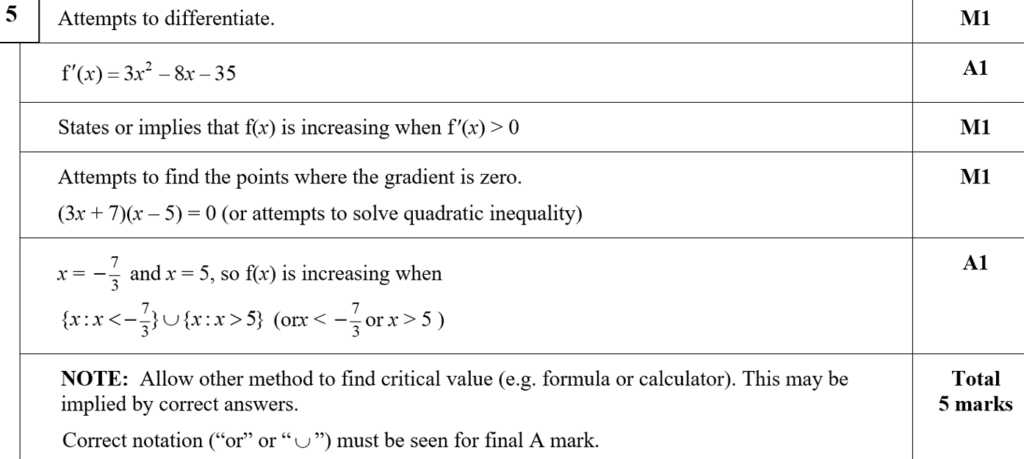
Attempts to solve \(\left\{\dfrac{\mathrm{d}y}{\mathrm{d}x} =\right\}2x^2 - 7x - 4 \ldots 0\) e.g., \((2x + 1)(x - 4) = 0\) leading to \(x = \ldots\) and \(x = \ldots\)
M1
1.1b
Correct critical values \(x = -\dfrac{1}{2}, 4\)
A1
1.1b
Chooses inside region for their critical values
dM1
1.1b
Accept either \(-\dfrac{1}{2} \lt x \lt 4\) or \(-\dfrac{1}{2} \leqslant x \leqslant 4\)
A1
1.1b
(4)
(6 marks)
Notes
M1: Sets their \(\dfrac{\mathrm{d}y}{\mathrm{d}x} \ldots 0\) where \(\ldots\) may be an equality or an inequality and proceeds to find two values for \(x\) from a 3TQ using the usual rules. This may be implied by their critical values.
A1: Correct critical values \(x \ldots -\dfrac{1}{2}, 4\) These may come directly from a calculator and might only be seen on a sketch.
dM1: Chooses the inside region for their critical values.
A1: Accept either \(-\dfrac{1}{2} \lt x \lt 4\) or \(-\dfrac{1}{2} \leqslant x \leqslant 4\) but not, e.g., \(-\dfrac{1}{2} \lt x \leqslant 4\) Condone, e.g., \(x \gt -\dfrac{1}{2},\ x \lt 4\) or \(x \gt -\dfrac{1}{2}\) and \(x \lt 4\) or \(\left\{x : x \gt -\dfrac{1}{2}\right\} \cap \{x : x \lt 4\}\) or \(x \in \left(-\dfrac{1}{2}, 4\right)\) or \(x \in \left[-\dfrac{1}{2}, 4\right]\)
Note: You may see \(x \lt -\dfrac{1}{2}, x \lt 4\) in their initial work before \(-\dfrac{1}{2} \lt x \lt 4\). Condone this so long as it is clear that the \(-\dfrac{1}{2} \lt x \lt 4\) is their final answer.
B1: Correct expression for \(h\) or \(rh\) or \(\pi rh\) in terms of \(r\). This may be implied by their later substitution.
M1: Scored for the sum of the three terms of the form \(0.04\ldots r^2\), \(0.09\ldots r^2\) and \(0.04 \times \ldots rh\) The \(0.04 \times \ldots rh\) may be implied by eg \(0.04 \times \ldots r \times \dfrac{355}{\pi r^2}\) if \(h\) has already been replaced
dM1: Substitutes \(h\) or \(rh\) or \(\pi rh\) into their equation for \(C\) which must be of an allowable form (see above) to obtain an equation connecting \(C\) and \(r\). It is dependent on a correct expression for \(h\) or \(rh\) or \(\pi rh\) in terms of \(r\)
A1*: Achieves given answer with no errors. Allow Cost instead of \(C\) but they cannot just have an expression. As a minimum you must see
the separate equation for volume
the two costs for the top and bottom separate before combining
a substitution before seeing the \(\dfrac{28.4}{r}\) term
M1: Differentiates to obtain at least \(r^{-1} \to r^{-2}\)
A1: Correct derivative.
M1: Sets \(\dfrac{\mathrm{d}C}{\mathrm{d}r} = 0\) and solves for \(r\). There must have been some attempt at differentiation of the equation for \(C\) (\(\ldots r^2 \to \ldots r\) or \(\ldots r^{-1} \to \ldots r^{-2}\)) Do not be concerned with the mechanics of their rearrangement and do not withhold this mark if their solution for \(r\) is negative
A1: Correct value for \(r\). Allow exact value or awrt 3.26
M1: Finds \(\dfrac{\mathrm{d}^2C}{\mathrm{d}r^2}\) at their (positive) \(r\) or considers the sign of \(\dfrac{\mathrm{d}^2C}{\mathrm{d}r^2}\). This mark can be scored as long as their second derivative is of the form \(A + \dfrac{B}{r^3}\) where \(A\) and \(B\) are non zero
A1: Requires
A correct \(\dfrac{\mathrm{d}^2C}{\mathrm{d}r^2}\)
Either
deduces \(\dfrac{\mathrm{d}^2C}{\mathrm{d}r^2} \gt 0\) for \(r \gt 0\) (without evaluating). There must be some minimal explanation as to why it is positive.
substitute their positive \(r\) into \(\dfrac{\mathrm{d}^2C}{\mathrm{d}r^2}\) without evaluating and deduces \(\dfrac{\mathrm{d}^2C}{\mathrm{d}r^2} \gt 0\) for \(r \gt 0\)
evaluate \(\dfrac{\mathrm{d}^2C}{\mathrm{d}r^2}\) (which must be awrt 2.5) and deduces \(\dfrac{\mathrm{d}^2C}{\mathrm{d}r^2} \gt 0\) for \(r \gt 0\)
M1: Uses the model and their positive \(r\) found in (b) to find the minimum cost. Their \(r\) embedded in the expression is sufficient. May be seen in (b) but must be used in (d).
Calculators: If no algebraic differentiation seen then maximum in a) is M0A0B1M1A0*
M1: \(x^n \to x^{n-1}\) seen at least once \(\ldots x^2 \to \ldots x^1,\ \ldots x^{\frac{1}{2}} \to \ldots x^{-\frac{1}{2}},\ 3 \to 0\). Also accept on sight of eg \(\ldots x^{\frac{1}{2}} \to \ldots x^{\frac{1}{2} - 1}\)
A1: \(\dfrac{2}{3}x - x^{-\frac{1}{2}}\) or any unsimplified equivalent (indices must be processed) accept the use of \(0.\dot{6}x\) but not rounded or ambiguous values eg \(0.6x\) or eg \(0.66\ldots x\)
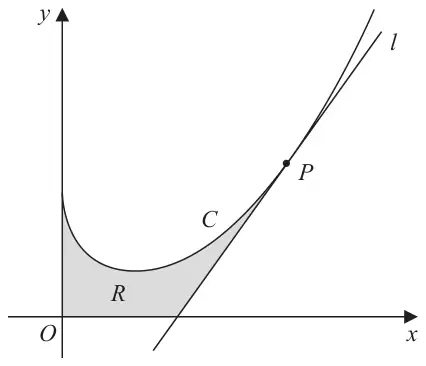
B1: Correct \(y\) coordinate of \(P\). May be seen embedded in an attempt of the equation of \(l\)
M1: Fully correct strategy for an equation for \(l\). Look for \(y - \text{``}\dfrac{13}{3}\text{''} = \text{``}\dfrac{13}{6}\text{''}(x - 4)\) where their \(\dfrac{13}{6}\) is from differentiating the equation of the curve and substituting in \(x = 4\) into their \(\dfrac{\mathrm{d}y}{\mathrm{d}x}\) and the \(y\) coordinate is from substituting \(x = 4\) into the given equation. If they use \(y = mx + c\) they must proceed as far as \(c = \ldots\) to score this mark. Do not allow this mark if they use a perpendicular gradient.
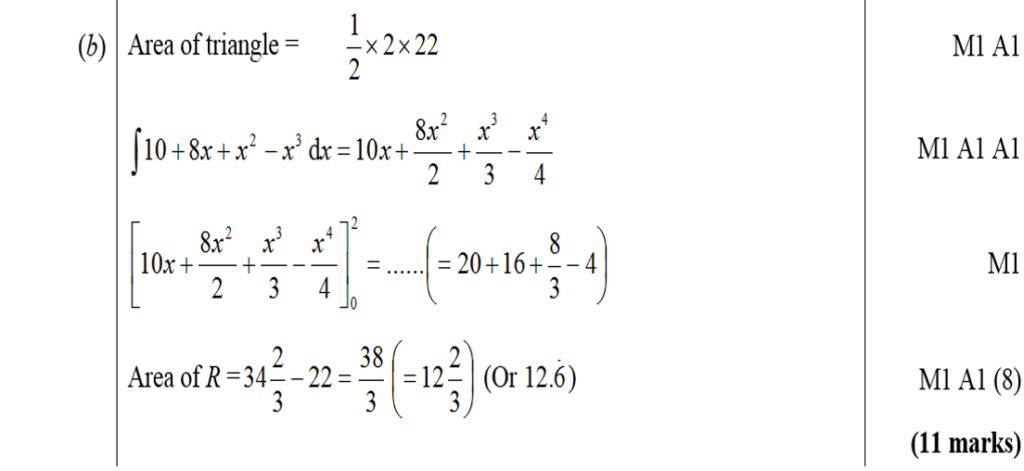
Area of \(R\) is \(\left[\dfrac{x^3}{9} - \dfrac{4}{3}x^{\frac{3}{2}} + 3x\right]_0^4 - \dfrac{1}{2} \times (4 - \text{``}2\text{''}) \times \text{``}\dfrac{13}{3}\text{''} = \dfrac{76}{9} - \dfrac{13}{3}\)
M1
3.1a
\(= \dfrac{37}{9}\)
A1
1.1b
(5)
(10 marks)
Notes
Calculators: If no algebraic integration seen then maximum in b) is M0A0B1M1A0
M1: \(x^n \to x^{n+1}\) seen at least once. Eg \(\ldots x^2 \to \ldots x^3,\ \ldots x^{\frac{1}{2}} \to \ldots x^{\frac{3}{2}},\ 3 \to 3x^1\). Allow eg \(\ldots x^2 \to \ldots x^{2+1}\) The \(+c\) is not a valid term for this mark.
A1: \(\dfrac{x^3}{9} - \dfrac{4}{3}x^{\frac{3}{2}} + 3x\) or any unsimplified equivalent (indices must be processed) accept the use of exact decimals for \(\dfrac{1}{9}\) \((0.\dot{1})\) and \(-\dfrac{4}{3}\) \((-1.\dot{3})\) but not rounded or ambiguous values.
B1: Deduces the correct value for \(x\) for the intersection of \(l\) with the \(x\)-axis. May be seen indicated on Figure 2.
M1: Fully correct strategy for the area. This needs to include
a correct attempt at the area of the triangle using their values (could use integration)
a correct attempt at the area under the curve using 0 and 4 in their integrated expression
the two values subtracted.
Be aware of those who mix up using the \(y\)-coordinate of \(P\) and the gradient at \(P\) which is M0. The values embedded in an expression is sufficient to score this mark.
A1: \(\dfrac{37}{9}\) or exact equivalent eg \(4\dfrac{1}{9}\) or \(4.\dot{1}\) but not \(4.111\ldots\) isw after a correct answer
Be aware of other strategies to find the area \(R\)
eg Finding the area under the curve between 0 and 2 and then the difference between the curve and the straight line between 2 and 4:\[\int_0^2 \frac{x^2}{3} - 2\sqrt{x} + 3\ \mathrm{d}x + \int_2^4 \frac{x^2}{3} - 2\sqrt{x} - \frac{13}{6}x + \frac{22}{3}\ \mathrm{d}x\]
M1 \(x^n \to x^{n+1}\) seen at least once on either integral (or on the equation of the line \(y = \dfrac{1}{3}x + 3\))
A1 for correct integration of either integral \(\dfrac{x^3}{9} - \dfrac{4}{3}x^{\frac{3}{2}} + 3x\) or \(\dfrac{x^3}{9} - \dfrac{4}{3}x^{\frac{3}{2}} - \dfrac{13}{12}x^2 + \dfrac{22}{3}x\) (may be unsimplified/uncollected terms but the indices must be processed with/without the \(+C\))
B1 Correct value for \(x\) can be seen from the top of the first integral (or bottom value of the second integral)
M1 Correct strategy for the area eg.\[\left[\dfrac{x^3}{9} - \dfrac{4}{3}x^{\frac{3}{2}} + 3x\right]_0^2 + \left[\dfrac{x^3}{9} - \dfrac{4}{3}x^{\frac{3}{2}} - \dfrac{13}{12}x^2 + \dfrac{22}{3}x\right]_2^4 = \frac{62}{9} - \frac{4}{3}(2)^{\frac{3}{2}} + \frac{76}{9} - \frac{101}{9} + \frac{4}{3}(2)^{\frac{3}{2}}\]
A1: \(\dfrac{37}{9}\) or exact equivalent eg \(4\dfrac{1}{9}\) or \(4.\dot{1}\) but not 4.1 or \(4.111\ldots\)
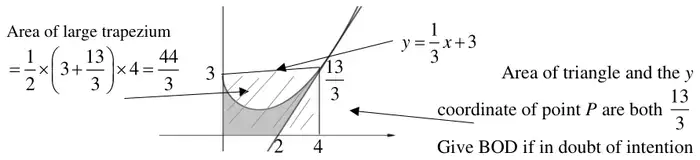
You could also see use of the area of a trapezium and/or the use of the line \(y = \dfrac{1}{3}x + 3\) to find other areas which could be combined or used as part of the strategy to find \(R\). Ignore areas which are not used. The marks should still be able to be applied as per the scheme
Area of trapezium – (Area between \(y = \dfrac{1}{3}x + 3\) and curve \(C\) + area of triangle)\[= \frac{44}{3} - \frac{56}{9} - \frac{13}{3} = \frac{37}{9}\]
Solves a correct equation and shows one correct intermediate step \(12a + 60 - 39 = -3 \Rightarrow 12a = -24 \Rightarrow a = -2\ *\)
A1*
2.1
(ii) Uses the fact that \((2, 10)\) lies on \(C \quad 10 = 8a + 60 - 78 + b\)
M1
3.1a
Subs \(a = -2\) into \(10 = 8a + 60 - 78 + b \Rightarrow b = 44\)
A1
1.1b
(4)
Notes
(a)(i)
M1: Attempts to use \(\dfrac{\mathrm{d}y}{\mathrm{d}x} = -3\) at \(x = 2\) to form an equation in \(a\). Condone slips but expect to see two of the powers reduced correctly
A1*: Correct differentiation with one correct intermediate step before \(a = -2\)
(a)(ii)
M1: Attempts to use the fact that \((2, 10)\) lies on \(C\) by setting up an equation in \(a\) and \(b\) with \(a = -2\) leading to \(b = \ldots\)
Attempts to show that \(-6x^2 + 30x - 39\) has no roots Eg. calculates \(b^2 - 4ac = 30^2 - 4 \times -6 \times -39 = -36\)
M1
3.1a
States that as \(\mathrm{f}'(x) \neq 0 \Rightarrow\) hence \(\mathrm{f}(x)\) has no turning points \(*\)
A1*
2.4
(3)
Notes
B1: \(\mathrm{f}'(x) = -6x^2 + 30x - 39\) oe
M1: Correct attempt to show that "\(-6x^2 + 30x - 39\)" has no roots. This could involve an attempt at
finding the numerical value of \(b^2 - 4ac\)
finding the roots of \(-6x^2 + 30x - 39\) using the quadratic formula (or their calculator)
completing the square for \(-6x^2 + 30x - 39\)
A1*: A fully correct method with reason and conclusion. Eg as \(b^2 - 4ac = -36 \lt 0,\ \mathrm{f}'(x) \neq 0\) meaning that no stationary points exist
\(\mathrm{g}^{\prime\prime}(2) = -\dfrac{33}{2} \lt 0\) hence maximum
A1
2.4
(2)
(9 marks)
Notes
M1: Attempts \(\mathrm{g}^{\prime\prime}(x) = -18x + \dfrac{39}{2}\) and substitutes \(x = 2\). Award for second derivatives of the form \(\mathrm{g}^{\prime\prime}(x) = Ax + B\) with \(x = 2\) substituted in. Alternatively attempts to find the value of their \(\mathrm{g}^{\prime}(x)\) or \(\mathrm{g}(x)\) either side of \(x = 2\) (by substituting a value for \(x\) within 0.5 either side of 2)
A1: \(\mathrm{g}^{\prime\prime}(2) = -\dfrac{33}{2} \lt 0\) hence maximum. (allow embedded values but they must refer to the sign or that it is less than zero) If \(\mathrm{g}^{\prime}(x) = -9x^2 + \dfrac{39}{2}x - 3\) or \(\mathrm{g}(x) = -3x^3 + \dfrac{39}{4}x^2 - 3x\) is calculated either side of \(x = 2\) then the values must be correct or embedded correctly (you will need to check these) they need to compare \(\mathrm{g}^{\prime}(x) \gt 0\) to the left of \(x = 2\) and \(\mathrm{g}^{\prime}(x) \lt 0\) to the right of \(x = 2\) or \(\mathrm{g}(x) \lt 9\) to the left and \(\mathrm{g}(x) \lt 9\) to the right of \(x = 2\) hence maximum. (corrected from the printed mark scheme: it prints “\(\mathrm{g}(x) \gt 9\) to the right of \(x = 2\)”, but for a maximum \(\mathrm{g}(x) \lt 9\) on both sides)
Note If they only sketch the cubic function \(\mathrm{g}(x) = -3x^3 + \dfrac{39}{4}x^2 - 3x\) then award M1A0
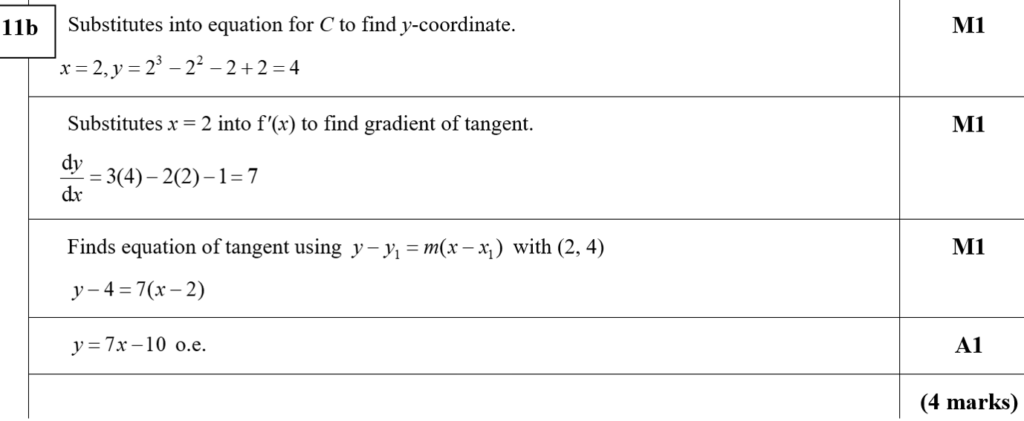
For substituting \(x = 2\) into their \(\dfrac{\mathrm{d}y}{\mathrm{d}x} = 6x^2 - 4\)
dM1
1.1b
For a correct method of finding a tangent at \(P(2, 13)\). Score for \(y - 13 = \text{``}20\text{''}(x - 2)\)
ddM1
1.1b
\(y = 20x - 27\)
A1
1.1b
(5)
(5 marks)
Notes
M1: Attempts to differentiate \(x^n \to x^{n-1}\) seen once. Score for \(x^3 \to x^2\) or \(\pm 4x \to 4\) or \(+5 \to 0\)
A1: \(\left(\dfrac{\mathrm{d}y}{\mathrm{d}x} =\right) 6x^2 - 4\) which may be unsimplified \(6x^2 - 4 + C\) is A0
dM1: Substitutes \(x = 2\) into their \(\dfrac{\mathrm{d}y}{\mathrm{d}x}\). The first M must have been awarded. Score for sight of embedded values, or sight of "\(\dfrac{\mathrm{d}y}{\mathrm{d}x}\) at \(x = 2\) is" or a correct follow through. Note that 20 on its own is not enough as this can be done on a calculator.
ddM1: For a correct method of finding a tangent at \(P(2, 13)\). Score for \(y - 13 = \text{``}20\text{''}(x - 2)\) It is dependent upon both previous M’s. If the form \(y = mx + c\) is used they must proceed as far as \(c = \ldots\)
A1: Completely correct \(y = 20x - 27\) (and in this form)
Area \(= \dfrac{1}{2}(4)^4 - \dfrac{17}{3}(4)^3 + 20(4)^2\)
M1
1.1b
\(= \dfrac{256}{3}\) *
A1*
2.1
(7)
(7 marks)
Notes
M1: An overall problem -solving method mark to find the minimum point. To score this you need to see
an attempt to differentiate with at least two correct terms
an attempt to set their \(\dfrac{\mathrm{d}y}{\mathrm{d}x} = 0\) and then solve to find \(x\). Don’t be overly concerned by the mechanics of this solution
(corrected from the printed mark scheme: the scheme says “the \(x\) coordinate of \(A\)”, but there is no point \(A\) in this question; it means the minimum point at \(x = k\))
B1: \(\left(\dfrac{\mathrm{d}y}{\mathrm{d}x} =\right) 6x^2 - 34x + 40\) which may be unsimplified
M1: Sets their \(\dfrac{\mathrm{d}y}{\mathrm{d}x} = 0\), which must be a 3TQ in \(x\), and attempts to solve via factorisation, formula or calculator. If a calculator is used to find the roots, they must be correct for their quadratic. If \(\dfrac{\mathrm{d}y}{\mathrm{d}x}\) is correct allow them to just choose the root 4 for M1 A1. Condone \((x - 4)\left(x - \dfrac{5}{3}\right)\)
A1: Chooses \(x = 4\) This may be awarded from the upper limit in their integral
B1: \(\displaystyle\int 2x^3 - 17x^2 + 40x\,\mathrm{d}x = \left[\frac{1}{2}x^4 - \frac{17}{3}x^3 + 20x^2\right]\) which may be unsimplified
M1: Correct attempt at area. There may be slips on the integration but expect two correct terms The upper limit used must be their larger solution of \(\dfrac{\mathrm{d}y}{\mathrm{d}x} = 0\) and the lower limit used must be 0. So if their roots are 6 and 10, then they must use 10 and 0. If only one value is found then the limits must be 0 to that value. Expect to see embedded or calculated values. Don’t accept \(\displaystyle\int_0^4 2x^3 - 17x^2 + 40x\,\mathrm{d}x = \frac{256}{3}\) without seeing the integration and the embedded or calculated values
A1*: Area \(= \dfrac{256}{3}\) with correct notation and no errors. Note that this is a given answer.
For correct notation expect to see
\(\dfrac{\mathrm{d}y}{\mathrm{d}x}\) or \(\dfrac{\mathrm{d}}{\mathrm{d}x}\) used correctly at least once. If \(\mathrm{f}(x)\) is used accept \(\mathrm{f}^{\prime}(x)\). Condone \(y^{\prime}\)
\(\displaystyle\int 2x^3 - 17x^2 + 40x\,\mathrm{d}x\) used correctly at least once with or without the limits.
M1: \(x^n \to x^{n-1}\) for any correct index of \(x\). Score for \(x^2 \to x\) or \(x^{-1} \to x^{-2}\) Allow for unprocessed indices. \(x^2 \to x^{2-1}\) oe
A1: Sight of either \(6x\) or \(-\dfrac{24}{x^2}\) which may be un simplified. Condone an additional term e.g. \(+\,2\) for this mark The indices now must have been processed
A1: \(\dfrac{\mathrm{d}y}{\mathrm{d}x} = 6x - \dfrac{24}{x^2}\) or exact simplified equivalent. Eg accept \(\dfrac{\mathrm{d}y}{\mathrm{d}x} = 6x^1 - 24x^{-2}\) You do not need to see the \(\dfrac{\mathrm{d}y}{\mathrm{d}x}\) and you should isw after a correct simplified answer.
Mark scheme (b)
Scheme
Marks
AO
Attempts \(6x - \dfrac{24}{x^2} > 0 \Rightarrow x >\)
M1
1.1b
\(x > \sqrt[3]{4}\) or \(x \geqslant \sqrt[3]{4}\)
A1
2.5
(2)
(5 marks)
Notes
M1: Sets an allowable \(\dfrac{\mathrm{d}y}{\mathrm{d}x}\ \boldsymbol{\ldots}\ 0\) and proceeds to \(x \ldots\) via an allowable intermediate equation \(\dfrac{\mathrm{d}y}{\mathrm{d}x}\) must be in the form \(Ax + Bx^{-2}\) where \(A, B \neq 0\) and the intermediate equation must be of the form \(x^p \ldots q\) oe Do not be concerned by either the processing, an equality or a different inequality. It may be implied by \(x = \text{awrt } 1.59\)
A1: \(x > \sqrt[3]{4}\) or \(x \geqslant \sqrt[3]{4}\) oe such as \(x > 4^{\frac{1}{3}}\) or \(x \geqslant 2^{\frac{2}{3}}\)
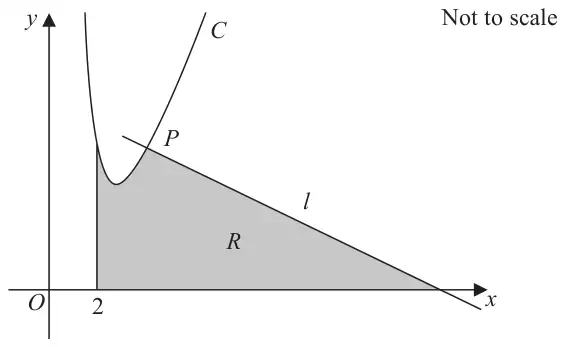
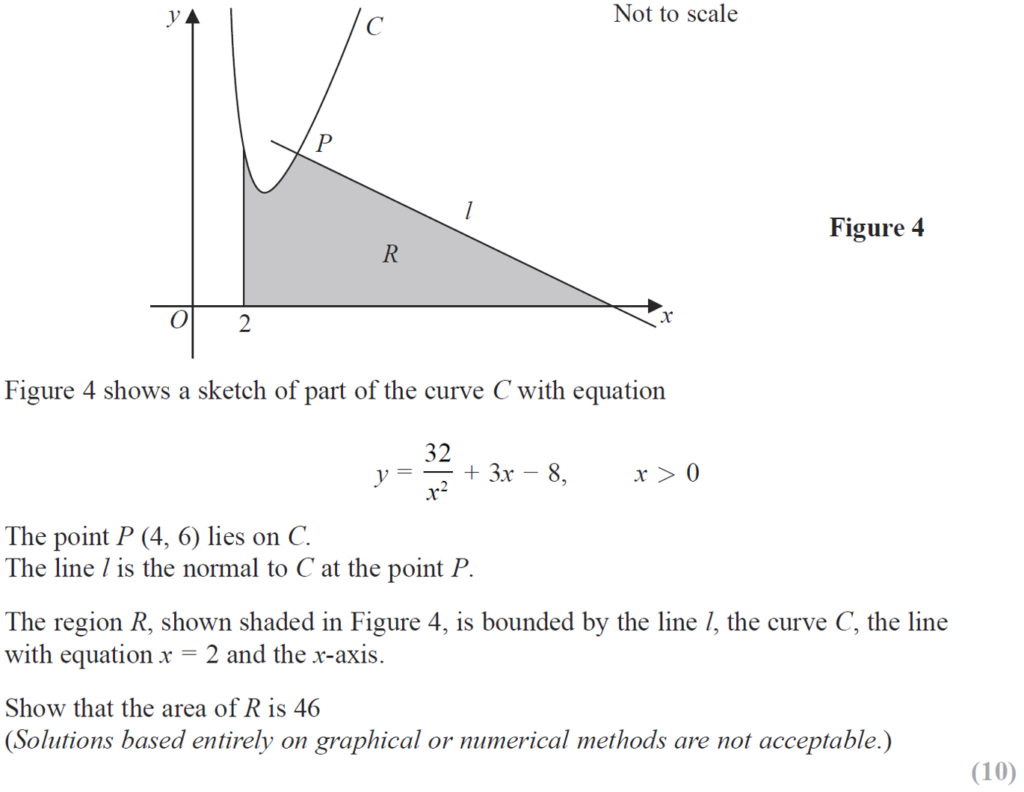
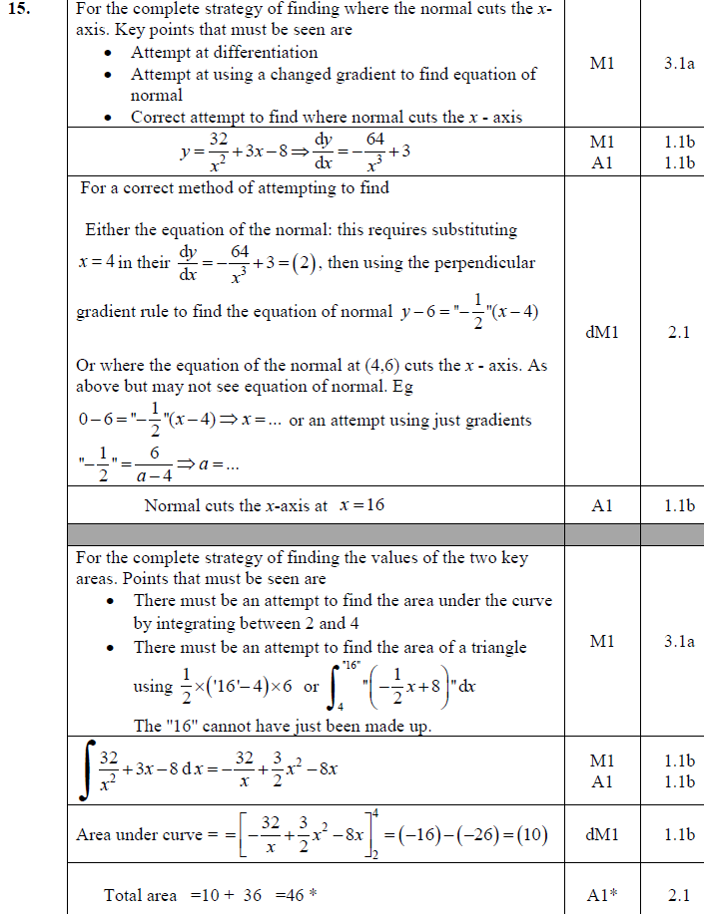
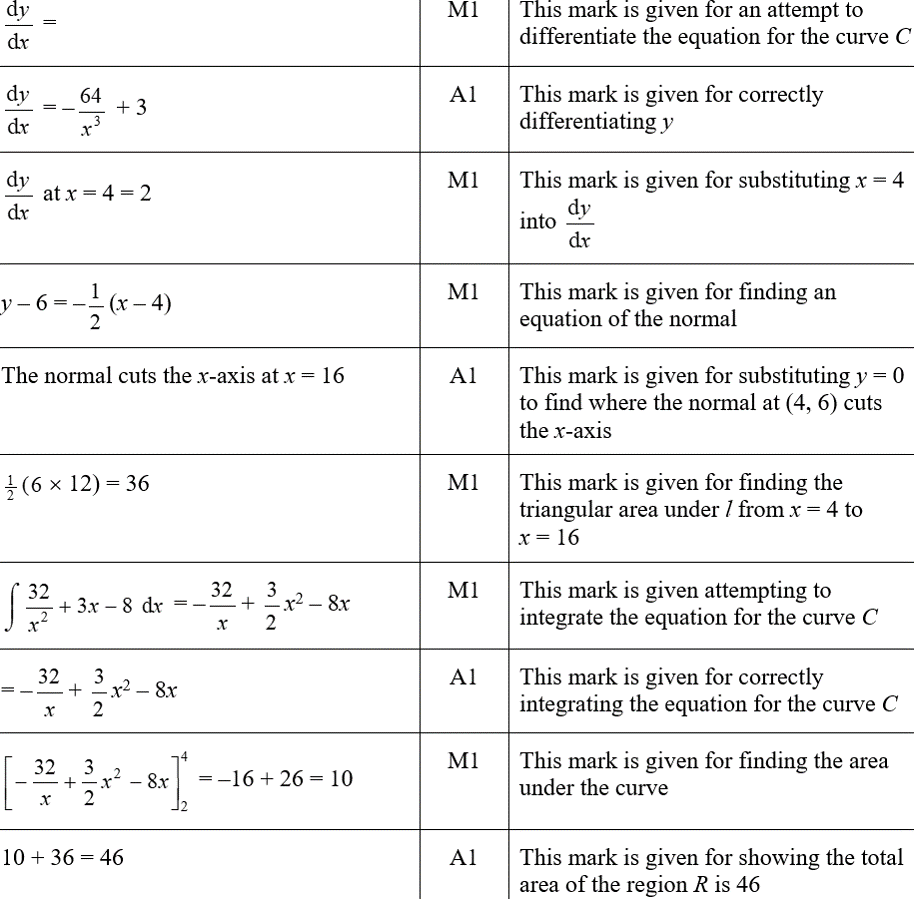
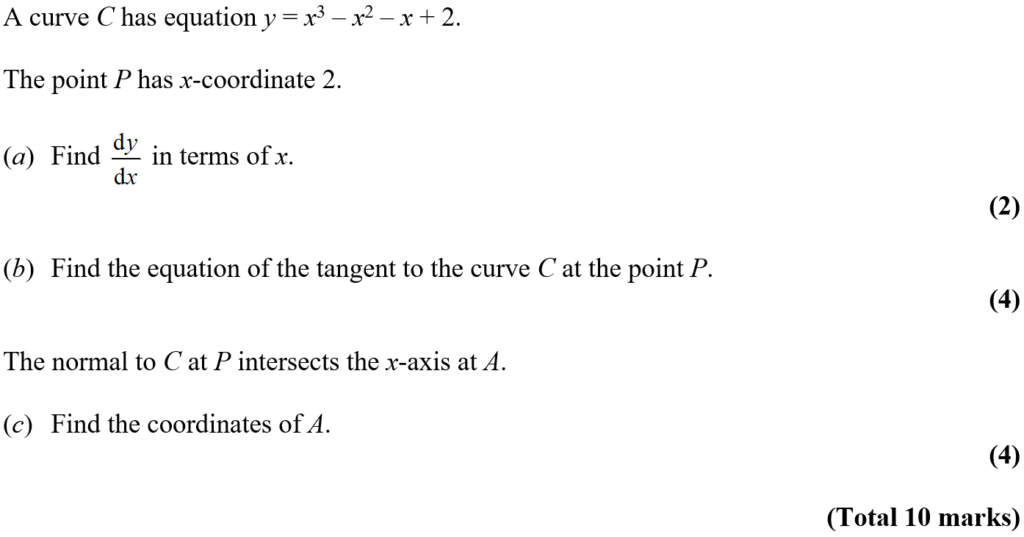
For a correct method of attempting to find Either the equation of the normal: this requires substituting \(x = 4\) in their \(\dfrac{\mathrm{d}y}{\mathrm{d}x} = -\dfrac{64}{x^3} + 3 = (2)\), then using the perpendicular gradient rule to find the equation of normal \(y - 6 = \text{``}{-\dfrac{1}{2}}\text{''}(x - 4)\) Or where the equation of the normal at (4,6) cuts the \(x\) - axis. As above but may not see equation of normal. Eg \(0 - 6 = \text{``}{-\dfrac{1}{2}}\text{''}(x - 4) \Rightarrow x = \ldots\) or an attempt using just gradients \(\text{``}{-\dfrac{1}{2}}\text{''} = \dfrac{6}{a - 4} \Rightarrow a = \ldots\)
dM1
2.1
Normal cuts the \(x\)-axis at \(x = 16\)
A1
1.1b
For the complete strategy of finding the values of the two key areas. Points that must be seen are
There must be an attempt to find the area under the curve by integrating between 2 and 4
There must be an attempt to find the area of a triangle using \(\dfrac{1}{2} \times (\text{‘}16\text{’} - 4) \times 6\) or \(\displaystyle\int_4^{\text{``}16\text{''}} \left(\text{``}{-\dfrac{1}{2}x + 8}\text{''}\right)\mathrm{d}x\)
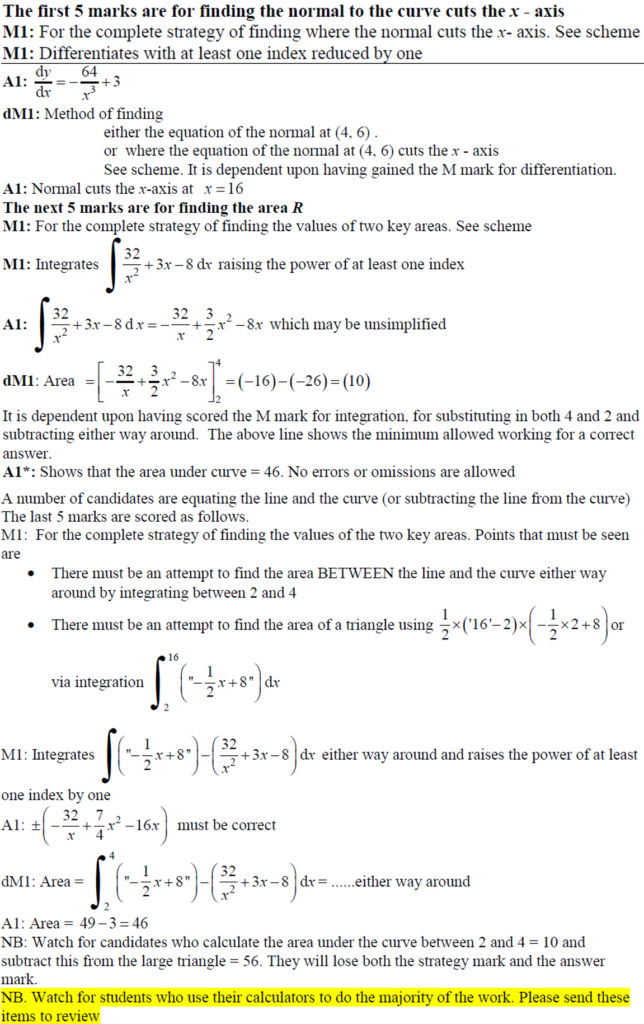
dM1: Method of finding either the equation of the normal at (4, 6). or where the equation of the normal at (4, 6) cuts the \(x\) - axis See scheme. It is dependent upon having gained the M mark for differentiation.
A1: Normal cuts the \(x\)-axis at \(x = 16\)
The next 5 marks are for finding the area \(R\)
M1: For the complete strategy of finding the values of two key areas. See scheme
M1: Integrates \(\displaystyle\int \frac{32}{x^2} + 3x - 8\,\mathrm{d}x\) raising the power of at least one index
A1: \(\displaystyle\int \frac{32}{x^2} + 3x - 8\,\mathrm{d}x = -\frac{32}{x} + \frac{3}{2}x^2 - 8x\) which may be unsimplified
dM1: Area \(= \left[-\dfrac{32}{x} + \dfrac{3}{2}x^2 - 8x\right]_2^4 = (-16) - (-26) = (10)\) It is dependent upon having scored the M mark for integration, for substituting in both 4 and 2 and subtracting either way around. The above line shows the minimum allowed working for a correct answer.
A1*: Shows that the area under curve = 46. No errors or omissions are allowed
Alternative
A number of candidates are equating the line and the curve (or subtracting the line from the curve) The last 5 marks are scored as follows.
M1: For the complete strategy of finding the values of the two key areas. Points that must be seen are
There must be an attempt to find the area BETWEEN the line and the curve either way around by integrating between 2 and 4
There must be an attempt to find the area of a triangle using \(\dfrac{1}{2} \times (\text{‘}16\text{’} - 2) \times \left(-\dfrac{1}{2} \times 2 + 8\right)\) or via integration \(\displaystyle\int_2^{16} \left(\text{``}{-\dfrac{1}{2}x + 8}\text{''}\right)\mathrm{d}x\)
M1: Integrates \(\displaystyle\int \left(\text{``}{-\dfrac{1}{2}x + 8}\text{''}\right) - \left(\dfrac{32}{x^2} + 3x - 8\right)\mathrm{d}x\) either way around and raises the power of at least one index by one
A1: \(\pm\left(-\dfrac{32}{x} + \dfrac{7}{4}x^2 - 16x\right)\) must be correct
dM1: Area \(= \displaystyle\int_2^4 \left(\text{``}{-\dfrac{1}{2}x + 8}\text{''}\right) - \left(\dfrac{32}{x^2} + 3x - 8\right)\mathrm{d}x = \ldots\ldots\) either way around
A1: Area \(= 49 - 3 = 46\)
NB: Watch for candidates who calculate the area under the curve between 2 and 4 = 10 and subtract this from the large triangle = 56. They will lose both the strategy mark and the answer mark.
NB. Watch for students who use their calculators to do the majority of the work. Please send these items to review
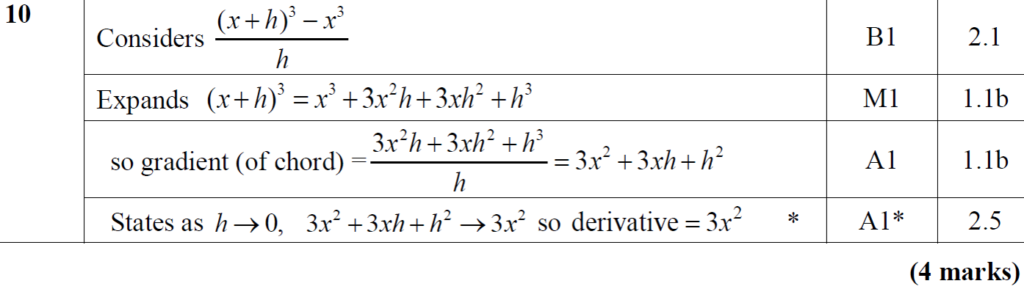
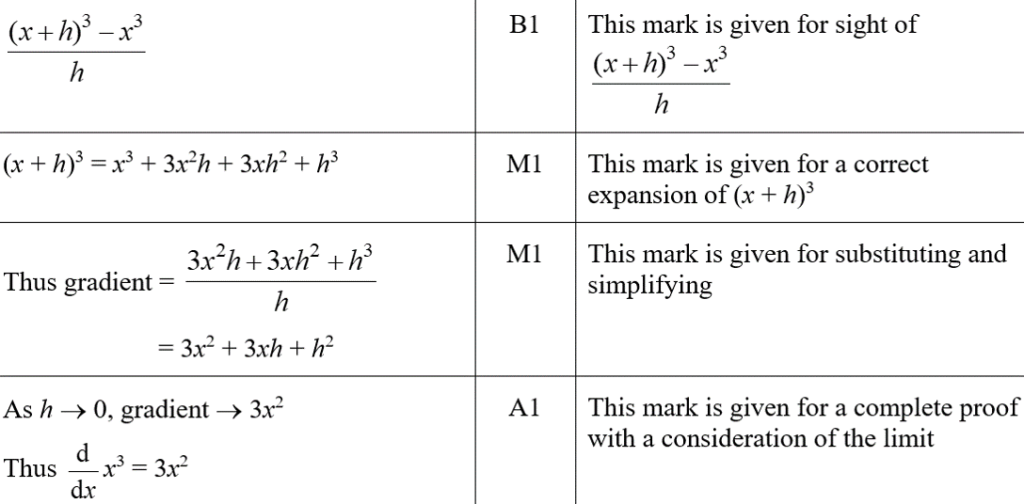
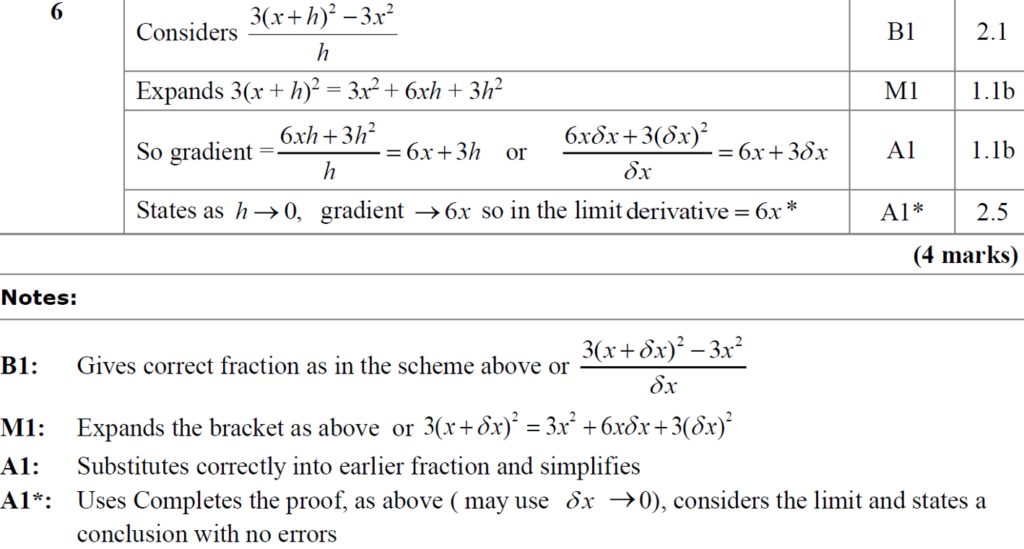
States as \(h \to 0\), \(3x^2 + 3xh + h^2 \to 3x^2\) so derivative \(= 3x^2\) *
A1*
2.5
(4 marks)
Notes
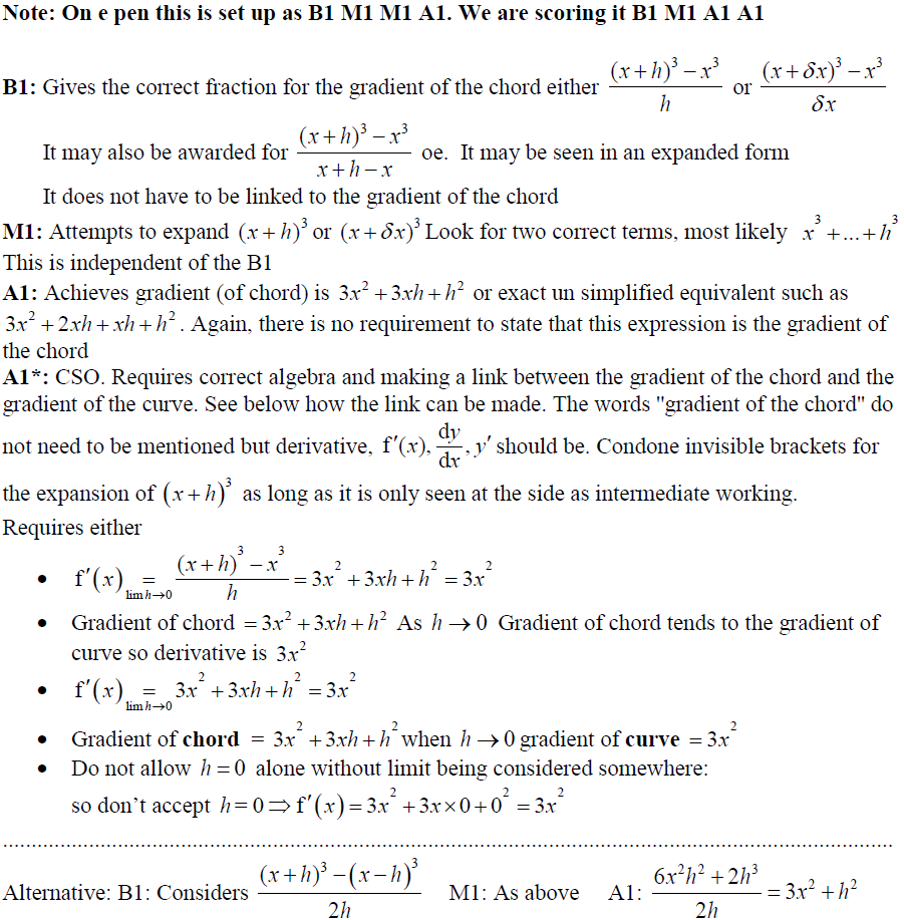
Note: On e pen this is set up as B1 M1 M1 A1. We are scoring it B1 M1 A1 A1
B1: Gives the correct fraction for the gradient of the chord either \(\dfrac{(x + h)^3 - x^3}{h}\) or \(\dfrac{(x + \delta x)^3 - x^3}{\delta x}\) It may also be awarded for \(\dfrac{(x + h)^3 - x^3}{x + h - x}\) oe. It may be seen in an expanded form It does not have to be linked to the gradient of the chord
M1: Attempts to expand \((x + h)^3\) or \((x + \delta x)^3\) Look for two correct terms, most likely \(x^3 + \ldots + h^3\) This is independent of the B1
A1: Achieves gradient (of chord) is \(3x^2 + 3xh + h^2\) or exact un simplified equivalent such as \(3x^2 + 2xh + xh + h^2\). Again, there is no requirement to state that this expression is the gradient of the chord
A1*: CSO. Requires correct algebra and making a link between the gradient of the chord and the gradient of the curve. See below how the link can be made. The words "gradient of the chord" do not need to be mentioned but derivative, \(\mathrm{f}'(x)\), \(\dfrac{\mathrm{d}y}{\mathrm{d}x}\), \(y'\) should be. Condone invisible brackets for the expansion of \((x + h)^3\) as long as it is only seen at the side as intermediate working. Requires either
Gradient of chord \(= 3x^2 + 3xh + h^2\) when \(h \to 0\) gradient of curve \(= 3x^2\)
Do not allow \(h = 0\) alone without limit being considered somewhere: so don’t accept \(h = 0 \Rightarrow \mathrm{f}'(x) = 3x^2 + 3x \times 0 + 0^2 = 3x^2\)
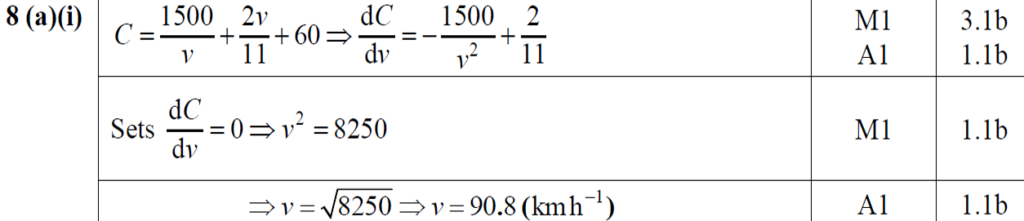
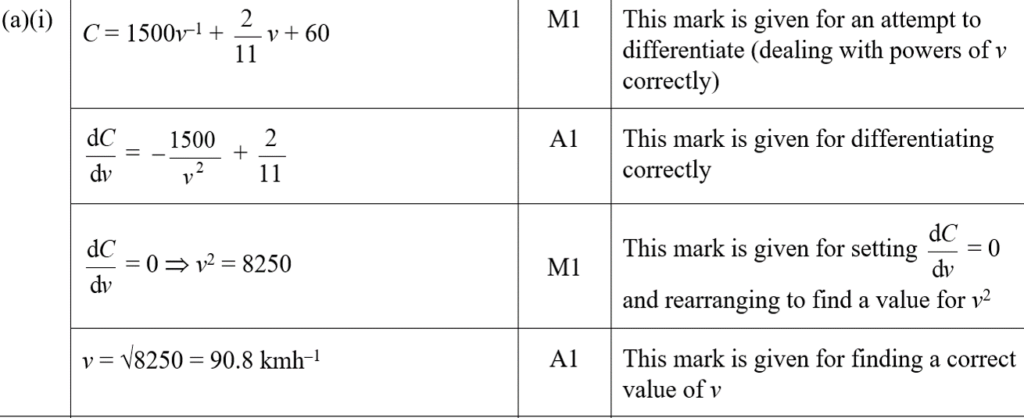
\(\Rightarrow v = \sqrt{8250} \Rightarrow v = 90.8\) (km h−1)
A1
1.1b
(ii) For substituting their \(v = 90.8\) in \(C = \dfrac{1500}{v} + \dfrac{2v}{11} + 60\)
M1
3.4
Minimum cost = awrt (£) 93
A1 ft
1.1b
(6)
Notes
(a)(i)
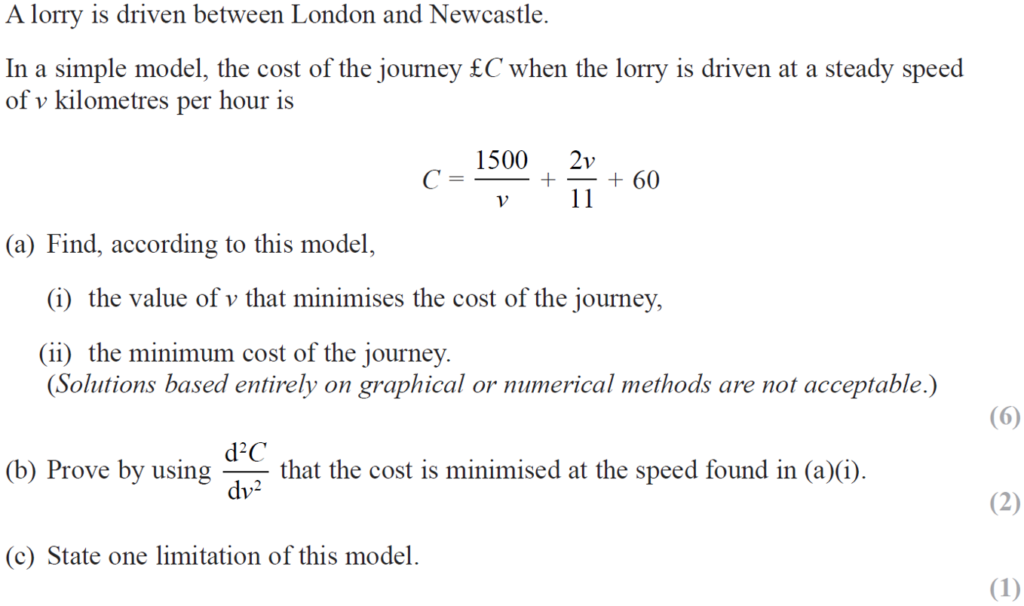
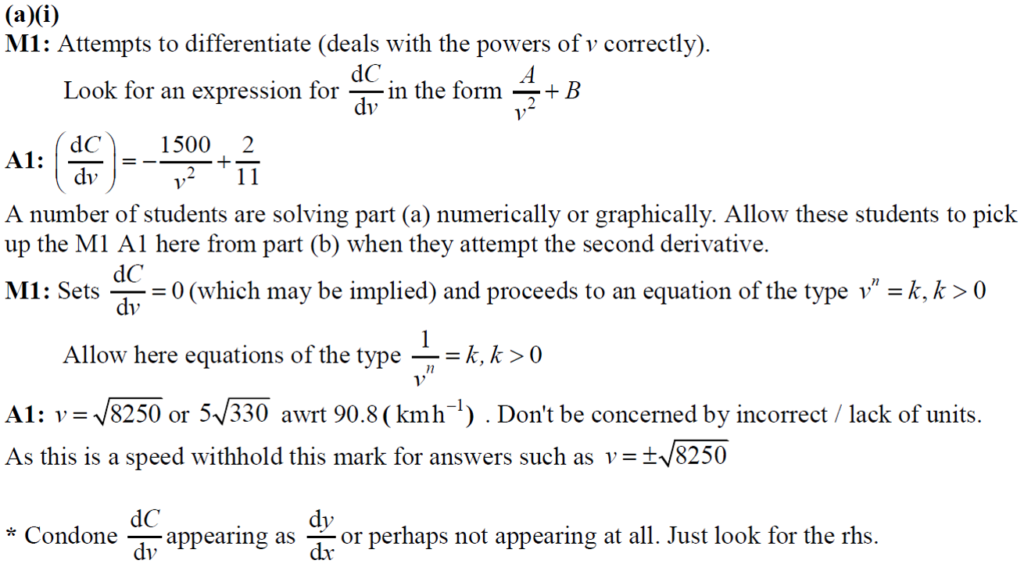
M1: Attempts to differentiate (deals with the powers of \(v\) correctly). Look for an expression for \(\dfrac{\mathrm{d}C}{\mathrm{d}v}\) in the form \(\dfrac{A}{v^2} + B\)
A1: \(\left(\dfrac{\mathrm{d}C}{\mathrm{d}v}\right) = -\dfrac{1500}{v^2} + \dfrac{2}{11}\) A number of students are solving part (a) numerically or graphically. Allow these students to pick up the M1 A1 here from part (b) when they attempt the second derivative.
M1: Sets \(\dfrac{\mathrm{d}C}{\mathrm{d}v} = 0\) (which may be implied) and proceeds to an equation of the type \(v^n = k, k \gt 0\) Allow here equations of the type \(\dfrac{1}{v^n} = k, k \gt 0\)
A1: \(v = \sqrt{8250}\) or \(5\sqrt{330}\) awrt 90.8 (km h−1). Don't be concerned by incorrect / lack of units. As this is a speed withhold this mark for answers such as \(v = \pm\sqrt{8250}\)
* Condone \(\dfrac{\mathrm{d}C}{\mathrm{d}v}\) appearing as \(\dfrac{\mathrm{d}y}{\mathrm{d}x}\) or perhaps not appearing at all. Just look for the rhs.
(a)(ii)
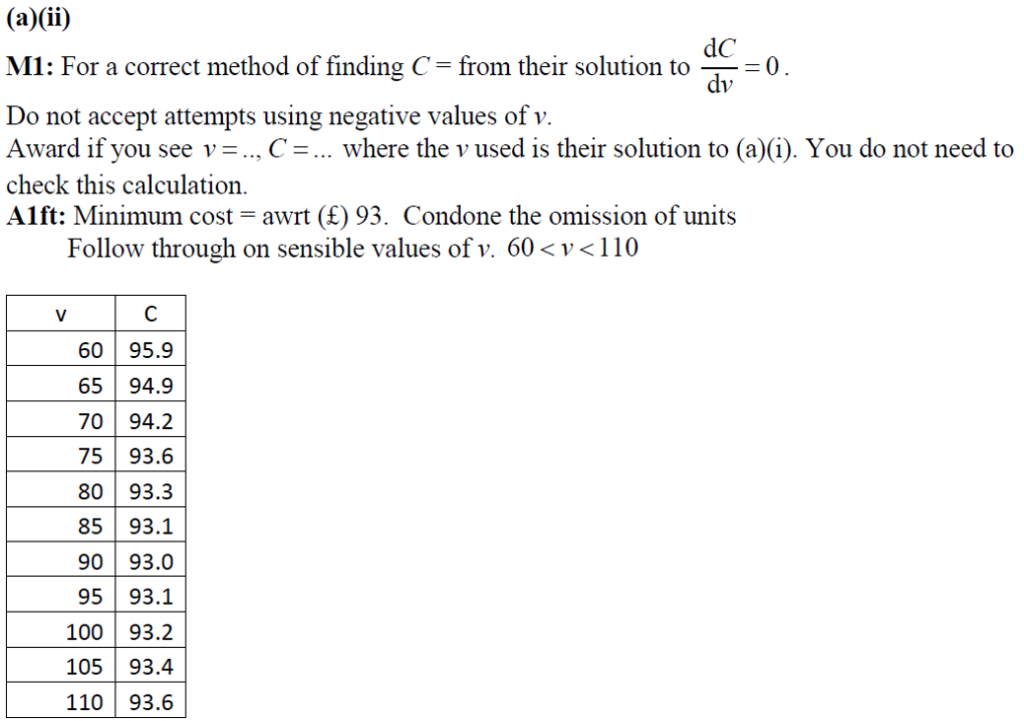
M1: For a correct method of finding \(C =\) from their solution to \(\dfrac{\mathrm{d}C}{\mathrm{d}v} = 0\). Do not accept attempts using negative values of \(v\). Award if you see \(v = \ldots, C = \ldots\) where the \(v\) used is their solution to (a)(i). You do not need to check this calculation.
A1ft: Minimum cost = awrt (£) 93. Condone the omission of units Follow through on sensible values of \(v\). \(60 \lt v \lt 110\)
\(v\)
\(C\)
60
95.9
65
94.9
70
94.2
75
93.6
80
93.3
85
93.1
90
93.0
95
93.1
100
93.2
105
93.4
110
93.6
Mark scheme (b)
Scheme
Marks
AO
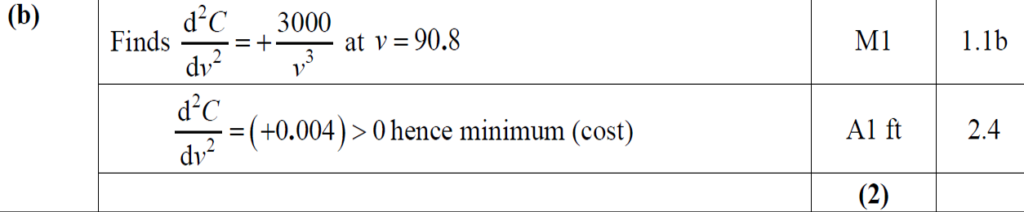
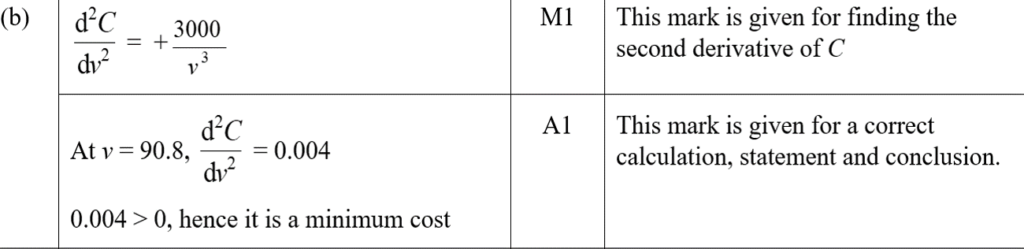
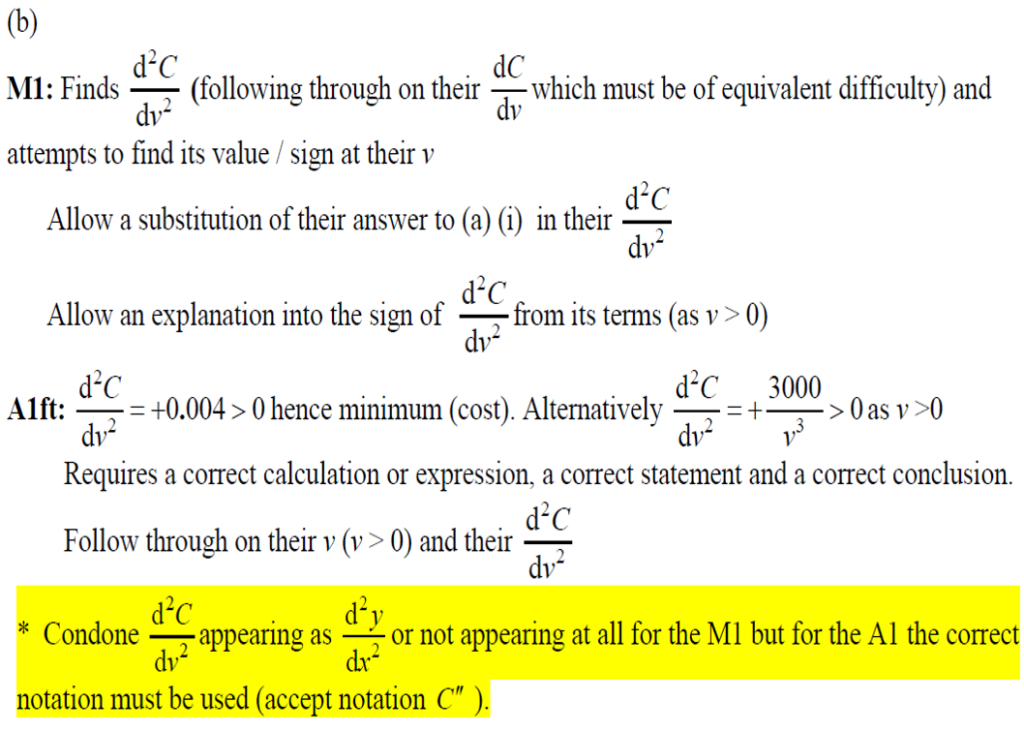
Finds \(\dfrac{\mathrm{d}^2C}{\mathrm{d}v^2} = +\dfrac{3000}{v^3}\) at \(v = 90.8\)
M1: Finds \(\dfrac{\mathrm{d}^2C}{\mathrm{d}v^2}\) (following through on their \(\dfrac{\mathrm{d}C}{\mathrm{d}v}\) which must be of equivalent difficulty) and attempts to find its value / sign at their \(v\) Allow a substitution of their answer to (a) (i) in their \(\dfrac{\mathrm{d}^2C}{\mathrm{d}v^2}\) Allow an explanation into the sign of \(\dfrac{\mathrm{d}^2C}{\mathrm{d}v^2}\) from its terms (as \(v \gt 0\))
A1ft: \(\dfrac{\mathrm{d}^2C}{\mathrm{d}v^2} = +0.004 \gt 0\) hence minimum (cost). Alternatively \(\dfrac{\mathrm{d}^2C}{\mathrm{d}v^2} = +\dfrac{3000}{v^3} \gt 0\) as \(v \gt 0\) Requires a correct calculation or expression, a correct statement and a correct conclusion. Follow through on their \(v\) (\(v \gt 0\)) and their \(\dfrac{\mathrm{d}^2C}{\mathrm{d}v^2}\)
* Condone \(\dfrac{\mathrm{d}^2C}{\mathrm{d}v^2}\) appearing as \(\dfrac{\mathrm{d}^2y}{\mathrm{d}x^2}\) or not appearing at all for the M1 but for the A1 the correct notation must be used (accept notation \(C''\)).
Mark scheme (c)
Scheme
Marks
AO
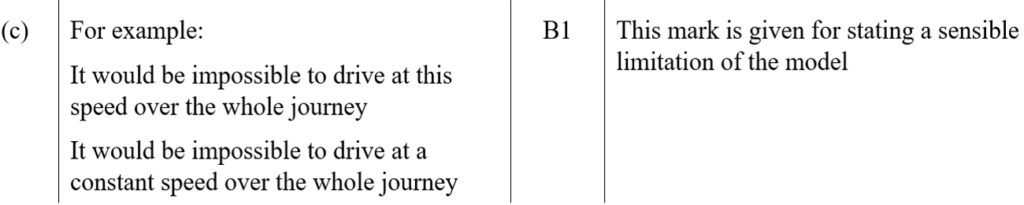
It would be impossible to drive at this speed over the whole journey
B1
3.5b
(1)
(9 marks)
Notes
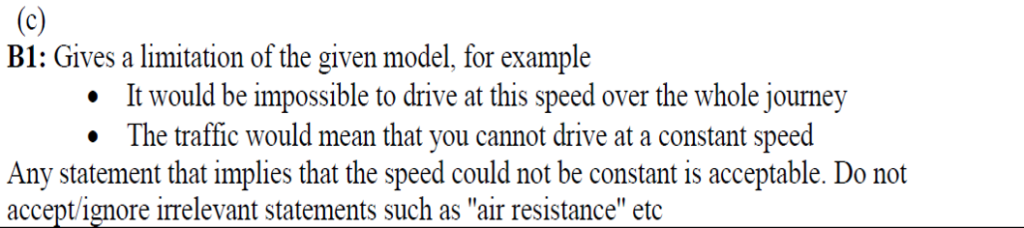
B1: Gives a limitation of the given model, for example
It would be impossible to drive at this speed over the whole journey
The traffic would mean that you cannot drive at a constant speed
Any statement that implies that the speed could not be constant is acceptable. Do not accept/ignore irrelevant statements such as "air resistance" etc
Mark Scheme for A (i)Student Friendly Mark Scheme for A (i)A (i) NotesMark Scheme for A (ii)Student Friendly Mark Scheme for A (ii)A (ii) NotesMark Scheme for BStudent Friendly Mark Scheme for BB NotesMark Scheme for CStudent Friendly Mark Scheme for CC Notes
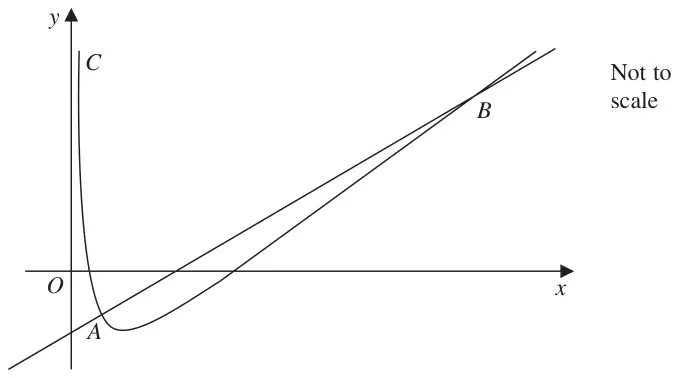
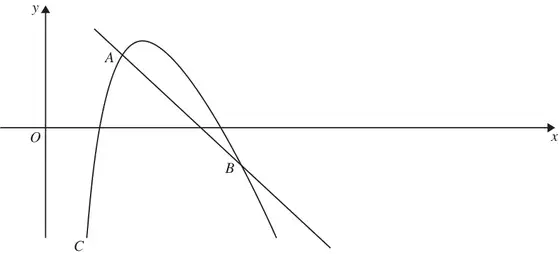
Figure 3 shows a sketch of part of the curve \(C\) with equation\[y = \frac{1}{2}x + \frac{27}{x} - 12, \qquad x > 0\]The point \(A\) lies on \(C\) and has coordinates \(\left(3, -\dfrac{3}{2}\right)\).
(a) Show that the equation of the normal to \(C\) at \(A\) can be written as \(10y = 4x - 27\) (5)
The normal to \(C\) at \(A\) meets \(C\) again at the point \(B\), as shown in Figure 3.
(b) Use algebra to find the coordinates of \(B\). (5)
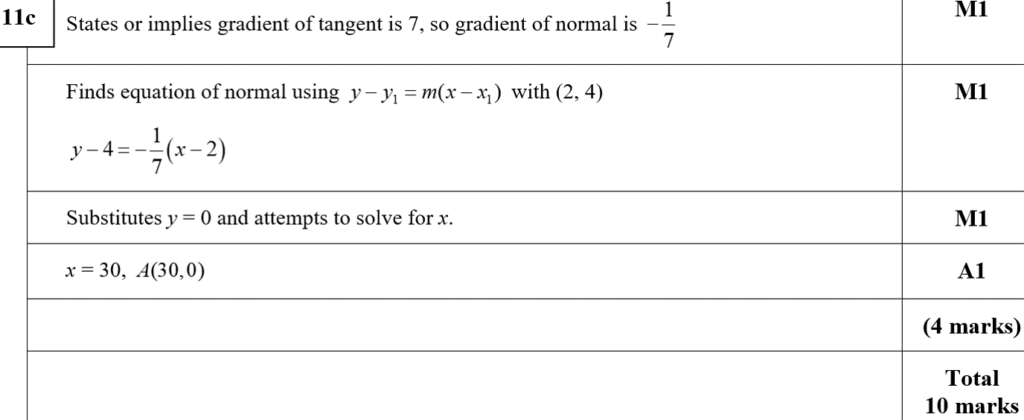
M1: Substitutes \(x = 3\) into their \(\dfrac{\mathrm{d}y}{\mathrm{d}x}\) to obtain a numerical gradient
M1: The correct method to find the equation of a normal. Uses \(-\dfrac{1}{m_T}\) with \(\left(3, -\dfrac{3}{2}\right)\) where \(m_T\) has come from calculus. If using \(y = mx + c\) must reach as far as \(c = \ldots\)
\((x - 90)(x - 3) = 0 \Rightarrow x = \ldots\) or \(x = \dfrac{93 \pm \sqrt{93^2 - 4\times 270}}{2}\) or \((10y - 333)(2y + 3) = 0 \Rightarrow y = \ldots\) or \(y = \dfrac{636 \pm \sqrt{636^2 - 4\times 20\times\left(-999\right)}}{2\times 20}\)
dM1
\(x = 90\) or \(y = 33.3\) oe
A1
\(x = 90\) and \(y = 33.3\) oe
A1
(5)
(10 marks)
Notes
M1: Equate equations to produce an equation just in \(x\) or just in \(y\). Do not allow e.g. \(\dfrac{1}{2}x^2 + 27 - 12x = \dfrac{4x - 27}{10}\) Unless \(\dfrac{1}{2}x + \dfrac{27}{x} - 12 = \dfrac{4x - 27}{10}\) was seen previously. Allow sign slips only.
A1: Correct 3 term quadratic equation (or any multiple of). Allow terms on both sides e.g. \(x^2 - 93x = -270\) (The “= 0” may be implied by their attempt to solve)
dM1: Attempt to solve a 3TQ (see general guidance) leading to at least one for \(x\) or \(y\). Dependent on the first method mark.
A1: Cso. The \(x\) must be 90 and the \(y\) an equivalent number such as e.g. \(\frac{333}{10}\)
A1: Cso. The \(x\) must be 90 and the \(y\) an equivalent number such as e.g. \(\frac{333}{10}\)
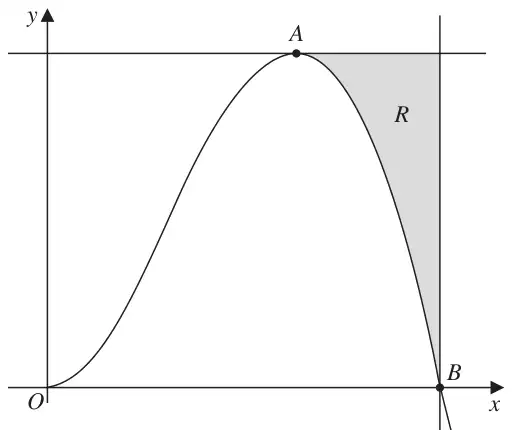
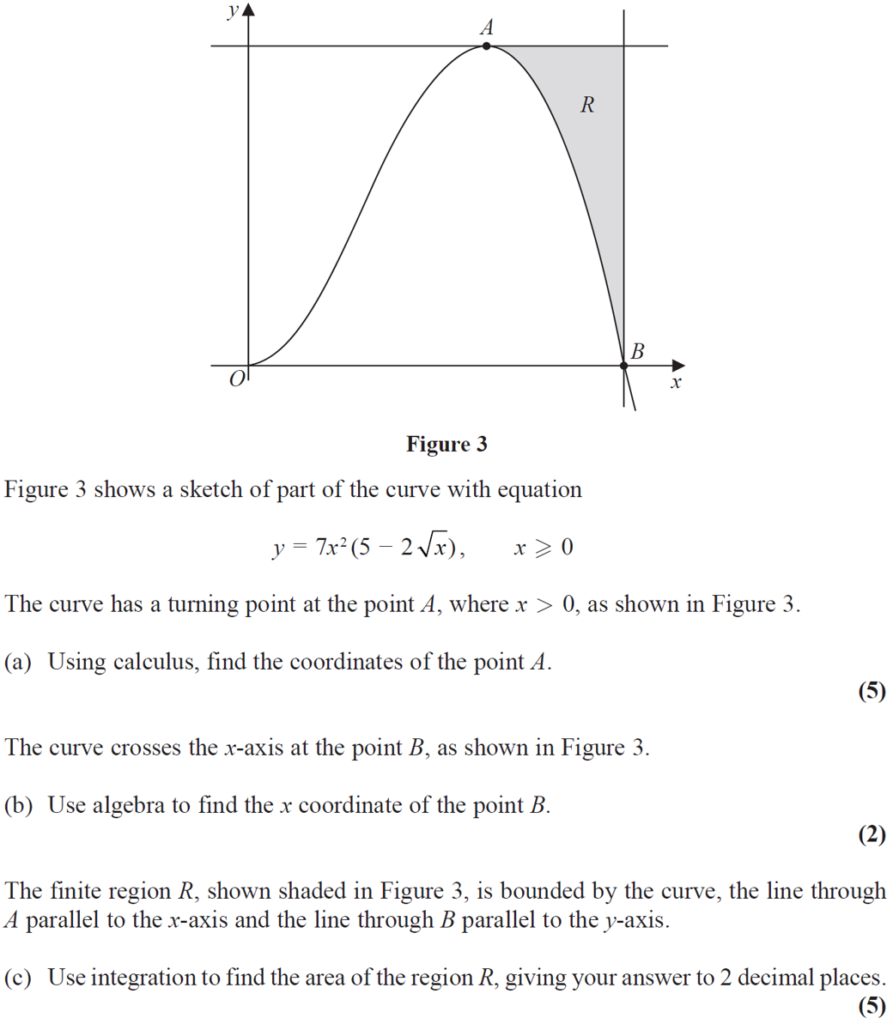
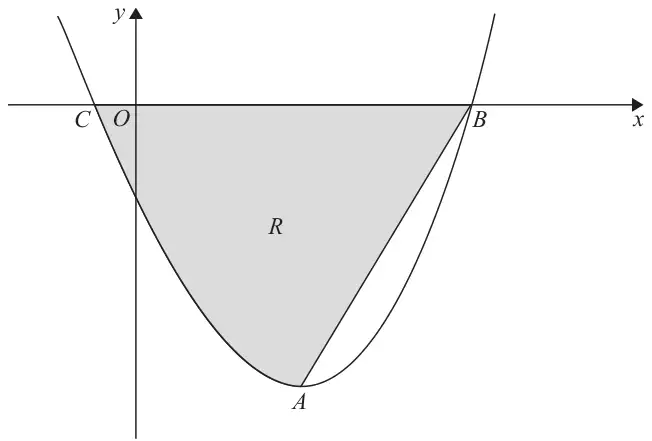
Figure 3 shows a sketch of part of the curve with equation\[y = 7x^2(5 - 2\sqrt{x}), \qquad x \geqslant 0\]The curve has a turning point at the point \(A\), where \(x > 0\), as shown in Figure 3.
(a) Using calculus, find the coordinates of the point \(A\). (5)
The curve crosses the \(x\)-axis at the point \(B\), as shown in Figure 3.
(b) Use algebra to find the \(x\) coordinate of the point \(B\). (2)
The finite region \(R\), shown shaded in Figure 3, is bounded by the curve, the line through \(A\) parallel to the \(x\)-axis and the line through \(B\) parallel to the \(y\)-axis.
(c) Use integration to find the area of the region \(R\), giving your answer to 2 decimal places. (5)
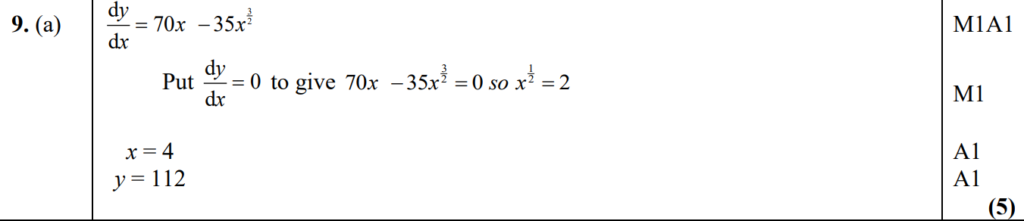
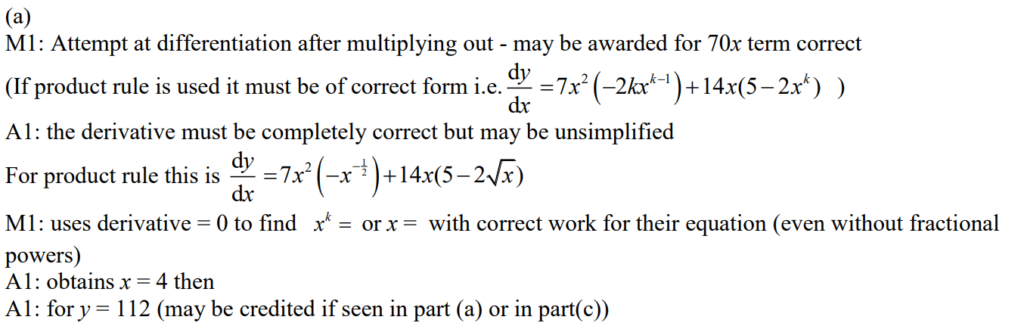
Put \(\dfrac{\mathrm{d}y}{\mathrm{d}x} = 0\) to give \(70x - 35x^{\frac{3}{2}} = 0\) so \(x^{\frac{1}{2}} = 2\)
M1
\(x = 4\) \(y = 112\)
A1 A1
(5)
Notes
M1: Attempt at differentiation after multiplying out - may be awarded for \(70x\) term correct (If product rule is used it must be of correct form i.e. \(\dfrac{\mathrm{d}y}{\mathrm{d}x} = 7x^2\left(-2kx^{k-1}\right) + 14x(5 - 2x^k)\) )
A1: the derivative must be completely correct but may be unsimplified For product rule this is \(\dfrac{\mathrm{d}y}{\mathrm{d}x} = 7x^2\left(-x^{-\frac{1}{2}}\right) + 14x(5 - 2\sqrt{x})\)
M1: uses derivative = 0 to find \(x^k =\) or \(x =\) with correct work for their equation (even without fractional powers)
A1: obtains \(x = 4\) then
A1: for \(y = 112\) (may be credited if seen in part (a) or in part(c))
Mark scheme (b)
Scheme
Marks
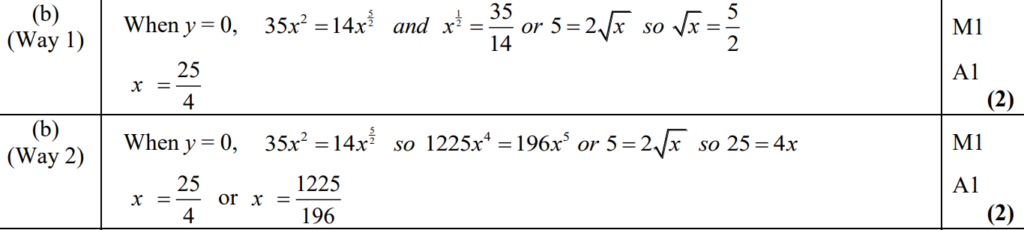
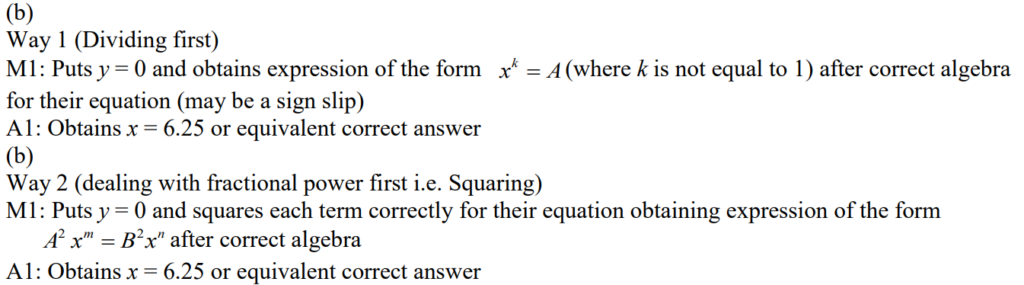
(Way 1) When \(y = 0\), \(35x^2 = 14x^{\frac{5}{2}}\) and \(x^{\frac{1}{2}} = \dfrac{35}{14}\) or \(5 = 2\sqrt{x}\) so \(\sqrt{x} = \dfrac{5}{2}\)
M1
\(x = \dfrac{25}{4}\)
A1
(2)
(Way 2) When \(y = 0\), \(35x^2 = 14x^{\frac{5}{2}}\) so \(1225x^4 = 196x^5\) or \(5 = 2\sqrt{x}\) so \(25 = 4x\)
M1
\(x = \dfrac{25}{4}\) or \(x = \dfrac{1225}{196}\)
A1
(2)
Notes
Way 1 (Dividing first)
M1: Puts \(y = 0\) and obtains expression of the form \(x^k = A\) (where \(k\) is not equal to 1) after correct algebra for their equation (may be a sign slip)
A1: Obtains \(x = 6.25\) or equivalent correct answer
Way 2 (dealing with fractional power first i.e. Squaring)
M1: Puts \(y = 0\) and squares each term correctly for their equation obtaining expression of the form \(A^2x^m = B^2x^n\) after correct algebra
A1: Obtains \(x = 6.25\) or equivalent correct answer
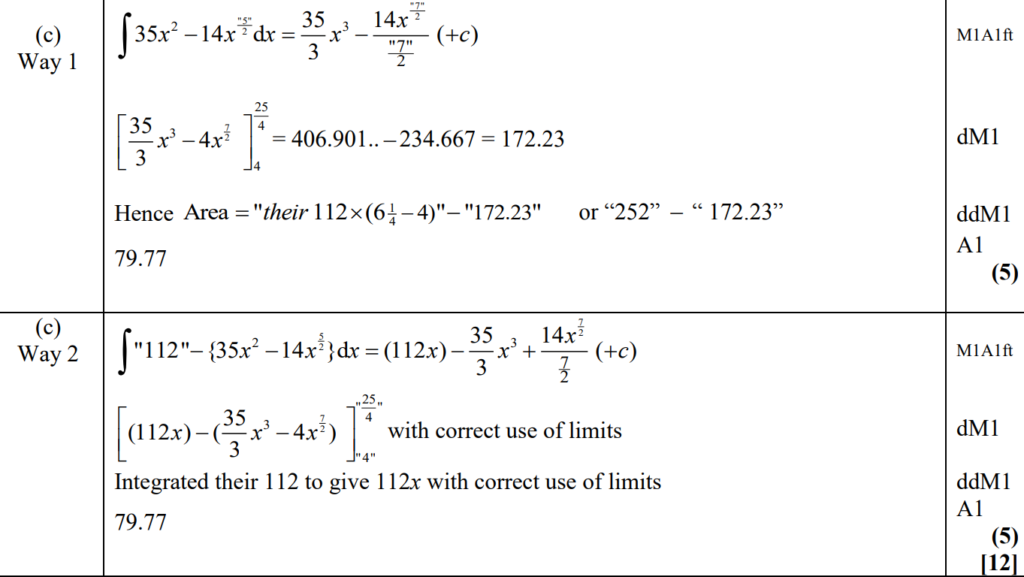
\(\left[(112x) - \left(\dfrac{35}{3}x^3 - 4x^{\frac{7}{2}}\right)\right]_{\text{"}4\text{"}}^{\text{"}\frac{25}{4}\text{"}}\) with correct use of limits
dM1
Integrated their 112 to give \(112x\) with correct use of limits
ddM1
79.77
A1
(5)
[12]
Notes
Way 1
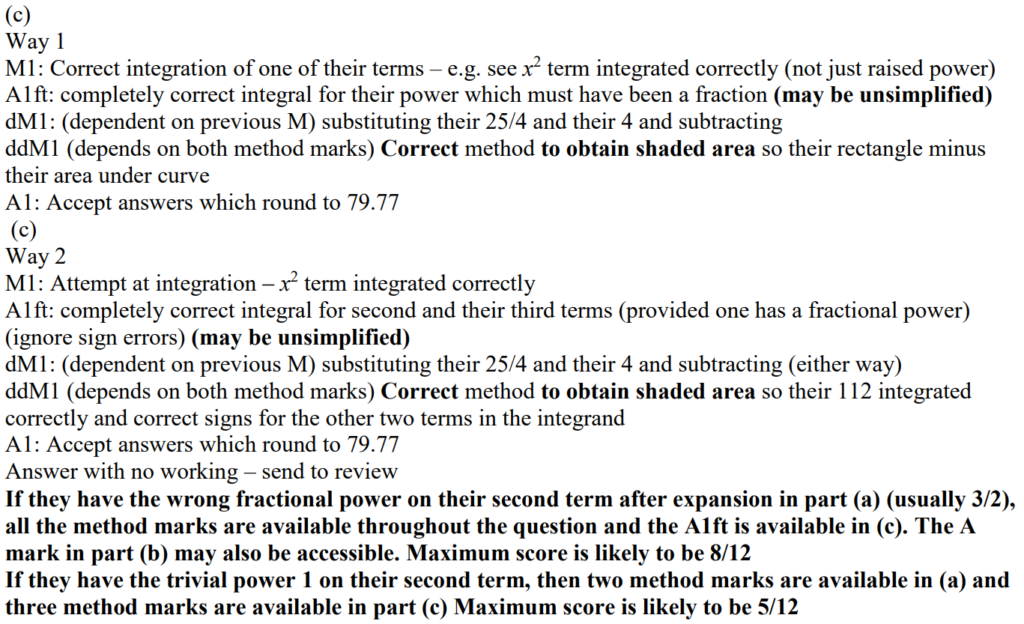
M1: Correct integration of one of their terms – e.g. see \(x^2\) term integrated correctly (not just raised power)
A1ft: completely correct integral for their power which must have been a fraction (may be unsimplified)
dM1: (dependent on previous M) substituting their 25/4 and their 4 and subtracting
ddM1 (depends on both method marks) Correct method to obtain shaded area so their rectangle minus their area under curve
A1: Accept answers which round to 79.77
Way 2
M1: Attempt at integration – \(x^2\) term integrated correctly
A1ft: completely correct integral for second and their third terms (provided one has a fractional power) (ignore sign errors) (may be unsimplified)
dM1: (dependent on previous M) substituting their 25/4 and their 4 and subtracting (either way)
ddM1 (depends on both method marks) Correct method to obtain shaded area so their 112 integrated correctly and correct signs for the other two terms in the integrand
A1: Accept answers which round to 79.77
Answer with no working – send to review
If they have the wrong fractional power on their second term after expansion in part (a) (usually 3/2), all the method marks are available throughout the question and the A1ft is available in (c). The A mark in part (b) may also be accessible. Maximum score is likely to be 8/12
If they have the trivial power 1 on their second term, then two method marks are available in (a) and three method marks are available in part (c) Maximum score is likely to be 5/12
(a) find \(\displaystyle\int y\,\mathrm{d}x\), simplifying each term. (3)
(b)
(i) Find \(\dfrac{\mathrm{d}y}{\mathrm{d}x}\)
(ii) Hence find the value of \(x\) such that \(\dfrac{\mathrm{d}y}{\mathrm{d}x} = 0\)
(4)
Mark scheme (a)
Scheme
Marks
\(2x^{1.5} - 3x^2 + 4x + c\)
M1A1A1
Ignore any spurious integral signs.
(3)
Notes
M1: For \(x^n \to x^{n+1}\) i.e. \(x^{1.5}\) or \(x^2\) or \(x\) seen (not for “+ \(c\)”)
A1: For two out of three terms correct un-simplified or simplified (Ignore \(+\,c\) for this mark)
A1: cao \(2x^{1.5} - 3x^2 + 4x + c\). All correct and simplified and on one line including “+ c”. Allow \(\sqrt{x^3}\) for \(x^{1.5}\) but not \(x^1\) for \(x\).
Mark scheme (b)
Scheme
Marks
Mark (b)(i) and (ii) together and must be differentiating the original function not their answer to part (a)
(i) \(\dfrac{3}{2}x^{-0.5} - 6\)
M1A1
(2)
(ii) \(\dfrac{3}{2}x^{-0.5} - 6 = 0 \Rightarrow x^n = \ldots\)
M1
\(x = \dfrac{1}{16}\) cso
A1
(2)
(7 marks)
Notes
(b)(i)
M1: For \(x^n \to x^{n-1}\) i.e. \(x^{0.5} \to x^{-0.5}\) or \(6x \to 6\)
A1: For \(\dfrac{3}{2}x^{-0.5} - 6\) or equivalent. May be un-simplified. Allow \(\dfrac{3/2}{\sqrt{x}} - 6\).
(b)(ii)
M1: Sets their \(\dfrac{\mathrm{d}y}{\mathrm{d}x} = 0\) (may be implied by their working) and reaches \(x^n = C\) (including \(n = 1\)) with correct processing allowing sign errors only – this may be implied by e.g. \(\sqrt{x} = \dfrac{1}{4}\) or \(\dfrac{1}{\sqrt{x}} = 4\).
A1: Allow equivalent fractions e.g. \(\dfrac{9}{144}\) or 0.0625. If other solutions are given (e.g. likely to be \(x = 0\) or \(x = -1/16\)) then this mark should be withheld.
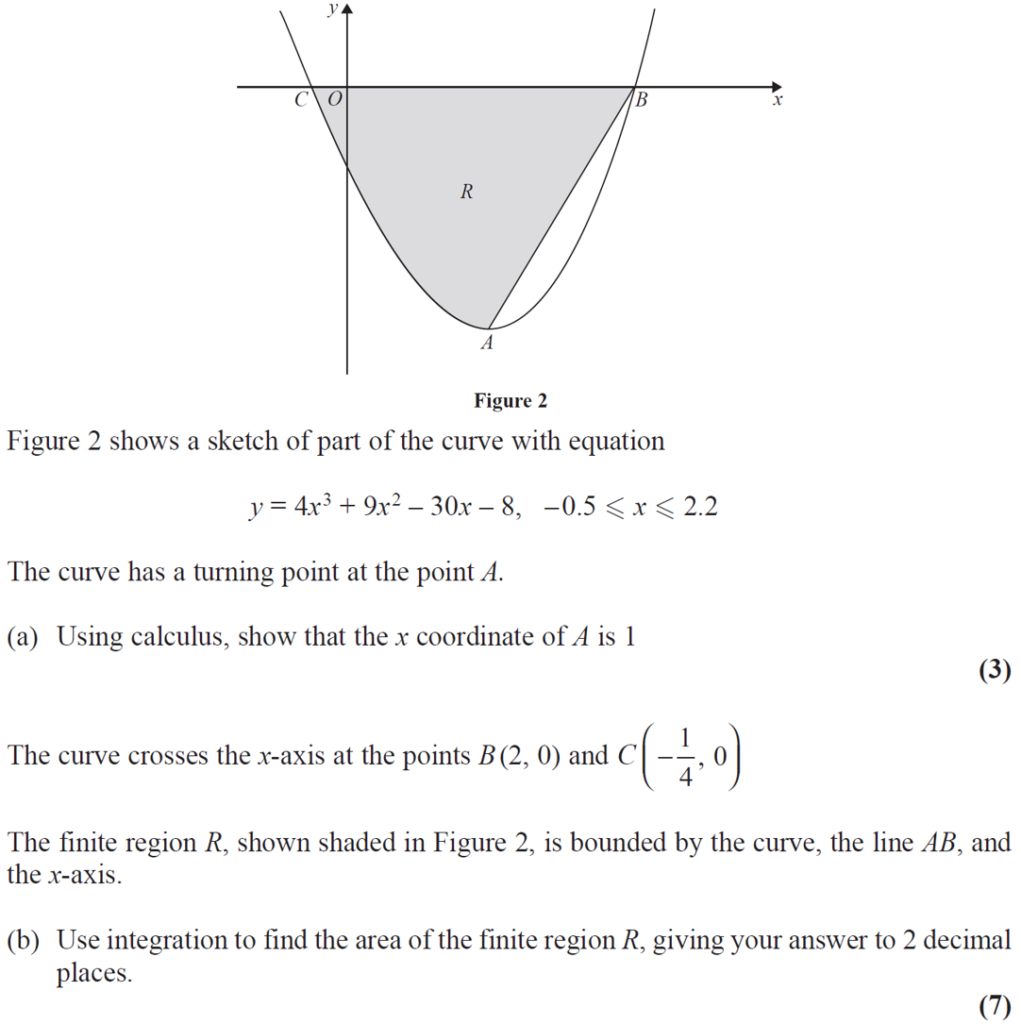
Figure 2 shows a sketch of part of the curve with equation\[y = 4x^3 + 9x^2 - 30x - 8, \quad -0.5 \leqslant x \leqslant 2.2\]The curve has a turning point at the point \(A\).
(a) Using calculus, show that the \(x\) coordinate of \(A\) is 1 (3)
The curve crosses the \(x\)-axis at the points \(B\,(2, 0)\) and \(C\left(-\dfrac{1}{4}, 0\right)\)
The finite region \(R\), shown shaded in Figure 2, is bounded by the curve, the line \(AB\), and the \(x\)-axis.
(b) Use integration to find the area of the finite region \(R\), giving your answer to 2 decimal places. (7)
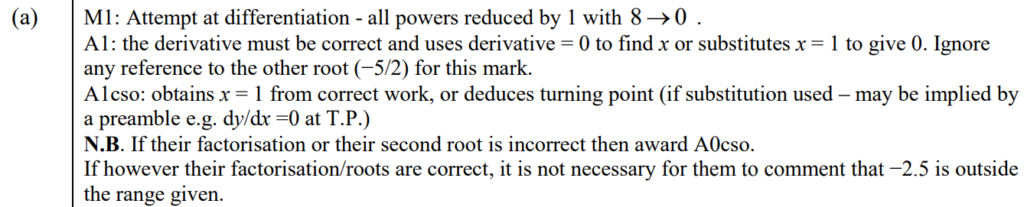
Either Substitute \(x = 1\) to give \(\dfrac{\mathrm{d}y}{\mathrm{d}x} = 12 + 18 - 30 = 0\) Or Solve \(\dfrac{\mathrm{d}y}{\mathrm{d}x} = 12x^2 + 18x - 30 = 0\) to give \(x =\)
A1
Either So turning point (all correct work so far) Or Deduce \(x = 1\) from correct work
A1cso
(3)
Notes
M1: Attempt at differentiation - all powers reduced by 1 with \(8 \to 0\).
A1: the derivative must be correct and uses derivative = 0 to find \(x\) or substitutes \(x = 1\) to give 0. Ignore any reference to the other root \((-5/2)\) for this mark.
A1cso: obtains \(x = 1\) from correct work, or deduces turning point (if substitution used – may be implied by a preamble e.g. \(\mathrm{d}y/\mathrm{d}x = 0\) at T.P.)
N.B. If their factorisation or their second root is incorrect then award A0cso. If however their factorisation/roots are correct, it is not necessary for them to comment that \(-2.5\) is outside the range given.
Mark scheme (b)
Scheme
Marks
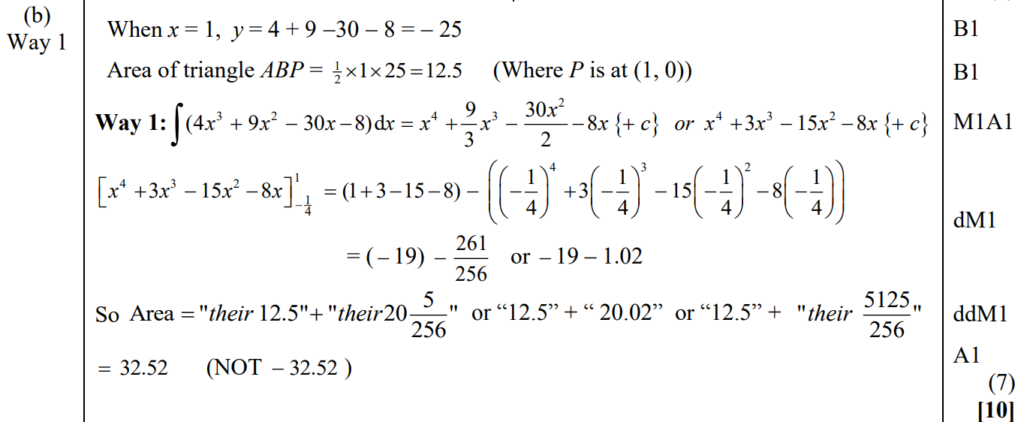
Way 1 When \(x = 1,\ y = 4 + 9 - 30 - 8 = -25\)
B1
Area of triangle \(ABP = \tfrac{1}{2} \times 1 \times 25 = 12.5\) (Where \(P\) is at \((1, 0)\))
So Area \(= \text{"}\textit{their } 12.5\text{"} + \text{"}\textit{their } 20\tfrac{5}{256}\text{"}\) or “12.5” + “20.02” or “12.5” + \(\text{"}\textit{their } \dfrac{5125}{256}\text{"}\)
ddM1
\(= 32.52\) (NOT \(-32.52\) )
A1
(7)
[10]
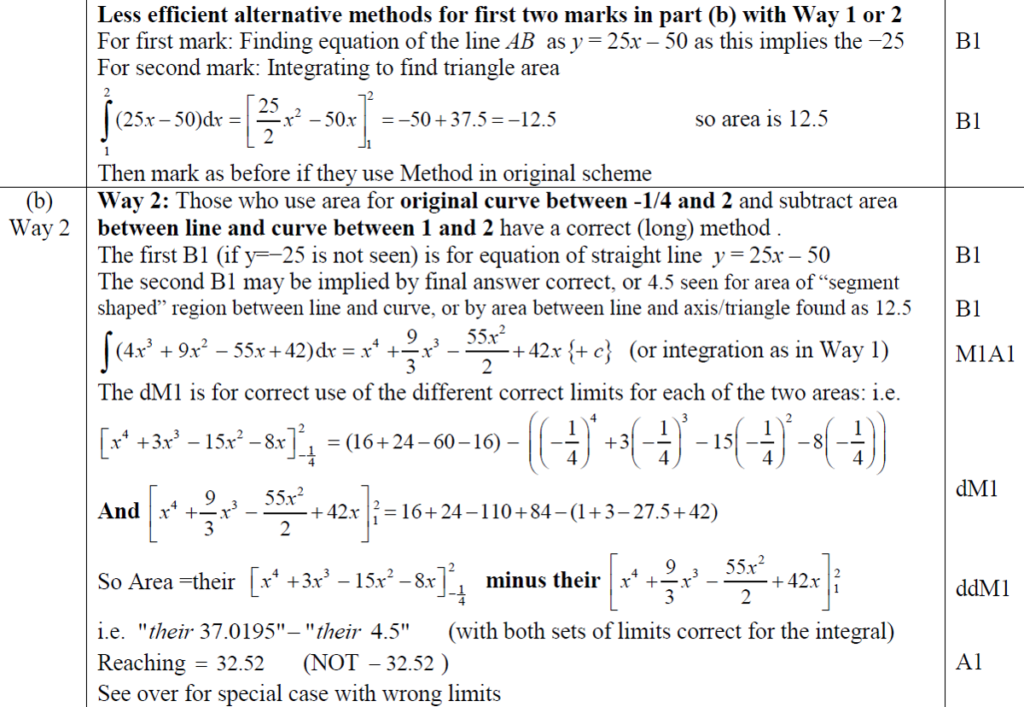
Less efficient alternative methods for first two marks in part (b) with Way 1 or 2
Scheme
Marks
For first mark: Finding equation of the line \(AB\) as \(y = 25x - 50\) as this implies the \(-25\)
B1
For second mark: Integrating to find triangle area \(\displaystyle\int_1^2 (25x - 50)\,\mathrm{d}x = \left[\frac{25}{2}x^2 - 50x\right]_1^2 = -50 + 37.5 = -12.5\) so area is 12.5
B1
Then mark as before if they use Method in original scheme
Way 2
Scheme
Marks
Way 2: Those who use area for original curve between -1/4 and 2 and subtract area between line and curve between 1 and 2 have a correct (long) method . The first B1 (if \(y = -25\) is not seen) is for equation of straight line \(y = 25x - 50\)
B1
The second B1 may be implied by final answer correct, or 4.5 seen for area of “segment shaped” region between line and curve, or by area between line and axis/triangle found as 12.5
B1
\(\displaystyle\int (4x^3 + 9x^2 - 55x + 42)\,\mathrm{d}x = x^4 + \frac{9}{3}x^3 - \frac{55x^2}{2} + 42x\ \{+c\}\) (or integration as in Way 1)
M1A1
The dM1 is for correct use of the different correct limits for each of the two areas: i.e. \(\left[x^4 + 3x^3 - 15x^2 - 8x\right]_{-\frac{1}{4}}^{2} = (16 + 24 - 60 - 16) - \left(\left(-\dfrac{1}{4}\right)^4 + 3\left(-\dfrac{1}{4}\right)^3 - 15\left(-\dfrac{1}{4}\right)^2 - 8\left(-\dfrac{1}{4}\right)\right)\) And \(\left[x^4 + \dfrac{9}{3}x^3 - \dfrac{55x^2}{2} + 42x\right]_1^2 = 16 + 24 - 110 + 84 - (1 + 3 - 27.5 + 42)\)
dM1
So Area =their \(\left[x^4 + 3x^3 - 15x^2 - 8x\right]_{-\frac{1}{4}}^{2}\) minus their \(\left[x^4 + \dfrac{9}{3}x^3 - \dfrac{55x^2}{2} + 42x\right]_1^2\) i.e. \(\text{"}\textit{their } 37.0195\text{"} - \text{"}\textit{their } 4.5\text{"}\) (with both sets of limits correct for the integral)
ddM1
Reaching \(= 32.52\) (NOT \(-32.52\) )
A1
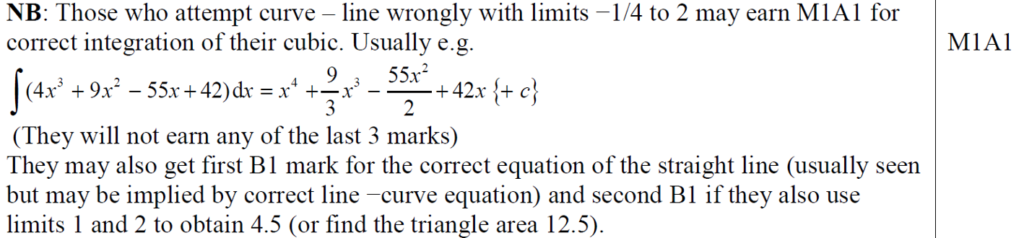
NB: Those who attempt curve – line wrongly with limits \(-1/4\) to 2 may earn M1A1 for correct integration of their cubic. Usually e.g. \(\displaystyle\int (4x^3 + 9x^2 - 55x + 42)\,\mathrm{d}x = x^4 + \frac{9}{3}x^3 - \frac{55x^2}{2} + 42x\ \{+c\}\) (They will not earn any of the last 3 marks) They may also get first B1 mark for the correct equation of the straight line (usually seen but may be implied by correct line −curve equation) and second B1 if they also use limits 1 and 2 to obtain 4.5 (or find the triangle area 12.5).
M1A1
Notes
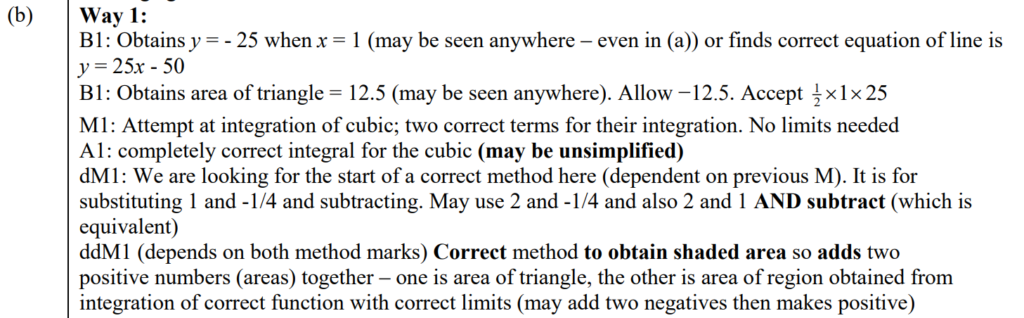
Way 1:
B1: Obtains \(y = -25\) when \(x = 1\) (may be seen anywhere – even in (a)) or finds correct equation of line is \(y = 25x - 50\)
B1: Obtains area of triangle = 12.5 (may be seen anywhere). Allow \(-12.5\). Accept \(\tfrac{1}{2} \times 1 \times 25\)
M1: Attempt at integration of cubic; two correct terms for their integration. No limits needed
A1: completely correct integral for the cubic (may be unsimplified)
dM1: We are looking for the start of a correct method here (dependent on previous M). It is for substituting 1 and -1/4 and subtracting. May use 2 and -1/4 and also 2 and 1 AND subtract (which is equivalent)
ddM1 (depends on both method marks) Correct method to obtain shaded area so adds two positive numbers (areas) together – one is area of triangle, the other is area of region obtained from integration of correct function with correct limits (may add two negatives then makes positive)
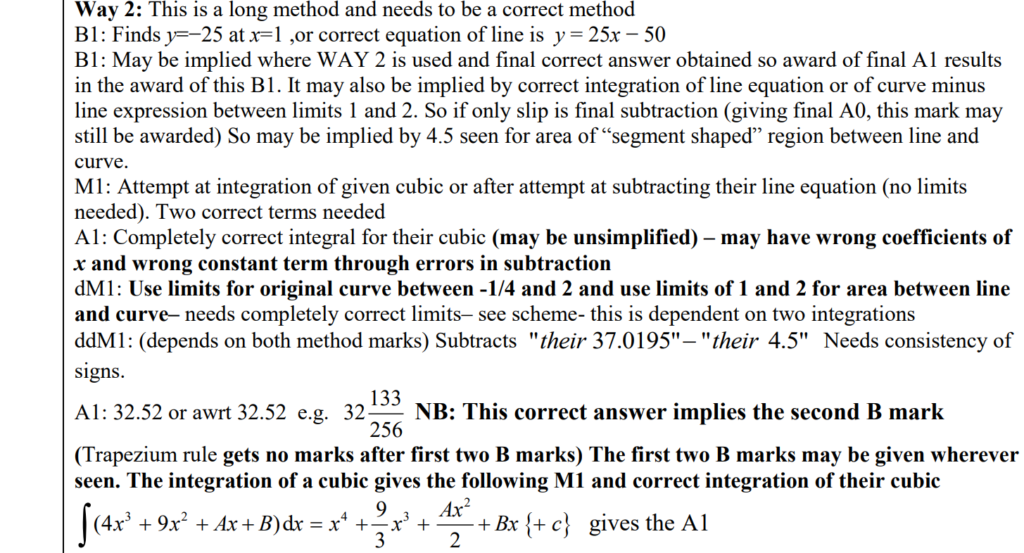
Way 2: This is a long method and needs to be a correct method
B1: Finds \(y = -25\) at \(x = 1\) ,or correct equation of line is \(y = 25x - 50\)
B1: May be implied where WAY 2 is used and final correct answer obtained so award of final A1 results in the award of this B1. It may also be implied by correct integration of line equation or of curve minus line expression between limits 1 and 2. So if only slip is final subtraction (giving final A0, this mark may still be awarded) So may be implied by 4.5 seen for area of “segment shaped” region between line and curve.
M1: Attempt at integration of given cubic or after attempt at subtracting their line equation (no limits needed). Two correct terms needed
A1: Completely correct integral for their cubic (may be unsimplified) – may have wrong coefficients of \(x\) and wrong constant term through errors in subtraction
dM1:Use limits for original curve between -1/4 and 2 and use limits of 1 and 2 for area between line and curve– needs completely correct limits– see scheme- this is dependent on two integrations
ddM1: (depends on both method marks) Subtracts \(\text{"}\textit{their } 37.0195\text{"} - \text{"}\textit{their } 4.5\text{"}\) Needs consistency of signs.
A1: 32.52 or awrt 32.52 e.g. \(32\dfrac{133}{256}\) NB: This correct answer implies the second B mark
(Trapezium rule gets no marks after first two B marks) The first two B marks may be given wherever seen. The integration of a cubic gives the following M1 and correct integration of their cubic \(\displaystyle\int (4x^3 + 9x^2 + Ax + B)\,\mathrm{d}x = x^4 + \frac{9}{3}x^3 + \frac{Ax^2}{2} + Bx\ \{+c\}\) gives the A1
Figure 2 shows a sketch of part of the curve \(y = \mathrm{f}(x)\), \(x \in \mathbb{R}\), where\[\mathrm{f}(x) = (2x - 5)^2(x + 3)\]
(a) Given that
(i) the curve with equation \(y = \mathrm{f}(x) - k\), \(x \in \mathbb{R}\), passes through the origin, find the value of the constant \(k\),
(ii) the curve with equation \(y = \mathrm{f}(x + c)\), \(x \in \mathbb{R}\), has a minimum point at the origin, find the value of the constant \(c\).
(3)
(b) Show that \(\mathrm{f}^{\prime}(x) = 12x^2 - 16x - 35\) (3)
Points \(A\) and \(B\) are distinct points that lie on the curve \(y = \mathrm{f}(x)\).
The gradient of the curve at \(A\) is equal to the gradient of the curve at \(B\).
Given that point \(A\) has \(x\) coordinate 3
(c) find the \(x\) coordinate of point \(B\). (5)
Mark scheme (a)
Scheme
Marks
(i) \(k = \left(-5\right)^2\times 3 = 75\)
M1A1
(ii) \(c = \dfrac{5}{2}\) only
B1
(3)
Notes
(a)(i)
M1: Attempts to find the ‘\(y\)’ intercept. Accept as evidence \(\left(-5\right)^2\times 3\) with or without the bracket. If they expand \(\mathrm{f}(x)\) to polynomial form here then they must then select their constant to score this mark. May be implied by sight of 75 on the diagram.
A1: \(k = 75\). Must clearly be identified as \(k\). Allow this mark even from an incorrect or incomplete expansion as long as the constant \(k = 75\) is obtained. Do not isw e.g. if 75 is seen followed by \(k = -75\) score M1A0.
(a)(ii)
B1: \(c = \dfrac{5}{2}\) oe (and no other values). Do not award just from the diagram – must be stated as the value of \(c\).
M1: Attempts \(\mathrm{f}(x)\) as a cubic polynomial by attempting to square the first bracket and multiply by the linear bracket or expands \((2x - 5)(x + 3)\) and then multiplies by \(2x - 5\) Must be seen or used in (b) but may be done in part (a). Allow poor squaring e.g. \((2x - 5)^2 = 4x^2 \pm 25\)
M1: Reduces powers by 1 in all terms including any constant \(\to 0\)
A1*: Correct proof. Withhold this mark if there have been any errors including missing brackets earlier e.g. \((2x - 5)^2(x + 3) = 4x^2 - 20x + 25(x + 3) = \ldots\)
Alt (b) Product rule.
Scheme
Marks
\(\mathrm{f}(x) = (2x - 5)^2(x + 3) \Rightarrow \mathrm{f}^{\prime}(x) = (2x - 5)^2\times 1 + (x + 3)\times 4(2x - 5)\) M1: Attempts product rule to give an expression of the form \(p(2x - 5)^2 + q(x + 3)(2x - 5)\) M1: Multiplies out and collects terms A1: \(\mathrm{f}^{\prime}(x) = 12x^2 - 16x - 35\,*\)
M1: Substitutes \(x = 3\) into their \(\mathrm{f}^{\prime}(x)\) or the given \(\mathrm{f}^{\prime}(x)\). Must be a changed function i.e. not into \(\mathrm{f}(x)\).
dM1: Sets their \(\mathrm{f}^{\prime}(x)\) or the given \(\mathrm{f}^{\prime}(x) =\) their \(\mathrm{f}^{\prime}(3)\) with a consistent \(\mathrm{f}^{\prime}\). Dependent on the previous method mark.
A1 cso: \(12x^2 - 16x - 60 = 0\) or equivalent 3 term quadratic e.g. \(12x^2 - 16x = 60\). (A correct quadratic equation may be implied by later work). This is cso so must come from correct work – i.e. they must be using the given \(\mathrm{f}^{\prime}(x)\).
ddM1: Solves 3 term quadratic by suitable method – see General Principles. Dependent on both previous method marks.
A1 cso: \(x = -\dfrac{5}{3}\) oe clearly identified. If \(x = 3\) is also given and not rejected, this mark is withheld. (allow -1.6 recurring as long as it is clear i.e. a dot above the 6). This is cso and must come from correct work – i.e. they must be using the given \(\mathrm{f}^{\prime}(x)\).
7. The curve \(C\) has equation \(y = \mathrm{f}(x)\), \(x > 0\), where\[\mathrm{f}^{\prime}(x) = 30 + \frac{6 - 5x^2}{\sqrt{x}}\]Given that the point \(P(4, -8)\) lies on \(C\),
(a) find the equation of the tangent to \(C\) at \(P\), giving your answer in the form \(y = mx + c\), where \(m\) and \(c\) are constants. (4)
(b) Find \(\mathrm{f}(x)\), giving each term in its simplest form. (5)
\(y - (-8) = \text{"}-7\text{"}\times(x - 4)\) or \(y = \text{"}-7\text{"}x + c \Rightarrow -8 = \text{"}-7\text{"}\times 4 + c \Rightarrow c = \ldots\)
M1
\(y = -7x + 20\)
A1
(4)
Notes
M1: Attempts to substitutes \(x = 4\) into \(\mathrm{f}^{\prime}(x) = 30 + \dfrac{6 - 5x^2}{\sqrt{x}}\) or their algebraically manipulated \(\mathrm{f}^{\prime}(x)\)
A1: Gradient = \(-7\)
M1: Attempts an equation of a tangent using their numeric \(\mathrm{f}^{\prime}(4)\) which has come from substituting \(x = 4\) into the given \(\mathrm{f}^{\prime}(x)\) or their algebraically manipulated \(\mathrm{f}^{\prime}(x)\) and \(\left(4, -8\right)\) with the 4 and -8 correctly placed. If using \(y = mx + c\), must reach as far as \(c = \ldots\)
A1: Cao. Allow \(y = 20 - 7x\) and allow the “\(y =\)” to become “detached” but it must be present at some stage. E.g. \(y = \ldots\) \(\phantom{y} = -7x + 20\)
Mark scheme (b)
Scheme
Marks
Allow the marks in (b) to score in (a) i.e. mark (a) and (b) together
M1: \(30 \to 30x\) or \(\dfrac{6}{\sqrt{x}} \to \alpha x^{\frac{1}{2}}\) or \(-\dfrac{5x^2}{\sqrt{x}} \to \beta x^{\frac{5}{2}}\) (these cases only)
A1: Any 2 correct terms which can be simplified or un-simplified. This includes the powers – so allow \(-\tfrac{1}{2} + 1\) for \(\tfrac{1}{2}\) and allow \(\tfrac{3}{2} + 1\) for \(\tfrac{5}{2}\) (With or without \(+\,c\))
A1: All 3 terms correct which can be simplified or un-simplified. (With or without \(+\,c\))
M1: Substitutes \(x = 4, \mathrm{f}(x) = -8\) into their \(\mathrm{f}(x)\) (not \(\mathrm{f}^{\prime}(x)\)) i.e. a changed \(\mathrm{f}^{\prime}(x)\) containing \(+c\) and rearranges to obtain a value or numerical expression for \(c\).
A1: Cao and cso (Allow \(\sqrt{x}\) for \(x^{\frac{1}{2}}\) and e.g. \(\sqrt{x^5}\) or \(x^2\sqrt{x}\) for \(x^{\frac{5}{2}}\)). Isw here so as soon as you see the correct answer, award this mark. Note that the “\(\mathrm{f}(x) =\)” is not needed.
2. Given\[y = \sqrt{x} + \frac{4}{\sqrt{x}} + 4, \qquad x > 0\]find the value of \(\dfrac{\mathrm{d}y}{\mathrm{d}x}\) when \(x = 8\), writing your answer in the form \(a\sqrt{2}\), where \(a\) is a rational number. (5)
M1: Decreases any power by 1. Either \(x^{\frac{1}{2}} \to x^{-\frac{1}{2}}\) or \(x^{-\frac{1}{2}} \to x^{-\frac{3}{2}}\) or \(4 \to 0\) or \(x^{\text{their }n} \to x^{\text{their }n-1}\) for fractional \(n\).
A1: Correct derivative, simplified or un-simplified including indices. E.g. allow \(\tfrac{1}{2} - 1\) for \(-\tfrac{1}{2}\) and allow \(-\tfrac{1}{2} - 1\) for \(-\tfrac{3}{2}\)
M1: Attempts to substitute \(x = 8\) into their ‘changed’ (even integrated) expression that is clearly not \(y\). If they attempt algebraic manipulation of their \(\mathrm{d}y/\mathrm{d}x\) before substitution, this mark is still available.
B1: \(\sqrt{8} = 2\sqrt{2}\) seen or implied anywhere, including from substituting \(x = 8\) into \(y\). May be seen explicitly or implied from e.g. \(8^{\frac{3}{2}} = 16\sqrt{2}\) or \(8^{\frac{5}{2}} = 128\sqrt{2}\) or \(4\sqrt{8} = 8\sqrt{2}\)
A1: cso \(\dfrac{1}{16}\sqrt{2}\) or \(\dfrac{\sqrt{2}}{16}\) and allow rational equivalents for \(\dfrac{1}{16}\) e.g. \(\dfrac{32}{512}\) Apply isw so award this mark as soon as a correct answer is seen.
B1: Uses or states \(\dfrac{17}{2}\) or equivalent e.g. 8.5. Must be stated or used in (b) and not just seen as part of \(y = \dfrac{17}{2}x + \dfrac{1}{2}\).
M1: Substitutes \(x = -2\) into their derivative (not the curve)
dM1: Puts their expression = their \(\dfrac{17}{2}\) (Allow BOD for 17 or -17 but not the normal gradient) and solves to obtain a value for \(k\). Dependent on the previous method mark.
A1: \(\dfrac{41}{8}\) or \(5\dfrac{1}{8}\) or 5.125
Note: \(6x^2 + 2kx + 5 = \dfrac{17}{2}x + \dfrac{1}{2}\) scores no marks on its own but may score the first M mark if they substitute \(x = -2\) into the lhs. If they rearrange this equation and then substitute \(x = -2\), this scores no marks.
7. Given that\[y = 3x^2 + 6x^{\frac{1}{3}} + \frac{2x^3 - 7}{3\sqrt{x}}, \qquad x > 0\]find \(\dfrac{\mathrm{d}y}{\mathrm{d}x}\). Give each term in your answer in its simplified form. (6)
M1: Attempts to split the fraction into 2 terms and obtains either \(\alpha x^{\frac{5}{2}}\) or \(\beta x^{-\frac{1}{2}}\). This may be implied by a correct power of \(x\) in their differentiation of one of these terms. But beware of \(\beta x^{-\frac{1}{2}}\) coming from \(\dfrac{2x^3 - 7}{3\sqrt{x}} = 2x^3 - 7 + 3x^{-\frac{1}{2}}\)
M1: Differentiates by reducing power by one for any of their powers of \(x\)
A1: \(6x\). Do not accept \(6x^1\). Depends on second M mark only. Award when first seen and isw.
A1: \(2x^{-\frac{2}{3}}\). Must be simplified so do not accept e.g. \(\dfrac{2}{1}x^{-\frac{2}{3}}\) but allow \(\dfrac{2}{\sqrt[3]{x^2}}\). Depends on second M mark only. Award when first seen and isw.
A1: \(\dfrac{5}{3}x^{\frac{3}{2}}\). Must be simplified but allow e.g. \(1\dfrac{2}{3}x^{1.5}\) or e.g. \(\dfrac{5}{3}\sqrt{x^3}\). Award when first seen and isw.
A1: \(\dfrac{7}{6}x^{-\frac{3}{2}}\). Must be simplified but allow e.g. \(1\dfrac{1}{6}x^{-1\frac{1}{2}}\) or e.g. \(\dfrac{7}{6\sqrt{x^3}}\). Award when first seen and isw.
In an otherwise fully correct solution, penalise the presence of + c by deducting the final A1
Use of Quotient Rule: First M1 and final A1A1 (Other marks as above)
A1: Two terms in \(x\) correct, simplification is not required in coefficients or powers
A1: All terms in \(x\) correct. Simplification not required in coefficients or powers and + c is not required
M1: Sub \(x = 4\), \(y = 9\) into \(\mathrm{f}(x)\) to obtain a value for \(c\). If no + \(c\) then M0. Use of \(x = 9\), \(y = 4\) is M0.
A1: Accept equivalents but must be simplified e.g. \(\mathrm{f}(x) = x^{\frac{3}{2}} - 4.5\sqrt{x} + 2x + 2\) Must be all ‘on one line’ and simplified. Allow \(x\sqrt{x}\) for \(x^{\frac{3}{2}}\)
Mark scheme (b)
Scheme
Marks
Gradient of normal is \(-\dfrac{1}{2} \Rightarrow\) Gradient of tangent = +2
M1: Gradient of \(2y + x = 0\) is \(\pm\dfrac{1}{2}\,(m) \Rightarrow \dfrac{\mathrm{d}y}{\mathrm{d}x} = -\dfrac{1}{\pm\frac{1}{2}}\)
A1: Gradient of tangent = +2 (May be implied)
The A1 may be implied by \(\dfrac{-1}{\frac{3\sqrt{x}}{2} - \frac{9}{4\sqrt{x}} + 2} = -\dfrac{1}{2}\)
M1: Sets the given \(\mathrm{f}^{\prime}(x)\) or their \(\mathrm{f}^{\prime}(x)\) = their changed \(m\) and not their \(m\) where \(m\) has come from \(2y + x = 0\)
M1: \(\times 4\sqrt{x}\) or equivalent correct algebraic processing (allow sign/arithmetic errors only) and attempt to solve to obtain a value for \(x\). If \(\mathrm{f}^{\prime}(x) \neq 2\) they need to be solving a three term quadratic in \(\sqrt{x}\) correctly and square to obtain a value for \(x\). Must be using the given \(\mathrm{f}^{\prime}(x)\) for this mark.
A1: \(x = \tfrac{3}{2}\) (1.5) Accept equivalents e.g . \(x = \tfrac{9}{6}\) If any ‘extra’ values are not rejected, score A0.
Beware \(\dfrac{-1}{\frac{3\sqrt{x}}{2} - \frac{9}{4\sqrt{x}} + 2} = -\dfrac{1}{2} \Rightarrow \dfrac{-2}{3\sqrt{x}} + \dfrac{4\sqrt{x}}{9} - \dfrac{1}{2} = -\dfrac{1}{2}\) etc. leads to the correct answer and could score M1A1M1M0(incorrect processing)A0
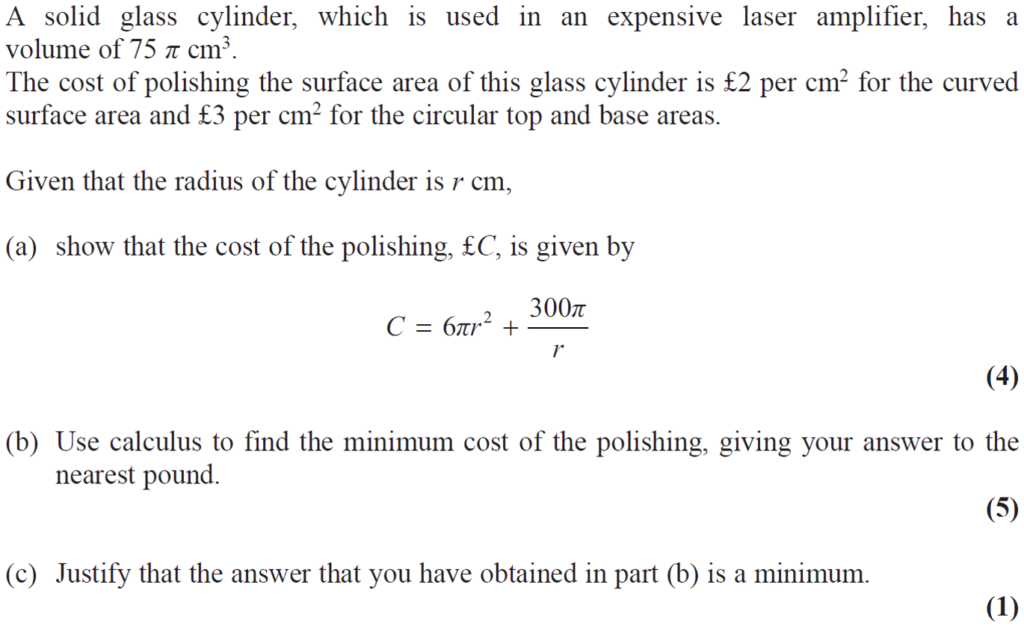
9. A solid glass cylinder, which is used in an expensive laser amplifier, has a volume of \(75\pi\) cm3. The cost of polishing the surface area of this glass cylinder is £2 per cm2 for the curved surface area and £3 per cm2 for the circular top and base areas.
Given that the radius of the cylinder is \(r\) cm,
(a) show that the cost of the polishing, £\(C\), is given by\[C = 6\pi r^2 + \frac{300\pi}{r}\] (4)
(b) Use calculus to find the minimum cost of the polishing, giving your answer to the nearest pound. (5)
(c) Justify that the answer that you have obtained in part (b) is a minimum. (1)
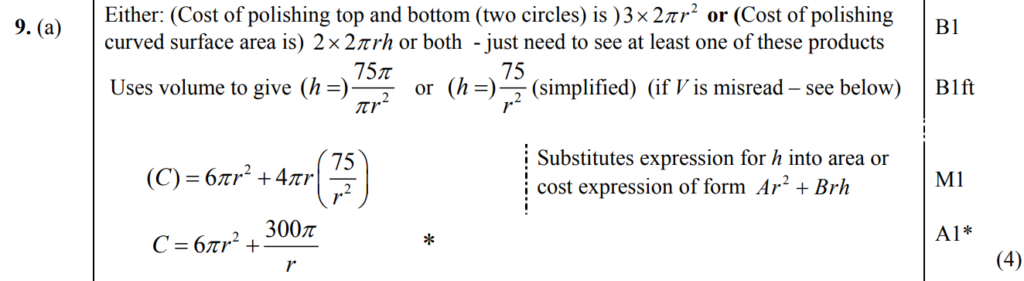
Mark scheme (a)
Scheme
Marks
Either: (Cost of polishing top and bottom (two circles) is )\(3 \times 2\pi r^2\) or (Cost of polishing curved surface area is) \(2 \times 2\pi rh\) or both - just need to see at least one of these products
B1
Uses volume to give \((h =)\dfrac{75\pi}{\pi r^2}\) or \((h =)\dfrac{75}{r^2}\) (simplified) (if \(V\) is misread – see below)
B1ft
\((C) = 6\pi r^2 + 4\pi r\left(\dfrac{75}{r^2}\right)\) Substitutes expression for \(h\) into area or cost expression of form \(Ar^2 + Brh\)
M1
\(C = 6\pi r^2 + \dfrac{300\pi}{r}\) *
A1*
(4)
Notes
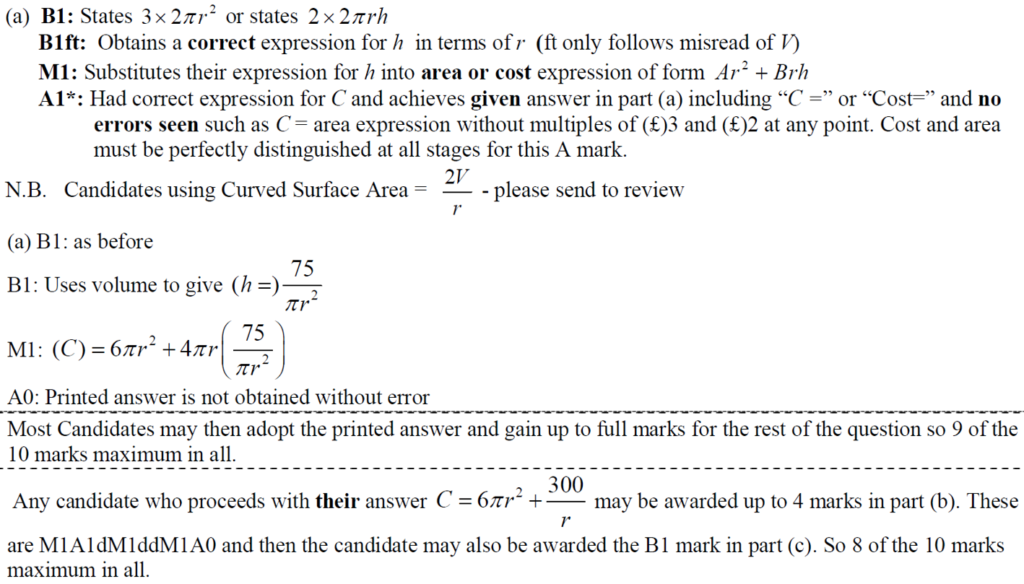
(a) B1: States \(3 \times 2\pi r^2\) or states \(2 \times 2\pi rh\)
B1ft: Obtains a correct expression for \(h\) in terms of \(r\) (ft only follows misread of \(V\))
M1: Substitutes their expression for \(h\) into area or cost expression of form \(Ar^2 + Brh\)
A1*: Had correct expression for \(C\) and achieves given answer in part (a) including “\(C\) =” or “Cost=” and no errors seen such as \(C\) = area expression without multiples of (£)3 and (£)2 at any point. Cost and area must be perfectly distinguished at all stages for this A mark.
N.B. Candidates using Curved Surface Area \(= \dfrac{2V}{r}\) - please send to review
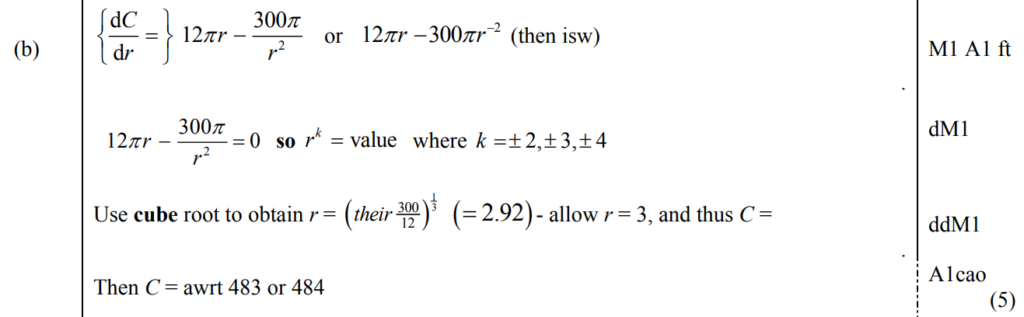
Mark scheme (b)
Scheme
Marks
\(\left\{\dfrac{\mathrm{d}C}{\mathrm{d}r} =\right\}\ 12\pi r - \dfrac{300\pi}{r^2}\) or \(12\pi r - 300\pi r^{-2}\) (then isw)
M1 A1 ft
\(12\pi r - \dfrac{300\pi}{r^2} = 0\) so \(r^k =\) value where \(k = \pm 2, \pm 3, \pm 4\)
dM1
Use cube root to obtain \(r = \left(\textit{their } \tfrac{300}{12}\right)^{\frac{1}{3}}\) \((= 2.92)\)- allow \(r = 3\), and thus \(C =\)
ddM1
Then \(C\) = awrt 483 or 484
A1cao
(5)
Notes
(b) M1: Attempts to differentiate as evidenced by at least one term differentiated correctly
A1ft: Correct derivative – allow \(12\pi r - 300\pi r^{-2}\) then isw if the power is misinterpreted (ft only for misread)
dM1: Sets their \(\dfrac{\mathrm{d}C}{\mathrm{d}r}\) to 0, and obtains \(r^k =\) value where \(k\) = 2, 3 or 4 (needs correct collection of powers of \(r\) from their original derivative expression – allow errors dividing by 12π)
ddM1: Uses cube root to find \(r\) or see \(r\) = awrt 3 as evidence of cube root and substitutes into correct expression for \(C\) to obtain value for \(C\)
A1: Accept awrt 483 or 484
Mark scheme (c)
Scheme
Marks
\(\left\{\dfrac{\mathrm{d}^2C}{\mathrm{d}r^2} =\right\}\ 12\pi + \dfrac{600\pi}{r^3} \gt 0\) so minimum
B1ft
(1)
[10]
Notes
(c) B1ft: Finds correct expression for \(\dfrac{\mathrm{d}^2C}{\mathrm{d}r^2}\) and deduces value of \(\dfrac{\mathrm{d}^2C}{\mathrm{d}r^2} \gt 0\) so minimum (\(r\) may have been wrong) OR checks gradient to left and right of 2.92 and shows gradient goes from negative to zero to positive so minimum OR checks value of \(C\) to left and right of 2.92 and shows that \(C\) > 483 so deduces minimum ( i.e. uses shape of graph) Only ft on misread of \(V\) for each ft mark (see below)
Misread of the volume
N..B. Some candidates have misread the volume as 75 instead of \(75\pi\).
Following this misread candidates cannot legitimately obtain the printed answer in part (a). Either they obtain \(C = 6\pi r^2 + \dfrac{300}{r}\) or they “fudge” their working to appear to give the printed answer.
The policy for a misread is to subtract 2 marks from A or B marks. In this case the A mark is to be subtracted from part (a) and the final A mark is to be subtracted from part (b) The maximum mark for part (a) following this misread is 3 marks. The award is B1 B1 M1 A0 as a maximum.
(a) B1: as before B1: Uses volume to give \((h =)\dfrac{75}{\pi r^2}\) M1: \((C) = 6\pi r^2 + 4\pi r\left(\dfrac{75}{\pi r^2}\right)\) A0: Printed answer is not obtained without error
Most Candidates may then adopt the printed answer and gain up to full marks for the rest of the question so 9 of the 10 marks maximum in all.
Any candidate who proceeds with their answer \(C = 6\pi r^2 + \dfrac{300}{r}\) may be awarded up to 4 marks in part (b). These are M1A1dM1ddM1A0 and then the candidate may also be awarded the B1 mark in part (c). So 8 of the 10 marks maximum in all.
(b) M1 A1: \(\left\{\dfrac{\mathrm{d}C}{\mathrm{d}r} =\right\}\ 12\pi r - \dfrac{300}{r^2}\) or \(12\pi r - 300r^{-2}\) (then isw) dM1: \(12\pi r - \dfrac{300}{r^2} = 0\) so \(r^k =\) value where \(k\) = 2, 3 or 4 or \(12\pi r - \dfrac{300}{r^2} = 0\) so \(r^k =\) value ddM1: Use cube root to obtain \(r = \left(\textit{their } \tfrac{300}{12\pi}\right)^{\frac{1}{3}}\) \((= 1.996)\)- allow \(r = 2\), and thus \(C = \ldots\) must use \(C = 6\pi r^2 + \dfrac{300}{r}\) A0: Cannot obtain \(C\) = 483 or 484
(c) B1: \(\left\{\dfrac{\mathrm{d}^2C}{\mathrm{d}r^2} =\right\}\ 12\pi + \dfrac{600}{r^3} \gt 0\) so minimum OR checks gradient to left and right of 1.996 and shows gradient goes from negative to zero to positive so minimum OR checks value of \(C\) to left and right of 1.996 and shows that \(C\) > 225.4 so deduces minimum ( i.e. uses shape of graph) (corrected from the printed mark scheme, which gives 1.966 twice in (c)) There is an example in Practice of this misread.
6. The curve \(C\) has equation\[y = \frac{\left(x^2 + 4\right)(x - 3)}{2x}, \qquad x \neq 0\]
(a) Find \(\dfrac{\mathrm{d}y}{\mathrm{d}x}\) in its simplest form. (5)
(b) Find an equation of the tangent to \(C\) at the point where \(x = -1\) Give your answer in the form \(ax + by + c = 0\), where \(a\), \(b\) and \(c\) are integers. (5)
\(\dfrac{\mathrm{d}y}{\mathrm{d}x} = x - \dfrac{3}{2} + \dfrac{6}{x^2}\) oe e.g. \(\dfrac{2x^3 - 3x^2 + 12}{2x^2}\)
ddM1A1
(5)
Notes
M1: Attempt to multiply out the numerator to get a cubic with 4 terms and at least 2 correct
M1: Attempt to divide each term by \(2x\). The powers of \(x\) of at least two terms must follow from their expansion. Allow an attempt to multiply by \(2x^{-1}\)
A1: Correct expression. May be un-simplified but powers of \(x\) must be combined e.g. \(\dfrac{x^2}{2}\) not \(\dfrac{x^3}{2x}\)
ddM1: \(x^n \to x^{n-1}\) or \(2 \to 0\) Dependent on both previous method marks.
A1: \(x - \dfrac{3}{2} + \dfrac{6}{x^2}\) oe and isw Accept \(1x\) or even \(1x^1\) but not \(\dfrac{2x}{2}\) and not \(x^0\). If they lose the previous A1 because of an incorrect constant only then allow recovery here and in part (b) for a correct derivative.
See appendix for alternatives using product/quotient rule (Ways 2 to 5 below)
M1: Attempt to multiply out the numerator to get a cubic with 4 terms and at least 2 correct
M1: Correct application of product rule A1: Correct derivative
ddM1: Expands and collects terms Dependent on both previous method marks.
A1: \(x - \dfrac{3}{2} + \dfrac{6}{x^2}\) oe e.g. \(\dfrac{2x^3 - 3x^2 + 12}{2x^2}\) and isw. Accept \(1x\) or even \(1x^1\) but not \(\dfrac{2x}{2}\) and not \(x^0\).
\(\dfrac{\mathrm{d}y}{\mathrm{d}x} = x - \dfrac{3}{2} + \dfrac{6}{x^2}\) oe e.g. \(\dfrac{2x^3 - 3x^2 + 12}{2x^2}\)
ddM1A1
M1: Divides one bracket by \(2x\)
M1: Expands
A1: Correct expression
ddM1: \(x^n \to x^{n-1}\) or \(2 \to 0\) Dependent on both previous method marks.
A1: \(x - \dfrac{3}{2} + \dfrac{6}{x^2}\) oe and isw Accept \(1x\) or even \(1x^1\) but not \(\dfrac{2x}{2}\) If they lose the previous A1 because of an incorrect constant only then allow recovery here for a correct derivative.
M1: Substitutes \(x = -1\) into their expression for \(\mathrm{d}y/\mathrm{d}x\)
A1: 3.5 oe cso
M1: Uses their tangent gradient which must come from calculus with \(x = -1\) and their numerical \(y\) with a correct straight line method. If using \(y = mx + c\), this mark is awarded for correctly establishing a value for \(c\).
Method 1: States or uses \(y - 3 = -2(x - 2)\) or \(y = -2x + c\) with their \((2, 3)\) Method 2: Or: Check that \((2, 3)\) lies on the line \(y = -2x + 7\)
dM1
Method 1: to deduce that \(y = -2x + 7\) * Method 2: Deduce equation of normal as it has the same gradient and passes through a common point
A1*
(6)
Notes
B1: Substitutes \(x = 2\) into expression for \(y\) and gets 3 cao (must be in part (a) and must use curve equation – not line equation) This must be seen to be substituted.
M1: For an attempt to differentiate the negative power with \(x^{-1} \to x^{-2}\).
dM1: Dependent on first M1 Substitutes \(x = 2\) into their derivative to obtain a numerical gradient and find negative reciprocal or states that \(-2\times\tfrac{1}{2} = -1\)
(Method 1)
dM1: Dependent on first M1 Finds equation of line using changed gradient (not their ½ but -1/2, 2 or -2) e.g. \(y - \text{"}3\text{"} = -\text{"}2\text{"}(x - 2)\) or \(y =\) “-2”\(x + c\) and use of (2, “3”) to find \(c =\)
A1*: CSO. This is a given answer \(y = -2x + 7\) obtained with no errors seen and equation should be stated
(Method 2)- checking given answer
dM1: Uses given equation of line and checks that \((2, 3)\) lies on the line
A1*: CSO. This is a given answer \(y = -2x + 7\) so statement that normal and line have the same gradient and pass through the same point must be stated
Mark scheme (b)
Scheme
Marks
Put \(20 - 4x - \dfrac{18}{x} = -2x + 7\) and simplify to give \(2x^2 - 13x + 18 = 0\) Or put \(y = 20 - 4\left(\dfrac{7 - y}{2}\right) - \dfrac{18}{\left(\dfrac{7 - y}{2}\right)}\) to give \(y^2 - y - 6 = 0\)
M1 A1
\((2x - 9)(x - 2) = 0\) so \(x =\) or \((y - 3)(y + 2) = 0\) so \(y =\)
dM1
\(x = \dfrac{9}{2},\ y = -2\)
A1, A1
(5)
(11 marks)
Notes
M1: Equate the two given expressions, collect terms and simplify to a 3TQ. There may be sign errors when collecting terms But putting for example \(20x - 4x^2 - 18 = -2x + 7\) is M0 here
A1: Correct 3TQ = 0 (need = 0 for A mark) \(2x^2 - 13x + 18 = 0\)
dM1: Attempt to solve an appropriate quadratic by factorisation, use of formula, or completion of the square (see general instructions).
A1: \(x = \dfrac{9}{2}\) oe or \(y = -2\) (allow second answers for this mark so ignore \(x = 2\) or \(y = 3\))
A1: Correct solution only so both \(x = \dfrac{9}{2},\ y = -2\) or \(\left(\dfrac{9}{2}, -2\right)\) If \(x = 2\), \(y = 3\) is included as an answer and point \(B\) is not identified then last mark is A0 Answer only – with no working – send to review. The question stated “use algebra”
The shape of the pool \(ABCDEFA\) consists of a rectangle \(BCEF\) joined to an equilateral triangle \(BFA\) and a semi-circle \(CDE\), as shown in Figure 4.
Given that \(AB = x\) metres, \(EF = y\) metres, and the area of the pool is 50 m2,
(a) show that\[y = \frac{50}{x} - \frac{x}{8}\left(\pi + 2\sqrt{3}\right)\] (3)
(b) Hence show that the perimeter, \(P\) metres, of the pool is given by\[P = \frac{100}{x} + \frac{x}{4}\left(\pi + 8 - 2\sqrt{3}\right)\] (3)
(c) Use calculus to find the minimum value of \(P\), giving your answer to 3 significant figures. (5)
(d) Justify, by further differentiation, that the value of \(P\) that you have found is a minimum. (2)
M1: Finds \(P\prime\prime\) (\(x^n \to x^{n-1}\) allow for constant \(\to 0\)) and considers sign
A1ft: \(\dfrac{200}{x^3}\) (need not be simplified) and \(\gt 0\) and conclusion. Only follow through on a correct \(P\prime\prime\) and a single positive value of \(x\) found earlier.
M1: For \(x^n \to x^{n+1}\). ie. \(x^6\) or \(x^{\frac{1}{2}}\) or \(\left(\sqrt{x}\right)\) seen Do not award for integrating their answer to part (a)
A1: For either \(2\dfrac{x^6}{6}\) or \(6\times\dfrac{x^{\frac{1}{2}}}{\frac{1}{2}}\) or simplified or unsimplified equivalents
A1: For fully correct and simplified answer with \(+c\).
Figure 4 shows a closed letter box \(ABFEHGCD\), which is made to be attached to a wall of a house.
The letter box is a right prism of length \(y\) cm as shown in Figure 4. The base \(ABFE\) of the prism is a rectangle. The total surface area of the six faces of the prism is \(S\) cm2.
The cross section \(ABCD\) of the letter box is a trapezium with edges of lengths \(DA = 9x\) cm, \(AB = 4x\) cm, \(BC = 6x\) cm and \(CD = 5x\) cm as shown in Figure 5. The angle \(DAB = 90^\circ\) and the angle \(ABC = 90^\circ\).
The volume of the letter box is 9600 cm3.
(a) Show that\[y = \frac{320}{x^2}\] (2)
(b) Hence show that the surface area of the letter box, \(S\) cm2, is given by\[S = 60x^2 + \frac{7680}{x}\] (4)
(c) Use calculus to find the minimum value of \(S\). (6)
(d) Justify, by further differentiation, that the value of \(S\) you have found is a minimum. (2)
Mark scheme (a)
Scheme
Marks
\(\dfrac{1}{2}(9x + 6x)4x\) or \(\quad 2x \times 15x\) or \(\quad \left(\dfrac{1}{2}4x \times (9x - 6x) + 6x \times 4x\right)\) or \(\quad 6x^2 + 24x^2\) or \(\quad \left(9x \times 4x - \dfrac{1}{2}4x \times (9x - 6x)\right)\) or \(\quad 36x^2 - 6x^2\)
M1A1cso
\(\Rightarrow 30x^2y = 9600 \Rightarrow y = \dfrac{9600}{30x^2} \Rightarrow y = \dfrac{320}{x^2}\) *
(2)
Notes
M1: Correct attempt at the area of a trapezium. Note that \(30x^2\) on its own or \(30x^2\) from incorrect work e.g. \(5x \times 6x\) is M0. If there is a clear intention to find the area of the trapezium correctly allow the M1 but the A1 can be withheld if there are any slips.
A1: Correct proof with at least one intermediate step and no errors seen. “\(y =\)” is required.
M1: An attempt to find the area of six faces of the prism. The 2 trapezia may be combined as \((9x + 6x)4x\) or \(60x^2\) and the 4 other faces may be combined as \(24xy\) but all six faces must be included. There must be attempt at the areas of two trapezia that are dimensionally correct.
A1: Correct expression in any form. Allow just \((S =)\ 60x^2 + 24xy\) for M1A1
M1: Substitutes \(y = \dfrac{320}{x^2}\) into their expression for \(S\) (may be done earlier). \(S\) should have at least one \(x^2\) term and one \(xy\) term but there may be other terms which may be dimensionally incorrect.
A1* cso: Correct solution only. “\(S =\)” is not required here.
M1: Either \(60x^2 \to 120x\) or \(\dfrac{7680}{x} \to \dfrac{\pm\lambda}{x^2}\)
A1: Correct differentiation (need not be simplified).
M1: \(S\prime = 0\) and “their \(x^3 = \pm\) value” or “their \(x^{-3} = \pm\) value” Setting their \(\dfrac{\mathrm{d}S}{\mathrm{d}x} = 0\) and “candidate’s ft correct power of \(x =\) a value”. The power of \(x\) must be consistent with their differentiation. If inequalities are used this mark cannot be gained until candidate states value of \(x\) or \(S\) from their \(x\) without inequalities. \(S\prime = 0\) can be implied by \(120x = \dfrac{7680}{x^2}\). Some may spot that \(x = 4\) gives \(S\prime = 0\) and provided they clearly show \(S\prime(4) = 0\) allow this mark as long as \(S\prime\) is correct. (If \(S\prime\) is incorrect this method is allowed if their derivative is clearly zero for their value of \(x\))
A1: \(x = 4\) only (\(x^3 = 64 \Rightarrow x = \pm 4\) scores A0) Note that the value of \(x\) is not explicitly required so the use of \(x = \sqrt[3]{64}\) to give \(S = 2880\) would imply this mark.
ddM1: Substitute candidate’s value of \(x\ (\neq 0)\) into a formula for \(S\). Dependent on both previous M marks.
M1: Attempt \(S\prime\prime\ \left(x^n \to x^{n-1}\right)\) and considers sign. This mark requires an attempt at the second derivative and some consideration of its sign. There does not necessarily need to be any substitution. An attempt to solve \(S\prime\prime = 0\) is M0
A1: \(120 + \dfrac{15360}{x^3}\) and \(\gt 0\) and conclusion. Requires a correct second derivative of \(120 + \dfrac{15360}{x^3}\) (need not be simplified) and a valid reason (e.g. > 0), and conclusion. Only follow through a correct second derivative i.e. \(x\) may be incorrect but must be positive and/or \(S\prime\prime\) may have been evaluated incorrectly.
A correct \(S\prime\prime\) followed by \(S\prime\prime(\text{"}4\text{"}) = \text{"}360\text{"}\) therefore minimum would score no marks in (d) A correct \(S\prime\prime\) followed by \(S\prime\prime(\text{"}4\text{"}) = \text{"}360\text{"}\) which is positive therefore minimum would score both marks
10. A curve with equation \(y = \mathrm{f}(x)\) passes through the point \((4, 25)\).
Given that\[\mathrm{f}^{\prime}(x) = \frac{3}{8}x^2 - 10x^{-\frac{1}{2}} + 1, \qquad x > 0\]
(a) find \(\mathrm{f}(x)\), simplifying each term. (5)
(b) Find an equation of the normal to the curve at the point \((4, 25)\). Give your answer in the form \(ax + by + c = 0\), where \(a\), \(b\) and \(c\) are integers to be found. (5)
Substitute \(x = 4,\ y = 25 \Rightarrow 25 = 8 - 40 + 4 + c \Rightarrow c =\)
M1
\(\left(\mathrm{f}(x)\right) = \dfrac{x^3}{8} - 20x^{\frac{1}{2}} + x + 53\)
A1
(5)
Notes
M1: Attempt to integrate \(x^n \to x^{n+1}\)
A1: Term in \(x^3\) or term in \(x^{\frac{1}{2}}\) correct, coefficient need not be simplified, no need for \(+x\) nor \(+c\)
A1: ALL three terms correct, coefficients need not be simplified, no need for \(+c\)
M1: For using \(x = 4\), \(y = 25\) in their \(\mathrm{f}(x)\) to form a linear equation in \(c\) and attempt to find \(c\)
A1: \(= \dfrac{x^3}{8} - 20x^{\frac{1}{2}} + x + 53\) cao (all coefficients and powers must be simplified to give this answer- do not need a left hand side and if there is one it may be \(\mathrm{f}(x)\) or \(y\)). Need full expression with 53 These marks need to be scored in part (a)
Gradient of tangent \(= 2 \Rightarrow\) Gradient of normal is \(-1/2\)
dM1
Substitute \(x = 4\), \(y = 25\) into line equation with their changed gradient e.g. \(y - 25 = -\dfrac{1}{2}(x - 4)\)
dM1
\(\pm k(2y + x - 54) = 0\) o.e. (but must have integer coefficients)
A1cso
(5)
(10 marks)
Notes
M1: Attempt to substitute \(x = 4\) into \(\mathrm{f}^{\prime}(x)\) must be in part (b)
A1: \(\mathrm{f}^{\prime}(x) = 2\) at \(x = 4\)
dM1: (Dependent on first method mark in part (b)) Using \(m_1\times m_2 = -1\) to find the gradient of the normal from their tangent gradient (Give mark if gradient of 1 becomes -1 as they will lose accuracy)
dM1: (Dependent on first method mark in part (b)) Attempt to find the equation of the normal (not tangent). Eg use \(x = 4\), \(y = 25\) in \(y =\) ‘\(-1/2\)’\(x + c\) to find a value of \(c\) or use ‘\(-\dfrac{1}{2}\)’\(= \dfrac{y - 25}{x - 4}\) with their adapted gradient.
A1: cso \(\pm k(2y + x - 54) = 0\) (where \(k\) is any integer)
M1: Attempt to multiply out bracket. Must be 3 or 4 term quadratic and must have constant term 1
M1: \(x^n \to x^{n-1}\). Follow through on any term in an incorrect expression. Accept a constant \(\to 0\)
A1: \(-4 + 8x\) Accept \(-4(1 - 2x)\) or equivalent. This is not cso and may follow error in the constant term Following correct answer by \(-2 + 4x\) – apply isw
Correct answer with no working – assume chain rule and give M1M1A1 i.e. 3/3
Common errors: \((1 - 2x)^2 = 2 - 4x + 4x^2\) is M0, then allow M1A1 for \(-4 + 8x\) \((1 - 2x)^2 = 1 - 4x^2\) is M0 then \(-8x\) earns M1A0 or \((1 - 2x)^2 = 1 - 2x^2\) is M0 then \(-4x\) earns M1A0
Alternative method using chain rule
Scheme
Marks
Answer of \(-4(1 - 2x)\)
M1M1A1
(3)
Use of Chain Rule: M1M1: first M1 for complete method so \(2\times(\pm 2)(1 - 2x)\) second M1 for \((1 - 2x)\) (as power reduced) Then A1 for \(-4(1 - 2x)\) or for \(-4 + 8x\) So (i) \(2(1 - 2x)\) gets M0 M1A0 for reducing power and (ii) \(2\times 2(1 - 2x)\) gets M1 M1A0
Quotient Rule (May rarely appear) – See note below
(4)
(7 marks)
Notes
M1: An attempt to divide by \(2x^2\) first. This can be implied by the sight of the following Some correct working e.g. \(\dfrac{x^5}{2x^2} + 6\dfrac{\sqrt{x}}{2x^2}\) or \(\left(x^5 + 6\sqrt{x}\right)\left(2x^2\right)^{-1}\) leading to \(ax^p + bx^q\) in either case or can be implied by \(\dfrac{1}{2}x^3 + 3x^p\) (after no working) i.e. both coefficients correct and power 3 correct
Common error: \(\left(x^5 + 6\sqrt{x}\right)2x^{-2}\) is M0 (may earn next M mark for the differentiation \(x^{-\frac{3}{2}} \to x^{-\frac{5}{2}}\))
A1: Writing the given expression as \(\dfrac{1}{2}x^3 + 3x^{-\frac{3}{2}}\) or \(0.5x^3 + \tfrac{6}{2}x^{-\frac{3}{2}}\) or \(0.5x^3 + \tfrac{6}{2}x^{-1\frac{1}{2}}\) or etc…
M1: \(x^{-\frac{3}{2}} \to x^{-\frac{5}{2}}\)
A1: Cao \(\dfrac{3}{2}x^2 - \dfrac{9}{2}x^{-\frac{5}{2}}\) o.e. e.g. \(\dfrac{3}{2}x^2 - \dfrac{9}{2x^2\sqrt{x}}\) then isw. Allow factorised form. Do not penalise \(+-\dfrac{9}{2}x^{-\frac{5}{2}}\) used instead of \(-\dfrac{9}{2}x^{-\frac{5}{2}}\)
Use of Quotient Rule: M1,A1: Reaching \(\dfrac{2x^2\left(5x^4 + 3x^{-\frac{1}{2}}\right) - 4x\left(x^5 + 6x^{\frac{1}{2}}\right)}{4x^4},\ = \dfrac{6x^6 - 18x^{\frac{3}{2}}}{4x^4}\)
M1A1: Simplifying (e.g.dividing numerator and denominator by 2) to reach \(\dfrac{3x^6 - 9x^{\frac{3}{2}}}{2x^4}\) o.e. Send to review if doubtful
M1: \(x^n \to x^{n-1}\) for any term including \(3 \to 0\).
A1: \(\left(\dfrac{\mathrm{d}y}{\mathrm{d}x}\right) = 3x^2 - 2\times 2x - 1\) There is no need to see any simplification
M1: Sub \(x\)=2 into their \(\mathrm{f}^{\prime}(x)\)
dM1: Uses their numerical gradient with (2, 1) to find an equation of a tangent to \(y = \mathrm{f}(x)\). It is dependent upon both M’s. Accept their \(\left.\dfrac{\mathrm{d}y}{\mathrm{d}x}\right|_{x=2} = \dfrac{y - 1}{x - 2}\). Both signs must be correct If \(y = mx + c\) is used then it must be a full attempt to find a numerical ‘\(c\)’
A1*: Cso \(y = 3x - 5\). This is a given answer and all steps must be correct. Look for gradient =3 having been achieved by differentiation.
Sub \(x = -\dfrac{2}{3}\) into \(y = x^3 - 2x^2 - x + 3\)
dM1
\(y = \dfrac{67}{27}\)
A1
(5)
(10 marks)
Notes
M1: Sets their \(\dfrac{\mathrm{d}y}{\mathrm{d}x} = 3\) and proceeds to a 3TQ=0. Condone errors on \(\left(\dfrac{\mathrm{d}y}{\mathrm{d}x}\right)\)
dM1: Factorises their 3TQ (usual rules) leading to a solution \(x\)=… . It is dependent upon the previous M. Award also for use of formula/ completion of square as long as the previous M has been awarded.
A1: \(x = -\dfrac{2}{3}\)
dM1: Sub their \(x = -\dfrac{2}{3}\) into \(y = x^3 - 2x^2 - x + 3\). It is dependent only upon the first M in (b) having been scored
A1: Correct y coordinate \(y = \dfrac{67}{27}\) or equivalent
M1: Correct method for trapezium including limits. An attempt to integrate their rearrangement of the normal with the limits 0 and 4. A1: Correct numerical expression
M1: \(x^n \to x^{n+1}\) A1: Correct integration
M1: Use of limits 0 and 4 in a changed function and subtracts (either way round)
M1: Trapezium – Integral or Integral - Trapezium A1: Cso
If the only error in this method is to do (Curve – Line) then only penalise the final mark – i.e. they get -80/9
(7)
M1A1: Allow (Curve – Line) for both marks. In either case, the A1 should not be awarded if brackets are missing unless a correct expression is implied by later work.
M2: \(x^n \to x^{n+1}\) on both line and curve. Second and third M’s, second A. A1: Correct integration
M1: Use of limits 0 and 4 in a changed function and subtracts (either way round)
Accept full valid alternative arguments for the minimum e.g. finds gradient either side of \(x = 9\)
(2)
Total 11
Notes
M1: Substitutes their \(x\) value(s) into their second derivative
A1: Fully correct solution including a correct numerical second derivative (awrt 0.04) and a reference to positive or > 0 There must be no other turning points for this mark i.e. \(x = 9\) only used but allow recovery as above.
\(\dfrac{\mathrm{d}y}{\mathrm{d}x} = 4x + 2x^{-\frac{3}{2}}\) or \(4x + \dfrac{2}{x^{\frac{3}{2}}}\) oe
A1,A1
(3)
Notes
M1: \(x^n \to x^{n-1}\) for any term. The sight of \(2x^2 \to Ax\) OR \(Cx^{-\frac{1}{2}} \to Dx^{-\frac{3}{2}}\) OR \(1 \to 0\) is sufficient Do not follow through on an incorrect index of \(\dfrac{4}{\sqrt{x}}\) for this mark.
A1: One of the first two terms correct and simplified. Either \(4x\) or \(2x^{-\frac{3}{2}}\) Accept equivalents such as \(4\times x\) and \(2\times x^{-\frac{3}{2}} = \dfrac{2}{x^{1.5}}\) Ignore +c for this mark. Do not accept unsimplified terms like \(2\times 2x\)
A1: A completely correct solution with no +c. That is \(4x + 2x^{-\frac{3}{2}}\) Accept simplified equivalent expressions such as \(4\times x + 2\times x^{-\frac{3}{2}}\) or \(4x + \dfrac{2}{x^{\frac{3}{2}}}\) There is no requirement to give the lhs ie \(\dfrac{\mathrm{d}y}{\mathrm{d}x} =\). However if the lhs is incorrect withhold the last A1
Mark scheme (b)
Scheme
Marks
\(x^n \to x^{n-1}\)
M1
\(\dfrac{\mathrm{d}^2y}{\mathrm{d}x^2} = 4 - 3x^{-\frac{5}{2}}\) or \(4 - \dfrac{3}{x^{\frac{5}{2}}}\)
A1
(2)
(5 marks)
Notes
M1: For either \(4x \to 4\) or \(x^n \to x^{n-1}\) for a fractional term. Follow through on incorrect answers in (a).
A1: A completely correct solution \(4 - 3x^{-\frac{5}{2}}\) Award for expressions such as \(4 - 3\times x^{-\frac{5}{2}}\) or \(4 - \dfrac{3}{x^{\frac{5}{2}}}\) or \(-3\times x^{-2.5} + 4\) There is no requirement to give the lhs ie \(\dfrac{\mathrm{d}^2y}{\mathrm{d}x^2} = \ldots\). However if the lhs is incorrect withhold the last A1
M1: Correct attempt to split into 2 separate terms or fractions. May be implied by one correct term. Divides by \(x^{\frac{1}{2}}\) or multiplies by \(x^{-\frac{1}{2}}\).
A1: \(x^{\frac{1}{2}} + 9x^{-\frac{1}{2}}\) or equivalent
M1: Independent method mark for \(x^n \to x^{n+1}\) on separate terms
A1: Allow un-simplified answers. No requirement for + c here
M1: Substitutes \(x = 9\) and \(y = 0\) into their integrated expression leading to a value for \(c\). If no \(c\) at this stage M0A0 follows unless their method implies that they are correctly finding a constant of integration.
A1: There is no requirement to simplify their \(\mathrm{f}(x)\) so accept any correct un-simplified form.
M1: Sets \(\mathrm{f}^{\prime}(x) = \dfrac{x + 9}{\sqrt{x}} = 10\) and multiplies by \(\sqrt{x}\). The terms in \(x\) must be in the numerator. E.g. allow \(\dfrac{x + 9}{10} = \sqrt{x}\)
dM1: Correct attempt to solve a relevant 3TQ in \(\sqrt{x}\) leading to solution for \(\sqrt{x}\). Dependent on the previous M1.
A1, B1: Note that the \(x = 1\) solution could be just written down and is B1 but must come from a correct equation.
M1: Sets \(\dfrac{x + 9}{\sqrt{x}} = 10\), squares and multiplies by \(x\). They must be setting either the original \(\mathrm{f}^{\prime}(x) = 10\) or an equivalent correct expression = 10
dM1: Correct attempt to solve a relevant 3TQ leading to solution for \(x\). Dependent on the previous M1.
A1, B1: Note that the \(x = 1\) solution could be just written down and is B1 but must come from a correct equation.
1st M1: At least one term differentiated ( not integrated) correctly, so \(2x \to 2\), or \(\dfrac{8}{x^2} \to -16x^{-3}\), or \(3 \to 0\)
A1: This answer or equivalent e.g. \(2 - \dfrac{16}{x^3}\)
2nd M1: Sets \(\dfrac{\mathrm{d}y}{\mathrm{d}x}\) to 0, and solves to give \(x^3 =\) value or \(x^{-3} =\) value (or states \(x = 2\) with no working following correctly stated \(2 - 16x^{-3} = 0\))
A1: \(x = 2\) cso (if \(x = -2\) is included this is A0 here)
3rd M1: Attempts to substitutes their positive \(x\) (found from attempt to differentiate) into \(y = 2x + 3 + \dfrac{8}{x^2},\ x > 0\) Or may be implied by \(y = 9\) or correct follow through from their positive \(x\)
A1: 9 cao (Does not need to be written as coordinates) (ignore the extra (-2,1) here)
A1: Correct differentiation (Do not allow \(4x^0\) unless \(x^0 = 1\) is implied by later work)
M1: Substitutes \(x = 3\) into their \(\dfrac{\mathrm{d}y}{\mathrm{d}x}\) (not \(y\)) Substitutes \(x = 3\) into a “changed” function. They may even have integrated.
A1: Cao (may be un-simplified but must be a fraction with no powers) e.g. \(-3(-3)^{-2}\) scores A0 unless evaluated as e.g. \(\dfrac{-3}{9}\) or is implied by their normal gradient.
dM1: Correct perpendicular gradient rule applied to a numerical gradient that must have come from substituting \(x = -3\) into their derivative. Dependent on the previous M1.
dM1: Correct straight line method using \((-3, 3)\) and a “changed” gradient. A wrong equation with no formula quoted is M0. Also dependent on the first M1.
A1: Any correct equation
Mark scheme (d)
Scheme
Marks
\((-4, 0)\) and \((0, 12)\).
B1
So \(AB\) has length \(\sqrt{160}\) or \(AB^2\) has length 160
M1 A1cso
(3)
(11 marks)
Notes
B1: Both correct (May be seen on a sketch)
M1: Correct use of Pythagoras for their \(A\) and \(B\) one of which lies on the \(x\)-axis and the other on the \(y\)-axis, obtained from their equation in (c). A correct method for \(AB^2\) or \(AB\).
A1: \(\sqrt{160}\) or better e.g. \(4\sqrt{10}\) with no errors seen
\(2x - 16x^{-\frac{1}{2}} = 0 \Rightarrow x^{\frac{3}{2}} = \ ,\ x^{-\frac{3}{2}} =\) ,or \(2x = 16x^{-\frac{1}{2}}\) then squared then obtain \(x^3 =\) [or \(2x - 16x^{-\frac{1}{2}} = 0 \Rightarrow x = 4\) (no wrong work seen)]
M1
\(\left(x^{\frac{3}{2}} = 8 \Rightarrow\right) x = 4\)
A1
\(x = 4,\ y = 4^2 - 32\sqrt{4} + 20 = -28\) (ignore \(y = 100\) as second answer)
M1 A1
(6)
Notes
1st M1: At least one term differentiated correctly, so \(x^2 \to 2x\), or \(32\sqrt{x} \to 16x^{-\frac{1}{2}}\), or \(20 \to 0\)
A1: This answer or equivalent e.g. \(2x - \dfrac{16}{\sqrt{x}}\)
2nd M1: Sets their \(\dfrac{\mathrm{d}y}{\mathrm{d}x}\) to 0, and solves to give \(x^{\frac{3}{2}} =\), \(x^{-\frac{3}{2}} = or\ x^3 =\) after correct squaring or spots \(x = 4\) (NB \(\left\{\dfrac{\mathrm{d}^2y}{\mathrm{d}x^2} = 0\right\}\ so\ 2 + 8x^{-\frac{3}{2}} = 0\) is M0 )
N.B. Common error: Putting derivative = 0 and merely obtaining \(x = 0\) is M0A0, then M0A0 for next two marks. (The first two marks in (a) and marks for second derivative may be earned in part (b).)
A1: \(x = 4\) cao [ \(x = -4\) is A0 and \(x = \pm 4\) is also A0 ]
3rd M1: Substitutes their positive found \(x\) (NOT zero) into \(y = x^2 - 32\sqrt{x} + 20,\ x > 0\).Should follow attempting to set \(\dfrac{\mathrm{d}y}{\mathrm{d}x} = 0\) and not setting \(\dfrac{\mathrm{d}^2y}{\mathrm{d}x^2} = 0\)
A1: -28 cao (Does not need to be written as coordinates)
(corrected from the printed mark scheme: “\(2x - = 16x^{-\frac{1}{2}}\)” in the second row)
\(\left(\dfrac{\mathrm{d}^2y}{\mathrm{d}x^2} > 0 \Rightarrow\right) y\) is a minimum ( there should be no wrong reasoning)
A1
(3)
[9]
Notes
M1: Attempts differentiation of their first derivative with at least one term differentiated correctly. Should be seen or referred to (in part (b)) in determining the nature of the stationary point.
A1: Answer in scheme or equivalent
A1: States minimum (Second derivative should be correct- can follow incorrect positive \(x\). Needs M1A1 to have been awarded- should not follow incorrect reasoning – (need not say \(\dfrac{\mathrm{d}^2y}{\mathrm{d}x^2} > 0\) but should not have said \(\dfrac{\mathrm{d}^2y}{\mathrm{d}x^2} = 0\) for example )
Alternative Method: Gradient Test
M1 for finding the gradient either side of their \(x\)-value from part (a).
A1 for both gradients calculated correctly to 1 significant figure, then using < 0 and > 0 respectively maybe by use of sketch or table. (See appendix for gradient values. This is not ft their \(x\))
A1 states minimum needs M1A1 to have been awarded.
\((\mathrm{f}(x) =) -9x^{-1} - 6x + \dfrac{x^3}{3} +\) their \(c\)
A1ft
Note that if they integrate in (b), no marks there but if they then go on to use their integration in (c), the marks for integration are available.
(5)
(10 marks)
Notes
M1: \(x^n \to x^{n+1}\) on separate terms at least once. (Differentiating is M0)
A1ft: \(-9x^{-1} + Ax + \dfrac{Bx^3}{3}\ (+c)\) with numerical \(A\) and \(B\), \(A, B \neq 0\)
M1: Uses \(x = -3\) and \(y = 10\) in what they think is \(\mathrm{f}(x)\) (They may have differentiated here) but it must be a changed function i.e. not the original \(\mathrm{f}^{\prime}(x)\), to form a linear equation in \(c\) and attempts to find \(c\). No + \(c\) gets M0 and A0 unless their method implies that they are correctly finding a constant.
A1: cso
A1ft: Follow through their \(c\) in an otherwise (possibly un-simplified) correct expression. Allow \(-\dfrac{9}{x}\) for \(-9x^{-1}\) or even \(\dfrac{9x^{-1}}{-1}\).
11. The curve \(C\) has equation\[y = 2x - 8\sqrt{x} + 5, \qquad x \geqslant 0\]
(a) Find \(\dfrac{\mathrm{d}y}{\mathrm{d}x}\), giving each term in its simplest form. (3)
The point \(P\) on \(C\) has \(x\)-coordinate equal to \(\dfrac{1}{4}\)
(b) Find the equation of the tangent to \(C\) at the point \(P\), giving your answer in the form \(y = ax + b\), where \(a\) and \(b\) are constants. (4)
The tangent to \(C\) at the point \(Q\) is parallel to the line with equation \(2x - 3y + 18 = 0\)
(c) Find the coordinates of \(Q\). (5)
Mark scheme (a)
Scheme
Marks
\(C: y = 2x - 8\sqrt{x} + 5, \quad x \geqslant 0\)
M1: Evidence of differentiation, so \(x^n \to x^{n-1}\) at least once so \(x^1 \to 1\) or \(x^0\) or \(x^{\frac{1}{2}} \to x^{-\frac{1}{2}}\) not just \(5 \to 0\)
A1: Any two of the three terms correct – do not need to see zero – the 5 disappearing is sufficient; need not be simplified.
A1: \(2 - 4x^{-\frac{1}{2}}\) Both terms correct, and simplified. Do not need to include domain \(x > 0\)
Either : \(y - \text{"}\tfrac{3}{2}\text{"} = \text{"}-6\text{"}\left(x - \tfrac{1}{4}\right)\) or: \(y = \text{"}-6\text{"}x + c\) and \(\text{"}\tfrac{3}{2}\text{"} = \text{"}-6\text{"}\left(\tfrac{1}{4}\right) + c \Rightarrow c = \text{"}3\text{"}\)
dM1
So \(\underline{y = -6x + 3}\)
A1
(4)
Notes
B1: Obtaining \(y = 3/2\) or fractional or decimal equivalent (no working need be seen)
M1: An attempt to substitute \(x = \tfrac{1}{4}\) into \(\dfrac{\mathrm{d}y}{\mathrm{d}x}\) to establish gradient. This may be implied by −6 or \(m = -6\) but not \(y = -6\). Can earn this M mark if they go on to use \(m = \tfrac{1}{6}\) or use their numerical value of \(\dfrac{\mathrm{d}y}{\mathrm{d}x}\).
dM1:This depends on previous method mark. Complete method for obtaining the equation of the tangent, using their tangent gradient and their value for \(y_1\) (obtained from \(x = \tfrac{1}{4}\), allow slip) i.e. \(y - y_1 = m_{\mathrm{T}}\left(x - \tfrac{1}{4}\right)\) with their tangent gradient and their \(y_1\) or uses \(y = mx + c\) with \(\left(\tfrac{1}{4},\ \text{their } y_1\right)\) and their tangent gradient.
A1: \(y = -6x + 3\) or \(y = 3 - 6x\) or \(a = -6\) and \(b = 3\)
Special Cases: In (b) Finds normal could get B1 M1 M0 A0 i.e. max of 2/4
Mark scheme (c)
Scheme
Marks
Tangent at \(Q\) is parallel to \(2x - 3y + 18 = 0\)
\(\left(y = \tfrac{2}{3}x + 6 \Rightarrow\right)\) Gradient \(= \tfrac{2}{3}\). so tangent gradient is \(\tfrac{2}{3}\)
B1
So, \(\text{"}2 - \dfrac{4}{\sqrt{x}}\text{"} = \text{"}\dfrac{2}{3}\text{"}\) Sets their gradient function = their numerical gradient.
M1
\(\Rightarrow \dfrac{4}{3} = \dfrac{4}{\sqrt{x}} \Rightarrow x = 9\) Ignore extra answer \(x = -9\)
A1
When \(x = 9\), \(y = 2(9) - 8\sqrt{9} + 5 = -1\) Substitutes their found \(x\) into equation of curve. \(y = -1\).
dM1 A1
(5)
(12 marks)
Notes
B1: For the value 2/3 not \(2/3\,x\) not −3/2
M1: Sets their gradient function dy/dx = their numerical gradient
A1: Obtains \(x = 9\)
dM1: Substitutes their \(x\) (from gradient equation) into original equation of curve \(C\) i.e. original expression \(y =\)
A1: \((9, -1)\) or \(x = 9\), \(y = -1\), or just \(y = -1\)
Special Cases: In (c) Uses perpendicular instead of parallel then award B0 M1 A0 M1 A0 i.e max 2/5 – see over
\(\dfrac{\mathrm{d}y}{\mathrm{d}x} = 0 \Rightarrow -3 + \dfrac{12}{x^4} = 0 \Rightarrow x = \ldots.\) or \(\dfrac{\mathrm{d}y}{\mathrm{d}x} = -3 + \dfrac{12}{\sqrt{2}^4}\)
M1
So \(x^4 = 4\) and \(x = \sqrt{2}\) or \(\dfrac{\mathrm{d}y}{\mathrm{d}x} = -3 + \dfrac{12}{\left(\sqrt{2}\right)^4}\) or \(-3 + 12\left(\sqrt{2}\right)^{-4} = 0\)
A1
(4)
Notes
M1: \(x^n \to x^{n-1}\) \((x^1 \to x^0\) or \(x^{-3} \to x^{-4}\) or \(6 \to 0)\)
A1: Correct derivative
M1: \(y\prime = 0\) and attempt to solve for \(x\). May be implied by \(\dfrac{\mathrm{d}y}{\mathrm{d}x} = -3 + \dfrac{12}{x^4} = 0 \Rightarrow \dfrac{12}{x^4} = 3 \Rightarrow x = \ldots\) or Substitutes \(x = \sqrt{2}\) into their \(y\prime\)
A1: Correct completion to answer with no errors by solving their \(y\prime = 0\) or substituting \(x = \sqrt{2}\) into their \(y\prime\)
Mark scheme (b)
Scheme
Marks
\(x = -\sqrt{2}\)
B1
(1)
Notes
B1: Awrt \(-1.41\)
Mark scheme (c)
Scheme
Marks
\(\dfrac{\mathrm{d}^2y}{\mathrm{d}x^2} = \dfrac{-48}{x^5}\) or \(-48x^{-5}\)
B1ft
(1)
Notes
B1ft: Follow through their first derivative from part (a)
Mark scheme (d)
Scheme
Marks
An appreciation that either \(y\prime\prime > 0 \Rightarrow\) a minimum or \(y\prime\prime < 0 \Rightarrow\) a maximum
B1
Maximum at P as \(y\prime\prime < 0\)
B1
Minimum at Q as \(y\prime\prime > 0\)
B1
(3)
[9]
Notes
B1 (Maximum at P): Cso. Need a fully correct solution for this mark. \(y\prime\prime\) need not be evaluated but must be correct and there must be reference to P or to \(\sqrt{2}\) and negative or < 0 and maximum. There must be no incorrect or contradictory statements (NB allow \(y\prime\prime =\) awrt-8 or -9)
B1 (Minimum at Q): Cso. Need a fully correct solution for this mark. \(y\prime\prime\) need not be evaluated but must be correct and part (b) must be correct and there must be reference to Q or to \(-\sqrt{2}\) and positive or > 0 and minimum. There must be no incorrect or contradictory statements (NB allow \(y\prime\prime =\) awrt 8 or 9) (corrected from the printed mark scheme: “reference to P or to \(-\sqrt{2}\)”; the minimum is at Q)
Other methods for identifying the nature of the turning points are acceptable. The first B1 is for finding values of \(y\) or \(\mathrm{d}y/\mathrm{d}x\) either side of \(\sqrt{2}\) or their \(x\) at Q and the second and third B1’s for fully correct solutions to identify the maximum/minimum.
A manufacturer produces pain relieving tablets. Each tablet is in the shape of a solid circular cylinder with base radius \(x\) mm and height \(h\) mm, as shown in Figure 3.
Given that the volume of each tablet has to be 60 mm\(^3\),
(a) express \(h\) in terms of \(x\), (1)
(b) show that the surface area, \(A\) mm\(^2\), of a tablet is given by \(A = 2\pi x^2 + \dfrac{120}{x}\) (3)
The manufacturer needs to minimise the surface area \(A\) mm\(^2\), of a tablet.
(c) Use calculus to find the value of \(x\) for which \(A\) is a minimum. (5)
(d) Calculate the minimum value of \(A\), giving your answer to the nearest integer. (2)
(e) Show that this value of \(A\) is a minimum. (2)
Mark scheme (a)
Scheme
Marks
\((h =)\dfrac{60}{\pi x^2}\) or equivalent exact (not decimal) expression e.g. \((h =) 60 \div \pi x^2\)
B1
(1)
Notes
B1: This expression must be correct and in part (a) \(\dfrac{60}{\pi r^2}\) is B0
Mark scheme (b)
Scheme
Marks
\((A =) 2\pi x^2 + 2\pi xh\) or \((A =) 2\pi r^2 + 2\pi rh\) or \((A =) 2\pi r^2 + \pi dh\) may not be simplified and may appear on separate lines
B1
Either \((A) = 2\pi x^2 + 2\pi x\left(\dfrac{60}{\pi x^2}\right)\) or As \(\pi xh = \dfrac{60}{x}\) then \((A =) 2\pi x^2 + 2\left(\dfrac{60}{x}\right)\)
M1
\(A = 2\pi x^2 + \left(\dfrac{120}{x}\right)\) *
A1 cso
(3)
Notes
B1: Accept any equivalent correct form – may be on two or more lines.
M1: substitute their expression for \(h\) in terms of \(x\) into Area formula of the form \(kx^2 + cxh\)
A1: There should have been no errors in part (b) in obtaining this printed answer
Mark scheme (c)
Scheme
Marks
\(\left(\dfrac{\mathrm{d}A}{\mathrm{d}x}\right) = 4\pi x - \dfrac{120}{x^2}\) or \(= 4\pi x - 120x^{-2}\)
M1 A1
\(4\pi x - \dfrac{120}{x^2} = 0\) implies \(x^3 =\) (Use of \(\gt 0\) or \(\lt 0\) is M0 then M0A0)
M1
\(x = \sqrt[3]{\dfrac{120}{4\pi}}\) or answers which round to 2.12 (\(-2.12\) is A0)
dM1 A1
(5)
Notes
M1: At least one power of \(x\) decreased by 1 A1 accept any equivalent correct answer
M1: Setting \(\dfrac{\mathrm{d}A}{\mathrm{d}x} = 0\) and finding a value for \(x^3\) (\(x^3 =\) may be implied by answer). Allow \(\dfrac{\mathrm{d}y}{\mathrm{d}x} = 0\)
dM1: Using cube root to find \(x\)
A1: For any equivalent correct answer (need 3sf or more) Correct answer implies previous M mark
Mark scheme (d)
Scheme
Marks
\(A = 2\pi(2.12)^2 + \dfrac{120}{2.12},\ = 85\) (only ft \(x = 2\) or 2.1 – both give 85)
M1, A1
(2)
Notes
M1: Substitute the (+ve) \(x\) value found in (c) into equation for \(A\) and evaluate. A1 is for 85 only
Mark scheme (e)
Scheme
Marks
Method 1
Methods 2 and 3
Either \(\dfrac{\mathrm{d}^2A}{\mathrm{d}x^2} = 4\pi + \dfrac{240}{x^3}\) and sign considered (May appear in (c))
Or (method 2) considers gradient to left and right of their 2.12 (e.g at 2 and 2.5) Or (method 3) considers value of \(A\) either side
M1
which is \(\gt 0\) and therefore minimum (most substitute 2.12 but it is not essential to see a substitution) (may appear in (c))
Finds numerical values for gradients and observes gradients go from negative to zero to positive so concludes minimum OR finds numerical values of \(A\), observing greater than minimum value and draws conclusion
A1
(2)
13 marks
Notes
M1: Complete method, usually one of the three listed in the scheme. For first method \(A^{\prime\prime}(x)\) must be attempted and sign considered
A1: Clear statements and conclusion. (numerical substitution of \(x\) is not necessary in first method shown, and \(x\) or calculation could be wrong but \(A^{\prime\prime}(x)\) must be correct. Must not see 85 substituted)
7. The point \(P\,(4, -1)\) lies on the curve \(C\) with equation \(y = \mathrm{f}(x)\), \(x > 0\), and\[\mathrm{f}^{\prime}(x) = \frac{1}{2}x - \frac{6}{\sqrt{x}} + 3\]
(a) Find the equation of the tangent to \(C\) at the point \(P\), giving your answer in the form \(y = mx + c\), where \(m\) and \(c\) are integers. (4)
(b) Find \(\mathrm{f}(x)\). (4)
Mark scheme (a)
Scheme
Marks
\(P(4, -1)\) lies on \(C\) where \(\mathrm{f}^{\prime}(x) = \dfrac{1}{2}x - \dfrac{6}{\sqrt{x}} + 3,\ x > 0\)
1st M1: for clear attempt at \(\mathrm{f}^{\prime}(4)\).
1st A1: for obtaining 2 from \(\mathrm{f}^{\prime}(4)\).
2nd dM1: for \(y - {-1} = \left(\text{their } \mathrm{f}^{\prime}(4)\right)(x - 4)\) or \(\dfrac{y - {-1}}{x - 4} = \left(\text{their } \mathrm{f}^{\prime}(4)\right)\) or full method of \(y = mx + c\), with \(x = 4\), \(y = -1\) and their \(\mathrm{f}^{\prime}(4)\) to find a value for \(c\). Note: this method mark is dependent on the first method mark being awarded.
2nd A1: for \(y = 2x - 9\) or \(y = -9 + 2x\)
Note: This work needs to be contained in part (a) only.
Mark scheme (b)
Scheme
Marks
\(\mathrm{f}(x) = \dfrac{x^{1+1}}{2(2)} - \dfrac{6x^{-\frac{1}{2}+1}}{\left(\frac{1}{2}\right)} + 3x\,(+\,c)\) or equivalent.
M1 A1
\(\{\mathrm{f}(4) = -1 \Rightarrow\}\ \dfrac{16}{4} - 12(2) + 3(4) + c = -1\) \(\{4 - 24 + 12 + c = -1 \ \Rightarrow\ c = 7\}\)
dM1
So, \(\{\mathrm{f}(x) =\}\ \dfrac{x^2}{2(2)} - \dfrac{6x^{\frac{1}{2}}}{\left(\frac{1}{2}\right)} + 3x + 7\)
1st M1: for a clear attempt to integrate \(\mathrm{f}^{\prime}(x)\) with at least one correct application of \(x^n \to x^{n+1}\) on \(\mathrm{f}^{\prime}(x) = \dfrac{1}{2}x - \dfrac{6}{\sqrt{x}} + 3\). So seeing either \(\dfrac{1}{2}x \to \pm\lambda x^{1+1}\) or \(-\dfrac{6}{\sqrt{x}} \to \pm\mu x^{-\frac{1}{2}+1}\) or \(3 \to 3x^{0+1}\) is M1.
1st A1: for correct un-simplified coefficients and powers (or equivalent) with or without \(+\,c\).
2nd dM1: for use of \(x = 4\) and \(y = -1\) in an integrated equation to form a linear equation in \(c\) equal to -1. ie: applying \(\mathrm{f}(4) = -1\). This mark is dependent on the first method mark being awarded.
A1: For \(\{\mathrm{f}(x) =\}\ \dfrac{x^2}{2(2)} - \dfrac{6x^{\frac{1}{2}}}{\left(\frac{1}{2}\right)} + 3x + 7\) stated on one line where coefficients can be un-simplified or simplified, but must contain one term powers. Note this mark is for correct solution only.
Note: For a candidate attempting to find f(x) in part (a) If it is clear that they understand that they are finding \(\mathrm{f}(x)\) in part (a); ie. by writing \(\mathrm{f}(x) = \ldots\) or \(y = \ldots\) then you can give credit for this working in part (b).
M1: for an attempt to differentiate \(x^n \to x^{n-1}\) to one of the first three terms of \(y = 5x^3 - 6x^{\frac{4}{3}} + 2x - 3\). So seeing either \(5x^3 \to \pm\lambda x^2\) or \(-6x^{\frac{4}{3}} \to \pm\mu x^{\frac{1}{3}}\) or \(2x \to 2\) is M1.
1st A1: for \(15x^2\) only.
2nd A1: for \(-8x^{\frac{1}{3}}\) or \(-8\sqrt[3]{x}\) only.
3rd A1: for \(+\,2\) (\(+c\) included in part (a) loses this mark). Note: \(2x^0\) is A0 unless simplified to 2.
M1: For differentiating \(\dfrac{\mathrm{d}y}{\mathrm{d}x}\) again to give either
a correct follow through differentiation of their \(x^2\) term
or for \(\pm\alpha x^{\frac{1}{3}} \to \pm\beta x^{-\frac{2}{3}}\).
A1: for any correct expression on the same line (accept un-simplified coefficients).
For powers: \(30x^{2-1} - \dfrac{8}{3}x^{\frac{1}{3}-1}\) is A0, but writing powers as one term eg: \((15\times 2x) - \dfrac{8}{3}x^{-\frac{4}{6}}\) is ok for A1.
Note: Candidates leaving their answers as \(\left\{\dfrac{\mathrm{d}y}{\mathrm{d}x} =\right\} 15x^2 - \dfrac{24}{3}x^{\frac{1}{3}} + 2\) and \(\left(\dfrac{\mathrm{d}^2y}{\mathrm{d}x^2} =\right) 30x - \dfrac{24}{9}x^{-\frac{2}{3}}\) are awarded M1A1A0A1 in part (a) and M1A1 in part (b).Be careful: \(30x - \dfrac{8}{3}x^{-\frac{1}{3}}\) will be A0.Note: For an extra term appearing in part (b) on the same line, ie \(30x - \dfrac{8}{3}x^{-\frac{2}{3}} + 2\) is M1A0Note: If a candidate writes in part (a) \(15x^2 - 8x^{\frac{1}{3}} + 2 + c\) and in part (b) \(30x - \dfrac{8}{3}x^{-\frac{2}{3}} + c\) then award (a) M1A1A1A0 (b) M1A1
Gradient of normal \(= -\dfrac{1}{m} \qquad \left(= -\dfrac{1}{4}\right)\)
M1
Equation of normal: \(y - 0 = -\dfrac{1}{4}\left(x - \dfrac{1}{2}\right)\)
M1
\(2x + 8y - 1 = 0 \qquad (*)\)
A1cso
(6)
Notes
1st M1: for \(kx^{-2}\) even if the ’2’ is not differentiated to zero. If no evidence of \(\dfrac{\mathrm{d}y}{\mathrm{d}x}\) seen then 0/6
1st A1: for \(x^{-2}\) (o.e.) only
2nd A1: for using \(x = 0.5\) to get \(m = 4\) (correctly) (or \(m = 1/0.25\)) To score final A1cso must see at least one intermediate equation for the line after \(m = 4\)
2nd M1: for using the perpendicular gradient rule on their \(m\) coming from their \(\dfrac{\mathrm{d}y}{\mathrm{d}x}\) Their \(m\) must be a value not a letter.
3rd M1: for using a changed gradient (based on \(y^{\prime}\)) and their \(A\) to find equation of line
3rd A1cso: for reaching printed answer with no incorrect working seen. Accept \(2x + 8y = 1\) or equivalent equations with \(\pm 2x\) and \(\pm 8y\) Trial and improvement requires sight of first equation.
\([\,= 2x^2 + 15x - 8 = 0\,]\) or \([\,8y^2 - 17y = 0\,]\) \((2x - 1)(x + 8) = 0\) leading to \(x = \ldots\)
M1
\(x = \left[\dfrac{1}{2}\right]\) or \(-8\)
A1
\(y = \dfrac{17}{8}\) (or exact equivalent)
A1ft
(4)
(11 marks)
Notes
1st M1: for attempt to form a suitable equation in one variable. Do not penalise poor use of brackets etc.
2nd M1: for simplifying their equation to a 3TQ and attempting to solve. May be \(\Rightarrow\) by \(x = -8\)
1st A1: for \(x = -8\) (ignore a second value). If found \(y\) first allow ft for \(x\) if \(x < 0\)
2nd A1ft: for \(y = \dfrac{17}{8}\) Follow through their \(x\) value in line or curve provided answer is \(> 0\) This second A1 is dependent on both M marks
Figure 3 shows a flowerbed. Its shape is a quarter of a circle of radius \(x\) metres with two equal rectangles attached to it along its radii. Each rectangle has length equal to \(x\) metres and width equal to \(y\) metres.
Given that the area of the flowerbed is 4 m2,
(a) show that\[y = \frac{16 - \pi x^2}{8x}\] (3)
(b) Hence show that the perimeter \(P\) metres of the flowerbed is given by the equation\[P = \frac{8}{x} + 2x\] (3)
(c) Use calculus to find the minimum value of \(P\). (5)
(d) Find the width of each rectangle when the perimeter is a minimum. Give your answer to the nearest centimetre. (2)
M1 : Uses Perimeter formula of the form \(2x + cy + k\pi r\) where \(c = 2\) or 4 and \(k = \tfrac{1}{4}\) or \(\tfrac{1}{2}\)
A1: Correct unsimplified formula with y substituted as shown, i.e. \(c = 4\), \(k = \tfrac{1}{2}\), \(r = x\) and \(y = \dfrac{16 - \pi x^2}{8x}\) or \(y = \left(\dfrac{4 - \frac{1}{4}\pi x^2}{2x}\right)\)
A1: obtains printed answer with at least one line of correct simplification or expansion before giving printed answer or stating result has been shown or equivalent
M1 : Substitute \(x\) value found in (c) into equation for \(y\) from (a) ( or substitute \(x\) and \(P\) into equation for \(P\) from (b)) and evaluate (may see 0.2146 and correct answer implies M1 or need to see substitution if \(x\) value was wrong.)
A1 is for 21 or 21cm or 0.21m as this is to nearest cm
At \(x = 0\): \(\dfrac{\mathrm{d}y}{\mathrm{d}x} = 0\) (Both values correct)
A1
(2)
Notes
M1: for attempt at \(y^{\prime}(0)\) or \(y^{\prime}(-2)\). Follow through their 0 or \(-2\) and their \(y^{\prime}(x)\) or for a correct statement of zero gradient for an identified point on their curve that touches \(x\)-axis
A1: for both correct answers
Mark scheme (d)
Scheme
Marks
Horizontal translation (touches \(x\)-axis still)
M1
\(k - 2\) and \(k\) marked on positive \(x\)-axis
B1
\(k^2(2 - k)\) (o.e) marked on negative \(y\)-axis
B1
(3)
(10 marks)
Notes
For the M1 in part (d) ignore any coordinates marked – just mark the shape.
M1: for a horizontal translation of their (b). Should still touch \(x\) – axis if it did in (b) Or for a graph of correct shape with min. and intersection in correct order on \(+\)ve \(x\)-axis
1st B1: for \(k\) and \(k - 2\) on the positive \(x\)-axis. Curve must pass through \(k - 2\) and touch at \(k\)
2nd B1: for a correct intercept on negative \(y\)-axis in terms of \(k\). Allow \((0, 2k^2 - k^3)\) (o.e.) seen in script if curve passes through \(-\)ve \(y\)-axis
1. Given that \(y = x^4 + 6x^{\frac{1}{2}}\), find in their simplest form
(a) \(\dfrac{\mathrm{d}y}{\mathrm{d}x}\) (3)
(b) \(\displaystyle\int y\,\mathrm{d}x\) (3)
Mark scheme (a)
Scheme
Marks
\(4x^3 + 3x^{-\frac{1}{2}}\)
M1A1A1
(3)
Notes
M1: for \(x^n \to x^{n-1}\) i.e. \(x^3\) or \(x^{-\frac{1}{2}}\) seen
1st A1: for \(4x^3\) or \(6\times\tfrac{1}{2}\times x^{-\frac{1}{2}}\) (o.e.) (ignore any \(+\,c\) for this mark)
2nd A1: for simplified terms i.e. both \(4x^3\) and \(3x^{-\frac{1}{2}}\) or \(\dfrac{3}{\sqrt{x}}\) and no \(+c\) \(\left[\dfrac{3}{1}x^{-\frac{1}{2}}\text{ is A0}\right]\) Apply ISW here and award marks when first seen
Mark scheme (b)
Scheme
Marks
\(\dfrac{x^5}{5} + 4x^{\frac{3}{2}} + C\)
M1A1A1
(3)
(6 marks)
Notes
M1: for \(x^n \to x^{n+1}\) applied to \(y\) only so \(x^5\) or \(x^{\frac{3}{2}}\) seen. Do not award for integrating their answer to part (a)
1st A1: for \(\dfrac{x^5}{5}\) or \(\dfrac{6x^{\frac{3}{2}}}{\frac{3}{2}}\) (or better). Allow \(1/5x^5\) here but not for 2nd A1
2nd A1: for fully correct and simplified answer with \(+C\). Allow \((1/5)x^5\) If \(+\,C\) appears earlier but not on a line where 2nd A1 could be scored then A0
\(y - (\text{"}-16\text{"}) = \text{"}20\text{"}(x - (-5))\) or \(y = \text{“}20x\text{”} + c\) with \((-5, -\text{“}16\text{”})\) used to find \(c\)
M1
\(y = 20x + 84\)
A1
(4)
Notes
(c) M: If the \(-5\) and “\(-16\)” are the wrong way round or – omitted the M mark can still be given if a correct formula is seen, (e.g. \(y - y_1 = m(x - x_1)\)) otherwise M0. \(m\) should be numerical and not 0 or infinity and should not have involved negative reciprocal.
(d) 1st M: Putting the derivative expression equal to their value for gradient 2nd M: Attempt to solve quadratic (see notes) This may be implied by correct answer.
A cuboid has a rectangular cross-section where the length of the rectangle is equal to twice its width, \(x\) cm, as shown in Figure 2. The volume of the cuboid is 81 cubic centimetres.
(a) Show that the total length, \(L\) cm, of the twelve edges of the cuboid is given by\[L = 12x + \frac{162}{x^2}\] (3)
(b) Use calculus to find the minimum value of \(L\). (6)
(c) Justify, by further differentiation, that the value of \(L\) that you have found is a minimum. (2)
Mark scheme (a)
Scheme
Marks
\(\{V =\}\ 2x^2y = 81\) \(2x^2y = 81\)
B1 oe
\(\{L = 2(2x + x + 2x + x) + 4y \Rightarrow L = 12x + 4y\}\)
\(y = \dfrac{81}{2x^2} \Rightarrow L = 12x + 4\left(\dfrac{81}{2x^2}\right)\) Making \(y\) the subject of their expression and substitute this into the correct \(L\) formula.
M1
So, \(L = 12x + \dfrac{162}{x^2}\) AG Correct solution only. AG.
A1 cso
[3]
Notes
B1: For any correct form of \(2x^2y = 81\). (may be unsimplified). Note that \(2x^3 = 81\) is B0. Otherwise, candidates can use any symbol or letter in place of \(y\).
M1: Making \(y\) the subject of their formula and substituting this into a correct expression for \(L\).
A1: Correct solution only. Note that the answer is given.
\(\{x = 3,\}\ L = 12(3) + \dfrac{162}{3^2} = 54\) (cm) Substitute candidate’s value of \(x\ (\ne 0)\) into a formula for \(L\).
ddM1
54
A1 cao
[6]
Notes
Note you can mark parts (b) and (c) together.
2nd M1: Setting their \(\dfrac{\mathrm{d}L}{\mathrm{d}x} = 0\) and “candidate’s ft correct power of \(x =\) a value”. The power of \(x\) must be consistent with their differentiation. If inequalities are used this mark cannot be gained until candidate states value of \(x\) or \(L\) from their \(x\) without inequalities. \(L^\prime = 0\) can be implied by \(12 = \tfrac{324}{x^3}\).
2nd A1: \(x^3 = 27 \Rightarrow x = \pm 3\) scores A0. 2nd A1: can be given for no value of \(x\) given but followed through by correct working leading to \(L = 54\).
3rd M1: Note that this method mark is dependent upon the two previous method marks being awarded.
Mark scheme (c)
Scheme
Marks
\(\{\text{For } x = 3\}\), \(\dfrac{\mathrm{d}^2L}{\mathrm{d}x^2} = \dfrac{972}{x^4} \gt 0 \Rightarrow\) Minimum Correct ft \(L^{\prime\prime}\) and considering sign.
M1
\(\dfrac{972}{x^4}\) and \(\gt 0\) and conclusion.
A1
[2]
11
Notes
M1: for attempting correct ft second derivative and considering its sign.
A1: Correct second derivative of \(\dfrac{972}{x^4}\) (need not be simplified) and a valid reason (e.g. \(\gt 0\)), and conclusion. Need to conclude minimum (allow \(x\) and not \(L\) is a minimum) or indicate by a tick that it is a minimum. The actual value of the second derivative, if found, can be ignored, although substituting their \(L\) and not \(x\) into \(L^{\prime\prime}\) is A0. Note: 2 marks can be scored from a wrong value of \(x\), no value of \(x\) found or from not substituting in the value of their \(x\) into \(L^{\prime\prime}\).
Gradient test or testing values either side of their \(x\) scores M0A0 in part (c).
Throughout this question allow confused notation such as \(\dfrac{\mathrm{d}y}{\mathrm{d}x}\) for \(\dfrac{\mathrm{d}L}{\mathrm{d}x}\).
2. Given that \(y = 2x^5 + 7 + \dfrac{1}{x^3}\), \(x \neq 0\), find, in their simplest form,
(a) \(\dfrac{\mathrm{d}y}{\mathrm{d}x}\), (3)
(b) \(\displaystyle\int y\,\mathrm{d}x\). (4)
Mark scheme (a)
Scheme
Marks
\(\dfrac{\mathrm{d}y}{\mathrm{d}x} = 10x^4 - 3x^{-4}\) or \(10x^4 - \dfrac{3}{x^4}\)
M1 A1 A1
(3)
Notes
(a) M1: Attempt to differentiate \(x^n \to x^{n-1}\) (for any of the 3 terms) i.e. \(ax^4\) or \(ax^{-4}\), where \(a\) is any non-zero constant or the 7 differentiated to give 0 is sufficient evidence for M1
(b) Show that the point \(P(4, -8)\) lies on \(C\). (2)
(c) Find an equation of the normal to \(C\) at the point \(P\), giving your answer in the form \(ax + by + c = 0\), where \(a\), \(b\) and \(c\) are integers. (6)
Gradient of the normal \(= -1 \div \text{"}{-\tfrac{7}{2}}\text{"}\)
M1
Equation of normal: \(\quad y - {-8} = \dfrac{2}{7}(x - 4)\)
M1A1ft
\(\underline{7y - 2x + 64 = 0}\)
A1
(6)
(12 marks)
Notes
1st M1: Substitute \(x = 4\) into \(y^{\prime}\) (allow slips)
A1: Obtains \(-3.5\) or equivalent
2nd M1: for correct use of the perpendicular gradient rule using their gradient. (May be slip doing the division) Their gradient must have come from \(y^{\prime}\)
3rd M1: for an attempt at equation of tangent or normal at \(P\)
2nd A1ft: for correct use of their changed gradient to find normal at \(P\). Depends on 1st, 2nd and 3rd Ms
3rd A1: for any equivalent form with integer coefficients
(corrected from the printed mark scheme: the gradient of the normal is printed as \(-1 \div \text{"}\tfrac{7}{2}\text{"}\); the gradient of the curve is \(-\tfrac{7}{2}\))
(c) Use calculus to justify that the volume that you found in part (b) is a maximum. (2)
Mark scheme (a)
Scheme
Marks
\(V = 4x(5 - x)^2 = 4x(25 - 10x + x^2)\)
So, \(V = 100x - 40x^2 + 4x^3\) \(\pm\alpha x \pm \beta x^2 \pm \gamma x^3\), where \(\alpha, \beta, \gamma \ne 0\)
M1
\(V = 100x - 40x^2 + 4x^3\)
A1
\(\dfrac{\mathrm{d}V}{\mathrm{d}x} = 100 - 80x + 12x^2\) At least two of their expanded terms differentiated correctly.
M1
\(100 - 80x + 12x^2\)
A1 cao
(4)
Notes
1st M1 for a three term cubic in the form \(\pm\alpha x \pm \beta x^2 \pm \gamma x^3\). Note that an un-combined \(\pm\alpha x \pm \lambda x^2 \pm \mu x^2 \pm \gamma x^3\), \(\alpha, \lambda, \mu, \gamma \ne 0\) is fine for the 1st M1.
1st A1 for either \(100x - 40x^2 + 4x^3\) or \(100x - 20x^2 - 20x^2 + 4x^3\).
2nd M1 for any two of their expanded terms differentiated correctly. NB: If expanded expression is divided by a constant, then the 2nd M1 can be awarded for at least two terms are correct. Note for un-combined \(\pm\lambda x^2 \pm \mu x^2\), \(\pm 2\lambda x \pm 2\mu x\) counts as one term differentiated correctly.
2nd A1 for \(100 - 80x + 12x^2\), cao.
Note: See appendix for those candidates who apply the product rule of differentiation (shown below).
\(\dfrac{\mathrm{d}y}{\mathrm{d}x} = 4(5 - x)^2 + 4x(2)(5 - x)^1(-1)\) A correct attempt at differentiating any one of either \(u\) or \(v\) correctly.
dM1
Both \(\dfrac{\mathrm{d}u}{\mathrm{d}x}\) and \(\dfrac{\mathrm{d}v}{\mathrm{d}x}\) correct
\(\dfrac{\mathrm{d}y}{\mathrm{d}x} = 4(25 - 10x + x^2) + 4x(-10 + 2x)\) A correct attempt at differentiating any one of either \(u\) or their \(v\) correctly.
dM1
Both \(\dfrac{\mathrm{d}u}{\mathrm{d}x}\) and \(\dfrac{\mathrm{d}v}{\mathrm{d}x}\) correct
Note: The candidate needs to use a complete product rule method in order for you to award the first M1 mark here. The second method mark is dependent on the first method mark awarded.
Mark scheme (b)
Scheme
Marks
\(100 - 80x + 12x^2 = 0\) Sets their \(\dfrac{\mathrm{d}V}{\mathrm{d}x}\) from part (a) \(= 0\)
\(\{\text{As } 0 \lt x \lt 5\}\ x = \dfrac{5}{3}\) \(x = \dfrac{5}{3}\) or \(x = \text{awrt } 1.67\)
A1
\(x = \tfrac{5}{3},\ V = 4\left(\tfrac{5}{3}\right)\left(5 - \tfrac{5}{3}\right)^2\) Substitute candidate’s value of \(x\) where \(0 \lt x \lt 5\) into a formula for \(V\).
dM1
So, \(V = \dfrac{2000}{27} = 74\dfrac{2}{27} = 74.074\ldots\) Either \(\dfrac{2000}{27}\) or \(74\dfrac{2}{27}\) or awrt 74.1
A1
(4)
Notes
Note you can mark parts (b) and (c) together.
Ignore the extra solution of \(x = 5\) (and \(V = 0\)). Any extra solutions for \(V\) inside found for values inside the range of \(x\), then award the final A0.
Mark scheme (c)
Scheme
Marks
\(\dfrac{\mathrm{d}^2V}{\mathrm{d}x^2} = -80 + 24x\) Differentiates their \(\dfrac{\mathrm{d}V}{\mathrm{d}x}\) correctly to give \(\dfrac{\mathrm{d}^2V}{\mathrm{d}x^2}\).
M1
When \(x = \dfrac{5}{3}\), \(\dfrac{\mathrm{d}^2V}{\mathrm{d}x^2} = -80 + 24\left(\dfrac{5}{3}\right)\)
\(\dfrac{\mathrm{d}^2V}{\mathrm{d}x^2} = -40 \lt 0 \Rightarrow V\) is a maximum \(\underline{\dfrac{\mathrm{d}^2V}{\mathrm{d}x^2} = -40}\) and \(\lt 0\) or negative and maximum.
A1 cso
(2)
[10]
Notes
M1 is for their \(\dfrac{\mathrm{d}V}{\mathrm{d}x}\) differentiated correctly (follow through) to give \(\dfrac{\mathrm{d}^2V}{\mathrm{d}x^2}\).
A1 for all three of \(\underline{\dfrac{\mathrm{d}^2V}{\mathrm{d}x^2} = -40}\) and \(\lt 0\) or negative and maximum.
Ignore any second derivative testing on \(x = 5\) for the final accuracy mark.
Alternative Method: Gradient Test: M1 for finding the gradient either side of their \(x\)-value from part (b) where \(0 \lt x \lt 5\). A1 for both gradients calculated correctly to the near integer, using \(\gt 0\) and \(\lt 0\) respectively or a correct sketch and maximum. (See appendix for gradient values, shown below.)
11. The curve \(C\) has equation \(y = \mathrm{f}(x),\ \ x > 0\), where\[\frac{\mathrm{d}y}{\mathrm{d}x} = 3x - \frac{5}{\sqrt{x}} - 2\]Given that the point \(P\,(4, 5)\) lies on \(C\), find
(a) \(\mathrm{f}(x)\), (5)
(b) an equation of the tangent to \(C\) at the point \(P\), giving your answer in the form \(ax + by + c = 0\), where \(a\), \(b\) and \(c\) are integers. (4)
1st M1: for an attempt to integrate \(x^n \to x^{n+1}\)
1st A1: for at least 2 correct terms in \(x\) (unsimplified)
2nd A1: for all 3 terms in \(x\) correct (condone missing \(+c\) at this point). Needn’t be simplified
2nd M1: for using the point \((4, 5)\) to form a linear equation for \(c\). Must use \(x = 4\) and \(y = 5\) and have no \(x\) term and the function must have “changed”.
3rd A1: for \(c = 9\). The final expression is not required.
Equation is: \(\qquad y - 5 = \dfrac{15}{2}(x - 4)\)
M1A1
\(\underline{2y - 15x + 50 = 0} \qquad\) o.e.
A1
(4)
(9 marks)
Notes
1st M1: for an attempt to evaluate \(\mathrm{f}^{\prime}(4)\). Some correct use of \(x = 4\) in \(\mathrm{f}^{\prime}(x)\) but condone slips. They must therefore have at least \(3\times 4\) or \(-\tfrac{5}{2}\) and clearly be using \(\mathrm{f}^{\prime}(x)\) with \(x = 4\). Award this mark wherever it is seen.
2nd M1: for using their value of \(m\) [or their \(-\dfrac{1}{m}\)] (provided it clearly comes from using \(x = 4\) in \(\mathrm{f}^{\prime}(x)\)) to form an equation of the line through \((4,5)\). Allow this mark for an attempt at a normal or tangent. Their \(m\) must be numerical. Use of \(y = mx + c\) scores this mark when \(c\) is found.
1st A1: for any correct expression for the equation of the line
2nd A1: for any correct equation with integer coefficients. An “=” is required. e.g. \(2y = 15x - 50\) etc as long as the equation is correct and has integer coefficients.
Normal Attempt at normal can score both M marks in (b) but A0A0
At \(x = 2\), \(\dfrac{\mathrm{d}y}{\mathrm{d}x} = 0\), so \(12 - 40 + k = 0\qquad k = 28\) (*) N.B. The ‘= 0’ must be seen at some stage to score the final mark.
A1 cso
(3)
Notes
Alternatively: (using \(k = 28\)) \(\dfrac{\mathrm{d}y}{\mathrm{d}x} = 3x^2 - 20x + 28\) (M1 A1) ‘Assuming’ \(k = 28\) only scores the final cso mark if there is justification that \(\dfrac{\mathrm{d}y}{\mathrm{d}x} = 0\) at \(x = 2\) represents the maximum turning point.
(a) M: \(x^n \to cx^{n-1}\) (\(c\) constant, \(c \neq 0\) ) for one term, seen in part (a).
\(\left[\dfrac{x^4}{4} - \dfrac{10x^3}{3} + 14x^2\right]_0^2 = \ldots\qquad \left(= 4 - \dfrac{80}{3} + 56 = \dfrac{100}{3}\right)\) (With limits 0 to 2, substitute the limit 2 into a 'changed function')
M1
\(y\)-coordinate of \(P = 8 - 40 + 56 = 24\) Allow if seen in part (a) (The B1 for 24 may be scored by implication from later working)
B1
Area of rectangle \(= 2 \times (\text{their } y\text{-coordinate of } P)\) Area of \(R = (\text{their } 48) - \left(\text{their } \dfrac{100}{3}\right)\quad = \dfrac{44}{3}\quad \left(14\dfrac{2}{3}\ \text{or}\ 14.\dot{6}\right)\) If the subtraction is the ‘wrong way round’, the final A mark is lost.
M1 A1
(6)
9
Notes
(b) 1st M: \(x^n \to cx^{n+1}\) (\(c\) constant, \(c \neq 0\) ) for one term. Integrating the gradient function loses this M mark.
2ndM: Requires use of limits 0 and 2, with 2 substituted into a ‘changed function’. (It may, for example, have been differentiated).
Final M: Subtract their values either way round. This mark is dependent on the use of calculus and a correct method attempt for the area of the rectangle.
A1: Must be exact, not 14.67 or similar, but isw after seeing, say, \(\dfrac{44}{3}\).
Alternative: (effectively finding area of rectangle by integration)\[\int\left\{24 - (x^3 - 10x^2 + 28x)\right\}\mathrm{d}x = 24x - \left(\frac{x^4}{4} - \frac{10x^3}{3} + \frac{28x^2}{2}\right),\ \text{etc.}\]This can be marked equivalently, with the 1st A being for integrating the same 3 terms correctly. The 3rd M (for subtraction) will be scored at the same stage as the 2nd M. If the subtraction is the ‘wrong way round’, the final A mark is lost.
1st M1: for attempting to divide(one term correct)
1st A1: for both terms correct on the same line, accept \(3x^1\) for \(3x\) or \(\dfrac{2}{x}\) for \(2x^{-1}\) These first two marks may be implied by a correct differentiation at the end.
2nd M1: for an attempt to differentiate \(x^n \to x^{n-1}\) for at least one term of their expression “Differentiating” \(\dfrac{3x^2 + 2}{x}\) and getting \(\dfrac{6x}{1}\) is M0
2nd A1: for \(24x^2\) only
3rd A1: for \(-2x^{-\frac{1}{2}}\) allow \(\dfrac{-2}{\sqrt{x}}\). Must be simplified to this, not e.g. \(\dfrac{-4}{2}x^{-\frac{1}{2}}\)
4th A1: for \(3 - 2x^{-2}\) allow \(\dfrac{-2}{x^2}\). Both terms needed. Condone \(3 + (-2)x^{-2}\) If “\(+c\)” is included then they lose this final mark
They do not need one line with all terms correct for full marks. Award marks when first seen in this question and apply ISW.
Condone a mixed line of some differentiation and some division e.g. \(24x^2 - 4x^{\frac{1}{2}} + 3x + 2x^{-1}\) can score 1st M1A1 and 2nd M1A1
Quotient/Product Rule
Scheme
Marks
\(\dfrac{x(6x) - (3x^2 + 2)\times 1}{x^2}\) or \(6x\left(x^{-1}\right) + \left(3x^2 + 2\right)\left(-x^{-2}\right)\) \(\dfrac{3x^2 - 2}{x^2}\) or \(3 - \dfrac{2}{x^2}\) (o.e.)
1st M1: for an attempt: \(\frac{P - Q}{x^2}\) or \(R + (-S)\) with one of \(P, Q\) or \(R, S\) correct.
(b) Substituting \(x = 4\) into their \(\dfrac{\mathrm{d}y}{\mathrm{d}x}\) and ‘compare with zero’ (The mark is allowed for : \(<, >, =, \leqslant, \geqslant\) )
(b) Substitution of \(x = 4\) into \(y\) scores M0. However, \(\dfrac{\mathrm{d}y}{\mathrm{d}x}\) is sometimes called \(y\), and in this case the M mark can be given.
\(\dfrac{\mathrm{d}y}{\mathrm{d}x} = 0\) may be ‘implied’ for M1, when, for example, a value of \(k\) or an inequality solution for \(k\) is found.
Working must be seen to justify marks in (b), i.e. \(k > 32\) alone is M0 A0.
Puts their \(\ \dfrac{6}{x^{\frac{1}{2}}} - \dfrac{3}{2}x^{\frac{1}{2}} = 0\)
M1
So \(x = \quad ,\dfrac{12}{3} = 4\) (If \(x = 0\) appears also as solution then lose A1)
M1, A1
\(x = 4,\quad\Rightarrow\ y = 12 \times 2 - 4^{\frac{3}{2}} - 10,\qquad\) so \(y = 6\)
dM1,A1
(7)
Notes
1st M1 for an attempt to differentiate a fractional power \(x^n \to x^{n-1}\) A1 a.e.f – can be unsimplified 2nd M1 for forming a suitable equation using their \(y'\)=0 3rd M1 for correct processing of fractional powers leading to \(x\) = … (Can be implied by \(x = 4\)) A1 is for \(x = 4\) only. If \(x = 0\) also seen and not discarded they lose this mark only. 4th M1 for substituting their value of \(x\) back into \(y\) to find \(y\) value. Dependent on three previous M marks. Must see evidence of the substitution with attempt at fractional powers to give M1A0, but \(y = 6\) can imply M1A1
M1 for differentiating their \(y'\) again A1 should be simplified
Mark scheme (c)
Scheme
Marks
[Since \(x\) >0] It is a maximum
B1
(1)
[10]
Notes
B1 . Clear conclusion needed and must follow correct \(y''\) It is dependent on previous A mark (Do not need to have found \(x\) earlier). (Treat parts (a),(b) and (c) together for award of marks)
1st M: Mult. out to get \(x^2 + bx + c,\ b \ne 0,\ c \ne 0\) and dividing by \(x\) (not \(x^2\)). Obtaining one correct term, e.g. \(x\ldots\ldots\) is sufficient evidence of a division attempt.
2nd M:Dependent on the 1st M: Evidence of \(x^n \to kx^{n-1}\) for one \(x\) term (i.e. not just the constant term) is sufficient). Note that mark is not given if, for example, the numerator and denominator are differentiated separately.
A mistake in the ‘middle term’, e.g. \(x + 5 - 24x^{-1}\), does not invalidate the 2nd A mark, so M1 A0 M1 A1 is possible.
Mark scheme (b)
Scheme
Marks
\(x = 2\colon \qquad y = -15 \qquad\qquad\) Allow if seen in part (a).
B1
\(\left(\dfrac{\mathrm{d}y}{\mathrm{d}x} =\right)\ 1 + \dfrac{24}{4} = 7 \quad\) Follow-through from candidate’s non-constant \(\dfrac{\mathrm{d}y}{\mathrm{d}x}\). This must be simplified to a “single value”.
B1ft: For evaluation, using \(x = 2\), of their \(\dfrac{\mathrm{d}y}{\mathrm{d}x}\), even if unlabelled or called \(y\).
M: For the equation, in any form, of a straight line through \((2,\ \)‘\(-15\)’\()\) with candidate’s \(\dfrac{\mathrm{d}y}{\mathrm{d}x}\) value as gradient. Alternative is to use \((2,\ \)‘\(-15\)’\()\) in \(y = mx + c\) to find a value for \(c\), in which case \(y = 7x + c\) leading to \(c = -29\) is sufficient for the A1).
(See general principles for straight line equations at the end of the scheme).
Final A: ‘Unsimplified’ forms are acceptable, but… \(y - (-15) = 7(x - 2)\) is A0 (unresolved ‘minus minus’).
1. Given that \(y = x^4 + x^{\frac{1}{3}} + 3\), find \(\dfrac{\mathrm{d}y}{\mathrm{d}x}\). (3)
Mark scheme
Scheme
Marks
\(x^4 \to kx^3\) or \(x^{\frac{1}{3}} \to kx^{-\frac{2}{3}}\) or \(3 \to 0\) (\(k\) a non-zero constant)
M1
\(\left(\dfrac{\mathrm{d}y}{\mathrm{d}x} =\right) \ 4x^3 \ldots\ldots\ldots\), with ‘3’ differentiated to zero (or ‘vanishing’)
A1
\(\left(\dfrac{\mathrm{d}y}{\mathrm{d}x} =\right) \ \ldots\ldots\ldots\ + \dfrac{1}{3}x^{-\frac{2}{3}}\) or equivalent, e.g. \(\dfrac{1}{3\sqrt[3]{x^2}}\) or \(\dfrac{1}{3\left(\sqrt[3]{x}\right)^2}\)
A1
(3 marks)
Notes
1st A1 requires \(4x^3\), and 3 differentiated to zero.
Having ‘\(+C\)’ loses the 1st A mark.
Terms not added, but otherwise correct, e.g. \(4x^3,\ \ \dfrac{1}{3}x^{-\frac{2}{3}}\) loses the 2nd A mark.
1st M1: for an attempt to differentiate with at least one of the given terms fully correct.
1st A1: for a fully correct expression
2nd A1ft: for sub. \(x = 2\) in their \(\dfrac{\mathrm{d}y}{\mathrm{d}x}\,(\ne y)\) accept for a correct expression e.g. \(3\times(2)^2 - 4\times 2 - 1\)
2nd M1: for use of their “3” (provided it comes from their \(\dfrac{\mathrm{d}y}{\mathrm{d}x}\,(\ne y)\) and \(x = 2\)) to find equation of tangent. Alternative is to use \((2, 7)\) in \(y = mx + c\) to find a value for \(c\). Award when \(c = \ldots\) is seen.
No attempted use of \(\dfrac{\mathrm{d}y}{\mathrm{d}x}\) in (b) scores 0/5
Mark scheme (c)
Scheme
Marks
\(m = -\dfrac{1}{3} \qquad\qquad\) (for \(-\dfrac{1}{m}\) with their \(m\))
M1: for an attempt to expand \(\left(3 - 4\sqrt{x}\right)^2\) with at least 3 terms correct- as printed or better Or \(9 - k\sqrt{x} + 16x \ (k \ne 0)\). See also the MR rule below
1st A1: for their coefficient of \(\sqrt{x} = 16\). Condone writing \((\pm)9x^{(\pm)\frac{1}{2}}\) instead of \(9x^{-\frac{1}{2}}\)
2nd A1: for \(B = -24\) or their constant term \(= -24\)
Misread (MR) Only allow MR of the form \(\dfrac{\left(3 - k\sqrt{x}\right)^2}{\sqrt{x}}\) N.B. Leads to answer in (c) of \(\dfrac{k^2 - 1}{6}\) Score as M1A0A0, M1A1A1ft, M1A1ft
M1: for an attempt to differentiate an \(x\) term \(x^n \to x^{n-1}\)
1st A1: for \(-\dfrac{9}{2}x^{-\frac{3}{2}}\) and their constant \(B\) differentiated to zero. NB \(-\dfrac{1}{2}\times 9x^{-\frac{3}{2}}\) is A0
2nd A1ft: follow through their \(Ax^{\frac{1}{2}}\) but can be scored without a value for \(A\), i.e. for \(\dfrac{A}{2}x^{-\frac{1}{2}}\)
Misread (MR) Only allow MR of the form \(\dfrac{\left(3 - k\sqrt{x}\right)^2}{\sqrt{x}}\) N.B. Leads to answer in (c) of \(\dfrac{k^2 - 1}{6}\) Score as M1A0A0, M1A1A1ft, M1A1ft
M1: for some correct substitution of \(x = 9\) in their expression for \(\mathrm{f}^{\prime}(x)\) including an attempt at \((9)^{\pm\frac{k}{2}}\) (\(k\) odd) somewhere that leads to some appropriate multiples of \(\dfrac{1}{3}\) or 3
A1: accept \(\dfrac{15}{6}\) or any exact equivalent of 2.5 e.g. \(\dfrac{45}{18}, \dfrac{135}{54}\) or even \(\dfrac{67.5}{27}\)
Misread (MR) Only allow MR of the form \(\dfrac{\left(3 - k\sqrt{x}\right)^2}{\sqrt{x}}\) N.B. Leads to answer in (c) of \(\dfrac{k^2 - 1}{6}\) Score as M1A0A0, M1A1A1ft, M1A1ft
M1: for an attempt to differentiate \(x^n \to x^{n-1}\)
1st A1: for \(6x^2\)
2nd A1: for \(-6x^{-3}\) or \(-\dfrac{6}{x^3}\) Condone \(+\,-6x^{-3}\) here. Inclusion of \(+c\) scores A0 here.
If part (b) is attempted first and this is clearly labelled then apply the scheme and allow the marks. Otherwise assume the first solution is for part (a).
M1: for some attempt to integrate an \(x\) term of the given \(y\). \(\quad x^n \to x^{n+1}\)
1st A1: for both \(x\) terms correct but unsimplified- as printed or better. Ignore \(+c\) here
2nd A1: for both \(x\) terms correct and simplified and \(+c\). Accept \(-\dfrac{3}{x}\) but NOT \(+\,-3x^{-1}\) Condone the \(+c\) appearing on the first (unsimplified) line but missing on the final (simplified) line
Apply ISW if a correct answer is seen
If part (b) is attempted first and this is clearly labelled then apply the scheme and allow the marks. Otherwise assume the first solution is for part (a).
11. The curve \(C\) has equation\[y = 9 - 4x - \frac{8}{x}, \qquad x > 0.\]The point \(P\) on \(C\) has \(x\)-coordinate equal to 2.
(a) Show that the equation of the tangent to \(C\) at the point \(P\) is \(y = 1 - 2x\). (6)
(b) Find an equation of the normal to \(C\) at the point \(P\). (3)
The tangent at \(P\) meets the \(x\)-axis at \(A\) and the normal at \(P\) meets the \(x\)-axis at \(B\).
(c) Find the area of triangle \(APB\). (4)
Mark scheme (a)
Scheme
Marks
\(\left(\dfrac{\mathrm{d}y}{\mathrm{d}x} =\right) -4 + 8x^{-2}\) (4 or \(8x^{-2}\) for M1… sign can be wrong)
M1A1
\(x = 2 \Rightarrow \quad m = -4 + 2 = -2\)
M1
\(y = 9 - 8 - \dfrac{8}{2} = -3\) The first 4 marks could be earned in part (b)
B1
Equation of tangent is: \(\quad y + 3 = -2(x - 2) \to \quad y = 1 - 2x\) (*)
M1 A1cso
(6)
Notes
1st M1: for 4 or \(8x^{-2}\) (ignore the signs).
1st A1: for both terms correct (including signs).
2nd M1: for substituting \(x = 2\) into their \(\dfrac{\mathrm{d}y}{\mathrm{d}x}\) (must be different from their \(y\))
B1: for \(y_P = -3\), but not if clearly found from the given equation of the tangent.
3rd M1: for attempt to find the equation of tangent at \(P\), follow through their \(m\) and \(y_P\). Apply general principles for straight line equations (see end of scheme). NO DIFFERENTIATION ATTEMPTED: Just assuming \(m = -2\) at this stage is M0
2nd A1cso: for correct work leading to printed answer (allow equivalents with \(2x\), \(y\), and 1 terms… such as \(2x + y - 1 = 0\)).
Mark scheme (b)
Scheme
Marks
Gradient of normal \(= \tfrac{1}{2}\)
B1ft
Equation is: \(\dfrac{y + 3}{x - 2} = \dfrac{1}{2}\) or better equivalent, e.g. \(y = \dfrac{1}{2}x - 4\)
M1A1
(3)
Notes
B1ft: for correct use of the perpendicular gradient rule. Follow through their \(m\), but if \(m \ne -2\) there must be clear evidence that the \(m\) is thought to be the gradient of the tangent.
M1: for an attempt to find normal at \(P\) using their changed gradient and their \(y_P\). Apply general principles for straight line equations (see end of scheme).
A1: for any correct form as specified above (correct answer only).
Mark scheme (c)
Scheme
Marks
\((A:)\ \dfrac{1}{2}, \qquad (B:)\ 8\)
B1, B1
Area of triangle is: \(\dfrac{1}{2}(x_B \pm x_A)\times y_P\) with values for all of \(x_B, x_A\) and \(y_P\)
M1
\(\dfrac{1}{2}\left(8 - \dfrac{1}{2}\right)\times 3 = \quad \dfrac{45}{4}\) or 11.25
A1
(4)
(13 marks)
Notes
1st B1 for \(\dfrac{1}{2}\) and 2nd B1 for 8.
M1: for a full method for the area of triangle \(ABP\). Follow through their \(x_A, x_B\) and their \(y_P\), but the mark is to be awarded ‘generously’, condoning sign errors.. The final answer must be positive for A1, with negatives in the working condoned.
B1: For any correct form of this equation (may be unsimplified, may be implied by 1st M1) M1 : Making \(h\) the subject of their three or four term formula M1: Substituting expression for \(h\) into \(\pi r^2 h\) (independent mark) Must now be expression in \(r\) only. A1: cso
Alternative for (a)
\(A = 2\pi r^2 + 2\pi rh\), \(\tfrac{A}{2} \times r = \pi r^3 + \pi r^2 h\) is M1 Equate to \(400r\) B1 Then \(V = 400r - \pi r^3\) is M1 A1
M1: At least one power of \(r\) decreased by 1 A1: cao M1: Setting \(\dfrac{\mathrm{d}V}{\mathrm{d}r} = 0\) and finding a value for correct power of \(r\) for candidate A1 : This mark may be credited if the value of \(V\) is correct. Otherwise answers should round to 6.5 (allow \(\pm 6.5\) )or be exact answer M1: Substitute a positive value of \(r\) to give \(V\) A1: 1737 or 1737.25….. or exact answer
Mark scheme (c)
Scheme
Marks
\(\dfrac{\mathrm{d}^2V}{\mathrm{d}r^2} = -6\pi r\), Negative, \(\therefore\) maximum (Parts (b) and (c) should be considered together when marking)
M1 A1
(2)
[12]
Other methods for part (c):
Either: M: Find value of \(\dfrac{\mathrm{d}V}{\mathrm{d}r}\) on each side of “\(r = \sqrt{\dfrac{400}{3\pi}}\)” and consider sign.
A: Indicate sign change of positive to negative for \(\dfrac{\mathrm{d}V}{\mathrm{d}r}\), and conclude max.
Or: M: Find value of \(V\) on each side of “\(r = \sqrt{\dfrac{400}{3\pi}}\)” and compare with “1737”.
A: Indicate that both values are less than 1737 or 1737.25, and conclude max.
Notes
M1: needs complete method e.g.attempts differentiation (power reduced) of their first derivative and considers its sign A1(first method) should be \(-6\pi r\) (do not need to substitute \(r\) and can condone wrong \(r\) if found in (b)) Need to conclude maximum or indicate by a tick that it is maximum. Throughout allow confused notation such as d\(y\)/d\(x\) for d\(V\)/d\(r\)
M1: for an attempt to differentiate \(x^n \to x^{n-1}\) (for any of the 4 terms)
1st A1: for \(20x^3\) (the \(-3\) must ‘disappear’)
2nd A1ft: for \(3x^{\frac{1}{2}}\) or \(3\sqrt{x}\). Follow through their \(p\) but they must be differentiating \(2x^p\), where \(p\) is a fraction, and the coefficient must be simplified if necessary.
3rd A1ft: for \(-1\) (not the unsimplified \(-x^0\)), or follow through for correct differentiation of their \(-x^q\) (i.e. coefficient of \(x^q\) is \(-1\)). If ft is applied, the coefficient must be simplified if necessary.
‘Simplified’ coefficient means \(\dfrac{a}{b}\) where \(a\) and \(b\) are integers with no common factors. Only a single \(+\) or \(-\) sign is allowed (e.g. \(-\,-\) must be replaced by \(+\)).
If there is a ‘restart’ in part (b) it can be marked independently of part (a), but marks for part (a) cannot be scored for work seen in (b).
Multiplying by \(\sqrt{x}\): (assuming this is a restart) e.g. \(y = 5x^4\sqrt{x} - 3\sqrt{x} + 2x^2 - x^{\frac{3}{2}}\) \(\left(\dfrac{\mathrm{d}y}{\mathrm{d}x} =\right)\dfrac{45}{2}x^{\frac{7}{2}} - \dfrac{3}{2}x^{-\frac{1}{2}} + 4x - \dfrac{3}{2}x^{\frac{1}{2}}\) scores M1 A0 A0 (\(p\) not a fraction) A1ft.
Extra term included: This invalidates the final mark. e.g. \(y = 5x^4 - 3 + 2x^2 - x^{\frac{3}{2}} - x^{\frac{1}{2}}\) \(\left(\dfrac{\mathrm{d}y}{\mathrm{d}x} =\right)20x^3 + 4x - \dfrac{3}{2}x^{\frac{1}{2}} - \dfrac{1}{2}x^{-\frac{1}{2}}\) scores M1 A1 A0 (\(p\) not a fraction) A0.
Numerator and denominator differentiated separately: For this, neither of the last two (ft) marks should be awarded.
Quotient/product rule: Last two terms must be correct to score the last 2 marks. (If the M mark has not already been earned, it can be given for the quotient/product rule attempt.)
The point \(A\) with \(x\)-coordinate \(-\tfrac{1}{2}\) lies on \(C\). The tangent to \(C\) at \(A\) is parallel to the line with equation \(2y - 7x + 1 = 0\).
Find
(b) the value of \(k\), (4)
(c) the value of the \(y\)-coordinate of \(A\). (2)
\(\dfrac{3k}{4} = \dfrac{3}{2} \Rightarrow k = 2\)
A1
(4)
Notes
B1: for \(m = \dfrac{7}{2}\). Rearranging the line into \(y = \dfrac{7}{2}x + c\) does not score this mark until you are sure they are using \(\dfrac{7}{2}\) as the gradient of the line or state \(m = \dfrac{7}{2}\)
1st M1: for substituting \(x = -\tfrac{1}{2}\) into their \(\dfrac{\mathrm{d}y}{\mathrm{d}x}\), some correct substitution seen
2nd M1: for forming a suitable equation in \(k\) and attempting to solve leading to \(k = \ldots\) Equation must use their \(\dfrac{\mathrm{d}y}{\mathrm{d}x}\) and their gradient of line. Assuming the gradient is 0 or 7 scores M0 unless they have clearly stated that this is the gradient of the line.
M1: for attempting to substitute their \(k\) (however it was found or can still be a letter) and \(x = -\tfrac{1}{2}\) into \(y\) (some correct substitution)
The final mark may also be scored by verifying that \(\dfrac{\mathrm{d}y}{\mathrm{d}x} = 0\) at \(x = 2\).
Mark scheme (b)
Scheme
Marks
Area of triangle \(= \dfrac{1}{2}\times 2\times 22\) (M: Correct method to find area of triangle) (Area = 22 with no working is acceptable)
M1 A1
\(\displaystyle\int 10 + 8x + x^2 - x^3\,\mathrm{d}x = 10x + \frac{8x^2}{2} + \frac{x^3}{3} - \frac{x^4}{4}\) (M: \(x^n \to x^{n+1}\) for one of the terms) Only one term correct: M1 A0 A0 2 or 3 terms correct: M1 A1 A0 [Integrating the gradient function loses this M mark.]
M1 A1 A1
\(\left[10x + \dfrac{8x^2}{2} + \dfrac{x^3}{3} - \dfrac{x^4}{4}\right]_0^2 = \ldots\ldots\) (Substitute limit 2 into a ‘changed function’) \(\left(= 20 + 16 + \dfrac{8}{3} - 4\right)\) (This M can be awarded even if the other limit is wrong)
M1
Area of \(R = 34\dfrac{2}{3} - 22 = \dfrac{38}{3}\ \left(= 12\dfrac{2}{3}\right)\) (Or \(12.\dot{6}\)) M: Dependent on use of calculus in (b) and correct overall ‘strategy’: subtract either way round. A: Must be exact, not 12.67 or similar. A negative area at the end, even if subsequently made positive, loses the A mark.
M1 A1
(8)
11
Notes
Alternative:
Eqn. of line \(y = 11x\). (Marks dependent on subsequent use in integration) (M1: Correct method to find equation of line. A1: Simplified form \(y = 11x\))
M1: for attempting to differentiate \(x^n \to x^{n-1}\). Just one term will do. A poor integration attempt that gives \(3x^2 + \ldots\) (or similar) scores M0A0
A1: for a fully correct expression. Must be 3 not \(3x^0\). If there is a \(+\,c\) they score A0.
Mark scheme (b)
Scheme
Marks
\(3 + 3x^2 = 15\) and start to try and simplify
M1
\(x^2 = k \to x = \sqrt{k}\) (ignore \(\pm\))
M1
\(x = 2\) (ignore \(x = -2\))
A1
(3)
(5 marks)
Notes
1st M1: for forming a correct equation and trying to rearrange their \(\mathrm{f}^{\prime}(x) = 15\) e.g. collect terms. e.g. \(3x^2 = 15 - 3\) or \(1 + x^2 = 5\) or even \(3 + 3x^2 \to 3x^2 = \dfrac{15}{3}\) or \(3x^{-1} + 3x^2 = 15 \to 6x = 15\) (i.e algebra can be awful as long as they try to collect terms in their \(\mathrm{f}^{\prime}(x) = 15\) equation)
2nd M1: this is dependent upon their \(\mathrm{f}^{\prime}(x)\) being of the form \(a + bx^2\) and attempting to solve \(a + bx^2 = 15\) For correct processing leading to \(x = \ldots\) Can condone arithmetic slips but processes should be correct so
10. The curve \(C\) has equation\[y = (x + 3)(x - 1)^2.\]
(a) Sketch \(C\) showing clearly the coordinates of the points where the curve meets the coordinate axes. (4)
(b) Show that the equation of \(C\) can be written in the form\[y = x^3 + x^2 - 5x + k,\]where \(k\) is a positive integer, and state the value of \(k\). (2)
There are two points on \(C\) where the gradient of the tangent to \(C\) is equal to 3.
(c) Find the \(x\)-coordinates of these two points. (6)
Mark scheme (a)
Scheme
Marks
Shape (drawn anywhere)
B1
Minimum at (1, 0) (perhaps labelled 1 on \(x\)-axis)
B1
\((-3, 0)\) (or \(-3\) shown on −ve \(x\)-axis)
B1
\((0, 3)\) (or 3 shown on +ve \(y\)-axis)
B1
N.B. The max. can be anywhere.
(4)
Notes
The individual marks are independent, but the 2nd, 3rd and 4th B’s are dependent upon a sketch having been attempted.
B marks for coordinates: Allow (0, 1), etc. (coordinates the wrong way round) if marked in the correct place on the sketch.
Mark scheme (b)
Scheme
Marks
\(y = (x + 3)\left(x^2 - 2x + 1\right)\) [Marks can be awarded if this is seen in part (a)]
M1
\(= x^3 + x^2 - 5x + 3 \qquad (k = 3)\)
A1cso
(2)
Notes
M: Attempt to multiply out \((x - 1)^2\) and write as a product with \((x + 3)\), or attempt to multiply out \((x + 3)(x - 1)\) and write as a product with \((x - 1)\), or attempt to expand \((x + 3)(x - 1)(x - 1)\) directly (at least 7 terms). The \((x - 1)^2\) or \((x + 3)(x - 1)\) expansion must have 3 (or 4) terms, so should not, for example, be just \(x^2 + 1\).
A: It is not necessary to state explicitly ‘\(k = 3\)’. Condone missing brackets if the intention seems clear and a fully correct expansion is seen.
Figure 4 shows an open-topped water tank, in the shape of a cuboid, which is made of sheet metal. The base of the tank is a rectangle \(x\) metres by \(y\) metres. The height of the tank is \(x\) metres.
The capacity of the tank is \(100\ \mathrm{m}^3\).
(a) Show that the area \(A\ \mathrm{m}^2\) of the sheet metal used to make the tank is given by\[A = \frac{300}{x} + 2x^2.\] (4)
(b) Use calculus to find the value of \(x\) for which \(A\) is stationary. (4)
(c) Prove that this value of \(x\) gives a minimum value of \(A\). (2)
(d) Calculate the minimum area of sheet metal needed to make the tank. (2)
For M1: Find \(\dfrac{\mathrm{d}^2A}{\mathrm{d}x^2}\) and explicitly consider its sign, state \(\gt 0\) or “positive”
A1: Candidate’s \(\dfrac{\mathrm{d}^2A}{\mathrm{d}x^2}\) must be correct for their \(\dfrac{\mathrm{d}A}{\mathrm{d}x}\), sign must be + ve and conclusion “so minimum”, (allow QED, \(\surd\)). (may be wrong \(x\), or even no value of \(x\) found)
Alternative: M1: Find value of \(\dfrac{\mathrm{d}A}{\mathrm{d}x}\) on either side of “\(x = \sqrt[3]{75}\)” and consider sign A1: Indicate sign change of negative to positive for \(\dfrac{\mathrm{d}A}{\mathrm{d}x}\), and conclude minimum. OR M1: Consider values of A on either side of “\(x = \sqrt[3]{75}\)” and compare with “107” A1: Both values greater than “\(x = 107\)” and conclude minimum.
Allow marks for (c) and (d) where seen; even if part labelling confused.
Mark scheme (d)
Scheme
Marks
Substituting found value of \(x\) into (a) (Or finding \(y\) for found \(x\) and substituting both in \(3xy + 2x^2\)) \(\left[y = \dfrac{100}{4.2172^2} = 5.6228\right]\)
At \(x = 4\), \(y = 1\): \(\quad 1 = (2\times 16) - \left(4\times 4^{\frac{3}{2}}\right) - \left(8\times 4^{-1}\right) + C\) Must be in part (a)
M1
\(C = 3\)
A1
(6)
Notes
The first 3 A marks are awarded in the order shown, and the terms must be simplified.
‘Simplified’ coefficient means \(\dfrac{a}{b}\) where \(a\) and \(b\) are integers with no common factors. Only a single + or − sign is allowed (e.g. + − must be replaced by −).
2nd M: Using \(x = 4\) and \(y = 1\) (not \(y = 0\)) to form an eqn in \(C\). (No \(C\) is M0)
Mark scheme (b)
Scheme
Marks
\(\mathrm{f}^{\prime}(4) = 16 - (6\times 2) + \dfrac{8}{16} = \dfrac{9}{2}\ (= m)\) [M: Attempt \(\mathrm{f}^{\prime}(4)\) with the given \(\mathrm{f}^{\prime}\). Must be in part (b)]
M1
Gradient of normal is \(-\dfrac{2}{9}\ \left(= -\dfrac{1}{m}\right)\) [M: Attempt perp. grad. rule. Dependent on the use of their \(\mathrm{f}^{\prime}(x)\)]
M1
Eqn. of normal: \(y - 1 = -\dfrac{2}{9}(x - 4)\) (or any equiv. form, e.g. \(\dfrac{y - 1}{x - 4} = -\dfrac{2}{9}\))
Final answer: gradient \(-\dfrac{1}{\left(\frac{9}{2}\right)}\) or \(-\dfrac{1}{4.5}\) is A0 (but all M marks are available).
(4)
(10 marks)
Notes
2nd M: Dependent upon use of their \(\mathrm{f}^{\prime}(x)\).
3rd M: eqn. of a straight line through (4, 1) with any gradient except 0 or \(\infty\).
Alternative for 3rd M: Using (4, 1) in \(y = mx + c\) to find a value of \(c\), but an equation (general or specific) must be seen.
Having coords the wrong way round, e.g. \(y - 4 = -\dfrac{2}{9}(x - 1)\), loses the 3rd M mark unless a correct general formula is seen, e.g. \(y - y_1 = m(x - x_1)\).
N.B. The A mark is scored for any form of the correct equation… be prepared to apply isw if necessary.
Attempt to differentiate either \(2x^p\) with a fractional \(p\), giving \(kx^{p-1}\ (k \neq 0)\), (the fraction \(p\) could be in decimal form) or \(3x^q\) with a negative \(q\), giving \(kx^{q-1}\ (k \neq 0)\).
N.B.: It is possible to ‘start again’ in (b), so the \(p\) and \(q\) may be different from those seen in (a), but note that the M mark is for the attempt to differentiate \(\underline{\underline{2}}x^p\) or \(\underline{\underline{3}}x^q\).
However, marks for part (a) cannot be earned in part (b).
1st A1ft: ft their \(2x^p\), but \(p\) must be a fraction and coefficient must be simplified (the fraction \(p\) could be in decimal form).
2nd A1ft: ft their \(3x^q\), but \(q\) must be negative and coefficient must be simplified.
‘Simplified’ coefficient means \(\dfrac{a}{b}\) where \(a\) and \(b\) are integers with no common factors. Only a single + or − sign is allowed (e.g. − − must be replaced by +).
1st M: Attempting an expression in terms of \(x\) and \(y\) for the total surface area (the expression should be dimensionally correct).
1st A: Correct expression (not necessarily simplified), equated to 600.
2nd M: Substituting their \(y\) into \(2x^2y\) to form an expression in terms of \(x\) only. (Or substituting \(y\) from \(2x^2y\) into their area equation).
Mark scheme (b)
Scheme
Marks
\(\dfrac{\mathrm{d}V}{\mathrm{d}x} = 200 - 4x^2\)
B1
Equate their \(\dfrac{\mathrm{d}V}{\mathrm{d}x}\) to 0 and solve for \(x^2\) or \(x\): \(\;x^2 = 50\) or \(x = \sqrt{50}\) (7.07…)
The 2nd M mark (for substituting their \(x\) value into the given expression for \(V\)) is dependent on the 1st M.
Final A: Allow also exact value \(\dfrac{400\sqrt{50}}{3}\) or \(\dfrac{2000\sqrt{2}}{3}\) or equiv. single term.
Mark scheme (c)
Scheme
Marks
\(\dfrac{\mathrm{d}^2V}{\mathrm{d}x^2} = -8x\) Negative, \(\therefore\) Maximum
M1, A1ft
(2)
11
Notes
Allow marks if the work for (c) is seen in (b) (or vice-versa).
M: Find second derivative and consider its sign.
A: Second derivative following through correctly from their \(\dfrac{\mathrm{d}V}{\mathrm{d}x}\), and correct reason/conclusion (it must be a maximum, not a minimum). An actual value of \(x\) does not have to be used… this mark can still be awarded if no \(x\) value has been found or if a wrong \(x\) value is used.
Alternative: M: Find value of \(\dfrac{\mathrm{d}V}{\mathrm{d}x}\) on each side of “\(x = \sqrt{50}\)” and consider sign. A: Indicate sign change of positive to negative for \(\dfrac{\mathrm{d}V}{\mathrm{d}x}\), and conclude max.
Alternative: M: Find value of \(V\) on each side of “\(x = \sqrt{50}\)” and compare with “943”. A: Indicate that both values are less than 943, and conclude max.
10. The curve \(C\) has equation \(y = x^2(x - 6) + \dfrac{4}{x}\), \(x > 0\).
The points \(P\) and \(Q\) lie on \(C\) and have \(x\)-coordinates 1 and 2 respectively.
(a) Show that the length of \(PQ\) is \(\sqrt{170}\). (4)
(b) Show that the tangents to \(C\) at \(P\) and \(Q\) are parallel. (5)
(c) Find an equation for the normal to \(C\) at \(P\), giving your answer in the form \(ax + by + c = 0\), where \(a\), \(b\) and \(c\) are integers. (4)
Mark scheme (a)
Scheme
Marks
\(x = 1:\ y = -5 + 4 = \underline{-1},\qquad x = 2:\ y = -16 + 2 = \underline{-14}\) (can be given in (b) or (c))
M1: for attempting \(PQ\) or \(PQ^2\) using their \(P\) and their \(Q\). Usual rules about quoting formulae. We must see attempt at \(1^2 + \left(y_P - y_Q\right)^2\) for M1. \(PQ^2 = \sqrt{\ldots}\) etc could be M1A0.
A1cso: for proceeding to the correct answer with no incorrect working seen.
1st M1: for multiplying by \(x^2\), the \(x^3\) or \(-6x^2\) must be correct.
2nd M1: for some correct differentiation, at least one term must be correct as printed.
1st A1: for a fully correct derivative.
These 3 marks can be awarded anywhere when first seen.
3rd M1: for attempting to substitute \(x = 1\) or \(x = 2\) in their derivative. Substituting in \(y\) is M0.
2nd A1: for -13 from both substitutions and a brief comment. The −13 must come from their derivative.
Mark scheme (c)
Scheme
Marks
Finding gradient of normal \(\left(m = \dfrac{1}{13}\right)\)
M1
\(y - -1 = \dfrac{1}{13}(x - 1)\)
M1 A1ft
\(\underline{x - 13y - 14 = 0}\) o.e.
A1cso
(4)
(13 marks)
Notes
1st M1: for use of the perpendicular gradient rule. Follow through their −13.
2nd M1: for full method to find the equation of the normal or tangent at \(P\). If formula is quoted allow slips in substitution, otherwise a correct substitution is required.
1st A1ft: for a correct expression. Follow through their −1 and their changed gradient.
2nd A1cso: for a correct equation with = 0 and integer coefficients. This mark is dependent upon the −13 coming from their derivative in (b) hence cso. Tangent can get M0M1A0A0, changed gradient can get M0M1A1A0orM1M1A1A0.
Condone confusion over terminology of tangent and normal, mark gradient and equation.
MR: Allow for \(-\dfrac{4}{x}\) or \((x+6)\) but not omitting \(4x^{-1}\) or treating it as \(4x\).
3. Given that \(y = 3x^2 + 4\sqrt{x}\), \(x > 0\), find
(a) \(\dfrac{\mathrm{d}y}{\mathrm{d}x}\), (2)
(b) \(\dfrac{\mathrm{d}^2y}{\mathrm{d}x^2}\), (2)
(c) \(\displaystyle\int y\,\mathrm{d}x\). (3)
Mark scheme (a)
Scheme
Marks
\(\left(\dfrac{\mathrm{d}y}{\mathrm{d}x}\right) = \underline{6x^1 + \dfrac{4}{2}x^{-\frac{1}{2}}}\) or \(\left(6x + 2x^{-\frac{1}{2}}\right)\)
M1 A1
(2)
Notes
M1: for some attempt to differentiate: \(x^n \to x^{n-1}\) Condone missing \(\dfrac{\mathrm{d}y}{\mathrm{d}x}\) or \(y = \ldots\)
A1: for both terms correct, as written or better. No \(+\,C\) here. Of course \(\dfrac{2}{\sqrt{x}}\) is acceptable.
Mark scheme (b)
Scheme
Marks
\(\underline{6 + -x^{-\frac{3}{2}}}\) or \(\underline{6 + -1\times x^{-\frac{3}{2}}}\)
M1 A1ft
(2)
Notes
M1: for some attempt to differentiate again. Follow through their \(\dfrac{\mathrm{d}y}{\mathrm{d}x}\), at least one term correct or correct follow through.
A1f.t.: as written or better, follow through must have 2 distinct terms and simplified e.g. \(\dfrac{4}{4} = 1\).
Mark scheme (c)
Scheme
Marks
\(\underline{x^3 + \dfrac{8}{3}x^{\frac{3}{2}} + C}\) A1: \(\tfrac{3}{3}x^3\) or \(\dfrac{4x^{\frac{3}{2}}}{\left(\frac{3}{2}\right)}\) A1: both, simplified and \(+\,C\)
M1 A1 A1
(3)
(7 marks)
Notes
M1: for some attempt to integrate: \(x^n \to x^{n+1}\). Condone misreading \(\dfrac{\mathrm{d}y}{\mathrm{d}x}\) or \(\dfrac{\mathrm{d}^2y}{\mathrm{d}x^2}\) for \(y\). (\(+C\) alone is not sufficient)
1st A1: for either \(\tfrac{3}{3}x^3\) or \(\dfrac{4x^{\frac{3}{2}}}{\left(\frac{3}{2}\right)}\) (or better) \(\dfrac{2}{3}\times 4x^{\frac{3}{2}}\) is OK here too but not for 2nd A1.
2nd A1: for both \(x^3\) and \(\dfrac{8}{3}x^{\frac{3}{2}}\) or \(\dfrac{8}{3}x\sqrt{x}\) i.e. simplified terms and \(+C\) all on one line. \(2\tfrac{2}{3}\) instead of \(\dfrac{8}{3}\) is OK
8. A diesel lorry is driven from Birmingham to Bury at a steady speed of \(v\) kilometres per hour. The total cost of the journey, £\(C\), is given by\[C = \frac{1400}{v} + \frac{2v}{7}.\]
(a) Find the value of \(v\) for which \(C\) is a minimum. (5)
(b) Find \(\dfrac{\mathrm{d}^2C}{\mathrm{d}v^2}\) and hence verify that \(C\) is a minimum for this value of \(v\). (2)
(c) Calculate the minimum total cost of the journey. (2)
M1: Attempt to differentiate \(v^n \to v^{n-1}\). Must be seen and marked in part (a) not part (b). Must be differentiating a function of the form \(av^{-1} + bv\).
A1: o.e. (\(-1400v^{-2} + \dfrac{2}{7} + c\) is A0)
M1: Their \(\dfrac{\mathrm{d}C}{\mathrm{d}v} = 0\). Can be implied by their \(\dfrac{\mathrm{d}C}{\mathrm{d}v} = P + Q \ \to\ P = \pm Q\).
dM1: Dependent on both of the previous Ms. Attempt to rearrange their \(\dfrac{\mathrm{d}C}{\mathrm{d}v}\) into the form \(v^n = \text{number}\) or \(v^n - \text{number} = 0,\ n \neq 0\).
A1cso: \(v = 70\) cso but allow \(v = \pm 70\). \(v = 70\) km per h also acceptable.
Answer only is 0 out of 5. Method of completing the square: send to review.
8(a) Trial and improvement
\(\mathrm{f}(v) = \dfrac{1400}{v} + \dfrac{2v}{7}\) Attempts to evaluate \(\mathrm{f}(v)\) for 3 values \(a, b, c\) where (i) \(a \lt 70,\ b = 70\) and \(c \gt 70\) or (ii) \(a, b \lt 70\) and \(c \gt 70\) or (iii) \(a \lt 70\) and \(b, c \gt 70\).
M1
All 3 correct and states \(v = 70\) (exact)
A1
Then 2nd M0, 3rd M0, 2nd A0.
8(a) Graph
Correct shape (ignore anything drawn for \(v \lt 0\)).
M1: Attempt to differentiate their \(\dfrac{\mathrm{d}C}{\mathrm{d}v}\); \(v^n \to v^{n-1}\) (including \(v^0 \to 0\)).
A1ft: \(\dfrac{\mathrm{d}^2C}{\mathrm{d}v^2}\) must be correct. Ft only from their value of \(v\) and provided their value of \(v\) is +ve. Must be some (minimal) indication that their value of \(v\) is being used. Statement: “When \(v =\) their value of \(v\), \(\dfrac{\mathrm{d}^2C}{\mathrm{d}v^2} \gt 0\)” is sufficient provided \(2800v^{-3} \gt 0\) for their value of \(v\). If substitution of their \(v\) seen: correct substitution of their \(v\) into \(2800v^{-3}\), but, provided evaluation is +ve, ignore incorrect evaluation. N.B. Parts in mark scheme in { } do not need to be seen.
\(v = 70,\ C = \dfrac{1400}{70} + \dfrac{2\times 70}{7}\)
M1
\(C = 40\)
A1
(2)
(9)
Notes
M1: Substitute their value of \(v\) that they think will give \(C_{\min}\) (independent of the method of obtaining this value of \(v\) and independent of which part of the question it comes from).
A1: 40 or £40 Must have part (a) completely correct (i.e. all 5 marks) to gain this A1.
Answer only gains M1A1 provided part (a) is completely correct..
For the 2 A marks coefficients need not be simplified, but powers must be simplified. For example, \(\dfrac{3}{2}\times 3x^{\frac{1}{2}}\) is acceptable.
All 3 terms correct: A1 A1 Two terms correct: A1 A0 Only one term correct: A0 A0
\(\dfrac{\mathrm{d}y}{\mathrm{d}x} = 4 + 9 - 16 = -3\) M: Evaluate their \(\dfrac{\mathrm{d}y}{\mathrm{d}x}\) at \(x = 4\)
M1
Gradient of normal \(= \dfrac{1}{3}\)
A1ft
Equation of normal: \(y - 8 = \dfrac{1}{3}(x - 4), \qquad 3y = x + 20 \quad (*)\)
M1, A1
(4)
Notes
In this part, beware ‘working backwards’ from the given answer.
A1ft: Follow through is just from the candidate’s value of \(\dfrac{\mathrm{d}y}{\mathrm{d}x}\).
2nd M: Is not given if an \(m\) value appears “from nowhere”.
2nd M: Must be an attempt at a normal equation, not a tangent.
2nd M: Alternative is to use (4, 8) in \(y = mx + c\) to find a value for \(c\).
Mark scheme (d)
Scheme
Marks
\(y = 0:\ x = \ldots\ldots\ (-20)\) and use \((x_2 - x_1)^2 + (y_2 - y_1)^2\)
M1
\(PQ = \sqrt{24^2 + 8^2}\) or \(PQ^2 = 24^2 + 8^2\) Follow through from \((k, 0)\) May also be scored with \((-24)^2\) and \((-8)^2\).
A1ft
\(= 8\sqrt{10}\)
A1
(3)
(11 marks)
Notes
M: Using the normal equation to attempt coordinates of \(Q\), (even if using \(x = 0\) instead of \(y = 0\)), and using Pythagoras to attempt \(PQ\) or \(PQ^2\).
Follow through from \((k, 0)\), but not from \((0, k)\)…
A common wrong answer is to use \(x = 0\) to give \(\dfrac{20}{3}\). This scores M1 A0 A0.
For final answer, accept other simplifications of \(\sqrt{640}\), e.g. \(2\sqrt{160}\) or \(4\sqrt{40}\).
7. The curve \(C\) has equation \(y = \mathrm{f}(x)\), \(x \neq 0\), and the point \(P\,(2, 1)\) lies on \(C\). Given that\[\mathrm{f}^{\prime}(x) = 3x^2 - 6 - \frac{8}{x^2},\]
(a) find \(\mathrm{f}(x)\). (5)
(b) Find an equation for the tangent to \(C\) at the point \(P\), giving your answer in the form \(y = mx + c\), where \(m\) and \(c\) are integers. (4)
Mark scheme (a)
Scheme
Marks
\(3x^2 \to cx^3\) or \(-6 \to cx\) or \(-8x^{-2} \to cx^{-1}\)
B1: Acceptable alternatives include \(3x^2 + 6x^1\); \(\;3x^2 + 3\times 2x\); \(\;3x^2 + 6x + 0\) Ignore LHS (e.g. use [whether correct or not] of \(\dfrac{\mathrm{d}y}{\mathrm{d}x}\) and \(\dfrac{\mathrm{d}^2y}{\mathrm{d}x^2}\)) \(3x^2 + 6x + c\) or \(3x^2 + 6x + \text{constant}\) (i.e. the written word constant) is B0
M1: Attempt to differentiate their \(\mathrm{f}'(x)\); \(x^n \to x^{n-1}\). \(x^n \to x^{n-1}\) seen in at least one of the terms. Coefficient of \(x^{\ldots}\) ignored for the method mark. \(x^2 \to x^1\) and \(x \to x^0\) are acceptable.
A1 cao: Acceptable alternatives include \(6x^1 + 6x^0\); \(\;3\times 2x + 3\times 2\) \(6x + 6 + c\) or \(6x + 6 + \text{constant}\) is A0
Examples
\(\mathrm{f}''(x) = 3x^2 + 6x\)
B1 M0 A0
\(\mathrm{f}'(x) = x^2 + 3x\) \(\mathrm{f}''(x) = x + 3\)
M1: Attempt to integrate \(\mathrm{f}(x)\); \(x^n \to x^{n+1}\) Ignore incorrect notation (e.g. inclusion of integral sign)
A1: o.e. Acceptable alternatives include \(\dfrac{x^4}{4} + x^3 + 5x\); \(\;\dfrac{x^4}{4} + \dfrac{3x^3}{3} + 5x^1\); \(\;\dfrac{x^4}{4} + \dfrac{3x^3}{3} + 5x + c\); \(\;\displaystyle\int \frac{x^4}{4} + \frac{3x^3}{3} + 5x\) N.B. If the candidate has written the integral (either \(\dfrac{x^4}{4} + \dfrac{3x^3}{3} + 5x\) or what they think is the integral) in part (a), it may not be rewritten in (b), but the marks may be awarded if the integral is used in (b).
M1: Substituting 2 and 1 into any function other than \(x^3 + 3x^2 + 5\) and subtracting either way round. So using their \(\mathrm{f}'(x)\) or \(\mathrm{f}''(x)\) or \(\int\) their \(\mathrm{f}'(x)\,\mathrm{d}x\) or \(\int\) their \(\mathrm{f}''(x)\,\mathrm{d}x\) will gain the M mark (because none of these will give \(x^3 + 3x^2 + 5\)). Must substitute for all \(x\) s but could make a slip. \(4 + 8 + 10 - \dfrac{1}{4} + 1 + 5\) (for example) is acceptable for evidence of subtraction (‘invisible’ brackets).
A1: o.e. (e.g. \(15\dfrac{3}{4}\), 15.75, \(\tfrac{63}{4}\)) Must be a single number (so \(22 - 6\tfrac{1}{4}\) is A0).
Accept equivalent alternatives to \(x^{-\frac{1}{2}}\), e.g. \(\dfrac{1}{x^{\frac{1}{2}}},\ \dfrac{1}{\sqrt{x}},\ x^{-0.5}\).
M1: \(4x^3\) ‘differentiated’ to give \(kx^2\), or… \(2x^{\frac{1}{2}}\) ‘differentiated’ to give \(kx^{-\frac{1}{2}}\) (but not for just \(-1 \to 0\)).
1st A1: \(12x^2\) (Do not allow just \(3\times 4x^2\))
2nd A1: \(x^{-\frac{1}{2}}\) or equivalent. (Do not allow just \(\dfrac{1}{2}\times 2x^{-\frac{1}{2}}\), but allow \(1x^{-\frac{1}{2}}\) or \(\dfrac{2}{2}x^{-\frac{1}{2}}\)).
B1: \(-1\) differentiated to give zero (or ‘disappearing’). Can be given provided that at least one of the other terms has been changed. Adding an extra term, e.g. \(+\,C\), is B0.
Figure 3 shows a sketch of part of the curve with equation \(y = x^3 - 8x^2 + 20x\). The curve has stationary points \(A\) and \(B\).
(a) Use calculus to find the \(x\)-coordinates of \(A\) and \(B\). (4)
(b) Find the value of \(\dfrac{\mathrm{d}^2y}{\mathrm{d}x^2}\) at \(A\), and hence verify that \(A\) is a maximum. (2)
The line through \(B\) parallel to the \(y\)-axis meets the \(x\)-axis at the point \(N\). The region \(R\), shown shaded in Figure 3, is bounded by the curve, the \(x\)-axis and the line from \(A\) to \(N\).
M1: Attempt second differentiation and substitution of one of the \(x\) values. A1ft: Requires correct second derivative and negative value of the second derivative, but ft from their \(x\) value.
Limits M1: Substituting their lower \(x\) value into a ‘changed’ expression.
Area of triangle M1: Fully correct method. Alternative for the triangle (finding an equation for the straight line then integrating) requires a fully correct method to score the M mark.
Final M1: Fully correct method (beware valid alternatives!)
10. The curve \(C\) with equation \(y = \mathrm{f}(x),\ x \neq 0\), passes through the point \((3, 7\tfrac{1}{2})\).
Given that \(\mathrm{f}^{\prime}(x) = 2x + \dfrac{3}{x^2}\),
(a) find \(\mathrm{f}(x)\). (5)
(b) Verify that \(\mathrm{f}(-2) = 5\). (1)
(c) Find an equation for the tangent to \(C\) at the point \((-2, 5)\), giving your answer in the form \(ax + by + c = 0\), where \(a\), \(b\) and \(c\) are integers. (4)
Mark scheme (a)
Scheme
Marks
\(\mathrm{f}(x) = \dfrac{2x^2}{2} + \dfrac{3x^{-1}}{-1}\ (+c)\) \(-\dfrac{3}{x}\) is OK
M1A1
\((3, 7\tfrac{1}{2})\) gives \(\dfrac{15}{2} = 9 - \dfrac{3}{3} + c\) \(3^2\) or \(3^{-1}\) are OK instead of 9 or \(\tfrac{1}{3}\)
M1A1f.t.
\(c = -\dfrac{1}{2}\)
A1
(5)
Notes
1st M1 for some attempt to integrate \(x^n \to x^{n+1}\)
1st A1 for both \(x\) terms as printed or better. Ignore \((+c)\) here.
2nd M1 for use of \((3, 7\tfrac{1}{2})\) or \((-2, 5)\) to form an equation for \(c\). There must be some correct substitution. No \(+c\) is M0. Some changes in \(x\) terms of function needed.
2nd A1f.t. for a correct equation for \(c\). Follow through their integration. They must tidy up fraction/fraction and signs (e.g. − − to +).
1st M1 For attempt to expand \((x + 4)^2\), must have \(x^2, x, x^0\) terms and at least 2 correct e.g. \(x^2 + 8x + 8\) or \(x^2 + 2x + 16\)
1st A1 Correct expression for \(\dfrac{(x + 4)^2}{x}\). As printed but allow \(\dfrac{16}{x}\) and \(8x^0\).
2nd M1 For some correct differentiation, any term. Can follow through their simplification. N.B. \(\dfrac{x^2 + 8x + 16}{x}\) giving rise to \((2x + 8)/1\) is M0A0
ALT Product or Quotient rule (If in doubt send to review)
M2 For correct use of product or quotient rule. Apply usual rules on formulae.
1st A1 For \(\dfrac{2(x + 4)}{x}\) or \(\dfrac{2x(x + 4)}{x^2}\)
Figure 2 shows part of the curve \(C\) with equation\[y = (x - 1)(x^2 - 4).\]The curve cuts the \(x\)-axis at the points \(P\), \((1, 0)\) and \(Q\), as shown in Figure 2.
(a) Write down the \(x\)-coordinate of \(P\), and the \(x\)-coordinate of \(Q\). (2)
(b) Show that \(\dfrac{\mathrm{d}y}{\mathrm{d}x} = 3x^2 - 2x - 4\). (3)
(c) Show that \(y = x + 7\) is an equation of the tangent to \(C\) at the point \((-1, 6)\). (2)
The tangent to \(C\) at the point \(R\) is parallel to the tangent at the point \((-1, 6)\).
(d) Find the exact coordinates of \(R\). (5)
Mark scheme (a)
Scheme
Marks
\(-2\ (P)\), \(2\ (Q)\) (\(\pm 2\) scores B1 B1)
B1, B1
(2)
Mark scheme (b)
Scheme
Marks
\(y = x^3 - x^2 - 4x + 4\) (May be seen earlier) Multiply out, giving 4 terms
(b) Alternative: Attempt to differentiate by product rule scores the second M1:\[\frac{\mathrm{d}y}{\mathrm{d}x} = \{(x^2 - 4)\times 1\} + \{(x - 1)\times 2x\}\]Then multiplying out scores the first M1, with A1 if correct (cso).
Eqn. of tangent: \(y - 6 = 1(x - (-1))\), \(y = x + 7\) (*)
M1 A1cso
(2)
Notes
(c) M1 requires full method: Evaluate \(\dfrac{\mathrm{d}y}{\mathrm{d}x}\) and use in eqn. of line through \((-1, 6)\), (n.b. the gradient need not be 1 for this M1).
Alternative:
Scheme
Marks
Gradient of \(y = x + 7\) is 1, so solve \(3x^2 - 2x - 4 = 1\), as in (d)…
M1
to get \(x = -1\).
A1cso
Mark scheme (d)
Scheme
Marks
\(3x^2 - 2x - 4 = 1\) (Equating to “gradient of tangent”)
Figure 1 shows part of the curve \(C\) with equation \(y = 2x + \dfrac{8}{x^2} - 5,\ x \gt 0\).
The points \(P\) and \(Q\) lie on \(C\) and have \(x\)-coordinates 1 and 4 respectively. The region \(R\), shaded in Figure 1, is bounded by \(C\) and the straight line joining \(P\) and \(Q\).
(a) Find the exact area of \(R\). (8)
(b) Use calculus to show that \(y\) is increasing for \(x \gt 2\). (4)
Area of trapezium \(= \dfrac{1}{2}(5 + 3.5)(4 - 1) \quad (= 12.75)\)
M1
Shaded area \(= 12.75 - 6 = 6.75\) (M: Subtract either way round)
M1 A1
(8)
Notes
Integration: One term wrong M1 A1 A0; two terms wrong M1 A0 A0. Limits: M1 for substituting limits 4 and 1 into a changed function, and subtracting the right way round.
Alternative
\(x = 1:\ y = 5\) and \(x = 4:\ y = 3.5\)
B1
Equation of line: \(y - 5 = -\dfrac{1}{2}(x - 1) \qquad y = \dfrac{11}{2} - \dfrac{1}{2}x\), subsequently used in integration with limits.
3rd M1
\(\left(\dfrac{11}{2} - \dfrac{1}{2}x\right) - \left(2x + \dfrac{8}{x^2} - 5\right)\) (M: Subtract either way round)
4th M1
\(\displaystyle\int\left(\frac{21}{2} - \frac{5x}{2} - 8x^{-2}\right)\mathrm{d}x = \frac{21x}{2} - \frac{5x^2}{4} - \frac{8x^{-1}}{-1}\) (Penalise integration mistakes, not algebra for the ft marks)
Alternative for the last 2 marks in (b): M1: Show that \(x = 2\) is a minimum, using, e.g., 2nd derivative. A1: Conclusion showing understanding of “increasing”, with accurate working.
When \(x = 3\), \(\dfrac{\mathrm{d}y}{\mathrm{d}x} = 9 - 24 + 8 \Rightarrow m = -7\)
M1
Equation of tangent: \(y - 0 = -7(x - 3)\)
M1
\(y = -7x + 21\)
A1 c.a.o
(5)
Notes
(b) 1st M1 some correct differentiation (\(x^n \to x^{n-1}\) for one term) 1st A1 correct unsimplified (all 3 terms) 2nd M1 substituting \(x_p\,(= 3)\) in their \(\dfrac{\mathrm{d}y}{\mathrm{d}x}\) clear evidence 3rd M1 using their \(m\) to find tangent at \(p\).
(c) 1st M1 forming a correct equation “their \(\dfrac{\mathrm{d}y}{\mathrm{d}x}\) = gradient of their tangent” 2nd M1 for solving a quadratic based on their \(\dfrac{\mathrm{d}y}{\mathrm{d}x}\) leading to \(x =\) 3rd M1 for using their \(x\) value in \(y\) to obtain \(y\) coordinate
Figure 3 shows the plan of a stage in the shape of a rectangle joined to a semicircle. The length of the rectangular part is \(2x\) metres and the width is \(y\) metres. The diameter of the semicircular part is \(2x\) metres. The perimeter of the stage is 80 m.
(a) Show that the area, \(A\) m2, of the stage is given by\[A = 80x - \left(2 + \frac{\pi}{2}\right)x^2.\] (4)
(b) Use calculus to find the value of \(x\) at which \(A\) has a stationary value. (4)
(c) Prove that the value of \(x\) you found in part (b) gives the maximum value of \(A\). (2)
(d) Calculate, to the nearest m2, the maximum area of the stage. (2)
Mark scheme (a)
Scheme
Marks
Perimeter \(\Rightarrow 2x + 2y + \pi x = 80\)
B1
Area \(\to A = 2xy + \dfrac{1}{2}\pi x^2\)
B1
\(y = \dfrac{80 - 2x - \pi x}{2}\) and sub in to \(A\)
9. The gradient of the curve \(C\) is given by\[\frac{\mathrm{d}y}{\mathrm{d}x} = (3x - 1)^2.\]The point \(P(1, 4)\) lies on \(C\).
(a) Find an equation of the normal to \(C\) at \(P\). (4)
(b) Find an equation for the curve \(C\) in the form \(y = \mathrm{f}(x)\). (5)
(c) Using \(\dfrac{\mathrm{d}y}{\mathrm{d}x} = (3x - 1)^2\), show that there is no point on \(C\) at which the tangent is parallel to the line \(y = 1 - 2x\). (2)
Mark scheme (a)
Scheme
Marks
Gradient of tangent at \(P\): \(m = 4\), Grad. of normal \(= -\dfrac{1}{m}\ \left(= -\dfrac{1}{4}\right)\)
8 Find the coordinates of the minimum point of the curve with equation
\[y = x^3 - 5x^2 - 8x + 2\]
Fully justify your answer. [8 marks]
Mark scheme
Scheme
Marks
AO
Differentiates with at least one term correct
M1
1.1a
Obtains correct derivative
A1
1.1b
Explains that \(\dfrac{\mathrm{d}y}{\mathrm{d}x} = 0\) for stationary point OE
E1
2.4
Sets their derivative \(= 0\) and solves to find at least one real value for \(x\) PI by both correct values of \(x\)
M1
1.1a
Obtains \(x = -\dfrac{2}{3}\) and \(x = 4\)
A1
1.1b
Substitutes at least one of their values of \(x\) to obtain a \(y\) value PI by \(-46\) or \(\dfrac{130}{27}\) Must have obtained M1 M1
M1
1.1a
Differentiates a second time using their \(\dfrac{\mathrm{d}y}{\mathrm{d}x}\) and tests at least one of the \(x\) coordinates of their turning points Or Evaluates the gradient either side of at least one of their \(x\) value Or Justifies fully from shape of cubic with reference to a sketch or using the nature of a positive cubic graph
M1
3.1a
Completes a reasoned argument to justify the minimum point at \((4, -46)\) Can obtain R1 without the E1 Must see derivative = 0 for R1 Must test both \(x\) values for R1 CSO
11 It is given that for the continuous function \(\mathrm{g}\)
\(\mathrm{g}^{\prime}(1) = 0\)
\(\mathrm{g}^{\prime}(4) = 0\)
\(\mathrm{g}^{\prime\prime}(x) = 2x - 5\)
(a) Determine the nature of each of the turning points of \(\mathrm{g}\)
Fully justify your answer. [3 marks]
(b) Find the set of values of \(x\) for which \(\mathrm{g}\) is an increasing function. [2 marks]
Mark scheme (a)
Scheme
Marks
AO
Evaluates \(\mathrm{g}^{\prime\prime}(1)\) or \(\mathrm{g}^{\prime\prime}(4)\)
M1
3.1a
Deduces nature of the turning point at \(x = 1\) or the turning point at \(x = 4\)
A1
2.2a
Obtains \(\mathrm{g}^{\prime\prime}(1) = -3\) and \(\mathrm{g}^{\prime\prime}(4) = 3\) and compares each value with 0 to correctly deduce the nature of both turning points Must link to explicitly stated \(x\) values or coordinates Condone incorrect y values for any coordinates given
9 A curve has equation \(y = \mathrm{f}(x)\) where
\[\mathrm{f}(x) = x(6 - x)\]
(a) Find \(\mathrm{f}^{\prime}(x)\) [2 marks]
(b) The diagram below shows the graph of \(y = \mathrm{f}(x)\)
On the same diagram sketch the gradient function for this curve, stating the coordinates of any points where the gradient function cuts the axes. [3 marks]
Mark scheme (a)
Scheme
Marks
AO
Expands bracket and differentiates with at least one term correct
Equates their derivative to 0 and solves for \(x^2\) or \(x\) Or Uses \(x^2 \gt 0\)
B1F
1.1a
Deduces from correct working that there are no stationary points with a reason such as: Cannot square root negative values (of \(x\)) OE Or solutions for \(x\) are imaginary/not real Or shows that quartic \(\gt 0\) Or shows that \(\dfrac{\mathrm{d}y}{\mathrm{d}x} \gt 0\) Do not accept cannot be solved/cannot factorise Can score B1 M1 A1 B0 E1
States that for a stationary (OE) point \(\dfrac{\mathrm{d}A}{\mathrm{d}x} = 0\) Must state \(\dfrac{\mathrm{d}A}{\mathrm{d}x} = 0\) not \(\dfrac{\mathrm{d}y}{\mathrm{d}x} = 0\) but allow use of \(\dfrac{\mathrm{d}y}{\mathrm{d}x}\) elsewhere
E1
2.4
Solves their linear equation = 0 to obtain \(x\) PI ACF
M1
1.1a
Obtains correct exact value of \(x\) ACF
A1
1.1b
Differentiates their \(\dfrac{\mathrm{d}A}{\mathrm{d}x}\) to obtain an expression independent of \(x\) Or Tests \(x\) values either side of \(12 + 2\sqrt{3}\) in \(\dfrac{\mathrm{d}A}{\mathrm{d}x}\)
M1
1.1a
Completes reasoned argument to deduce the maximum. Must state that \(x = 12 + 2\sqrt{3}\)
Substitutes \(x = -1\) to obtain the correct gradient at the other intersection point.
Or
Obtains \(y = \sqrt{2}\) at the other intersection point.
B1
1.1b
Completes a reasoned argument to show the required result using the perpendicular gradients condition.
Or
Completes argument by finding the equation of the line with gradient \(-\dfrac{\sqrt{2}}{4}\) passing through \((-1, \sqrt{2})\) and verifying that this equation is identical to the equation found in part (a). OE
Obtains two correct factors or obtains two correct solutions. ACF
A1
1.1b
Concludes that as there are only 2 solutions, there are only 2 stationary points. OE
R1
2.2a
(3)
Typical solution
\[(x^2 - 3)(x^2 + 1) = 0\]
\((x^2 - 3) = 0\) gives stationary points at \(\pm\sqrt{3}\)
\((x^2 + 1) = 0\) has no real solutions so there are only two stationary points
Mark scheme (c)
Scheme
Marks
AO
Differentiates their \(\dfrac{\mathrm{d}y}{\mathrm{d}x}\) again, at least one of the two non-zero terms correct, or uses values to test the sign of \(\dfrac{\mathrm{d}y}{\mathrm{d}x}\) close to their \(\pm\sqrt{3}\) OE
M1
1.1a
Makes consistent deduction about the nature of one of their stationary points from sign of their \(\dfrac{\mathrm{d}^2y}{\mathrm{d}x^2}\) or the sign of \(\dfrac{\mathrm{d}y}{\mathrm{d}x}\) close to their \(\pm\sqrt{3}\)
M1
1.1a
States correct coordinates for one stationary point. ACF
B1
1.1b
Obtains the correct exact coordinates of both stationary points, along with their correct natures (from correct \(\dfrac{\mathrm{d}^2y}{\mathrm{d}x^2}\))
9 A curve has equation\[y = \frac{a}{\sqrt{x}} + bx^2 + \frac{c}{x^3} \qquad \text{for } x \gt 0\]where \(a\), \(b\) and \(c\) are positive constants.
The curve has a single turning point.
Use the second derivative of \(y\) to determine the nature of this turning point.
You do not need to find the coordinates of the turning point.
Fully justify your answer. [7 marks]
Mark scheme
Scheme
Marks
AO
Expresses all terms as powers of \(x\) at least 2 correct. PI
M1
1.1a
Differentiates at least one of their negative powers correctly
M1
1.1a
Obtains completely correct differential
A1
1.1b
Differentiates again, powers and signs correct
M1
1.1a
Deduces that \(\dfrac{\mathrm{d}^2y}{\mathrm{d}x^2}\) is positive
A1F
2.2a
Explains that positive second differential shows that turning point is a minimum
E1F
2.4
Shows completely correct mathematics throughout, including coefficients of \(\dfrac{\mathrm{d}^2y}{\mathrm{d}x^2}\) must refer to \(a\), \(b\), \(c\) and \(x\) being > 0
9 A curve \(C\) has equation \(y = \mathrm{f}(x)\) where\[\mathrm{f}(x) = (x - 2)(x - 3)^2\]
(a) Find the exact coordinates of the turning points of \(C\).
Determine the nature of each turning point.
Fully justify your answer. [8 marks]
(b) State the coordinates of the turning points of the curve\[y = \mathrm{f}(x + 1) - 4\] [2 marks]
Mark scheme (a)
Scheme
Marks
AO
Multiplies out \(\mathrm{f}(x)\) correctly
B1
1.1b
Differentiates, with at least one term of \(3x^2 - 16x + 21\) correct
M1
1.1a
Explains that \(\mathrm{f}'(x) = 0\) for a turning point
E1
2.4
Sets ‘their’ differential equal to zero and solves to find ‘their’ two \(x\) values PI
M1
1.1a
Obtains correct \(x\) coordinates of turning points
A1
1.1b
Substitutes ‘their’ \(x\) values into \(\mathrm{f}(x)\) to obtain ‘their’ \(y\) values
M1
1.1a
Differentiates a second time, using ‘their’ \(\mathrm{f}'(x)\) and tests each of the \(x\) coordinates of ‘their’ turning points or Tests the gradient either side of each value or Justifies fully from shape of cubic with reference to a sketch or using the nature of a positive cubic graph
M1
1.1a
Determines correct nature of turning points at the correct coordinates, clearly identifying which is maximum and which is minimum
8 Prove that the curve with equation\[y = 2x^5 + 5x^4 + 10x^3 - 8\]has only one stationary point, stating its coordinates. [6 marks]
Mark scheme
Scheme
Marks
AO
Selects differentiation as the first step. At least one term correct
M1
1.1a
Differentiates fully correctly
A1
1.1b
Equates their derivative to zero
M1
1.1a
States \(x = 0\) is one solution or verifies \(x = 0\) is a solution
A1
1.1b
Deduces the quadratic factor has no real roots using discriminant, completing the square, using formula Or uses a sketch from their calculator Or finds roots of quartic but discounts non-real roots (only real root is \(x = 0\))
M1
2.2a
Deduces that there are no further stationary points and concludes that (0, –8) is the only one.
States that gradient of normal is \(-\frac{1}{8}\) PI
B1
1.2
Writes down equation of line through (2, 3) with ‘their’ gradient of the normal ACF
M1
1.1a
Substitutes \(x = 0\) or \(y = 0\) into ‘their’ straight line equation to find at least one intercept
M1M1 PI by \(x = 26\) or \(y = 3\frac{1}{4}\)
M1
1.1a
Calculates area of triangle using both ‘their’ intercepts or Calculates area of triangle by using integration of ‘their’ line between \(x = 0\) and \(x =\) ‘their’ \(x\) intercept
M1
1.1a
Obtains correct area as \(\frac{169}{4}\) or \(42\frac{1}{4}\) or 42.25 CAO
11 Rakti makes open-topped cylindrical planters out of thin sheets of galvanised steel.
She bends a rectangle of steel to make an open cylinder and welds the joint. She then welds this cylinder to the circumference of a circular base.
The planter must have a capacity of 8000 cm3
Welding is time consuming, so Rakti wants the total length of weld to be a minimum.
Calculate the radius, \(r\), and height, \(h\), of a planter which requires the minimum total length of weld.
Fully justify your answers, giving them to an appropriate degree of accuracy. [9 marks]
Mark scheme
Scheme
Marks
AO
Obtains correct weld length in terms of \(h\) and \(r\)
B1
1.1b
Obtains formula for \(h\) in terms of \(r\) or vice versa using volume \(= 8000\)
M1
3.1b
Substitutes to get weld length in terms of one variable, obtaining correct formula for \(w\)
A1
1.1b
States that for a stationary point the first derivative is zero. (OE)
E1
2.4
Differentiates correctly (FT provided formula includes negative powers) (accept numerical value of \(-\frac{16000}{\pi}\) used)
B1F
1.1b
Solves to find a value of \(r\) and a value of \(h\) (do not award if the final value of \(r\) or \(h\) is negative)
M1
1.1a
Obtains \(r = 9\) or 9.3 (AWRT) and \(h = 29\), 29.3 (AWRT) or 30
A1
1.1b
Differentiates ‘their’ first differential and substitutes in ‘their’ value of \(r\) or \(h\)
M1
1.1a
Sets out a well-constructed mathematical argument, using precise statements throughout to find the values of \(r\) (9 or 9.3) and \(h\) (29, 29.3 or 30) and justifies the minimum value. Can be awarded if E1 not obtained.
R1
2.1
(9 marks)
Typical solution
(using \(r\))
\[\text{Length of weld} = w = h + 2\pi r\]\[\text{Volume} = 8000 = \pi r^2 h\]\[\text{So } h = \frac{8000}{\pi r^2}\]\[w = \frac{8000}{\pi r^2} + 2\pi r\]
10 A curve has equation \(y = 2x^2 - 8x\sqrt{x} + 8x + 1\) for \(x \geqslant 0\)
(a) Prove that the curve has a maximum point at \((1, 3)\)
Fully justify your answer. [9 marks]
(b) Find the coordinates of the other stationary point of the curve and state its nature. [2 marks]
Mark scheme (a)
Scheme
Marks
AO
Verifies that \(x = 1\) gives \(y = 3\)
B1
1.1b
Expresses \(x\sqrt{x}\) as \(x^{\frac{3}{2}}\)
B1
1.1b
Attempts to differentiate (at least one term correct)
M1
1.1a
Correctly differentiates
A1
1.1b
Explains \(\frac{dy}{dx} = 0\) for stationary or maximum point Must be explicitly seen
E1
2.4
Shows solution of \(\frac{dy}{dx} = 0\) to give \(x = 1\) (and \(x = 4\)) (May be awarded for work seen in (b)) or correct verification of \(x = 1\)
B1
1.1b
Differentiates again (May be awarded for work seen in (b))
M1
1.1a
Shows that \(x = 1\) gives a negative value (in a correct second differential)
A1
1.1b
Concludes that maximum point is at \((1, 3)\). Constructs rigorous mathematical argument to show the required result. Failure to score E1 does not rule out award of this mark
9 Craig is investigating the gradient of chords of the curve with equation \(\mathrm{f}(x) = x - x^2\)
Each chord joins the point \((3, -6)\) to the point \((3 + h, \mathrm{f}(3 + h))\)
The table shows some of Craig’s results.
\(x\)
\(\mathrm{f}(x)\)
\(h\)
\(x + h\)
\(\mathrm{f}(x + h)\)
Gradient
3
\(-6\)
1
4
\(-12\)
\(-6\)
3
\(-6\)
0.1
3.1
\(-6.51\)
\(-5.1\)
3
\(-6\)
0.01
3
\(-6\)
0.001
3
\(-6\)
0.0001
(a) Show how the value \(-5.1\) has been calculated. [1 mark]
(b) Complete the third row of the table above. [2 marks]
(c) State the limit suggested by Craig’s investigation for the gradient of these chords as \(h\) tends to 0 [1 mark]
(d) Using differentiation from first principles, verify that your result in part (c) is correct. [4 marks]
Mark scheme (a)
Scheme
Marks
AO
Shows how this particular value has been calculated As in typical solution Or \((-6.51 - (-6)) \div (3.1 - 3)\)
B1
1.1b
(1)
Typical solution
\[(-6.51 - (-6)) \div 0.1\]
Mark scheme (b)
Scheme
Marks
AO
Calculates values for \((x + h)\) and \(\mathrm{f}(x + h)\) CAO
B1
1.1b
Calculates value for gradient
B1
1.1b
(2)
Typical solution
\[3.01,\ -6.0501\]\[-5.01\]
Mark scheme (c)
Scheme
Marks
AO
Infers suggested limit
B1
2.2b
(1)
Typical solution
\[-5\]
Mark scheme (d)
Scheme
Marks
AO
Recalls and applies formula for gradient
M1
1.2
Substitutes correct expressions for \(\mathrm{f}(3 + h)\) and \(\mathrm{f}(3)\)
A1
1.1b
Simplifies to obtain \(-h - 5\)
A1
1.1b
Evaluates gradient at \(x = 3\) and shows that it is the required value. Constructs rigorous mathematical argument to show the required result. Only award if they have a completely correct solution, using \(h \to 0\) (not \(= 0\))
Substitutes correct expressions for \(\mathrm{f}(x + h)\) and \(\mathrm{f}(x)\)
A1
1.1b
Simplifies to obtain \(-h - (2x - 1)\)
A1
1.1b
Evaluates gradient at \(x = 3\) and shows that it is the required value. Constructs rigorous mathematical argument to show the required result. Only award if they have a completely correct solution, which is clear, easy to follow and contains no slips.
\(= 0\) therefore \((2x + 1)\) is a factor (of \(\mathrm{f}(x)\))
A1
2.4
[2]
Notes
M1: Substitute \(x = \pm\tfrac{1}{2}\) into given \(\mathrm{f}(x)\)
A1:AG so conclusion must be given
Mark scheme (c)
Scheme
Marks
AO
\(\mathrm{f}(x) = (2x + 1)(x^2 + bx + c)\)
M1*
1.1
\(x^2 - 2x + 3\)
A1
1.1
\(\Delta = (-2)^2 - 4(1)(3)\)
M1dep*
1.1
\(\Delta \lt 0\) so the only root of the equation is the solution of the linear equation \(2x + 1 = 0\) (which is \(x = -\tfrac{1}{2}\))
A1
2.2a
[4]
Notes
M1*: Attempt to factorise \(\mathrm{f}(x)\) as the product of a linear and quadratic factor (allow any non-zero values for \(b\) and \(c\)) Or by long division to get \(x^2 + px + q\) (possibly with a remainder). Allow any non-zero values for \(p\) and \(q\)
M1dep*: Correctly calculate the discriminant (oe) for their three-term quadratic. This discriminant may be in the quadratic formula Or correctly solve their three-term quadratic by any correct method or BC
A1: Showing the discriminant is negative and an indication of only one real root (e.g. stating the root) Or stating the quadratic has no real roots and an indication of only one real root (e.g. stating the root)
This is positive (for \(x = \tfrac{1}{2}\) or for all \(x \gt 0\)) Hence minimum
A1FT
2.4
[2]
Notes
M1: Attempt to differentiate their \(\tfrac{\mathrm{d}y}{\mathrm{d}x}\), at least one term correct
A1FT: Or \(\gt 0\) etc. No need to show calculation but if present it must be correct for their \(x\) (e.g. 24) Need both lines for A1 and no incorrect working in this part (FT their \(\tfrac{\mathrm{d}y}{\mathrm{d}x}\) and their \(x\) but do not award this mark for an incorrect \(\tfrac{\mathrm{d}^2y}{\mathrm{d}x^2}\) or incorrect method in part (b)). If correct work in this part leads to \(\tfrac{\mathrm{d}^2y}{\mathrm{d}x^2} \lt 0\) then conclusion should be ‘maximum’.
Mark scheme (c)
Scheme
Marks
AO
\(8x - x^{-2} \geqslant 0\)
M1
3.1a
\(x \geqslant \tfrac{1}{2}\)
A1FT
1.1
[2]
Notes
M1: Their \(\dfrac{\mathrm{d}y}{\mathrm{d}x} \geqslant 0\). Allow \(\gt\)
A1FT: FT their \(x\). Allow \(\gt\) and allow without working, but www.
5 At the point \(P\) on the curve \(y = \mathrm{e}^{3x} - 21x - 8\) the gradient of the tangent is 3.
(a) Determine the \(x\)-coordinate of \(P\). Give your answer in the form \(\ln a\), where \(a\) is an integer to be determined. [4]
(b) Hence determine the equation of the tangent at \(P\). Give your answer in the form \(y = 3x + c\) where \(c\) is an exact constant to be determined. [3]
M1*: Setting derivative equal to 3 and re-arranging to \(\mathrm{e}^{3x} = k\) where \(k \gt 0\)
M1dep*: Correctly taking the natural log of both sides of an equation of the form \(\mathrm{e}^{3x} = k\) or \(\mathrm{e}^{x} = \sqrt[3]{k}\) where \(k \gt 0\)
A1: cao – not necessary to explicitly state \(a = 2\)
B1FT: Substitute their \(x\) involving “ln” to find the corresponding exact \(y\)-coordinate Need not be simplified
M1: Tangent must be of the of the form \(y - \left(\mathrm{e}^{3x_1} - 21x_1 - 8\right) = 3(x - x_1)\) Could use \(y = mx + c\) to obtain \(c = \mathrm{e}^{3x_1} - 24x_1 - 8\) Allow non-exact working
The diagram shows the curve \(C\) with equation \(y = 4x^2 - 10x + 7\) and two straight lines, \(l_1\) and \(l_2\). The line \(l_1\) is the normal to \(C\) at the point \(\left(\tfrac{1}{2}, 3\right)\). The line \(l_2\) is the normal to \(C\) at the minimum point of \(C\).
(a) Determine the equation of \(l_1\), giving your answer in the form \(ax + by + c = 0\), where \(a\), \(b\) and \(c\) are integers to be determined. [4]
The shaded region shown in the diagram is bounded by \(C\), \(l_1\) and \(l_2\).
(b) Determine the inequalities that define the shaded region, including its boundaries. [3]
M1*: Substitutes \(x = 0.5\) into their two-term derivative and using product of gradients is \(-1\)
M1dep*: Using \(y - 3 = m\left(x - \tfrac{1}{2}\right)\) with \(m \neq -6\) or their tangent gradient (so must have attempted normal gradient) Or using \(y = mx + c\)
A1: Must \(= 0\) and integer coefficients All terms on one side
Mark scheme (b)
Scheme
Marks
AO
\(x \geqslant 1.25\)
B1
1.1
\(y \geqslant 4x^2 - 10x + 7\)
B1
2.2a
\(2x - 12y + 35 \geqslant 0\)
B1FT
2.2a
[3]
Notes
B1: \((y' = 0 \Rightarrow x = 1.25)\)
B1FT: o.e. Follow through their (a)
SCB2 if all “correct” (including FT from (a)), but either all strict or a mix of strict and non-strict inequalities used
(a) Determine the two real roots of the equation \(8x^6 + 7x^3 - 1 = 0\). [3]
(b) Determine the coordinates of the stationary points on the curve \(y = 8x^7 + \tfrac{49}{4}x^4 - 7x\). [4]
(c) For each of the stationary points, use the value of \(\dfrac{\mathrm{d}^2 y}{\mathrm{d}x^2}\) to determine whether it is a maximum or a minimum. [4]
Mark scheme (a)
Scheme
Marks
AO
\(x^3 = -1\) or \(\tfrac{1}{8}\)
M1
1.1
\(x = -1\)
A1
1.1
or \(x = \tfrac{1}{2}\)
A1
1.1
[3]
Notes
M1: For attempting to solve as a quadratic in \(x^3\) (May be implied by these correct answers for \(x^3\))
A1: (Must be explicitly, separately, stated following \(x^3 = -1\)) Some working must be seen
Answers only (no working or inadequate working) SCB1 for each (max 2/3)
\(56x^6 + 49x^3 - 7 = 0\) \(\left(8x^6 + 7x^3 - 1 = 0,\ x = -1 \text{ or } x = \tfrac{1}{2}\right)\)
M1
1.1
SPs are \((-1,\ 11.25)\) and \(\left(0.5,\ -\tfrac{171}{64}\right)\) or \((0.5,\ -2.67)\) (3sf)
A1
1.1
[4]
Notes
M1: Attempt differentiate, at least two terms correct
A1: All correct
M1: Setting their \(\dfrac{\mathrm{d}y}{\mathrm{d}x} = 0\) and attempting to solve (must show attempt at solving the quadratic in \(x^3\) or reach \(x = \ldots\) from part (a)) Must see =0 here (may be implied by fully correct solutions only)
A1: (Accept 11.3 or \(\tfrac{45}{4}\)) Coordinates must be correctly paired
M1*: Attempt differentiate their \(\dfrac{\mathrm{d}y}{\mathrm{d}x}\), allow one error only
A1ft: \(\dfrac{\mathrm{d}^2 y}{\mathrm{d}x^2} = \dfrac{189}{4} = 47.25\) (not required but if given then must be correct for their value of \(x\)) Must see both statements; no need to see calculation ft their 2nd derivative and their positive \(x\)
dM1: Substitute their −ve \(x\) into their \(\dfrac{\mathrm{d}^2 y}{\mathrm{d}x^2}\); may be implied by −189
A1ft: www in this part, ft their −ve \(x\) value (−189 not required but if given then must be correct for their value of \(x\))
NB differentiating \(8x^6 + 7x^3 - 1\) can achieve M1A0dM1A0 (max 2/4)
(a) Determine the value of \(x\) when \(y = 10\). [2]
(b) Determine the gradient of the tangent to the curve at the point where \(x = 2\). [2]
Mark scheme (a)
Scheme
Marks
AO
\(10 = \mathrm{e}^{3x}\) \(3x = \ln 10\)
M1
1.1a
\(x = \tfrac{1}{3}\ln 10\) or 0.768
A1
1.1
[2]
Notes
M1: Attempt to take logs of \(10 = \mathrm{e}^{3x}\)
A1: 0.767528… Allow answer in range [0.767, 0.768] Answer only (without working) SCB1
Mark scheme (b)
Scheme
Marks
AO
Gradient \(= 3\mathrm{e}^{3x}\)
M1
1.1a
Gradient of tangent at \(x = 2\) is \(3\mathrm{e}^{6}\) or 1210
A1
1.1
[2]
Notes
M1: soi. Allow \(k\mathrm{e}^{3x}\) for this mark \((k \neq 1)\) or sight of \(3\mathrm{e}^{3(2)}\)
A1: 1210.286… isw if numerical form inaccurate (but do not accept \(-1/m\) if the perpendicular gradient is given as the final answer) Answer only (without working) SCB1
(a) The quadratic polynomial \(ax^2 + bx\), where \(a\) and \(b\) are constants, is denoted by \(\mathrm{f}(x)\).
Use differentiation from first principles to determine, in terms of \(a\), \(b\) and \(x\), an expression for \(\mathrm{f}'(x)\). [4]
(b)
The diagram shows the quadratic curve \(y = ax^2 + bx\), where \(a\) and \(b\) are constants. The shaded region is enclosed by the curve, the \(x\)-axis and the lines \(x = 1\) and \(x = 4\).
The tangent to the curve at \(x = 4\) intersects the \(x\)-axis at the point with coordinates \((k, 0)\).
Given that the area of the shaded region is 9 units\(^2\), and the gradient of this tangent is \(-\frac{3}{4}\), determine the value of \(k\). [7]
M1*: Attempt to integrate (with at least one term correct)
M1dep*: Correct use of limits \(x = 1\) and \(x = 4\) in their integrated expression (need not be simplified)
M1: Dependent on both previous M marks – setting up an equation in \(a\) and \(b\) using the area of shaded region
B1: Correct equation in \(a\) and \(b\)
A1:BC (oe)
M1: Sets up the equation of the tangent at \(x = 4\) using 4, \(-0.75\) and their \(y\) value at \(x = 4\) (dependent on all previous M marks) or for \(-\dfrac{\text{their } y}{k - 4} = -0.75\) Equation of tangent may have \(y\) set to 0 and \(x\) equal to \(k\)
The diagram shows a curve \(C\) for which \(y\) is inversely proportional to \(x\). The curve passes through the point \(\left(1, -\frac{1}{2}\right)\).
(a)
(i) Determine the equation of the gradient function for the curve \(C\). [3]
(ii) Sketch this gradient function on a pair of axes. [1]
(b) The diagram indicates that the curve \(C\) has no stationary points.
State what feature of your sketch in part (a)(ii) corresponds to this. [1]
(c) The curve \(C\) is translated by the vector \(\begin{pmatrix} -2 \\ 0 \end{pmatrix}\).
Find the equation of the curve after it has been translated. [2]
Mark scheme (a)
Scheme
Marks
AO
(i) \(y = \dfrac{k}{x}\)
M1
2.1
The curve passes through the point \(\left(1, -\frac{1}{2}\right)\) so \(k = -\dfrac{1}{2}\) or \(y = -\dfrac{1}{2x}\)
M1: Allow any letter, (except \(x\), \(y\)) or value, for \(k\)
A1: Allow this mark for just \(-\dfrac{1}{2x}\) oe
A1ft: Differentiating their \(\mathrm{f}(x)\) correctly. Need to see their value of \(k\) substituted. Need to see \(y' =\) or \(\mathrm{f}'(x) =\) or \(\dfrac{\mathrm{d}y}{\mathrm{d}x} =\)
(a)(ii)
B1ft: Excellent curve in 1st and 2nd quadrants only:
Correct shape, symmetrical, not touching axis
Asymptote clearly the axes
Not finite
Allow slight movement away from asymptote at one end but not more
Follow through provided their curve is of the form \(y = \dfrac{k}{x^2}\) where \(k \gt 0\)
Mark scheme (b)
Scheme
Marks
AO
C has no stationary points as indicated by the fact that the curve for the gradient function (seen in part (a)(ii)) does not intersect (or touch) the \(x\)-axis
B1
2.4
[1]
Notes
B1: Curve in 5(a)(ii) must be of the form \(y = \dfrac{k}{x^2}\)
Need to see idea of intersecting, touching, crossing etc \(x\)-axis only
Mark scheme (c)
Scheme
Marks
AO
M1
1.1
\(y = -\dfrac{1}{2(x + 2)}\)
A1
2.2a
[2]
Notes
M1: Their \(y = \mathrm{f}(x)\) with \(x\) replaced by \(x \pm 2\). May be \(y = \dfrac{k}{x}\)
A1: oe (e.g., \(y = -\dfrac{1}{2x + 4}\)). Must have \(y = \ldots\)
5 The fuel consumption of a car, \(C\) miles per gallon, varies with the speed, \(v\) miles per hour. Jamal models the fuel consumption of his car by the formula
\(C = \frac{12}{5}v - \frac{3}{125}v^2\), for \(0 \leqslant v \leqslant 80\).
(a) Suggest a reason why Jamal has included an upper limit in his model. [1]
(b) Determine the speed that gives the maximum fuel consumption. [4]
Amaya’s car does more miles per gallon than Jamal’s car. She proposes to model the fuel consumption of her car using a formula of the form
\(C = \frac{12}{5}v - \frac{3}{125}v^2 + k\), for \(0 \leqslant v \leqslant 80\), where \(k\) is a positive constant.
(c) Give a reason why this model is not suitable. [1]
(d) Suggest a different change to Jamal’s formula which would give a more suitable model. [2]
Mark scheme (a)
Scheme
Marks
Maximum speed of the car or model will show consumption eventually becoming negative or model may not apply for above 80 mph
B1
[1]
Notes
B1: or, eg, doesn't drive faster than 80, or speed limit
Condone eg “Maximum number of miles car can drive”
\(\dfrac{\mathrm{d}^2}{\mathrm{d}v^2}\left(\frac{12}{5}v - \frac{3}{125}v^2\right) = -\frac{6}{125}\) when \(v = 50\) or any correct method showing that SP is a maximum
2 The number of people, \(n\), living in a small town is changing over time. In an attempt to predict the future growth of the town, a researcher uses the following model for \(n\) in terms of \(t\), where \(t\) is the time in years from the start of the research.
\(n = 12\,500 + \dfrac{5000}{t}\), for \(t \geqslant 1\)
Find the rate of change of \(n\) when \(t = 5\). [4]
Mark scheme
Scheme
Marks
\(\dfrac{\mathrm{d}n}{\mathrm{d}t}\)
M1
\(= -5000t^{-2}\)
A1
At \(t = 5\), \(\dfrac{\mathrm{d}n}{\mathrm{d}t} = \dfrac{-5000}{25}\) ISW
M1
(Rate of change of \(n\) is) \(-200\)
A1
[4]
Notes
M1: Attempt differentiate
M1: Substitute \(t = 5\) into their \(\dfrac{\mathrm{d}n}{\mathrm{d}t}\) which must include \(t^{-2}\)
The diagram shows a model for the roof of a toy building. The roof is in the form of a solid triangular prism \(ABCDEF\). The base \(ACFD\) of the roof is a horizontal rectangle, and the cross-section \(ABC\) of the roof is an isosceles triangle with \(AB = BC\).
The lengths of \(AC\) and \(CF\) are \(2x\) cm and \(y\) cm respectively, and the height of \(BE\) above the base of the roof is \(x\) cm.
The total surface area of the five faces of the roof is \(600\ \text{cm}^2\) and the volume of the roof is \(V\ \text{cm}^3\).
(a) Show that \(V = kx(300 - x^2)\), where \(k = \sqrt{a} + b\) and \(a\) and \(b\) are integers to be determined. [6]
(b) Use differentiation to determine the value of \(x\) for which the volume of the roof is a maximum. [4]
(c) Find the maximum volume of the roof. Give your answer in \(\text{cm}^3\), correct to the nearest integer. [1]
(d) Explain why, for this roof, \(x\) must be less than a certain value, which you should state. [2]
3In this question you must show detailed reasoning.
Find the equation of the normal to the curve \(y = 4\sqrt{x} - 3x + 1\) at the point on the curve where \(x = 4\). Give your answer in the form \(ax + by + c = 0\), where \(a\), \(b\) and \(c\) are integers. [7]
Mark scheme
Scheme
Marks
AO
DR \(\left(\dfrac{\mathrm{d}y}{\mathrm{d}x} =\right) \dfrac{2}{\sqrt{x}} - 3\)
M1 A1
2.1 1.1
When \(x = 4\), \(\left(\dfrac{\mathrm{d}y}{\mathrm{d}x} =\right) -2\)
A1
1.1
Gradient of normal \(= \dfrac{1}{2}\)
B1 FT
1.2
When \(x = 4\), \(y = -3\)
B1
1.1
\(y + 3 = \dfrac{1}{2}(x - 4)\)
M1
1.1
\(x - 2y - 10 = 0\)
A1
1.1
[7]
Notes
M1A1:M1 for attempt to differentiate (so therefore answer of the form \(\dfrac{\mathrm{d}y}{\mathrm{d}x} = \dfrac{k}{\sqrt{x}} - 3\)) and A1 for correct derivative oe A0 if “\(+c\)”
A1: Correct value of \(\dfrac{\mathrm{d}y}{\mathrm{d}x}\)
B1 FT: Follow through their evaluated \(\dfrac{\mathrm{d}y}{\mathrm{d}x}\) Must be processed correctly
B1: Correct \(y\) coordinate, accept equivalent forms
M1: Correct method for equation of straight line through (4, their evaluated \(y\)), any non-zero gradient
A1: Correct equation in required form i.e. \(k(x - 2y - 10) = 0\) for integer \(k\). Must have = 0
(a) Write down an expression for the gradient of the curve \(y = \mathrm{e}^{kx}\). [1]
(b) The line L is a tangent to the curve \(y = \mathrm{e}^{\frac{1}{2}x}\) at the point where \(x = 2\). Show that L passes through the point \((0, 0)\). [4]
(c) Find the coordinates of the point of intersection of the curves \(y = 3\mathrm{e}^{x}\) and \(y = 1 - 2\mathrm{e}^{\frac{1}{2}x}\). [6]
(Equation of tangent is) \(y - \mathrm{e} = \frac{1}{2}\mathrm{e}(x - 2)\) or \(y = \frac{1}{2}\mathrm{e}x + c\) AND sub \((2, \mathrm{e})\)
M1
1.1
\(y = \frac{1}{2}\mathrm{e}x\) (cao), Passes through \((0, 0)\) or \(x = 0 \Rightarrow y = 0\) or \(y\)-int is 0 oe
A1
2.2a
[4]
Notes
Allow decimals throughout
M1: Subst \(k = \frac{1}{2}\), \(x = 2\) into their (a)
A1f: ft (a) May be implied by next line. May be implied by 1.36 or 1.35 ft (a)
M1: M1 for attempt find equation of tangent by correct method. ft their gradient, so long as it involves e (possibly implied by decimal)
A1: or verify, eg: \(0 - \mathrm{e} = \frac{1}{2}\mathrm{e}(0 - 2)\) so \(-\mathrm{e} = -\mathrm{e}\) or \(y - 1.36x = 0\), \(0 - 1.36 \times 0 = 0\) A1 for obtain correct equation and state or show or verify that it passes thro' \((0, 0)\) No ft.
\(\mathrm{e}^{\frac{1}{2}x} = -1\): no solutions stated
B1
2.3
\(\mathrm{e}^{\frac{1}{2}x} = \dfrac{1}{3}\) oe
A1
2.1
\(x = 2\ln\dfrac{1}{3}\) or \(\ln\dfrac{1}{9}\) or \(-2\ln 3\) or \(-\ln 9\) or \(-2.20\)
A1
1.1
\(y = 3\exp(\ln\frac{1}{9}) = \dfrac{1}{3}\) or 0.333 Point of intersection is \(\left(\ln\dfrac{1}{9}, \dfrac{1}{3}\right)\)
A1
2.2a
[6]
Notes
Allow decimals throughout
M1: oe
M1: Attempt write quadratic equation in \(\mathrm{e}^{\frac{1}{2}x}\) or attempt a substitution and form QE. Allow one sign error. Allow substitute \(x\) or \(y = \mathrm{e}^{\frac{1}{2}x}\)
The factorised line may not be seen
B1: eg "Cannot be negative" or "Impossible" or just "✗"
A1: or \(\frac{1}{2}x = \ln\frac{1}{3}\) or \(\frac{1}{2}x = -1.10\). not just eg \(u = \frac{1}{3}\)
A1 (final): or equivalent exact or \((-2.20, 0.333)\) (3 sf). If any extra points of intersection: A0 Correct ans, with no working or irrelevant working: SC B2
(a) Find the coordinates of the stationary points on the curve \(y = x^3 - 6x^2 + 9x\). [4]
(b) The equation \(x^3 - 6x^2 + 9x + k = 0\) has exactly one real root. Using your answers from part (a) or otherwise, find the range of possible values of \(k\). [2]
Mark scheme (a)
Scheme
Marks
AO
M1
1.1a
\(3x^2 - 12x + 9 = 0\)
A1
1.1
\(x = 3\) or 1
A1f
1.1
\((3, 0)\) and \((1, 4)\)
A1
1.1
[4]
Notes
M1: Attempt differentiate & = 0 May be implied \(x(x-3)^2 = 0\) M1 tp at \(x = 3\) A1
A1: Correct equation. May be implied by ans
A1f:BC ft their equation
A1: Allow When \(x = 3\), \(y = 0\); when \(x = 1\), \(y = 4\) cao. Must be paired
Mark scheme (b)
Scheme
Marks
AO
Sketch (drawn in this part) of "+ve" cubic with two SPs, roughly correct shape, or just two TPs shown OR: \(\mathrm{f}(1) = 0\) and \(\mathrm{f}(3) = 0\), find \(k\) for each
M1
3.1a
\(k \gt 0\) or \(k \lt -4\)
A1f
2.2a
[2]
Notes
M1: Subst \(x = 1\) & \(x = 3\) into \(y = x^3 - 6x^2 + 9x\) ft (a) or identify \(k = -4\) and 0. ft (a)
12 The equation of a curve is \(\mathrm{f}(x) = 3x^2 + 2x\).
(a) Determine an expression for the gradient of the chord joining the points \((a, \mathrm{f}(a))\) and \((a + h, \mathrm{f}(a + h))\). Express your answer as simply as possible in terms of \(a\) and \(h\). [3]
(b) Use your answer to part (a) to determine an expression for the gradient of \(\mathrm{f}(x)\) at the point where \(x = a\). [1]
M1: Using gradient = \(\frac{\Delta y}{\Delta x}\) allow a single coefficient error or missing term in the numerator. Condone use of \(x\) and \(h\).
M1: Simplifying the numerator to three terms, must follow from their initial numerator. Allow one error involving a single coefficient. Condone use of \(x\) and \(h\).
When \(x = 4,\ \frac{\mathrm{d}^2y}{\mathrm{d}x^2}\,[= 14] \gt 0\) so minimum point
A1
2.2a
[4]
Notes
M1: Differentiating their expanded \(\mathrm{f}(x)\)
M1: Substitution seen to give zero Also allow evidence of solving their \(\frac{\mathrm{d}y}{\mathrm{d}x} = 0\) (eg factors, formula or both roots seen) Also allow for max or min stated
M1: Attempt to differentiate their first derivative
A1: Draw a correct conclusion from correct value
Alternative method
Scheme
Marks
AO
When \(x = 3,\ \frac{\mathrm{d}y}{\mathrm{d}x} = -11\) When \(x = 5,\ \frac{\mathrm{d}y}{\mathrm{d}x} = 17\)
M1
Gradient changes from negative to positive so minimum point
A1
M1: Evaluates gradient for points \(-\frac{2}{3} \lt x \lt 4\) and for \(x \gt 4\)
Attempt to solve \(12x^2 + 14x - 6 = 0\) or any multiple e.g. \(6x^2 + 7x - 3 = 0\) (accept with \(\lt 0\) or \(\gt 0\) etc shown)
M1
1.1
\(x = -\frac{3}{2}\) and \(x = \frac{1}{3}\) only identified
A1
1.1
\(-\frac{3}{2} \lt x \lt \frac{1}{3}\)
A1
3.2a
[5]
Notes
M1: Expression of the form \(\alpha x^2 + \beta x + \gamma\) where \(\alpha, \beta, \gamma \in \mathbb{R}\) with at least two terms of the correct form
A1: Fully correct derivative
M1: May see quadratic formula (QF) or \((2x + 3)(3x - 1)\) or completing the square or calculator method. \((2x \pm 3)(3x \pm 1)\) M1 \(k(2x \pm 3)(3x \pm 1)\) M1 Solving \(\alpha x^2 + \beta x + \gamma = 0\) to get \((ax + b)(cx + d)\) where \(|ac| = \alpha\) and \(|bd| = \gamma\) scores M1 If using QF a correctly quoted formula followed by a slip in the substitution of values scores M1, but if the formula isn’t quoted and there are errors in the substitution then M0.
A1: If these values are stated incorrectly with no method shown for solving the quadratic, then the last three marks are lost.
A1: Accept strict or non-strict inequalities here. Accept \(x \gt -\frac{3}{2}\) and \(x \lt \frac{1}{3}\) or \(x \in \left(-\frac{3}{2}, \frac{1}{3}\right)\) with strict or non-strict inequalities but NOT \(x \gt -\frac{3}{2}\) or \(x \lt \frac{1}{3}\)
12 The diagram shows the graph of \(\mathrm{f}(x) = k(x - p)(x - q)\) where \(k\), \(p\) and \(q\) are constants. The graph passes through the points \((-1, 0)\), \((0, -4)\) and \((2, 0)\).
(a) Find \(\mathrm{f}(x)\) in the form \(ax^2 + bx + c\). [3]
A cubic curve has gradient function \(\mathrm{f}(x)\). This cubic curve passes through the point \((0, 8)\).
(b) Find the equation of the cubic curve. [4]
(c) Determine the coordinates of the stationary points of the cubic curve. [3]
Mark scheme (a)
Scheme
Marks
AO
\(\mathrm{f}(x) = k(x + 1)(x - 2)\)
M1
3.1a
When \(x = 0\), \(\mathrm{f}(x) = -4\) so \(k = 2\)
B1
1.1a
So \(\mathrm{f}(x) = 2x^2 - 2x - 4\)
A1
1.1
[3]
Notes
M1: Uses product of linear terms in an equation. Condone \(k = 1\) used
B1: Allow if \(2x^2\) or \(k = 2\) seen
A1: Correct expanded expression
Alternative method
Scheme
Marks
AO
\((-1, 0)\quad 0 = a - b + c\) \((2, 0)\quad\ \ 0 = 4a + 2b + c\)
5In this question you must show detailed reasoning.
(a) Show that the gradient of the curve \(y = \sqrt{x}\left(\dfrac{1}{x^2} - 2x\right)\) at the point \(\left(\frac{1}{4}, \frac{31}{4}\right)\) is \(-\frac{99}{2}\). [4]
(b) Find the equation of the tangent to the curve at \(\left(\frac{1}{4}, \frac{31}{4}\right)\) giving your answer in the form \(ax + by + c = 0\), where \(a\), \(b\) and \(c\) are integers. [2]
M1: Uses negative or fractional powers, and the laws of indices to rewrite the equation. May be implied by one correct term
M1: Differentiates their non-integer power(s) of \(x\). Need not be simplified
M1: Substitution seen in their expression for \(\frac{\mathrm{d}y}{\mathrm{d}x}\)
A1: AG Do not allow without clear expression seen
Mark scheme (b)
Scheme
Marks
AO
DR
Tangent is \(y - \frac{31}{4} = -\frac{99}{2}\left(x - \frac{1}{4}\right)\)
M1
1.1a
\(396x + 8y - 161 = 0\)
A1
1.1
[2]
Notes
M1: Uses given \(x\)- and \(y\)-coordinates and gradient in a formula for straight line. Allow if their value for gradient used. Do not allow for gradient 2/99 used
A1: Must be in the form \(ax + by + c = 0\) where \(a, b, c\) are integers
Alternative solution
Scheme
Marks
AO
Tangent is \(y = -\frac{99}{2}x + c\) So \(\frac{31}{4} = -\frac{99}{2} \times \frac{1}{4} + c \Rightarrow c = \frac{161}{8}\)
M1
\(396x + 8y - 161 = 0\)
A1
M1: Uses \(y = -\frac{99}{2}x + c\) and attempts to evaluate \(c\). Allow if their value for gradient used. Do not allow for gradient 2/99 used
A1: Must be in the form \(ax + by + c = 0\) where \(a, b, c\) are integers
e.g. sub (4, ‘34’) into their \(y = mx + c\) to find their ‘c’
M1 FT
1.1
\(y = \dfrac{7}{2}x + 20\) o.e.
A1
3.2a
[7]
Notes
B1: May be implied by correct derivative
M1: At least one term of the form \(\alpha x^{-\frac{1}{2}}\) or \(\beta x^{-2}\) obtained
A1: All correct
B1FT: FT their \(\frac{\mathrm{d}y}{\mathrm{d}x}\), dep on award of M1
M1 FT: Their 7/2 must come from substituting \(x = 4\) into their derivative
A1: All correct. Depends on all previous marks. We can accept any form of the equation of the line: \(7x - 2y + 40 = 0\) or \(y - 34 = \frac{7}{2}(x - 4)\) o.e.
Once the correct equation is seen in any form we can ISW if they simplify incorrectly etc
NOTE: Final answer can be obtained from incorrect working- check their derivative
their derivative \(\dfrac{\mathrm{d}y}{\mathrm{d}x} = 0\)
M1
1.1
their \(18^2 - 4 \times 6 \times 24\) calculated (may be seen embedded in an attempt to solve their quadratic with QF etc. If no formula quoted then the the solutions must be correct for the method mark. If the formula is quoted, we can allow one error with the substitution of values)
M1
3.1a
‘\(-252 \lt 0\)’ o.e. for their quadratic
A1
1.1
Hence \(\dfrac{\mathrm{d}y}{\mathrm{d}x} = 0\) has no solutions and therefore there are no stationary points on the curve
A1*
3.2a
[5]
Notes
M1: The \(\frac{\mathrm{d}y}{\mathrm{d}x} = 0\) may be implied by their concluding statement e.g if they say ‘no real roots’. Use of discriminant implies this mark
M1: Most common quadratics seen are: \(6x^2 + 18x + 24 = 0\) or \(3x^2 + 9x + 12 = 0\) or \(2x^2 + 6x + 8 = 0\) or \(x^2 + 3x + 4 = 0\)
May have to check for their quadratic
NOTE: They could also use a sketch method here: sketch their quadratic and then complete the square to show that the TP is above the \(x\)–axis- will need to check their work carefully
A1: \(-252 \lt 0\) or \(-63 \lt 0\) or \(-28 \lt 0\) or \(-7 \lt 0\) etc. May be implied by correct solutions to their quadratic e.g. \(\frac{-3 \pm \sqrt{7}\,i}{2}\)
A1*: Must give a concluding statement e.g. ‘therefore no stationary points’. Depends on all previous marks. Condone SPs or ‘turning points’ or TPs for stationary points
12 Below is a faulty argument that appears to show that the gradient of the curve \(y = x^2\) at the point (3, 9) is 1.
Consider the chord joining (3, 9) to the point \((3 + h, (3 + h)^2)\)
The gradient is \(\dfrac{(3 + h)^2 - 9}{h} = \dfrac{6h + h^2}{h}\)
When \(h = 0\) the gradient is \(\dfrac{0}{0}\) so the gradient of the curve is 1
(a) Identify a fault in the argument. [1]
(b) Write a valid first principles argument leading to the correct value for the gradient at (3, 9). [3]
(c) Find the equation of the normal to the curve at the point (3, 9). [2]
Mark scheme (a)
Scheme
Marks
AO
Letting \(h = 0\) does not make sense as this has the two points coincident Dividing by zero is not allowed \(\frac{0}{0}\) is not well defined \(\frac{0}{0}\) is not equal to 1
B1
2.3
[1]
Notes
B1: Statement identifying a fault – should be equivalent to one of these statements
Do not allow for \(\dfrac{0}{0} = 0\) or \(\dfrac{0}{0} = 6\) etc
M1: replaces \(h = 0\) with the idea of limit for an expression which is not just \(\displaystyle\lim_{h \to 0}\left(\frac{\mathrm{f}(x + h) - \mathrm{f}(x)}{h}\right)\). Allow for the value 3 used or this function ie \(\displaystyle\lim_{h \to 0}\left(\frac{(x + h)^2 - x^2}{h}\right)\)
M1: Simplifies the fraction
A1: Must be seen
Mark scheme (c)
Scheme
Marks
AO
Gradient of the normal is \(-\dfrac{1}{6}\)
M1
1.1a
Equation of the normal is \(y - 9 = -\dfrac{1}{6}(x - 3)\)
A1
1.1b
[2]
Notes
M1: Allow for \(y = -\frac{1}{6}x + c\) seen even if their \(c\) is incorrect. FT their (b). Allow for a value found by an attempt to differentiate \(y = x^2\) not from first principles
M1: rearrange equation to make \(\sqrt{x}\) or \(x\) the subject
A1: www. A0 if more than one value of \(x\)
A1: www. Must have brackets
Correct answer with no working for M and A marks gives (4,16) gives M1M1A1A1; \(x = 4\) only gives M1M1A1A0
Mark scheme (d)
Scheme
Marks
AO
B1
B1
B1
1.1
1.1
1.1
[3]
Notes
B1: correct shape of curve
B1: curve passes through (4,16) and (9,0) and touches (condone passes through) (0,0); may be identified on or adjacent to graph. FT their stationary point
B1: curve in 1st and 4th quadrants only with correct shape, No points in 2nd or 3rd quadrant
8In this question you must show detailed reasoning.
(a) Use differentiation to find the coordinates of the stationary point on the curve with equation \({y = 2x^2 - 3x - 2}\). [3]
(b) Use the second derivative to determine the nature of the stationary point. [2]
(c) Show by shading on a sketch the region defined by the inequality \(y \geqslant 2x^2 - 3x - 2\), indicating clearly whether the boundary is included or not. [3]
(d) Solve the inequality \(2x^2 - 3x - 2 > 0\) using set notation for your answer. [4]
Mark scheme (a)
Scheme
Marks
AO
DR
\(\dfrac{\mathrm{d}y}{\mathrm{d}x} = 4x - 3 = 0\) at a stationary point
M1
1.1
\(x = 0.75\)
A1
1.1
When \(x = 0.75,\ y = 2 \times 0.75^2 - 3 \times 0.75 - 2 = -3.125\) So stationary point at (0.75, −3.125)
A1
1.1
[3]
Notes
M1: Attempt to differentiate and equate to zero
Differentiation must be used
A1: cao any form
A1: cao \(\left(\frac{3}{4}, -\frac{25}{8}\right)\)
Mark scheme (b)
Scheme
Marks
AO
DR
\(\dfrac{\mathrm{d}^2y}{\mathrm{d}x^2} = 4 > 0\) so minimum point
M1 E1
1.1 2.2a
[2]
Notes
M1: Finding the second derivative FT their derivative
E1: Clear conclusion from consideration of the sign of the second derivative
Do not allow from an argument based on the coefficient of \(x^2\)
Mark scheme (c)
Scheme
Marks
AO
DR
Min point at (0.75, −3.125) (0, −2) is on the curve \(y \geqslant 2x^2 - 3x - 2\) is the shaded region above the curve including the boundary
M1
A1
A1
1.1a
1.1a
1.1b
[3]
Notes
M1: Attempt to sketch a parabola using their labelled minimum point
Also allow M1 for attempt to sketch parabola using the intersection with at least one axis
A1: Parabola with their minimum point and one other correct point clearly shown
A1 parabola through 3 correct points eg (−0.5, 0), (2, 0) and (0, −2). Other points include (−2, 12), (−1, 3) (1, −3) (3, 7) (corrected from the printed mark scheme: “(2. 0)”)
A1: Area above their curve indicated and the boundary clearly included
Mark scheme (d)
Scheme
Marks
AO
DR
\((2x + 1)(x - 2) > 0\)
M1
1.1a
boundary values \(x = -\frac{1}{2}\) and 2
A1
1.1a
\(\left\{x : x < -\frac{1}{2}\right\} \cup \left\{x : x > 2\right\}\)
A1
A1
1.1a
2.5
[4]
Notes
M1: Factorising the quadratic expression or attempting to solve \(2x^2 - 3x - 2 = 0\)
Allow M1A1 for roots of quadratic equation BC
A1: Correct roots of the quadratic equation soi
A1: Indicates that the required sets are less than their lower root and more than their upper root
A1: Correct set notation must be used. FT their roots
Allow M1A1A1A0 if solved BC without set notation seen
12In this question you must show detailed reasoning.
Fig. 12 shows part of the graph of \(y = x^2 + \dfrac{1}{x^2}\).
Fig. 12
The tangent to the curve \(y = x^2 + \dfrac{1}{x^2}\) at the point \(\left(2, \frac{17}{4}\right)\) meets the \(x\)-axis at A and meets the \(y\)-axis at B. O is the origin.
(a) Find the exact area of the triangle OAB. [6]
(b) Use calculus to prove that the complete curve has two minimum points and no maximum point. [6]
(b) Find the coordinates of the turning point. [3]
(c) Determine the nature of the turning point. [2]
Mark scheme (a)
Scheme
Marks
AO
\(Ax^{-\frac{1}{2}}\)
M1
1.1
\((+/-)\ Bx^{\frac{1}{2}}\)
M1
1.1
\(\dfrac{12}{\sqrt{x}} - 12\sqrt{x}\)
A1
1.1
[3]
Notes
A1: allow equivalent in index form, but coefficients must be 12 and −12
Accept mixed, eg \(12x^{-0.5} - 12\sqrt{x}\)
Mark scheme (b)
Scheme
Marks
AO
their \(\frac{\mathrm{d}y}{\mathrm{d}x} = 0\) seen
M1
3.1a
\(x = 1\)
A1
1.1
\(y = 32\)
A1
1.1
[3]
Mark scheme (c)
Scheme
Marks
AO
their 1 substituted in their \(\dfrac{\mathrm{d}^2y}{\mathrm{d}x^2}\)
M1
3.1a
\(= -12\) so (1, 32) is a (local) maximum
A1
3.2a
[2]
Notes
NB \(-6x^{-\frac{3}{2}} - 6x^{-\frac{1}{2}}\)
allow explanation that for \(x > 0\) both terms in 2nd derivative are negative so must be a local maximum; 2nd derivative must be correct for this approach
Alternatively, substitution of their \(1 \pm \delta\) in their \(\frac{\mathrm{d}y}{\mathrm{d}x}\) (either)
Correct values obtained for \(\frac{\mathrm{d}y}{\mathrm{d}x}\) and correct conlusion made
5 Fig. 5.1 shows part of the curve \(y = x^{\frac{1}{2}}\). P is the point (1, 1) and Q is the point on the curve with \(x\)-coordinate \(1 + h\).
Fig. 5.1
Table 5.2 shows, for different values of \(h\), the coordinates of P, the coordinates of Q, the change in \(y\) from P to Q and the gradient of the chord PQ.
\(x\) for P
\(y\) for P
\(h\)
\(x\) for Q
\(y\) for Q
change in \(y\)
gradient PQ
1
1
1
1
1
0.1
1.1
1.048 809
0.048 809
0.488 088
1
1
0.01
1.01
1.004 988
0.004 988
0.498 756
1
1
0.001
1.001
1.000 500
0.000 500
0.499 875
Table 5.2
(a) Fill in the missing values for the case \(h = 1\) in Table 5.2. Give your answers correct to 6 decimal places where necessary. [1]
(b) Explain how the sequence of values in the last column of Table 5.2 relates to the gradient of the curve \(y = x^{\frac{1}{2}}\) at the point P. [1]
(c) Use calculus to find the gradient of the curve at the point P. [2]
Mark scheme (a)
Scheme
Marks
AO
2
1.414 214
0.414 214
0.414 214
B1
1.1a
[1]
Notes
B1: cao Must be to 6 dp
Condone truncated to 6 dp (1.414213 etc.)
Mark scheme (b)
Scheme
Marks
AO
The limit of the sequence of gradients as \(h\) tends to zero is the gradient of (the tangent to) the curve. (The sequence of gradients tends to 0.5.)
B1
2.4
[1]
Notes
B1: Must communicate the idea of a limit as \(h\) tends to zero but need not be expressed in that way
Do not allow “as \(h\) decreases, gradient increases” without “towards 0.5” or “towards a limit” or “towards the gradient of the curve/tangent”
Area \(= \frac{1}{2} \times 7\frac{1}{2} \times 3\)
M1
2.1
\(\dfrac{45}{4}\) cao
A1
1.1
[10]
Notes
B1: soi
M1: Differentiation with 1 term correct
M1: NB \(\frac{1}{2}\)
M1: equation of tangent: \(y = \dfrac{1}{2}x + 2\)
M1: and equation of normal; FT their tangent gradient: \(y = -2x + 7\)
M1: OR \(\frac{1}{2} \times \sqrt{6^2 + 3^2} \times \sqrt{3^2 + 1.5^2}\) – lengths of tangent and normal. May see \(3\sqrt{5}\) and \(\frac{3}{2}\sqrt{5}\) – or integration (complete method)
Repeated root so the normal is a tangent to \(\text{C}_2\)
E1
3.2a
[7]
Notes
B1: Finding the equation of \(\text{C}_2\). Any form
M1: Finding the derivative
M1: Finding negative reciprocal of their gradient
A1: FT their value for derivative
M1: Attempt to solve simultaneous equations
A1: Repeated factor or root, or zero discriminant seen.
E1: Must interpret their solution in the context.
(corrected from the printed mark scheme: “At \((0.1)\)” is printed for the point \((0, 1)\), here and in the alternative)
Alternative (OR)
Scheme
Marks
AO
\(\text{C}_2\) is \(y = 4.25x - x^2 - 3\)
B1
Normal to \(y = 4x^2 - 4x + 1\) \(\dfrac{\mathrm{d}y}{\mathrm{d}x} = 8x - 4\) At \((0, 1)\ \dfrac{\mathrm{d}y}{\mathrm{d}x} = -4\)
M1
Gradient of normal is \(\dfrac{1}{4}\)
M1
Equation of normal is \(y = \dfrac{1}{4}x + 1\)
A1
Point on \(\text{C}_2\) where gradient is \(\dfrac{1}{4}\) \(\dfrac{\mathrm{d}y}{\mathrm{d}x} = 4.25 - 2x = \dfrac{1}{4}\)
M1
giving \(x = 2\) \(y = 1.5\)
A1
EITHER So the equation of the tangent is \(y - \dfrac{3}{2} = \dfrac{1}{4}(x - 2)\) Which is the same equation as the normal to \(\text{C}_1\)
E1
OR show that point \((2, 1.5)\) lies on normal So the normal to \(\text{C}_1\) is a tangent to \(\text{C}_2\)
(E1)
[7]
B1: Finding the equation of \(\text{C}_2\). Any form
M1: Finding the derivative
M1: Finding negative reciprocal of their gradient
A1: FT their value for derivative
M1: Attempting to find the point on \(\text{C}_2\) where tangent parallel to the normal found.
A1: Both coordinates required
E1: Correct equation for the tangent in form that makes it clear it is the same line as the normal.
(corrected from the printed mark scheme: the scheme prints “Point on \(\text{C}_1\)” and “the point on \(\text{C}_1\)” here; the gradient \(4.25 - 2x\) and the point \((2, 1.5)\) belong to \(\text{C}_2\))
Special case: when the candidate tries to show that the normal to \(\text{C}_2\) is a tangent to \(\text{C}_1\)
Scheme
Marks
AO
\(\text{C}_2\) is \(y = 4.25x - x^2 - 3\)
B1
Normal to \(y = 4.25x - x^2 - 3\) \(\dfrac{\mathrm{d}y}{\mathrm{d}x} = 4.25 - 2x\) At \((0, 1)\ \dfrac{\mathrm{d}y}{\mathrm{d}x} = 4.25\)
M1
Gradient of normal is \(-\dfrac{4}{17}\)
A1
Equation of normal is \(y = -\dfrac{4}{17}x + 1\)
A0
EITHER point of intersection with \(\text{C}_1\) \(4x^2 - 4x + 1 = -\dfrac{4}{17}x + 1\)
M1
OR Attempt to find both coordinates of the point on \(\text{C}_1\) with gradient \(-\dfrac{4}{17}\) \(\dfrac{\mathrm{d}y}{\mathrm{d}x} = 8x - 4 = -\dfrac{4}{17}\)
(M1)
B1: Finding the equation of \(\text{C}_2\). Any form
M1: Finding the derivative
A1: Finding negative reciprocal of their gradient
A0: \((0, 1)\) does not lie on \(\text{C}_2\)
M1: Attempt to solve simultaneous equations
(M1): Attempting to find the point on \(\text{C}_1\) where tangent parallel to the normal found.
11. The function \(f\) is defined by \(f(x)=x^3-9x^2+28x+4\).
(a) Show that \(f(x)\) is an increasing function. [4]
(b) Two straight lines, both with gradient 4, are tangents to the curve \(y=f(x)\). Find the equation of each of these tangents. [5]
Mark scheme (a)
Scheme
Marks
Comments
Differentiate \(f(x)=x^3-9x^2+28x+4\)
M1
\(f^{\prime}(x)=3x^2-18x+28\)
A1
\(=3(x-3)^2+1\)
m1
\((x-3)\) seen oe eg \(f^{\prime\prime}\) and \(f^{\prime\prime\prime}\) Calculation of \(\text{b}^2-4\text{ac}<0\), therefore no solutions, and one +ve \(f^{\prime}(x)\)
Hence \(f^{\prime}(x)>0\) for all values of \(x\). Therefore \(f(x)\) is an increasing function.
\(\dfrac{\mathrm{d}y}{\mathrm{d}x}=6x^{-\frac{1}{2}}+27x^{-2}\) When \(x=9\), \(\dfrac{\mathrm{d}y}{\mathrm{d}x}=2-\left(-\frac{1}{3}\right)=\frac{7}{3}\)
B1
cao, accept decimal answers correctly derived from \(\frac{7}{3}\), isw
(a) Given that \(y=x^2-3x\), find \(\dfrac{\mathrm{d}y}{\mathrm{d}x}\) from first principles. [5]
(b) The function \(f\) is defined by \(f(x)=4x^{\frac{3}{2}}+\dfrac{6}{\sqrt{x}}\) for \(x>0\).
(i) Find \(f^{\prime}(x)\). [2]
(ii) When \(x>k\), \(f(x)\) is an increasing function. Determine the least possible value of \(k\). Give your answer correct to two decimal places. [4]
11. The diagram below shows a sketch of the curve \(y=f(x)\), where \(f(x)=10x+3x^2-x^3\). The curve intersects the \(x\)-axis at the origin \(O\) and at the points \(A(-2,\ 0)\), \(B(5,\ 0)\). The tangent to the curve at the point \(C(2,\ 24)\) intersects the \(y\)-axis at the point \(D\).
(a) Find the coordinates of \(D\). [5]
(b) Find the area of the shaded region. [6]
(c) Determine the range of values of \(x\) for which \(f(x)\) is an increasing function. [4]
Mark scheme (a)
Scheme
Marks
Comments
\(\dfrac{\mathrm{d}y}{\mathrm{d}x}=10+6x-3x^2\)
M1
At least one correct term
Attempt to find \(\dfrac{\mathrm{d}y}{\mathrm{d}x}\) at \(x=2\)
m1
Grad of tangent at \(C=10\)
A1
cao
Equation of tangent at \(C\) is \(y-24=10(x-2)\)
m1
oe
\(y=10x+4\)
\(D\) is the point \((0,\ 4)\)
A1
cao
Mark scheme (b)
Scheme
Marks
Comments
Area of trapezium \(=\frac{1}{2}(4+24)\times 2\ (=28)\)
B1
ft their \(D(0,k)\), \(0<k<24\)
A under curve \(=\displaystyle\int_0^2\left(10x+3x^2-x^3\right)\mathrm{d}x\)
M1
attempt to integrate, at least one term correct, limits not required
13. A curve \(C\) has equation \(y=\dfrac{1}{9}x^3-kx+5\). A point \(Q\) lies on \(C\) and is such that the tangent to \(C\) at \(Q\) has gradient \(-9\). The \(x\)-coordinate of \(Q\) is 3.
(a) Show that \(k=12\). [3]
(b) Find the coordinates of each of the stationary points of \(C\) and determine their nature. [6]
(c) Sketch the curve \(C\), clearly labelling the stationary points and the point where the curve crosses the \(y\)-axis. [2]
16. The curve C has equation \(y=7+13x-2x^2\). The point P lies on C and is such that the tangent to C at P has equation \(y=x+c\), where \(c\) is a constant. Find the coordinates of P and the value of \(c\). [5]
(a) Find the stationary points of C and determine their nature. [7]
(b) Draw a sketch of C, clearly indicating the stationary points and the points where the curve crosses the coordinate axes. [3]
(c)Without performing the integration, state whether \(\displaystyle\int_0^3(x^3-3x^2)\,\mathrm{d}x\) is positive or negative, giving a reason for your answer. [1]
Mark scheme (a)
Scheme
Marks
Comments
\(\dfrac{\mathrm{d}y}{\mathrm{d}x}=3x^2-6x\)
B1
At stationary points \(\dfrac{\mathrm{d}y}{\mathrm{d}x}=0\).
We'd like to use Google Analytics cookies to count visits and see which pages help most. They're optional, and the site works exactly the same either way. Privacy policy