
C2 June 2006 Q10
10.
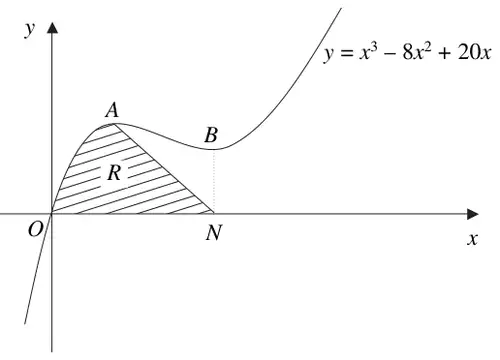
Figure 3 shows a sketch of part of the curve with equation \(y = x^3 - 8x^2 + 20x\).
The curve has stationary points \(A\) and \(B\).
The line through \(B\) parallel to the \(y\)-axis meets the \(x\)-axis at the point \(N\).
The region \(R\), shown shaded in Figure 3, is bounded by the curve, the \(x\)-axis and the line from \(A\) to \(N\).
| Scheme | Marks |
|---|---|
| \(\dfrac{\mathrm{d}y}{\mathrm{d}x} = 3x^2 - 16x + 20\) | M1 A1 |
| \(3x^2 - 16x + 20 = 0 \quad (3x - 10)(x - 2) = 0 \quad x = \ldots, \qquad \dfrac{10}{3}\) and 2 | dM1, A1 |
| (4) |
Notes
The second M is dependent on the first, and requires an attempt to solve a 3 term quadratic.
| Scheme | Marks |
|---|---|
| \(\dfrac{\mathrm{d}^2y}{\mathrm{d}x^2} = 6x - 16 \qquad\) At \(x = 2,\ \dfrac{\mathrm{d}^2y}{\mathrm{d}x^2} = \ldots\) | M1 |
| \(-4\) (or \(\lt 0\), or both), therefore maximum | A1ft |
| (2) |
Notes
M1: Attempt second differentiation and substitution of one of the \(x\) values.
A1ft: Requires correct second derivative and negative value of the second derivative, but ft from their \(x\) value.
| Scheme | Marks |
|---|---|
| \(\displaystyle\int\left(x^3 - 8x^2 + 20x\right)\mathrm{d}x = \frac{x^4}{4} - \frac{8x^3}{3} + \frac{20x^2}{2} \ (+C)\) | M1 A1 A1 |
| (3) |
Notes
All 3 terms correct: M1 A1 A1, Two terms correct: M1 A1 A0, One power correct: M1 A0 A0.
| Scheme | Marks |
|---|---|
| \(4 - \dfrac{64}{3} + 40 \qquad \left(= \dfrac{68}{3}\right)\) | M1 |
| \(A:\ x = 2: \quad y = 8 - 32 + 40 = 16\) (May be scored elsewhere) | B1 |
| Area of \(\Delta = \dfrac{1}{2}\left(\dfrac{10}{3} - 2\right) \times 16 \qquad \left(\dfrac{1}{2}(x_B - x_A) \times y_A\right) \qquad \left(= \dfrac{32}{3}\right)\) | M1 |
| Shaded area \(= \dfrac{68}{3} + \dfrac{32}{3} = \dfrac{100}{3} \quad \left(= 33\dfrac{1}{3}\right)\) | M1 A1 |
| (5) | |
| (14 marks) |
Notes
Limits M1: Substituting their lower \(x\) value into a ‘changed’ expression.
Area of triangle M1: Fully correct method.
Alternative for the triangle (finding an equation for the straight line then integrating) requires a fully correct method to score the M mark.
Final M1: Fully correct method (beware valid alternatives!)