
June 2023 Paper 2 Q7
7
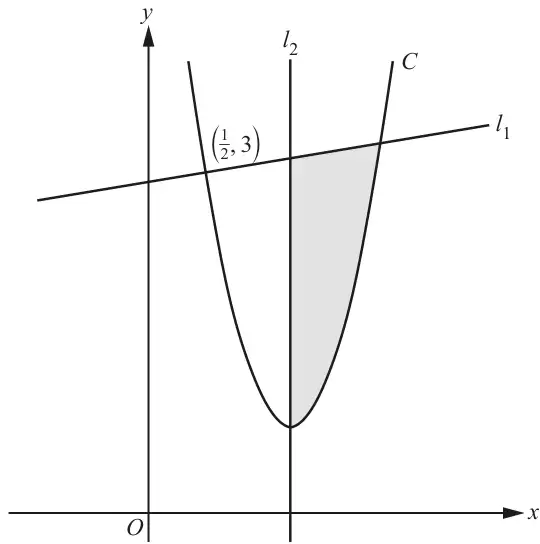
The diagram shows the curve \(C\) with equation \(y = 4x^2 - 10x + 7\) and two straight lines, \(l_1\) and \(l_2\). The line \(l_1\) is the normal to \(C\) at the point \(\left(\tfrac{1}{2}, 3\right)\). The line \(l_2\) is the normal to \(C\) at the minimum point of \(C\).
The shaded region shown in the diagram is bounded by \(C\), \(l_1\) and \(l_2\).
| Scheme | Marks | AO |
|---|---|---|
| \(\left(\dfrac{\mathrm{d}y}{\mathrm{d}x} =\right) 8x - 10\) | B1 | 1.1 |
| At \(\left(\tfrac{1}{2}, 3\right)\colon m_T = -6 \Rightarrow m_N = \tfrac{1}{6}\) | M1* | 1.2 |
| \(y - 3 = \tfrac{1}{6}\left(x - \tfrac{1}{2}\right)\) | M1dep* | 1.1 |
| \(2x - 12y + 35 = 0\) | A1 | 1.1 |
| [4] |
Notes
B1: Correct derivative
M1*: Substitutes \(x = 0.5\) into their two-term derivative and using product of gradients is \(-1\)
M1dep*: Using \(y - 3 = m\left(x - \tfrac{1}{2}\right)\) with \(m \neq -6\) or their tangent gradient (so must have attempted normal gradient)
Or using \(y = mx + c\)
A1: Must \(= 0\) and integer coefficients
All terms on one side
| Scheme | Marks | AO |
|---|---|---|
| \(x \geqslant 1.25\) | B1 | 1.1 |
| \(y \geqslant 4x^2 - 10x + 7\) | B1 | 2.2a |
| \(2x - 12y + 35 \geqslant 0\) | B1FT | 2.2a |
| [3] |
Notes
B1: \((y' = 0 \Rightarrow x = 1.25)\)
B1FT: o.e.
Follow through their (a)
SCB2 if all “correct” (including FT from (a)), but either all strict or a mix of strict and non-strict inequalities used