
C2 June 2011 Q8
8.
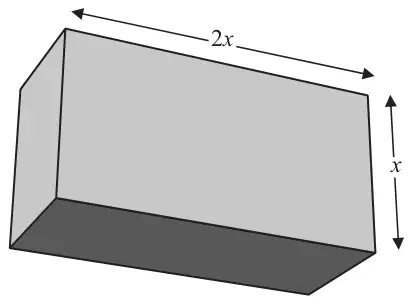
A cuboid has a rectangular cross-section where the length of the rectangle is equal to twice its width, \(x\) cm, as shown in Figure 2.
The volume of the cuboid is 81 cubic centimetres.
| Scheme | Marks |
|---|---|
| \(\{V =\}\ 2x^2y = 81\) \(2x^2y = 81\) | B1 oe |
| \(\{L = 2(2x + x + 2x + x) + 4y \Rightarrow L = 12x + 4y\}\) | |
| \(y = \dfrac{81}{2x^2} \Rightarrow L = 12x + 4\left(\dfrac{81}{2x^2}\right)\) Making \(y\) the subject of their expression and substitute this into the correct \(L\) formula. | M1 |
| So, \(L = 12x + \dfrac{162}{x^2}\) AG Correct solution only. AG. | A1 cso |
| [3] |
Notes
B1: For any correct form of \(2x^2y = 81\). (may be unsimplified). Note that \(2x^3 = 81\) is B0. Otherwise, candidates can use any symbol or letter in place of \(y\).
M1: Making \(y\) the subject of their formula and substituting this into a correct expression for \(L\).
A1: Correct solution only. Note that the answer is given.
Alternative (a) Way 2 (Appendix)
| Scheme | Marks |
|---|---|
| \(2x^2\left(\dfrac{L - 12x}{4}\right) = 81\) \(2x^2\left(\dfrac{L - 12x}{4}\right) = 81\) | B1 oe |
| \(\Rightarrow x^2\left(L - 12x\right) = 162 \Rightarrow L = 12x + \dfrac{162}{x^2}\) Rearranges their equation to make \(y\) the subject. | M1 |
| Correct solution only. AG. | A1 cso |
| [3] |
| Scheme | Marks |
|---|---|
| \(\dfrac{\mathrm{d}L}{\mathrm{d}x} = 12 - \dfrac{324}{x^3}\ \left\{= 12 - 324x^{-3}\right\}\) Either \(12x \to 12\) or \(\dfrac{162}{x^2} \to \dfrac{\pm\lambda}{x^3}\) | M1 |
| Correct differentiation (need not be simplified). | A1 aef |
| \(\left\{\dfrac{\mathrm{d}L}{\mathrm{d}x} =\right\} 12 - \dfrac{324}{x^3} = 0 \Rightarrow x^3 = \dfrac{324}{12}; = 27 \Rightarrow x = 3\) \(L^\prime = 0\) and “their \(x^3 = \pm\) value” or “their \(x^{-3} = \pm\) value” | M1; |
| \(x = \sqrt[3]{27}\) or \(x = 3\) | A1 cso |
| \(\{x = 3,\}\ L = 12(3) + \dfrac{162}{3^2} = 54\) (cm) Substitute candidate’s value of \(x\ (\ne 0)\) into a formula for \(L\). | ddM1 |
| 54 | A1 cao |
| [6] |
Notes
Note you can mark parts (b) and (c) together.
2nd M1: Setting their \(\dfrac{\mathrm{d}L}{\mathrm{d}x} = 0\) and “candidate’s ft correct power of \(x =\) a value”. The power of \(x\) must be consistent with their differentiation. If inequalities are used this mark cannot be gained until candidate states value of \(x\) or \(L\) from their \(x\) without inequalities.
\(L^\prime = 0\) can be implied by \(12 = \tfrac{324}{x^3}\).
2nd A1: \(x^3 = 27 \Rightarrow x = \pm 3\) scores A0.
2nd A1: can be given for no value of \(x\) given but followed through by correct working leading to \(L = 54\).
3rd M1: Note that this method mark is dependent upon the two previous method marks being awarded.
| Scheme | Marks |
|---|---|
| \(\{\text{For } x = 3\}\), \(\dfrac{\mathrm{d}^2L}{\mathrm{d}x^2} = \dfrac{972}{x^4} \gt 0 \Rightarrow\) Minimum Correct ft \(L^{\prime\prime}\) and considering sign. | M1 |
| \(\dfrac{972}{x^4}\) and \(\gt 0\) and conclusion. | A1 |
| [2] | |
| 11 |
Notes
M1: for attempting correct ft second derivative and considering its sign.
A1: Correct second derivative of \(\dfrac{972}{x^4}\) (need not be simplified) and a valid reason (e.g. \(\gt 0\)), and conclusion. Need to conclude minimum (allow \(x\) and not \(L\) is a minimum) or indicate by a tick that it is a minimum. The actual value of the second derivative, if found, can be ignored, although substituting their \(L\) and not \(x\) into \(L^{\prime\prime}\) is A0. Note: 2 marks can be scored from a wrong value of \(x\), no value of \(x\) found or from not substituting in the value of their \(x\) into \(L^{\prime\prime}\).
Gradient test or testing values either side of their \(x\) scores M0A0 in part (c).
Throughout this question allow confused notation such as \(\dfrac{\mathrm{d}y}{\mathrm{d}x}\) for \(\dfrac{\mathrm{d}L}{\mathrm{d}x}\).